

E-cigarette And Vape Market Analysis & Forecast 2026-2033
The Global E-cigarette and Vape Market is estimated to be valued at USD 48.20 Bn in 2026. The market is expected to reach USD 255.28 Bn by 2033, exhibiting a compound annual growth rate (CAGR) of 26.9% from 2026 to 2033.
Key Takeaways of the E-cigarette and Vape Market
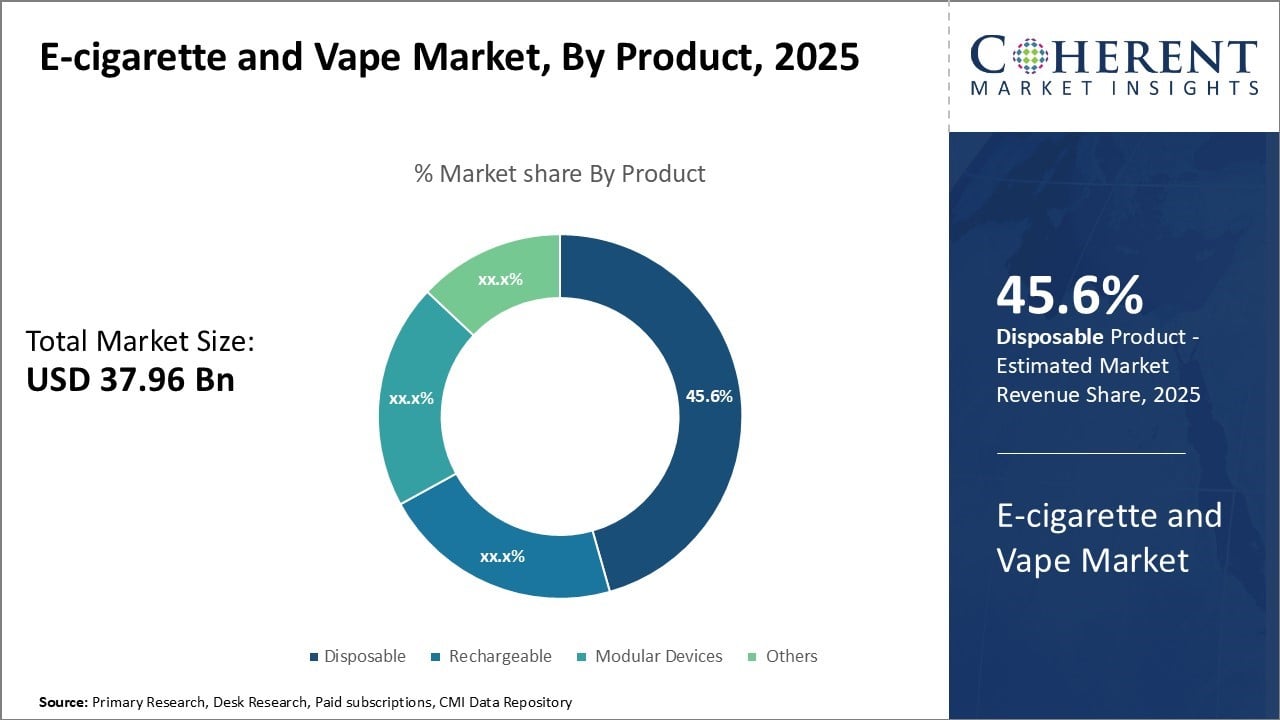
- By Product, The Disposable Segment is projected to account for 46.6% market share in 2026.
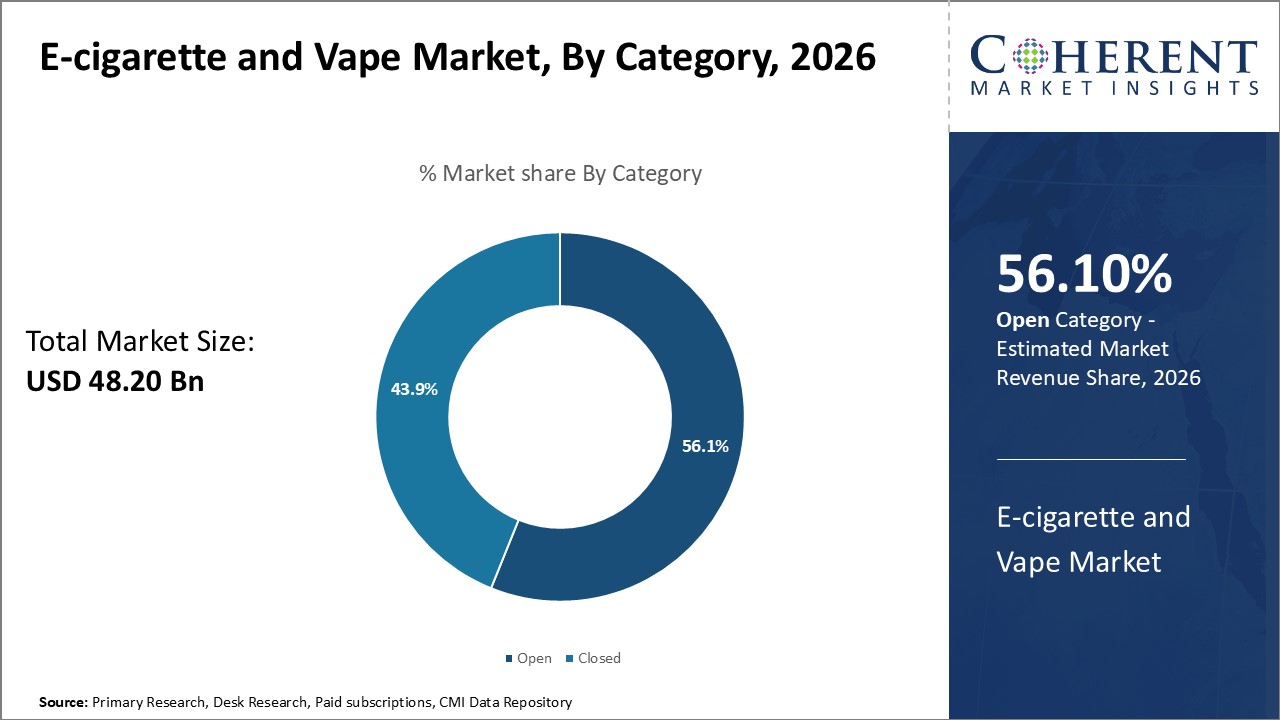
- In terms of Category, The Open Segment is poised to capture 56.1% of the market share in 2026 due to its high customization capabilities.
- By Distribution Channel, the offline segment is anticipated to comprise 54.9% share of the market in 2026.
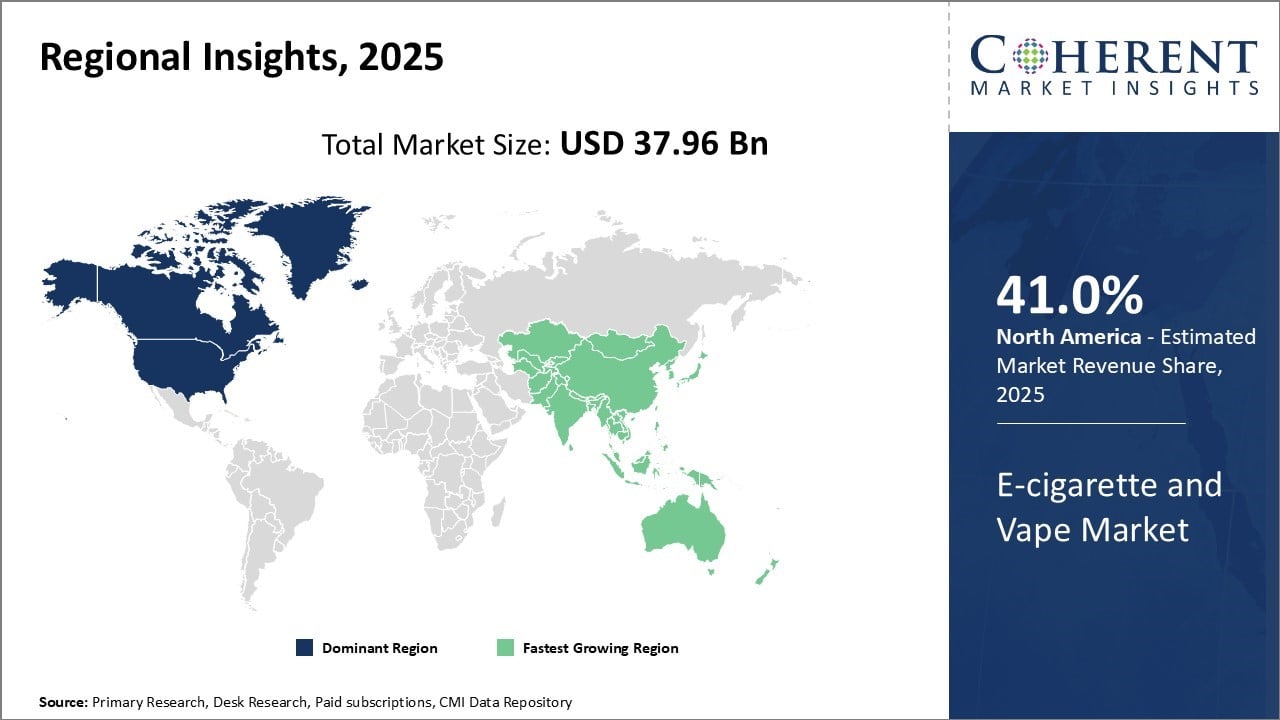
- North American region is expected to dominate the global market with 41.0% share in 2026 while Asia Pacific region stands at 30.3%.
Market Overview
The escalating volume of people transitioning from traditional cigarettes to electronic ones has greatly contributed to the growth the market has experienced over the last few years. With both developed and developing countries accepting and using e-cigarettes and vapes at an increasing rate, these devices are quickly becoming popular in the global marketplace. The market growth during the projected duration is likely to be fueled by the rising campaign against smoking traditional cigarettes along with aggressive marketing of e-cigarettes and vapes. In a bid to enhance customer experience and maximize their appeal, companies are launching more novel products with distinct designs, flavors, and nicotine levels. However, the lack of regulations in some regions such as Africa and concerns around the long-term health impacts of e-cigarettes use can hamper the market growth.
Current Events and Its Impact on the Global E-cigarette and Vape Market
Event | Description and Impact |
Regulatory Framework Evolution and Policy Changes |
|
Health Research Developments and Public Perception Shifts |
|
Supply Chain Disruptions and Manufacturing Challenges |
|
Pricing Analysis: E-cigarette and Vape Market
The E-cigarette and Vape Market has evolved with dynamic pricing structures driven by product innovation, nicotine regulation, and shifting consumer preferences. According to the Global E-cigarette and Vape Market: Comprehensive End User Pricing Analysis, the industry was valued at $18.13 billion in 2023 and is set to expand through 2030.
Products range from budget-friendly disposables to high-end mod systems, reflecting both market segmentation and user sophistication. Disposable e-cigarettes dominate the low-cost tier, priced between $3.99 to $16.99, with Puff Bar and Elf Bar leading. In contrast, pod systems, known for their balance of form and function, are priced from $1.99 (Vuse Alto) to $39.99 (SMOK Nord), reflecting increasing emphasis on nicotine delivery precision and safety.
Mod systems offer customization and power, priced from $34.99 to over $1,200, appealing to enthusiasts seeking advanced features. Refill pod and e-liquid pricing vary by brand and quality, with premium options like Naked 100 and Dinner Lady ranging from $12.99 to $22.99.
As regulatory and safety concerns rise, innovation in E-cigarette and Vape by device components (like AI-enabled mods and leak-proof pods) is influencing both price and consumer trust. Ultimately, pricing reflects a convergence of technological innovation, health priorities, and evolving nicotine consumption habits.
- Current Industry Events of 2026
- Market Size Estimation
- Regional Breakdown
- Competitive Landscape
- Customer Intelligence
- Segmental Analysis
- Pricing Analysis
- Key Market Drivers, Challenges & Future Trends
- Customized Insights Section
Role of Technologies like AI on the E-cigarette and Vape Market
The Vape and E-cigarette market is emerging as a new age technology-based and consumer-oriented sector because of the implementation of Artificial Intelligence (AI). The market is becoming more than $18 billion, and now AI is used in everything from firmware updates to optimizing nicotine delivery systems, compliance with regulations, and even in customization on an individual basis. BAT and PAX Labs are some of the largest companies which have integrated AI into their products.
They analyze data regarding user interaction to optimize flavors and improve devices performance with machine learning. AI systems make vaping safer as they track consumption, provide programmed dosing, and improve battery efficiency. JUUL is equally the first to introduce AI for age verification and tampering detection programs eliminating chances of underage usage which strengthens their anti-age restriction abuse program. AI is also being used to enhance predictive maintenance and quality control on the manufacturing side and simulating thousands of flavors to aid product development in R&D.
Through PAX Labs’ AI-powered app, tailored sessions provided could increase satisfaction while decreasing waste. AI coupled with stricter compliance standards will aid innovation in devises mechanisms concerning screws, frames, and lenses. Intelligent systems that will govern the customization of devices while maintaining regulations is the future of vaping.
Consumer Feedback and Unmet Demand in the E-cigarette and Vape Market
Feedback from consumers in the E-Cigarette and Vape sector shows that there is some level of satisfaction but persistent frustration within primary consumer segments. Traditional smokers aged 25 to 45 prioritize optimal nicotine absorption and price while young adults aged 18 to 30 lean towards flavors and social acceptance. Adoption is strong; for instance, 20 million smokers globally switching to IQOS, but users report significant gaps. One critical gap is product consistency in vapor delivery, battery lifespan, and device function.
Especially for inexpensive brands, this is damaging to perception and is a huge trust issue. Wireless charging ports, flavor bans in the U.S., and health skepticism all contribute to panic buying. For pod system users, the accumulation of costs is a problem, particularly when the required spending outstrips what one spends on cigarettes. Stigma also plays a role in public use/visibility, notably for adult professionals.
Focus areas include more bang for refillable devices, non-nicotine or low nicotine options, clearer health data regarding vaping, and outside of health-tracking data, more precise information about long-term consequences. There is also a desire that revolves around innovation around taste, self-contained customer service, as well as compact and non-invasive, easy to use, streamlined gadgets.
Global E-Cigarette and Vape Market - Segmental Insights
Global E-Cigarette and Vape Market Insights, By Product
In terms of product, the disposable segment is expected to contribute 46.6% share of the market in 2026, owing to its unmatched convenience. As the name implies, disposable e-cigarettes are meant for single-use and then disposal. They come pre-filled with e-liquid, making them extremely convenient for new or occasional users who do not want the hassle and learning curve of refilling and maintenance. Disposables are also very discreet and compact, easily fitting in pockets or bags, which makes them perfect for on-the-go use. Their single-use nature means users face no issues with leaking or dead batteries, eliminating potential maintenance woes.
Global E-Cigarette and Vape Market Insights, By Category
In terms of category, the open segment is expected to contribute 56.1% share in 2026 as it allows high customization. As opposed to closed pod systems like JUUL, open vaping involves refillable tank-based e-cigarettes that give users control over variables like e-liquid, wattage, and coil type.
This customizability is a major attraction for experienced vapers seeking to personalize their experience through flavor exploration and tweaking settings. Being able to choose from a massive selection of e-liquids in different nicotine strengths, PG/VG ratios and unique flavor profiles gives open vapers tremendous satisfaction.
Global E-Cigarette and Vape Market Insights, By Distribution Channel
In terms of distribution channel, the offline segment is expected to contribute 54.9% share in 2026, owing to deep market penetration. Traditional brick-and-mortar retailers like vape shops, gas stations, and convenience stores have built strong relationships with vapers over the last decade, carrying a wide variety of open and closed system e-cigarettes as well as various consumables. Their large nationwide presence ensures even casual or new vapers can easily browse options and get hands-on demonstrations from knowledgeable staff anytime, anywhere.
Global E-Cigarette and Vape Market - Regional Insights
North America E-cigarette and Vape Market Trends
North America is expected to lead the e-cigarette and vape market in 2026, capturing a 41.0% of the market share. Key industry participants from North America are some of the oldest and most established vaping companies. This region greatly influences the adoption of new products among consumers with effective marketing strategies and a broad range of options. Furthermore, North America’s early foray into the industry, along with effective adoption motivators and innovative technologies, has also contributed to the prevalence of established distribution channels.
Asia Pacific E-cigarette and Vape Market Trends
The Asia Pacific region is projected to claim a 30.3% market share in 2026, emerging as the fastest-growing market. This growth is driven by rising health consciousness, evolving consumer lifestyles, and continuous efforts by global industry leaders to capitalize on the vast opportunities in populous countries like China and India. While regulatory uncertainties persist in certain markets, the presence of an aspirational youth demographic offers significant potential for expansion.
E-cigarette And Vape Market Outlook for Key Countries
U.S. E-cigarette and Vape Market Trends
The U.S. remains one of the biggest markets for e-cigarettes and vaping devices, with new pod mod systems and disposable vapes contributing the most. Consumers are shifting to disposable vapes because of their low cost and hands-free convenience. For example, Puff Bar and Vuse grew dramatically in 2022, capturing market share as JUUL and other pod-based systems faced stricter regulatory limits.
China E-cigarette and Vape Market Trends
With a rising demographic of consumers, China leads the e-cigarette and vape market. As local companies increase output and broaden their portfolios, the market is expected to grow even more. Several Chinese firms, including Zinwi Bio-Tech, launched new e-liquid flavors to meet the changing tastes of customers in 2023. Maintaining and gaining a competitive advantage drives market initiatives to address the versatile needs of consumers.
Japan E-cigarette and Vape Market Trends
What sets Japan's e-cigarette and vape industry apart is its emphasis on heated tobacco products instead of conventional vaping. The industry is supported by a gradual change in the culture of smoking towards lesser-health hazard products. To capitalize on the growing demand for smoke-free products in 2023, some of the leading tobacco firms launched new heated tobacco devices. BAT also introduced glo HILO and glo HILO Plus in Serbia as part of their premium heated tobacco platform. These devices provide advanced heating with flavor and improved responsiveness to demand by delivering intense taste more rapidly.
Market Players, Key Development, and Competitive Intelligence

Key Developments
- In June 2023, Altria Group, Inc., a leading U.S.-based tobacco company, acquired NJOY Holdings, Inc., a prominent vaping company. Altria plans to market NJOY’s innovative e-vapor products through its subsidiary, NJOY, LLC, while leveraging the extensive distribution network of the Altria Group Distribution Company. This acquisition aligns with Altria's strategy to expand its smoke-free product portfolio.
- In June 2023, Imperial Brands plc, a U.K.-based multinational tobacco company, entered the U.S. oral nicotine market by acquiring nicotine pouches from TJP Labs. Through its U.S. division, ITG Brands, Imperial Brands introduced 14 distinct pouch variants that had shown strong consumer acceptance during testing. TJP Laabs, known for its innovation in nicotine delivery systems, highlighted its commitment to harm reduction by offering flexible and diverse options to consumers.
Top Strategies Followed by Global E-cigarette and Vape Market Players
- Established Players: E-cigarette and vape market leaders focus on rigorous R&D to create advanced products. They invest greatly in improving scientific understanding and developing new technologies.
- For example, Juul Labs put more than USD 12 Bn in 2019 towards better methods of nicotine delivery, device construction, and safety protocols. Aggressive R&D expenditures bolster innovation, helping these companies outperform competitors.
- Mid-Level Players: Medium sized enterprises in the vape and e cigarette sector focus on capturing the budget sensitive market. These firms strive for affordable but quality products. Competitive pricing often stems from strict strategic management of operational costs. Some set up local plants in regions with cheaper raw materials and equipment. Certain processes are also contracted out to control costs. Along with these strategies, mid-level players partner with small tech startups offering more economical complimentary technologies, enabling them to incorporate new features without incurring too much expense on independent R&D.
- Small-Scale Players: New small firms target niche markets that more established brands overlook. These segments are targeted with products such as customizable devices, exotic flavors, and unique selling propositions. Some focus on gourmet products for aficionados, while others add different exotic flavors.
Emerging Startups - Global E-cigarette and Vape Industry Ecosystem
- Advanced Innovations: Companies such as Vapor Innovations are pioneering new vaporizing methods for the heating of tobacco and herb extracts. Their smart sensor vaporizers can be controlled from mobile applications which customize the temperature settings. Users also receive health analytics data through the wearable devices. With such innovations, traditional cigarette users may alter their preferences towards these new and safer alternatives.
- Eco-Friendly Initiatives: EcoSmart focuses on sustainability with compostable e-cigarette products made from agricultural waste. Their pods are free of plastic, with wooden encased batteries. Through partnerships, other industry actors are able to adopt EcoSmart technologies, thereby improving the eco footprint of the industry. Other startups also have tried using natural and recycled materials for their components.
Market Report Scope
E-cigarette and Vape Market Report Coverage
| Report Coverage | Details | ||
|---|---|---|---|
| Base Year: | 2025 | Market Size in 2026: | USD 48.20 Bn |
| Historical Data for: | 2020 To 2024 | Forecast Period: | 2026 To 2033 |
| Forecast Period 2026 to 2033 CAGR: | 26.9% | 2033 Value Projection: | USD 255.28 Bn |
| Geographies covered: |
| ||
| Segments covered: |
| ||
| Companies covered: | Juul Labs, Inc., British American Tobacco plc, Imperial Brands PLC, Philip Morris International Inc., Altria Group, Inc., Vuse (Reynolds American Inc.), NJOY, Inc., VaporFi, Inc., Innokin Technology, Vaporesso (Smoore Technology Ltd.), GeekVape, Aspire, SMOK (Shenzhen IVPS Technology Co., Ltd.), KangerTech, and Joyetech | ||
| Growth Drivers: |
| ||
| Restraints & Challenges: |
| ||
Market Driver - Rising awareness about smoking cessation and harm reduction
The key smoking-cessation motivator for an individual has been the increase in awareness amongst the general population regarding smoking cessation. In recent years, more and more studies have come out such as “Burden of Disease Study” published in The Lancet which studies the harm smoking can do to one’s health.
Published in 2022, the study cited that exceeded supply resulted in a massive burden of disease prevalence, something as abstract as sleep could be linked to smoking and harmful habits. Smokers are now well aware about the various diseases such as lung cancer, respiratory diseases, and even cardiovascular problems. The dangers of smoking have really encouraged people to quit smoking altogether.
In recent years, however, focusing on smoking cigarettes has become an increase due to innovation that comes with vaping. Nicotine is one of the most addictive substances known today and has an unprecedented potential to foster habitual dependence.
Market Opportunity - Expansion of product lines with innovative flavors and devices
The global e-cigarette and vape market has a massive opportunity to expand its product lines with innovative flavors and devices. Traditional tobacco flavors no longer interest new consumers, especially the younger demographic. Companies that introduce exciting flavors like unique fruits, desserts, beverages, etc. along with innovative vapor device designs can attract a wider consumer base.
Successful brands in the industry have already shown how the right blend of flavors, vapor quality, and modifiable devices have led to increasing customer loyalty and business growth. The availability of open tank systems, pod mods, disposables, and other exciting form factors also keeps the market vibrant.
Market Challenge - Regulatory challenges and restrictions on e-cigarette sales in various regions
The global market for e-cigarettes and vapes, as well as facing strict regulatory hurdles, are restrictions in the selling of e-cigarettes in different parts of the world. Health concerns have led several countries to either completely ban or heavily restrict the production and sale of e-cigarettes. Brazil, Thailand, and Singapore are examples of countries that have completely outlawed the sale and use of e-cigarettes. In places where e-cigarettes are allowed to be sold, there are still many rules that govern their sale. The U.S. FDA has imposed sales to minors and a ban on advertising as restrictions on marketing and advertising.
Analyst Opinion (Expert Opinion)
- Vaping offers a great alternative to smoking for traditional cigarette users, which promises the expansion of the e-cigarette and vape market in the upcoming five years. During these years, the focus will be on growing the market. As a result, vaping is on the rise as a healthier alternative to smoking and aids in the absorption of nicotine. As such, e-cigarettes are becoming increasingly available.
- Compliance with regulations is needless to say, a challenge due to the difference in policies between states. The rise in health concerns for long term effects and potential use among children and adolescents could lead to weaker demand. Stricter sociocultural policies against vaping would limit the growth of this market too.
- The US has been a strong adopter of these products which is the key reason why North America leads in sales. However, the Asia Pacific is expected to see the biggest advancement. Consumption in China, India and Southeast Asia is expected to rise due to a greater focus on health among consumers who are relatively healthier compared the Western World.
Speak to the analyst
Want personalized insights?
Take the findings above to one of our principal consultants, or have the report rebuilt around the segments, geographies and competitors you actually track.
Market Segmentation
- Product Insights (Revenue, USD Bn, 2021 - 2033)
- Disposable
- Rechargeable
- Modular Devices
- Others
- Category Insights (Revenue, USD Bn, 2021 - 2033)
- Open
- Closed
- Distribution Channel Insights (Revenue, USD Bn, 2021 - 2033)
- Offline
- Online
- Regional Insights (Revenue, USD Bn, 2021 - 2033)
- North America
- U.S.
- Canada
- Latin America
- Brazil
- Argentina
- Mexico
- Rest of Latin America
- Europe
- Germany
- U.K.
- Spain
- France
- Italy
- Russia
- Rest of Europe
- Asia Pacific
- China
- India
- Japan
- Australia
- South Korea
- ASEAN
- Rest of Asia Pacific
- Middle East
- GCC Countries
- Israel
- Rest of Middle East
- Africa
- South Africa
- North Africa
- Central Africa
- Key Players Insights
- Juul Labs, Inc.
- British American Tobacco plc
- Imperial Brands PLC
- Philip Morris International Inc.
- Altria Group, Inc.
- Vuse (Reynolds American Inc.)
- NJOY, Inc.
- VaporFi, Inc.
- Innokin Technology
- Vaporesso (Smoore Technology Ltd.)
- GeekVape
- Aspire
- SMOK (Shenzhen IVPS Technology Co., Ltd.)
- KangerTech
- Joyetech
Sources
Primary Research Interviews
- E-cigarette manufacturers and brand executives
- Vape product distributors and retailers
- Healthcare professionals and tobacco cessation specialists
- Regulatory affairs specialists in tobacco alternatives
- Others
Databases
- Global Trade Atlas (GTA)
- Euromonitor International
- IBISWorld Industry Research
- Statista Market Research
- Others
Magazines
- Vaping360 Magazine
- Vapor Voice Magazine
- E-Cigarette Summit Magazine
- Tobacco Reporter Magazine
- Others
Journals
- Tobacco Control Journal
- Nicotine & Tobacco Research Journal
- Journal of Public Health Policy
- Others
Newspapers
- Financial Times
- The Wall Street Journal
- Reuters Business News
- Bloomberg News
- Others
Associations
- Vapor Technology Association (VTA)
- Electronic Cigarette Industry Trade Association (ECITA)
- Independent European Vape Alliance (IEVA)
- Tobacco Vapor Electronic Cigarette Association (TVECA)
- Others
Public Domain Sources
- U.S. Food and Drug Administration (FDA)
- World Health Organization (WHO)
- European Medicines Agency (EMA)
- Centers for Disease Control and Prevention (CDC)
- Others
Proprietary Elements
- CMI Data Analytics Tool
- Proprietary CMI Existing Repository of information for last 8 years
Get access to 250+ pages report
Every segment, forecast, competitor profile and data table behind the analysis above — available for instant download.
- ESOMAR Member
- ISO 9001:2015 Certified
- D-U-N-S Registered
- GDPR & CCPA Compliant
Missing comfort of reading report in your local language? Find your preferred language:
Transform your Strategy with Exclusive Trending Reports
Frequently Asked Questions
The E-cigarette and Vape Market size is estimated to be valued at USD 48.20 Bn in 2026, and is expected to reach USD 255.28 Bn by 2033.
The CAGR of the global Market is projected to be 26.9% from 2026 to 2033.
Rising awareness about smoking cessation and harm reduction and increasing popularity of flavored vaping products among younger consumers are the major factors driving the growth of the global market.
Regulatory challenges and restrictions on e-cigarette sales in various regions and health concerns and negative perceptions surrounding vaping are the major factors hampering the growth of the global e-cigarette and vape industry.
In terms of product, the disposable segment is estimated to dominate the market revenue share in 2026.
Juul Labs, Inc., British American Tobacco plc, Imperial Brands PLC, Philip Morris International Inc., Altria Group, Inc., Vuse (Reynolds American Inc.), NJOY, Inc., VaporFi, Inc., Innokin Technology, Vaporesso (Smoore Technology Ltd.), GeekVape, Aspire, SMOK (Shenzhen IVPS Technology Co., Ltd.), KangerTech, and Joyetech are the major players.
North America is expected to lead the global e-cigarette and vape industry in 2026.