

Alcohol Test Equipment Market Size and Forecast – 2026 to 2033
The Alcohol Test Equipment Market is estimated to be valued at USD 2.60 Bn in 2026 and is expected to reach USD 3.10 Bn by 2033, exhibiting a compound annual growth rate (CAGR) of 8.7% from 2026 to 2033.
Key Takeaways
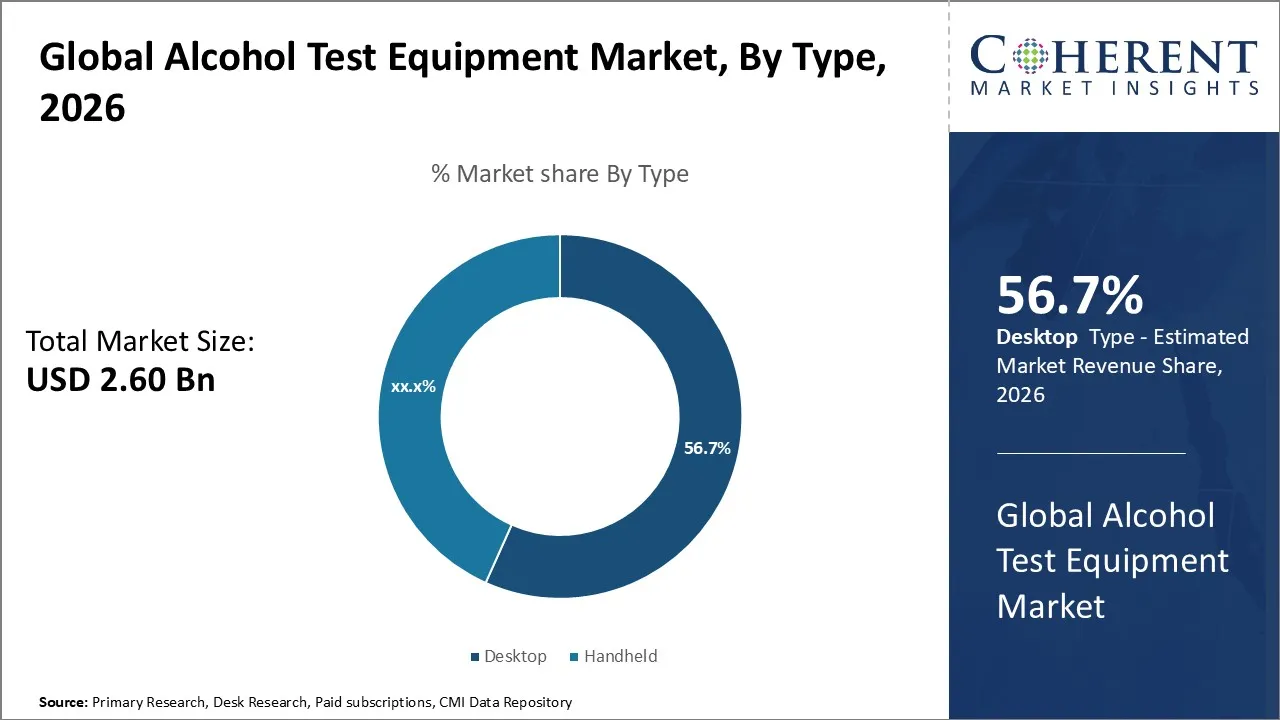
- By Type, Desktop hold the largest market share of 56.7% in 2026 owing to the stringent regulatory & road safety enforcement.
- By Application, Medical is expected to hold the largest market share of 33.7% in 2026 owing to its increasing incidence of alcohol-related health issues.
- By End Users, Hospitals acquired the prominent market share of 35.6% in 2026 owing to its clinical diagnosis and emergency care needs.
- By Region, North America dominates the overall market with an estimated share of 39.9% in 2026 owing to the stringent regulatory frameworks & enforcement.
Market Overview
The Alcohol Test Equipment Market centers on devices that actively detect and measure alcohol consumption for law enforcement, healthcare providers, workplaces, and rehabilitation centers. Stricter drunk-driving laws, expanding workplace safety mandates, and growing awareness of alcohol-related health risks are driving market growth. Technological advancements, including fuel-cell and infrared sensors, enhance testing accuracy and reliability. Hospitals, emergency care units, and public safety agencies continue to adopt these devices widely, further reinforcing global market demand.
Current Events and Its Impact on the Alcohol Test Equipment Market
Current Events | Description and its impact |
Regulatory and Policy Changes in Key Regions |
|
Technological Advancements and Innovation |
|
Economic Factors and Market Dynamics |
|
Segmental Insights
- Current Industry Events of 2026
- Market Size Estimation
- Regional Breakdown
- Competitive Landscape
- Customer Intelligence
- Segmental Analysis
- Pricing Analysis
- Key Market Drivers, Challenges & Future Trends
- Customized Insights Section
Alcohol Test Equipment Market Insights, By Type - Desktop contribute the highest share of the market owing to its growth of institutional & healthcare use
Desktop hold the largest market share of 56.7% in 2026. The desktop segment of the Alcohol Test Equipment Market grows as organizations rely on high-precision systems for controlled testing environments. Laboratories, hospitals, forensic units, and industrial facilities use these devices to handle large testing volumes while maintaining accurate records and traceable results. Desktop systems integrate smoothly with information platforms, follow standardized testing procedures, and deliver dependable performance. These advantages encourage institutions and compliance-driven users to choose desktop solutions over portable alternatives, sustaining demand across a wide range of end-use applications.
Alcohol Test Equipment Market Insights, By Application - Medical contribute the highest share of the market owing to its monitoring in addiction treatment & rehabilitation
Medical expected to hold the largest market share of 33.7% in 2026. The medical segment of the Alcohol Test Equipment Market expands as healthcare providers seek fast and precise tools for detecting alcohol exposure in clinical settings. Hospitals actively use these devices to aid diagnosis, guide emergency interventions, and monitor patients effectively. Non-invasive and rapid testing methods enable clinicians to make timely decisions without interrupting care delivery. At the same time, greater emphasis on treating alcohol-related conditions and supporting recovery programs continues to drive adoption across medical and healthcare environments. For instance, in April 2025, Dräger, a global safety technology leader, launched the Alcotest 7000, an advanced alcohol screening device designed to support DUI prevention, DOT compliance, and workplace safety.
Alcohol Test Equipment Market Insights, By End Users - Hospitals contribute the highest share of the market owing to its integration with healthcare systems
Hospitals acquired the prominent market share of 35.6% in 2026. The hospital segment of the Alcohol Test Equipment Market grows as healthcare facilities prioritize dependable alcohol screening for both emergency and routine care. Emergency departments actively use testing devices to evaluate intoxication in trauma and accident patients, enabling quicker medical decisions. Hospitals also apply these systems for inpatient observation, behavioral health services, and detox programs. An increasing focus on patient safety, precise diagnosis, and streamlined clinical operations continues to drive hospitals toward adopting advanced alcohol testing solutions. For instance, in April 2024, The UHNM Alcohol Care Team launched an online Alcohol Self-Assessment through the new patient portal, Patients Know Best (PKB), allowing emergency and hospital patients to discreetly self-register and complete the test.
Regional Insights

North America Alcohol Test Equipment Market Trends
North America dominates the overall market with an estimated share of 39.90% in 2026. In North America, strict legal and safety standards actively shape the Alcohol Test Equipment Market by emphasizing drunk-driving prevention and workplace compliance. Law enforcement agencies regularly implement advanced testing technologies, while hospitals and corporate safety programs increasingly rely on alcohol screening tools for quick and dependable evaluation. Strong public awareness of alcohol impairment, combined with continuous innovation in portable and connected devices, drives wider adoption across multiple sectors and strengthens the region’s leading position in the market.
Asia Pacific Alcohol Test Equipment Market Trends
In the Asia Pacific region, governments actively strengthen drunk-driving enforcement and road safety programs, driving increased use of alcohol test equipment among law enforcement and public safety agencies. Industries such as transportation and manufacturing also adopt alcohol screening tools as workplace safety awareness grows. Rapid urban development, expanding vehicle ownership, and continuous innovation in portable and connected alcohol detection technologies further stimulate demand, supporting steady market expansion across the region. For instance, Kerala police launched the SoToxa Mobile Test System, a hand-held device that screens drugs using saliva and delivers results in five minutes. The system is being trialed in Thiruvananthapuram and may expand statewide based on its accuracy and reliability.
United States Alcohol Test Equipment Market Trends
In the United States, law enforcement agencies actively enforce impaired‑driving laws and widely use breathalyzer technology during roadside checks, making alcohol screening a standard safety practice. Healthcare providers and workplaces increasingly deploy testing devices to enhance patient care and maintain employee safety. Continuous improvements in sensor accuracy, mobile connectivity, and portable device design drive greater adoption among professionals and individuals committed to responsible alcohol monitoring, reinforcing the country’s focus on safety and efficient alcohol detection. For instance, in December 2025, Cannabix Technologies Inc., developer of marijuana and alcohol breath devices, launched new videos showcasing its Marijuana Breath Test (MBT). The videos highlight the MBT’s non-invasive detection of recent cannabis use, supporting workplace safety and aiding law enforcement in roadside screening.
China Alcohol Test Equipment Market Trends
In China, authorities are actively intensifying efforts to curb drunk driving and enhance road safety, driving traffic police and public safety agencies to deploy breathalyzers and other alcohol testing devices more frequently. Employers and institutions increasingly implement alcohol screening to strengthen workplace safety and comply with regulations. Users are adopting advanced and portable testing technologies that provide fast and reliable results. Growing awareness of alcohol misuse, along with stricter enforcement of safety policies, continues to propel market demand.
End-user Feedback and Unmet Needs in the Alcohol Test Equipment Market
- Accuracy and Reliability Concerns: End-users often report discrepancies in readings, especially in portable or older devices. Hospitals, law enforcement, and workplaces require highly precise results for legal, medical, and safety purposes. Users seek devices that maintain consistent accuracy across varying environmental conditions and repeated tests, highlighting a need for robust calibration and sensor technology improvements.
- Speed and Ease of Use: Many users desire faster testing processes that do not interrupt workflow. Emergency rooms, roadside checks, and industrial safety programs benefit from devices that deliver instant results with minimal training. Current models may be cumbersome or require multiple steps, creating demand for intuitive, user-friendly interfaces and automated features.
- Data Management and Integration: End-users in hospitals and corporate settings emphasize the need for seamless digital integration. Devices that connect to electronic health records, lab information systems, or compliance software can reduce errors, track historical results, and streamline reporting. Limited connectivity and manual data entry remain key gaps in existing equipment.
Alcohol Test Equipment Market Trend
Technological Advancements in Sensors
The market is witnessing rapid improvements in sensor technology, including fuel-cell, infrared, and semiconductor-based systems. These advancements enhance accuracy, reduce false readings, and extend device lifespan. Manufacturers are also integrating smart calibration and self-diagnostic features to improve reliability. Users increasingly prefer devices that combine precision with ease of use, supporting law enforcement, healthcare, and industrial applications. These technological upgrades are driving broader adoption across institutional and consumer segments.
Growth of Portable and Connected Devices
Portable and connected alcohol testing devices are becoming popular due to their convenience and mobility. Law enforcement, emergency responders, and industrial safety teams favor compact breathalyzers with mobile app integration and cloud-based data storage. Real-time connectivity allows instant reporting, compliance tracking, and remote monitoring. The trend reflects a shift toward on-the-go testing solutions that maintain accuracy while enabling data-driven decision-making in professional and personal safety applications.
Alcohol Test Equipment Market Opportunity
Adoption in Workplace Safety Programs
Industries such as transportation, construction, and manufacturing are focusing on employee safety and compliance with alcohol regulations. Organizations are seeking robust, fast, and easy-to-use testing solutions to prevent workplace accidents and ensure operational safety. Devices that allow random, post-incident, and pre-shift testing provide an opportunity for manufacturers to cater to corporate clients. Integration with digital compliance and reporting systems further enhances value, positioning alcohol testing equipment as essential in modern workplace safety initiatives.
Market Report Scope
Alcohol Test Equipment Market Report Coverage
| Report Coverage | Details | ||
|---|---|---|---|
| Base Year: | 2025 | Market Size in 2026: | USD 2.60 Bn |
| Historical Data for: | 2020 To 2024 | Forecast Period: | 2025 To 2032 |
| Forecast Period 2026 to 2033 CAGR: | 8.7% | 2033 Value Projection: | USD 3.10 Bn |
| Geographies covered: |
| ||
| Segments covered: |
| ||
| Companies covered: | Drager, Intoximeters, Lifeloc Technologies, Alcohol Countermeasure Systems, Lion Laboratories Limited, Alcolizer Technology, Akers Biosciences, Alere, and AlcoPro. | ||
| Growth Drivers: |
| ||
| Restraints & Challenges: |
| ||
Alcohol Test Equipment Market News
In May 2024, Healthtech startup Seek launched the first at-home lab test specifically designed to assess alcohol’s impact on women’s health
Analyst Opinion (Expert Opinion)
- The Alcohol Test Equipment market is transitioning from a compliance-driven niche to a critical safety and risk‑mitigation infrastructure across public and private sectors. Regulatory enforcement remains the principal demand vector: stringent drunk‑driving laws and mandatory roadside testing protocols have driven law enforcement agencies to standardize the use of fuel‑cell and infrared breathalyzer technologies, which now dominate the landscape due to their high specificity and legally admissible results. Today’s evidential devices featuring fuel cell sensors command a majority of professional deployments—indicative of user preference for precision under judicial scrutiny—while legacy semiconductor systems are increasingly marginalized due to higher calibration drift and false positive rates.
- The market has also seen digital integration elevate product utility beyond standalone testing. Connectivity enhancements—such as Bluetooth/Wi‑Fi data transmission and cloud‑based evidence management—are no longer optional; they are requisites for competitive positioning. Adoption metrics illustrate this shift: connectivity features now appear on a substantial proportion of new device launches, reflecting both compliance documentation needs and broader enterprise digitization trends.
- Regional dynamics underline divergent growth pathways: while North America retains market leadership owing to robust enforcement and public safety budgets, the Asia‑Pacific region is outpacing other geographies in growth potential, propelled by escalating road safety concerns, expanding vehicle ownership, and government‑led enforcement initiatives that mirror those in mature markets.
- Despite these structural tailwinds, operational hurdles persist. Calibration requirements—mandating periodic device servicing—introduce logistical friction that can erode utilization efficiency within active fleet inventories. Legacy calibration cycles still impose downtime that affects a non‑trivial percentage of devices annually.
Speak to the analyst
Want personalized insights?
Take the findings above to one of our principal consultants, or have the report rebuilt around the segments, geographies and competitors you actually track.
Market Segmentation
- On the basis of Type, Global Alcohol Test Equipment Market is segmented into:
- Desktop
- Handheld
- On the basis of Application, Global Alcohol Test Equipment Market is segmented into:
- Transportation Industry
- Medical
- Other
- On the basis of End User, Global Alcohol Test Equipment Market is segmented into:
- Federal Departments
- Hospitals
- Private Sectors
- Rehabilitation Centers
- On the basis of Region, Global Alcohol Test Equipment Market is segmented into:
- Asia Pacific
- China
- India
- Japan
- ASEAN
- Australia
- South Korea
- Rest of Asia Pacific
- North America
- U.S.
- Canada
- Europe
- U.K.
- Germany
- France
- Italy
- Russia
- Rest of Europe
- Latin America
- Brazil
- Argentina
- Rest of Latin America
- Mexico
- Middle East
- GCC
- Israel
- Rest of Middle East
- Africa
- North Africa
- Central Africa
- South Africa
- Asia Pacific
- Key Players Insights
- Drager
- Intoximeters
- Lifeloc Technologies
- Alcohol Countermeasure Systems
- Lion Laboratories Limited
- Alcolizer Technology
- Akers Biosciences
- Alere
- AlcoPro
Sources
Primary Research interviews
- Interviews with hospital laboratory managers and clinical staff
- Interviews with law enforcement agencies using alcohol testing devices
- Interviews with occupational health and safety officers
- Interviews with alcohol test equipment distributors and suppliers
- Interviews with manufacturers of alcohol testing devices
Databases
- PubMed
- Scopus
- Web of Science
- CDC (Centers for Disease Control and Prevention) data portals
- WHO (World Health Organization) data repository
Magazines
- Laboratory Equipment Magazine
- American Laboratory
- Medical Device & Diagnostic Industry (MD+DI)
- Forensic Magazine
- Clinical Laboratory News
Journals
- Journal of Analytical Toxicology
- Alcohol: Clinical and Experimental Research
- Forensic Science International
- Clinical Chemistry
- Journal of Occupational and Environmental Medicine
Newspapers
- The New York Times – Health & Science section
- The Guardian – Science section
- The Washington Post – Health section
- Financial Times – Health & Technology section
- Reuters Health News
Associations
- American Association for Clinical Chemistry (AACC)
- Society of Forensic Toxicologists (SOFT)
- International Association of Forensic Toxicologists (TIAFT)
- National Safety Council (NSC)
- American Society of Addiction Medicine (ASAM)
Public Domain sources
- FDA (U.S. Food & Drug Administration) device approvals and guidelines
- WHO Global Status Report on Alcohol and Health
- U.S. Department of Transportation alcohol testing regulations
- CDC Behavioral Risk Factor Surveillance System (BRFSS)
- Government patents databases (USPTO)
Proprietary Elements
- CMI Data Analytics Tool
- Proprietary CMI Existing Repository of information for last 8 years
Get access to 250+ pages report
Every segment, forecast, competitor profile and data table behind the analysis above — available for instant download.
- ESOMAR Member
- ISO 9001:2015 Certified
- D-U-N-S Registered
- GDPR & CCPA Compliant
Missing comfort of reading report in your local language? Find your preferred language:
Transform your Strategy with Exclusive Trending Reports
Frequently Asked Questions
The Alcohol Test Equipment Market is estimated to be valued at USD 2.6 Bn in 2026 and is expected to reach USD 3.1 Bn by 2033.
The CAGR of the Alcohol Test Equipment Market is projected to be 8.7% from 2026 to 2033.
The Alcohol Test Equipment market includes a range of devices designed to detect and measure the presence of alcohol in biological samples such as breath and blood.
Fuel cell sensor technology is the leading technology segment due to its superior specificity and reliability for ethanol detection, particularly in law enforcement and evidentiary applications.
Stringent regulation around blood alcohol concentration limits, increasing enforcement of drunk driving laws, and rising public safety initiatives are key drivers.