

Organic Tobacco Market size and share Analysis (2026-2033)
The Organic Tobacco Market is anticipated to grow at a CAGR of 4% with USD 142.2 Mn share in 2026 and is expected to reach USD 189.4 Mn in 2033. This growth in the market is driven by increasing consumer health consciousness and rising demand for chemical-free and sustainable tobacco products, along with supportive organic farming regulations and shifting preferences toward additive-free tobacco alternatives.
Key Takeaways
- The flue-cured segment dominates the market with 48.3% in 2026, because it is widely used in business and has the most up-to-date production data. According to the USDA, flue-cured tobacco made up 276.86 million pounds of the 358.57 million pounds of tobacco produced in the U.S. in 2025. This is 77.2% of the total output. The USDA also said that 134,400 acres of tobacco were harvested out of 171,300 acres, which is 78.5% of the total area harvested. (USDA)
- Based on application, the smoking segment is expected to hold about 70% of the market share in 2026, as cigarettes, cigars, and roll-your-own products are still the most popular types of tobacco. The smoking segment is likely to stay at the top and be the most popular application segment. According to WHO, there were 1.2 billion tobacco users in 2024, and tobacco still affects 1 in 5 adults around the world. A European Parliament study from 2026 found that cigarettes still make up the majority of consumption in all of the case-study countries. (WHO)
- The Semi-Processed segment has the biggest share of the organic tobacco market, with 73.0% of it in 2026, as it is the main type of tobacco that moves through the supply chain and makes the most money from all tobacco exports. India's Tobacco Board said that in 2024–25, the country exported INR 12,216.71 crore worth of unmanufactured tobacco. This is less than the total value of tobacco and tobacco products exported, which was ₹16,728.02 crore. This means that unmanufactured or semi-processed tobacco made up 73.0% of the total value of exports.
- In terms of region, North America has the largest share of the organic tobacco market, accounting for about 45% of the global market in 2026. FiBL and IFOAM stated that the U.S. made up 43.3% of the global organic market in 2023, worth €59.0 billion out of a total of €136.4 billion. The USDA said that the U.S. produced 358.57 million pounds of tobacco in 2025. (FiBL)
Segmental Insights
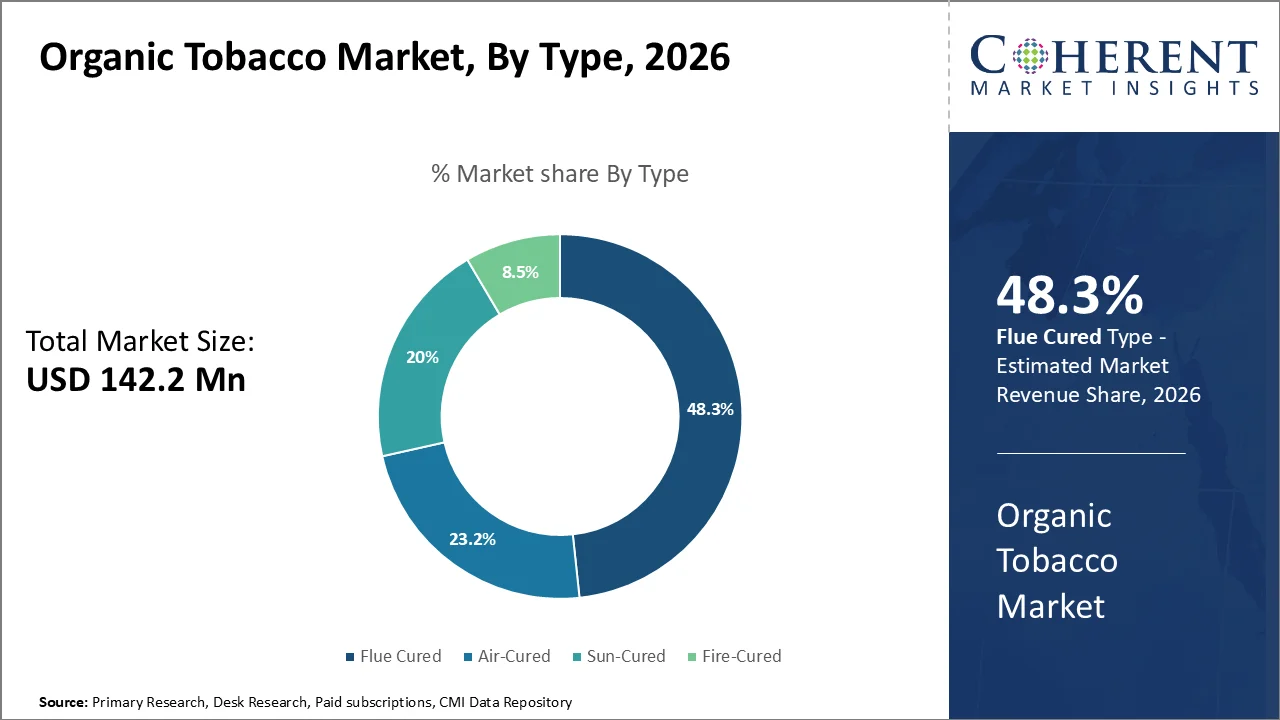
The Dominance of the Flue-Cured Segment in the Organic Tobacco Market
The flue-cured segment is still the most popular because it is widely used in business and has the most up-to-date production data. The most recent published segment-share split shows that flue-cured makes up 48.3% of total revenue. USDA data from 2025 backs up this claim: flue-cured tobacco made up 276.86 million pounds out of 358.57 million pounds of total U.S. tobacco production, which is 77.2% of output. It also stood for 134,400 acres that were harvested out of a total of 171,300 acres of tobacco, or 78.5% of the harvested area.
Flue-cured tobacco is a popular choice for cigarette blends because it has a mild taste, a balanced aroma, and a smoother smoking profile. This makes it more appealing to businesses than other types of tobacco. Strong grower and manufacturer preference: The segment benefits from an established cultivation base, standardized curing process, and consistent leaf quality, making it easier for manufacturers to source, process, and use in large-scale tobacco product production.
Its large and stable production base helps it stay on top. The 2025 Flue-Cured Tobacco Guide from NC State said that there would be 185,000 to 200,000 acres of flue-cured tobacco in the US, with 110,000 to 120,000 acres in North Carolina. Prices were expected to be between $2.30 and $2.40 per pound. The 2026 Flue-Cured Tobacco Guide, which came out on December 15, 2025, said that tight world supplies would probably keep prices high into 2026. If quality stays the same, prices could be between $2.30 and $2.50 per pound.
- Current Industry Events of 2026
- Market Size Estimation
- Regional Breakdown
- Competitive Landscape
- Customer Intelligence
- Segmental Analysis
- Pricing Analysis
- Key Market Drivers, Challenges & Future Trends
- Customized Insights Section
Why is the Smoking Segment Dominating the Organic Tobacco Market?
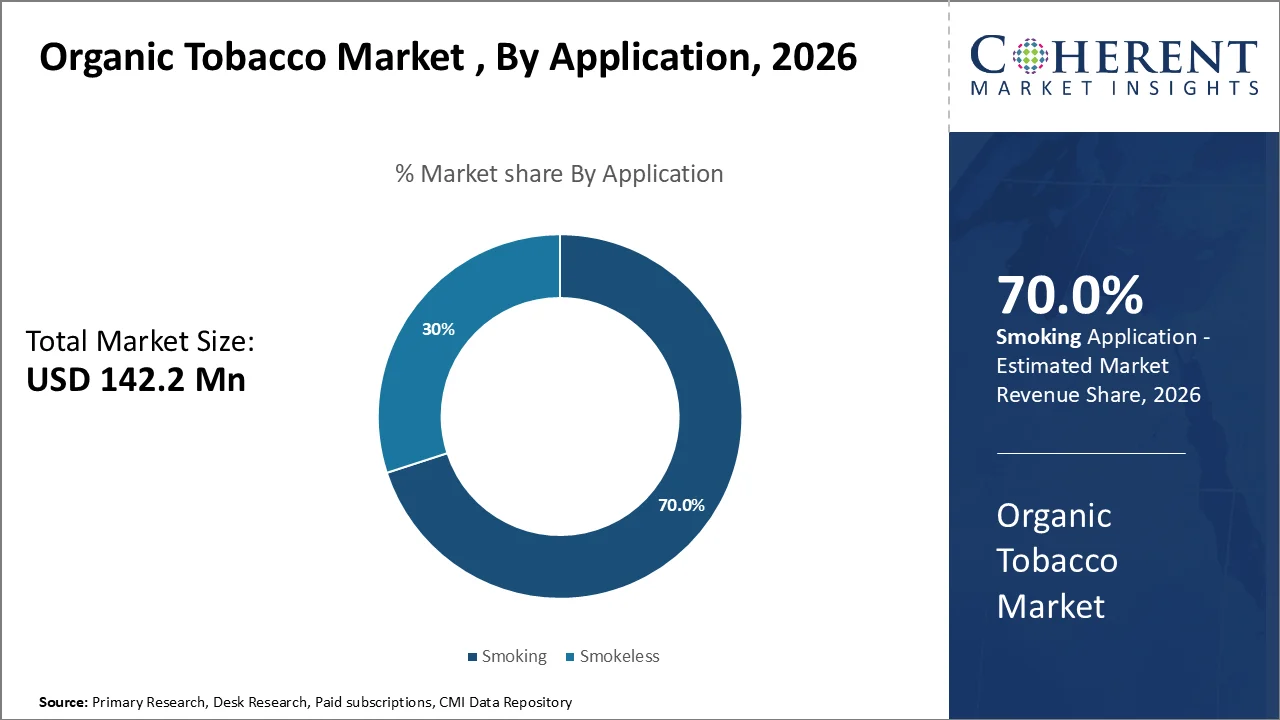
The smoking segment is estimated to account for around 70% market share in 2026 as cigarettes, cigars, and roll-your-own products are still the most popular types of tobacco, so the smoking segment is likely to stay at dominance and the most popular application segment. Cigarettes and roll-your-own formats are still the most well-known and widely used types of tobacco products, which keeps demand focused on this group. The segment has a well-established supply chain, a wide range of retail options, and strong product standardization. This makes it easier to make, distribute, and sell smoking formats on a large scale than many other types of tobacco formats.
WHO said in October 2025 that the number of people who used tobacco around the world had dropped to 1.2 billion in 2024. However, tobacco still affected 1 in 5 adults around the world, which shows that smoked formats are still the most popular way to use tobacco. (Source- WHO)
The 2026 European Parliament study found that in 2024, cigarettes made up 84.65% of all tobacco and nicotine product use in Bulgaria, 67% in Italy, and 64% in Poland. This shows that smoking products are still more popular than smokeless and new options.
Semi-Processed Segment Dominance is supported by growing tobacco exports
The Semi-Processed segment has the largest share of 73.0% in 2026 of the organic tobacco market. This is because it is the main commercial form that moves through the supply chain and makes the most money from total tobacco exports. This is because most of the time, tobacco moves through the commercial chain as unprocessed or partially processed leaf before being turned into cigarettes, cigars, snuff, chewing tobacco, and other end products.
In January 2026, the USDA said that total U.S. tobacco production in 2025 was 359 million pounds, which included 277 million pounds of flue-cured tobacco. This shows that the supply of leaf-based tobacco is still very large. The Ministry of Commerce also says that India is the second largest exporter of raw tobacco by volume, after Brazil. Overall, these official numbers back up the idea that semi-processed tobacco is still the most important commercial form in the value chain.
Organic Tobacco Market Trends
- The organic tobacco market has been on the rise and is expected to continue its upward trend of approximately 4% compound annual growth rate for the foreseeable future which indicates an increased desire for natural and environmentally friendly tobacco products.
- Consumers are willing to pay a premium of approximately 15% to 25% more of organic tobacco products compared to traditional tobacco products. This indicates a strong demand for organic tobacco based on perceptions of higher quality, as well as the perceived sustainability of organic tobacco.
Organic Tobacco Market Innovations : Traceability, Certification Technology, and Sustainable Farming Trends
Innovation is moving more and more toward cleaner farming, better traceability, and stricter control of certification. The new NPOP Regulation 2024, which went into effect on January 9, 2025, was meant to make things clearer and add new technology to the processes of certification and traceability in India. The new NPOP rules say that certification bodies must test at least 5% of operators and at least 2% of farmers in each grower group every year for illegal substances. USDA's 2025 NOSB documents show that they are still focused on using natural sucker-control inputs like soybean or mineral oil in growing tobacco. This shows that they are making progress in using new methods to manage crops biologically for certified tobacco production.
Current Events and Their Impact
Current Event | Description and its Impact |
Growing Health and Environmental Awareness |
|
EU Tightening Pesticide Residue Regulations (2024–2025) |
|
Regional Insights
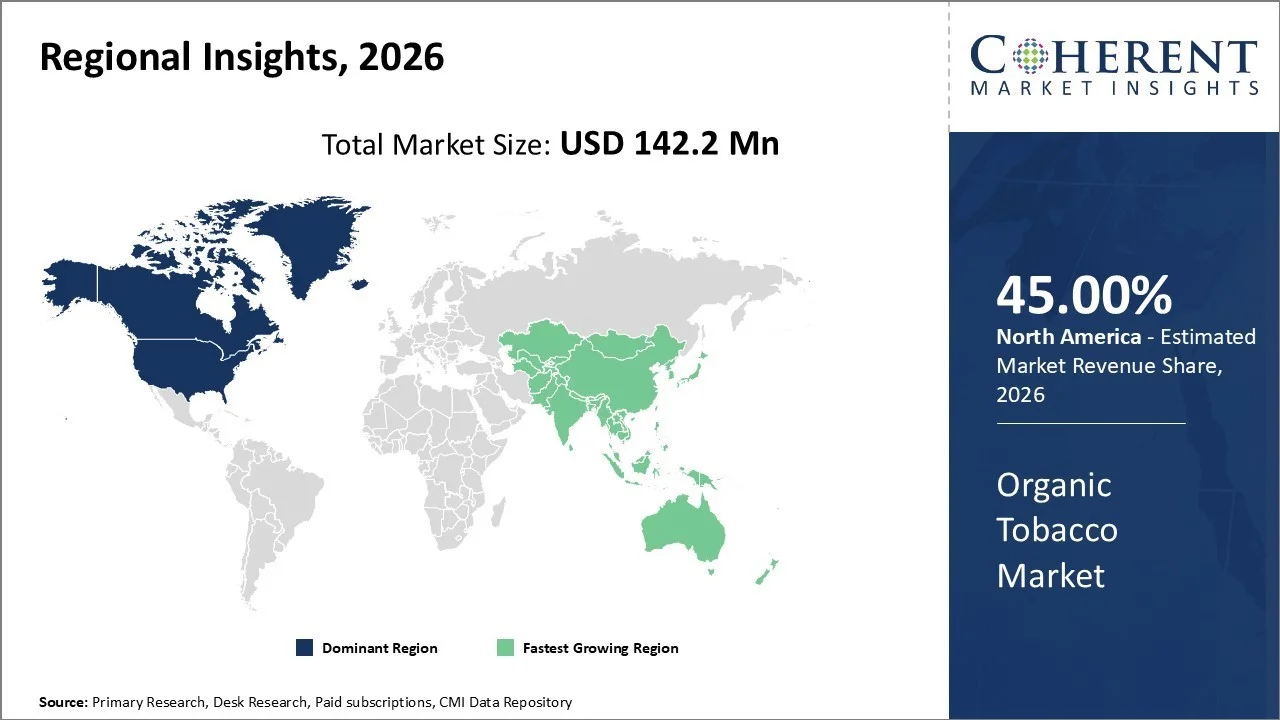
North America Leads Organic Tobacco Market with 45% of the Market Share
In 2026, North America maintains its dominance over all other regions of the world in organic tobacco market with approximately 45% of the worldwide share of this market. The growth of North America’s strong position is driven by high levels of consumer awareness about how chemical-free tobacco can benefit their health, strong demand for premium products sourcing from sustainable resources, as well as strict legislation on the use of pesticides to produce organic tobacco, and the desire of a considerable percentage of consumers to purchase certified organic product. North America also has well-established distribution networks and the presence of numerous key suppliers and producers of organic tobacco in the USA and Canada, creating a continuous source of availability of products and opportunities for innovation in both the smoking and smokeless organic tobacco categories.
Asia Pacific Drives Rapid Growth in Organic Tobacco Market
The Asia Pacific region is projected to experience the fastest growth of all regions in the organic tobacco market place in 2026, with an estimated 30% of the market share projected to be held by this region. Growth will mainly result from increasing disposable incomes, urbanization, and an overall increase in awareness of natural and chemical-free tobacco products within this region, however the growth rate for organic tobacco products within Asia-Pacific will likely be larger than average due to countries like China in India making the shift from purchasing only lower-cost products to purchasing higher-price including organic variants. Developing retail distribution networks and continuing to see the demand for non-smoke alternatives to traditional tobacco also play and important part in the acceleration of overall growth of the organic tobacco market in the Asia Pacific region.
Country Analysis
United States Leads the Organic Tobacco Market followed by Canada
The U.S. is still the most important country in North America because it has a strong agricultural infrastructure, a well-established organic certification system, and a large base of tobacco production. Canada also helps the area by having a well-established organic industry, stable rules and regulations, and a growing interest in certified and sustainable agricultural goods. Both countries work together to make North America stronger by having organized supply chains, high quality standards, and a long history in the tobacco market.
India Dominates the Growth in the Organic Tobacco Market followed by Indonesia
India is a big growth country in the Asia-Pacific region because it has a lot of organic farms, a growing certification system, and a big part in the tobacco trade. Indonesia is also important because it has a long history of growing tobacco and is still important in regional agricultural and tobacco-related industries. These countries are helping the Asia-Pacific region grow by getting more people to use organic products, growing more crops, and getting more people involved in the market.
Who are the Major Companies in Organic Tobacco Market?
Some of the major key players in Organic Tobacco Market are Santa Fe Natural Tobacco Company, Hi Brasil Tobacco, Bigaratte & Co., Vape Organics, Mother Earth Tobacco
Market Report Scope
Organic Tobacco Market Report Coverage
| Report Coverage | Details | ||
|---|---|---|---|
| Base Year: | 2025 | Market Size in 2026: | USD 142.2 Mn |
| Historical Data for: | 2020 To 2024 | Forecast Period: | 2026 To 2033 |
| Forecast Period 2026 to 2033 CAGR: | 4% | 2033 Value Projection: | USD 189.4 Mn |
| Geographies covered: |
| ||
| Segments covered: |
| ||
| Companies covered: | Santa Fe Natural Tobacco Company, Hi Brasil Tobacco, Bigaratte & Co., Vape Organics, Mother Earth Tobacco | ||
Key News
- Philip Morris Limited announced on April 5, 2026, that it would launch DELIA, a new tobacco stick that only works with the IQOS ILUMA range in the UK and Ireland. This will add to the company's line of heated tobacco products.
Analyst Opinion
- The organic tobacco market is likely to stay a small, high-end niche market instead of becoming a big, mainstream market. That view is backed up by two opposing forces: tobacco use is still very common around the world, with 1.2 billion users in 2024, which keeps demand strong. However, the tobacco industry as a whole is still under a lot of public health and regulatory pressure around the world.
- From the point of view of supply, the market looks better where there are already organic certification systems and well-established tobacco value chains. As of July 2025, India's NPOP system included 4,712 active grower groups and about 1.93 million certified farmers. The USDA reported that the U.S. produced 359 million pounds of tobacco in 2025. This shows that certified agriculture infrastructure and tobacco-processing capacity can exist together on a large scale.
Speak to the analyst
Want personalized insights?
Take the findings above to one of our principal consultants, or have the report rebuilt around the segments, geographies and competitors you actually track.
Market Segmentation
- Global Organic Tobacco Market, By Type
- Flue Cured
- Air Cured
- Sun Cured
- Fire Cured
- Global Organic Tobacco Market, By Application
- Smoking
- Cigarettes
- Cigars and Cigarillos
- RYO
- Others
- Smokeless
- Chewing
- Snuff
- Vapor and e-cigarettes
- Smoking
- Global Organic Tobacco Market, By Form
- Semi Processed
- Chewing
- Snuff
- Homogenized
- Tobacco Extracts
- Global Organic Tobacco Market, By Region
- North America
- U.S.
- Canada
- Latin America
- Brazil
- Mexico
- Argentina
- Rest of Latin America
- Europe
- Germany
- U.K.
- France
- Italy
- Spain
- Russia
- Rest of Europe
- Asia Pacific
- China
- India
- Japan
- Australia
- South Korea
- ASEAN
- Rest of Asia Pacific
- Middle East
- GCC
- Israel
- Rest of Middle East
- Africa
- South Africa
- Central Africa
- North Africa
- North America
Sources
- Primary Research interviews
- Interviews with industry experts, tobacco producers, and regulatory bodies.
- Databases
- World Bank
- United Nations
- FAOSTAT
- Statista
- Government of India Tobacco Board Database
- Tobacco Control Database
- Magazines
- Tobacco Reporter
- Tobacco Journal International
- Global Tobacco News
- Tobacco Business International
- Journals
- Journal of Agricultural and Food Chemistry
- Tobacco Control
- International Journal of Environmental Research and Public Health
- Journal of Food Science
- Newspapers
- The Financial Times
- The Wall Street Journal
- The Guardian
- The Times of India
- Associations
- Tobacco Institute
- International Tobacco Growers Association (ITGA)
- World Health Organization (WHO)
- International Tobacco Control (ITC)
- National Tobacco Growers Association of the U.S.
- Public Domain sources
- US FDA Tobacco Control Regulations
- WHO Tobacco Control Policies
- Food and Agriculture Organization (FAO) reports
- Proprietary Elements
- CMI Data Analytics Tool
- Proprietary CMI Existing Repository of information for last 8 years
Get access to 250+ pages report
Every segment, forecast, competitor profile and data table behind the analysis above — available for instant download.
- ESOMAR Member
- ISO 9001:2015 Certified
- D-U-N-S Registered
- GDPR & CCPA Compliant
Missing comfort of reading report in your local language? Find your preferred language:
Transform your Strategy with Exclusive Trending Reports
Frequently Asked Questions
The organic tobacco market is valued at around USD 142.2 million in 2026 and it is expected to grow at approximately USD 189.4 million due to increasing demand for natural and chemical free tobacco products.
The Organic Tobacco Market is projected to grow at a CAGR of approximately 4% from 2026 to 2033. This growth rate is significantly higher than that of the conventional tobacco market.
North America dominates the market, accounting for 45% of the global share in 2026. This is driven by high consumer awareness and strong demand for premium tobacco products.
Key drivers include growing demand for chemical-free tobacco, rising health awareness, and increasing adoption of sustainable farming practices.