

Lingerie Market Size and Forecast — 2026 - 2033
The Global Lingerie Market size is estimated to be valued at USD 65.24 billion in 2026 and is expected to reach USD 98.13 billion by 2033, exhibiting a compound annual growth rate (CAGR) of 6.2% from 2026 to 2033.
Overview
The lingerie market is driven by increasing fashion consciousness, rising disposable incomes, and growing demand for comfortable yet stylish innerwear. Changing consumer preferences toward premium, sustainable, and size-inclusive products are reshaping the industry. The influence of social media and celebrity endorsements is boosting brand visibility and encouraging frequent purchases. E-commerce expansion has improved accessibility, offering a wide range of options and personalized shopping experiences. Additionally, innovations in fabric technology, such as breathable and seamless materials, are enhancing comfort and functionality. Growing awareness around body positivity and self-expression is further fueling demand, making lingerie an essential segment in the global apparel market.
Key Takeaways
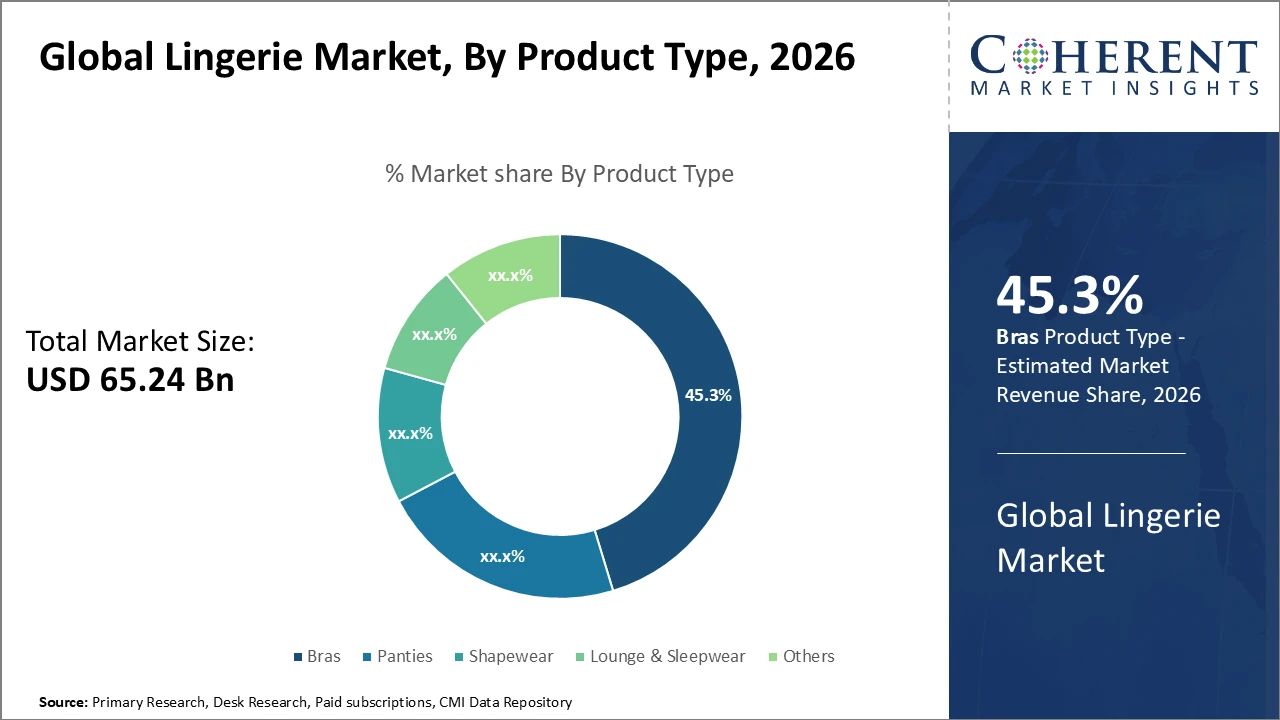
The bras segment dominates the lingerie market with a 45.3% industry share, driven by continuous innovation in design, fit, and fabric technology, while shapewear is the fastest-growing subsegment due to increasing demand for body contouring and aesthetic enhancement solutions.
In end-user segmentation, women’s lingerie accounts for over 82% of total market revenue, supported by high product variety and consistent replacement cycles, whereas men’s undergarments represent a smaller but rapidly growing niche category.
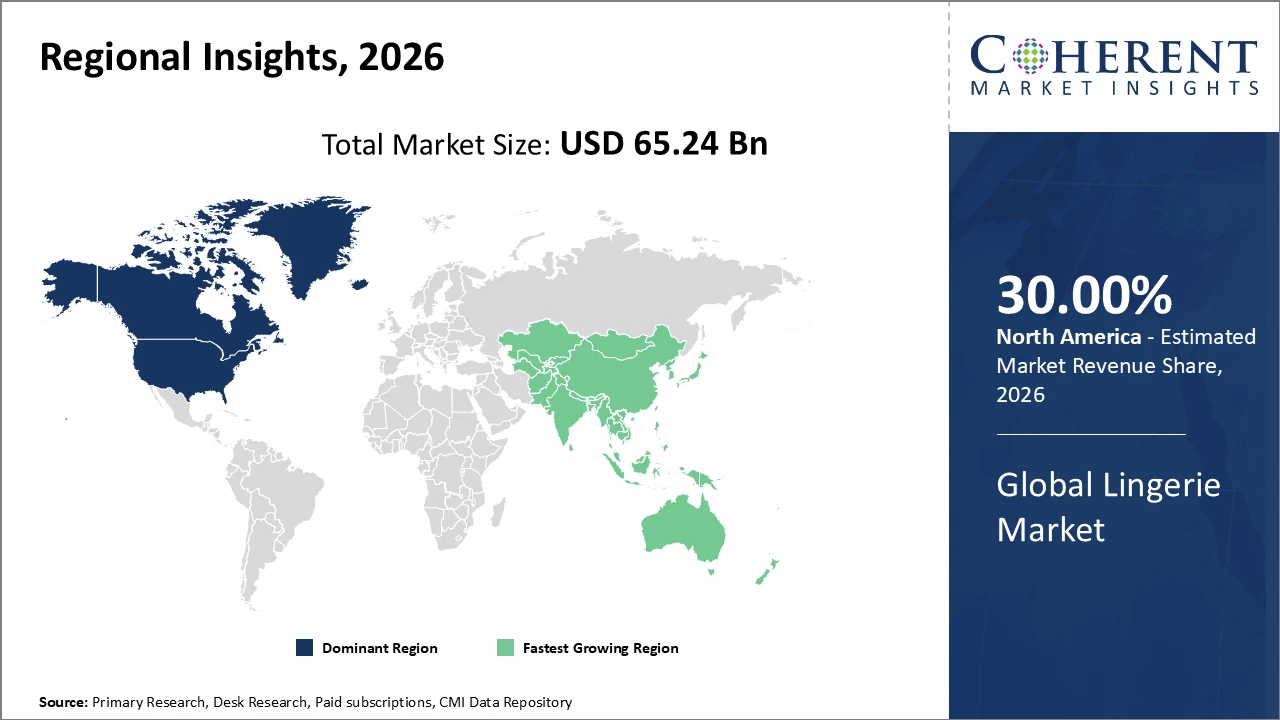
North America holds the largest market share at 30%, driven by strong retail infrastructure, premium product adoption, and high disposable income levels.
Asia Pacific is the fastest-growing region, registering a CAGR exceeding 8%, supported by urbanization, rising e-commerce penetration, and increasing fashion consciousness among consumers.
Lingerie Market Segmentation Analysis
Lingerie Market Insights, By Product Type
Bras dominate the market share, accounting for 45.3% of the lingerie market, driven by continuous innovation in support, fit, and fabric technology. Growing demand for seamless, wireless, and comfort-oriented designs further strengthens this segment’s leadership. Shapewear is the fastest-growing subsegment, supported by increasing consumer interest in body contouring solutions for both daily wear and special occasions. Panties show steady growth, driven by diverse styles such as briefs, thongs, and boyshorts catering to fashion-forward consumers.
Lingerie Market Insights, By Distribution Channel
Online Retail dominates the lingerie market, accounting for 38.7% share due to its convenience, wide product assortment, and personalized shopping experience. It is also the fastest-growing channel, driven by advancements in mobile commerce, AI-based product recommendations, and virtual fitting technologies offered by leading brands. Offline Retail continues to hold a strong position, supported by experiential shopping, in-store trials, and established brand loyalty, particularly in mature markets. Specialty stores serve premium and niche consumers, while departmental stores provide broad multi-brand assortments. The Others segment, including direct selling and multi-level marketing, contributes a smaller but stable share, supporting overall distribution channel diversification.
Lingerie Market Insights, By End User
Women dominate the lingerie market, accounting for over 82.1% of total revenue, driven by a wide range of products from everyday essentials to premium and luxury intimate wear. Continuous innovation in design, comfort, and fabric variety further strengthens this segment’s leadership. Men’s lingerie represents the fastest-growing subsegment, supported by rising awareness of grooming, comfort-focused designs, and increasing acceptance of male intimate apparel. The teenagers segment is witnessing steady growth due to early adoption of comfortable and stylish undergarments.
Lingerie Market Trends
The lingerie market trend is increasingly driven by sustainability and technological integration, reshaping product development and consumer engagement.
In 2025, eco-conscious lingerie made from recycled and organic fabrics accounted for nearly 22% of total market revenue, highlighting a strong shift toward sustainable and responsible manufacturing practices.
The adoption of AI-powered tools and virtual fitting rooms has transformed the online shopping experience, reducing return rates by up to 15% in 2026.
Inclusivity and body diversity-focused marketing campaigns have strengthened brand loyalty and expanded market reach.
In 2024, such inclusive campaigns increased consumer engagement by over 30%, reflecting growing demand for representation-driven branding.
Lingerie Market Insights, By Geography
North America Lingerie Market Analysis and Trends
In North America, the lingerie market dominance is driven by a well-established retail infrastructure, high consumer purchasing power, and evolving fashion trends that emphasize comfort, premium quality, and inclusivity. The region accounts for approximately 30% of the global market share, supported by strong brand presence and innovation from leading companies such as Victoria’s Secret and Calvin Klein. These players continue to influence market dynamics through product diversification and advanced marketing strategies. Additionally, supportive digital infrastructure and strong e-commerce penetration further enhance market accessibility and growth. The presence of organized retail and high brand awareness also strengthens North America’s leadership position globally.
Asia Pacific Lingerie Market Analysis and Trends
Meanwhile, the Asia Pacific region is witnessing the fastest growth in the lingerie market, with a CAGR exceeding 8%. This rapid expansion is driven by rising urbanization, increasing disposable incomes, and the growing influence of Western fashion trends among younger consumers. Expanding e-commerce ecosystems in countries such as China, India, and Southeast Asia are significantly improving product accessibility and boosting online sales. Additionally, supportive government initiatives aimed at strengthening textile manufacturing and enhancing export competitiveness are further accelerating market development. The region’s large population base and evolving consumer preferences continue to create strong long-term growth opportunities for lingerie market players.
Lingerie Market Outlook for Key Countries
USA Lingerie Market Analysis and Trends
The USA lingerie market is a key contributor to global industry growth, representing the largest share within North America due to strong consumer demand for premium, fashion-forward, and athleisure lingerie. In 2026, online lingerie sales in the country grew by approximately 7% annually, driven by increasing preference for convenience, personalization, and sustainable product offerings. Leading brands such as Victoria’s Secret have restructured their strategies to emphasize inclusivity and body diversity, resulting in a 12% increase in market share. The well-developed retail infrastructure, strong brand presence, and advanced e-commerce ecosystem further reinforce the USA’s position as a major market driver.
Germany Lingerie Market Analysis and Trends
Germany is a mature and highly competitive lingerie market driven by strong consumer preference for comfort, quality, and sustainability. The country emphasizes eco-friendly materials such as organic cotton, recycled lace, and OEKO-TEX certified fabrics, reflecting strict environmental regulations and high awareness among consumers. Demand is also supported by a growing shift toward functional lingerie, including wireless bras, shapewear, and seamless designs. E-commerce adoption is increasing steadily, complemented by strong presence of specialty retail stores. German consumers prioritize durability and minimalist design aesthetics, influencing product innovation. Overall, the market is stable with moderate growth, supported by premiumization, sustainability trends, and evolving fashion consciousness.
Analyst Opinion
Consumer demand for seamless and sustainable lingerie has accelerated, with purchases of eco-friendly fabric lingerie rising by 25% in 2025 across North America and Europe. Pricing dynamics remain competitive, with mid-range brands achieving 15% higher revenue growth than luxury segments in 2024 due to affordability and wider consumer reach.
The rise of online sales channels has significantly reshaped supply-side dynamics, with e-commerce contributing over 40% of global lingerie market revenue in 2026, doubling since 2023. This growth is supported by advanced logistics networks and personalized digital shopping experiences, particularly strengthening market penetration in Asia Pacific.
Usage trends indicate strong growth in athleisure-inspired lingerie, which accounts for 18% of total market share in 2026. This reflects increasing consumer preference for multifunctional apparel aligned with fitness, wellness, and comfort-oriented lifestyles worldwide.
Global trade flows are expanding, with Asia Pacific emerging as a net exporter valued at USD 12 billion in 2025 due to strong manufacturing capacity and favorable trade policies. Meanwhile, North America imports increased by 10% year-over-year, highlighting dependence on diversified global supply chains.
- Current Industry Events of 2026
- Market Size Estimation
- Regional Breakdown
- Competitive Landscape
- Customer Intelligence
- Segmental Analysis
- Pricing Analysis
- Key Market Drivers, Challenges & Future Trends
- Customized Insights Section
Market Scope
| Report Coverage | Details | ||
|---|---|---|---|
| Base Year: | 2025 | Market Size in 2026: | USD 65.24 billion |
| Historical Data for: | 2020 To 2024 | Forecast Period: | 2026 To 2033 |
| Forecast Period 2026 to 2033 CAGR: | 6.2% | 2033 Value Projection: | USD 98.13 billion |
| Geographies covered: |
| ||
| Segments covered: |
| ||
| Companies covered: | Victoria’s Secret, Aerie, Calvin Klein Inc., La Perla, Jockey International Inc., Wacoal Holdings corp., Intimissimi, Triumph International, L Brands, Jockey International Inc. | ||
| Growth Drivers: |
| ||
Lingerie Market Growth Factors
The lingerie market growth is primarily driven by increasing consumer preference for personalized and comfortable undergarments, particularly among millennials and Gen Z consumers. The introduction of smart, breathable, and sustainable fabrics has significantly expanded product innovation, attracting environmentally conscious buyers and enhancing market scope. Rapid urbanization and rising disposable incomes, especially in Asia Pacific, are further boosting demand and overall market revenue. This growth is strongly supported by the expansion of digital distribution channels, including e-commerce platforms that improve accessibility and convenience. Additionally, the growing perception of lingerie as both a functional and fashion-oriented product is encouraging continuous innovation and strengthening overall market dynamics.
Lingerie Market Development
In April 2026, Marks & Spencer expanded its lingerie range with the exclusive launch of Body, a new brand designed to redefine everyday underwear.
Key Players
Leading Companies of the Market
Victoria’s Secret
Aerie
Calvin Klein Inc.
Triumph International
La Perla
L Brands
Jockey International Inc.
Wacoal Holdings Corp.
Intimissimi
Several key players in the lingerie market have adopted aggressive digital transformation and customer-centric strategies to strengthen their competitive positioning. Victoria's Secret & Co. focused on inclusivity-driven brand relaunch initiatives in 2025, which resulted in a 12% increase in market share by improving brand perception and customer engagement. Calvin Klein invested in AI-powered virtual fitting technologies in 2026, enhancing personalized shopping experiences and driving an 18% improvement in customer conversion rates. Meanwhile, Hanesbrands Inc. expanded its direct-to-consumer sales channels, leading to a 20% revenue increase in 2025 by strengthening digital retail presence and improving access to end consumers.
Lingerie Market Future Outlook
The lingerie market is expected to witness steady growth in the coming years, driven by rising demand for comfortable, sustainable, and fashion-forward intimate apparel. Increasing digitalization, including AI-based sizing tools and virtual fitting rooms, will further enhance online shopping experiences and reduce return rates. Growing awareness of body positivity and inclusivity is encouraging brands to expand size ranges and diversify product offerings. The shift toward eco-friendly fabrics and ethical manufacturing will also play a crucial role in shaping future demand. Additionally, expanding e-commerce penetration in emerging markets, especially Asia Pacific, will continue to support long-term market expansion and revenue growth globally.
Lingerie Market Historical Analysis
The lingerie market has experienced steady historical growth driven by evolving fashion trends, increasing disposable incomes, and changing consumer perceptions of intimate apparel. Initially dominated by basic functional undergarments, the market gradually shifted toward design-oriented and comfort-focused products. Over time, innovations in fabrics such as lace, microfiber, and stretchable blends improved fit and appeal, expanding consumer adoption. The rise of global fashion brands and organized retail further accelerated market penetration. In the past decade, digital transformation and e-commerce significantly reshaped distribution channels, while the growing influence of body positivity and inclusivity trends has further diversified product offerings and strengthened overall market development.
Sources
Primary Research Interviews:
Lingerie designers, product development heads, and apparel manufacturing specialists focusing on fabric innovation and comfort engineering
Retail buyers, fashion merchandisers, and category managers from departmental stores and specialty lingerie brands
E-commerce managers and digital marketing strategists analyzing online lingerie sales and consumer behavior trends
Magazines:
Vogue Business – Fashion lingerie trends and luxury intimate wear insights
Women’s Wear Daily (WWD) – Retail performance and lingerie brand developments
Cosmopolitan – Consumer preferences and lingerie style trends
Fashion United – Global apparel industry updates and brand strategies
Journals:
Journal of Fashion Marketing and Management – Consumer behavior in intimate apparel
Clothing and Textiles Research Journal – Fabric innovation and apparel design studies
International Journal of Fashion Design, Technology and Education – Lingerie design and textile innovation
Textile Research Journal – Sustainable fabrics and material performance
Newspapers:
The Wall Street Journal – Luxury fashion and retail market trends
Financial Times – Global apparel industry and consumer spending insights
Reuters – Fashion industry developments and corporate expansions
Bloomberg – Retail performance of lingerie and apparel brands
Business Standard – Emerging fashion trends in Asia-Pacific and global trade
Associations:
The Underfashion Club – Lingerie industry networking and innovation support
Intimate Apparel Council – Market standards and industry collaboration
Council of Fashion Designers of America (CFDA) – Fashion design and industry trends
Textile Institute – Fabric innovation and textile research standards
Get access to 250+ pages report
Every segment, forecast, competitor profile and data table behind the analysis above — available for instant download.
- ESOMAR Member
- ISO 9001:2015 Certified
- D-U-N-S Registered
- GDPR & CCPA Compliant
Missing comfort of reading report in your local language? Find your preferred language:
Transform your Strategy with Exclusive Trending Reports
Frequently Asked Questions
The market is led by industry giants such as Victoria’s Secret, Calvin Klein Inc., and Triumph International, which command strong brand equity and innovative product portfolios.
The lingerie market is projected to reach USD 98.13 billion by 2033, reflecting a robust CAGR of 6.2% from 2026 to 2033, underscoring solid market growth prospects.
Women’s lingerie remains the primary driver with substantial market share, while men’s lingerie and athleisure-inspired products are rapidly gaining traction.
Market development will be shaped by sustainability, digital innovation, personalization, and increasing demand for comfort-focused and inclusive designs.
The competitive landscape is characterized by continuous innovation and strong brand differentiation, with key challenges including supply chain volatility and fluctuating raw material costs.
Companies focus on omnichannel retailing, digital marketing expansion, and influencer collaborations to enhance consumer engagement and strengthen market presence.