

Global Gas Equipment Market Size and Forecast – 2026 To 2033
The Global Gas Equipment Market is estimated to be valued at USD 95,421.6 Mn in 2026 and is expected to reach USD 151,232.6 Mn by 2033, exhibiting a compound annual growth rate (CAGR) of 6.8% from 2026 to 2033. This steady expansion is a result of rising demand in the industrial sector, infrastructure projects, and the development of gas equipment technologies in different industrial applications worldwide.
Market growth is also supported by the rising need for real-time gas detection, worker safety, and portable monitoring systems in industrial facilities. In March 2025, Industrial Scientific launched the Radius BZ1 Area Monitor, designed to improve gas detection coverage across hazardous work zones and support faster safety response in industrial operations. (Source: Industrial Scientific)
Key Takeaways of the Global Gas Equipment Market
- Gas delivery systems are expected to hold 24.6 % of the market share in 2026, supported by the need for safe, continuous, and high-volume gas transfer across industrial and healthcare facilities. In June 2025, Air Liquide announced up to USD 200 million investment in Louisiana to modernize an ASU and expand pipeline infrastructure for oxygen and nitrogen delivery. (Source: Air Liquide)
- Oxygen is expected to account for 26.3 % of the market share in 2026, reflecting its critical role in medical systems, metal processing, chemical operations, and emergency care infrastructure. In May 2025, the World Health Organization (WHO) issued regulatory considerations for medical oxygen covering production, quality control, final containers, and market release, reinforcing the importance of compliant oxygen handling systems.
- Industrial processing is expected to capture 32.8 % of the market share in 2026, as gas equipment remains essential for refining, chemical synthesis, metal treatment, combustion control, and process safety. In June 2025, Linde signed a long-term agreement to build and operate a world-scale ASU supplying oxygen and nitrogen to Blue Point’s low-carbon ammonia facility in Louisiana, U.S.
- North America is expected to dominate with 31.6 % of the market share in 2026, supported by mature industrial gas infrastructure, strong healthcare demand, and hydrogen-focused energy investments. In March 2024, the U.S. DOE announced USD 750 million for 52 hydrogen projects across 24 states, supporting electrolysis, manufacturing, and hydrogen system components.
- Asia Pacific is expected to hold 28.9 % of the market share in 2026 and record the fastest growth, led by semiconductor, electronics, industrial manufacturing, and healthcare capacity expansion. In April 2026, Air Products was selected to supply industrial gases for Samsung Electronics’ next-generation semiconductor fab in Pyeongtaek, South Korea, strengthening regional specialty gas infrastructure.
- Shift Toward Integrated Safety and Monitoring: Gas equipment procurement is moving beyond standalone hardware toward integrated systems combining detection, pressure control, flow regulation, and real-time monitoring. This shift improves plant safety, reduces downtime, and supports compliance-heavy industries where leaks, pressure instability, or purity deviations can directly affect productivity, worker safety, and customer qualification standards.
- On-Site and High-Purity Supply Models Gain Strategic Importance: As customers seek to minimize logistics dependence and enhance process reliability, dedicated gas generation systems and high purity gas supplies are gaining significant traction. In sectors like semiconductors, healthcare, chemicals, and advanced manufacturing, continuous supply, traceability, and quality assurance of purity and reduced risk of operations are increasingly critical factors.
Segmental Insights
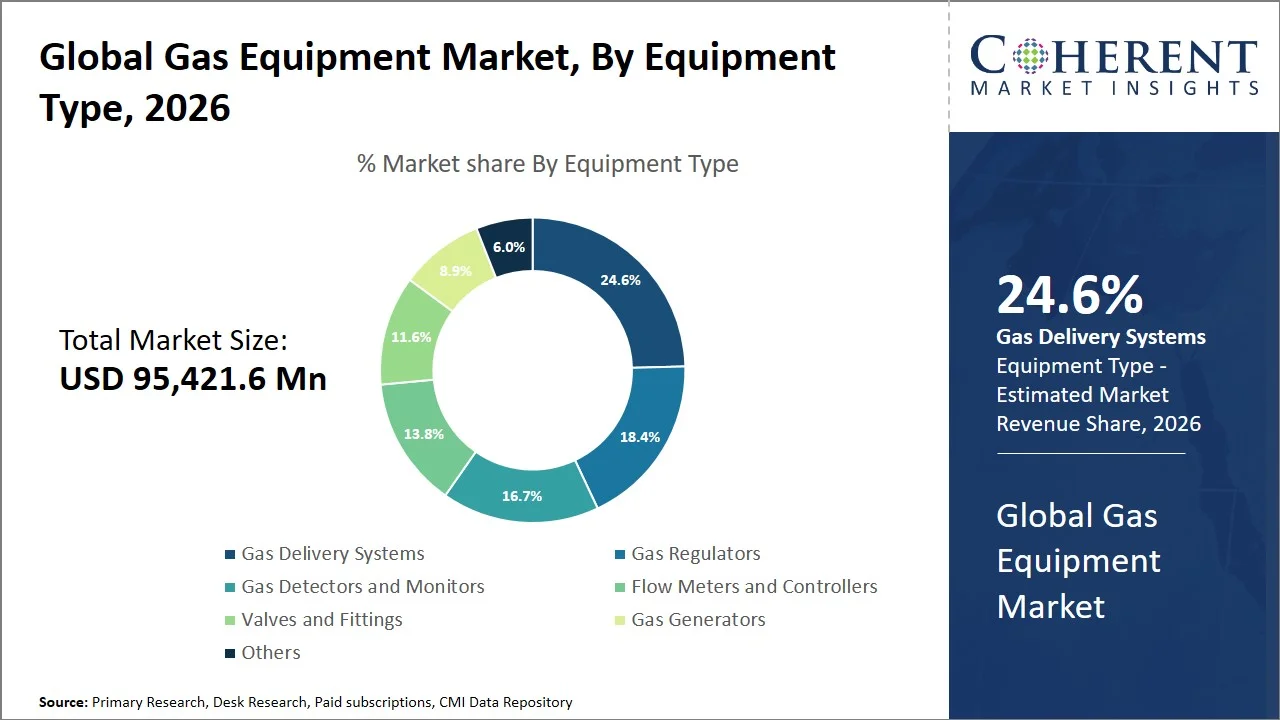
Why Do Gas Delivery Systems Dominate the Global Gas Equipment Market?
The global gas equipment market is projected to be dominated by gas delivery systems, accounting for 24.6% of the market share in 2026. This is because gas delivery systems are the main infrastructure for the safe storage, transport, pressure stability and controlled supply of gases. Industries with applications that demand constant gas delivery, such as semiconductor fabrication facilities, hospitals, laboratories and high-purity manufacturing facilities, provide support for their leadership. Demand is stronger where hazardous, corrosive, flammable, or specialty gases must be handled with precision and safety compliance. On the supply side, integrated cabinets, purge systems, automatic switching, and monitoring-enabled delivery platforms are improving uptime and lowering operational risk. In semiconductor manufacturing, adoption is particularly high because gas purity and delivery consistency directly affect yield and defect control. In July 2025, Entegris opened its Korea Technology Center in South Korea, with capabilities supporting semiconductor materials, process solutions, and delivery system applications closer to chipmakers. (Source: Entegris)
- Current Industry Events of 2026
- Market Size Estimation
- Regional Breakdown
- Competitive Landscape
- Customer Intelligence
- Segmental Analysis
- Pricing Analysis
- Key Market Drivers, Challenges & Future Trends
- Customized Insights Section
Why Does Oxygen Represent the Largest Gas Type in the Global Gas Equipment Market?
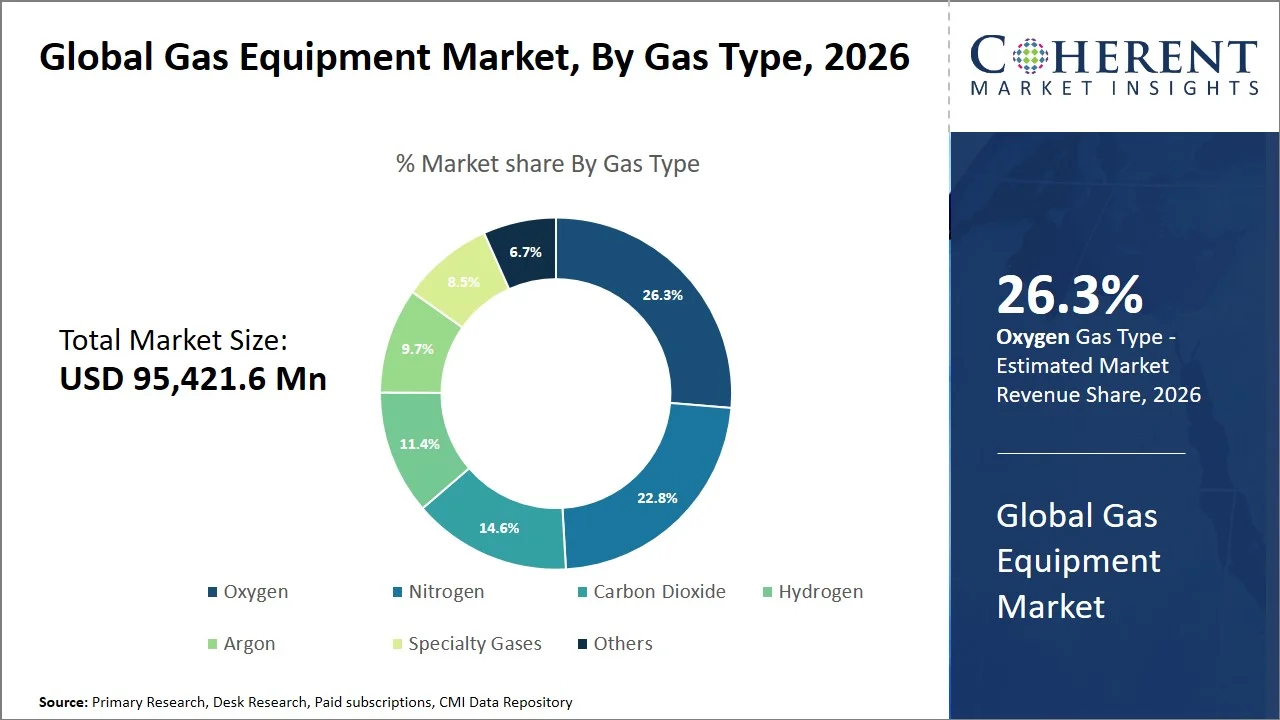
Oxygen is projected to hold the highest share, accounting for 26.3% of the market share in 2026 due to its wide commercial applications in the healthcare sector, steelmaking, welding, enhancement of combustion, wastewater treatment, glass manufacturing, and chemical oxidation processes. It is not only used in medicine, but it is also a part of the industrial productivity – oxygen is supplied in a controlled amount and it has beneficial effect on the furnace efficiency, speed of reactions and high-temperature processes. The strength of the demand side is the critical care infrastructure combined with strong industrial demand. Supply-side adoption is supported by cryogenic air separation units, liquid oxygen storage systems, cylinder networks, vaporizers, and on-site generation systems that enable scalable availability. In June 2025, SOL India inaugurated a new air separation unit in Ranipet, Tamil Nadu for oxygen, nitrogen, and argon production, strengthening oxygen supply infrastructure in Southern India.
Why Does Industrial Processing Dominate the Global Gas Equipment Market?
Industrial processing is expected to dominate the global gas equipment market with 32.8% of share in 2026, as gas equipment is essential for maintaining controlled atmospheres, heating efficiency, oxidation, purging, cutting, welding, and process safety across heavy industries. The segment benefits from recurring equipment needs in metals, chemicals, glass, refining, energy, and advanced materials production. Demand is supported by industries that depend on high-volume gases and precision control to improve output quality, reduce process variability, and meet environmental targets. Supply-side growth is linked to advanced burners, regulators, flow controllers, valves, and integrated gas skids designed for harsh industrial environments. In March 2025, Taiyo Nippon Sanso demonstrated its Innova-Jet oxy-fuel burner for glass manufacturing processes, verifying lower fuel use and improved thermal efficiency in industrial furnace applications.
Global Gas Equipment Market Dynamics
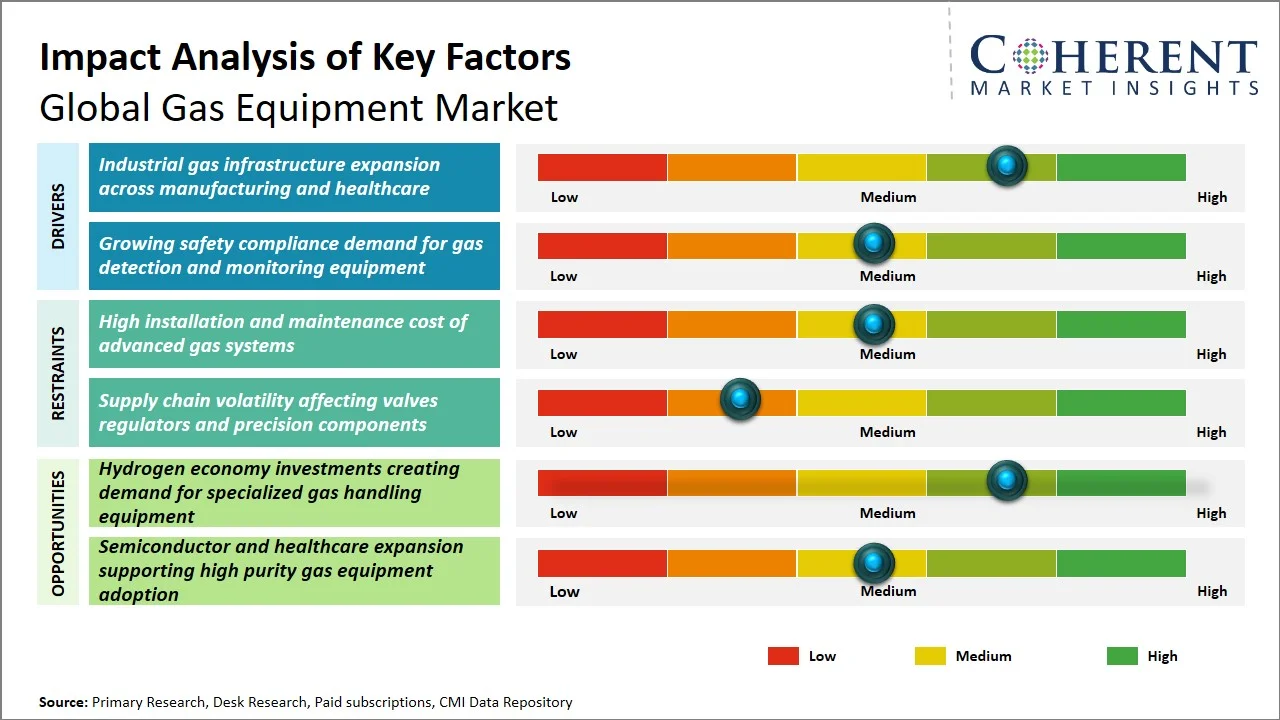
Key Market Drivers
- Industrial Gas Infrastructure Expansion Across Manufacturing and Healthcare: Continued investment in industrial and medical gas production, filling, storage, and distribution infrastructure are contributing to an expansion of industrial gas infrastructure across the manufacturing and healthcare sectors in The Global Gas Equipment Market. Regulators, valves, flow controllers, delivery systems, vaporizers, cylinders and monitoring equipment are all necessary at manufacturing plants to ensure the continuous supply of oxygen, nitrogen, argon, hydrogen and specialty gases. Medical gas handling systems, cylinder filling lines and safe delivery networks are also required to meet regulatory requirements for healthcare facilities. This infrastructure-led demand improves recurring equipment replacement, maintenance, and upgrade cycles. In June 2024, Messer opened a new production center in Estella, Spain, to fill industrial, food, medical, and special gases in cylinders and bundles, with 250,000 cylinders per year capacity and future green hydrogen filling lines.
- Growing Safety Compliance Demand for Gas Detection and Monitoring Equipment: Safety compliance is becoming a stronger demand driver as industries handling flammable, toxic, oxygen-deficient, and high-pressure gases increase investment in gas detectors, alarm systems, fixed sensors, portable monitors, and connected safety devices. Adoption is especially important in oil and gas, mining, petrochemicals, chemicals, wastewater treatment, manufacturing, and confined-space operations, where leakage or gas accumulation can cause operational shutdowns, worker exposure, explosions, or regulatory penalties. End users are shifting from basic detection units to more durable, low-maintenance sensing technologies that reduce false alarms and improve field reliability. In March 2026, Honeywell launched an NDIR hydrocarbon gas sensor for detecting methane, propane, and butane in industrial settings, including refineries, mining, manufacturing plants, and processing facilities. (Source: Honeywell International Inc)
Emerging Market Trends
- Shift Toward High-Purity and Application-Specific Gas Handling Systems: The market is moving from standard gas equipment toward application-specific systems designed for high-purity, ultra-high-purity, and contamination-sensitive environments. Semiconductor, electronics, laboratories, pharmaceuticals, healthcare, and advanced materials sectors require gas delivery systems that can maintain stable pressure, controlled flow, leak-tight performance, and material compatibility. This is increasing demand for precision regulators, stainless-steel fittings, automated purge systems, diaphragm valves, mass flow controllers, and analytical-grade monitoring solutions. The trend supports premiumization because end users are willing to pay for equipment that protects process yield, reduces contamination risk, and supports audit-ready quality systems. Suppliers with engineering capability, cleanroom-compatible products, and documentation support are better positioned than low-cost general equipment providers.
- Integration of Digital Monitoring and Preventive Maintenance in Gas Equipment: Gas equipment adoption is increasingly influenced by digital monitoring, remote diagnostics, and predictive maintenance requirements. Industrial users want equipment that can provide real-time visibility into pressure deviation, flow instability, gas leakage, cylinder consumption, sensor drift, and system health. This shift is creating demand for smart regulators, connected detectors, IoT-enabled flow meters, automated alarm panels, and cloud-linked monitoring systems. The commercial value lies in reducing unplanned downtime, improving safety response, and lowering maintenance costs in facilities where gas supply interruptions can affect production quality or regulatory compliance. As end users consolidate vendor relationships, suppliers offering integrated hardware, software, calibration, and service contracts are expected to gain stronger customer retention and higher aftermarket revenue.
Current Events and their Impact
Current Events | Description and its Impact |
May 2024 – OSHA Hazard Communication Standard Final Rule |
|
March 2024 – EPA Risk Management Program Final Rule |
|
March 2024 – PHMSA Hazardous Materials Regulatory Amendments |
|
Regional Insights
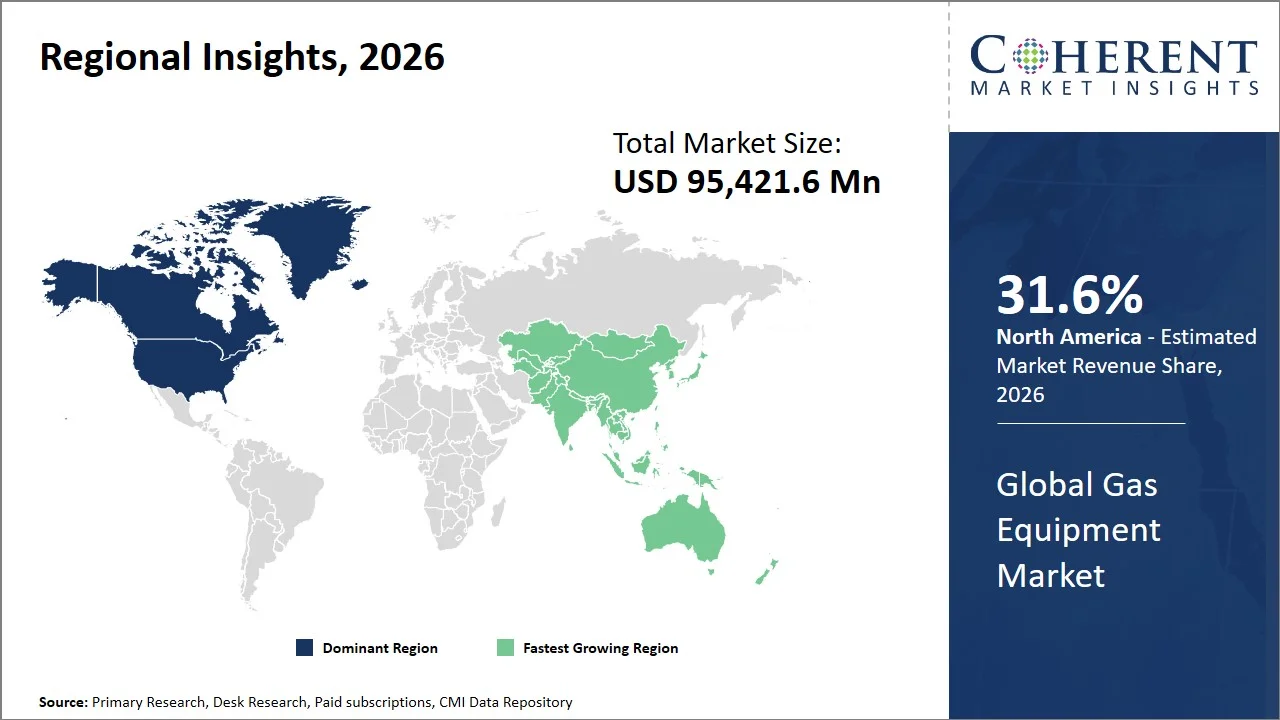
Why Does North America Dominate the Global Gas Equipment Market?
North America dominates the global gas equipment market with an estimated 31.6% share in 2026, supported by a mature industrial gas ecosystem, strong safety compliance culture, and high adoption of advanced gas storage, distribution, detection, and flow-control systems. The region has deep demand from manufacturing, chemicals, healthcare, oil and gas, food processing, and advanced energy applications. Industrial users in the U.S. and Canada prioritize equipment reliability, certified components, calibration support, and supplier service networks, which strengthens demand for premium gas equipment. The region also benefits from established distributors and aftermarket support for cylinders, tanks, regulators, valves, and gas delivery systems. In January 2026, Chart Industries signed a North American distribution partnership with Ratermann Manufacturing for industrial MicroBulk and portable liquid cylinder tanks, improving equipment availability and distributor support across the region. (Source: Chart Industries)
Why is Asia Pacific Emerging as the Fastest-Growing Region in the Global Gas Equipment Market?
Asia Pacific is emerging as the fastest-growing region in the global gas equipment market with an estimated 28.9% share in 2026, supported by rapid industrialization, expanding healthcare infrastructure, electronics manufacturing, steel production, clean energy projects, and growing industrial gas consumption. Countries such as China, India, Japan, South Korea, and Southeast Asian economies are increasing demand for cryogenic storage systems, gas delivery equipment, regulators, vaporizers, transport tanks, valves, and monitoring systems. Regional growth is also supported by domestic equipment manufacturing and rising demand for high-purity gas infrastructure in advanced manufacturing. In June 2025, INOX India secured orders worth USD 3.95 Mn across industrial gas, cryo-scientific solutions, LNG, storage tanks, transport tanks, dispensers, and related cryogenic equipment, reflecting strong regional demand for gas equipment and cryogenic infrastructure.
Global Gas Equipment Market Outlook for Key Countries
Why is the U.S. a Key Market for the Global Gas Equipment Market?
The U.S. is a key market for gas equipment because demand is linked to high-value industrial applications such as aerospace, medical gases, metals processing, fabrication, chemicals, and semiconductor manufacturing. These industries require reliable air separation units, liquid oxygen systems, nitrogen supply infrastructure, argon storage, gas regulators, cryogenic tanks, and flow-control equipment. The country also has a strong replacement market, as industrial users regularly upgrade safety, storage, and gas delivery systems to reduce downtime and meet strict operating standards. In April 2026, Air Products announced plans to build, own, and operate a new air separation unit in Cocoa, Florida, to produce liquid oxygen, nitrogen, and argon for space launch, metals processing, medical, fabrication, and chemical applications.
Why is India Important in the Global Gas Equipment Market?
India is important in the global gas equipment market because its demand is closely connected to industrial gas storage, LNG distribution, medical oxygen infrastructure, specialty manufacturing, and clean fuel adoption. Steel, chemicals, pharmaceuticals, food processing, hospitals, and emerging energy applications require cryogenic tanks, vaporizers, transport tanks, medical gas systems, regulators, and gas delivery components. India is also becoming a manufacturing base for cryogenic and gas-handling equipment, which supports domestic availability and export potential. In June 2025, INOX India secured multiple orders worth USD 3.95 Mn across industrial gas, cryo-scientific solutions, LNG, and beverage keg segments, including demand for industrial gas and LNG equipment. This shows the country’s rising requirement for storage, distribution, and cryogenic infrastructure.
Why Does China Support Growth in the Global Gas Equipment Market?
China supports growth in the global gas equipment market through its large electronics, semiconductor, chemicals, steel, refining, and advanced manufacturing base. These industries need specialty gas delivery systems, gas abatement equipment, high-purity gas handling, oxygen and nitrogen systems, flow-control equipment, valves, regulators, and monitoring solutions. The country’s semiconductor supply chain is particularly important because chip manufacturing uses hazardous and ultra-high-purity process gases that require precise delivery and abatement. In July 2025, Atlas Copco announced that New Star Technology (Suzhou) Co. Ltd., a Chinese company producing gas abatement equipment using absorbers and catalyst technology for semiconductor customers, would become part of Atlas Copco Group. This highlights China’s role in advanced gas equipment for semiconductor manufacturing.
Why is Germany a Strategic Country in the Global Gas Equipment Market?
Germany is a strategic country in the global gas equipment market because of its strong engineering base, advanced manufacturing standards, chemical industry, automotive sector, hydrogen transition, and precision industrial equipment ecosystem. Demand is linked to hydrogen production, process gases, specialty gases, laboratory applications, metal processing, and high-quality pressure and flow-control systems. German customers typically require certified, efficient, and technically advanced systems, making the country important for premium gas equipment suppliers. In March 2025, Bosch announced that Hybrion PEM electrolysis stacks would initially be manufactured at its Bamberg site, with each stack producing up to 23 kilograms of hydrogen per hour. This supports demand for hydrogen-related gas handling, water treatment, compression, and safety systems.
Why is Saudi Arabia an Important Growth Market for the Global Gas Equipment Market?
Saudi Arabia is an important growth market for gas equipment because of its large oil and gas, refining, petrochemical, hydrogen, carbon capture, and industrial gas ecosystem. Facilities in the country require pressure-control systems, gas delivery networks, compressors, detectors, valves, storage systems, flow meters, and gas handling equipment for oxygen, nitrogen, hydrogen, carbon dioxide, and specialty gases. Petrochemical and energy facilities also need equipment for inerting, purging, process safety, and emissions reduction. In March 2025, Aramco launched Saudi Arabia’s first CO₂ Direct Air Capture test unit in Dhahran, developed with Siemens Energy, and highlighted the Jubail CCS hub planned with Linde and SLB to capture CO₂ from gas plants and industrial sources. This strengthens demand for advanced gas capture and handling infrastructure.
Technology Adoption Landscape in the Global Gas Equipment Market
Technology | Adoption Level | Key Application Area | Business Impact |
Smart Gas Detection Sensors | High | Oil and gas, chemicals, confined spaces, manufacturing | Improves leak response, worker safety, and compliance readiness. |
Mass Flow Controllers | High | Laboratories, semiconductors, analytical systems, process control | Enables precise gas dosing and supports high-value process consistency. |
Automated Gas Delivery Systems | High | Healthcare, electronics, specialty gas supply, industrial plants | Reduces manual handling risk and improves uninterrupted gas availability. |
Cryogenic Storage and Vaporization Systems | Medium | Oxygen, nitrogen, argon, LNG, bulk industrial gas users | Supports large-volume gas supply with lower distribution frequency. |
Pressure Regulation and Safety Shut-off Systems | High | Medical gas networks, welding, chemicals, industrial processing | Stabilizes gas pressure and reduces equipment failure risk. |
IoT-enabled Monitoring Platforms | Medium | Multi-site plants, hospitals, laboratories, gas distribution networks | Enables remote diagnostics, preventive maintenance, and service-based revenue models. |
How are High-Purity Gas Handling Systems and Connected Safety Technologies Creating New Growth Opportunities in the Global Gas Equipment Market?
High-purity gas handling systems and connected safety technologies are creating strong commercial opportunities as end users move toward tighter process control, higher safety assurance, and lower operational downtime. Semiconductor, electronics, healthcare, specialty chemicals, laboratories, and advanced manufacturing facilities increasingly need equipment that can maintain purity, pressure stability, leak integrity, and traceable performance. This creates scope for premium regulators, valves, fittings, gas cabinets, flow controllers, and integrated monitoring systems. At the same time, connected detectors and remote monitoring platforms allow suppliers to expand beyond one-time product sales into calibration, maintenance, data services, and long-term service agreements. The opportunity is commercially important because customers are prioritizing total cost of ownership, process reliability, and compliance documentation rather than only upfront equipment price. Companies that combine engineered product quality with digital service capability can improve margins, strengthen customer retention, and differentiate in both mature and emerging industrial gas markets.
Market Players, Key Development, and Competitive Intelligence
Key Developments
- In July 2025, Crowcon launched BESafe, a dual-channel gas detector designed to detect hydrogen, carbon monoxide, and methane in battery energy storage and backup power installations. The device supports early hazard detection, lower maintenance, compact installation, and improved safety for energy storage infrastructure, creating new demand beyond traditional industrial gas applications.
- In June 2026, Air Products Membrane Solutions opened a USD 70 million expansion of its Missouri Manufacturing and Logistics Center to support growing demand for membrane-based gas separation solutions across biogas, hydrogen recovery, nitrogen generation, aerospace, and marine applications. This development strengthens the gas equipment market by expanding the production of membrane separators and engineered gas-generation systems.
Competitive Landscape
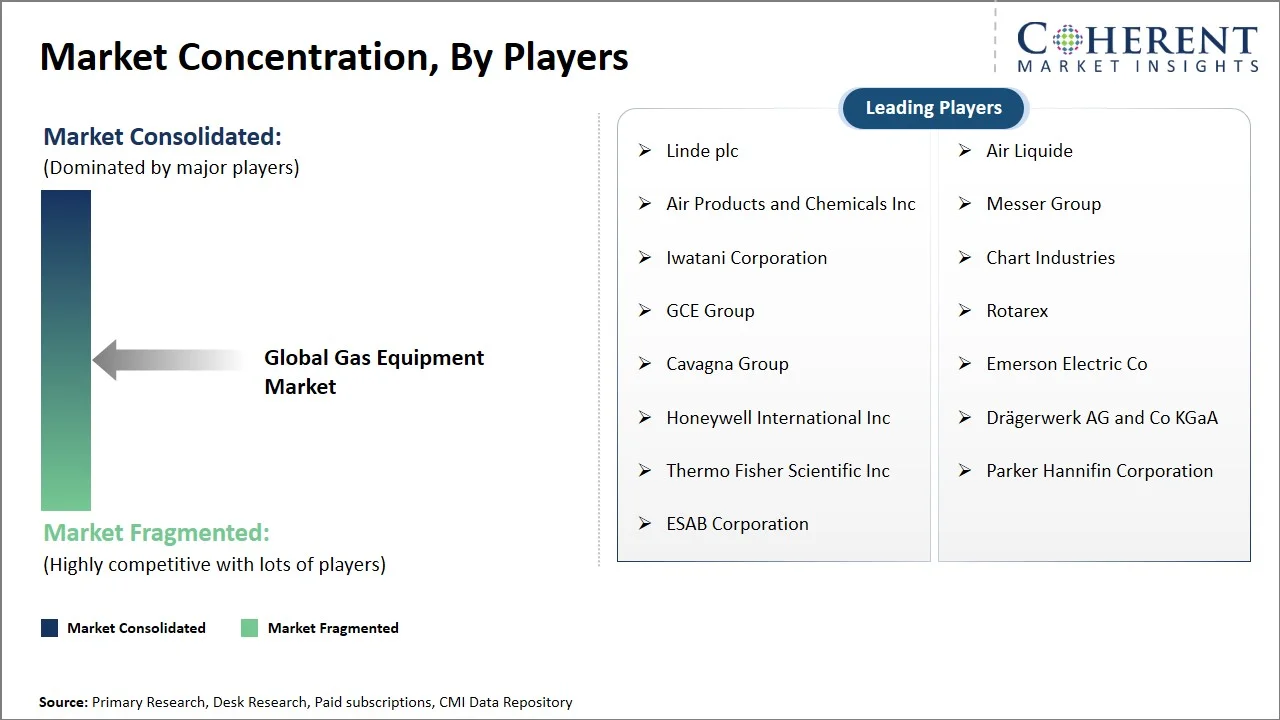
The global gas equipment market is moderately fragmented, with competition between global industrial gas equipment manufacturers, safety technology providers, cylinder and valve specialists, flow-control companies, medical gas system suppliers, and regional distributors. Large players compete on product reliability, certification coverage, service networks, and integrated solutions, while regional suppliers remain relevant in price-sensitive cylinder, regulator, fitting, and distribution-based categories.
Key focus areas include
- Improving product quality, leak-tight performance, and equipment life to differentiate in safety-critical applications.
- Adopting smart sensors, automated delivery systems, and digital monitoring to improve control and operational visibility.
- Maintaining price competitiveness in standard regulators, valves, fittings, and cylinder equipment.
- Strengthening supply reliability and service availability to support healthcare and manufacturing customers.
- Providing certifications, calibration support, and safety documentation for regulated end users.
- Expanding distribution reach to serve small and mid-sized industrial customers more effectively.
- Differentiating products by specification, grade, purity, and application fit for specialty gas, high-purity, and medical gas use.
- Building aftermarket services, preventive maintenance programs, and long-term supply agreements to improve customer retention.
Market Report Scope
Gas Equipment Market Report Coverage
| Report Coverage | Details | ||
|---|---|---|---|
| Base Year: | 2025 | Market Size in 2026: | USD 95,421.6 Mn |
| Historical Data for: | 2020 To 2024 | Forecast Period: | 2026 To 2033 |
| Forecast Period 2026 to 2033 CAGR: | 6.8% | 2033 Value Projection: | USD 151,232.6 Mn |
| Geographies covered: |
| ||
| Segments covered: |
| ||
| Companies covered: | Linde plc, Air Liquide, Air Products and Chemicals Inc, Messer Group, Iwatani Corporation, Chart Industries, GCE Group, Rotarex, Cavagna Group, Emerson Electric Co, Honeywell International Inc, Drägerwerk AG and Co KGaA, Thermo Fisher Scientific Inc, Parker Hannifin Corporation, and ESAB Corporation | ||
| Growth Drivers: |
| ||
| Restraints & Challenges: |
| ||
Analyst Opinion (Expert Opinion)
- The global gas equipment market is expected to grow steadily over the forecast period, supported by wider use of industrial gases across manufacturing, healthcare, chemicals, food processing, oil and gas, and electronics. Companies are increasingly investing in safe, efficient, and reliable gas handling systems to reduce operational risks and improve process continuity.
- Gas delivery systems, oxygen equipment, gas detectors, flow controllers, and regulators are expected to remain key focus areas for suppliers. Asia Pacific is likely to offer strong growth opportunities due to expanding manufacturing, semiconductor production, healthcare infrastructure, and industrial gas consumption, while North America will remain important due to strong safety standards and established industrial infrastructure.
- Market players should focus on high-purity gas systems, smart monitoring devices, safety-compliant products, and strong after-sales service. Companies that can offer reliable equipment, technical support, calibration services, and customized solutions for industrial and healthcare users are expected to gain a competitive advantage.
Speak to the analyst
Want personalized insights?
Take the findings above to one of our principal consultants, or have the report rebuilt around the segments, geographies and competitors you actually track.
Market Segmentation
- Equipment Type Insights (Revenue, USD Mn, 2021 - 2033)
- Gas Delivery Systems
- Gas Regulators
- Gas Detectors and Monitors
- Flow Meters and Controllers
- Valves and Fittings
- Gas Generators
- Others
- Gas Type Insights (Revenue, USD Mn, 2021 - 2033)
- Oxygen
- Nitrogen
- Carbon Dioxide
- Hydrogen
- Argon
- Specialty Gases
- Others
- Application Insights (Revenue, USD Mn, 2021 - 2033)
- Industrial Processing
- Healthcare and Medical Gas Systems
- Laboratory and Analytical Use
- Oil and Gas Operations
- Food and Beverage Processing
- Electronics and Semiconductor Manufacturing
- Others
- End-use Industry Insights (Revenue, USD Mn, 2021 - 2033)
- Manufacturing
- Healthcare
- Chemicals and Petrochemicals
- Oil and Gas
- Food and Beverages
- Electronics
- Others
- Sales Channel Insights (Revenue, USD Mn, 2021 - 2033)
- Direct Sales
- Indirect (Via distributors)
- Regional Insights (Revenue, USD Mn, 2021 - 2033)
- North America
- U.S.
- Canada
- Latin America
- Brazil
- Argentina
- Mexico
- Rest of Latin America
- Europe
- Germany
- U.K.
- Spain
- France
- Italy
- Russia
- Rest of Europe
- Asia Pacific
- China
- India
- Japan
- Australia
- South Korea
- ASEAN
- Rest of Asia Pacific
- Middle East
- GCC Countries
- Israel
- Rest of Middle East
- Africa
- South Africa
- North Africa
- Central Africa
- North America
- Key Players Insights
- Linde plc
- Air Liquide
- Air Products and Chemicals Inc
- Messer Group
- Iwatani Corporation
- Chart Industries
- GCE Group
- Rotarex
- Cavagna Group
- Emerson Electric Co
- Honeywell International Inc
- Drägerwerk AG and Co KGaA
- Thermo Fisher Scientific Inc
- Parker Hannifin Corporation
- ESAB Corporation
Sources
Primary Research Interviews
- Gas equipment manufacturers and component suppliers
- Industrial gas producers and distributors
- Gas delivery system manufacturers
- Gas regulator, valve, fitting, and flow meter suppliers
- Gas detector and monitoring equipment manufacturers
- Cryogenic tank, cylinder, vaporizer, and storage equipment providers
- Medical gas system installers and healthcare facility engineering teams
- Oil and gas, chemical, food processing, electronics, and manufacturing plant operators
- Procurement and safety compliance teams from industrial end-use companies
Stakeholders
- Gas equipment manufacturers
- Industrial gas companies
- Medical gas infrastructure providers
- Gas detector and safety monitoring solution providers
- Flow-control and pressure-control equipment suppliers
- Cylinder, cryogenic tank, and bulk storage system manufacturers
- Distributors, dealers, and gas equipment service providers
- Calibration, inspection, and maintenance service companies
- Regulatory, workplace safety, transport safety, and environmental authorities
End-use Sectors
- Manufacturing
- Healthcare and hospitals
- Chemicals and petrochemicals
- Oil and gas
- Food and beverages
- Electronics and semiconductor manufacturing
- Laboratories and analytical testing
- Metal fabrication and welding
- Energy, utilities, and hydrogen infrastructure
- Industrial processing and specialty gas applications
Regulatory & Government Sources Used
- U.S. Occupational Safety and Health Administration (OSHA) – workplace gas safety, hazard communication, and confined space safety standards
- U.S. Environmental Protection Agency (EPA) – chemical accident prevention, emissions, and hazardous gas compliance updates
- U.S. Department of Transportation (DOT) / Pipeline and Hazardous Materials Safety Administration (PHMSA) – compressed gas cylinder, hazardous material transport, and packaging regulations
- U.S. Food and Drug Administration (FDA) – medical gas manufacturing, labeling, and quality compliance
- European Commission – industrial safety, machinery, pressure equipment, and medical device regulatory framework
- European Chemicals Agency (ECHA) – chemical classification, labeling, and REACH/CLP compliance
- Bureau of Indian Standards (BIS) – gas cylinder, pressure vessel, and industrial safety standards
- Petroleum and Explosives Safety Organisation (PESO), India – gas cylinder, pressure vessel, and storage approval regulations
- National Fire Protection Association (NFPA) – medical gas, industrial gas, and fire safety standards
Industry / Trade / Technical Sources
- Compressed Gas Association (CGA) technical standards and safety guidelines
- European Industrial Gases Association (EIGA) publications
- Asia Industrial Gases Association (AIGA) safety and technical documents
- International Organization for Standardization (ISO) standards for gas cylinders, valves, pressure systems, and gas detection equipment
- International Electrotechnical Commission (IEC) standards for gas detection and electrical safety equipment
- National Fire Protection Association (NFPA) codes for medical and industrial gas systems
- Occupational safety and industrial hygiene publications related to gas detection and exposure monitoring
- Technical papers on cryogenic storage, gas flow control, pressure regulation, and industrial gas handling
Associations / Industry Reference
- Compressed Gas Association (CGA)
- European Industrial Gases Association (EIGA)
- Asia Industrial Gases Association (AIGA)
- International Oxygen Manufacturers Association (IOMA)
- National Fire Protection Association (NFPA)
- American Society of Mechanical Engineers (ASME)
- International Society of Automation (ISA)
- International Organization for Standardization (ISO)
- Safety Equipment Association and industrial safety reference bodies
- Company annual reports, investor presentations, product catalogs, and technical datasheet
Public Domain Sources
- Annual reports, investor presentations, and press releases of key companies including Air Liquide, Linde, Air Products, Messer, Chart Industries, INOX India, Honeywell, Dräger, MSA Safety, Emerson, Parker Hannifin, Swagelok, Entegris, Industrial Scientific, Crowcon, Rotarex, Cavagna Group, and GCE Group
- Government and regulatory publications from OSHA, EPA, PHMSA, FDA, European Commission, ECHA, BIS, PESO, and NFPA
- Standards, technical documents, and safety guidelines from ISO, IEC, ASME, CGA, EIGA, AIGA, ISA, and IOMA
- Public procurement documents, healthcare infrastructure records, industrial safety manuals, and trade association publications related to gas equipment and gas handling systems
Proprietary Elements
- CMI Data Analytics Tool, Proprietary CMI Existing Repository of information for last 10 years.
Get access to 250+ pages report
Every segment, forecast, competitor profile and data table behind the analysis above — available for instant download.
- ESOMAR Member
- ISO 9001:2015 Certified
- D-U-N-S Registered
- GDPR & CCPA Compliant
Missing comfort of reading report in your local language? Find your preferred language:
Transform your Strategy with Exclusive Trending Reports
Frequently Asked Questions
The CAGR of the global gas equipment market is projected to be 6.8% from 2026 to 2033.
The global gas equipment market is estimated to be valued at USD 95,421.6 million in 2026 and is expected to reach USD 151,232.6 million by 2033.
Gas detection equipment is gaining importance due to stricter workplace safety requirements and rising use of hazardous, flammable, and specialty gases across industrial facilities.
Healthcare is a major end-use sector, as hospitals and medical facilities require reliable oxygen systems, regulators, cylinders, valves, and medical gas delivery infrastructure.
High-purity gas equipment systems are becoming important due to growing demand from electronics, semiconductors, laboratories, and specialty manufacturing applications.
In terms of application, industrial processing is estimated to lead the global gas equipment market, accounting for an expected 32.8% share in 2026.
Industrial gas infrastructure expansion across manufacturing and healthcare and growing safety compliance demand for gas detection and monitoring equipment are the major factors driving the growth of the global gas equipment market.