

Gas Diffusion Layer Market Size and Forecast: 2026-2033
The Gas Diffusion Layer Market is estimated to be valued at USD 2.2 Bn in 2026 and is expected to reach USD 17.6 Bn by 2033, exhibiting a compound annual growth rate (CAGR) of 24.3% from 2026 to 2033.
Key Takeaways
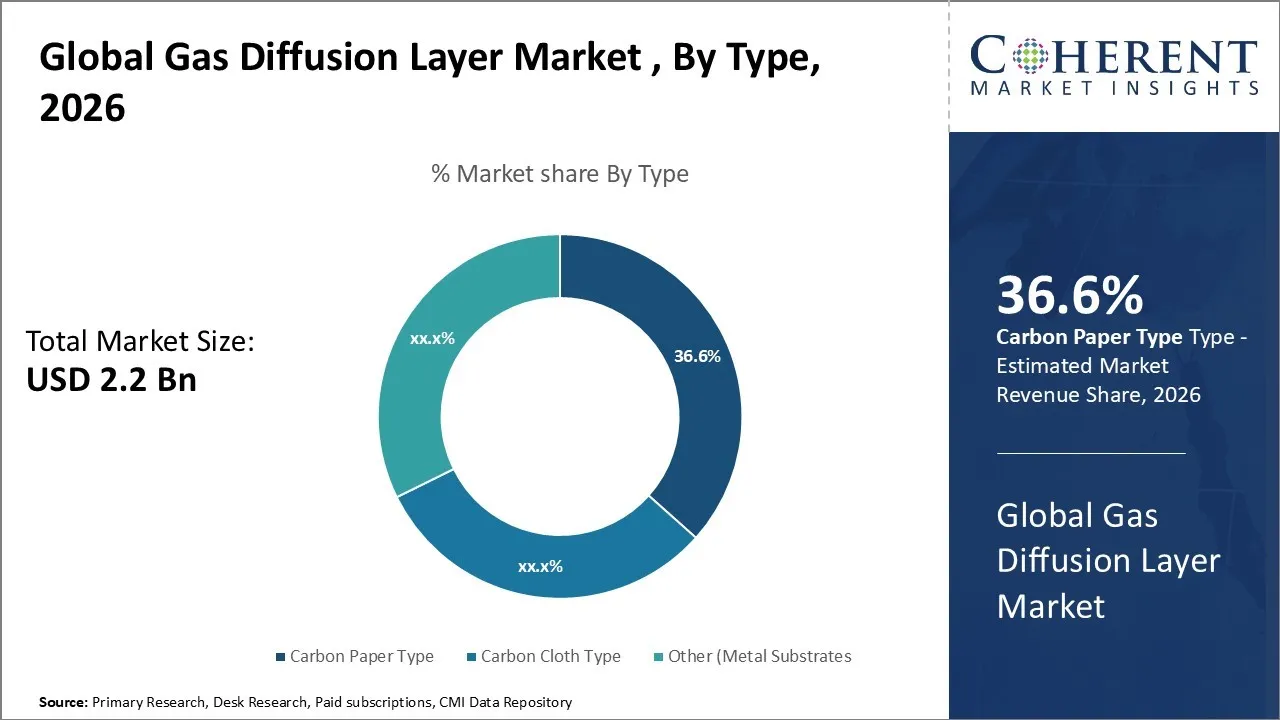
- By Type, Carbon Paper Type hold the largest market share of 36.6% in 2026 owing to its rising fuel cell adoption.
- By Application, Polymer Electrolyte Fuel Cells expected to hold largest market share of 42.2% in 2026 owing to the global clean energy transition & decarbonization.
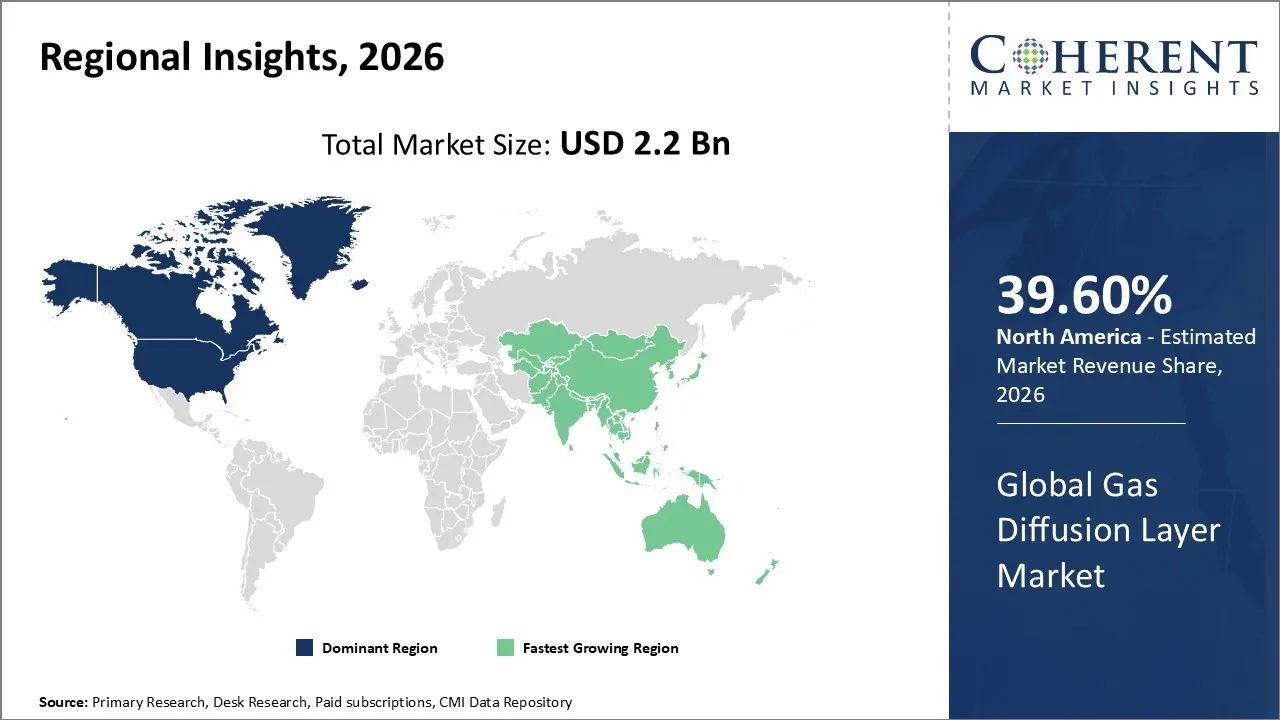
- By Region, North America dominates the overall market with an estimated share of 39.60% in 2026 owing to the advanced R&D and innovation capabilities.
Market Overview
The Gas Diffusion Layer (GDL) market is growing steadily as industries increasingly adopt hydrogen fuel cells and clean energy technologies. Manufacturers use GDLs as essential components in proton exchange membrane fuel cells and electrolyzers to ensure efficient gas distribution, electrical conductivity, and effective water management. Expanding deployment of fuel cell electric vehicles, stationary power systems, and green hydrogen projects continues to drive demand. Ongoing advancements in carbon paper and carbon cloth materials, supported by favorable government policies and infrastructure investments, further boost demand across automotive, energy, and industrial sectors.
Current Events and their Impact on the Gas Diffusion Layer Market
Current Events | Description and its impact |
Macro-level Technological Advancements in Fuel Cell Technology |
|
Regional Government Policies and Incentives |
|
Geopolitical and Trade Tensions Affecting Key Markets |
|
Segmental Insights
- Current Industry Events of 2026
- Market Size Estimation
- Regional Breakdown
- Competitive Landscape
- Customer Intelligence
- Segmental Analysis
- Pricing Analysis
- Key Market Drivers, Challenges & Future Trends
- Customized Insights Section
Gas Diffusion Layer Market Insights, By Type - Carbon Paper Type contribute the highest share of the market owing to its expanding applications beyond fuel cells
Carbon Paper Type hold the largest market share of 36.6% in 2026. Manufacturers are increasingly adopting carbon paper type gas diffusion layers because they provide superior electrical conductivity, lightweight design, and uniform porosity that improve fuel cell efficiency and durability. Engineers prefer their thin profile and strong mechanical stability for automotive fuel cell stacks and compact energy systems. The growing commercialization of hydrogen fuel cell vehicles and electrolyzers is accelerating their use. Ongoing material innovations, enhanced hydrophobic treatments, and scalable production technologies continue to reinforce the preference for carbon paper in advanced fuel cell applications.
Gas Diffusion Layer Market Insights, By Application - Polymer Electrolyte Fuel Cells contribute the highest share of the market owing to its expansion of hydrogen infrastructure
Polymer Electrolyte Fuel Cells expected to hold largest market share of 42.2% in 2026. Polymer Electrolyte Fuel Cells significantly contribute to the growth of the Gas Diffusion Layer market as industries deploy them across transportation, backup power, and distributed energy systems. Their high-power density, rapid start-up capability, and low operating temperature require efficient gas diffusion layers to manage reactant flow and water balance effectively. Expanding hydrogen infrastructure and increasing investments in zero-emission mobility continue to accelerate adoption. Ongoing advancements in membrane and stack design further raise performance standards, driving demand for advanced GDL materials designed for PEM fuel cell applications.
In January 2026, Nimbus Power Systems announced that its advanced, gravity-independent fuel cell technology successfully passed shock and vibration tests simulating launch conditions for NASA’s upcoming Artemis lunar missions.
Regional Insights
North America Gas Diffusion Layer Market Trends
North America dominates the overall market with an estimated share of 39.60% in 2026. The North America Gas Diffusion Layer market is gaining momentum as companies expand hydrogen projects and commercialize fuel cell technologies. Manufacturers are investing in domestic production and localizing supply chains to strengthen regional output. Industry players are developing advanced carbon paper and coated GDL solutions to enhance durability and performance in automotive and stationary applications. Research institutions and private firms are collaborating to accelerate innovation, while government-backed clean energy policies actively promote the integration of fuel cells across transportation and power generation sectors. For instance, in February 2026, Gen 2 Carbon and Americarb formed a strategic partnership to develop and commercialize recycled carbon fiber (rCF) materials for clean energy, converting waste carbon fiber into high-performance products that advance the global shift toward a circular, net-zero economy.
Asia Pacific Gas Diffusion Layer Market Trends
The Asia Pacific Gas Diffusion Layer market is growing rapidly as governments and industries actively invest in hydrogen infrastructure and fuel cell technologies. Manufacturers are producing high-performance carbon paper and carbon cloth GDLs to satisfy the needs of automotive fuel cells and stationary power systems. Technology providers and research institutes are collaborating strategically to drive innovation and speed up commercialization. Supportive policies, expanding clean energy initiatives, and increasing adoption of fuel cell vehicles are collectively boosting market growth throughout the Asia Pacific region.
United States Gas Diffusion Layer Market Trends
The United States Gas Diffusion Layer market is growing as the country actively invests in hydrogen production and fuel cell deployment. Automotive manufacturers are incorporating high-performance carbon paper and coated GDLs into fuel cell vehicles, while stationary power providers are using them to ensure reliable backup and distributed energy solutions. Research institutions and private companies are collaborating to improve material efficiency and durability. Government incentives and clean energy programs are promoting broader fuel cell adoption, driving innovation and boosting market expansion across the United States.
India Gas Diffusion Layer Market Trends
The India Gas Diffusion Layer market is expanding as the country actively invests in hydrogen energy and fuel cell technologies. Manufacturers are producing advanced carbon paper and carbon cloth GDLs to serve automotive fuel cells, stationary power systems, and new green hydrogen projects. Industry players and research institutions are collaborating to accelerate innovation and enhance product performance. Government initiatives, renewable energy policies, and rising interest in clean mobility are collectively boosting the adoption of GDL solutions across India’s transportation and energy sectors.
End-user Feedback and Unmet Needs in the Gas Diffusion Layer Market
- Durability and Longevity Challenges: End-users report that current GDL materials, especially under high humidity and temperature cycles, degrade faster than expected. Prolonged operation can cause cracks, delamination, or performance drop in fuel cells. Users seek more robust carbon paper and carbon cloth solutions that maintain conductivity, porosity, and hydrophobicity over extended lifetimes without frequent replacement.
- Water Management Limitations: Many fuel cell operators note issues with uneven water distribution and flooding within the GDL. Inefficient water management reduces fuel cell efficiency and causes localized drying or accumulation. End-users require advanced GDL designs with improved microporous layers, tailored porosity, and hydrophobic coatings to optimize water transport and maintain consistent performance.
- Performance under High Load Conditions: Operators face challenges when fuel cells operate at high current densities or under fluctuating loads. GDLs sometimes fail to maintain uniform gas distribution, limiting performance. End-users are requesting GDLs with higher mechanical stability, better gas diffusion characteristics, and consistent electrical conductivity to sustain peak operations without degradation.
Gas Diffusion Layer Market Trend
Rising Adoption of Hydrogen Fuel Cells
The increasing use of hydrogen fuel cells in automotive, stationary, and portable applications is driving GDL demand. Manufacturers focus on materials like carbon paper and carbon cloth to improve conductivity, gas transport, and water management. Expansion in hydrogen infrastructure and growing interest in zero-emission mobility solutions are further accelerating fuel cell integration, prompting GDL producers to develop high-performance, durable, and scalable solutions for diverse industrial and energy applications.
Technological Advancements in GDL Materials
Innovations in carbon-based GDLs, including microporous layers, hydrophobic coatings, and advanced composites, are enhancing fuel cell efficiency and reliability. Companies are optimizing porosity, thickness, and conductivity to meet evolving application requirements. Research collaborations between academic institutions and industry players are driving the development of next-generation GDLs that balance performance, durability, and cost-effectiveness, catering to automotive, stationary, and emerging green hydrogen sectors.
Gas Diffusion Layer Market Opportunity
Expansion of Hydrogen Fuel Cell Vehicles
The growing adoption of hydrogen fuel cell vehicles presents a major opportunity for GDL manufacturers. Automotive OEMs require high-performance carbon paper and carbon cloth GDLs to improve fuel cell efficiency, durability, and water management. Suppliers can capitalize on this trend by developing lightweight, scalable, and robust GDL solutions tailored for varying vehicle types, including buses, trucks, and passenger cars, while supporting the global push toward zero-emission transportation and sustainable mobility initiatives.
Market Report Scope
Gas Diffusion Layer Market Report Coverage
| Report Coverage | Details | ||
|---|---|---|---|
| Base Year: | 2025 | Market Size in 2026: | USD 2.2 Bn |
| Historical Data for: | 2020 To 2024 | Forecast Period: | 2026 To 2033 |
| Forecast Period 2026 to 2033 CAGR: | 24.3% | 2033 Value Projection: | USD 17.6 Bn |
| Geographies covered: |
| ||
| Segments covered: |
| ||
| Companies covered: | AvCarb Llc., Caplinq Corporation, Freudenberg Group, Fuel Cells Etc., Mitsubishi Chemical Corporation, Mott Corporation, SGL Carbon, Technical Fibre Products, Toray Industries, Inc., and GKD Gebr. Kufferath AG. | ||
| Growth Drivers: |
| ||
| Restraints & Challenges: |
| ||
Gas Diffusion Layer Market News
- In September 2025, Gen 2 Carbon and Americarb announced a strategic partnership to advance the development and commercialization of recycled carbon fiber (rCF) materials for clean energy applications. This transatlantic collaboration focuses on converting carbon fiber waste into high-performance products that support the shift toward a circular, net-zero economy.
Analyst Opinion (Expert Opinion)
- Expert consensus indicates that the Gas Diffusion Layer (GDL) market is uniquely positioned at the intersection of material science and clean energy deployment, yet its trajectory reflects nuanced pressures beyond simple demand growth. Data from recent industry analyses show that carbon‑based GDLs account for a dominant share of installations, driven by stringent performance thresholds for conductivity and water management in PEM fuel cells, validated by over 300 independent experimental data points showing substantive gains in permeability and strength with newer formulations.
- However, manufacturing realities constrain broader adoption. High‑temperature, multi‑stage processes and reliance on specialized carbon fiber inputs contribute disproportionately to stack costs and result in significant production complexity, often accounting for nearly a third of total fuel cell stack expenses. These pressures are compounded by supply chain vulnerabilities, as fewer than five producers dominate critical precursor outputs, creating bottlenecks that ripple through GDL supply.
- Regionally, Asia‑Pacific’s concentration of stack manufacturing and OEM programs underscores a competitive imbalance; markets with less developed hydrogen infrastructure lag in uptake, limiting global equilibrium. Consequently, while performance improvements and innovations in hybrid GDL materials are noteworthy, true commercial scalability will be dictated by breakthroughs that reduce production cost pressures and standardize quality across geographies, rather than by demand forecasts alone.
Speak to the analyst
Want personalized insights?
Take the findings above to one of our principal consultants, or have the report rebuilt around the segments, geographies and competitors you actually track.
Market Segmentation
- By Type
- Carbon Paper Type
- Carbon Cloth Type
- Other (Metal Substrates)
- By Application
- Polymer Electrolyte Fuel Cells
- Hydrogen /Oxygen Air Fuel Cells
- Direct Methanol Fuel Cells
- Others
- By Regional Insights
- North America
- U.S.
- Canada
- Latin America
- Brazil
- Argentina
- Mexico
- Rest of Latin America
- Europe
- Germany
- U.K.
- Spain
- France
- Italy
- Russia
- Rest of Europe
- Asia Pacific
- China
- India
- Japan
- Australia
- South Korea
- ASEAN
- Rest of Asia Pacific
- Middle East
- GCC Countries
- Israel
- Rest of Middle East
- Africa
- South Africa
- North Africa
- Central Africa
- North America
- Key Players Insights
- AvCarb Llc.
- Caplinq Corporation
- Freudenberg Group
- Fuel Cells Etc.
- Mitsubishi Chemical Corporation
- Mott Corporation
- SGL Carbon
- Technical Fibre Products
- Toray Industries, Inc.
- GKD Gebr. Kufferath AG.
Sources
Primary Research interviews
- Fuel cell stack manufacturers
- Automotive OEMs deploying fuel cell vehicles
- Stationary power solution providers
- Electrolyzer and green hydrogen technology developers
- Materials scientists and engineers specializing in carbon paper and carbon cloth
Databases
- Scopus
- Web of Science
- IEEE Xplore
- SpringerLink
- ScienceDirect
Magazines
- Hydrogen Fuel News
- Fuel Cell Today
- Electrochemical Energy Review
- Clean Energy Review
Journals
- Journal of Power Sources
- International Journal of Hydrogen Energy
- Electrochimica Acta
- Renewable & Sustainable Energy Reviews
- Journal of Materials Science
Newspapers
- The Wall Street Journal – Energy & Technology Section
- Financial Times – Energy & Sustainability Coverage
- The Hindu Business Line – Renewable Energy Section
- Nikkei Asia – Energy & Automotive Focus
Associations
- Fuel Cell and Hydrogen Energy Association (FCHEA)
- International Partnership for Hydrogen and Fuel Cells in the Economy (IPHE)
- European Fuel Cells and Hydrogen Joint Undertaking (FCH JU)
- Hydrogen Council
Public Domain sources
- U.S. Department of Energy (DOE) Hydrogen & Fuel Cells Program Reports
- International Energy Agency (IEA) Hydrogen Reports
- National Renewable Energy Laboratory (NREL) Publications
- European Commission Clean Energy & Hydrogen Policy Documents
Proprietary Elements
- CMI Data Analytics Tool
- Proprietary CMI Existing Repository of information for last 8 years
Get access to 250+ pages report
Every segment, forecast, competitor profile and data table behind the analysis above — available for instant download.
- ESOMAR Member
- ISO 9001:2015 Certified
- D-U-N-S Registered
- GDPR & CCPA Compliant
Missing comfort of reading report in your local language? Find your preferred language:
Transform your Strategy with Exclusive Trending Reports
Frequently Asked Questions
Global gas diffusion layer market was valued at around USD 17.6 Bn in 2033.
Increasing awareness regarding harmful effects of greenhouse gases and promotional activities undertaken by statutory governing bodies is projected to propel the overall product demand during the forecast period
Increasing awareness regarding harmful effects of greenhouse gases and promotional activities undertaken by statutory governing bodies is projected to propel the overall product demand during the forecast period.
High cost associated with gas diffusion layer is anticipated to restrain the market growth in the coming years.
Major players operating in the market include AvCarb Llc., Caplinq Corporation, Freudenberg Group, Fuel Cells Etc., Mitsubishi Chemical Corporation, Mott Corporation, SGL Carbon, Technical Fibre Products, Toray Industries, Inc., and GKD Gebr. Kufferath AG
The market is estimated to grow at around 24.3% CAGR in the forecast period.