

Global Glyphosate Market Size and Forecast – 2026 To 2033
The Global Glyphosate Market is estimated to be valued at USD 8.95 Bn in 2026 and is expected to reach USD 11.46 Bn by 2033, exhibiting a compound annual growth rate (CAGR) of 3.6% from 2026 to 2033. The continued expansion of herbicide-tolerant GM crop cultivation remains a key demand driver for the global glyphosate market, as glyphosate is widely used in weed-control programs for GM soybean, maize, cotton, and canola. This supports steady market growth, particularly outside the European Union, where biotech crop adoption remains comparatively limited due to stricter regulatory controls. According to ISAAA, global biotech crop adoption reached 191.7 million hectares in 2018, while herbicide tolerance remained the leading biotech trait, particularly across soybean, canola, maize, alfalfa, and cotton crops. (Source: ISAAA)
Key Takeaways of the Global Glyphosate Market
- The agricultural segment is expected to hold 84.5 % share of the glyphosate market in 2026, driven by rising global food demand and the need for efficient weed control to improve crop productivity. Glyphosate is widely used in agriculture to control broadleaf weeds and grasses, especially in pre-plant burndown and post-emergence weed-management practices across major row and field crops. Agriculture remains the largest application area for glyphosate, with the segment accounting for over 83% of the market in 2023, highlighting its key role in modern crop-protection systems.
- GM crops are expected to hold 72.1 % share of the glyphosate market in 2026, as glyphosate-resistant soybean, maize, and cotton allow farmers to control weeds without damaging the crop. The expansion of GM crop cultivation further supports glyphosate demand, with global GM crop acreage rising to 209.8 million hectares in 2024 from 191.7 million hectares in 2018.
- Solid segment is expected to hold 78.5 % share of the market in 2026, as solid formulations offer easier storage, lower spillage risk, and better handling during rural distribution. Products in granule, water-soluble granule, water-dispersible granule, and dry-flowable forms are preferred in areas with challenging logistics and varying climatic conditions. Examples of herbicides sold in the solid form include Roundup PowerMax dry granular glyphosate, Roundup QuikPRO granular herbicide, Cropstar Glyphosate 680 water-soluble granule, Sencor 750 WG herbicide, and Prism SG herbicide.
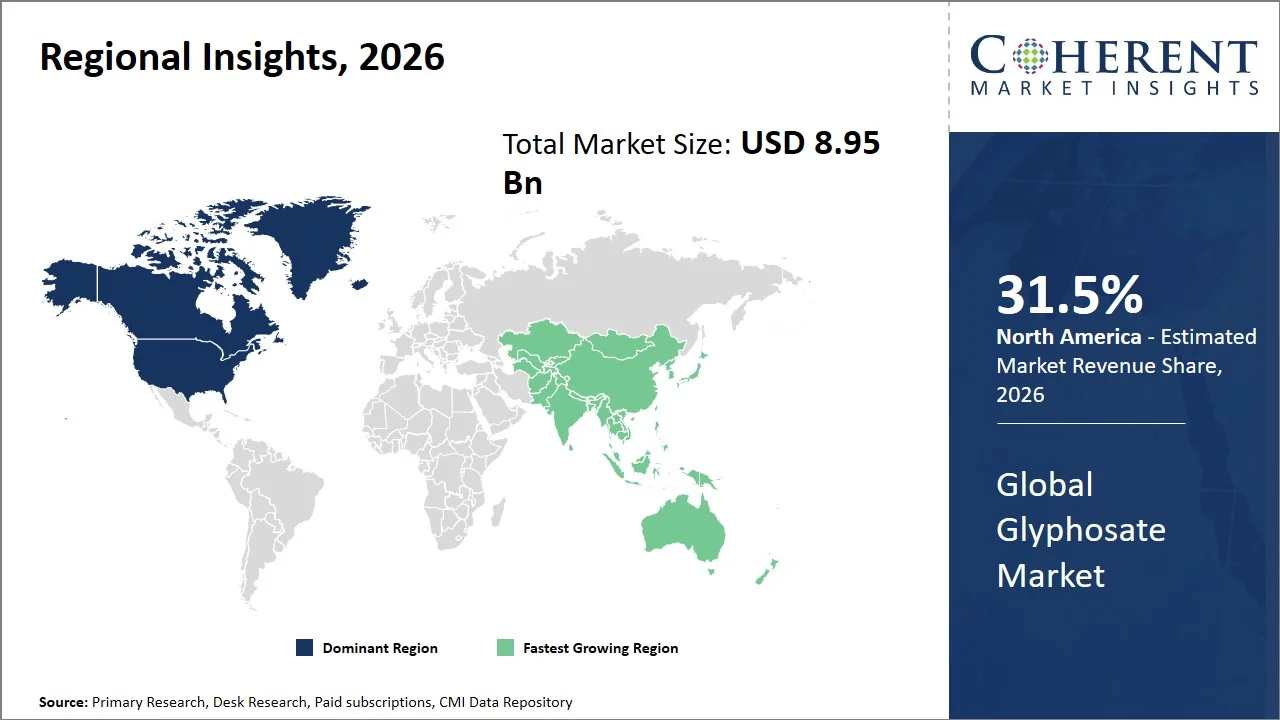
- North America leads the global glyphosate market with an estimated 31.5 % share in 2026, driven by widespread herbicide-tolerant crop cultivation and no-till farming. USDA ERS reported that over 90% of U.S. soybean, corn, and cotton acres were planted with genetically engineered seeds in 2024, supporting strong herbicide demand. Popular herbicide brands include Roundup PowerMAX 3, Credit Xtreme, Enlist Duo, and Liberty ULTRA. (Source: USDA)
- Asia Pacific is anticipated to witness the highest growth, with an estimated market share of 19.3 % in 2026, driven by intensive agriculture, modernization of farming practices, and food security concerns in populous countries such as China and India. For instance, China approved additional GM soybean, corn, and cotton varieties in December 2024 to improve yields and strengthen food security, supporting wider adoption of modern crop-protection systems. In Oceania, Australia’s APVMA notes that glyphosate is widely used in agriculture and no-till cropping to control weeds before planting, helping reduce soil erosion compared to traditional ploughing.
- Conservation Agriculture Alignment: Glyphosate-based herbicides are increasingly supporting conservation tillage and no-till farming practices by enabling effective weed control with reduced soil disturbance.
- Market Expansion Catalysts: Rising adoption of glyphosate-tolerant GM crops, expanding large-scale sustainable farming, and the need for cost-effective weed management are propelling glyphosate market growth.
Segmental Insights
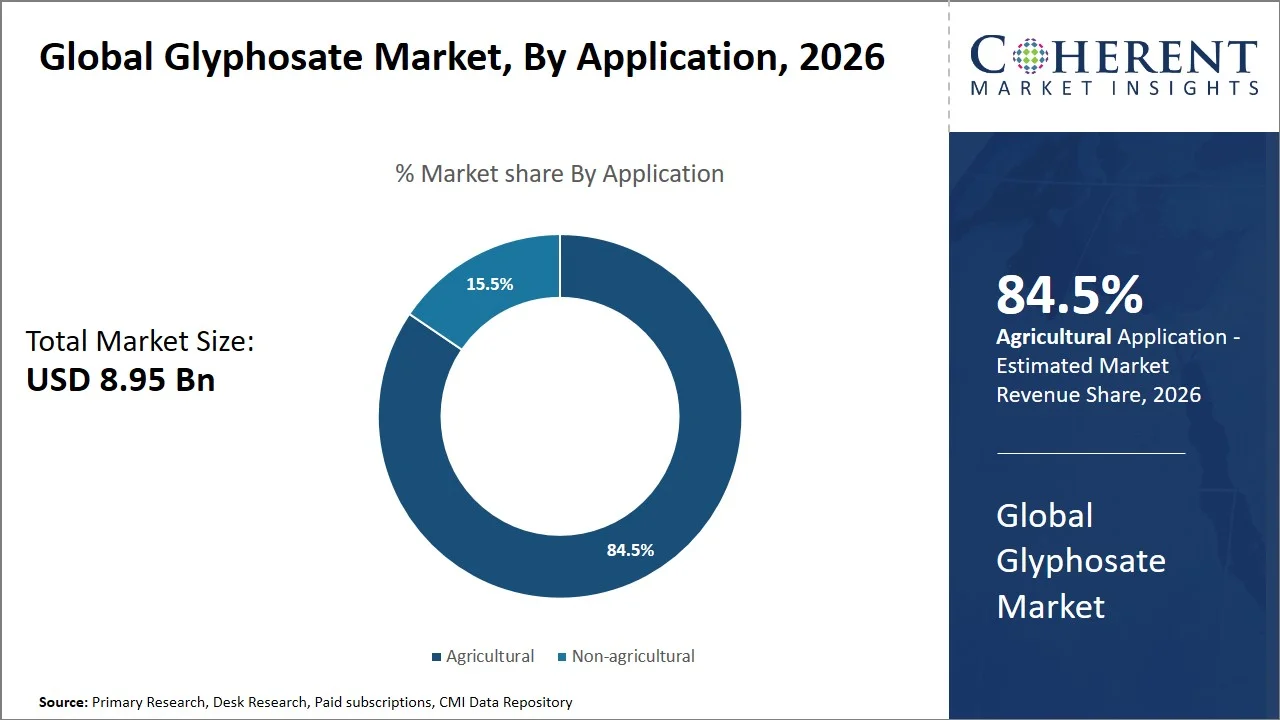
Why Does the Agricultural Segment Dominate the Glyphosate Market?
The agricultural segment is expected to account for 84.5% of the global glyphosate market in 2026, as it is vital for ensuring good weed control over various crops. Glyphosate's ability to kill a wide range of different weeds means that farmers can now manage weeds which are competing for nutrients, water, and sunlight directly on crop yields and overall farm productivity. Brazil-based studies show that glyphosate supports effective weed management in soybean and sugarcane systems by reducing early-season weed competition and improving field operations.
For instance, a Brazilian soybean field study conducted across nine locations during the 2009/2010 and 2010/2011 seasons found that pre-emergence residual herbicides followed by post-emergence glyphosate provided consistent weed control and reduced early weed competition. In sugarcane, Brazilian research also highlights glyphosate’s use for weed control, ratoon eradication, and crop ripening, supporting productivity and operational efficiency.
- Current Industry Events of 2026
- Market Size Estimation
- Regional Breakdown
- Competitive Landscape
- Customer Intelligence
- Segmental Analysis
- Pricing Analysis
- Key Market Drivers, Challenges & Future Trends
- Customized Insights Section
Why is the Adoption of GM Crops Rising in the Glyphosate Market?
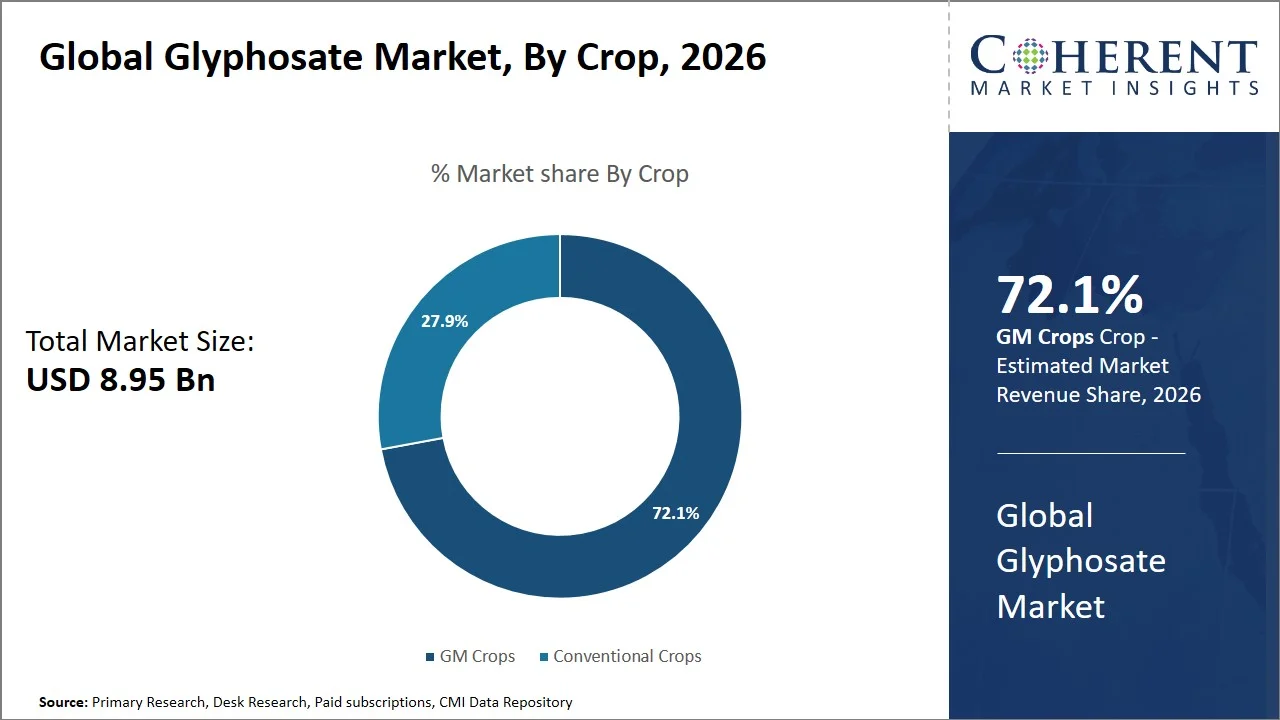
GM crops are expected to hold 72.1% share of the market in 2026 due to their engineered herbicide tolerance traits. GM crops are genetically modified to tolerate glyphosate application, without causing crop damage. This has enabled farmers to spray herbicides directly over the top of the crop, to control weeds efficiently, making weed control easier and less burdensome.
For example, the adoption of genetically modified herbicide-tolerant crops improves operational efficiency by enabling easier weed control, reducing repeated field interventions, and lowering labor and application costs. For instance, USDA ERS reported that herbicide-tolerant soybean acreage in the U.S. reached 96% in 2024, highlighting the strong adoption of GM crops in large-scale weed management.(Source: USDA)
Solid Segment Dominates the Glyphosate Market
Solid segment is expected to hold 78.5% share of the market in 2026, primarily due to its stability, ease of transport, and cost-effectiveness. Compared to liquid formulations, solid products, such as granules and powder, have a longer shelf life, improving logistic efficiency and the risk of spoilage during storage and distribution. They enable farmers and applicators to precisely apply the right amount for the right pressure and field size, which lowers the cost of the inputs used and minimizes chemical losses. Solids may have a longer shelf life than liquids. The USDA and FAO reports stress that solid glyphosate will last for more than 5 years with proper storage, thus making it suitable for remote distribution.
Currents Events and their Impact
Current Events | Description and its Impact |
Regulatory Scrutiny and Legal Cases |
|
Expansion of GM Herbicide-Tolerant Crops |
|
Glyphosate Market Dynamics
Market Drivers
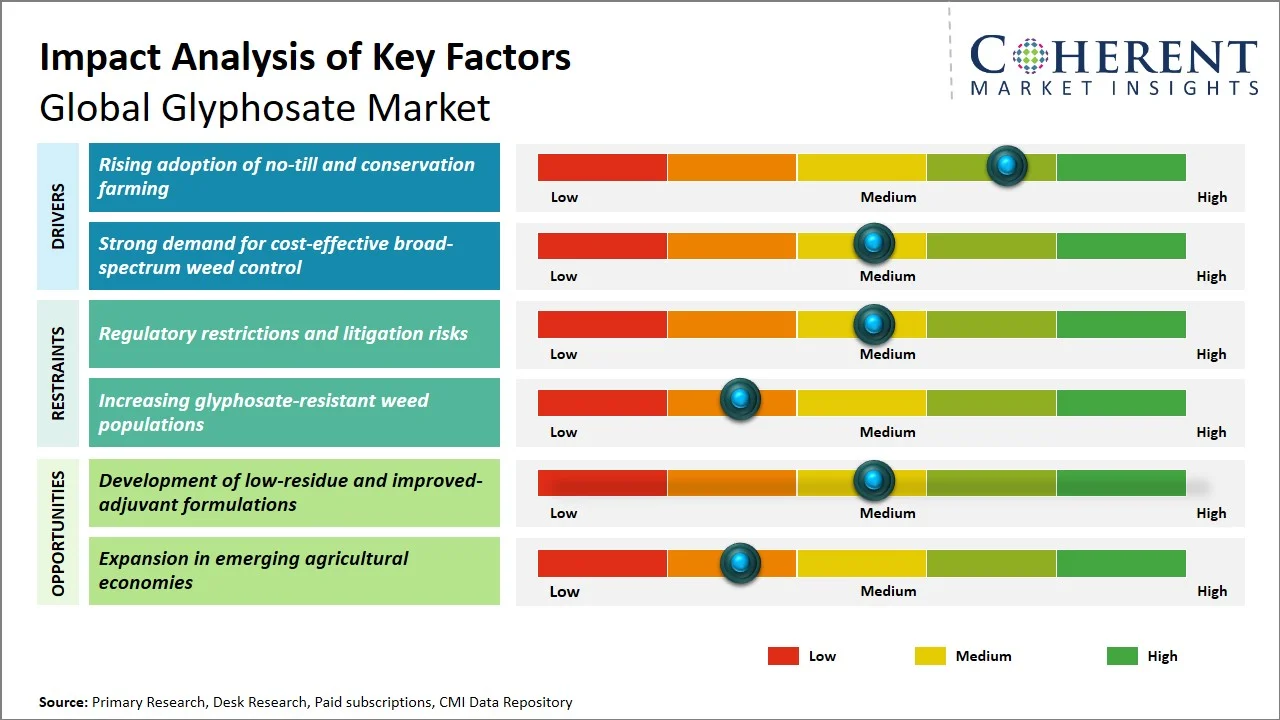
- Rising Adoption of No-Till and Conservation Farming Practices: No-till and conservation farming are increasingly popular sustainable agricultural practices, and as this trend grows in many parts of the world, the demand for glyphosate is expected to increase. For no-till systems that require less tillage than plowed systems, weed control is a critical factor in this practice because competition for nutrients and water from weeds can be a serious problem. Glyphosate’s broad-spectrum weed-control capability has made it a valuable solution for farmers, enabling effective weed management while allowing the adoption of conservation tillage methods that reduce soil disturbance and help preserve soil structure. According to USDA ERS data, the percentage of wheat in no-till/reduced till has grown from 21% in 1998 to 69% in 2022. Glyphosate-tolerant crops are important enablers for the success of no-till, as these crops enable farmers to control weeds with herbicides rather than tillage. (Source: USDA)
- Strong Demand for Cost‑Effective Broad‑Spectrum Weed Control: The primary agricultural drivers boosting glyphosate demand globally is its ability to deliver broad‑spectrum weed control at relatively low cost, especially compared with alternative herbicides and mechanical weed management. Weeds fight for the same resources as crops, including sunlight, nutrients, moisture and space and when not properly managed can cause yield losses of 10% or more in many cropping systems. A comprehensive weed management approach which addresses a wide spectrum of weed species assists farmers in maintaining good crop yields and controlling production costs. Glyphosate has been shown to be cost beneficial when combined with the adoption of glyphosate resistant crops; for instance, U.S. glyphosate resistant maize, soybean, cotton, and sugarbeet growers have saved more than USD 1.2 billion in the cost of conventional herbicide purchases, applications, tillage and manual weeding compared to conventional farming methods over the past decade. (Source: National Library of Medicine)
Emerging Trends
- Advanced Formulations and Specialty Blends: Salt formulations, water-dispersible granules, and tank-mix compatible blends are emerging in glyphosate products, offering benefits in terms of efficacy, improved weed control, and crop safety to boost adoption in a variety of agricultural sectors.
- Sustainability and Regulatory Alignment: Increasing environmental focus and global regulatory review of glyphosate products are leading to the development of low-residue, eco-friendly and precision-application glyphosate products. In response to farmer and regulatory expectations, companies are innovating how they apply the product, in the biodegradable adjuvants they use, and how to use the product more efficiently to achieve yield.
Regional Insights
Why is North America a Strong Market for Glyphosate?
North America leads the global glyphosate market, accounting for an estimated 31.5% share in 2026. The region also has high levels of mechanized farms and large-scale crop production, especially for corn, soybeans and cotton, that rely on frequent weed management. These are the main crops that are commonly sprayed with glyphosate. For example, the USDA reports that more than 90% of U.S. soybean acres were planted in glyphosate-tolerant varieties in 2024, reflecting the high uptake of glyphosate in the U.S. (Source: USDA)
Why Does the Asia Pacific Glyphosate Market Exhibit High Growth?
Asia Pacific is anticipated to witness the highest growth, with an estimated market share of 19.3% in 2026, which can be attributed to the growing agricultural activities and increasing food demand owing to the increasing population and modernization in agriculture practices. Population growth in China and India has been rapid and has created the demand for staple crops, while farmers are using more efficient crop production inputs, such as herbicides, to get more crops out of the land.
In 2026, China’s population is expected to be around 1.41 billion, making it the second most populous country in the world. At that time, the population of India is approximately 1.47 billion, making it the most populous country in the world. Indian and Chinese governments encourage mechanization, high-yield seeds, and IPM, which leads to more glyphosate use. For instance, the Ministry of Agriculture in China is encouraging precision farming, with the use of glyphosate-based herbicides on soya beans and corn cultivation.
Global Glyphosate Market Outlook for Key Countries
Why is the U.S. Leading Innovation and Adoption in the Glyphosate Market?
The U.S. glyphosate market has an established high regulatory compliance and a high level of adoption of staple crops. Companies such as Corteva Agriscience and Bayer are the ones that dominate, with integrated herbicide solutions and digital agriculture technologies being used to optimize the use of glyphosate. U.S. regulatory agencies aim to balance product safety with agricultural productivity by setting EPA-approved guidelines for glyphosate use. This is significant because more than 90% of soybeans grown in the U.S. are glyphosate-tolerant, making clear regulatory guidance important for large-scale weed management. (Source: Environmental Protection Agency)
Is China Emerging as a Key Growth Hub for the Glyphosate Market?
Government encouragement for modern farming methods and the increased demand for food and cash crops drive the market expansion in the country of China. China's regulatory regime is tough, but steadily conforms with international standards, which will drive the development of improved glyphosate variants. Supportive trade and industrial policies in Asia Pacific, such as import-duty adjustments, export incentives/rebates, domestic manufacturing support, and regional trade facilitation measures, are encouraging local agrochemical production and strengthening intra-regional exports.
In parallel, national-level precision agriculture initiatives are improving the adoption of advanced crop-protection practices. These benefits leading domestic producers such as SinoHarvest and Shandong Huanong, which are well-positioned to serve both domestic demand and export.
Is Brazil a Favorable Market for Glyphosate?
Brazil is an important market in which glyphosate is vital to large soy and sugarcane production. The country's climate and its great amount of arable land promote the use of glyphosate in weed management practices. Established players such as FMC Corporation and Bayer have solid positions in operations and provide a range of glyphosate-based herbicide products to meet regional crop requirements. Environmental monitoring still plays a role in market dynamics and government policies support agrochemical applications for increased productivity.
Why Does India Top the Asia Pacific Glyphosate Market?
The India glyphosate market benefits from increasing awareness and adoption of glyphosate-based weed management practices across diverse agricultural zones. Glyphosate use also varies according to government initiatives to increase input efficiency in the agricultural sector and to promote sustainability India’s glyphosate market is witnessing rising regulatory scrutiny, with greater focus on safe handling, approved usage, and environmental impact. This is driving product innovation and compliance-led growth. Domestic players such as Parijat Industries and Rallis India remain important in the market, alongside international giants such as Bayer CropScience, Syngenta, BASF, and Corteva Agriscience. (Source: Bayer AG)
How are Low-Residue Glyphosate Formulations Creating New Growth Opportunities in the Glyphosate Market?
The global glyphosate market presents a significant opportunity through the development of low-residue and improved-adjuvant formulations, addressing rising consumer and regulatory demands for safer and more sustainable agricultural practices. Traditional glyphosate applications often leave residues on crops, leading to growing concerns about environmental impact and human health risks, which in turn pressures manufacturers to innovate formulations that minimize residue levels. Advancements in adjuvant technology—substances added to herbicide formulations to enhance efficacy—can improve the performance of glyphosate by increasing its bioavailability, optimizing leaf surface coverage, and enhancing absorption, thus enabling lower dosages without compromising weed control effectiveness.
Macro and Micro Economic Factors Impacting the Glyphosate Market
Factor Type | Economic Factor | Impact on Glyphosate Market Growth |
Macro | Rising Global Food Demand | Growing population and food consumption increase the need for higher crop yield, supporting glyphosate demand for effective weed control in cereals, oilseeds, pulses, and cash crops |
Macro | Expansion of Commercial Farming | Large-scale farming in countries such as the U.S., Brazil, Argentina, India, and Australia supports higher use of herbicides, as farmers require cost-efficient weed management solutions |
Micro | Adoption of GM Herbicide-Tolerant Crops | Wider cultivation of glyphosate-tolerant soybean, maize, cotton, and canola increases glyphosate consumption, especially in mechanized farming systems |
Market Players, Key Development, and Competitive Intelligence
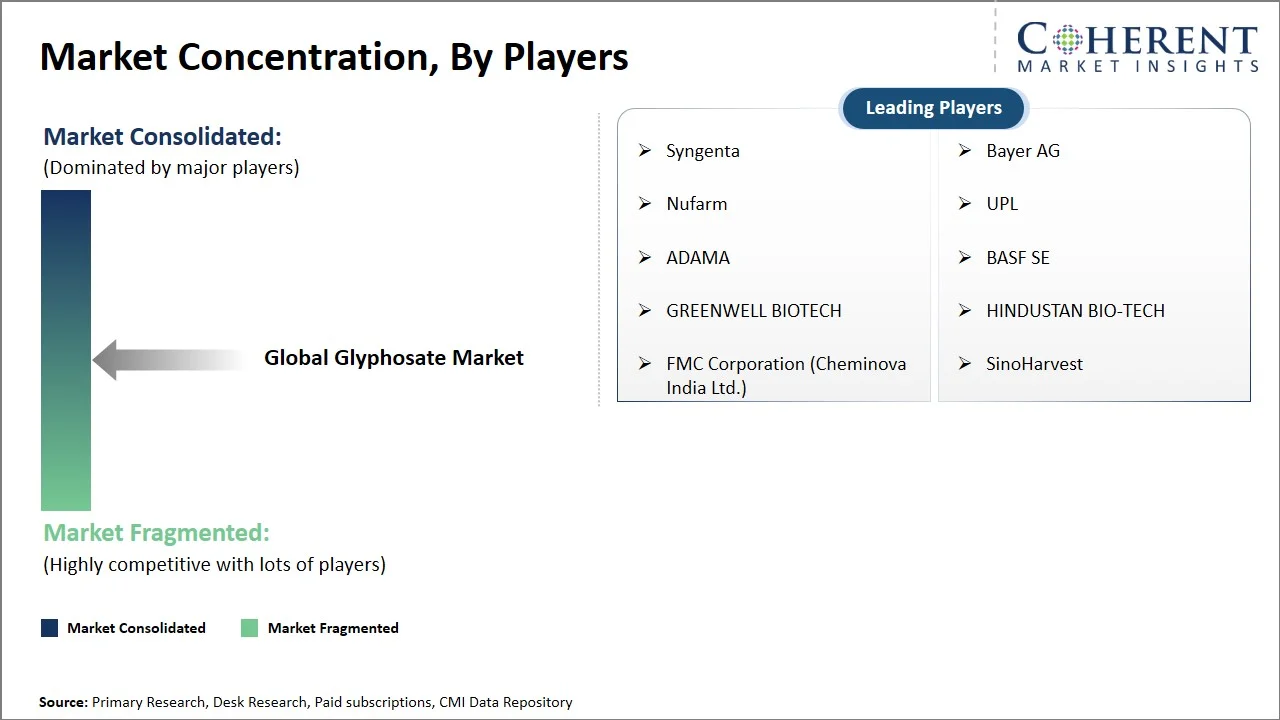
Key Developments
- In March 2023, Albaugh, LLC acquired Corteva Agriscience's glyphosate business. This acquisition includes intangible assets such as formulations, trade names, regulatory data, registrations, patents, and know-how used worldwide in Corteva's straight-goods glyphosate business, except in Argentina.
- In August 2022, Bayer launched a glyphosate herbicide, Roundup Top, in Argentina. It is specifically for the pre-emergent and post-emergent control of annual and perennial weeds on grasses and broadleaf.
Competitive Landscape
The market is very competitive, and there are significant market demands for glyphosate from large scale agriculture and weed control programmes as well as cost-effective herbicide solutions. The existing agrochemical companies compete on the basis of brand name, regulatory factors, formulation quality, and global distribution and the regional and generic manufacturers are competing primarily based on price, bulk supply and local availability. The main focus areas will be:
- High performance and cost effective herbicide formulations
- Diversification of products, including glyphosate salts, blends and tank mix products
- Good distribution networks in agricultural, industrial and non-crop applications
- Regulatory compliance, residue management, and product positioning for sustainability
Market Report Scope
Glyphosate Market Report Coverage
| Report Coverage | Details | ||
|---|---|---|---|
| Base Year: | 2025 | Market Size in 2026: | USD 8.95 Bn |
| Historical Data for: | 2020 To 2024 | Forecast Period: | 2026 To 2033 |
| Forecast Period 2026 to 2033 CAGR: | 3.6% | 2033 Value Projection: | USD 11.46 Bn |
| Geographies covered: |
| ||
| Segments covered: |
| ||
| Companies covered: | Syngenta, Bayer AG, Nufarm, UPL, ADAMA, BASF SE, GREENWELL BIOTECH, HINDUSTAN BIO-TECH, FMC Corporation (Cheminova India Ltd.), and SinoHarvest | ||
| Growth Drivers: |
| ||
| Restraints & Challenges: |
| ||
Analyst Opinion (Expert Opinion)
- The glyphosate market will witness steady growth in the coming 5–7 years with the continual global demand for staple crops and the rising use of modern weed management methods. Innovations in formulation, precision application technologies, and integrated weed management will keep glyphosate in the crop protection toolbox, whereas regulatory pressure and sustainability issues will continue to increase.
- Asia Pacific, particularly India and China, is expected to offer strong growth opportunities for the glyphosate market due to extensive crop acreage, rising weed-control requirements, and increasing mechanization in agricultural practices. With limited herbicide penetration into the region's markets. In this, the rows for maize, soybean and cotton are the most scalable application segments. Disaggregated distribution networks and labor limited farms will result in disproportionate growth of solid formulations and pre-mixed ready-to-use granules. The adoption of these technologies is likely greater on medium-to-large sized commercial farms, but smallholder grouping via cooperatives is another opportunity to explore.
Speak to the analyst
Want personalized insights?
Take the findings above to one of our principal consultants, or have the report rebuilt around the segments, geographies and competitors you actually track.
Market Segmentation
- Application Insights (Revenue, USD Bn, 2021 - 2033)
- Agricultural
- Grains & Cereals
- Oilseeds & Pulses
- Fruits & Vegetables
- Others
- Non-agricultural
- Agricultural
- Crop Insights (Revenue, USD Bn, 2021 - 2033)
- GM Crops
- Conventional Crops
- Form Insights (Revenue, USD Bn, 2021 - 2033)
- Solid
- Liquid
- Regional Insights (Revenue, USD Bn, 2021 - 2033)
- North America
- U.S.
- Canada
- Latin America
- Brazil
- Argentina
- Mexico
- Rest of Latin America
- Europe
- Germany
- U.K.
- Spain
- France
- Italy
- Russia
- Rest of Europe
- Asia Pacific
- China
- India
- Japan
- Australia
- South Korea
- ASEAN
- Rest of Asia Pacific
- Middle East
- GCC Countries
- Israel
- Rest of Middle East
- Africa
- South Africa
- North Africa
- Central Africa
- North America
- Key Players Insights
- Syngenta
- Bayer AG
- Nufarm
- UPL
- ADAMA
- BASF SE
- GREENWELL BIOTECH
- HINDUSTAN BIO-TECH
- FMC Corporation (Cheminova India Ltd.)
- SinoHarvest
Sources
Primary Research Interviews
- Glyphosate manufacturers and formulators
- Agricultural supply chain directors at crop protection companies
- Distributor and agro-retail executives handling herbicides
- Farm input procurement managers and large farm operators
- Sustainability and regulatory affairs officers at agrochemical firms
Stakeholders
- Manufacturers of glyphosate and glyphosate-based formulations, such as Bayer, Syngenta, Corteva, Nufarm, and UPL
- End-use sectors: Row crop farmers, plantation growers, vineyards, orchards, and municipal/industrial vegetation management users
- Agricultural contractors and custom applicators
- Regulatory and certification bodies: EPA, EFSA, FAO/WHO JMPR, and national pesticide regulators.
- E-commerce platforms and distributors: Farm supply retailers, agricultural cooperatives, and distribution chains
- Technology integration players: Precision agriculture, application equipment, and crop protection formulation innovators
Databases
- FAOSTAT for crop acreage, production, and agricultural context
- UN Comtrade Database for herbicide and related chemical trade flows
- USITC DataWeb for US imports and exports of pesticide products
- Eurostat Trade Statistics for chemical and agricultural product trade
- India EXIM Database for glyphosate imports and exports
Magazines
- Agrow
- CropLife International publications
- Farm Progress
- Successful Farming
- Agri Business Global
Journals
- Pest Management Science
- Weed Science
- Weed Technology
- Journal of Agricultural and Food Chemistry
- Agronomy Journal
Newspapers
- The Wall Street Journal for agrochemical industry and farm input demand
- Business Standard for India-linked agricultural chemical trade
- Financial Times for global agrochemical market and M&A coverage
Associations
- CropLife International
- Weed Science Society of America (WSSA)
- International Survey of Herbicide Resistant Weeds
- FAO and WHO Joint Meeting on Pesticide Residues
- European Crop Protection Association (ECPA)
Public Domain Sources
- US Environmental Protection Agency pesticide registration and re-evaluation documents
- European Commission and EFSA glyphosate approval documents, including the current EU approval through December 15, 2033
- APVMA and other national regulator assessments, which summarize the status of glyphosate in multiple jurisdictions
Proprietary Elements
- CMI Data Analytics Tool, Proprietary CMI Existing Repository of information for last 10 years.
Get access to 250+ pages report
Every segment, forecast, competitor profile and data table behind the analysis above — available for instant download.
- ESOMAR Member
- ISO 9001:2015 Certified
- D-U-N-S Registered
- GDPR & CCPA Compliant
Missing comfort of reading report in your local language? Find your preferred language:
Transform your Strategy with Exclusive Trending Reports
Frequently Asked Questions
The global glyphosate market is estimated to be valued at USD 8.95 Bn in 2026 and is expected to reach USD 11.46 Bn by 2033.
Glyphosate is a broad-spectrum systemic herbicide widely used to control annual and perennial weeds in agriculture, horticulture, forestry, and non-crop applications.
Glyphosate supports reduced-tillage and no-till farming by helping control weeds without repeated mechanical cultivation, which may help preserve soil structure and reduce erosion. ISAAA highlights the compatibility of herbicide-tolerant crops with no-till practices.
The CAGR of the global glyphosate market is projected to be 3.6% from 2026 to 2033.
Rising adoption of no-till and conservation farming and strong demand for cost-effective broad-spectrum weed control are the major factors driving the growth of the global glyphosate market.
Regulatory restrictions and litigation risks and increasing glyphosate-resistant weed populations are the major factors hampering the growth of the global glyphosate market.
In terms of application, agricultural is estimated to dominate the market revenue share in 2026.