

Global Hair Brush Market Size and Forecast – 2026 To 2033
The Global Hair Brush Market is estimated to be valued at USD 4.62 Bn in 2026 and is expected to reach USD 6.81 Bn by 2033, growing at a compound annual growth rate (CAGR) of 5.7% from 2026 to 2033. Market expansion is supported by greater attention to structured hair-care routines, higher discretionary spending on grooming products, and product innovation addressing different hair textures, scalp-care needs, and styling requirements.
In March 2026, Kai Corporation launched five new hair-care brushes in Japan, including premium scalp-care and metal-pin variants featuring multi-level bristles, rounded designs, and specialized configurations for different hair lengths and grooming purposes, illustrating continued manufacturer investment in function-specific brush design.
Key Takeaways of the Global Hair Brush Market
- Paddle Brushes are estimated to expand at a 6.0% CAGR during 2026–2033 and capture 28.6% of the global hair brush market in 2026. Their broad surface supports detangling, smoothing, and blow-dry styling across multiple routines. In March 2026, Firstline Brands launched the Evolve Texas Heat Thermal Brush, a curved thermal paddle design with an ionic plate supporting even heat distribution and frizz control.
- Synthetic Bristles are projected to grow at an estimated 5.8% CAGR during 2026–2033 while representing 46.8% of the global hair brush market in 2026. Nylon and engineered polymer bristles offer manufacturers consistent flexibility, durability, hygiene, and scalable pricing while supporting low-pull detangling and heat-styling formats. In March 2025, KareCo introduced its Perfect Blow Out Brush with long nylon bristles engineered for smoother, gentler styling at home or in salons.
- Women are expected to register an estimated 5.7% CAGR during 2026–2033 and account for 59.3% of the global hair brush market in 2026. Frequent use across detangling, blow-drying, smoothing, extensions, travel, and occasion-led grooming supports ownership of multiple brush formats. In April 2025, Beauty Works launched its Molly-Mae Soft Bristle Brush, pairing a female-led beauty collaboration with premium nylon bristles for natural hair and extensions.
- North America is estimated to advance at a 5.2% CAGR during 2026–2033 while contributing 32.8% of global market revenue in 2026. High beauty-tool spending, strong specialty retail, broad brand choice, and rapid commercialization of social-media-led products reinforce the region’s leadership. In May 2025, FHI Heat expanded its UNbrush into more than 1,400 Ulta Beauty stores across the U.S., widening nationwide physical and online access.
- Asia Pacific is forecast to post an estimated 7.0% CAGR during 2026–2033 and hold 29.7% of the global hair brush market in 2026. Expanding grooming budgets, beauty e-commerce, localized design, and dense salon networks create multiple commercial routes across the region. In January 2025, Tangle Teezer Japan announced cumulative Japanese sales had surpassed 10 million brushes, demonstrating deep consumer adoption in a major Asian beauty market.
Segmental Insights
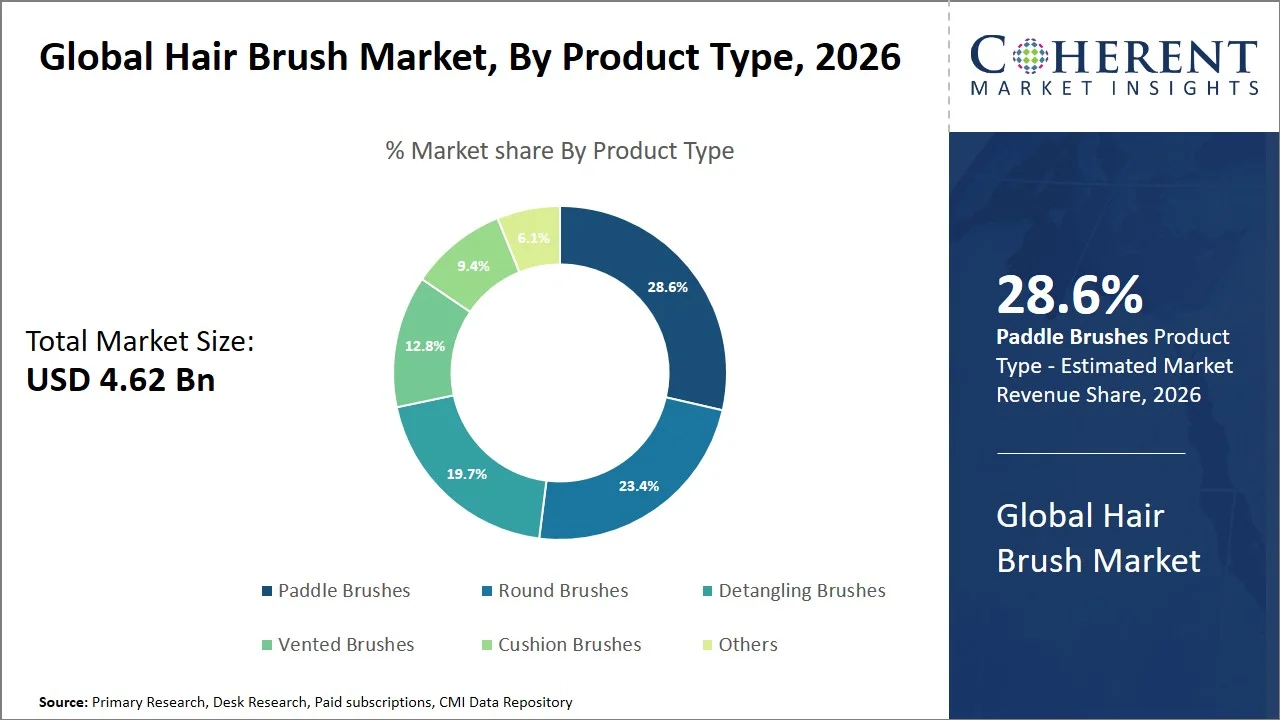
Why Do Paddle Brushes Lead the Product Type Category in the Global Hair Brush Market?
Paddle Brushes are positioned to lead the product-type category with an expected market share of 28.6% in 2026 because their broad working surface covers larger sections of hair in each stroke, making them efficient for everyday detangling, smoothing, blow-drying, and gathering hair into controlled styles. This format is particularly relevant for medium-to-long, dense, wavy, and textured hair, where users value faster coverage without repeated passes. From a supply perspective, the large brush body gives manufacturers room to integrate cushions, venting, flexible pins, ergonomic grips, and scalp-friendly bristle layouts across mass and premium ranges. This makes paddle brushes commercially attractive as a scalable platform rather than a single-use tool. In May 2025, Cécred launched its professional-grade Tools Collection, including a Vented Paddle Brush with widely spaced flexible bristles and a honeycomb structure designed to improve airflow during blow-drying, reinforcing the format’s multi-routine relevance.
- Current Industry Events of 2026
- Market Size Estimation
- Regional Breakdown
- Competitive Landscape
- Customer Intelligence
- Segmental Analysis
- Pricing Analysis
- Key Market Drivers, Challenges & Future Trends
- Customized Insights Section
Why Do Synthetic Bristles Represent the Largest Bristle Material Category in the Global Hair Brush Market?
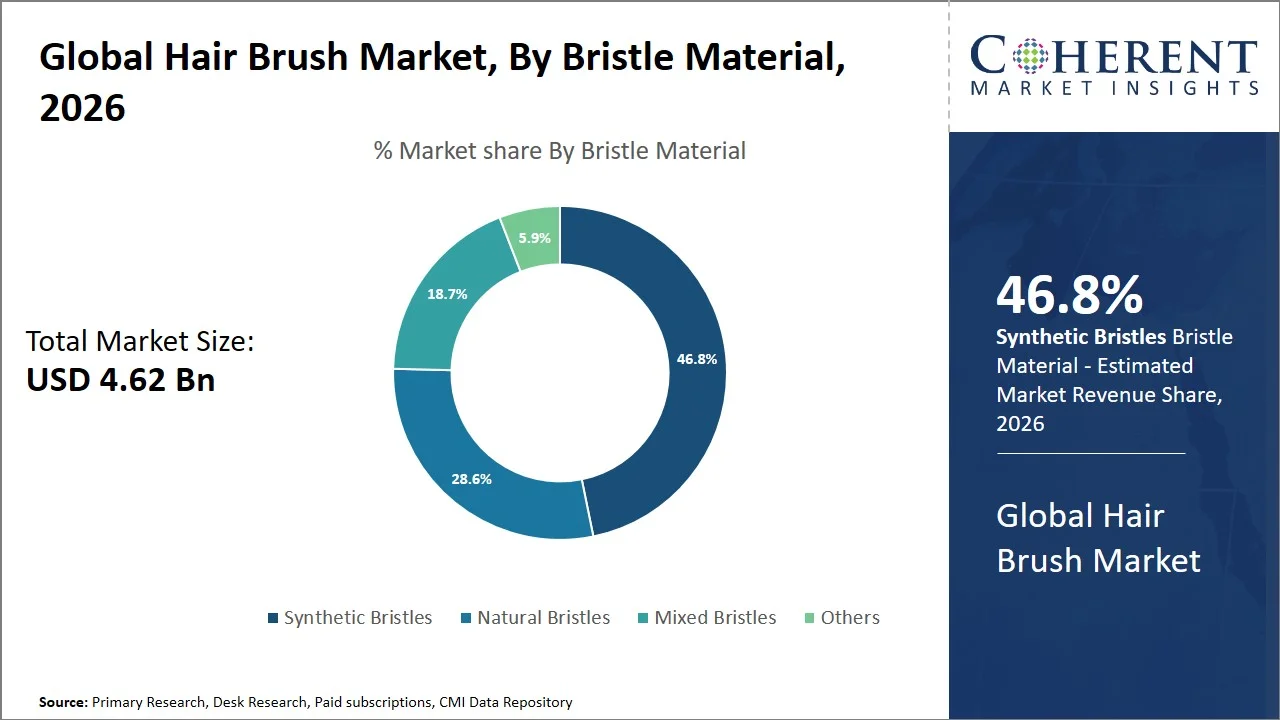
Synthetic Bristles represent the largest bristle-material segment with an expected market share of 46.8% in 2026 because polymers such as nylon allow manufacturers to control stiffness, tip shape, spacing, flexibility, and heat tolerance more consistently than many natural-fiber alternatives. Their resistance to moisture, easier cleaning, predictable quality, and compatibility with automated bristle-insertion processes support high-volume production and broad price coverage. These characteristics also let brands engineer distinct brushes for detangling, anti-static styling, blow-drying, and professional salon use without materially changing the underlying manufacturing platform. For buyers, that translates into repeatable performance and accessible pricing across multiple hair types. In September 2025, Ikonic Professional launched its Ebony Collection of styling brushes; its Carbon Fibre Roller Brush incorporated ball-tipped nylon bristles alongside V-shaped ionic bristles, while other models in the range also used heat-resistant or ionic nylon configurations for professional styling applications.
Why Do Women Dominate the End User Category of the Global Hair Brush Market?
Women are expected to remain the largest end user group with a share of 59.3% in 2026 because hair-brush purchasing among female consumers is spread across multiple routines rather than one basic grooming need. Detangling, smoothing, blow-drying, slick-back styling, extension care, scalp maintenance, travel, and occasion-led styling encourage ownership of different brush formats, while aesthetic design and gifting further expand purchase occasions. Beauty retailers also merchandise brushes alongside haircare and styling products, improving cross-selling and premiumization opportunities for brands. Manufacturers therefore benefit from wider assortment depth, more frequent product refreshes, and stronger color or design differentiation within women-focused portfolios. In February 2025, Emi Jay expanded into Sephora, with its prestige hair brushes included in the assortment and a rollout planned across nearly 400 U.S. stores, illustrating how women-oriented hair accessories are moving from direct-to-consumer channels into large prestige beauty networks.
Current Events and their Impact
Current Event | Description and Its Impact |
December 2024 – EU General Product Safety Regulation became applicable |
|
July 2025 – UK Product Regulation and Metrology Act received Royal Assent |
|
August 2026 – EU Packaging and Packaging Waste Regulation entered general application |
|
Global Hair Brush Market Dynamics
Key Market Drivers
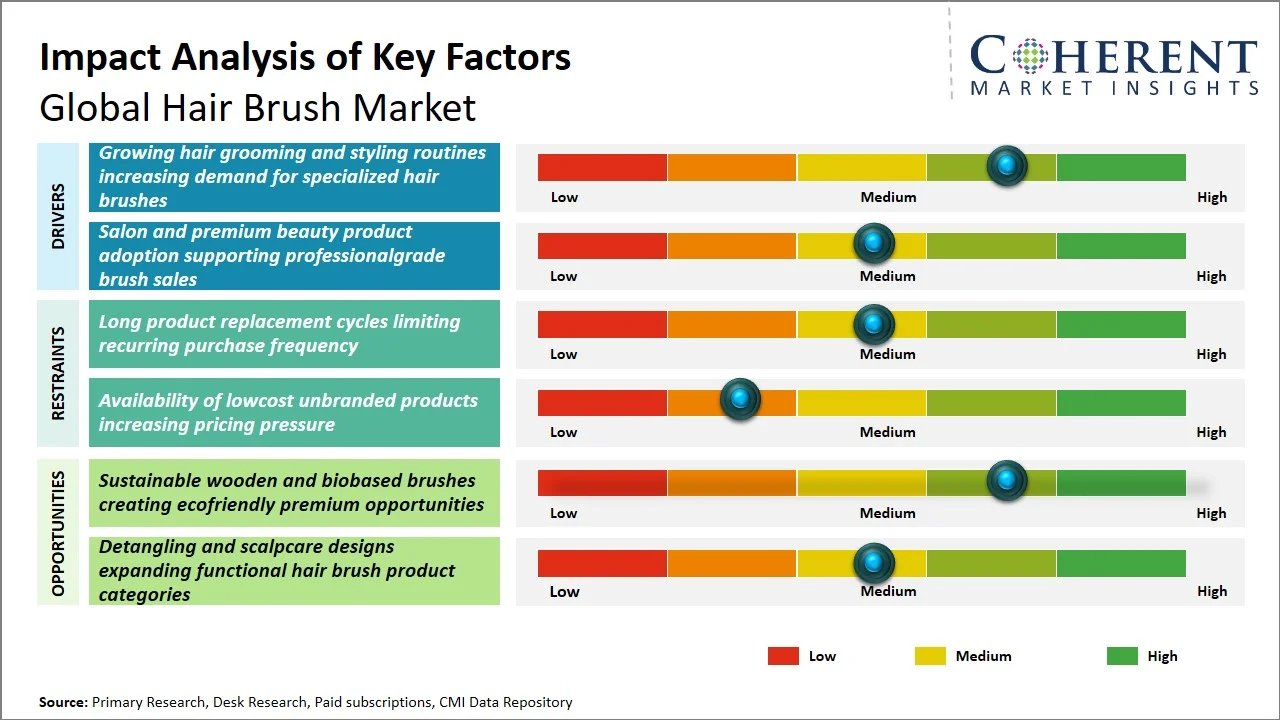
- Growing hair grooming and styling routines increasing demand for specialized hair brushes: Growing hair grooming and styling routines increasing demand for specialized hair brushes is strengthening purchase frequency as consumers assemble separate tools for detangling, smoothing, blow-drying, curl definition, scalp comfort, and finishing rather than relying on one general-purpose brush. This behavior benefits brands with clearly differentiated brush geometries, bristle tensions, and hair-type positioning, while retailers gain from broader assortments and repeat accessory purchases. Social platforms also shorten the discovery cycle by demonstrating technique-specific outcomes that are easy to replicate at home. In February 2025, The Washington Post reported renewed popularity of Mason Pearson hairbrushes among younger consumers, with TikTok helping a long-established premium brush reach a new generation of buyers. Commercially, this illustrates how routine-led education and digital visibility can reactivate mature product categories and support premium replacement demand.
- Salon and premium beauty product adoption supporting professional grade brush sales: Salon and premium beauty product adoption supporting professional grade brush sales is increasing the value placed on heat tolerance, airflow efficiency, ergonomic handling, sectioning control, and bristle durability. Professional stylists influence retail buyers because products proven behind the chair often migrate into at-home styling routines, giving salon-oriented manufacturers a route into higher-margin consumer demand. Premium brushes also face less direct price comparison when they solve specific workflow problems such as faster blowouts or reduced snagging. In May 2025, Olivia Garden introduced the HeatPro SpeedXL thermal round brush for professional stylists, combining an extra-long ceramic-coated barrel, heat-resistant bristles, and a design intended for high-heat styling. The launch shows how salon productivity requirements are translating into specialized brush engineering, reinforcing the commercial case for professional-grade formats across both trade and prestige beauty channels.
Emerging Market Trends
- Scalp-Care Functionality Is Reframing the Brush as a Hair-Health Tool: Hair brushes are evolving from basic grooming accessories into scalp-care and hair-health tools. Product development is increasingly focused on flexible bristles, gentle detangling, scalp contact, oil distribution, and reduced mechanical stress. This is encouraging brands to position brushes around hair preservation, scalp comfort, breakage control, and texture-specific needs. Suppliers with credible performance-led designs may gain stronger differentiation, while basic shape- and color-led products could face greater pricing pressure.
- Circular Material Engineering Is Moving into Core Product Design: Material circularity is becoming an important product-design consideration in the hair brush market. Manufacturers are evaluating recycled polymers, bio-based resins, simplified material structures, and longer-life designs while maintaining durability, hygiene, and affordability. This shift increases the importance of material traceability and quality control. Suppliers with stronger sustainable-material capabilities may gain an advantage, while manufacturers dependent on conventional virgin plastics could face increasing retailer and consumer scrutiny.
Regional Insights
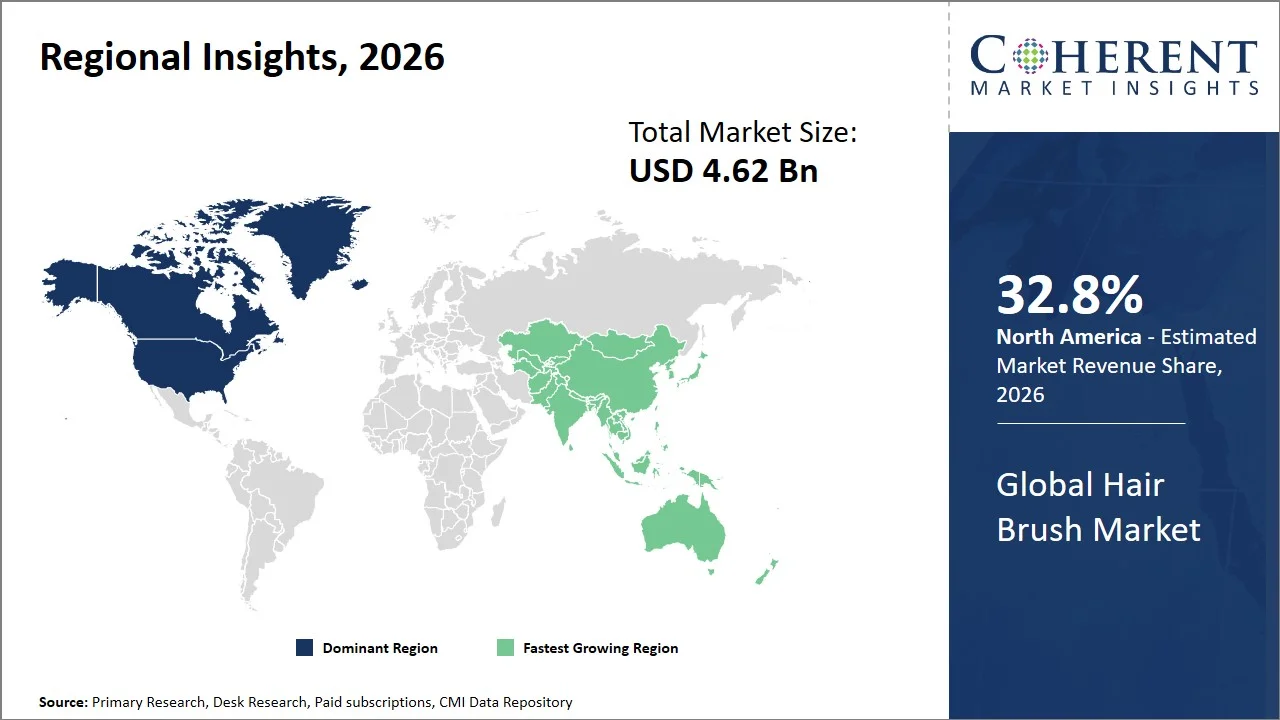
Why Does North America Dominate the Global Hair Brush Market?
North America is expected to retain leadership with a market share of 32.8% in 2026 because hair brushing is embedded in frequent at-home styling, salon maintenance, textured-hair care, and premium beauty routines, while consumers have broad access to specialty beauty chains, mass merchants, pharmacies, marketplaces, and direct-to-consumer brands. The region also supports rapid commercialization of differentiated bristle systems, ergonomic formats, scalp-care designs, and premium materials, allowing brands to compete on performance rather than price alone. High product visibility through social media and professional stylists shortens trial cycles and supports replacement purchases across detangling, smoothing, and blow-dry applications. In June 2024, U.S.-based GIMME Beauty introduced a Metal Bristle Brush using stainless-steel bristles for detangling and scalp stimulation across hair types, illustrating continued product engineering within the regional accessory category. For suppliers, North America remains attractive for premiumization, omnichannel distribution, and fast conversion of functional innovation into retail demand.
Why Is Asia Pacific Emerging as the Fastest-Growing Region in the Global Hair Brush Market?
Asia Pacific is emerging as the fastest-growing region with an expected market share of 29.7% in 2026 because its hair brush market combines a large consumer base with expanding beauty retail, salon modernization, e-commerce penetration, and increasingly segmented hair-care routines. Manufacturers can address highly diverse hair textures and price points, creating room for mass-market detangling brushes, professional round brushes, scalp-care formats, and premium natural-bristle products. Japan and South Korea contribute design and beauty-tool innovation, while China and India provide scale in manufacturing, digital commerce, and consumer acquisition. In February 2025, Japan’s ReFa began test sales of its ROLL BRUSH range through selected salons, with nationwide salon distribution scheduled from May, demonstrating how professional channels are being used to validate premium brush formats before broader release. This regional combination of product experimentation, salon influence, local manufacturing capacity, and mobile-first retail is likely to support faster category expansion through 2033.
Global Hair Brush Market Outlook for Key Countries
Why Is the U.S. a Key Market for the Global Hair Brush Market?
The U.S. is a key hair brush market because consumers purchase across mass, prestige, professional, and direct-to-consumer channels, creating room for both high-volume functional brushes and premium craftsmanship-led products. Hair-type segmentation is commercially important, with retailers increasingly organizing brushes around detangling, scalp care, blow-drying, textured hair, smoothing, and styling outcomes rather than treating them as undifferentiated accessories. Social commerce also gives visually distinctive products a route to scale before wider physical distribution. In October 2025, La Bonne Brosse opened its first U.S. store in New York City and expanded nationally through Bloomingdale’s and BEAUTYSPACE, indicating that premium specialist hairbrush brands see sufficient U.S. demand for dedicated retail investment. With an estimated 26.4% global share in 2026, the U.S. should remain especially important for brands seeking premium pricing, category education, influencer-led discovery, and high-value omnichannel placement.
Why Is India Important in the Global Hair Brush Market?
India is becoming increasingly important to the global hair brush market because daily grooming demand is broadening beyond basic combing toward detangling, blow-dry styling, anti-frizz care, scalp comfort, and salon-inspired at-home routines. The country combines a large young consumer base with fast-growing beauty e-commerce, quick-commerce platforms, organized salons, and domestic professional-tool brands, improving access across both value and premium price tiers. Local manufacturing and import distribution also allow suppliers to serve highly varied income groups without relying on a single channel. In February 2025, Philips India launched its 2-in-1 Airstyler with both paddle-brush and round-brush attachments and made it available through Blinkit, showing how brush-based styling functions are being integrated into convenience-led digital retail. With an estimated 5.9% global share in 2026, India offers strong headroom for affordable specialization, salon-grade formats, and digitally distributed grooming tools.
Why Does China Support Growth in the Global Hair Brush Market?
China supports growth in the global hair brush market through a combination of large-scale brush manufacturing, plastics processing, bristle insertion capability, tooling expertise, export infrastructure, and dense beauty-product trading clusters. These capabilities allow Chinese suppliers to manufacture wide assortments spanning mass-market paddle brushes, round brushes, vented formats, private-label products, and increasingly feature-rich designs at competitive cost. Domestic e-commerce also provides a large testing ground for rapid SKU turnover and hair-type-specific product positioning. In October 2025, Brazil’s final review of anti-dumping measures on Chinese hair brushes cited China’s substantial export profile and recorded that it represented 72.3% of global hair-brush exports in 2023, underscoring its supply-side relevance. With an estimated 12.7% global market share in 2026, China matters not only as a consumer market but also as a core manufacturing and sourcing base influencing global price, assortment, and private-label availability.
Why Is Germany a Strategic Country in the Global Hair Brush Market?
Germany is strategically important to the global hair brush market because consumers and professional channels place strong emphasis on product durability, ergonomic design, material quality, electrical safety, and credible performance claims. The country’s established drugstore networks, salons, appliance specialists, and e-commerce platforms support both manual brushes and higher-value brush-based styling systems. German engineering capability also encourages integration of ceramic surfaces, ionic functions, heat control, and modular attachments, helping suppliers compete through functionality rather than decorative differentiation alone. In March 2025, Ulm-based Beurer presented a new HairCare Design-Line that included the HT 85 rotating hot-air brush, featuring ceramic coating, automatic bidirectional rotation, ionic functionality, and interchangeable styling attachments. With an estimated 6.8% global share in 2026, Germany provides a valuable market for premium, safety-oriented, technically differentiated brushes and acts as an important reference market for broader European product positioning.
Why Is Brazil an Important Growth Market for the Global Hair Brush Market?
Brazil is an important growth market for hair brushes because hair styling and personal-care routines are deeply integrated into household consumption, professional beauty services, and a broad multichannel retail structure. The country’s highly diverse hair textures create demand for detangling, smoothing, curl-compatible, blow-dry, and salon-grade brush formats, while pharmacies, supermarkets, beauty specialists, direct selling, salons, and e-commerce provide wide consumer access. Domestic beauty-sector scale also supports frequent product experimentation and strong professional influence on at-home routines. In January 2026, ABIHPEC reported that Brazil’s beauty and personal-care sector exceeded US$1 billion in exports during 2025 and remained one of the world’s largest consumer beauty markets, highlighting the depth of the surrounding grooming ecosystem. With an estimated 3.4% global share in 2026, Brazil offers opportunities for texture-specific designs, affordable professional products, and locally adapted assortments.
Technology Adoption Landscape in the Global Hair Brush Market
Technology | Adoption Level | Key Application Area | Business Impact |
Flexible Multi-Length Synthetic Bristle Engineering | High | Wet and dry detangling brushes | Improves strand separation and controlled flex while limiting snagging, supporting differentiated products for multiple hair textures and sensitivity levels. |
Ceramic-Coated Thermal Barrel Technology | High | Round brushes used in blow-drying and heat styling | Improves heat distribution and thermal consistency, enabling more efficient styling workflows and supporting premium professional positioning. |
Airflow-Optimized Vent Architecture | High | Vented brushes and professional blow-dry tools | Allows heated air to move through the brush body more efficiently, reducing handling time and improving drying control during salon and home styling. |
Tourmaline and Ionic Surface Treatments | Medium | Anti-static and frizz-control styling brushes | Helps manufacturers differentiate brushes around smoother finishing and static management, although credible performance substantiation remains important for premium claims. |
Mixed Natural-Synthetic Bristle Systems | Medium | Smoothing, polishing, finishing, and oil distribution | Combines gripping and smoothing characteristics to serve specialized finishing routines, supporting higher-value products but requiring more complex sourcing and assembly. |
Recycled-Polymer and Mono-Material Molding | Medium | Brush handles, bodies, and sustainability-oriented product lines | Reduces dependence on virgin resin and can simplify material recovery while supporting retailer sustainability requirements; consistent mechanical performance and resin quality remain essential. |
How Are Hair-Type-Specific Modular Brush Systems Creating New Growth Opportunities in the Global Hair Brush Market?
Hair-type-specific modular brush systems are creating an underdeveloped opportunity because consumers increasingly want tools matched to texture, density, scalp sensitivity, extensions, wet detangling, and styling technique, yet many portfolios still rely on fixed one-piece formats. A modular platform could combine interchangeable bristle pads, handles, vent patterns, or tension levels, allowing one base product to serve several routines while creating recurring replacement revenue. The opportunity is especially relevant to professional stylists, textured-hair consumers, households sharing grooming tools, and premium direct-to-consumer buyers seeking personalized performance. Companies can capture it by investing in bristle mechanics, hygienic attachment systems, clear hair-type diagnostics, durable locking mechanisms, and retail education that makes configuration simple. The model favors specialist brands and design-led entrants able to iterate quickly, although established manufacturers could scale it faster through existing distribution. Success will depend on proving that modularity improves performance and replacement economics rather than adding complexity, because consumers will resist systems that feel cumbersome, difficult to clean, or unnecessarily expensive.
Market Players, Key Development, and Competitive Landscape
Key Developments
- In March 2026, Wet Brush announced a limited-edition collaboration with Hill House Home centered on its Original Detangler alongside coordinated hair accessories featuring the lifestyle brand’s signature prints. The collection was scheduled for distribution through Ulta, Wet Brush, and Hill House Home channels. This is important for the global hair brush market because it demonstrates how functional brush platforms can be extended into fashion-oriented collections that encourage gifting, refresh established SKUs, and attract customers through design identity rather than functional innovation alone.
- In October 2025, Denman introduced its Future Dusk collection across established tools including the D38 Detangling & Styling Paddle, D3 curl styling platform, and other grooming formats. This is important for the global hair brush market because extending proven functional platforms through coordinated seasonal designs allows established manufacturers to refresh retail assortments and generate incremental purchasing interest without bearing the development risk associated with entirely new brush architectures.
- In September 2025, The Belle Brush implemented a comprehensive brand and portfolio refresh that introduced clearer categories spanning detangling, blow-drying, styling, care, and accessories, together with revised packaging and improved product-navigation cues. This is important for the global hair brush market because better category architecture can reduce buyer confusion, improve shelf communication, and help salons, stockists, and consumers connect specific brush designs with intended routines, strengthening conversion across an expanding product portfolio.
Competitive Landscape
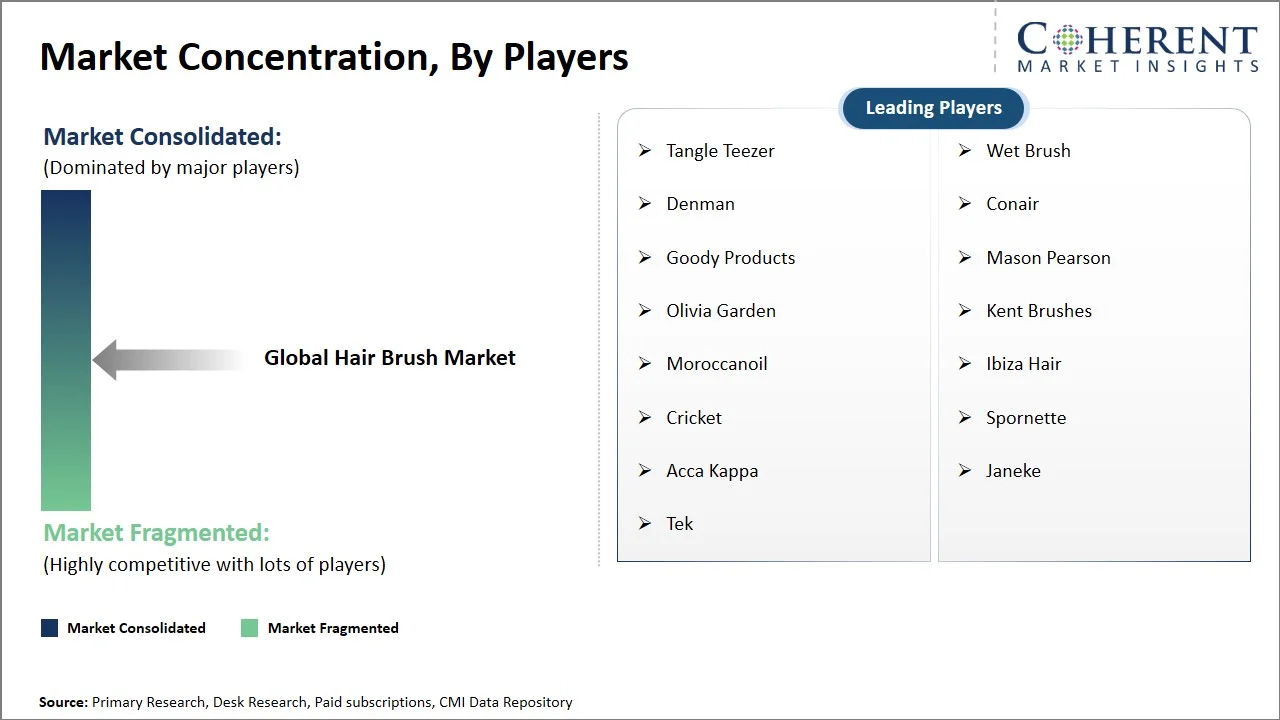
The global hair brush market is fragmented, comprising heritage brush manufacturers, professional salon-tool specialists, mass-market personal-care suppliers, digitally native hair-tool brands, private-label producers, and regional manufacturers. Competitive strength depends less on manufacturing scale alone and increasingly on the combination of bristle engineering, ergonomic performance, product consistency, recognizable design, pricing architecture, retail access, and supply reliability. Specialist and regional companies can compete effectively by addressing specific hair textures, salon workflows, or price points, while larger suppliers benefit from broader distribution and sourcing leverage. Product-safety compliance, packaging requirements, quality assurance, and credible material claims are becoming additional barriers separating disciplined manufacturers from commodity suppliers.
Key focus areas include
- Bristle engineering and hair-type performance: Controlled flexibility, spacing, density, and tip geometry provide meaningful differentiation beyond brush appearance.
- Professional usability: Grip comfort, weight balance, heat tolerance, airflow, and durability remain important purchasing criteria in salon-oriented ranges.
- Pricing architecture: Effective competitors maintain clear value separation between entry, mid-tier, professional, and prestige products rather than relying on excessive discounting.
- Manufacturing consistency: Reliable molding, bristle insertion, pad assembly, and finishing quality are critical to repeat purchases and retailer acceptance.
- Distribution execution: Beauty specialists, mass retailers, salons, marketplaces, and direct channels require distinct assortment, packaging, and merchandising strategies.
- Compliance and traceability: Product identification, material control, documentation, and packaging compliance are becoming increasingly relevant for cross-border market access.
- Sustainability credibility: Verifiable material choices and durable construction can strengthen positioning, whereas unsupported environmental claims create reputational and regulatory risk.
Market Report Scope
Hair Brush Market Report Coverage
| Report Coverage | Details | ||
|---|---|---|---|
| Base Year: | 2025 | Market Size in 2026: | USD 4.62 Bn |
| Historical Data for: | 2020 To 2024 | Forecast Period: | 2026 To 2033 |
| Forecast Period 2026 to 2033 CAGR: | 5.7% | 2033 Value Projection: | USD 6.81 Bn |
| Geographies covered: |
| ||
| Segments covered: |
| ||
| Companies covered: | Tangle Teezer, Wet Brush, Denman, Conair, Goody Products, Mason Pearson, Olivia Garden, Kent Brushes, Moroccanoil, Ibiza Hair, Cricket, Spornette, Acca Kappa, Janeke, Tek | ||
| Growth Drivers: |
| ||
| Restraints & Challenges: |
| ||
Analyst Opinion (Expert Opinion)
- The global hair brush market leadership is likely to shift from broad brush assortments toward performance-led portfolios organized by hair texture, density, styling objective, and scalp sensitivity. Suppliers that combine clear product architecture, credible performance testing, and disciplined SKU management should strengthen retailer acceptance, while overlapping and weakly differentiated ranges may face rationalization.
- As generic brush designs become easier to replicate, competitive value is likely to move toward proprietary bristle mechanics, ergonomic design, testing capability, and manufacturing precision. Brands relying mainly on aesthetics may face margin pressure, while engineering-led specialists that deliver noticeable performance differences should gain stronger pricing power and customer loyalty.
- Manufacturers should prioritize bristle engineering, flexible tooling, supplier qualification, durability testing, and expertise in textured, fragile, and professionally styled hair. They should also diversify material and packaging suppliers, strengthen product-claim governance, and limit unnecessary SKU expansion. Investment in complex electronic brushes should remain selective unless functionality delivers a clear, measurable grooming benefit.
Speak to the analyst
Want personalized insights?
Take the findings above to one of our principal consultants, or have the report rebuilt around the segments, geographies and competitors you actually track.
Market Segmentation
- Product Type Insights (Revenue, USD Bn, 2021 - 2033)
- Paddle Brushes
- Round Brushes
- Detangling Brushes
- Vented Brushes
- Cushion Brushes
- Others
- Bristle Material Insights (Revenue, USD Bn, 2021 - 2033)
- Synthetic Bristles
- Natural Bristles
- Mixed Bristles
- Others
- End User Insights (Revenue, USD Bn, 2021 - 2033)
- Women
- Men
- Children
- Distribution Channel Insights (Revenue, USD Bn, 2021 - 2033)
- Supermarkets and Hypermarkets
- Specialty Beauty Stores
- Online Retail
- Department Stores
- Salons and Professional Distributors
- Others
- Regional Insights (Revenue, USD Bn, 2021 - 2033)
- North America
- U.S.
- Canada
- Latin America
- Brazil
- Argentina
- Mexico
- Rest of Latin America
- Europe
- Germany
- U.K.
- Spain
- France
- Italy
- Russia
- Rest of Europe
- Asia Pacific
- China
- India
- Japan
- Australia
- South Korea
- ASEAN
- Rest of Asia Pacific
- Middle East
- GCC Countries
- Israel
- Rest of Middle East
- Africa
- South Africa
- North Africa
- Central Africa
- North America
- Key Players Insights
- Tangle Teezer
- Wet Brush
- Denman
- Conair
- Goody Products
- Mason Pearson
- Olivia Garden
- Kent Brushes
- Moroccanoil
- Ibiza Hair
- Cricket
- Spornette
- Acca Kappa
- Janeke
- Tek
Sources
Primary Research Interviews
- Hair brush manufacturers, professional styling-tool brands, private-label producers, and specialty brush manufacturers
- Bristle suppliers, polymer/resin suppliers, handle manufacturers, molding companies, and packaging suppliers
- Salons, hairstylists, beauty retailers, distributors, e-commerce platforms, and importers
- Product-development managers, procurement executives, salon professionals, category managers, and beauty-industry consultants
Stakeholders
- Hair brush and personal-care accessory manufacturers
- Synthetic/natural bristle, plastics, rubber, wood, and packaging suppliers
- Beauty retailers, salons, distributors, wholesalers, marketplaces, and private-label brands
- Women, men, children, professional stylists, and institutional buyers
End-use Sectors
- Household and personal grooming
- Professional salons and hairstyling services
- Hotels, spas, beauty studios, and wellness centers
- Professional hairstyling, detangling, scalp-care, and blow-dry applications
Regulatory and Government Bodies
- U.S. Consumer Product Safety Commission (CPSC) and Federal Trade Commission (FTC)
- European Commission and European Chemicals Agency (ECHA)
- China State Administration for Market Regulation (SAMR)
- Bureau of Indian Standards (BIS) and Department of Consumer Affairs
- Brazil INMETRO and national consumer-protection authorities
- National customs, product-safety, chemicals, labeling, and packaging authorities
Databases
- UN Comtrade and ITC Trade Map – including HS 960329, covering hair brushes and other personal-use brushes
- Eurostat, U.S. Census Bureau, China Customs, India Department of Commerce, and national trade databases
- Company annual reports, product catalogues, technical documents, pricing records, retail listings, and customs shipment data
- Beauty, salon, consumer-products, plastics, and brush-manufacturing industry databases
Magazines and Journals
- International Journal of Cosmetic Science
- Journal of Cosmetic Science
- Cosmetics & Toiletries
- Cosmetics Business
- BeautyMatter
- Professional Beauty
- Modern Salon
Associations
- American Brush Manufacturers Association (ABMA)
- European Brushware Federation (FEIBP), which specifically covers personal-care and hair brushes
- Personal Care Products Council (PCPC)
- Cosmetics Europe
- Professional Beauty Association (PBA)
- National beauty, salon, plastics, packaging, and retail associations
Public Domain Sources
- Hair brush product launches, bristle technologies, ergonomic designs, scalp-care features, and professional styling innovations
- Manufacturing facilities, material developments, sustainability initiatives, distribution expansions, and retail launches
- Product catalogues, technical specifications, patents, packaging information, and performance claims
- Import-export statistics for hair brushes, personal-care brushes, plastics, bristles, and related components
Key Standards and Regulations
- EU General Product Safety Regulation (EU) 2023/988 for consumer non-food products
- EU REACH requirements applicable to restricted substances in materials and consumer articles
- U.S. consumer-product safety and advertising requirements
- Applicable national product-quality, labeling, packaging, and chemical-safety requirements
- ISO 9001 quality-management practices and relevant material, durability, bristle-retention, and product-performance testing protocols
Proprietary Elements
- CMI Data Analytics Tool, Proprietary CMI Existing Repository of information for the last 10 years
Get access to 250+ pages report
Every segment, forecast, competitor profile and data table behind the analysis above — available for instant download.
- ESOMAR Member
- ISO 9001:2015 Certified
- D-U-N-S Registered
- GDPR & CCPA Compliant
Missing comfort of reading report in your local language? Find your preferred language:
Transform your Strategy with Exclusive Trending Reports
Frequently Asked Questions
The CAGR of global hair brush market is projected to be 5.7% from 2026 to 2033.
The global hair brush market is estimated to be valued at USD 4.62 billion in 2026 and is expected to reach USD 6.81 billion by 2033.
The global hair brush market is segmented by product type, bristle material, end user, distribution channel, and region.
Major distribution channels include supermarkets and hypermarkets, specialty beauty stores, online retail, department stores, salons and professional distributors, and other retail channels.
The major end user groups in the global hair brush market include women, men, and children, with product requirements varying according to hair type, grooming routine, and styling preferences.
Competition in the global hair brush market is shaped by product performance, bristle design, ergonomic features, material quality, brand positioning, pricing, retail availability, professional salon acceptance, and the ability to address different hair textures and styling requirements.
Growing hair grooming and styling routines increasing demand for specialized hair brushes and Salon and premium beauty product adoption supporting professional grade brush sales are the major factor driving the growth of global hair brush market.