

Global Hair Wax Stick Market Size and Forecast – 2026 To 2033
The Global Hair Wax Stick Market is estimated to be valued at USD 280.8 Mn in 2026 and is expected to reach USD 379.6 Mn by 2033, growing at a compound annual growth rate (CAGR) of 4.40% from 2026 to 2033. The steady expansion of this market points to the rising demand from consumers for hairstyling products that offer convenience and versatility, while also delivering lasting hold, precise application and frizz control. The growing trend of online beauty retail channels, product formulation improvements and sleek hairstyles trend are stimulating manufacturers to deliver differentiated styling solutions.
In February 2025, DESIGNME Hair launched its HOLD.ME Styling Stick, a compact, wax-based styling product that aims to create smooth buns and ponytails, and to tame flyaways. Manufacturers are responding to everyday styling needs through product functionality and convenience, with the precision applicator and portable design being clear examples.
Key Takeaways of the Global Hair Wax Stick Market
- Synthetic Ingredient-Based formulations are estimated to grow at a 4.1% CAGR during 2026–2033 and hold 62.2% of the global hair wax stick market in 2026. Engineered additives improve stick stability and controlled application, allowing brands to provide consistent performance across a range of climates. In January 2026, Evonik documented improved thermal stability in hair wax stick formulations with silica after heat testing.
- Strong & Extra-Strong Hold products are expected to grow at a 4.8% CAGR through 2033 and represent an estimated 47.6% of the global hair wax stick market in 2026. Sleek buns and pulled-back styles require durable control for a tough everyday routine. In March 2024, Nexxus added its Slick Stick Strong Hold Hair Wax to its styling range.
- Natural Finish products are expected to capture 42.6% of the market in 2026 and is anticipated to grow at an estimated CAGR of 4.7% from 2026 to 2033. Consumers like the flyaway control that is discreet enough to prevent visible build-up and stiff-looking hair. Developlus launched the Color Oops Color Barrier+ Style Stick in March 2026. The product features a non-crunchy, non-sticky finish and the flexibility to style.
- Asia Pacific is forecast to advance at an estimated 4.2% CAGR during 2026–2033 and command 32.2% of global hair wax stick market revenue in 2026. The increase in products that serve specific hair textures and the growth of digital buying channels also help spread the adoption. In December 2025, Bessemer Venture Partners invested in Indian haircare brand Moxie Beauty. The brand’s styling portfolio includes wax sticks for local consumers.
- North America is expected to register an estimated 5.3% CAGR during 2026–2033 while contributing 29.3% of global hair wax stick market sales in 2026. Increased consumer trial of portable styling formats is driven by product demonstrations and widespread retail availability. In April 2026, göt2b launched mobile activations in Miami and New York aimed at connecting consumers to its styling line. The activations were based around wax sticks.
Segmental Insights
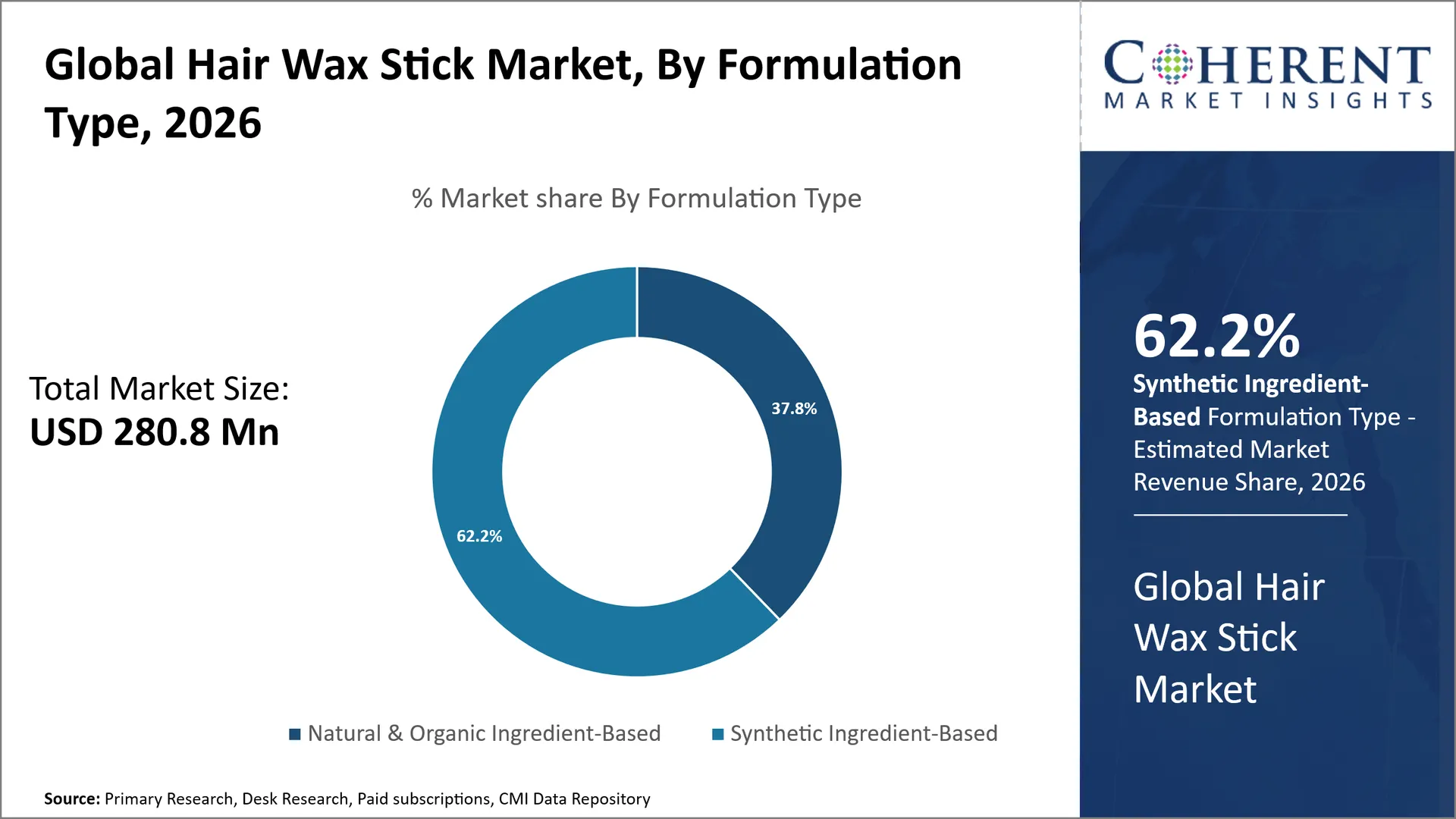
Why Do Synthetic Ingredient-Based Formulations Dominate the Global Hair Wax Stick Market?
Synthetic Ingredient-Based formulations are expected to account for 62.2% of the global hair wax stick market in 2026, reflecting their adaptability across different product specifications and price categories. Synthetic waxes and polymers combined with botanical oils and other conditioning ingredients allow manufacturers to adjust adhesion, product pickup and application texture. That flexibility allows a contract manufacturer to create unique recipes using proven manufacturing methods. Also, brand owners have more flexibility in selecting ingredients and formulation costs without sacrificing styling performance. In January 2025, DKSH Spain developed a Taming Hair Wax stick formulation containing synthetic wax CIREWAX 80, rice-bran wax and plant-derived oils. The formulation is an example of how the combination of synthetic and natural ingredients can allow for product customization, opening opportunities for manufacturers serving both premium and mass-market haircare brands.
- Current Industry Events of 2026
- Market Size Estimation
- Regional Breakdown
- Competitive Landscape
- Customer Intelligence
- Segmental Analysis
- Pricing Analysis
- Key Market Drivers, Challenges & Future Trends
- Customized Insights Section
Why Does Strong & Extra-Strong Hold Represent the Largest Hold Strength Segment in the Global Hair Wax Stick Market?
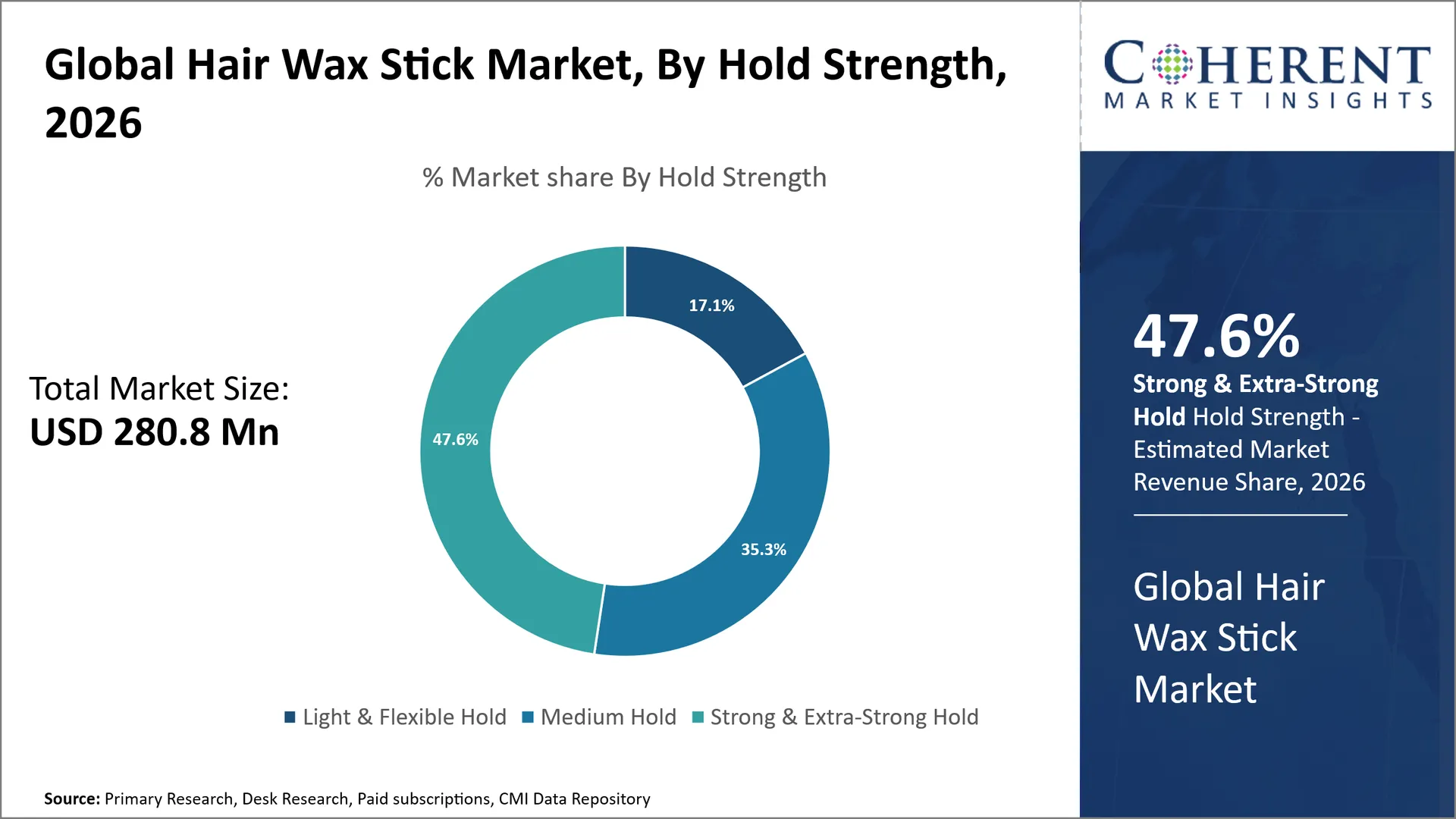
Strong & Extra-Strong Hold products are projected to capture 47.6% of the global hair wax stick market in 2026 within the hold strength category. Their reign speaks volumes to the demand for strong hair hold, especially from consumers with thick, curly or coily hair needing more control over their style. These formulations help to hold structured hair dos and defined edges in situations where lighter options may not be sufficient in hold. Identifying products that work for textured hair, reduce flaking and deliver lasting-hold performance benefits manufacturers. In September 2024, KISS Colors & Care highlighted its Edge Fixer Wax Stick through a partnership with singer Ari Lennox. Provides controlled application and 24-hour hold for textured hair styles. This positioning shows the commercial value of dedicated hold performance in attracting consumers with demanding styling needs.
Why Does Natural Finish Dominate the Finish Type Segment of the Global Hair Wax Stick Market?
Natural Finish products are anticipated to hold 42.6% of the global hair wax stick market in 2026, supported by consumer preferences for controlled hairstyles that retain their original appearance. Consumers’ desire for controlled hairstyles that preserve their natural appearance is driving demand for Natural Finish products. Unlike glossy alternatives, these formulations offer subtle styling definition without excess shine and are therefore suitable for everyday grooming, short styles and fine hair. Balanced wax concentrations provide flexible control without weighing hair down, and manufacturers can create more appealing products. Also beneficial to the professional hairstylist, the finishes that keep the natural movement. In July 2026, Salerm Cosmetics introduced its Wax Stick under the Pro·Line collection, offering medium hold, a natural finish, and precise styling control. The product emphasizes the opportunity for suppliers to create versatile finishing solutions that can be used both professionally in salons and by individual consumers.
Why Does Flyaway & Frizz Control Lead the Application Segment in the Global Hair Wax Stick Market?
Flyaway & Frizz Control is expected to contribute 35.4% of the global hair wax stick market in 2026, making it the largest application segment. Its leadership demonstrates the practical need to control short regrowth, uneven strands and surface frizz without the use of styling products on the entire hairstyle. Hair wax sticks are also useful for holding hair styles that require a clean finish on the outside, such as braids, wigs and other hair styles due to the ability to apply it locally. Manufacturers can address this application with formulations that minimize residue on a wide variety of hair textures and controlled wax deposition. In May 2024, tgin introduced its Smooth & Sleek Wax Stick within the Miracle Styling Collection, designed to support polished hairstyles across diverse hair types. The launch highlights the opportunity for targeted frizz-control products in specialist haircare portfolios.
Current Events and their Impact
Current Event | Description and Its Impact |
December 2024 – U.S. FDA Updates Cosmetic Registration and Listing Guidance |
|
July 2026 – European Union Expands Fragrance Allergen Labelling Requirements |
|
April–August 2026 – Canada Implements Expanded Cosmetic Fragrance Disclosure |
|
Global Hair Wax Stick Market Dynamics
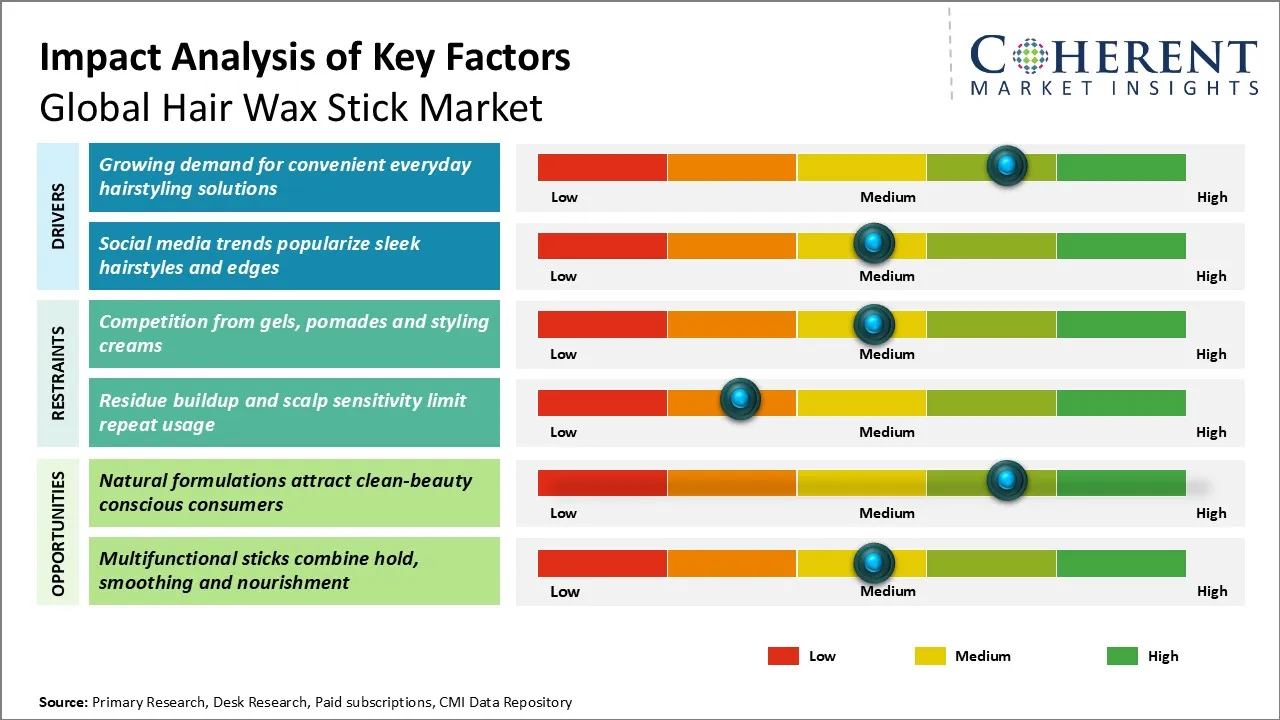
Key Market Drivers
- Growing Demand for Convenient Everyday Hairstyling Solutions: consumers are turning to hair wax sticks for quick touch-ups that don’t require a lot of styling tools or long periods of preparation. They are intended for direct application and are perfect for use at work, on the go and to style between washes, promoting frequent use. It’s a win for the manufacturers too, who want to make wax sticks a daily grooming staple, not just a styling aid for special occasions. In November 2025, Janni Bars introduced a plastic-free hair wax stick designed for portable application, flexible hold, and flyaway control. These developments illustrate how practical product formats can encourage repeat purchases and broaden retail opportunities.
- Social Media Trends Popularize Sleek Hairstyles and Edges: Visual content on hairstyles plays a big role in how consumers find out about hair wax sticks, particularly in relation to defined edges, polished ponytails and sleek hairstyles. Demonstrations make product benefits more understandable, helping brands turn styling inspiration into purchases. Influencers can offer specialist haircare businesses an alternative to traditional advertising. In May 2026, Bjorn Axen launched its Unbroken campaign with artist Silvana Imam and the styling product Sleek Stick. The campaign showcases how culturally relevant styling imagery can boost product recognition and drive consumer engagement.
Emerging Market Trends
- Styling and Haircare Benefits Converge in Wax Stick Formulations: Manufacturers will need to establish a point of difference in formulations and market as a premium product to offset the conditioning and effective hold benefits. Better sensory performance in brands may lead to higher customer retention.
- Impact: The multifunctional styling products may be more suitable to specialty beauty retailers. The way a product feels on the skin, how easy it is to take off and ingredient transparency will increasingly drive purchasing decisions.
- Market Relevance: Specialty beauty retailers may provide a better fit for multifunctional styling products. Ingredient transparency, the feel on application and the ease of removal will increasingly influence purchasing decisions.
- Hair-Texture-Specific Formulations Gain Commercial Importance: Hair wax stick manufacturers are moving toward more targeted product development for fine, thick, curly, coily and chemically treated hair. The density, texture and styling requirements of hair offer opportunities for formulations with more precise performance characteristics.
- Impact: Brands can create specific products with different wax concentrations, application consistency and holding power. Specialized manufacturers can boost consumer loyalty through improved suitability of their products.
- Market Relevance: Texture as a positioning tool can improve the effectiveness of product recommendations across retail channels. But organizations will need stronger inventory management and consumer testing to support expanded portfolios that are commercially viable.
Key Restraining Factors
- Product Buildup and Difficult Removal Limit Repeat Usage: Hair wax sticks tend to leave a noticeable residue, especially if users apply too much product or restyle too often without cleansing. Thick formulas may need an additional wash, as the natural movement of the hair may be limited and it may look greasy. These issues may put off consumers who want lightweight styling or have fine hair. Better wax distribution, washability and application guidance could raise dissatisfaction and repeat purchases for manufacturers.
- Price Competition and Temperature-Sensitive Formulations Challenge Manufacturers: Hair wax sticks are threatened by cheap private-label products and alternative styling formats such as gels, pomades and finishing sprays. Manufacturers also need to worry about changes in stick firmness, sweating and consistency of application during storage and transportation in hot weather. Formulation stability testing, protective packaging and supply-chain controls become more important in the face of these challenges, especially for brands with cross-border distribution.
Regional Insights
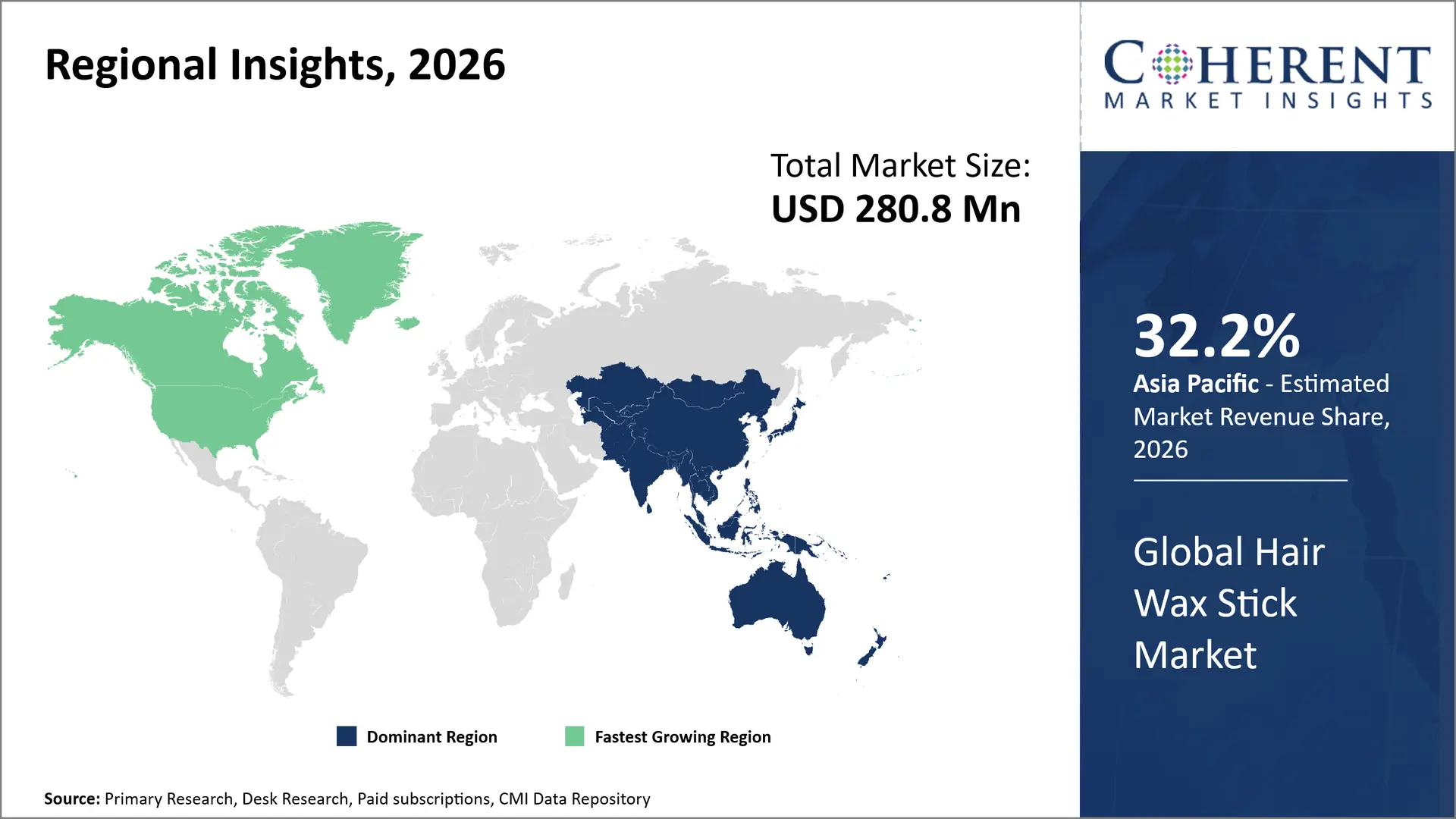
Why Does Asia Pacific Dominate the Global Hair Wax Stick Market?
Asia Pacific is projected to capture 32.2% of the global hair wax stick market by 2026, driven by ingrained hair styling practices, diverse product preferences and local manufacturing strengths. In major Asian beauty markets consumers are using compact styling products to refresh bangs, manage shorter layers and create structured hairstyles. Regional manufacturers also provide product availability through private-label production and flexible sourcing arrangements, so beauty brands can bring affordable styling products to market. In November 2026, Chinese haircare manufacturer SEVICH presented its hair wax stick portfolio at Cosmoprof Asia in Hong Kong, aiming at international distributors with ready-stock products and customized manufacturing options. These supply side capacities add to the region’s position by connecting Asian production networks to domestic retailers and export-oriented beauty companies.
Why Is North America Emerging as the Fastest-Growing Region in the Global Hair Wax Stick Market?
North America hair wax stick market is expected to hold 29.3% share of the global market by 2026, growing at the fastest growth rate among all the regions during the forecast period. The region has well-developed mass-market beauty retail networks and a high level of consumer demand for specialized styling products. Wax sticks are becoming commercially important in the retail industry as retailers are diversifying their offerings across accessible and premium price segments, providing an opportunity for emerging brands to compete with established haircare brands. In September 2026, Australian styling brand SLICKHAIR entered Target Beauty Studios in the U.S., introducing its wax stick range to a wider physical retail audience. This development demonstrates how international brands can expand beyond direct-to-consumer sales through national retail partnerships, improving product accessibility and creating opportunities for repeat purchases.
Global Hair Wax Stick Market Outlook for Key Countries
Why Is the U.S. a Key Market for the Global Hair Wax Stick Market?
US is a prominent consumer market for hair wax sticks, owing to the high demand for specialized styling products and the presence of diverse hair textures. Consumers with curly, coily and wavy hair are increasingly able to find products that deliver edge definition, protective styles and controlled finishes. That’s an opportunity for indie brands to meet styling needs that traditional products can’t completely address. The Hair Wax Stick, a product of U.S. haircare brand Rizos Curls, was launched in December 2024. It aims to help people achieve sleek ponytails and buns for all hair types. The product shows the potential of texture-inclusive styling solutions to increase the customer base. Manufacturers producing products for specific hair needs can improve brand differentiation and ensure higher regular repeat purchases.
Why Is India Important in the Global Hair Wax Stick Market?
In India there is a growth potential for hair wax sticks with the commercialization of traditional hair grooming practices in modern styling formats. Consumers managing humidity-related frizz, thick hair and sleek hairstyles represent an attractive customer base for multifunctional products. Beauty brands can stand out in the local market by merging modern styling performance with trusted botanical ingredients. Indē wild’s Champi Slick Stick, featuring keratin and peptides, and amla, bhringraj, and hibiscus, launched in November 2025. The product combines conditioning-oriented positioning with hair smoothing, showing how Indian brands can transform established haircare preferences into value-added styling products. Such formulations may help with premium positioning, especially with consumers who want the styling convenience without sacrificing their current haircare regimens.
Why Is Japan a Strategic Country in the Global Hair Wax Stick Market?
Japan supports the global hair wax stick market through its established emphasis on precise hairstyling and specialized product functionality. Consumers use compact styling products to keep their hairstyles neat, smooth down short hair and hold bangs in place. This encourages manufacturers to develop applicators that are better able to work with smaller sections of hair. The LUCIDO-L Multi Arrange Stick Extra Hard is produced by the Japanese company Mandom and is equipped with an oval applicator for precise and extensive application. The formulation features a humidity-shield system to help protect hairstyles and powders to reduce greasiness. Such a type of product engineering shows how Japanese manufacturers can compete by emphasizing consistent performance and applicator design, rather than just styling strength. The improvement of compact formats on a continual basis may improve the differentiation of domestic products.
Why Is South Korea an Important Growth Market for the Global Hair Wax Stick Market?
South Korea is strategically important for hair wax stick manufacturers because of its sophisticated beauty retail ecosystem and consumer preference for detailed hairstyling. The popularity of neat bangs, sleek hair styles, and controlled hairlines creates demand for compact products that allow for precise application. Korean beauty retailers also promote product differentiation through complementary accessories and specialized styling formats. Daleaf’s Glam Stick Hair Wax is now available at Olive Young, a small styling product with a brush keyring promotion. This retail positioning shows how Korean brands add purchase appeal with practical product functionality combined with accessory-led merchandising. In the competitive beauty market in South Korea, manufacturers that are able to produce coordinated styling accessories, distinctive packaging, and convenient applicators can help improve product visibility and consumer engagement.
Consumer Preference and Product Evolution Landscape in the Global Hair Wax Stick Market
Product Innovation | Application in Hair Wax Sticks | Commercial Significance | Adoption Outlook |
Controlled Wax Crystallization | Prevents over softening and crumbling and maintains structural integrity | Increases the stability of the product during storage and transport | Established, with continued optimization |
Wax-Polymer Hybrid Formulations | Prevents over softening and crumbling and maintains structural integrity | Increases the stability of the product during storage and transport | Expanding |
Lightweight Emollient Systems | Includes wax structure with film forming flexible properties | supports differentiation without excessive stiffness | Expanding |
Surface Powder and Silica Dispersion | Improves glide and reduces the need for heavy or greasy applications | Improves compatibility with fine, low density hair | Selective adoption |
Humidity-Resistant Styling Networks | Modifies the finish characteristics, oil absorption and texture | Encourages the creation of products with a matte or natural finish. | Developing |
How Are Professional-to-Consumer Styling Kits Creating New Growth Opportunities in the Global Hair Wax Stick Market?
Professional-to-consumer styling kits offer hair wax stick manufacturers an opportunity to generate additional revenue beyond individual product sales. Consumers receiving bridal styling, protective styles, wig styling or salon finishing services often need the right products to keep up their look between visits.
To meet this need, manufacturers can provide compact maintenance kits, complete with precision brushes, hair wax sticks and application instructions for specific styles.
A recommendation-led sales channel could be established through partnerships with professional salons, bridal stylists and specialist hairdressers, reducing the reliance on traditional retail advertising.
Successful participation requires suitable packaging, consistent product quality, competitive bundle pricing, and professional training materials to help professionals demonstrate how to apply the product correctly.
Specialist brands and contract manufacturers could benefit from private-label arrangements and bespoke kits. Existing hair care companies may capitalize on the existing relationships they have with salons to distribute these products more effectively.
This opportunity is particularly appealing where recommendations from professionals suggest continued use at home.
Market Players, Key Developments, and Competitive Intelligence
Key Developments
- In November 2026, As I Am reported its participation in New York and Paris Fashion Week styling activities, including the use of its Rosemary Wax Stick for defined edges and textured hairstyles. This professional application strengthens the product's relevance among stylists seeking controlled finishing performance across diverse hair textures.
- In March 2026, Oribe Hair Care introduced its Supershine Smoothing Wax Stick, combining flexible hold with conditioning ingredients and a high-shine finish. Its availability through the brand's website and professional salon network demonstrates the commercial potential of premium wax sticks positioned between luxury haircare and precision styling.
- In March 2025, Utena Co., Ltd launched its Matomage Homme Hair Stick Wax in Japan, introducing a styling product specifically positioned for men's grooming. This expansion demonstrates how targeted product development can extend hair wax stick adoption beyond conventional female-focused styling applications and create additional retail opportunities.
Competitive Landscape
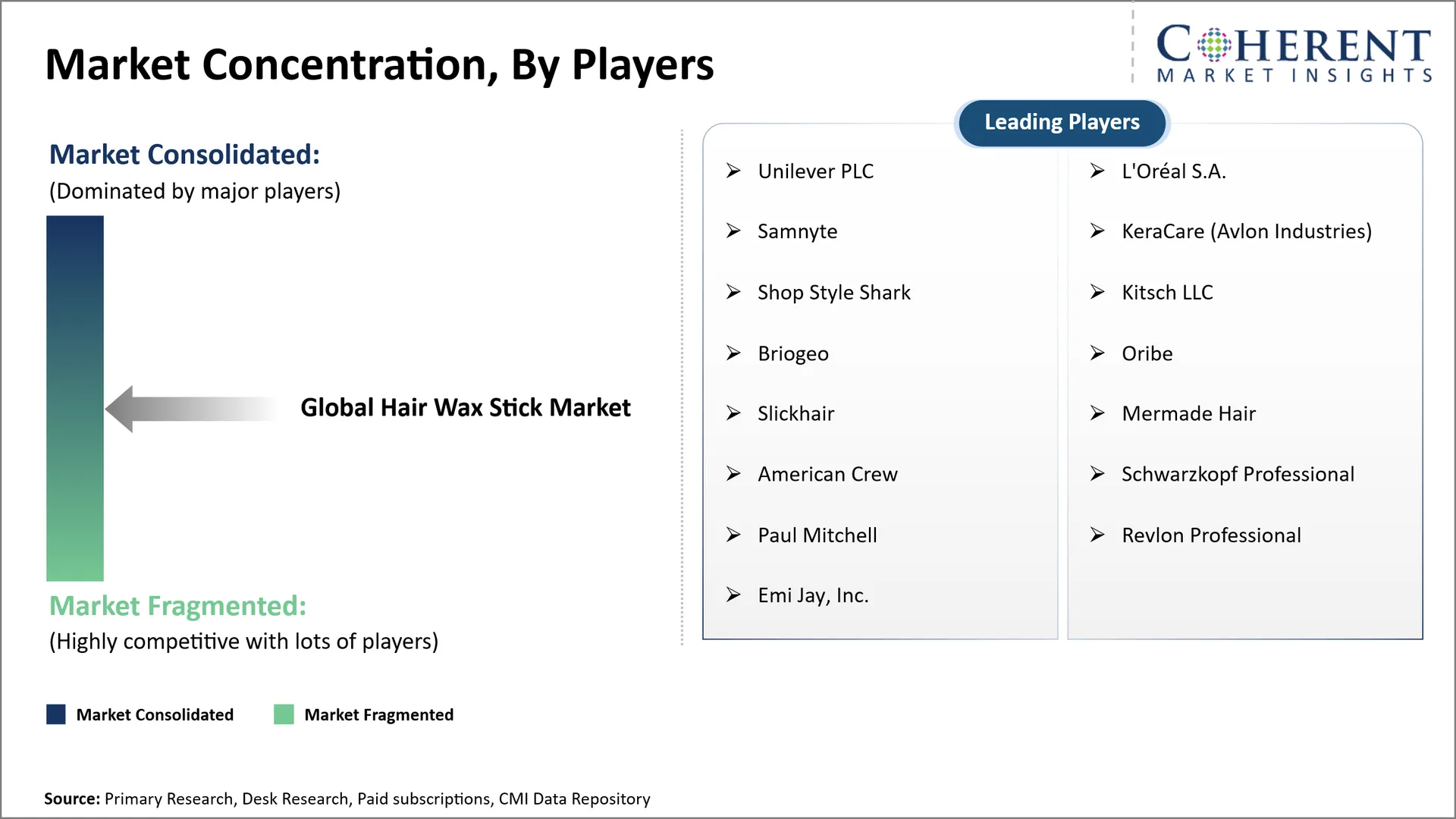
The global hair wax stick market appears fragmented with the presence of multinational haircare companies, independent styling brands, regional manufacturers, and private-label suppliers. The main battlefields are brand positioning, formulation quality, residue control and hold performance. The bigger players leverage their existing retail relationships, while specialist firms differentiate themselves through targeted styling applications. The key is consistency in manufacturing, compliance with ingredients, and an effective inventory management process to maintain profitability and access to distribution.
Key Competitive Focus Areas
- Product Performance: Little flaking, easy application and consistent hold.
- Formulation Quality: Dependable organoleptic properties and good wax balance.
- Pricing Strategy: Finding a competitive price without eroding margins too much.
- Manufacturing Efficiency: Consistent filling, cooling, and product-weight control.
- Regulatory Compliance: Proven product safety and accurate ingredient details.
- Retail Distribution: Strong shelf placement and dependable replenishment capabilities.
- Private-Label Manufacturing: Flexible production quantities and customized product specifications.
- Brand Differentiation: Distinct product claims supported by meaningful consumer testing.
Market Report Scope
Global Hair Wax Stick Market Report Coverage | |||
Report Coverage | Details | ||
Base Year | 2025 | Market Size in 2026: | USD 280.8 Mn |
Historical Data For: | 2020 to 2024 | Forecast Period: | 2026 to 2033 |
Forecast Period 2026 To 2033 CAGR: | 4.40% | 2033 Value Projection: | USD 379.6 Mn |
Geographies covered: |
| ||
Segments covered: |
| ||
Companies covered: | Unilever PLC, L'Oreal S.A., Samnyte, KeraCare (Avlon Industries), Shop Style Shark, Kitsch LLC, Briogeo, Oribe, Slickhair, Mermade Hair, American Crew, Schwarzkopf Professional, Paul Mitchell, Revlon Professional, Emi Jay, Inc. | ||
Growth Drivers: |
| ||
Restraints & Challenges: |
| ||
Analyst Opinion (Expert Opinion)
- Future Market Direction: The global hair wax stick market leadership is likely to be increasingly based on the ability to translate initial consumer trials into a predictable repeat purchase. Brands that manage replenishment better, deliver consistent batch quality and track customer satisfaction might have an edge over rivals that push promotional visibility. Having a systematic approach to product assortment might be more effective than just constantly coming out with similar style variations.
- Transformative Trend or Disruption: Growing availability of low-cost, visually similar styling sticks could accelerate product commoditization and erode brand differentiation. They may be required to validate performance claims by means of standardized testing and to establish identifiable product identities. If a company can’t prove a meaningful difference in quality or durability of its applications, it may continue to face pricing pressure.
- Strategic Priorities, Risks and Recommendations: Manufacturers should focus on formulation stability testing, controlled manufacturing costs, compliant ingredient documentation, and reliable wax sourcing. Commercial positioning can be improved by professional testing of products and successful distribution partnerships. Companies should not diversify their product lines beyond the limits of consumer demand, because fragmented inventories and inconsistent sales volumes can depress operating margins.
Speak to the analyst
Want personalized insights?
Take the findings above to one of our principal consultants, or have the report rebuilt around the segments, geographies and competitors you actually track.
Market Segmentation
- Formulation Type Insights (Revenue, USD Mn, 2021 - 2033)
- Natural & Organic Ingredient-Based
- Synthetic Ingredient-Based
- Hold Strength Insights (Revenue, USD Mn, 2021 - 2033)
- Light & Flexible Hold
- Medium Hold
- Strong & Extra-Strong Hold
- Finish Type Insights (Revenue, USD Mn, 2021 - 2033)
- Matte Finish
- Natural Finish
- Glossy & Shine Finish
- Application Insights (Revenue, USD Mn, 2021 - 2033)
- Flyaway & Frizz Control
- Edge Control & Baby Hair Styling
- Sleek Buns & Ponytail Styling
- Hair Texture & Definition
- End User Insights (Revenue, USD Mn, 2021 - 2033)
- Individual Consumers
- Professional Salons
- Barber Shops
- Distribution Channel Insights (Revenue, USD Mn, 2021 - 2033)
- Online Retail
- Specialty Beauty Stores
- Supermarkets & Drugstores
- Professional Salons & Other Channels
- Regional Insights (Revenue, USD Mn, 2021 - 2033)
- North America
- U.S.
- Canada
- Latin America
- Brazil
- Argentina
- Mexico
- Rest of Latin America
- Europe
- Germany
- U.K.
- Spain
- France
- Italy
- Russia
- Rest of Europe
- Asia Pacific
- China
- India
- Japan
- Australia
- South Korea
- ASEAN
- Rest of Asia Pacific
- Middle East
- GCC Countries
- Israel
- Rest of Middle East
- Africa
- South Africa
- North Africa
- Central Africa
- North America
- Key Players Insights
- Unilever PLC
- L'Oreal S.A.
- Samnyte
- KeraCare (Avlon Industries)
- Shop Style Shark
- Kitsch LLC
- Briogeo
- Oribe
- Slickhair
- Mermade Hair
- American Crew
- Schwarzkopf Professional
- Paul Mitchell
- Revlon Professional
- Emi Jay, Inc.
Sources
Primary Research Interviews
- Hair wax stick manufacturers, cosmetic formulators, and contract manufacturers
- Haircare brands, product development specialists, and packaging suppliers
- Professional hairstylists, salon owners, and barbers
- Beauty retailers, e-commerce distributors, and private-label manufacturers
- Cosmetic chemists, dermatologists, and regulatory consultants
Stakeholders
- Synthetic and natural wax, polymer, and emollient suppliers
- Hair styling product manufacturers and private-label companies
- Cosmetic packaging and twist-up applicator manufacturers
- Beauty retailers, wholesalers, and online marketplaces
- Professional salons, barber shops, and individual consumers
End-use Sectors
- Individual Consumers: Everyday styling, frizz control, and hair finishing
- Professional Salons: Sleek hairstyles, flyaway control, and finishing applications
- Barber Shops: Short-hair styling, hair definition, and controlled finishing
- Beauty Retailers: Consumer hairstyling product sales and distribution
Product Applications
- Flyaway and frizz control
- Edge control and baby hair styling
- Sleek buns and ponytail styling
- Hair texture and definition
- Light, medium, and strong-hold styling
- Matte, natural, and glossy finishing
Regulatory and Industry Bodies
- U.S. Food and Drug Administration (FDA)
- European Commission and European Chemicals Agency (ECHA)
- Health Canada
- Central Drugs Standard Control Organization (CDSCO), India
- National Medical Products Administration (NMPA), China
- Ministry of Food and Drug Safety (MFDS), South Korea
- International Organization for Standardization (ISO)
Databases
- UN Comtrade and ITC Trade Map
- Eurostat – Cosmetics and Retail Trade Statistics
- U.S. Census Bureau – Retail Trade Data
- U.S. FDA – Cosmetics Registration and Listing Resources
- Google Trends – Hairstyling Product Search Interest
- Company Annual Reports and Investor Presentations
- E-commerce Retail Listings and Product Pricing Databases
Magazines and Journals
- International Journal of Cosmetic Science
- Cosmetics
- Journal of Cosmetic Dermatology
- Cosmetics & Toiletries
- Global Cosmetic Industry
- Beauty Packaging
- Happi Magazine
- CosmeticsDesign
Associations
- Personal Care Products Council (PCPC)
- Cosmetics Europe
- Cosmetic, Toiletry and Perfumery Association (CTPA)
- Society of Cosmetic Chemists (SCC)
- International Federation of Societies of Cosmetic Chemists (IFSCC)
- Japan Cosmetic Industry Association (JCIA)
- Korea Cosmetic Association (KCA)
Public Domain Sources
- Hair wax stick product catalogues and ingredient disclosures
- Cosmetic formulation patents and technical datasheets
- Hair styling performance, hold strength, and stability studies
- Consumer grooming preferences and hairstyling trends
- Product launches, retail partnerships, and distribution expansions
- Company financial reports and manufacturing disclosures
- Product pricing, e-commerce listings, and import-export statistics
- Cosmetic safety assessments and packaging sustainability studies
Key Standards and Regulations
- EU Regulation (EC) No. 1223/2009 – Cosmetic Products
- EU Regulation (EU) 2023/1545 – Fragrance Allergen Labelling
- U.S. Modernization of Cosmetics Regulation Act of 2022 (MoCRA)
- U.S. 21 CFR Part 701 – Cosmetic Labelling
- India Cosmetics Rules, 2020
- China Cosmetics Supervision and Administration Regulation (CSAR)
- ISO 22716 – Cosmetics Good Manufacturing Practices
- ISO 16128 – Natural and Organic Cosmetic Ingredient Guidelines
- ISO 11930 – Evaluation of Antimicrobial Protection
- ISO 17516 – Cosmetics Microbiological Limits
Proprietary Elements
- CMI Data Analytics Tool
- Proprietary research repository, supported by primary interviews, hair wax stick formulation analysis, product pricing and ASP benchmarking, hold strength and finish performance assessment, consumer purchasing behavior analysis, distribution-channel evaluation, retail and e-commerce pricing analysis, country-level market sizing, import-export assessment, cosmetic regulatory analysis, manufacturer benchmarking, product launch tracking, and competitive intelligence.
Get access to 250+ pages report
Every segment, forecast, competitor profile and data table behind the analysis above — available for instant download.
- ESOMAR Member
- ISO 9001:2015 Certified
- D-U-N-S Registered
- GDPR & CCPA Compliant
Frequently Asked Questions
The CAGR of global hair wax stick market is projected to be 4.40% from 2026 to 2033.
The global hair wax stick market is estimated to be valued at USD 280.8 Mn in 2026 and is expected to reach USD 379.6 Mn by 2033.
Consumers increasingly prioritize styling performance, ease of application, ingredient quality, and value for money. Product reviews, brand reputation, and convenient packaging also influence purchasing decisions.
Pricing influences brand positioning and consumer purchasing decisions. Manufacturers differentiate their offerings through formulation quality, packaging design, product performance, and premium features to maintain competitive margins.
The report offers a detailed analysis of major manufacturers, product portfolio, competitive positioning, distribution strategy and business developments for companies to assess their competitors and find possible commercial opportunities.
The report helps manufacturers, investors, and distributors evaluate market potential, consumer preferences, competitive strategies, product differentiation opportunities, and distribution priorities to support informed business planning.
The growing demand for convenient everyday hairstyling solutions and the increasing popularity of sleek hairstyles and defined edges on social media are the major factors driving the growth of the global hair wax stick market.