

Global Healthcare Insurance Market Size and Forecast – 2026 To 2033
The global healthcare insurance market is expected to grow from USD 3.27 Tn in 2026 to USD 4.82 Tn by 2033, registering a compound annual growth rate (CAGR) of 5.7% from 2026 to 2033. The market for global healthcare insurance is poised for significant expansion, fueled by the rising burden of chronic diseases and the resulting need for ongoing healthcare financing.
The World Health Organization (WHO), approximately 2 billion people worldwide live with noncommunicable diseases (NCDs), including cardiovascular diseases, cancer, diabetes, and chronic respiratory diseases. NCDs account for the majority of global deaths, creating sustained demand for healthcare services and financial protection through insurance coverage.
Key Takeaways of the Global Healthcare Insurance Market
- Public health insurance is projected to hold 68.4% of the global healthcare insurance market share in 2026, making it dominant type segment across North America due to extensive coverage provided through government-backed healthcare programs. For instance, the U.S. Centers for Medicare & Medicaid Services (CMS) reported approximately 70.1 million Medicare beneficiaries in February 2026, highlighting the large scale of publicly administered health coverage in the U.S. The continued enrollment in Medicare and other federal health programs supports the strong position of public health insurance across the region.
- Group is projected to hold 66.4% of the global healthcare insurance market share in 2026, making it dominant coverage segment particularly across North America due to the established role of employer-sponsored health coverage. For instance, U.S. Centers for Medicare & Medicaid Services (CMS) projects employer-sponsored insurance enrollment to increase by 2.5 million in 2026, reflecting continued reliance on employment-based coverage in the U.S. The regulatory framework supporting employer-sponsored insurance further strengthens the adoption of group health plans across the region.
- Intermediaries are projected to hold 47.3% of the global healthcare insurance market share in 2026, making it dominant distribution channel segment across Asia Pacific due to the expanding agent, point-of-sale, and institutional distribution networks in emerging insurance markets. For instance, the Government of India reported that the country’s insurance distribution network increased from approximately 4.8 million (48 lakh) in FY2020–21 to nearly 8.3 million (83 lakh) in FY2024–25, supported by agents, point-of-sale persons, and institutional partners. This expansion is improving insurance access across rural and underserved populations and strengthening intermediary-led distribution.
- North America market maintains dominance with an expected share of 45.3% in 2026, bolstered by its mature insurance infrastructure, broad employer-sponsored coverage, and high healthcare benefit penetration. For instance, the U.S. Bureau of Labor Statistics (BLS) reported that 72% of private-industry workers had access to medical care plans in March 2025, highlighting the region’s established health insurance coverage.
- Asia Pacific is expected to exhibit the fastest growth in the global healthcare insurance market, registering an estimated CAGR of 7.0% during 2026–2033, driven by expanding government-funded health coverage and improving healthcare access. For instance, India’s Ministry of Health and Family Welfare reported 435.2 million (43.52 crore) Ayushman cards and 36,229 empanelled hospitals as of February 2026, reflecting the rapid expansion of publicly supported healthcare coverage in the region.
Segmental Insights
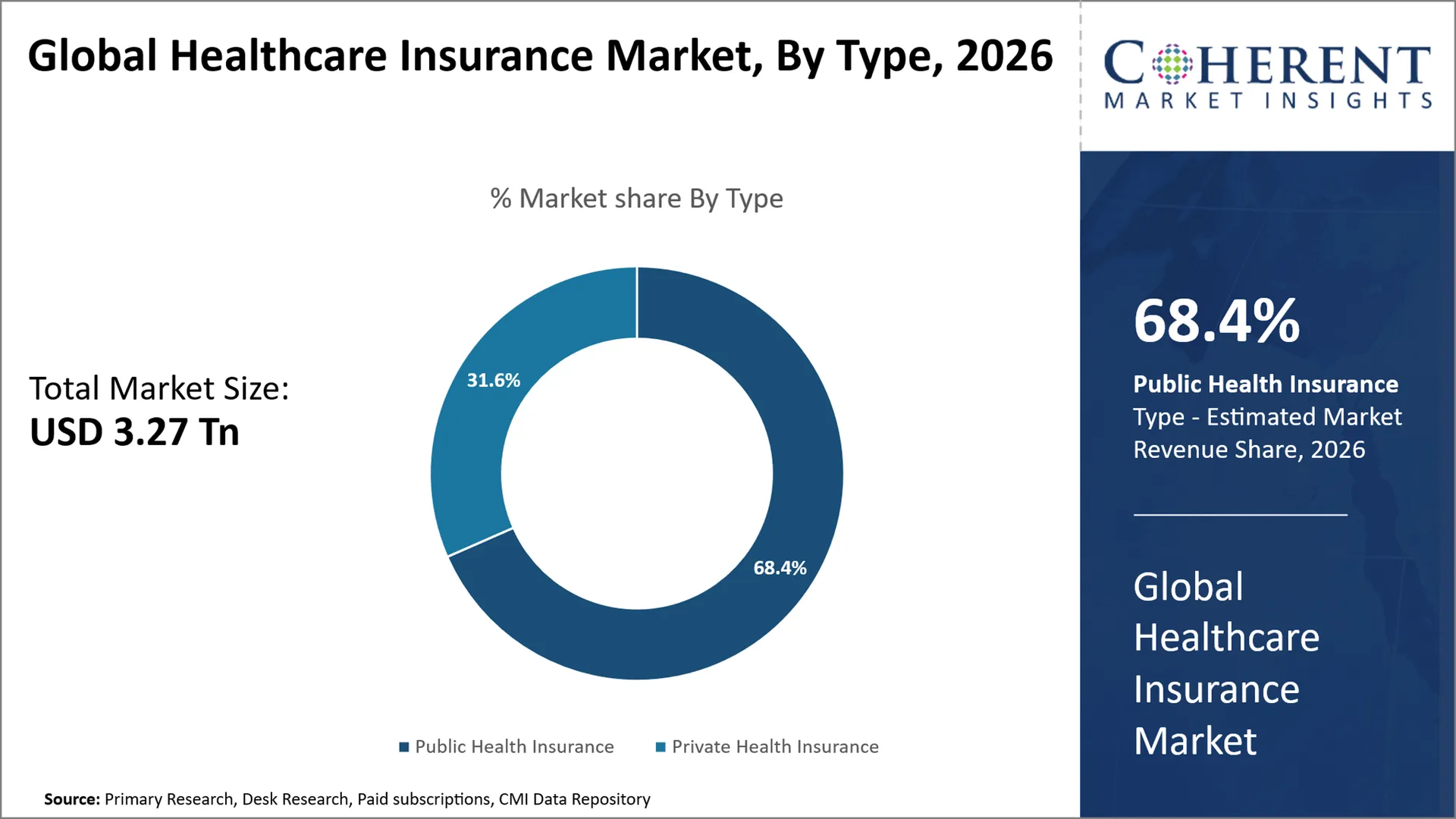
Why Do Public Health Insurance Dominate the Global Healthcare Insurance Market?
Public health insurance is projected to hold the market share of 68.4% in 2026, aided by extensive government-funded schemes, extensive beneficiaries, and an increased emphasis on economical and equitable healthcare. Government schemes cover low income and at-risk populations and limit their exposure to high expenses of medical treatment. For instance, the U.S. government reported 68.9 million Medicare enrollees and 78.1 million Medicaid and CHIP enrollees in 2025, reinforcing the extensive scale of publicly funded health insurance coverage. (Source: SeniorLiving.org)
- Current Industry Events of 2026
- Market Size Estimation
- Regional Breakdown
- Competitive Landscape
- Customer Intelligence
- Segmental Analysis
- Pricing Analysis
- Key Market Drivers, Challenges & Future Trends
- Customized Insights Section
Why Does Group Represent the Largest Coverage Segment in the Healthcare Insurance Market?
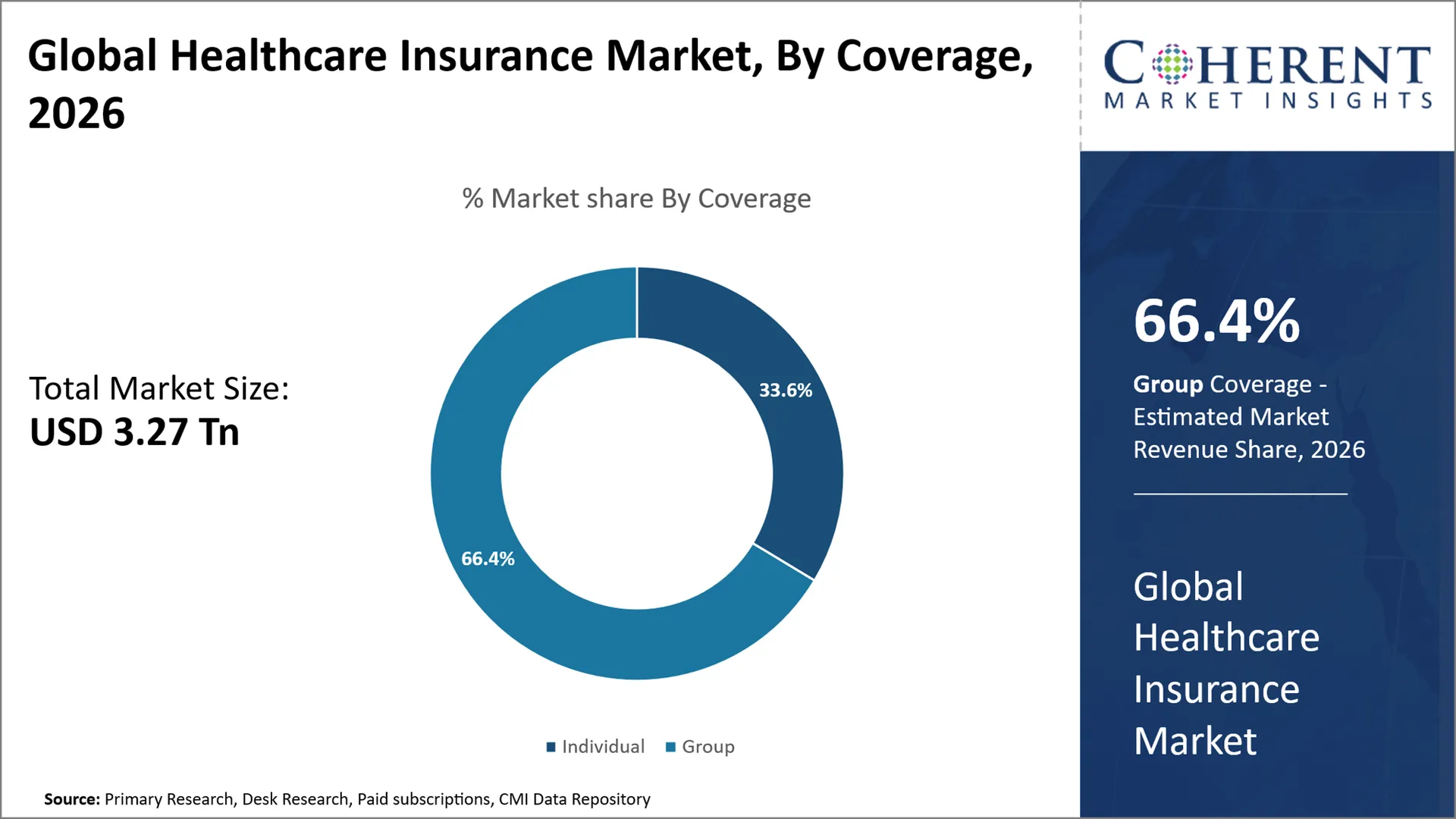
Group is projected to hold a market share of 66.4% in 2026, because of widespread employer sponsored healthcare benefits, risk pooling and greater coverage at a lower cost. Employer-based plans help retain existing employees and lower their individual healthcare costs. For instance, according to Statistics Canada, 66.8% of workers had workplace medical or dental benefits through their primary job in 2024, up from 63.3% in 2021, demonstrating employers' importance in providing group coverage. (Source: Government of Canada)
Intermediaries Segment Dominates the Global Healthcare Insurance Market
The intermediaries segment is projected to hold a market share of 47.3% in 2026, due to their ability to guide consumers with tailored advice, to demystify difficult policy decisions, and to accompany the consumer through the lifecycle of the insurance policy. Brokers and agents broaden an insurer's reach through existing customer and business networks. For instance, European Insurance and Occupational Pensions Authority (EIOPA), reported that agents and brokers remained the main distribution channels across most EU markets in 2024.
Currents Events and their Impact
Current Events | Description and its Impact |
U.S. Centers for Medicare & Medicaid Services (CMS) Final Rule Strengthening Health Insurance Exchanges (May 2026) |
|
India Insurance Laws Amendment Passed by Parliament (December 2025) |
|
India GST Exemption for Individual Health Insurance (September 2025) |
|
Healthcare Insurance Market Dynamics
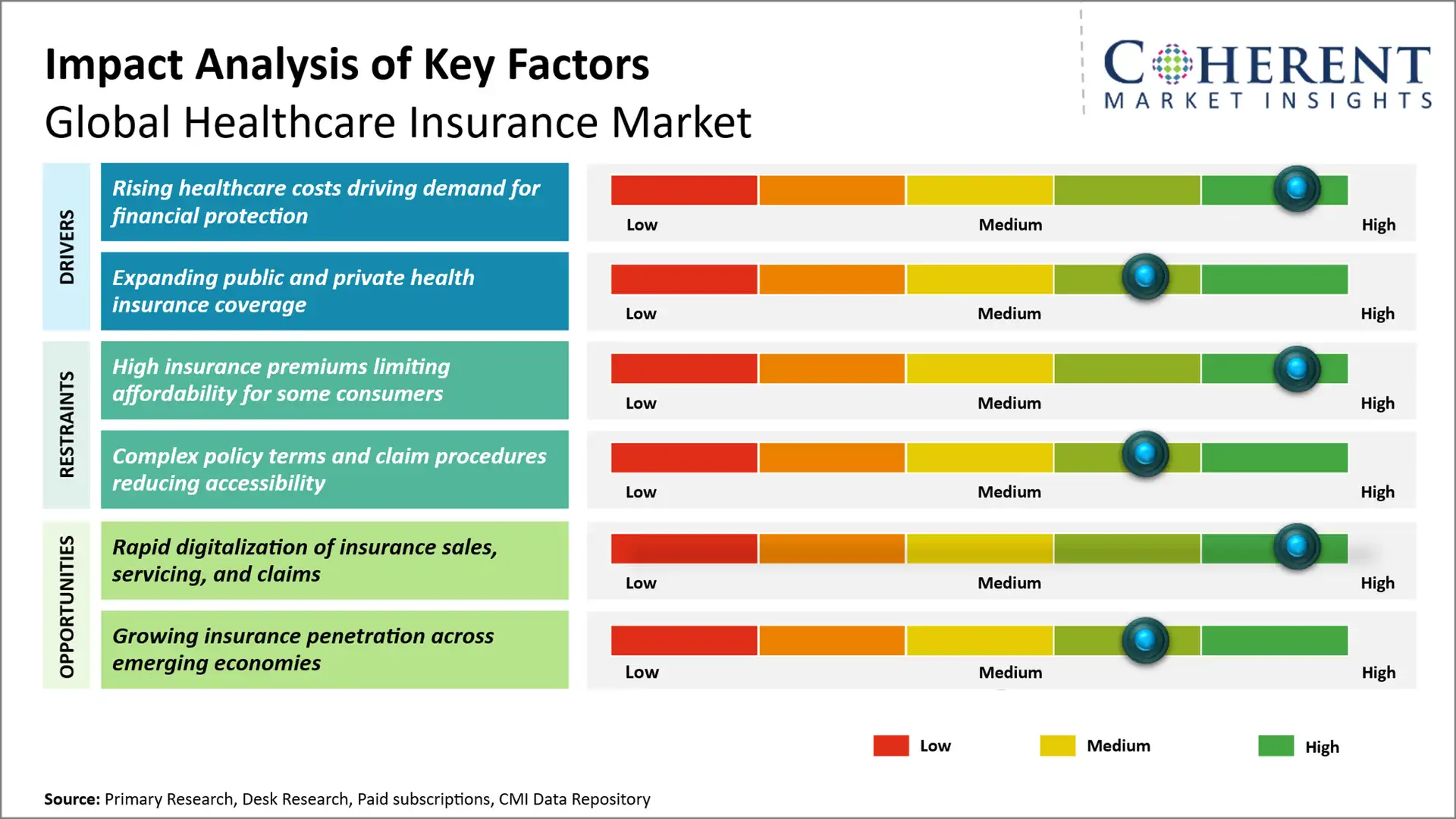
Market Drivers
- Rising healthcare costs driving demand for financial protection: Rising healthcare costs are increasing the financial burden on individuals and households, driving demand for health insurance that protects against high medical and out-of-pocket expenses. For instance, according to the WHO–World Bank 2025 UHC Global Monitoring Report, 2.1 billion people experienced financial hardship from out-of-pocket healthcare spending in 2022, while 4.6 billion lacked full coverage of essential health services in 2023. The persistent financial exposure to healthcare costs is strengthening the need for risk-pooling and prepaid health coverage globally.
- Expanding public and private health insurance coverage: Expanding government-backed health programs and private health insurance enrollment is increasing the population covered by healthcare financing schemes, particularly in emerging and underserved markets. For instance, India’s Ministry of Health and Family Welfare reported that AB-PMJAY’s beneficiary base increased to 120 million (12 crore) families, while the scheme became operational across all 36 States and Union Territories in July 2026. The expansion of publicly funded coverage is expected to improve insurance penetration and create further demand for complementary private health insurance products.
- Increasing healthcare utilization and hospitalization demand: Increasing utilization of healthcare services is strengthening the need for financial coverage against hospitalization, outpatient treatment, and other medical expenses. For instance, the OECD reported that hospital discharge rates across OECD countries averaged 127 discharges per 1,000 population in 2023, reflecting sustained demand for hospital-based care. Higher healthcare utilization increases exposure to medical costs and supports demand for comprehensive health insurance coverage.
Emerging Trends
- AI-powered underwriting and claims processing: Insurers are increasingly adopting artificial intelligence and advanced analytics to automate underwriting, fraud detection, assess risks, and accelerate claims processing. These technologies are improving operational efficiency while enabling more personalized insurance offerings.
- Expansion of digital and embedded health insurance: Digital platforms, mobile applications, and embedded insurance models are expanding access to healthcare coverage by enabling consumers to purchase and manage policies through online channels. This trend is particularly gaining traction in emerging markets with growing smartphone and digital-payment adoption.
- Personalized and preventive health insurance models: Insurers are increasingly incorporating wellness programs, preventive-care benefits, and health data analytics into insurance products to encourage healthier behaviors and reduce long-term claims costs. Usage-based and personalized coverage models are also gaining adoption as insurers seek to align premiums with individual risk profiles.
Regional Insights
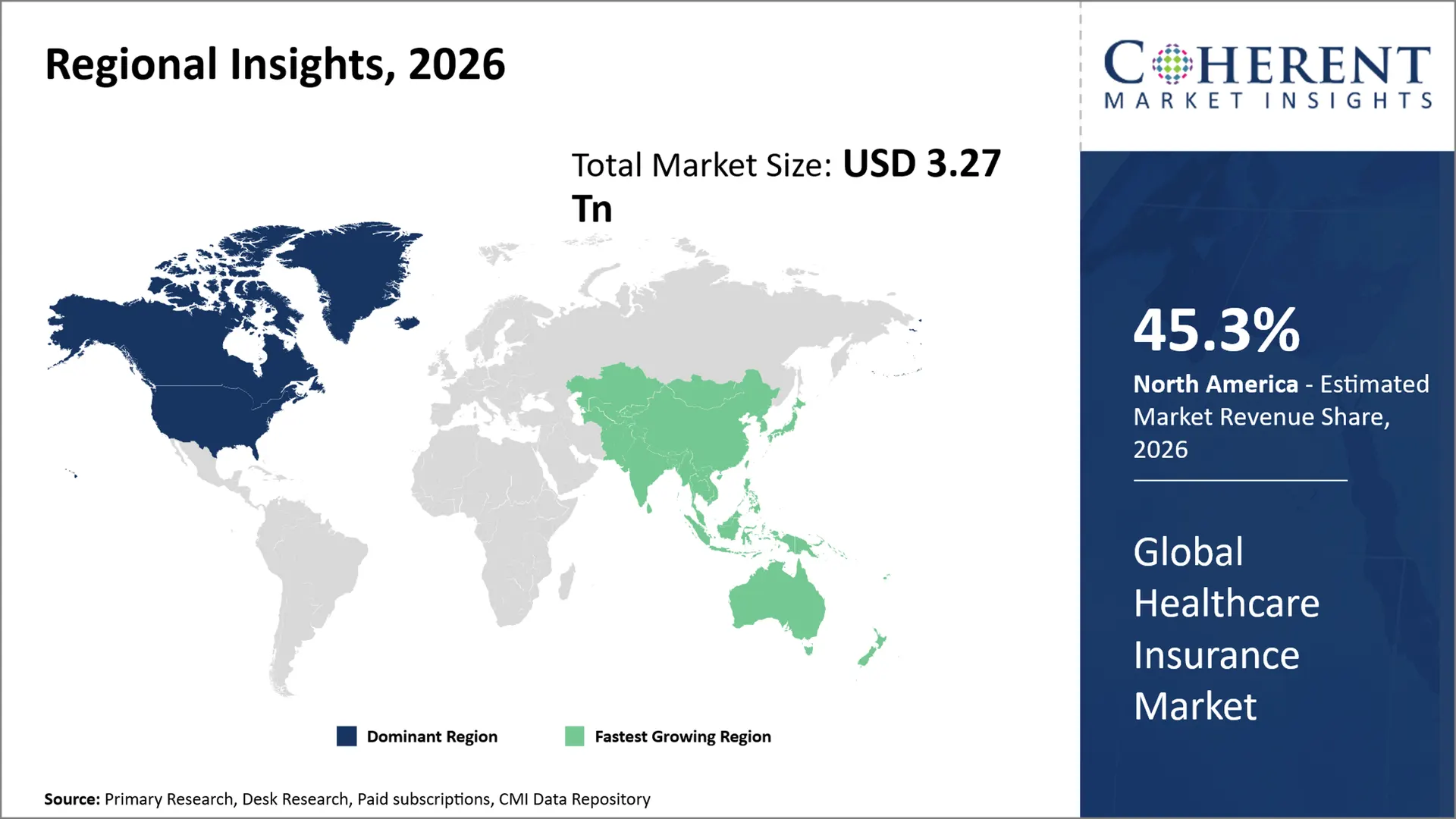
Why is North America a Strong Market for Healthcare Insurance?
North America leads the global healthcare insurance market, accounting for an estimated 45.3% share in 2026, by virtue of a well-established healthcare network, high patient coverage, high healthcare expenditure, and insurance penetration. The countries in the region such as Canada and the U.S., have a highly regulated insurance industry, primarily due to increased government-funded policies regarding healthcare coverage and penetration and institutionalized healthcare delivery infrastructure.
For instance, the Canada Health Act specifies that all provinces and territories must establish publicly administered health insurance plans to provide comprehensive coverage of all medically necessary hospital and physician services based on uniform terms and conditions, including no out-of-pocket costs to the patient. (Source: Government of Canada) Furthermore, the mature healthcare delivery system and mature public-private insurance operating structures further sustain demand for diverse healthcare coverage.
Why Does Asia Pacific Healthcare Insurance Market Exhibit High Growth?
Asia Pacific is expected to exhibit the fastest growth in the global Healthcare Insurance market, registering an estimated CAGR of 7.0% during 2026–2033. The region is projected to account for 20.2% of the global market in 2026, owing to rapid economic growth, increasing healthcare spend, expanding middle-class people and growing insurance penetration in emerging economies.
Governments' efforts to strengthen the public health infrastructure and insurance penetration would be key growth drivers of the market, as rising private sector participation and digitization facilitate healthcare insurance access. For instance, according to the National Healthcare Security Administration of China, 1.32 billion (around 95%) of the population had basic medical insurance in 2024, highlighting the country’s extensive government-backed healthcare coverage and strong insurance penetration. (Source: The People’s Republic of China)
Global Healthcare Insurance Market Outlook for Key Countries
Why is the U.S. Leading Innovation and Adoption in the Healthcare Insurance Market?
The U.S. is the leader in healthcare insurance innovation owing to its deeply mature ecosystem of private health insurance companies, strong digital health technology infrastructure, and mature adoption of technology within the areas of underwriting, claims processing, and care management. The market has a strong degree of integration among insurers, providers, digital health companies, and data-driven risk management providers.
Is Japan a Favorable Market for Healthcare Insurance Market?
Japan represents an attractive healthcare insurance market, aided by near-universal health coverage, a mature public insurance system, an aging population and continued demand for both medical and long-term care services. Private insurers have potential to introduce products to supplement the public system for care that does not fully cover medical costs.
Is China Emerging as a Key Growth Hub for the Healthcare Insurance Market?
China remains an important growth driver with greater penetration of government schemes and insurance, increasing health spending, higher commercial health insurance demand and easier access to healthcare. A huge population and further liberalization of the healthcare ecosystem also open opportunities for greater insurance penetration.
Why Does Germany Top the European Healthcare Insurance Market?
Germany leads the European healthcare insurance market owing to state systems, large coverage populations and the importance of private supplementary and substitutive insurance. A dual public-private system ensures majority of the population are well covered by publicly funded schemes while consumers also have the choice of private plans.
Is Healthcare Insurance Market Developing in France?
France constitutes a matured insurance market characterized by a universal Statutory Health Insurance (SHI) system combined with a broad coverage of complementary private health insurance. A well-balanced amount of public reimbursement, with private complementary cover explains the efficiency of demand for private health insurance.
Healthcare Insurance Coverage by Selected Country, 2024
Country | Population Covered for Core Healthcare Services (%) | Public & Primary Private Coverage (%) |
Australia | 100% | 100% |
Canada | 100% | 100% |
UK | 100% | 100% |
Germany | 89% | 89% |
France | 100% | 100% |
The Netherlands | 100% | 100% |
Belgium | 98% | 98% |
Japan | 100% | 100% |
South Korea | 100% | 100% |
U.S. | ~96% | ~96% |
Mexico | 78% | 78% |
Colombia | 99% | 99% |
Chile | 83% | 83% |
Türkiye | 99% | 99% |
How is the rapid digitalization of insurance sales, servicing, and claims creating new growth opportunities in the healthcare insurance market?
Digitalizing healthcare insurance quickly using an array of digital tools-such as AI and ML, analytics, telemedicine, and mobile devices-healthcare insurers can streamline policy issuance, automate underwriting, digitally onboard clients, process claims, and serve the insured. These digital capabilities are enabling health insurers to personalize coverage, assess risk more accurately, and reduce costs of administration and customer engagement. Digital claims and servicing platforms can help improve claims processing, reduce fraud and increase transparency. For instance, in 2025, the U.S. National Association of Insurance Commissioners (NAIC) reported that 84% of surveyed health insurers were employing AI/ML in functions including claims adjudication, fraud detection, prior authorization and risk management, highlighting the ongoing expansion of AI into core health insurance processes.
Market Players, Key Development, and Competitive Landscape
Key Developments
- In August 2026, Prudential HCL Health Insurance commenced operations in India after receiving its Certificate of Registration from the Insurance Regulatory and Development Authority of India (IRDAI). The 70:30 joint venture between Prudential plc and HCL Group entered India’s rapidly expanding health insurance market. The insurer plans to leverage digital and AI-enabled capabilities to provide customer-centric health insurance solutions, strengthening competition and expanding insurance offerings in the Indian market.
- In August 2026, KKR announced an agreement to acquire Medicover India, a multispecialty hospital network comprising 24 hospitals and approximately 4,800 beds across South and West India. The investment is expected to support further expansion of healthcare infrastructure, clinical capabilities, technology, and access to advanced medical services. The transaction reflects growing investment in India’s healthcare ecosystem, supported by rising healthcare spending and insurance penetration.
- In June 2026, Bupa announced an agreement to acquire Partnered Health Group in Australia, subject to regulatory approval. The acquisition would add 68 primary care clinics and three urgent care clinics to Bupa’s healthcare network, alongside corporate health and wellbeing services. The expansion is expected to strengthen Bupa’s integrated healthcare capabilities and improve access to healthcare services for its customers across Australia.
- In April 2026, Jio Financial Services Limited and Allianz Group entered into a binding agreement to establish a 50:50 primary insurance joint venture in India covering general and health insurance. The partnership combines Jio Financial Services’ digital capabilities and distribution reach with Allianz’s global insurance expertise. The joint venture is expected to expand access to innovative and digitally enabled health insurance solutions across India, subject to statutory and regulatory approvals.
Competitive Landscape
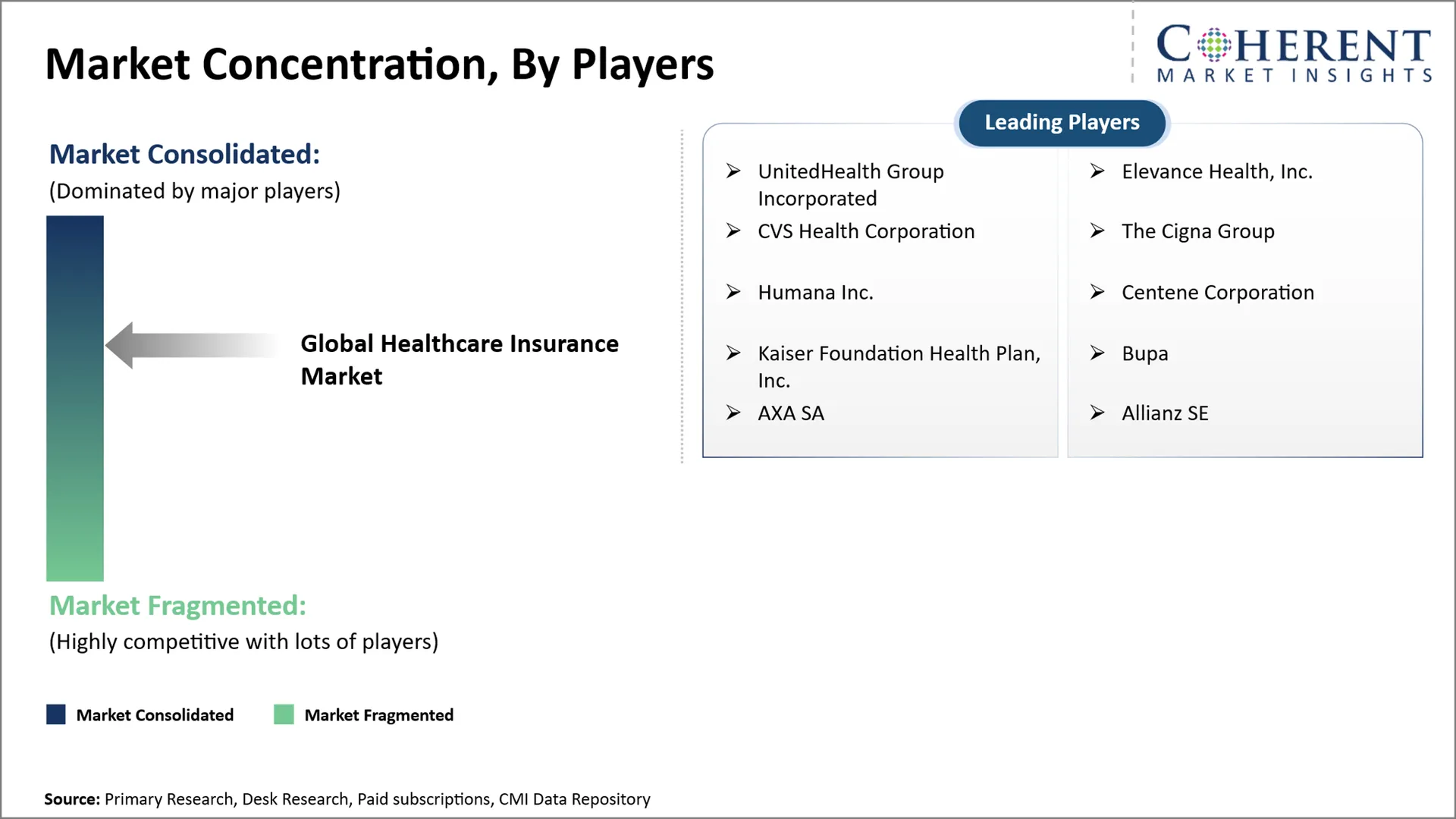
The global healthcare insurance market is highly competitive, with competition centered on coverage breadth, premium affordability, claims efficiency, digital accessibility, customer experience, and provider-network strength. Market participants are increasingly investing in digital platforms, AI-driven underwriting and claims management, personalized insurance products, and integrated healthcare ecosystems to strengthen customer retention and expand coverage. Key focus areas include:
- Expansion of digital and omnichannel insurance distribution
- Integration of AI and automation in underwriting, claims, and fraud detection
- Development of personalized and preventive health insurance products
- Integration of telemedicine, digital health, and remote-care services
- Expansion of healthcare provider networks and value-based care models
Market Report Scope
Healthcare Insurance Market Report Coverage | |||
Report Coverage | Details | ||
Base Year | 2025 | Market Size in 2026: | USD 3.27 Tn |
Historical Data For: | 2020 To 2024 | Forecast Period: | 2026 To 2033 |
Forecast Period 2026 To 2033 CAGR: | 5.7% | 2033 Value Projection: | USD 4.82 Tn |
Geographies covered: |
| ||
Segments covered: |
| ||
Companies covered: | UnitedHealth Group Incorporated, Elevance Health, Inc., CVS Health Corporation, The Cigna Group, Humana Inc., Centene Corporation, Kaiser Foundation Health Plan, Inc., Bupa, AXA SA, Allianz SE | ||
Growth Drivers: |
| ||
Restraints & Challenges: |
| ||
Analyst Opinion (Expert Opinion)
- In the coming years, the global healthcare insurance market is expected to shift from traditional reimbursement-focused models toward digitally enabled, preventive, and personalized coverage models. Insurers will increasingly combine AI, digital health platforms, telemedicine, and data-driven underwriting to improve affordability, claims efficiency, customer engagement, and risk management. The industry is also expected to see stronger integration between public and private healthcare financing systems, particularly across emerging economies.
- The maximum opportunities will probably exist within private health insurance for individual coverage in India. India offers substantial room for private insurance expansion as healthcare costs rise, insurance penetration remains below mature-market levels, and digital distribution enables insurers to reach previously underserved consumers. Players that develop affordable, flexible, digitally purchased individual plans with outpatient, preventive, and hospitalization benefits are likely to capture the strongest incremental demand.
- In order to obtain a competitive advantage, market participants should prioritize technology-led differentiation rather than competing primarily on premiums. Investments in AI-enabled underwriting and claims, seamless digital onboarding, personalized products, broad healthcare-provider networks, and faster claims settlement can strengthen customer retention and operating efficiency. Insurers should also develop tiered and modular products that address different income groups while using data-driven pricing to balance affordability with profitability.
Speak to the analyst
Want personalized insights?
Take the findings above to one of our principal consultants, or have the report rebuilt around the segments, geographies and competitors you actually track.
Market Segmentation
- Type Insights (Revenue, USD Tn, 2021 - 2033)
- Public Health Insurance
- Private Health Insurance
- Coverage Insights (Revenue, USD Tn, 2021 - 2033)
- Individual
- Group
- Distribution Channel Insights (Revenue, USD Tn, 2021 - 2033)
- Direct Sales
- Intermediaries
- Online
- Regional Insights (Revenue, USD Tn, 2021 - 2033)
- North America
- U.S.
- Canada
- Latin America
- Brazil
- Argentina
- Mexico
- Rest of Latin America
- Europe
- Germany
- U.K.
- Spain
- France
- Italy
- Russia
- Rest of Europe
- Asia Pacific
- China
- India
- Japan
- Australia
- South Korea
- ASEAN
- Rest of Asia Pacific
- Middle East
- GCC Countries
- Israel
- Rest of Middle East
- Africa
- South Africa
- North Africa
- Central Africa
- North America
- Key Players Insights
- UnitedHealth Group Incorporated
- Elevance Health, Inc.
- CVS Health Corporation
- The Cigna Group
- Humana Inc.
- Centene Corporation
- Kaiser Foundation Health Plan, Inc.
- Bupa
- AXA SA
- Allianz SE
Sources
Primary Research Interviews
- Health insurance executives and underwriting professionals involved in policy design, pricing, risk assessment, and portfolio management
- Healthcare insurance claims and benefits specialists responsible for claims administration, utilization management, and fraud detection
- Insurance brokers, agents, and distribution professionals involved in individual and group health insurance sales
- Healthcare providers and hospital administrators involved in insurer-provider contracting, reimbursement, and network management
- Healthcare technology and digital-health professionals involved in AI-enabled underwriting, claims automation, telemedicine, and digital insurance platforms
Stakeholders
- Public and private health insurance providers
- Health insurance brokers, agents, and third-party administrators
- Hospitals, clinics, and healthcare provider networks
- Employers and organizations purchasing group health insurance
- Healthcare technology, digital-health, and insurtech providers
- Policyholders and healthcare consumers
- Reinsurance companies and insurance service providers
- Government healthcare programs and public health financing agencies
- End-use Sectors
- Hospitals and multispecialty healthcare centers
- Clinics and ambulatory healthcare facilities
- Corporate and employer-sponsored healthcare programs
- Government and public healthcare programs
- Individual and family healthcare coverage
- Long-term care and senior healthcare services
- Telehealth and digital healthcare services
- Preventive and wellness healthcare programs
- Regulatory & Health Bodies
- Centers for Medicare & Medicaid Services (CMS), U.S.
- U.S. Department of Health and Human Services (HHS), U.S.
- National Association of Insurance Commissioners (NAIC), U.S.
- European Insurance and Occupational Pensions Authority (EIOPA), Europe
- Insurance Regulatory and Development Authority of India (IRDAI), India
- Financial Conduct Authority (FCA), U.K.
- Prudential Regulation Authority (PRA), U.K.
- Australian Prudential Regulation Authority (APRA), Australia
- Health Insurance Authority (HIA), Ireland
- World Health Organization (WHO)
Databases
- CMS Medicare and Medicaid Data
- CMS Health Insurance Marketplace Data
- WHO Global Health Observatory
- OECD Health Statistics
- World Bank Health, Nutrition and Population Database
- IRDAI Insurance Statistics and Annual Reports
- EIOPA Insurance Statistics
- NAIC Insurance Regulatory Information System (IRIS)
- U.S. Census Bureau Health Insurance Data
Journals
- The Lancet
- Journal of Health Economics
- Health Economics
- International Journal of Health Economics and Management
- BMC Health Services Research
- International Journal for Equity in Health
- Journal of Risk and Insurance
- The Geneva Papers on Risk and Insurance – Issues and Practice
Associations
- National Association of Insurance Commissioners (NAIC)
- American Health Insurance Plans (AHIP)
- International Insurance Society (IIS)
- Insurance Information Institute (Triple-I)
- Geneva Association
- European Insurance and Reinsurance Federation (Insurance Europe)
- International Association of Insurance Supervisors (IAIS)
- Global Federation of Insurance Associations (GFIA)
Public Domain Sources
- CMS – Medicare, Medicaid, Health Insurance Marketplace enrollment, coverage, premiums, and policy data
- IRDAI – Health insurance regulations, insurer registrations, products, claims, premiums, and policyholder information
- WHO – Universal health coverage, health financing, insurance schemes, and global healthcare expenditure data
- OECD – Healthcare coverage, health expenditure, insurance financing, and cross-country health statistics
- World Bank – Health expenditure, financial protection, and healthcare coverage indicators
- EIOPA – European insurance market, premiums, distribution, and regulatory statistics
- NAIC – U.S. insurance market, regulatory, health insurance, and insurer data
Proprietary Elements
- CMI Data Analytics Tool, Proprietary CMI Existing Repository of information for last 10 years.
Get access to 250+ pages report
Every segment, forecast, competitor profile and data table behind the analysis above — available for instant download.
- ESOMAR Member
- ISO 9001:2015 Certified
- D-U-N-S Registered
- GDPR & CCPA Compliant
Missing comfort of reading report in your local language? Find your preferred language:
Frequently Asked Questions
The global healthcare insurance market is estimated to be valued at USD 3.27 Tn in 2026 and is expected to reach USD 4.82 Tn by 2033.
Public health insurance dominates due to broad government-backed coverage, large beneficiary pools, and extensive public healthcare programs.
Healthcare insurance provides financial coverage against medical and healthcare expenses, including hospitalization, treatment, and related healthcare services.
The CAGR of global healthcare insurance market is projected to be 5.7% from 2026 to 2033.
Rising healthcare costs driving demand for financial protection, and expanding public and private health insurance coverage are the major factors driving the growth of the global healthcare insurance market.
High insurance premiums limiting affordability for some consumers, and complex policy terms and claim procedures reducing accessibility are the major factors hampering the growth of the global healthcare insurance market.
In terms of coverage, group are estimated to dominate the market revenue share in 2026.