

Health Insurance Market Size and Trends - 2026 to 2033
The Health Insurance Market is estimated to be valued at USD 3,775.0 Mn in 2026 and is expected to reach USD 7,309.6 Mn by 2033, growing at a compound annual growth rate (CAGR) of 9.9% from 2026 to 2033.
Key Takeaways
- Based on Distribution Channel, the Direct Sales segment is expected to lead the market with 63.1% share in 2026, as it helps in reducing acquisition costs and building customer trust.
- Based on Insurance Type, the Diseases Insurance segment is expected to lead the market with the highest share in 2026, due to increasing burden of chronic diseases.
- Based on Coverage, the Preferred Provider Organizations (PPOs) segment is expected to lead the market with a major share in 2026, due to broader networks.
- Based on End User, the Group segment is expected to hold a major share of the market in 2026, driven by increasing employee wellness focus.
- Based on Age Group, the Senior Citizens segment is projected to account for the highest share in 2026, due to growing geriatric population.
- Based on Region, North America is set to lead the Health Insurance Market with 62.1% share in 2026. While, Asia Pacific is anticipated to be the fastest growing region.
Market Overview
The Health Insurance Market includes premium payments, claims processing, and reimbursements between insurers, healthcare providers, employer and patients. The industry is growing substantially due to rising healthcare costs, an aging population and increasing chronic diseases.
The Health Insurance Market is trending towards the greater digitalization and automation of payment processes. Healthcare organizations are increasingly adopting digital payment solution with patients using smartphones and secure mobile banking applications to settle bills, insurance premiums, and prescription costs online. Cloud-based platforms are enabling greater scalability, improved security, and accessibility. API driven integration allows payment systems to seamlessly connect with Electronic Health Record systems and practice management software.
Current Events and Its Impacts on the Health Insurance Market
Current Event | Description and the Impact |
Technological Advancements |
|
Regulatory and Policy Developments |
|
Industry-Specific Market Dynamics |
|
Role of AI (Artificial Intelligence) in Health Insurance
Artificial Intelligence (AI) plays a transformative role in health insurance by improving accuracy, efficiency, and personalization. AI helps insurers assess risk more precisely by analyzing health data, lifestyle patterns, and medical histories. It enables personalized policy recommendations, ensuring customers receive coverage that matches their needs. AI also streamlines claims processing through automation, reducing fraud and speeding up approvals. Chatbots and virtual assistants enhance customer support by providing instant responses and guidance. Additionally, AI-driven analytics support preventive healthcare by identifying potential health risks early, benefiting both insurers and policyholders through better outcomes and cost control.
In April 2025, Future Generali India Insurance (FGII) launched Health Shield Advisor, an industry-first AI-powered tool that helps individuals determine the right health insurance coverage based on their lifestyle and needs.
- Current Industry Events of 2026
- Market Size Estimation
- Regional Breakdown
- Competitive Landscape
- Customer Intelligence
- Segmental Analysis
- Pricing Analysis
- Key Market Drivers, Challenges & Future Trends
- Customized Insights Section
Segmental Insights
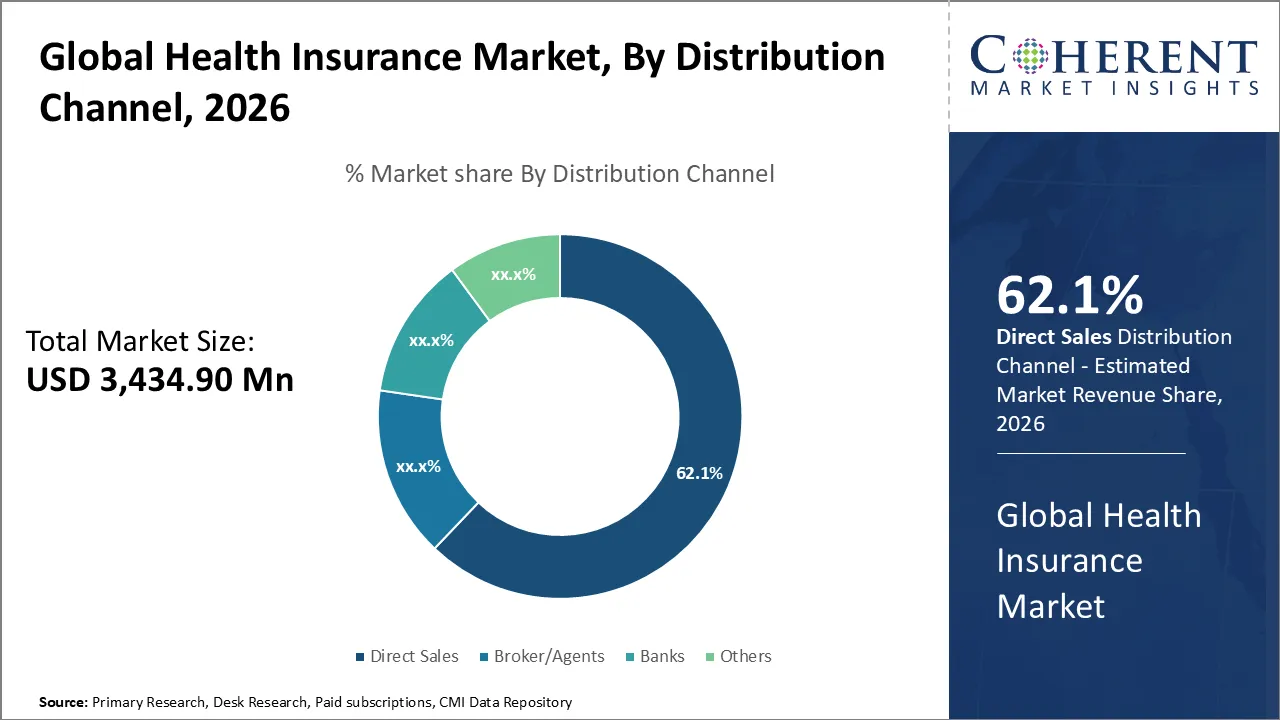
Health Insurance Market Insights By, Distribution Channel - Personalized Customer Service Drives Preference for Direct Sales
In terms of distribution channel, direct sales segment contributes the highest share of 63.1% in 2026 of the market owing to their personalized customer service and customized policy recommendations. Potential customers can gain trust and confidence from agents' ability to adequately explain complicated policy terms, coverage alternatives, and premium structures through in-person conversations. Insurance companies can better retain their clientele and gather insightful input for new product development by using direct sales channels.
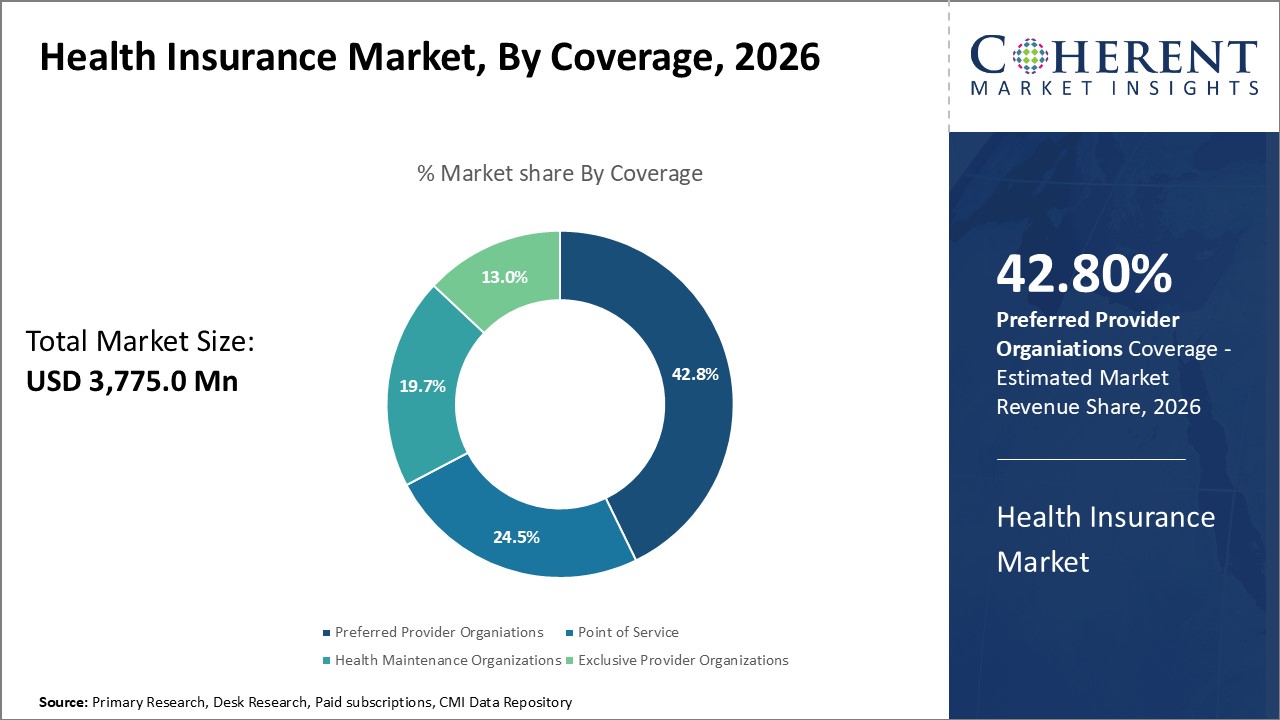
Health Insurance Market Insights By, Coverage - Flexibility and Wider Healthcare Provider Choices Drives Priority for Preferred Provider Organizations (PPOs)
In terms of coverage, the Preferred Provider Organizations (PPOs) contribute the highest share in 2026 of the market. The growth is owing to the flexibility and wider healthcare provider choices that PPO plans offer to policyholders. Unlike restrictive plans, PPO coverage allows members to visit any healthcare provider without requiring referrals, though staying within the preferred network offers lower out-of-pocket costs. The segment’s popularity is also due to the balance it provides between flexibility and affordability. PPO plans appeal to individuals who value the freedom to choose their doctors and specialists while still benefitting from negotiated rates with network providers.
Health Insurance Market Insights, By End User - Group Leads Owing to its Cost Benefits
In terms of end user, the group segment is expected to lead the market with largest share in 2026, due to the wide use of employer-sponsored health insurance programs that provide coverage to employees and their families. Group health insurance plans offer cost benefits through bulk buying and shared risk, making them more affordable than individual policies while providing complete coverage. The growth is also supported by mandatory corporate wellness programs and legal requirements for employe health coverage in many regions.
Regional Insights
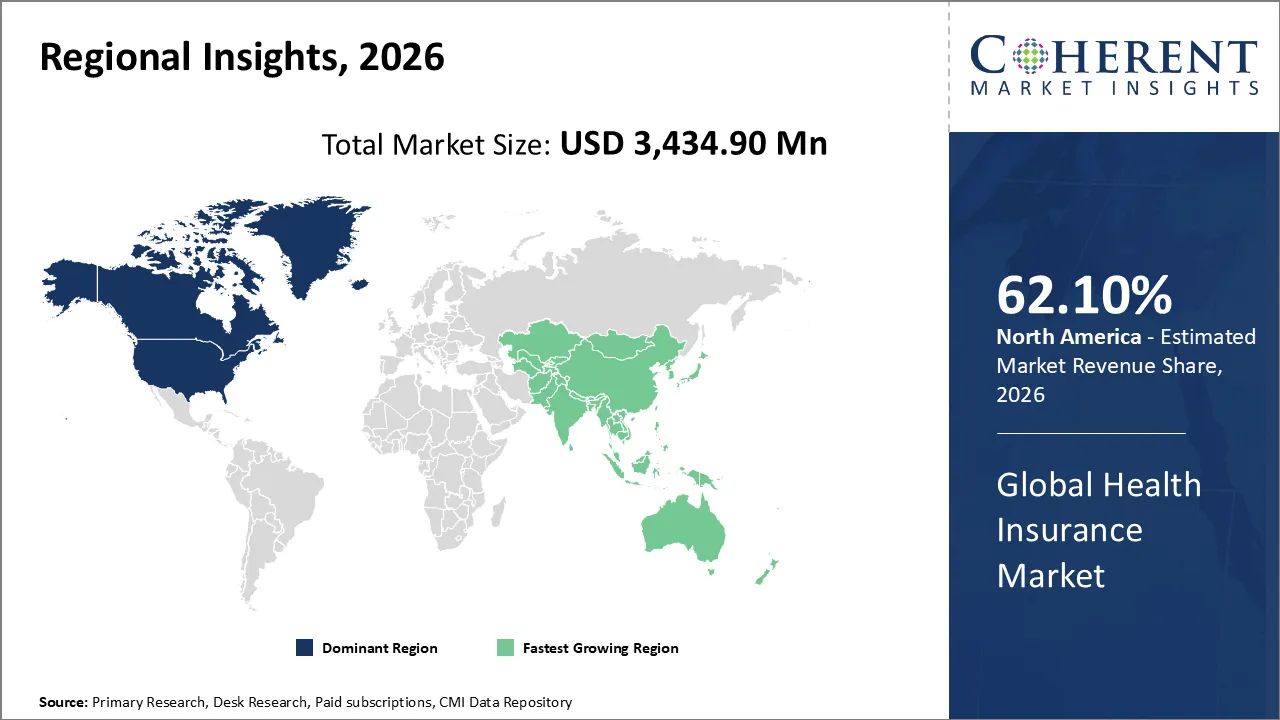
North America Health Insurance Market Analysis & Trends
North America has remained the dominant region with 62.1% in 2026 of the global Health Insurance Market over the past decade. The aging population is driving the demand for comprehensive medical coverages because elderly people require more frequent healthcare services. Employers and individuals are looking for better insurance options to safeguard their finances from medical bills due to rising healthcare costs. The Affordable Care Act in the United States and universal improvements in Canada are two examples of government measures that are broadening market reach. Through data analytics and artificial intelligence, insurers can now provide customized plans owing to the technological breakthroughs, improving client involvement and experience. The growing prevalence of chronic diseases is creating demand for long term care coverage.
For instance, in October 2026, Oscar Health, Inc. a prominent healthcare technology firm unveiled a range of user-friendly insurance plans and AI-powered tools for the 2026 enrollment period. Individuals managing conditions like diabetes, COPD, asthma, and cardiovascular-kidney-metabolic syndrome can reduce their annual expenses by approximately USD 800 through specialized plans developed by Oscar clinicians.
Asia Pacific Health Insurance Market Analysis & Trends
The Asia Pacific region has emerged as the fastest growing market globally in recent years. There is a significant need for universal healthcare coverage due to the increasingly aging populations of nations like South Korea, China, and Japan. More people are able to buy private health insurance policies owing to growing middle class populations and increased disposable incomes in the region. Customers are also looking for financial security through insurance products as a result of rising healthcare expenditures. The region's market is expanding more quickly because of government programs that support universal healthcare coverage and insurance penetration. The growing awareness about preventive healthcare and wellness is driving demand for diverse insurance offerings. The rising prevalence of chronic diseases and lifestyle related conditions is also necessitating long term coverage solutions. All these factors are driving the growth of the market in the region.
For instance, in December 2026, STAR Health Insurance launched an advertising initiative showcasing prominent figures from India’s cinema and music industries. The campaign uses everyday scenarios to inspire families nationwide to integrate health coverage decisions naturally into their daily routines.
Health Insurance Market Outlook Country-Wise
The U.S. Health Insurance Market Trends
In 2026, the market in the U.S. is expected to be strong owing to the presence of private insurers and government programs like Medicare and Medicaid. The growth is also attributable to the aging population requiring more coverage and rising healthcare costs necessitating insurance protection. The increasing chronic diseases is also fueling demand as more Americans require ongoing coverage for diabetes, heart disease, cancer and other long-term conditions.
China Health Insurance Market Trends
In 2026, the market in China is booming. The rising middle class now has sufficient disposable income to invest in comprehensive health insurance coverage for their families. Government healthcare reforms are actively promoting universal coverage and improving accessibility to medical services for all citizens nationwide. The pandemic has heightened healthcare awareness making people more proactive about securing adequate medical protection and coverage.
Market Report Scope
Health Insurance Market Report Coverage
| Report Coverage | Details | ||
|---|---|---|---|
| Base Year: | 2025 | Market Size in 2026: | USD 3,775.0 Mn |
| Historical Data for: | 2020 To 2024 | Forecast Period: | 2026 To 2033 |
| Forecast Period 2026 to 2033 CAGR: | 9.9% | 2033 Value Projection: | USD 7,309.6 Mn |
| Geographies covered: |
| ||
| Segments covered: |
| ||
| Companies covered: | Aetna Inc., AIA Group Limited, Allianz, Assicurazioni Generali S.P.A., AVIVA, AXA, CIGNA, Ping an Insurance, and UnitedHealth Group Inc., among others. | ||
| Growth Drivers: |
| ||
| Restraints & Challenges: |
| ||
Health Insurance Market Drivers
Growing geriatric population
The rising number of elderly populations is a major force driving the health insurance market growth worldwide. Seniors now occupy a greater portion of the population in need of health insurance as life expectancy rises and birth rates fall in developed countries. Diabetes, heart disease, and joint difficulties are common among older adults which necessitates frequent medical visits, prescription drugs, and specialized care. Insurance firms are being forced by this age shift to come up with geriatric-specific plans that cover prescription medications, nursing care services, and ongoing medical care. Government’s also feel pressure to provide affordable options for retirees through programs like Medicare. Since elderly population spend much more on healthcare than younger individuals they represent a significant business opportunity for insurers.
For instance, in July 2025, Galaxy Health Insurance introduced Galaxy Privilege, a specialized insurance solution tailored for elderly individuals. This plan provides advantages centered on wellbeing, autonomy, and financial stability. It also accompanies senior policyholders throughout their healthcare needs. It is available within 12 months of policy activation.
Health Insurance Market Trends
Growing demand for personalized and "consumption-first" policies
Instead of generic, standardized solutions, today's consumers are demanding health insurance policies that are customized to their own needs, lifestyle, and financial constraints. People nowadays prefer paying primarily for healthcare services they really use rather than comprehensive plans that cover everything because of this consumption-first strategy. Insurance companies are using technology like fitness trackers and health apps to monitor individual habits and provide discounts to those maintaining healthy lifestyles. Younger, health aware customers especially like policies where they can pick and choose specific benefits they need avoiding unnecessary coverage that raises costs. In order to meet these demands, insurers are providing adjustable deductibles, flexible plans, and pay as you go alternatives for specific treatments. This development illustrates how customers in all sectors now demand products that are tailored specifically for them. This also compels established insurance firms to use technologies and implement more flexible strategies.
For instance, in December 2023, Aditya Birla Capital's health insurance division, Aditya Birla Health Insurance Co. Limited, introduced "Activ One," a comprehensive yet simplified health insurance plan. This program provides policyholders customized solutions that support their overall wellness journey and meet their medical insurance needs.
Analyst Opinion (Expert Opinion)
The health insurance market represents a central pillar of global healthcare financing, supported by extensive premium volumes and broad population coverage. Industry data show that total global health insurance premiums run into the trillions annually, reflecting strong participation across public schemes, employer-sponsored plans, and individual policies. North America remains the largest regional market, driven by high per-capita healthcare spending and widespread enrollment in private and group insurance programs. Europe and Asia Pacific also contribute significantly, with expanding coverage penetration and policy diversification.
The market structure varies by region, with public health systems complemented by private insurance in many developed economies, while private insurers play a dominant role in employer-based and voluntary coverage models. Demographic trends such as population aging and the rising prevalence of chronic conditions continue to increase healthcare utilization, driving demand for comprehensive and specialized insurance products. In emerging economies, insurance enrollment is rising steadily, supported by growing middle-class populations and increased awareness of financial protection against medical expenses.
Operational data indicate a growing emphasis on cost management and efficiency, as insurers respond to sustained increases in treatment and pharmaceutical expenses. Digitalization is reshaping the market, with online platforms and automated claims processing improving customer engagement and reducing administrative turnaround times. Overall, the health insurance market is characterized by scale, regulatory complexity, and continuous adaptation to evolving healthcare utilization patterns and cost pressures.
Speak to the analyst
Want personalized insights?
Take the findings above to one of our principal consultants, or have the report rebuilt around the segments, geographies and competitors you actually track.
Health Insurance Industry News
- In December 2025, InsurTech platform CoverSure has introduced Policy Health Check, an innovative health insurance assessment tool designed to enable insurance holders to determine if their current health plans match their evolving medical requirements and lifestyle patterns.
- In October 2025, SBI General Insurance has unveiled Health Alpha, a flexible health insurance product. It allows customers to personalize their plans by modifying benefit levels, sum insured amounts, and exclusion periods instead of choosing from fixed policy packages.
- In July 2024, ICICI Lombard, a prominent private general insurer provider in India, launched ‘Elevate’, an innovative health insurance offering. This product incorporates AI-driven capabilities and features advanced customization tools and supplementary coverage options designed to address modern healthcare demands and rising treatment costs.
- In April 2025, Odisha took a significant leap toward achieving healthcare for all by implementing Ayushman Bharat-Pradhan Mantri Jan Arogya Yojana as a consolidated health coverage program. Program participants can now receive complimentary, cashless medical services at 29,000 public and private healthcare facilities nationwide.
Market Segmentation
- Distribution Channel Insights (Revenue, USD Bn, 2026 - 2033)
- Direct Sales
- Broker/Agents
- Banks
- Others
- Insurance Type Insights (Revenue, USD Bn, 2026 - 2033)
- Diseases Insurance
- Medical Insurance
- Coverage Insights (Revenue, USD Bn, 2026 - 2033)
- Preferred Provider Organizations (PPOs)
- Point of Service (POS)
- Health Maintenance Organizations (HMOs)
- Exclusive Provider Organizations (EPOs)
- End User Insights (Revenue, USD Bn, 2026 - 2033)
- Group
- Individuals
- Age Group Insights (Revenue, USD Bn, 2026 - 2033)
- Senior Citizens
- Adult
- Minors
- Regional Insights (Revenue, USD Bn, 2026 - 2033)
- North America
- U.S.
- Canada
- Latin America
- Brazil
- Argentina
- Mexico
- Rest of Latin America
- Europe
- Germany
- U.K.
- France
- Italy
- Russia
- Rest of Europe
- Asia Pacific
- China
- India
- Japan
- Australia
- South Korea
- ASEAN
- Rest of Asia Pacific
- Middle East & Africa
- GCC Countries
- South Africa
- Rest of Middle East & Africa
- Key Players Insights (Revenue, USD Mn, 2021 - 2033)
- Aetna Inc.
- AIA Group Limited
- Allianz
- Assicurazioni Generali S.P.A.
- AVIVA
- AXA
- CIGNA
- Ping an Insurance
- UnitedHealth Group Inc.
Sources
Primary Research Interviews
- Health Insurance Providers & Underwriters
- Public & Private Health Payers
- Health Policy Experts & Actuaries
- Hospital & Healthcare Network Administrators
- Third-Party Administrators (TPAs)
- Insurance Brokers & Distribution Partners
- Others
Databases
- Bloomberg Terminal
- Thomson Reuters Eikon
- Others
Magazines
- Health Affairs Magazine
- Modern Healthcare
- Managed Care Magazine
- Insurance Journal
- Healthcare Finance News
- Others
Journals
- Health Affairs
- Journal of Health Economics
- International Journal of Health Policy and Management
- BMC Health Services Research
- The Lancet Public Health
- Others
Newspapers
- Financial Times
- The Wall Street Journal
- Reuters
- Bloomberg News
- The Economic Times
- Others
Associations
- America’s Health Insurance Plans (AHIP)
- International Association of Insurance Supervisors (IAIS)
- Insurance Regulatory and Development Authority of India (IRDAI)
- European Health Insurance and Reinsurance Federation (Insurance Europe)
- World Health Organization (WHO)
- Others
Public Domain Sources
- U.S. Department of Health & Human Services (HHS)
- Centers for Medicare & Medicaid Services (CMS)
- World Bank Open Data
- World Health Organization (WHO)
- Organisation for Economic Co-operation and Development (OECD) Health Data
- Others
Proprietary Elements
- CMI Data Analytics Tool
- Proprietary CMI Existing Repository of Information for the Last 8 Years
Definition: The Health Insurance Market provides financial protection against medical expenses by offering coverage plans that help individuals and families pay for healthcare services. It facilitates transactions between insurers, healthcare providers, policyholders, and employers to manage premium payments, claims processing and reimbursements in a secure and efficient manner. Individuals and businesses use this market to obtain coverage for doctor visits, hospital stays, prescription medications, preventive care, and specialized treatments. The market operates through various channels including employer sponsored plans, government programs, individual policies and group insurance schemes.
Get access to 250+ pages report
Every segment, forecast, competitor profile and data table behind the analysis above — available for instant download.
- ESOMAR Member
- ISO 9001:2015 Certified
- D-U-N-S Registered
- GDPR & CCPA Compliant
Missing comfort of reading report in your local language? Find your preferred language:
Transform your Strategy with Exclusive Trending Reports
Frequently Asked Questions
The Health Insurance Market is estimated to be valued at USD 3,131.3 Mn in 2026, and is expected to reach USD 5,986.5 Mn by 2033.
The CAGR of the Health Insurance Market is projected to be 9.9% from 2026 to 2033.
Rise in global disease burden, rise in patient pool, and growing geriatric population is fueling the growth of the market.
The Broker/Agents segment is the leading distribution channel segment in the market.
Rise in health insurance premium cost and lack of awareness among people are factors restraining growth of the market.
Major players operating in the market are Aetna Inc., AIA Group Limited, Allianz, Assicurazioni Generali S.P.A., AVIVA, AXA, CIGNA, Ping an Insurance, and UnitedHealth Group Inc., among others.