

Global Fraud Detection Market Size and Forecast – 2026 to 2033
The Global Fraud Detection Market is estimated to be valued at USD 52.06 Bn in 2026 and is expected to reach USD 146.25 Bn by 2033, exhibiting a compound annual growth rate (CAGR) of 15.9% from 2026 to 2033.
Key Takeaways of the Global Fraud Detection Market
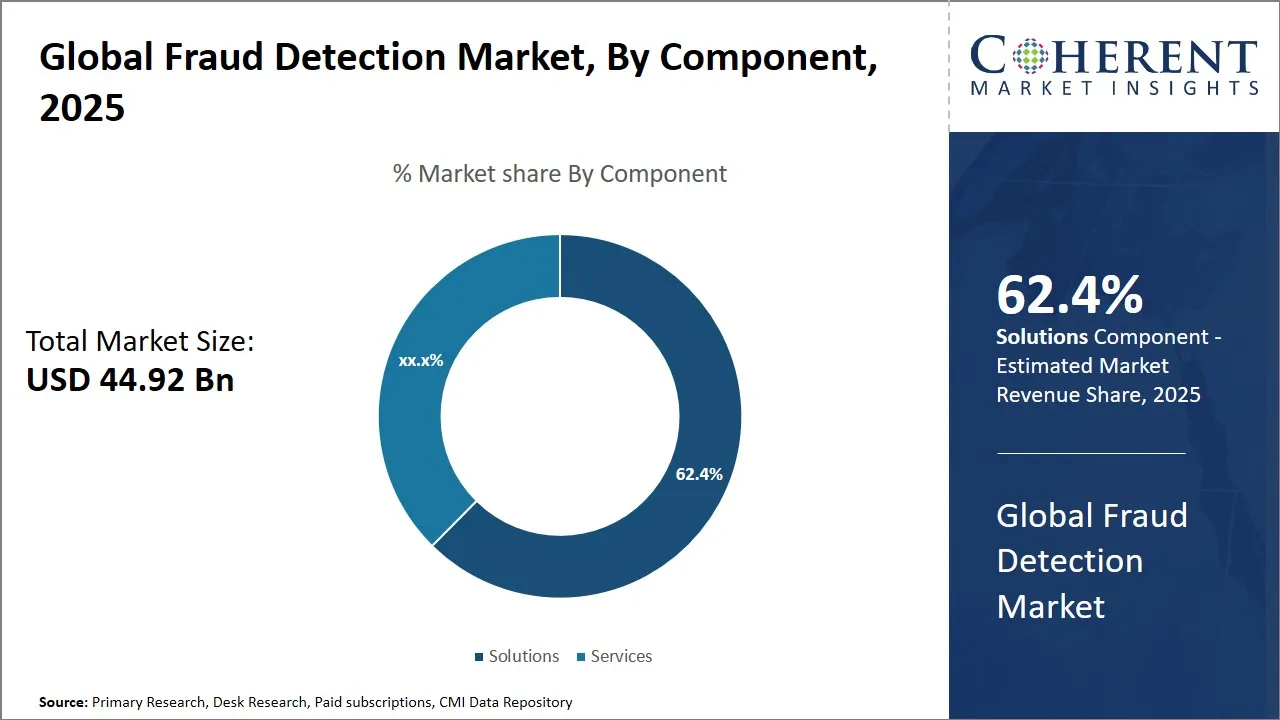
- The solutions segment is expected to lead the market holding a share of 63.4% in 2026.
- The fraud analytics segment is projected to dominate with a share of 60.2% in 2026.
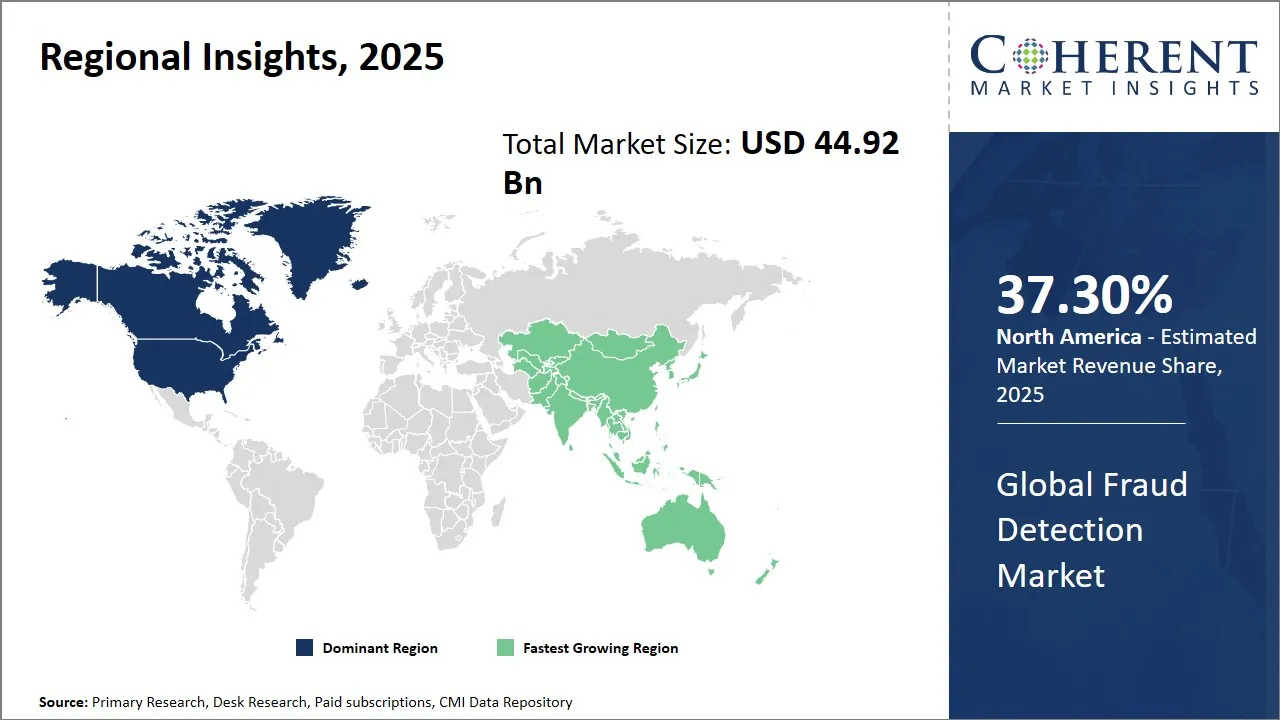
- North America, expected to hold a share of 37.3% in 2026, dominates the market.
- Asia Pacific, projected to hold a share of 21.7% in 2026, shows the fastest growth in the market.
Market Overview
A key market trend is the widespread adoption of advanced analytics and AI-driven solutions that provide real-time fraud monitoring and predictive insights. Organizations are increasingly using biometric authentication, Blockchain technology, and cloud-based platforms to improve accuracy and reduce false positives. Also, the rising use of mobile payments and e-commerce platforms is making demand for robust fraud detection systems, making innovation and scalability big growth factors.
Current Events and Its Impact
Current Events | Description and its impact |
Geopolitical and Trade Developments |
|
Segmental Insights
- Current Industry Events of 2026
- Market Size Estimation
- Regional Breakdown
- Competitive Landscape
- Customer Intelligence
- Segmental Analysis
- Pricing Analysis
- Key Market Drivers, Challenges & Future Trends
- Customized Insights Section
Global Fraud Detection Market Insights, By Component – Solutions Lead Because of Rising Demand For Advanced Fraud Prevention Technologies
The solutions segment is projected to hold 63.4% of the market share in 2026, driven by the rising need for advanced, real-time fraud prevention systems. As digital transactions grow across BFSI, e-commerce, and telecom, fraud patterns have become more complex, pushing organizations toward automated and scalable solutions powered by AI, ML, and big-data analytics. These platforms reduce false positives, support AML/KYC compliance, and add seamlessly with cloud and hybrid IT environments.
In 2024, Mastercard enhanced its Decision Intelligence 2.0 AI-based fraud solution, reporting a significant reduction in false declines for merchants using real-time risk scoring.
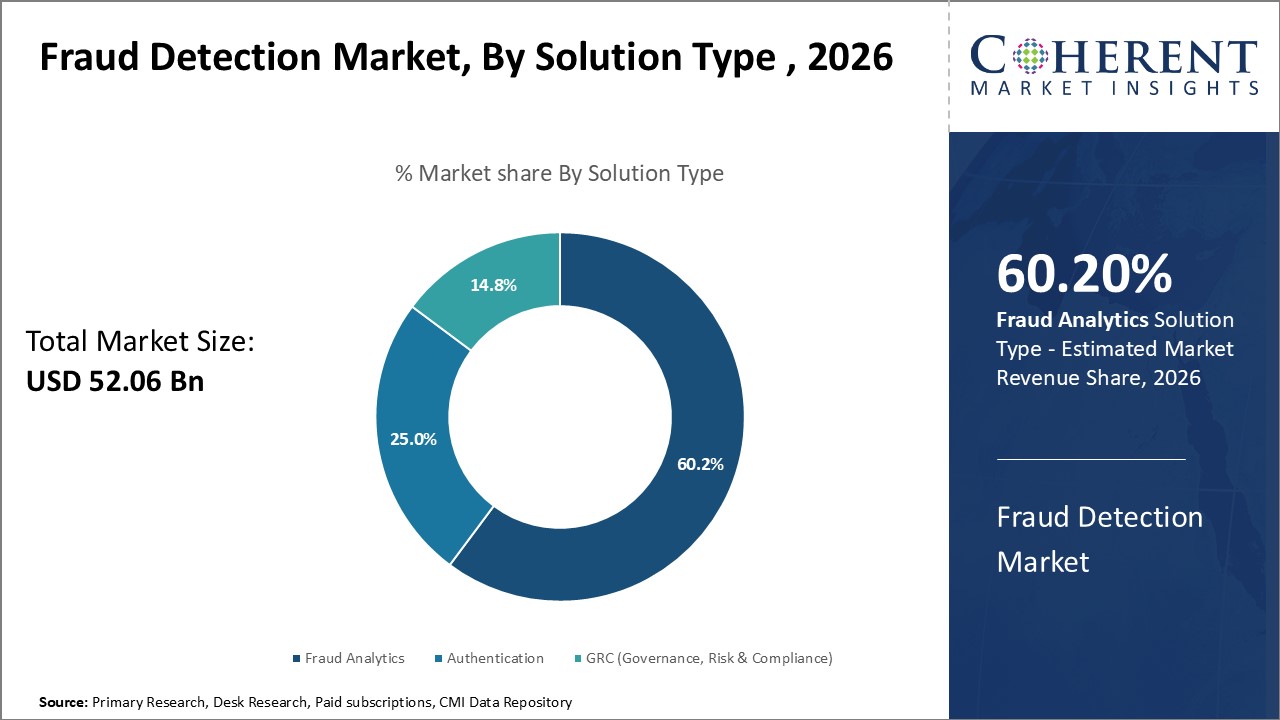
Global Fraud Detection Market Insights, By Solution Type – Fraud Analytics Leads Because of Its Superior Capability In Predicting And Preventing Complex Fraud Patterns
The fraud analytics segment is expected to reach a 60.2% share in 2026, because of its ability to detect sophisticated fraud through machine learning, statistical modeling, and data mining. Growing multi-channel fraud, identity abuse, and synthetic ID attacks have made adaptive, real-time analytics essential. Fraud analytics enhances prediction accuracy, lowers operational workload, and makes risk scoring stronger while scaling across large data environments.
In 2024, FICO's Falcon Fraud Manager, one of the most widely used analytics platforms, reported improved fraud detection accuracy for major banks after using updated ML models trained on billions of transactions.
Pricing Analysis of the Fraud Detection Market
Pricing Model/Use-Case | Typical Cost/Price (USD) |
AWS Amazon Fraud Detector | • USD 0.03 per prediction for first 100,000 predictions/month; USD 0.0075 beyond. |
AWS Marketplace – Financial Transaction Fraud Detection (ML inference) | • Real-time inference (ml.m5.large): USD 8.00/hour |
Fraud Detection SDK (for mobile/app) | • Monthly SDK cost: USD 600 – USD 2,500/month (e.g., behavioral biometrics) for startups/smaller apps. |
Custom/In-house Built Fraud Detection Software (low–mid complexity) | • Basic version: USD 30,000–50,000 (real-time monitoring + basic fraud logic). |
Enterprise-level Custom Fraud System | • Estimated build cost: USD 150,000–500,000+, depending on features, scale, and compliance. |
All-in-one Fraud Detection Service (on-prem appliance + subscription) | • Fraud Detection Appliance hardware: USD 10,000/USD 20,000/USD 30,000 (for different appliance models) per document. |
Adoption of AI/ML-based Fraud Detection Systems
Adoption Metric | Value/Insight |
% of financial institutions using AI-driven fraud detection | 87% |
% of firms that believe fraud prevention’s future will be driven by AI/ML | 71% |
% of organizations planning to implement AI/ML in anti-fraud (within ~2 years) | 32% |
Forecasted adoption of AI in fraud detection by 2025 (VPNRanks) | 95% of organizations predicted to adopt by 2025 |
% of organizations using data analysis techniques in anti-fraud programs now | >90% use some form of data analytics; many also plan to adopt AI/ML |
Key Regulatory Compliance & Data Security Regulations
Regulatory/Compliance Area | Description & Specific Requirements |
GDPR/Data Privacy (EU) | Organizations must process personal/customer data lawfully, transparently, and for specific purposes. Fraud detection systems need proper consent or legal grounds, data minimization, and strong access controls. |
Anti-Money Laundering (AML)/KYC | Institutions are required to verify customer identities (KYC), conduct ongoing customer due diligence, monitor transactions, and report suspicious activity (SARs) to regulators. |
Payment Services Directive 2 (PSD2) | In the EU, PSD2 mandates Strong Customer Authentication (SCA) (e.g. multi-factor authentication) for many electronic payments. |
PCI DSS (Payment Card Data Security) | Standard for how cardholder data (PAN, cardholder name, etc.) must be stored, processed, and transmitted by organizations. |
Bank Secrecy Act/SAR Reporting (USA) | U.S. financial institutions must file Suspicious Activity Reports (SARs) under the BSA when transactions look potentially illegal or unusual. |
Digital Operational Resilience (e.g., EU DORA) | Regulations like DORA require financial institutions and third-party providers to maintain operational resilience, manage technology risk, and ensure continuity, including cybersecurity and incident reporting. |
AI/Model Transparency (AI Act, Explainability) | Upcoming regulations (e.g., EU AI Act) classify many fraud-detection models as “high-risk AI systems,” demanding transparency, explainability, and human oversight. |
Regional Insights
North America Fraud Detection Market Analysis and Trends
North America, expected to hold a share of 37.3% in 2026, dominates the global fraud detection market. This stems from a highly developed technological ecosystem, stringent regulatory frameworks, and the presence of major financial institutions and enterprises with critical needs for fraud prevention. The U.S. government’s focus on cybersecurity and data protection, added with extensive investments by both the public and private sectors, foster innovation and adoption of advanced fraud detection solutions.
Established tech hubs in Silicon Valley and other urban centers house significant R&D activities, facilitating constant improvement in AI, machine learning, and big data analytics relevant to fraud detection. Big industry players such as IBM, SAS Institute, and FICO have deeply penetrated the market with comprehensive fraud prevention platforms tailored for banking, retail, and healthcare sectors. Also, strong collaborations between fintech startups and legacy institutions accelerate solution deployment, adding to North America’s lead in this domain.
Asia Pacific Fraud Detection Market Analysis and Trends
The Asia Pacific region, expected to hold a share of 21.7% in 2026, exhibits the fastest growth because of rising digital transformation across emerging economies and growing internet penetration. Government initiatives promoting cashless transactions, digital banking, and e-commerce are paramount in making demand for fraud detection technologies. Countries like India, China, and Southeast Asian nations are seeing increased incidences of online fraud, which further escalate urgency for robust fraud prevention systems.
Local and global vendors are tapping into this growing market by forming joint ventures and partnerships. The region’s dynamic fintech landscape and growing base of tech-savvy consumers add to fast adoption. Companies such as NEC Corporation, Huawei Technologies, and Paytm use fraud analytics and biometric authentication tools to secure financial transactions and digital identities. Also, regulatory bodies are improving frameworks for data privacy and cybersecurity.
Global Fraud Detection Market Outlook for Key Countries:
U.S. Fraud Detection Market Analysis and Trends
The U.S. maintains a strategic lead in the fraud detection market because of advanced infrastructure and huge financial services networks that demand high-end fraud management capabilities. Industry giants such as IBM, FICO, and Experian play pivotal roles by offering innovative AI-driven platforms focused on real-time fraud analysis and prevention across sectors like banking, insurance, and retail. Governmental regulations, including strict compliance requirements like the Sarbanes-Oxley Act and ongoing cybersecurity mandates, push organizations to invest a lot in fraud detection technologies.
China Fraud Detection Market Analysis and Trends
China fraud detection market grows because of its massive e-commerce sector, expansive digital payments infrastructure, and increasing consumer base engaging in online financial activities. Leading domestic players such as Ant Financial (Alipay) and Tencent use sophisticated fraud detection modules in their digital ecosystems to mitigate risks associated with payment fraud and identity theft. Government policies targeting digital economy growth and making cybersecurity frameworks stronger add to the market’s scope.
The country’s technological capabilities in AI and big data handling add to the deployment of advanced fraud mitigation platforms. Moreover, the prevalence of mobile wallets and online lending services invites further investment in cutting-edge fraud detection tools.
India Fraud Detection Market Analysis and Trends
India fraud detection market is flourishing amid government-backed financial inclusion initiatives and rapid digitization of banking and payment systems. Big contributors like Infosys, TCS, and emerging fintech firms are offering customized fraud detection solutions that address challenges such as phishing, account takeover, and transaction laundering. Regulatory bodies such as the Reserve Bank of India have put in place guidelines mandating robust fraud control mechanisms in financial institutions, adding to adoption.
The use of digital identity systems like Aadhaar supports biometric authentication integration in fraud detection frameworks. India’s growing e-commerce market and increased digital literacy make demand for agile and scalable fraud prevention technologies.
U.K. Fraud Detection Market Analysis and Trends
The U.K. continues to lead as a mature market because of comprehensive regulatory oversight and a sophisticated financial services sector reliant on real-time fraud detection systems. Major players including Experian, NICE Actimize, and BAE Systems use advanced analytics and machine learning to protect against increasingly complex fraud schemes in banking, insurance, and government services.
The U.K.’s proactive approach to data protection and privacy, shown by adherence to GDPR, influences the development of privacy-compliant fraud detection solutions. Also, collaboration among financial institutions and cybersecurity agencies makes the ecosystem stronger for fraud intelligence sharing and collective defense.
Market Players, Key Development, and Competitive Intelligence
Key Developments
- On November 20, 2025, GFT Technologies and FICO, a global leader in analytic software, joined forces in a new global partnership. Their goal is to help banks act in real-time, stop fraud early, and simplify risk decisions using AI.
- In October 2025, global analytics software leader, FICO, was awarded 10 new patents by the U.S. Patent and Trademark Office and Canadian Intellectual Property Office, reinforcing its position as a leader in Responsible AI innovation and in advancing the field of applied intelligence technology.
- In March 2025, Visa, a global leader in payment technology, unveiled its scam disruption practice focused on identifying and stopping complex scams as they emerge
- In March 2025, Oracle Financial Services added a broad class of AI agents and agentic workflows to its Investigation Hub Cloud Service that enable financial firms to automate investigative processes needed to uncover complex patterns and fight financial crime.
Top Strategies Followed by Fraud Detection Market Players
- Established players dominate the landscape by investing a lot in research and development, aimed at making high-performance fraud detection solutions that leverage advanced technologies such as artificial intelligence, machine learning, and big data analytics.
- IBM launched AI-powered threat and fraud detection enhancements for IBM Security solutions, driven by multi-year R&D investments into generative AI and advanced analytics.
- Mid-level players in the fraud detection market use strategies for providing cost-effective and scalable solutions that give a balance between quality and affordability.
- net offers an affordable modular fraud detection suite with subscription-based pricing, allowing SMEs to use fraud analytics without enterprise-level costs.
- Small-scale players, often startups or specialized firms, use a markedly different approach to thrive in the global fraud detection market.
- ArkOwl specializes exclusively in email intelligence for fraud detection, offering high-accuracy email reputation scoring rather than broad fraud solutions.
Market Report Scope
Fraud Detection Market Report Coverage
| Report Coverage | Details | ||
|---|---|---|---|
| Base Year: | 2025 | Market Size in 2026: | USD 52.06 Bn |
| Historical Data for: | 2020 To 2024 | Forecast Period: | 2026 To 2033 |
| Forecast Period 2026 to 2033 CAGR: | 15.9% | 2033 Value Projection: | USD 146.25 Bn |
| Geographies covered: |
| ||
| Segments covered: |
| ||
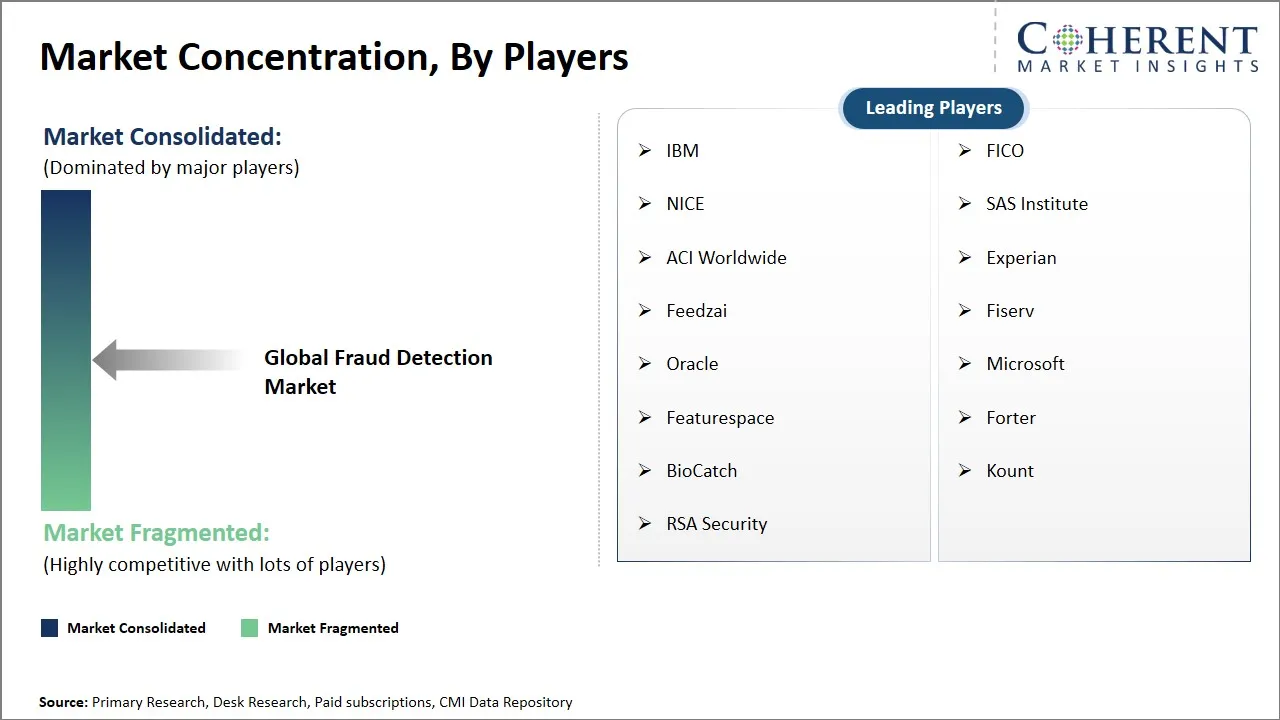
| Companies covered: | IBM, FICO, NICE, SAS Institute, ACI Worldwide, Experian, Feedzai, Fiserv, Oracle, Microsoft, Featurespace, Forter, BioCatch, Kount, and RSA Security | ||
| Growth Drivers: | Rapid growth of digital payments & e-commerce volumes Adoption of AI/ML and real-time analytics for transaction monitoring | ||
| Restraints & Challenges: | High false-positive rates and operational cost of manual investigations Regulatory/data-privacy constraints (localization) that slow cloud rollouts in some verticals | ||
Market Dynamics
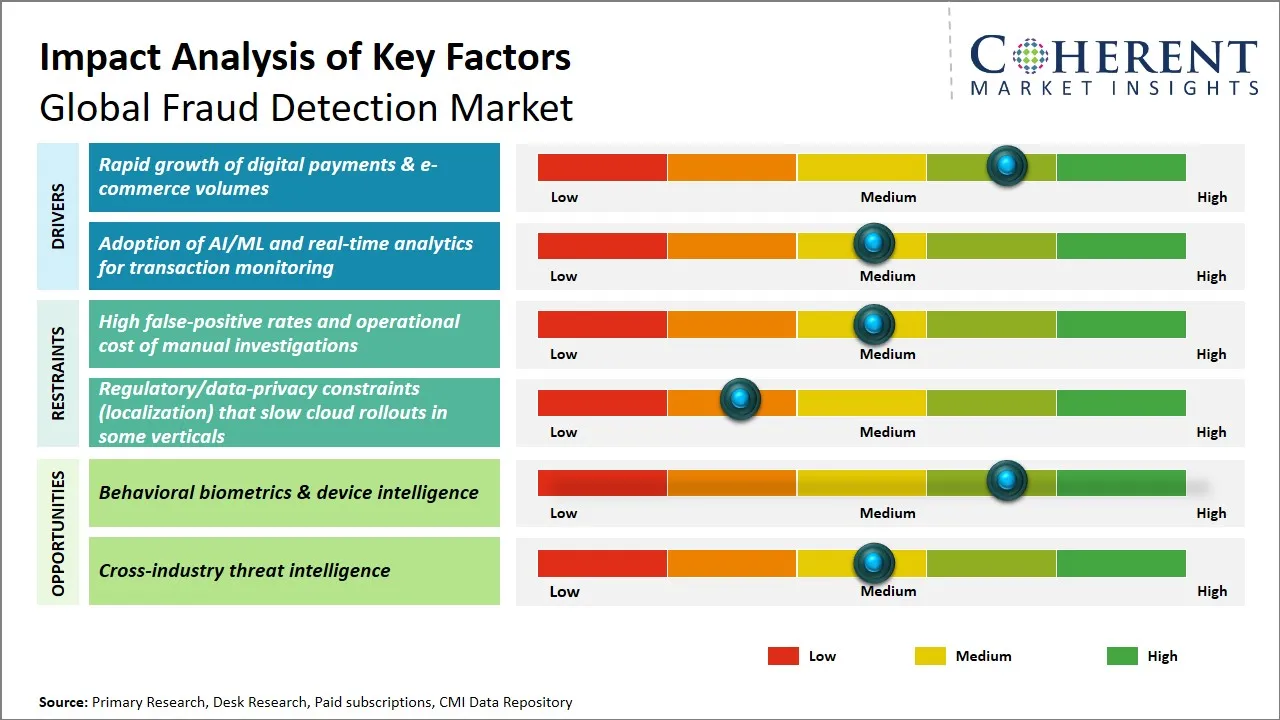
Global Fraud Detection Market Driver – Rapid Growth Of Digital Payments & E-Commerce Volumes
The surge in digital payments and e-commerce has dramatically increased transactional volumes, exposing businesses to higher risks of identity theft, payment fraud, and account takeovers. As fraud schemes grow more complex, organizations are using AI/ML-driven fraud detection tools that can analyzing real-time data and reducing false positives. This accelerated digital shift, especially in online retail and mobile payments, is a key driver making demand for advanced fraud prevention systems.
Visa reported a significant rise in online transaction volumes in 2023, prompting the company to expand its AI-powered Visa Advanced Authorization system, which analyzes over 500 risk factors to detect fraudulent transactions globally.
Global Fraud Detection Market Opportunity – Behavioral Biometrics & Device Intelligence
Behavioral biometrics and device intelligence present a big growth opportunity as fraudsters increasingly bypass static authentication methods. By analyzing user behavior patterns (e.g., typing rhythm, touch pressure) and device-level attributes, these technologies support continuous, frictionless authentication. Their addition with ML models adds to detection accuracy and customer experience, making them especially valuable in mobile banking and digital commerce ecosystems.
HSBC uses BioCatch’s behavioral biometrics solution to prevent account takeover fraud, reducing false positives and improving detection of abnormal user behavior across its digital banking channels.
Analyst Opinion (Expert Opinion)
- The industry is chronically struggling to keep pace with fraudsters who innovate faster than vendors can deploy defenses. Despite fast AI/ML advancements, fraud tactics are growing at a rate that makes a widening gap between threat complexity and current detection capabilities.
- Data privacy regulations are increasingly becoming a double-edged sword, slowing innovation while asking for greater accuracy. With GDPR, CCPA, RBI guidelines, and emerging cross-border data restrictions, vendors are trapped between compliance pressures and the need for vast, diverse datasets.
- Organizations remain overly dependent on legacy systems, making fragmented fraud prevention environments that are nearly impossible to secure end-to-end. Many enterprises cling to outdated infrastructure, causing integration failures, high false-positive rates, and operational bottlenecks. This technological inertia is one of the biggest—and least acknowledged—obstacles hindering market maturity.
Market Segmentation
- Component Insights (Revenue, USD Bn, 2021 - 2033)
- Solutions
- Services
- Solution Type Insights (Revenue, USD Bn, 2021 - 2033)
- Fraud Analytics
- Authentication
- GRC
- Regional Insights (Revenue, USD Bn, 2021 - 2033)
- North America
- U.S.
- Canada
- Latin America
- Brazil
- Argentina
- Mexico
- Rest of Latin America
- Europe
- Germany
- U.K.
- Spain
- France
- Italy
- Russia
- Rest of Europe
- Asia Pacific
- China
- India
- Japan
- Australia
- South Korea
- ASEAN
- Rest of Asia Pacific
- Middle East
- GCC Countries
- Israel
- Rest of Middle East
- Africa
- South Africa
- North Africa
- Central Africa
- North America
- Key Players Insights
- IBM
- FICO
- NICE
- SAS Institute
- ACI Worldwide
- Experian
- Feedzai
- Fiserv
- Oracle
- Microsoft
- Featurespace
- Forter
- BioCatch
- Kount
- RSA Security
Sources
Primary Research Interviews
Stakeholders
- CISOs, Chief Risk Officers, Fraud Managers – from major banks, fintech firms, and digital payment providers
- Fraud Detection Software Vendors (e.g., solution architects, product managers, R&D heads)
- Cybersecurity Service Providers & Managed Security Operations Centers (SOC)
- E-commerce & Online Marketplace Security Teams
- Telecom Operators’ Fraud Risk & Revenue Assurance Departments
- Insurance Companies’ Fraud Investigation Units
- Identity Verification & KYC Compliance Specialists
- Behavioral Biometrics and Device Intelligence Technology Providers
- Regulatory Compliance Consultants (AML/KYC/GDPR experts)
- Digital Wallet & Mobile Payment Platform Operators
- Law Enforcement Cybercrime Divisions
- Data Encryption & Secure Access Platform Providers
- Cloud Services Providers supporting fraud analytics deployments
Databases
- Eurostat
- U.S. Census Bureau
- OECD Digital Economy Database
- Financial Crimes Enforcement Network (FinCEN) Open Data
- European Union Agency for Cybersecurity (ENISA) Incident Database
- UNCTAD Digital Economy Statistics
- FDATA Global Open Banking Repository
- Cybersecurity Infrastructure & Security Agency (CISA) Alerts Database
- MITRE ATT&CK Knowledge Base
Magazines
- Cybersecurity Today
- Digital Payments Magazine
- Fraud Intelligence Review
- Fintech Cyber Defense Magazine
- Payment Security & Compliance Digest
- InfoSecurity Magazine
Journals
- Journal of Cybersecurity & Digital Forensics
- IEEE Transactions on Information Forensics and Security
- Journal of Financial Crime & Anti-Fraud Systems
- ACM Journal of Information Security
- International Journal of Machine Learning in Cybersecurity
- Journal of Digital Authentication & Identity Management
Newspapers
- The Financial Times
- The Wall Street Journal — Cybersecurity Section
- The Guardian (UK)
- The Economic Times (India)
- Cybercrime Daily News
- Fintech Times Global
Associations
- Association of Certified Fraud Examiners (ACFE)
- Global Cyber Alliance (GCA)
- European Payments Council (EPC)
- Open Identity Exchange (OIX)
- Anti-Phishing Working Group (APWG)
- National Cybersecurity Alliance (NCA)
- The Payment Card Industry Security Standards Council (PCI SSC)
Public Domain Sources
- EUROSTAT
- U.S. Census Bureau
- World Bank – Digital Development Reports
- United Nations Economic Commission for Europe (UNECE)
- U.S. Federal Trade Commission (FTC) Fraud Reports
- Interpol Cybercrime Public Briefings
- ResearchGate (Open Publications)
- GitHub Open-Source Fraud Detection Datasets
Proprietary Elements
- CMI Data Analytics Tool
- Proprietary CMI Existing Repository of information for last 8 years
Get access to 250+ pages report
Every segment, forecast, competitor profile and data table behind the analysis above — available for instant download.
- ESOMAR Member
- ISO 9001:2015 Certified
- D-U-N-S Registered
- GDPR & CCPA Compliant
Missing comfort of reading report in your local language? Find your preferred language:
Transform your Strategy with Exclusive Trending Reports
Frequently Asked Questions
The global fraud detection market is estimated to be valued at USD 52.06 billion in 2026 and is expected to reach USD 146.25 billion by 2033.
The CAGR of global fraud detection market is projected to be 15.9% from 2026 to 2033.
Rapid growth of digital payments & e-commerce volumes and adoption of AI/ML and real-time analytics for transaction monitoring are the major factors driving the growth of the global fraud detection market.
High false-positive rates and operational cost of manual investigations and regulatory/data-privacy constraints (localization) that slow cloud rollouts in some verticals are the major factors hampering the growth of the global fraud detection market.
In terms of component, solutions are estimated to dominate the market revenue share in 2026.
IBM, FICO, NICE, SAS Institute, ACI Worldwide, Experian, Feedzai, Fiserv, Oracle, Microsoft, Featurespace, Forter, BioCatch, Kount, and RSA Security are the major players.
North America is expected to lead the global fraud detection market in 2026.