

Global Heart Transplant Market Size and Forecast – 2026 To 2033
The global heart transplant market is expected to grow from USD 14.12 Bn in 2026 to USD 28.65 Bn by 2033, registering a compound annual growth rate (CAGR) of 10.6% from 2026 to 2033. The market for global heart transplant is poised for significant expansion, fueled by the increasing heart transplantation activity and surging demand for donor organs.
According to the Organ Procurement and Transplantation Network and Scientific Registry of Transplant Recipients 2024 Annual Data Report, U.S. heart transplants increased to 4,636 in 2024 from 2,554 in 2013, reflecting an 81.5% rise over the period. The report also recorded 9,444 heart transplant candidates on the waiting list in 2024, underscoring the growing need for transplantation.
Key Takeaways of the Global Heart Transplant Market
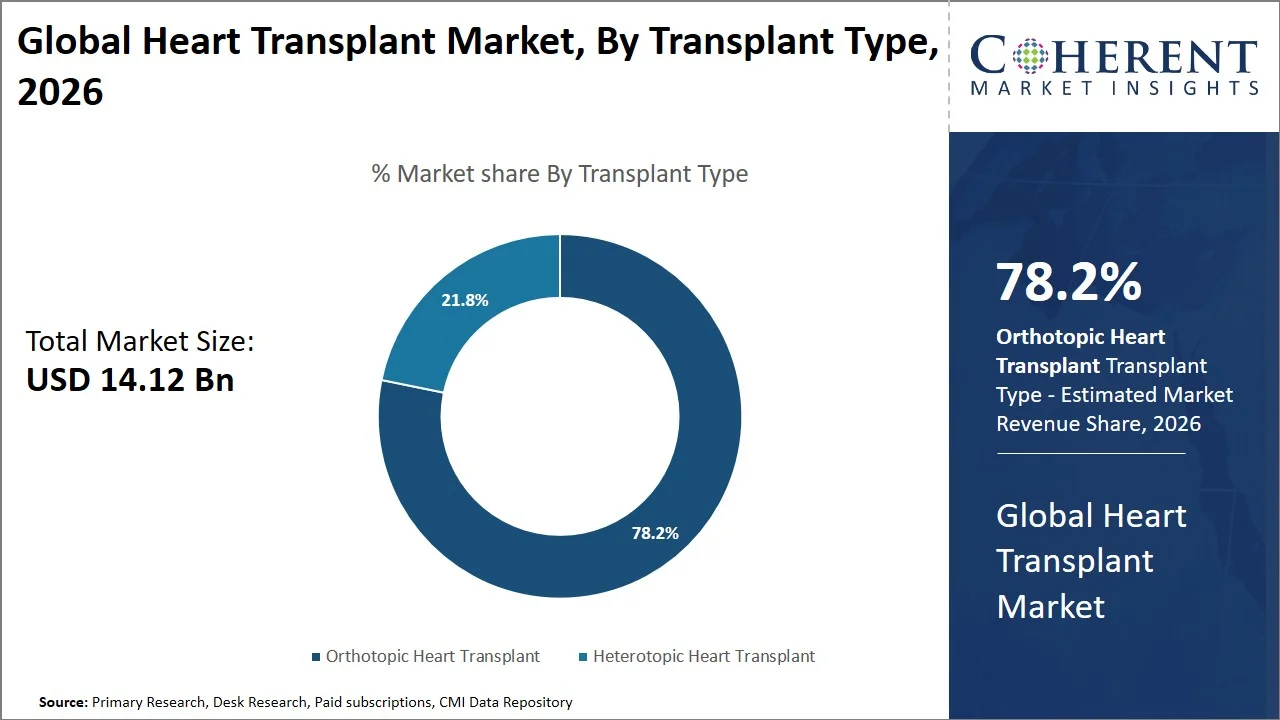
- Orthotopic heart transplant is projected to hold 78.2 % of the global heart transplant market share in 2026, making it dominant transplant type segment, across Europe due to the region’s established heart transplantation infrastructure and specialized transplant centers. For instance, NHS Blood and Transplant reports that heart transplantation is performed through specialized centers across the UK, supporting the continued use of established orthotopic transplantation procedures
- Donation after brain death (DBD)is projected to hold 80.6 % of the global heart transplant market share in 2026, making it dominant donor type segment, across Europe due to established regulatory frameworks governing deceased-organ donation and neurological death determination. For instance, the Human Tissue Authority provides specific regulatory guidance for organ donation following brainstem death, supporting standardized deceased-donor procurement practices in the UK.
- End-stage heart failure is projected to hold 64.1 % of the global heart transplant market share in 2026, making it dominant indication segment, across Asia-Pacific due to continued expansion of transplantation programs and unmet demand for advanced heart-failure treatment. For instance, the Australian Government reported that heart transplantation remains a critical treatment for patients with severe heart disease, with Australia performing approximately 100 heart transplants annually, demonstrating sustained clinical demand for transplantation in the region.
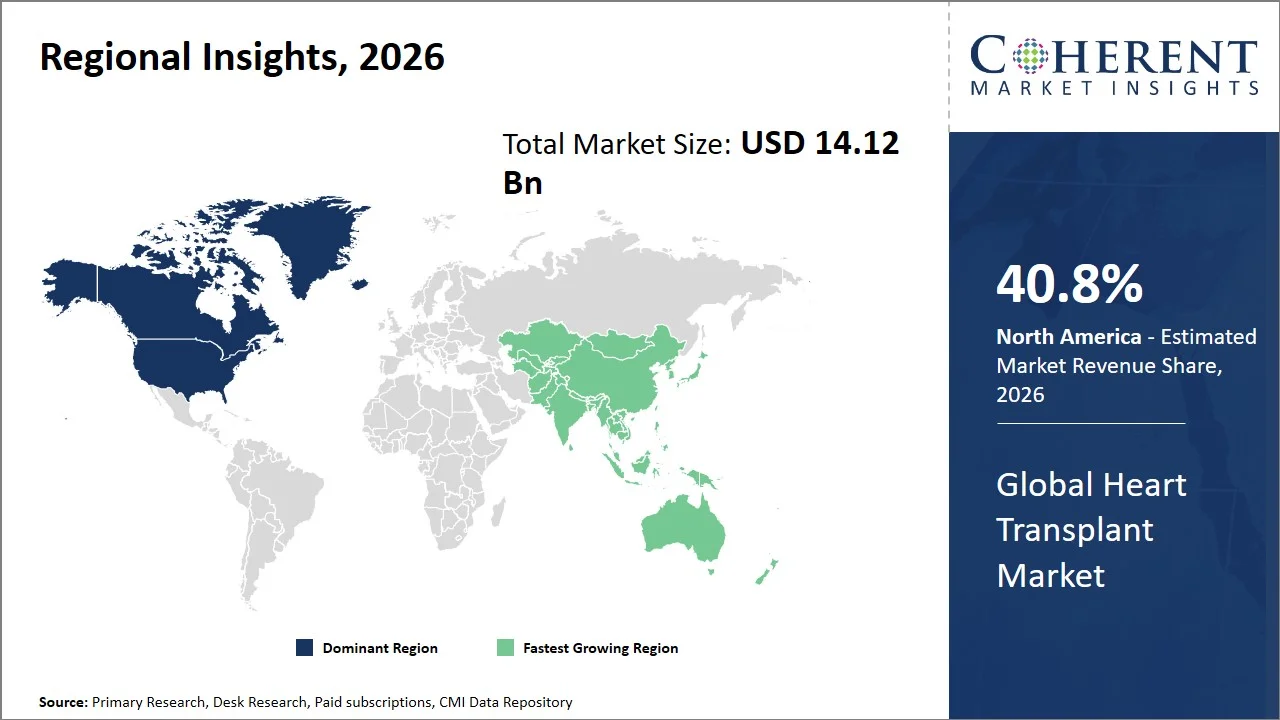
- North America market maintains dominance with an expected share of 40.8 % in 2026, bolstered by its mature heart-transplant ecosystem and concentration of specialized transplant programs. For instance, the Canadian Blood Services reports that Canada has a national organ and tissue donation and transplantation system supporting deceased-donor organ recovery and allocation, strengthening the region’s established transplantation infrastructure.
- Asia Pacific is expected to exhibit the fastest growth in the global heart transplant market, registering an estimated CAGR of 11.1 % during 2026–2033, propelled by the expansion of transplant programs and strengthening organ-donation systems. For instance, Singapore’s Ministry of Health operates a national organ-transplant framework under the Human Organ Transplant Act, providing a regulated pathway for deceased-donor transplantation and supporting the development of advanced transplantation services.
Segmental Insights
Why Do Orthotopic Heart Transplant Dominate the Global Heart Transplant Market?
Orthotopic heart transplant is projected to hold the market share of 78.2% in 2026, owing to their proven surgical protocol, replacement of native pump’s cardiac functions and wide applications in patients with end stage heart failure. Ongoing advancements in perioperative management and graft preservation enhance patient results and promote the application of this procedure. For instance, in September 2025, a study published by National Library of Medicine, examined 417 orthotopic heart transplant recipients and concluded that survivors of severe primary graft dysfunction had similar long-term survival rates to transplant recipients who had favorable recoveries, emphasizing advances in perioperative management.
- Current Industry Events of 2026
- Market Size Estimation
- Regional Breakdown
- Competitive Landscape
- Customer Intelligence
- Segmental Analysis
- Pricing Analysis
- Key Market Drivers, Challenges & Future Trends
- Customized Insights Section
Why Does Donation After Brain Death (DBD) Represent the Largest Donor Type Segment in the Heart Transplant Market?
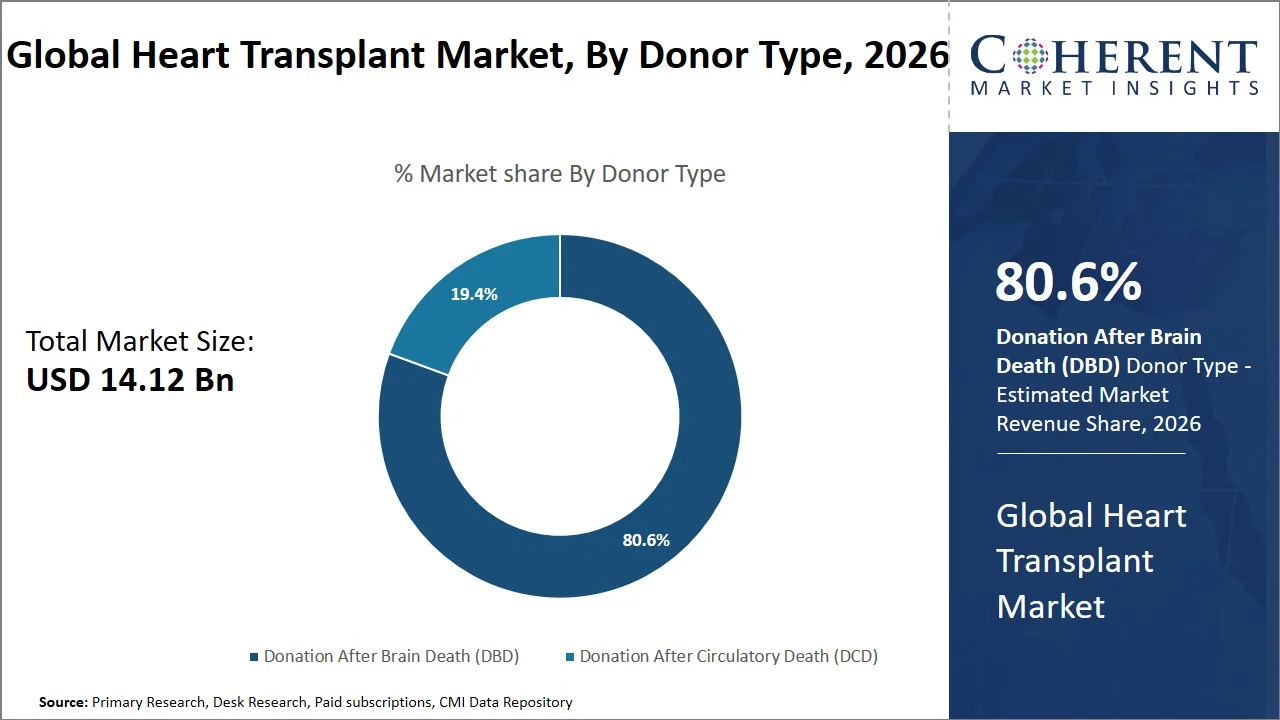
Donation after brain death (DBD) is projected to hold a market share of 80.6% in 2026, due to well-established organ- procurement methods, wide clinical acceptance, and organ procurement predictability. The organ supply after a heart recipient brain death has been optimized through the constant physiologic support system to maintain optimal blood perfusion to the heart donor organ. For instance, in January 2026, a study based on analysis of the united network for organ sharing registry published by National Library of Medicine estimated that 86.5% of 14,035 adult heart transplants during the 2019–2023 period was derived from donors with donation after brain death (DBD) organs. The remaining 6.9% were from donation-after-circulatory-death type III donors, and 6.5% from donation-after-circulatory-death type IV donors, underscoring the existing trend of dominance of donation after brain death (DBD) organ donors.
End-Stage Heart Failure Segment Dominates the Global Heart Transplant Market
The end-stage heart failure segment is projected to hold a market share of 64.1% in 2026, since heart transplantations are a consolidated, state-of-the-art, advanced therapy used in those advanced heart-failure patients who are no longer properly managed by medical treatment. A rising awareness of the advanced heart-failure patients and a better management of those patients being considered for transplant have increased patient demand for transplant, and mechanical circulatory support can be used as a bridge to transplant. For instance, the International Society for Heart and Lung Transplantation 2024 guidelines list criteria that accurately define advanced heart failure and identify heart transplantation candidates, such as chronic refractory severe symptoms, end-organ dysfunction, severely depressed ejection fraction, recurrent hospitalizations.
Current Events and their Impact
Current Events | Description and its Impact |
International Society for Heart and Lung Transplantation (ISHLT) Foundation Funded Research on Artificial Intelligence and Biomarkers for Heart Transplant Monitoring (May 2026) |
|
U.S. Food and Drug Administration Cleared OrganProtex HTK for Donor-Heart Preservation (January 2025) |
|
Heart Transplant Market Dynamics
Market Drivers
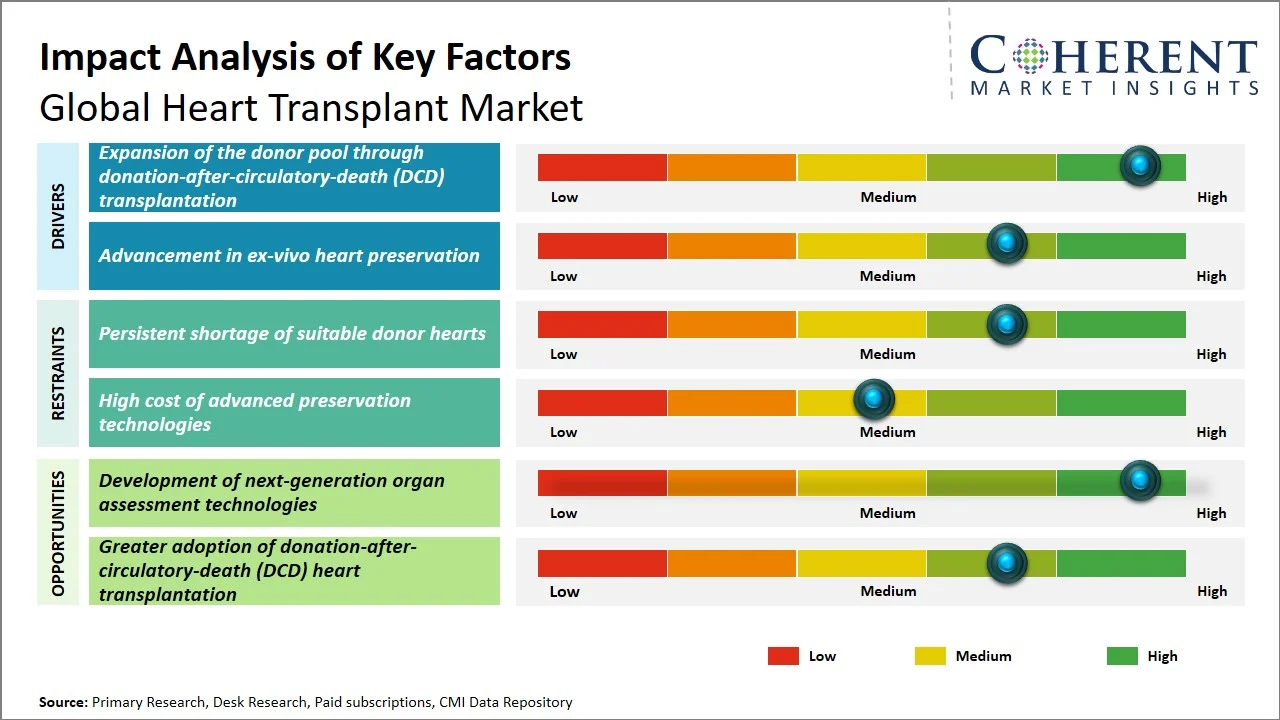
- Expansion of the donor pool through donation-after-circulatory-death (DCD) transplantation: The integration of donation-after-circulatory-death (DCD) transplantation is creating a significant opportunity to expand the heart donor pool and improve access to transplantation. Advances in recovery protocols and preservation methods are making DCD hearts increasingly suitable for clinical use, while standardized allocation and safety practices are supporting broader adoption. For instance, in October 2025, the U.S. Health Resources and Services Administration directed the organ procurement and transplantation network to develop enhanced DCD policies covering donor safeguards, family communication, and standardized procurement practices, supporting the continued expansion of DCD transplantation.
- Advancement in ex-vivo heart preservation: Ex-vivo heart preservation is evolving from a niche preservation approach toward a more capable platform for extending preservation duration, reducing ischemic injury, and enabling broader donor-heart utilization. Increasing clinical evidence is also supporting its use for hearts requiring longer transport or more complex donor assessment. For instance, in April 2025, a study published by Journal of the American College of Cardiology (JACC), evaluated real-world use of ex-vivo heart perfusion in donation-after-brain-death transplantation, highlighting its potential to expand the donor pool and support transplantation of hearts that may otherwise face preservation limitations.
- Expansion of mechanical circulatory support as a bridge to transplantation: The growing use of mechanical circulatory support devices as a bridge to heart transplantation is supporting the market by stabilizing patients with advanced heart failure while they await a suitable donor heart. These technologies can help maintain patients in transplantable condition, increasing the number of candidates who can reach transplantation and strengthening demand for transplant procedures and associated technologies. For instance, according to the International Society for Heart and Lung Transplantation, approximately 60% of adult heart-transplant recipients were supported by mechanical circulatory support at transplantation during 2019–2024, highlighting the increasing integration of these technologies into the transplant pathway.
Emerging Trends
- Increasing use of artificial intelligence in transplant decision-making: Artificial intelligence is emerging as a tool for donor-recipient matching, risk stratification, rejection prediction, and post-transplant monitoring, enabling transplant teams to integrate complex clinical and imaging data into treatment decisions.
- Growth of personalized immunosuppression strategies: Heart transplantation is moving toward individualized immunosuppressive regimens based on recipient characteristics, immune-response profiles, and rejection risk, with the aim of reducing long-term toxicity while maintaining graft protection.
- Emergence of xenotransplantation and bioengineered organs: Research is increasingly shifting toward gene-edited animal organs and regenerative approaches, with the potential to create alternative sources of transplantable hearts and reduce long-term dependence on human donor organs.
Regional Insights
Why is North America a Strong Market for Heart Transplant?
North America leads the global heart transplant market, accounting for an estimated 40.8% share in 2026, due to a well-structured health system, state-of-the-art transplantation technologies and established transplant centers, coupled with a robust government presence in facilitating organ procurement and allocation programs. The region benefits from the availability of well-conducted clinical studies and qualified transplantation personnel as well as developed remuneration models.
Robust coverage plans from government and private payees help improve patients’ accessibility for the transplant and long-term care after the procedure. For instance, the Centers for Medicare & Medicaid services offer coverage to individuals receiving a heart transplantation service at an approved site, this includes medically indicated management and the drugs necessary to protect against the procedure with continuing their access to the service going into their own health. (Source: Heart Failure Society of America)
Why Does Asia Pacific Heart Transplant Market Exhibit High Growth?
Asia Pacific is expected to exhibit the fastest growth in the global heart transplant market, registering an estimated CAGR of 11.1% during 2026–2033. The region is projected to account for approximately 23.4% of the global market in 2026, fuelled by increasing prevalence of cardiovascular diseases, expanding healthcare facilities and investments in improving transplant technology. Countries like India, China, South Korea are rapidly increasing transplant capabilities via development of dedicated heart care centers and government support aimed at boosting organ donation rates and transplant systems.
For instance, in July 2025, India initiated a year-long campaign to encourage organ and tissue donation called "Angdaan - Jeevan Sanjeevani Abhiyaan", with July being celebrated as "Organ Donation Month" with widespread awareness campaigns being organized throughout the country to encourage more people to take the 'pledge to donate'. (Source: Embassy of India) Furthermore, increasing healthcare expenditure and access to advanced cardiac care among patients will drive the Asia-Pacific market.
Global Heart Transplant Market Outlook for Key Countries
Why is the U.S. Leading Innovation and Adoption in the Heart Transplant Market?
The U.S. holds the largest market share for innovation and adoption in heart transplant market due to early clinical adoption of ex-vivo machine perfusion and donation-after-circulatory-death (DCD) heart transplants. The country has mature pipeline of transplant hardware with U.S. Food and Drug Administration organ care system heart system for perfusion, and preservation of DCD donor hearts toward longer preservation and wider access.
Is the UK a Favorable Market for Heart Transplant Market?
The U.K. is a promising market for heart transplant driven by a centrally governed organ-allocation system and world class transplant centers (such as Royal Papworth Hospital, Harefield Hospital, and Queen Elizabeth Hospital Birmingham). Excellent opportunity exists for the organ-preservation devices, donor-heart application devices and transplant-supporting devices, as National Health Service (NHS) England targets unmet demand in heart transplantation on large scale.
Is China Emerging as a Key Growth Hub for the Heart Transplant Market?
China is becoming an important growth area in the heart transplant market due to increasing organ donation activity, larger transplant capacity, as well as improved regulations for organ acquisition and allocation. From May 2024, China had officially issued the revised regulation on human organ donation and transplantation, which has laid stricter rules for organ donation, allocation and acquisition, qualification of medical institution, and techniques of transplantation.
Why Does Germany Top the European Heart Transplant Market?
Germany leads the European heart transplant market due to country’s extensive network of specialty transplant centers and highest volume numbers in heart-transplantation procedures among the Euro transplant network countries. For instance, Germany performed 348 transplants from deceased donors in 2024, more than any other Euro transplant country, with an established organ-allocation and transplantation infrastructure.
Is Heart Transplant Market Developing in Japan?
The heart transplant market in Japan is gradually expanding as the transplant activity increases with the broadening presence of the licensed facilities. In fiscal 2024, Japan Organ Transplant Network tallied 116 heart transplantation procedures, and as of May 2025,12 heart transplantation institutions were newly accredited nationwide and the transplantation function was reinforced.
Global Heart Transplant Activity by Donor Type
Metric | Global Data (2024) |
Total Heart Transplants | 10,287 |
Heart Transplants from Donation After Brain Death (DBD) | 9,210 |
Heart Transplants from Donation After Circulatory Death (DCD) | 1,073 |
Share from Donation After Brain Death | 89.5% |
Share from Donation After Circulatory Death | 10.4% |
Patients on Heart Transplant Waiting Lists | 13,243 |
Patients Who Died While Waiting | 1,744 |
How is the development of next-generation organ assessment technologies creating new growth opportunities in the heart transplant market?
The global market for heart transplant represents a crucial opportunity for state-of-the-art donor-heart preservation technologies that may increase transplant utilization and access to the therapy. Preservation technologies that extend heart viability, reduce ischemia, and streamline organ retrieval may render marginal hearts suitable for transplant. They would be highly pertinent for donation after circulatory death due to distance and logistics constraints. For instance, in July 2025, Vanderbilt University Medical Center reported that quick recovery with prolonged ultra-oxygenated preserved (REUP) transplantation had successfully been applied to 20 transplants, and donor hearts had been preserved up to and above 4 and 8 hours. The method aims to increase the number of donation after circulatory death (DCD) hearts available for transplantation.
Market Players, Key Development, and Competitive Landscape
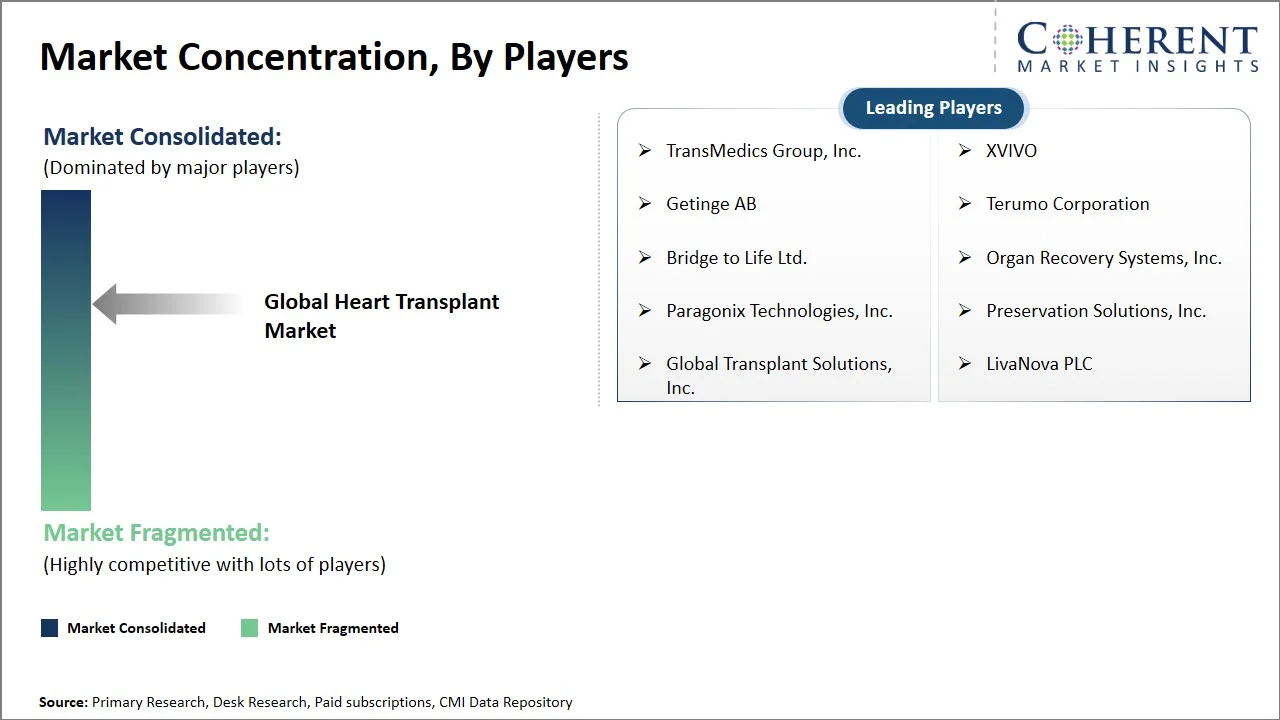
Key Developments
- In June 2026, the American Heart Association, Inc. launched its first-ever Heart Transplant Research Network, bringing together 14 medical research centers and a coordinating center to strengthen heart transplant research and care in the U.S. The initiative is backed by USD 4.5 million and focuses on improving transplant outcomes through coordinated data, research, and quality-improvement infrastructure. The network is expected to accelerate innovation in areas such as rejection detection, monitoring, and therapies, supporting advances in heart transplant care.
- In May 2026, Paragonix Technologies and UW Medicine launched the CONCERT-DCD clinical trial to evaluate a novel direct procurement approach for donation after circulatory death (DCD) donor hearts using the SherpaPak cardiac transport system. The prospective, multicenter study aims to validate the safety and clinical outcomes of this preservation approach while reducing reliance on complex machine perfusion. The initiative could support broader utilization of DCD hearts and expand the pool of transplantable donor organs.
- In February 2026, TransMedics Group, Inc. received full FDA approval for its Investigational Device Exemption (IDE) for the next-generation OCS ENHANCE Heart trial. The two-part trial will evaluate prolonged heart perfusion and compare OCS Heart perfusion with static cold storage in donation after brain death (DBD) cases. With more than 650 expected participants, the trial could support expanded clinical use of OCS Heart and broader utilization of donor hearts.
Competitive Landscape
The global heart transplant market is moderately competitive, with competition centered on organ preservation, ex-vivo perfusion, donor-heart transport, and technologies that expand the pool of transplantable hearts. Key players are focusing on extending organ preservation time, improving real-time assessment of donor-heart viability, and increasing utilization of donation after circulatory death (DCD) organs. Key focus areas include:
- Advancement of ex-vivo heart perfusion and preservation technologies
- Development of DCD heart recovery and donor-organ utilization solutions
- Integration of real-time organ monitoring and viability assessment
- Clinical trials, regulatory approvals, and strategic collaborations to expand transplant indications and improve transplantation outcomes
Market Report Scope
Heart Transplant Market Report Coverage
| Report Coverage | Details | ||
|---|---|---|---|
| Base Year: | 2025 | Market Size in 2026: | USD 14.12 Bn |
| Historical Data for: | 2020 To 2024 | Forecast Period: | 2026 To 2033 |
| Forecast Period 2026 to 2033 CAGR: | 10.6% | 2033 Value Projection: | USD 28.65 Bn |
| Geographies covered: |
| ||
| Segments covered: |
| ||
| Companies covered: | TransMedics Group, Inc., XVIVO, Getinge AB, Terumo Corporation, Bridge to Life Ltd., Organ Recovery Systems, Inc., Paragonix Technologies, Inc., Preservation Solutions, Inc., Global Transplant Solutions, Inc., LivaNova PLC | ||
| Growth Drivers: |
| ||
| Restraints & Challenges: |
| ||
Analyst Opinion (Expert Opinion)
- In the coming years, global heart transplant market is expected to shift from a donor-limited model toward a donor-optimization model, with greater emphasis on technologies that can recover, preserve, assess, and transport hearts that may previously have been considered unsuitable for transplantation. We expect ex-vivo perfusion, donation after circulatory death utilization, advanced preservation, and eventually xenotransplantation to become increasingly important in expanding the addressable donor pool and improving transplant accessibility.
- The maximum opportunities are foreseen within orthotopic heart transplant segment in Asia-Pacific, particularly India and China, represents the strongest long-term opportunity. We believe the combination of expanding transplant infrastructure, growing specialist cardiac-care capacity, and increasing adoption of advanced organ-preservation technologies will create room for both procedure volumes and supporting transplant technologies to scale faster than in mature markets.
- In order to gain a competitive advantage, market players should move beyond conventional preservation products and build integrated heart-transplant solutions covering organ recovery, preservation, viability assessment, transportation, and post-procurement monitoring. Differentiation will increasingly depend on demonstrating that technologies can increase donor-heart utilization, extend preservation windows, simplify transplant logistics, and generate clinically meaningful outcomes, rather than competing primarily on individual products.
Speak to the analyst
Want personalized insights?
Take the findings above to one of our principal consultants, or have the report rebuilt around the segments, geographies and competitors you actually track.
Market Segmentation
- Transplant Type Insights (Revenue, USD Bn, 2021 - 2033)
- Orthotopic Heart Transplant
- Heterotopic Heart Transplant
- Donor Type Insights (Revenue, USD Bn, 2021 - 2033)
- Donation After Brain Death (DBD)
- Donation After Circulatory Death (DCD)
- Indication Insights (Revenue, USD Bn, 2021 - 2033)
- End-Stage Heart Failure
- Cardiomyopathy
- Congenital Heart Disease
- Others
- End User Insights (Revenue, USD Bn, 2021 - 2033)
- Hospitals
- Specialized Cardiac Transplant Centers
- Academic and Research Institutes
- Others
- Regional Insights (Revenue, USD Bn, 2021 - 2033)
- North America
- U.S.
- Canada
- Latin America
- Brazil
- Argentina
- Mexico
- Rest of Latin America
- Europe
- Germany
- U.K.
- Spain
- France
- Italy
- Russia
- Rest of Europe
- Asia Pacific
- China
- India
- Japan
- Australia
- South Korea
- ASEAN
- Rest of Asia Pacific
- Middle East
- GCC Countries
- Israel
- Rest of Middle East
- Africa
- South Africa
- North Africa
- Central Africa
- North America
- Key Players Insights
- TransMedics Group, Inc.
- XVIVO
- Getinge AB
- Terumo Corporation
- Bridge to Life Ltd.
- Organ Recovery Systems, Inc.
- Paragonix Technologies, Inc.
- Preservation Solutions, Inc.
- Global Transplant Solutions, Inc.
- LivaNova PLC
Sources
Primary Research Interviews
- Heart transplant surgeons and cardiothoracic surgeons involved in transplantation procedures
- Heart failure and transplant cardiologists involved in patient evaluation and post-transplant management
- Transplant coordinators and organ procurement specialists involved in donor-heart allocation and recovery
- Clinical researchers involved in heart transplantation, organ preservation, and ex-vivo perfusion studies
- Medical affairs and clinical development executives from companies developing organ preservation and transplant technologies
Stakeholders
- Organ preservation and ex-vivo perfusion technology companies
- Organ procurement organizations and transplant coordination networks
- Hospitals and specialized heart transplant centers
- Pharmaceutical companies developing immunosuppressive therapies
- Medical device companies providing cardiac and transplant-support technologies
- Patient advocacy and organ-donation organizations
- End-use Sectors
- Specialized heart transplant centers
- Hospitals and academic medical centers
- Organ procurement organizations
- Cardiac and transplant research institutions
- Regulatory & Health Bodies
- U.S. Food and Drug Administration (FDA)
- European Medicines Agency
- Medicines and Healthcare products Regulatory Agency, UK
- National Medical Products Administration, China
- Pharmaceuticals and Medical Devices Agency, Japan
- Health Canada
- Therapeutic Goods Administration, Australia
- World Health Organization
Databases
- ClinicalTrials.gov
- Organ Procurement and Transplantation Network Database
- Scientific Registry of Transplant Recipients
- International Society for Heart and Lung Transplantation Registry
Journals
- The Journal of Heart and Lung Transplantation
- Journal of the American College of Cardiology
- European Journal of Heart Failure
Associations
- International Society for Heart and Lung Transplantation
- American Heart Association
- American Society of Transplantation and Cellular Therapy
- European Society of Cardiology
- European Society for Organ Transplantation
- The Transplantation Society
Proprietary Elements
- CMI Data Analytics Tool, Proprietary CMI Existing Repository of information for last 10 years.
Get access to 250+ pages report
Every segment, forecast, competitor profile and data table behind the analysis above — available for instant download.
- ESOMAR Member
- ISO 9001:2015 Certified
- D-U-N-S Registered
- GDPR & CCPA Compliant
Missing comfort of reading report in your local language? Find your preferred language:
Transform your Strategy with Exclusive Trending Reports
Frequently Asked Questions
The global heart transplant market is estimated to be valued at USD 14.12 Bn in 2026 and is expected to reach USD 28.65 Bn by 2033.
Orthotopic heart transplant dominates due to its established clinical efficacy, standardized surgical approach, and suitability for the majority of patients requiring complete cardiac replacement.
Heart transplantation is a surgical procedure that replaces a diseased or failing heart with a healthy donor heart to restore cardiac function in eligible patients.
The CAGR of global heart transplant market is projected to be 10.6% from 2026 to 2033.
Ex-vivo heart perfusion enables donor hearts to remain perfused outside the body, allowing assessment of organ function and potentially increasing the utilization of marginal donor hearts.
Organ preservation technology helps maintain donor-heart viability during procurement and transportation while reducing damage associated with prolonged ischemic periods.
Donation after circulatory death involves recovering a donor heart after the irreversible cessation of circulatory and respiratory functions under established transplantation protocols.