

Global High Brightness LED Market Size and Forecast – 2026 To 2033
The global high brightness LED market is expected to grow from USD 25 Bn in 2026 to USD 41 Bn by 2033, registering a compound annual growth rate (CAGR) of 7.8% from 2026 to 2033. The global high brightness LED market is driven by the expanding demand for mini LED and micro LED displays. On January 8, 2026, Hisense unveiled the 116UXS RGB MiniLED TV at CES 2026, placing display innovation at the center of its global showcase and highlighting its latest breakthroughs in human-centric display technology.
Key Takeaways of the Global High Brightness LED Market
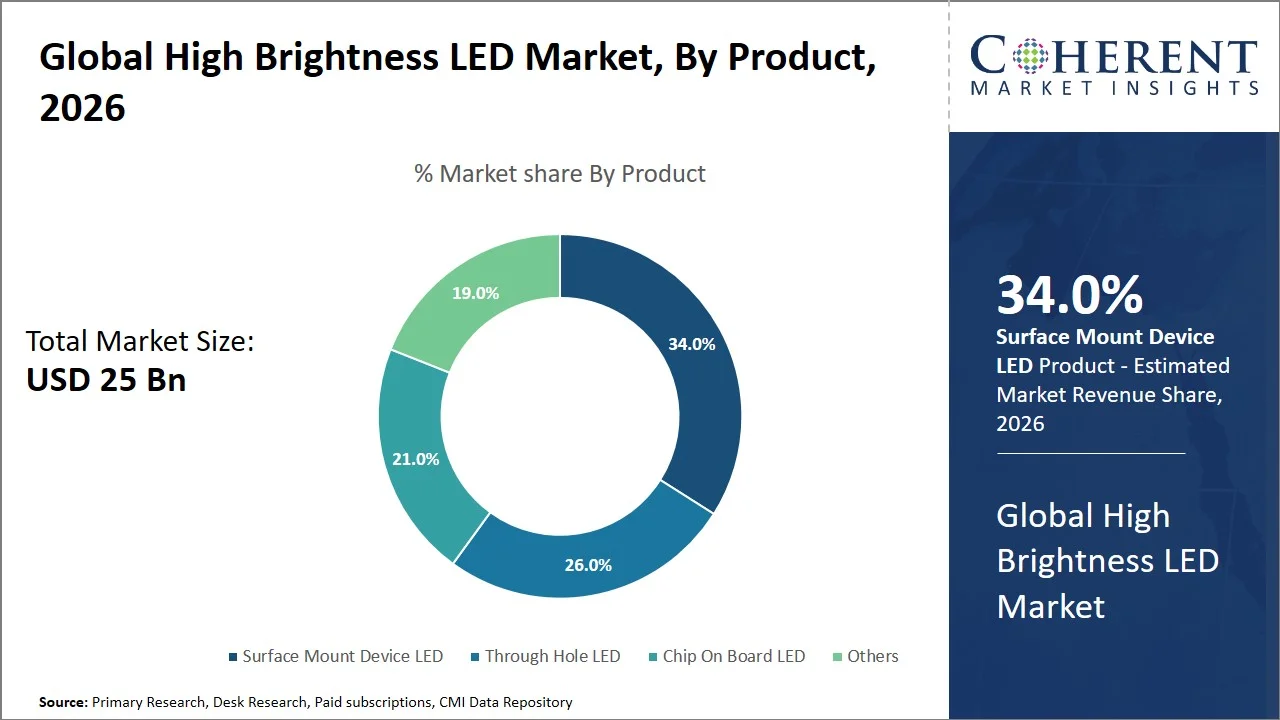
- The surface mount device LED segment is expected to account for 34.0 % of the global high brightness LED market share in 2026. Growing use of surface mount LEDs in industrial and commercial applications is driving the growth of the segment. On July 15, 2025, Cree LED announced that it is taking legal action to protect its portfolio of High Contrast Surface Mount Device (SMD) LED technologies used in indoor and outdoor commercial digital signage, highlighting the continued adoption of its SMD innovations in retail, entertainment and industrial display installations.
- The general lighting segment is estimated to capture 32.0 % of the market share in 2026. Increasing investments in smart city infrastructure is majorly driving the growth of the segment. On June 23, 2026, Signify announced a renewed strategic focus on connected outdoor lighting and smart city infrastructure during its Capital Markets Day, prioritizing intelligent LED street lighting systems integrated with digital control platforms for municipalities and urban infrastructure projects.
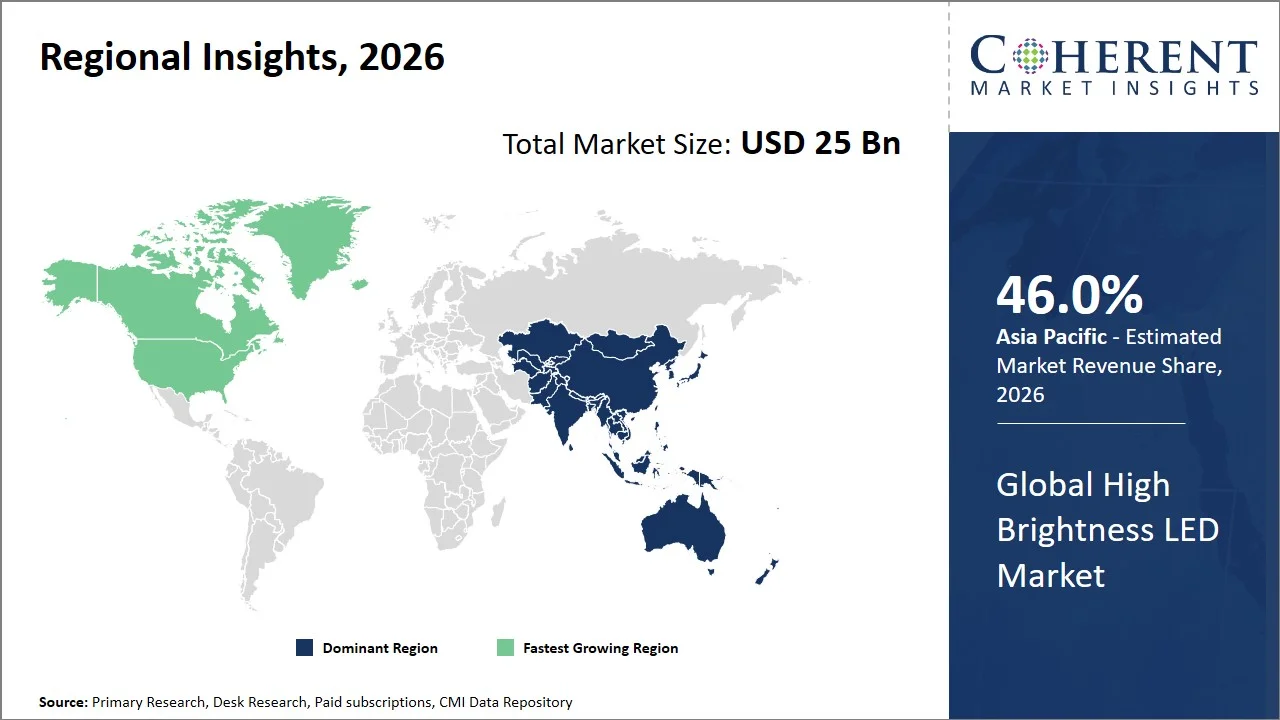
- Asia Pacific is expected to dominate the high brightness LED market in 2026 with a market share of 46.0 %. Growing advancements in display technologies in Asia Pacific are driving the growth of the regional market. On November 14, 2025, TCL China Star Optoelectronics Technology unveiled TCL CSOT’s cutting-edge lineup of LCD, OLED and MLED products, in parallel with breakthroughs in AI-powered displays, establishing new standards and redefining excellence across multiple display categories.
- North America is expected to account for 24.0 % of the market share in 2026 and is projected to record the fastest growth over the forecast period. Emerging demand from healthcare and medical applications in North America is driving the growth of the regional market. On June 4, 2026, Medtronic, a global leader in healthcare technology, announced the expansion of its strategic partnership with Corsano Health B.V., a pioneering MedTech company specializing in advanced real-time remote patient monitoring solutions.
- Rapid commercialization of Micro LED and Mini LED technologies: Manufacturers are increasing investments in Micro LED and Mini LED production for premium TVs, automotive smart displays, AR and VR devices, digital signage and high-end monitors, as they offer superior brightness, contrast, energy efficiency and longer operating life than conventional LED technologies.
- Growing adoption of smart and connected LED lighting systems: High brightness LEDs are being combined with IoT platforms, wireless controls, occupancy sensors, daylight harvesting systems and AI-based lighting management solutions to deliver intelligent energy optimization in commercial buildings, industrial facilities and smart city infrastructure.
Segmental Insights
Why Does Surface Mount Device LED Dominate the Global High Brightness LED Market?
The surface mount device LED segment is expected to account for 34.0% of the global high brightness LED market share in 2026. The main reason that surface mount device LED technology is so widely used is that it is more compatible with high volume automated manufacturing processes. Its compact design allows for faster pick-and-place assembly and cheaper production costs, as well as higher package density on printed circuit boards, while yet providing exceptional brightness, thermal performance and reliability. These benefits have led to SMD LEDs being the de facto standard for automotive lighting, consumer electronics, digital displays, commercial lighting and industrial applications where manufacturers need scalable manufacturing, consistent performance and space-saving designs. On March 4, 2026, Vishay Intertechnology launched the VLMRGB1500, an ultra-compact 0404 surface-mount package that is ideal for automated pick-and-place assembly and is suited for industrial controls, dashboard indicators, backlighting and display systems that facilitate high-density PCB layouts.
- Current Industry Events of 2026
- Market Size Estimation
- Regional Breakdown
- Competitive Landscape
- Customer Intelligence
- Segmental Analysis
- Pricing Analysis
- Key Market Drivers, Challenges & Future Trends
- Customized Insights Section
Why is General Lighting the Most Widespread Application?
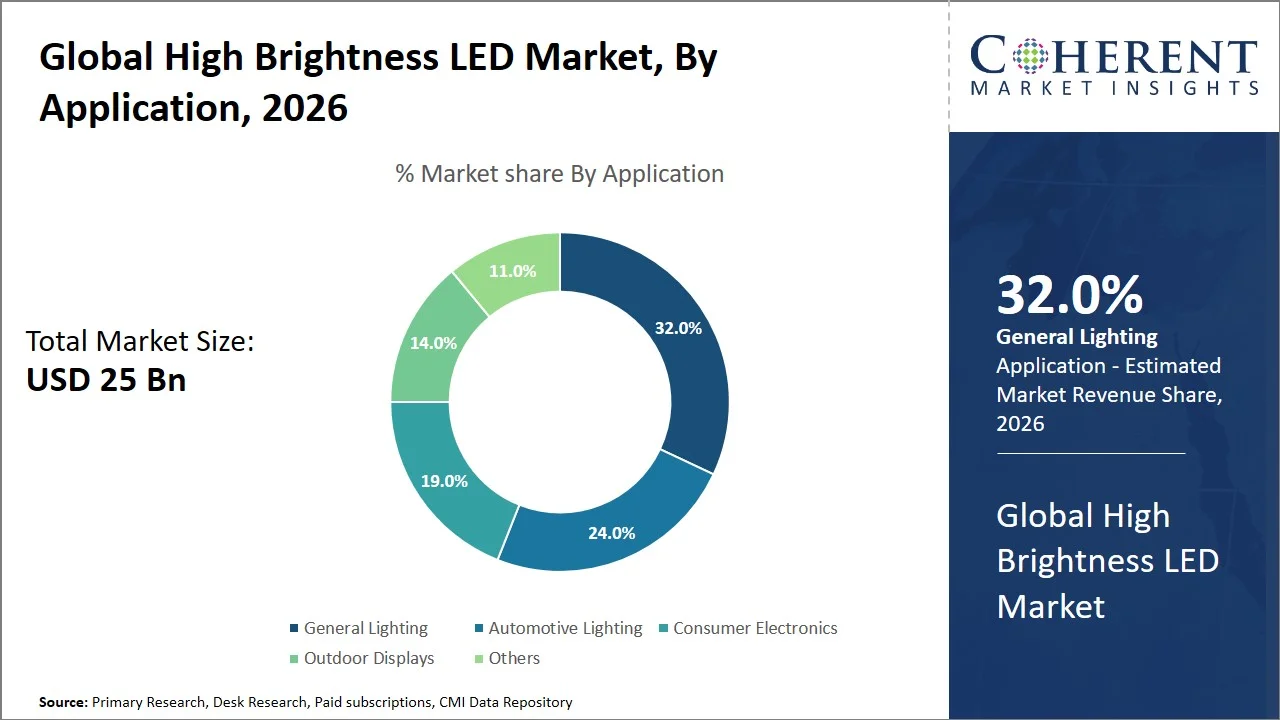
The general lighting segment is expected to account for 32.0% of the global high brightness LED market share in 2026. The key driver for broad usage of general lighting is the global move towards energy efficient lighting in residential, commercial and public facilities. High brightness LEDs are the ideal lighting technology for homes, offices, retail spaces, factories, streets and public buildings because of their much lower power consumption, longer operational life, decreased maintenance requirements and high luminous output. The replacement of traditional lighting systems and continuous government energy-efficiency programs further enhance the need for high brightness LEDs in general illumination applications. On April 23, 2025, Cree Lighting and Lumileds announced a collaboration that resulted in the introduction of a 1900K/50 CRI outdoor LED lighting solution that will eliminate blue light emissions while retaining excellent energy efficiency.
Currents Events and their Impact
Current Events | Description and its Impact |
European Union Ecodesign for Sustainable Products Regulation (ESPR) |
|
European Union Corporate Sustainability Due Diligence Directive (CSDDD) |
|
High Brightness LED Market Dynamics
Market Drivers
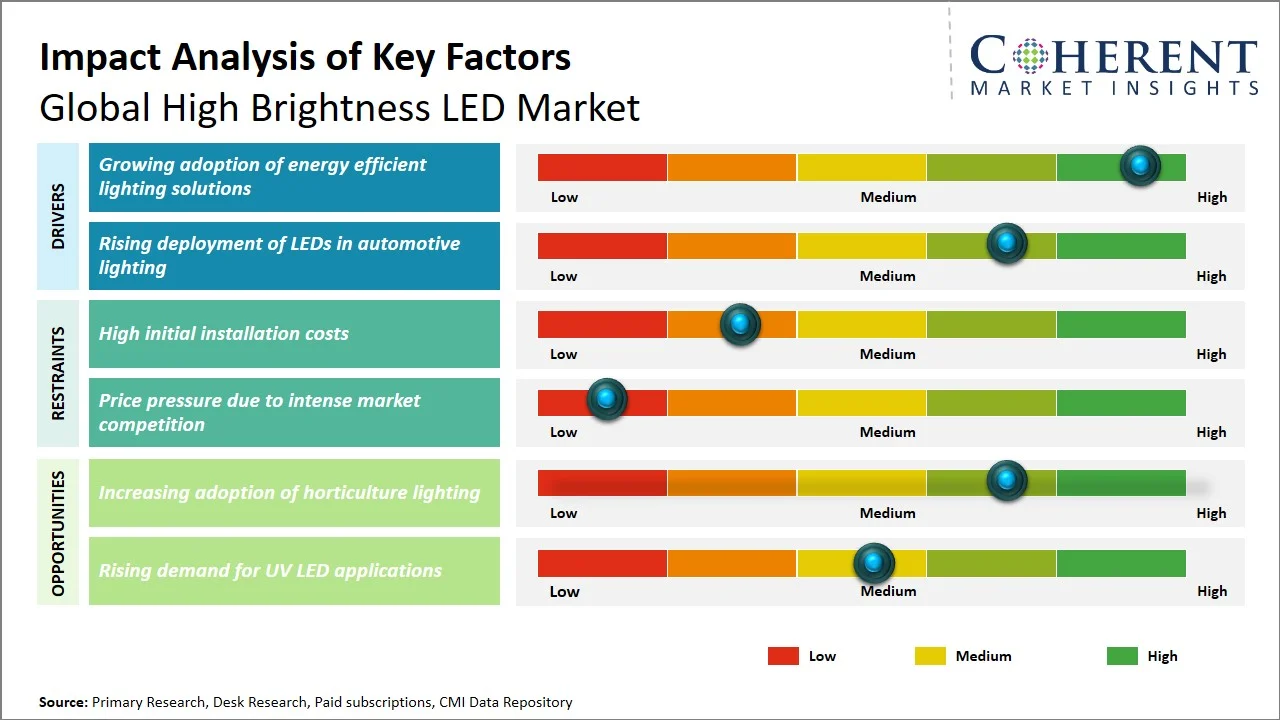
- Growing adoption of energy efficient lighting solutions: One of the major factors driving the growth of the high brightness LED market is the global shift to energy-efficient lighting. Governments, businesses, and consumers are replacing traditional incandescent, halogen, and fluorescent lighting with LED-based solutions. High brightness LEDs utilize less power yet have higher luminous efficacy, longer life, cheaper maintenance costs and lower carbon emissions. Government efficiency regulations, green building initiatives, smart city projects and corporate sustainability goals are also further accelerating LED adoption across residential, commercial, industrial and public infrastructure applications creating sustained demand for high performance lighting products. On January 7, 2025, Signify, the global leader in smart lighting, launched groundbreaking features and accessories for Philips Hue, revolutionizing how users illuminate, entertain, and secure their homes.
- Rising deployment of LEDs in automotive lighting: The demand for high brightness LED products is increasing rapidly due to the growing adoption of LEDs in automotive lighting. Auto makers are focusing on energy-efficient, safe and innovative lighting technologies. The high brightness LEDs are widely used in adaptive headlights, daytime running lights, taillights, fog lamps, interior ambient lighting and digital display systems owing to their small size, fast response time, excellent illumination and long service life. The fast rise of electric vehicles, luxury vehicle production, and advanced driver assistance systems is also pushing automakers to adopt advanced LED lighting solutions that boost visibility, vehicle appearance, and overall driving performance. On February 23, 2026, Marelli, together with its joint venture partner, Motherson, inaugurated a new manufacturing facility for automotive lighting in Sanand in the Indian state of Gujarat in India. The new plant marks an important expansion of the Marelli Motherson Lighting India (MMLI) joint venture’s presence in the country.
Emerging Trends
- Expansion of automotive high brightness LED applications: Automotive manufacturers are using high brightness LEDs in adaptive driving beam headlights, matrix lighting, daytime running lights, interior ambient lighting, and advanced signaling systems to improve road safety, design flexibility, and energy efficiency while supporting electric and autonomous vehicle development.
- Increasing focus on high efficiency and sustainable LED manufacturing: LED manufacturers are investing in advanced semiconductor materials, wafer technologies, improved thermal management, recyclable components and environmentally sustainable production processes to improve luminous efficacy, reduce power consumption, extend product lifetime and meet increasingly stringent global energy efficiency regulations.
Regional Insights
Why is Asia Pacific a Strong Market for High Brightness LED?
Asia Pacific is expected to account for a market share of 46.0% in 2026. Asia Pacific is the world's core of manufacture and innovation for high brightness LEDs, supported by large production ecosystems in China, Japan, South Korea and Taiwan. China continues to push forward in the production of Mini LED displays and automotive LED manufacturing. Japan leads in advanced LED chip technology with businesses such as Nichia and Toyoda Gosei. South Korea is bolstering its position by investing in Micro LED displays from Samsung Electronics and LG Display, while governments across the region are driving the implementation of LEDs through smart city development, railway renovation and energy-efficient public lighting schemes.
Why Does the North America High Brightness LED Market Exhibit High Growth?
North America is projected to account for 24.0% of the global high brightness LED market and is expected to register the fastest growth. North America is being driven by significant demand from automotive, aerospace, industrial automation and premium commercial lighting applications. In the U.S., high brightness LEDs are increasingly being deployed in electric car lighting systems, enhanced driver assistance technology, digital billboards and controlled-environment agriculture. Companies, such as Cree LED, Lumileds, and Signify, continue to release high-performance LED solutions for industrial facilities, healthcare infrastructure, and smart building projects. Data center expansion is also boosting the demand for energy-efficient lighting systems.
Global High Brightness LED Market Outlook for Key Countries
Why is China Emerging as a Major Hub in the High Brightness LED Market?
Owing to vertically integrated supply chains including LED chips, packaging and completed lighting products, China is the world's largest manufacturer and consumer of high brightness LEDs. NationStar Optoelectronics, MLS Co Ltd, HC Semitek and Sanan Optoelectronics are all ramping up the manufacturing of Mini LED displays, automotive lighting and commercial lighting. The domestic demand is further boosted by massive smart city projects, metro train expansions, smart manufacturing facilities, and the widespread replacement of conventional lighting systems with LED systems.
Is the U.S. the Next Growth Engine for the High Brightness LED Market?
The U.S. is experiencing more widespread use of high brightness LEDs in automotive manufacture, commercial building, digital signage, horticulture and defense applications. Automotive manufacturers are including adaptive LED headlamps and enhanced interior lighting in electric vehicles. Commercial building owners are replacing heritage lighting with linked LED lighting to enhance operational efficiency. Continued market expansion is supported by the ongoing existence of technology developers such as Cree LED and Lumileds and ongoing investment in smart infrastructure and semiconductor manufacturing.
Germany High Brightness LED Market Analysis and Trends
The Germany high brightness LED market is marked by a highly developed automobile industry and a sophisticated industrial production base. Car manufacturers, such as BMW, Mercedes-Benz, Volkswagen and Audi, are continuing to bring matrix LED headlamps, adaptive lighting systems, and smart interior lighting to premium vehicle platforms. As industrial automation projects, energy-efficient factory upgrades and sustainable commercial building constructions increase, high brightness LED solutions are also gaining demand in the manufacturing and infrastructure sectors.
Japan High Brightness LED Market Analysis and Trends
Japan’s strength in the high brightness LED industry is in LED chip innovation, automotive lighting and precision production. High-efficiency LEDs for adaptive car lighting, industrial equipment and purpose-built medical applications are still being developed by companies such as Nichia, Toyoda Gosei, Stanley Electric and Koito Manufacturing. The nation’s drive for energy saving, automation of factories, upgrading of railways and development of sophisticated electronic products is driving further uptake of high brightness LED technology across a range of industries.
South Korea High Brightness LED Market Analysis and Trends
South Korea is enhancing its leadership in high brightness LED technology through continual innovation in advanced display production and consumer electronics. Samsung Electronics and LG Display are speeding up the commercialization of Micro LED and Mini LED display technologies for televisions, commercial displays and automotive applications, while Seoul Semiconductor is developing high-performance LED components for automotive and industrial customers. Government assistance for semiconductor production and next-generation display technologies further strengthens the nation’s competitive position.
Global High Brightness LED Market - Automotive LED Penetration By Vehicle Segment (2025)
Vehicle Segment | Estimated LED Penetration in New Vehicle Production |
Premium Passenger Cars | 98% |
Electric Passenger Vehicles (BEV/PHEV) | 96% |
Mid-Range Passenger Cars | 82% |
Entry-Level Passenger Cars | 61% |
Light Commercial Vehicles (Vans & Pickups) | 74% |
Heavy Commercial Vehicles (Trucks) | 69% |
Buses & Coaches | 77% |
Off-Highway Vehicles (Construction & Agriculture) | 58% |
How is the Increasing Adoption of Horticulture Lighting Creating New Growth Opportunities in the High Brightness LED Market?
The rising use of horticulture lighting is driving substantial development potential in the high brightness LED market as commercial greenhouses, vertical farms and indoor agriculture facilities are increasingly using LED-based lighting to improve crop growth throughout the year. High brightness LEDs provide precise control of light intensity and spectrum output, resulting in improved photosynthesis, crop quality and energy efficiency and lower operating costs compared to conventional lighting solutions. The growing investments in controlled environment agriculture, the rising demand for locally produced food and the increasing government support for sustainable farming practices are driving manufacturers to develop specialized high brightness LED solutions. On June 3, 2025, Signify launched the Philips GrowWise smart spectrum, a new algorithm that automatically adjusts horticultural LED lighting to real-time sunshine irradiation.
Market Players, Key Development, and Competitive Landscape
Key Developments
- On May 30, 2026, Seoul Semiconductor Co., Ltd announced that its world’s first High Voltage (HV) opto-semiconductor technology has entered mass production with four of the world's top automotive brands across the Americas, Europe, and Asia, with plans to expand supply to 10 models by the end of the year.
- On October 24, 2025, Lumileds launched the LUXEON Altilon SMD-A, described as its thinnest single-chip addressable LED package for high-performance forward lighting. Lumileds’ new LUXEON Altilon SMD-A is designed to support most demanding automotive headlighting applications including front fog, low and high beam, and adaptive driving beam (ADB).
Competitive Landscape
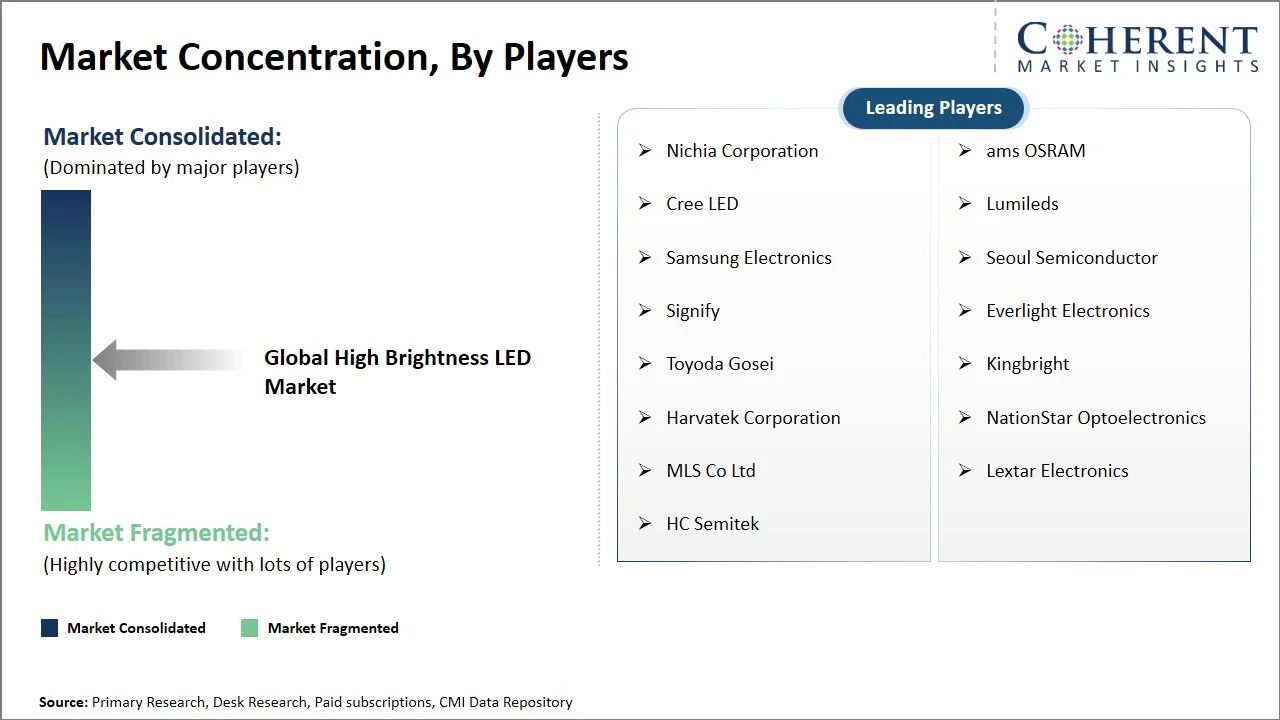
The high brightness LED industry is very competitive, with existing LED chip producers, packaging specialists, and vertically integrated lighting firms all competing on technological distinction and not just price. Nichia, ams OSRAM, Samsung Electronics, Seoul Semiconductor, Lumileds, Signify, Everlight Electronics, NationStar Optoelectronics and MLS Co Ltd are all investing in chip architecture, wafer processing and thermal management technologies to expand their automotive lighting, mini LED backlighting, micro LED displays and industrial illumination portfolios.
Market Report Scope
High Brightness LED Market Report Coverage
| Report Coverage | Details | ||
|---|---|---|---|
| Base Year: | 2025 | Market Size in 2026: | USD 25 Bn |
| Historical Data for: | 2020 To 2024 | Forecast Period: | 2026 To 2033 |
| Forecast Period 2026 to 2033 CAGR: | 7.8% | 2033 Value Projection: | USD 41 Bn |
| Geographies covered: |
| ||
| Segments covered: |
| ||
| Companies covered: | Nichia Corporation, ams OSRAM, Cree LED, Lumileds, Samsung Electronics, Seoul Semiconductor, Signify, Everlight Electronics, Toyoda Gosei, Kingbright, Harvatek Corporation, NationStar Optoelectronics, MLS Co Ltd, Lextar Electronics, and HC Semitek | ||
| Growth Drivers: |
| ||
| Restraints & Challenges: |
| ||
Analyst Opinion (Expert Opinion)
- The high brightness LED market is slowly moving from traditional lighting applications to more value-added categories such as automotive lighting, innovative displays, horticulture lighting and intelligent industrial systems. Competitive advantage in the high brightness LED market is increasingly being shaped by improvements in luminous efficacy, chip miniaturization, thermal management, and integration with smart lighting control technologies rather than manufacturing scale alone. Ongoing investments in Micro LED commercialization, advanced packaging technologies, and application-specific lighting solutions are expected to strengthen product differentiation, accelerate technological innovation, and redefine the competitive positioning of leading manufacturers over the coming years.
- The high brightness LED market is anticipated to see continued technical progress with high brightness LEDs finding increased application in adaptive automotive lighting, AI-driven smart lighting networks, next-generation display technologies and precision agriculture systems. The commercialization of Micro LED displays, advancements in intelligent transportation infrastructure and rising penetration of high-performance LEDs in medical devices and machine vision equipment are expected to broaden the use of high brightness LED. Manufacturers are also expected to focus on gallium nitride innovation, sophisticated thermal management and automated production methods to boost efficiency, reliability and product differentiation in an increasingly performance-driven industry.
Speak to the analyst
Want personalized insights?
Take the findings above to one of our principal consultants, or have the report rebuilt around the segments, geographies and competitors you actually track.
Market Segmentation
- Product Insights (Revenue, USD Billion, 2021 - 2033)
- Surface Mount Device LED
- Through Hole LED
- Chip On Board LED
- Others
- Application Insights (Revenue, USD Billion, 2021 - 2033)
- General Lighting
- Automotive Lighting
- Consumer Electronics
- Outdoor Displays
- Others
- Regional Insights (Revenue, USD Billion, 2021 - 2033)
- North America
- U.S.
- Canada
- Latin America
- Brazil
- Argentina
- Mexico
- Rest of Latin America
- Europe
- Germany
- U.K.
- Spain
- France
- Italy
- Russia
- Rest of Europe
- Asia Pacific
- China
- India
- Japan
- Australia
- South Korea
- ASEAN
- Rest of Asia Pacific
- Middle East
- GCC Countries
- Israel
- Rest of Middle East
- Africa
- South Africa
- North Africa
- Central Africa
- North America
- Key Players Insights
- Nichia Corporation
- ams OSRAM
- Cree LED
- Lumileds
- Samsung Electronics
- Seoul Semiconductor
- Signify
- Everlight Electronics
- Toyoda Gosei
- Kingbright
- Harvatek Corporation
- NationStar Optoelectronics
- MLS Co Ltd
- Lextar Electronics
- HC Semitek
Sources
Primary Research Interviews
- LED Manufacturers & Suppliers
- Electronics & Semiconductor Distributors
- End-use Industry Representatives (Automotive, Consumer Electronics, General Lighting)
- Government & Regulatory Bodies
Magazines
- LEDs Magazine
- Electronics Weekly
- Photonics Media Magazine
- Semiconductor Today
Journals
- Journal of Applied Physics
- IEEE Photonics Technology Letters
- Optics Express (Optical Society of America)
Associations
- Illuminating Engineering Society (IES)
- Semiconductor Industry Association (SIA)
- LED Association (LEDiL & Global Lighting Association)
- European Lighting Industry Association (Lighting Europe)
Public Domain Sources
- U.S. Department of Energy (DOE) – Solid-State Lighting Program
- International Energy Agency (IEA)
- S. Patent and Trademark Office (USPTO)
- European Commission – Energy Efficiency Reports
Proprietary Elements
- CMI Data Analytics Tool
- Proprietary CMI Existing Repository of Information for the last 10 years
Get access to 250+ pages report
Every segment, forecast, competitor profile and data table behind the analysis above — available for instant download.
- ESOMAR Member
- ISO 9001:2015 Certified
- D-U-N-S Registered
- GDPR & CCPA Compliant
Missing comfort of reading report in your local language? Find your preferred language:
Transform your Strategy with Exclusive Trending Reports
Frequently Asked Questions
The global high brightness LED market is expected to stand at USD 25 Bn in 2026 and is expected to reach USD 41 Bn by 2033.
The CAGR of the global high brightness LED market is projected to be 7.8% from 2026 to 2033.
Growing adoption of energy efficient lighting solutions and rising deployment of LEDs in automotive lighting are the major factors driving the growth of the global high brightness LED market.
High initial installation costs and price pressure due to intense market competition are the major factors hampering the growth of the global high brightness LED market.
In terms of product, the surface mount device LED segment is estimated to dominate the market revenue share in 2026.
They provide superior illumination, long operating life, low power consumption, and compact designs for advanced vehicle lighting.
Smart city projects are increasing the deployment of intelligent street lighting and connected public infrastructure.