

Railway Connectors Market Size & Forecast 2026-2033
The global railway connectors market is estimated to be valued at USD 1,229.5 Mn in 2026 and expected to reach USD 1,824.4 Mn by 2033, exhibiting a CAGR of 5.8% between 2026 and 2033.
Key Takeaways
- Based on Type, the Power Connector segment leads the market holding an estimate share of 35.1% in 2026, driven by advancements in rail infrastructure, increasing passenger demand, and the adoption of modern technologies in the transportation sector.
- Based on Design, the Circular segment is expected to account for the largest share of the market in 2026, due to their robustness and ability to withstand vibrations, shocks, and harsh environmental conditions.
- Based on Physical Application, the Rolling Stock segment leads the market with the highest share in 2026, as modern trains and locomotives require reliable, high-performance electrical and signal connections.
- Based on Function, the Power Distribution segment represents the greatest share of the market in 2026, as modern trains require high-voltage, reliable, and continuous electrical supply for propulsion, lighting, HVAC, signaling, and onboard systems.
- Based on Rail Type, the Passenger Train segment is expected to hold the dominate share of the market in 2026, due to the rapid expansion of high-speed rail networks, which require advanced and reliable connectors for power, signaling, and data transmission.
- Based on Region, North America is estimated to lead the market with a share of 34% in 2026, While, Asia Pacific, holding a share of 20.3% in 2025, is projected to be the fastest growing region.
Market Overview
The Railway Connectors Market is experiencing steady growth, driven by advancements in rail infrastructure, increasing passenger demand, and the adoption of modern technologies in the transportation sector. Railway connectors are essential components that facilitate the transmission of power, data, and signals between various parts of railway systems, ensuring seamless operation and safety. The rising need for reliable and efficient rail communication and power systems is significantly boosting railway connectors market demand, as rail operators and manufacturers increasingly invest in advanced connector solutions to enhance system performance and passenger safety.
Current Events and Their Impact on the Railway Connectors Market
Current Event | Description and its Impact |
Asian High-Speed Rail Expansion and Modernization |
|
Global Railway Electrification and Decarbonization Push |
|
Role of Artificial Intelligence (AI) in Railway Connectors Market
Artificial Intelligence (AI) is increasingly being integrated into the Railway Connectors Market, enhancing the performance, reliability, and maintenance of rail systems. AI-powered solutions are enabling predictive maintenance of connectors, allowing operators to monitor real-time conditions and anticipate potential failures before they disrupt operations. Smart sensors embedded in connectors can analyze electrical, thermal, and mechanical signals, providing actionable insights to optimize energy efficiency and reduce downtime. Furthermore, AI-driven analytics improve fault detection and system diagnostics, ensuring seamless data and power transmission across trains and rail infrastructure.
For instance, in April 2025, South Western Railway (SWR) launched a ₹550 million Converged Communication System (CCS), marking a significant upgrade in Indian Railways' operational infrastructure. This advanced system integrates voice, video, and data services across stations, trains, and control centres, enhancing communication and security. A key component is the deployment of a Video Surveillance System (VSS) featuring 2,784 high-definition cameras equipped with AI technologies like Face Recognition and Video Analytics. These cameras are monitored through Integrated Command and Control Centres (ICCC) at divisional and zonal levels.
- Current Industry Events of 2026
- Market Size Estimation
- Regional Breakdown
- Competitive Landscape
- Customer Intelligence
- Segmental Analysis
- Pricing Analysis
- Key Market Drivers, Challenges & Future Trends
- Customized Insights Section
Segmental Insights
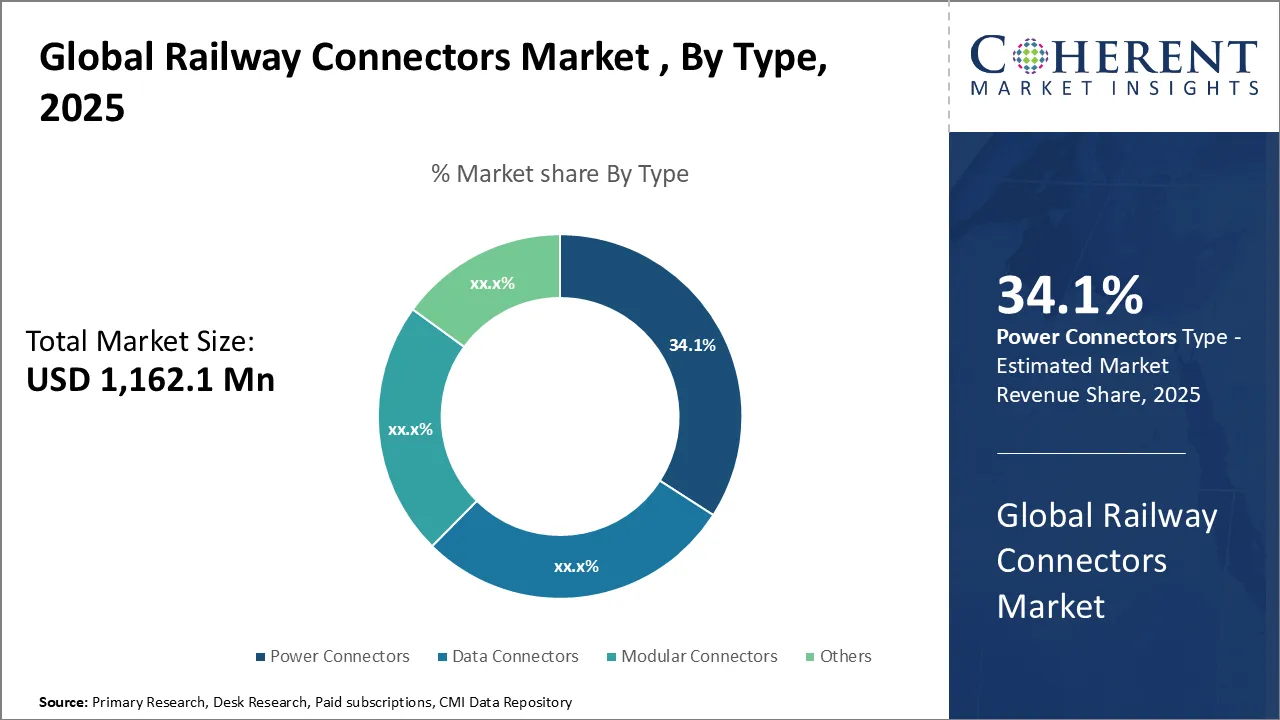
Railway Connectors Market Insights, By Type: Power Connector dominates driven by Advanced Rail Infrastructure
In terms of type, the power connector segment command the largest share of the global railway connectors market with an estimated 35.1% in 2026, driven by advancements in rail infrastructure, increasing passenger demand, and the adoption of modern technologies in the transportation sector. Railway connectors are essential components that facilitate the transmission of power, data, and signals between various parts of railway systems, ensuring seamless operation and safety. The rising need for reliable and efficient rail communication and power systems is significantly boosting railway connectors market demand, as rail operators and manufacturers increasingly invest in advanced connector solutions to enhance system performance and passenger safety.
For instance, in September 2024, Degson Electronics introduced the DS16-TW Push-In DIN-Rail Terminal Block, enhancing its industrial connectivity solutions. This front-wired terminal block simplifies wiring processes by eliminating the need for tools, offering efficient and reliable connections. Designed for applications requiring secure and rapid installation, the DS16-TW is ideal for automation systems, control panels, and other industrial environments.
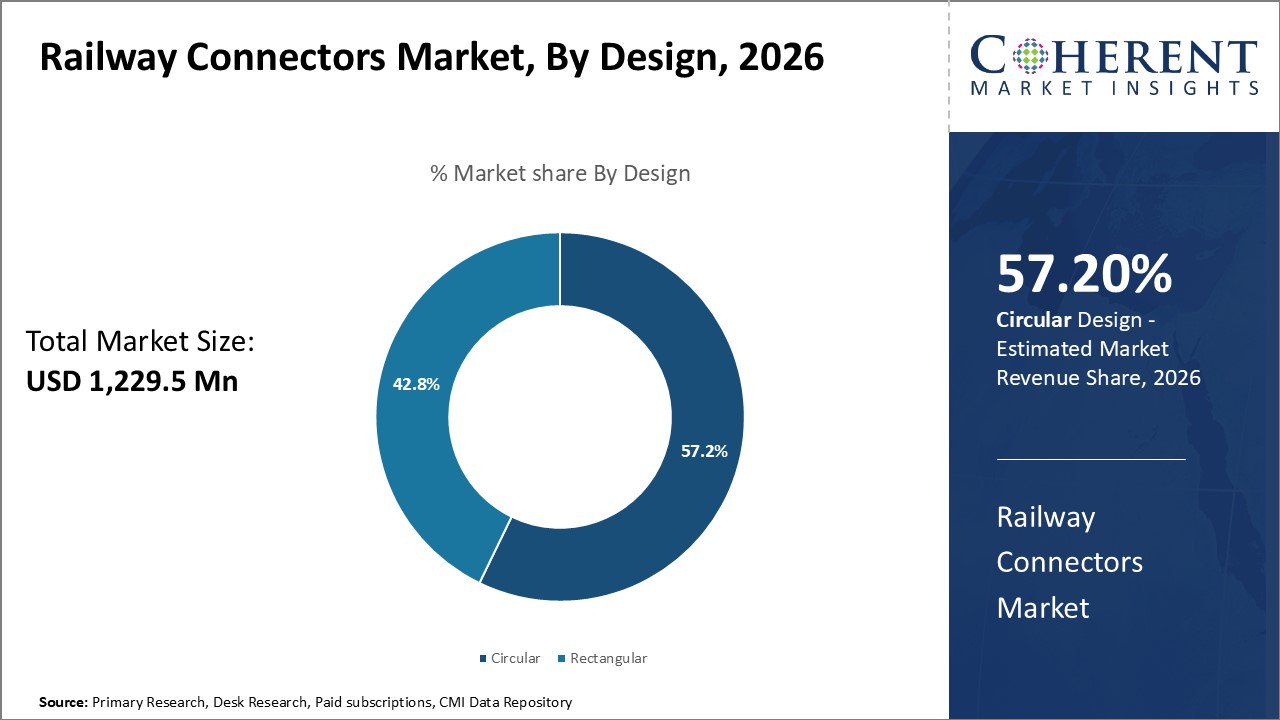
Railway Connectors Market Insights, By Design: Circular Leads Owing to Robustness and Ability to Withstand Harsh Environment
In terms of design, the circular segment is expected to hold the largest share of the market in 2026, due to their robustness and ability to withstand vibrations, shocks, and harsh environmental conditions common in rail applications. Their simple plug-and-play design allows for quick installation and maintenance, reducing downtime for trains. Additionally, circular connectors provide excellent sealing and protection against dust, water, and temperature variations, ensuring reliable performance in all weather conditions. They are versatile, supporting power, signal, and data transmission within a single connector, which is crucial for modern trains. Overall, their reliability and durability make them essential for safe and uninterrupted train operations, particularly in high-speed and passenger rail systems.
For instance, in September 2024, HARTING introduced its UIC IT circular connectors, designed to deliver fast and robust Ethernet connectivity for railway applications. These connectors are engineered to meet the stringent requirements of the UIC 568 standard, ensuring reliable data transmission in challenging environments. The UIC IT series offers features such as high vibration resistance, secure locking mechanisms, and compatibility with existing infrastructure, making them ideal for modernizing train communication systems.
Railway Connectors Market Insights, By Physical Application: Rolling Stock Leads Due to Rising need for High Performance Electrical AN Singal Connections
In terms of physical application, the rolling stock segment is expected to contribute the highest share of the market in 2026, as modern trains and locomotives require reliable, high-performance electrical and signal connections for power, control, and communication systems. Increasing electrification of trains, along with the adoption of high-speed and digitalized rolling stock, has significantly raised the need for robust, vibration-resistant connectors. These components are essential for ensuring operational safety, supporting braking and signaling systems, and enabling smart features such as onboard sensors, monitoring, and communication systems. Consequently, the growth of advanced rolling stock directly fuels the demand for specialized railway connectors.
For instance, in June 2025, the Mumbai Metropolitan Region Development Authority (MMRDA) awarded a ₹2,269 crore contract to NCC Ltd for the development of Mumbai Metro Line 6. This contract encompasses the design, manufacture, supply, installation, integration, testing, and commissioning of rolling stock, communication-based signaling and train control systems, telecommunication infrastructure, platform screen doors, and depot machinery and plant.
Railway Connectors Market Insights, By Function: Rising Requirement for High Voltage and Reliable Train Drives Power Distribution
In terms of function, the power distribution segment is expected to hold the greatest share of the market in 2026, as modern trains require high-voltage, reliable, and continuous electrical supply for propulsion, lighting, HVAC, signaling, and onboard systems. Efficient connectors ensure minimal energy loss, safety, and system reliability, especially in high-speed and electrified rail networks, making power distribution a critical and growing application.
For instance, in September 2024, Schaltbau expanded its high-power contactor portfolio at InnoTrans 2024, featuring models rated from 600A to 2000A. These contactors are designed to enhance power distribution in rail applications, including propulsion and battery-train systems. The new versions offer improved performance and reliability, catering to the evolving demands of the rail industry. This launch underscores Schaltbau's commitment to advancing rail innovation and supporting sustainable transportation solutions.
Railway Connectors Market Insights, By Rail Type: Rapid Expansion of High Speen Rail Networks Fuels the Demand for Passenger Train
In terms of rail type, the passenger train is expected to hold the maximum share of the market in 2026, due to the rapid expansion of high-speed rail networks, which require advanced and reliable connectors for power, signaling, and data transmission. Ongoing electrification and modernization of existing passenger rail transport systems further increase the need for connectors that support complex electrical and automation systems. Additionally, stringent safety and reliability standards in passenger trains necessitate high-performance connectors for critical applications. Coupled with growing urbanization and rising intercity travel, the expansion of passenger train fleets is significantly boosting the demand for railway connectors, making this segment the largest in the market.
For instance, in August 2025, The Vande Bharat Express, India's flagship semi-high-speed train, has set new benchmarks in rail travel. Achieving a maximum design speed of 180 km/h during trials, it operates at an impressive 160 km/h in service. Notably, it accelerates from 0 to 100 km/h in just 52 seconds, offering swift and efficient travel. Despite this, average operational speeds range between 75–77 km/h, influenced by track conditions and station stops. The train's advanced bolsterless bogie design and KAVACH safety system enhance ride quality and passenger safety.
Regional Insights
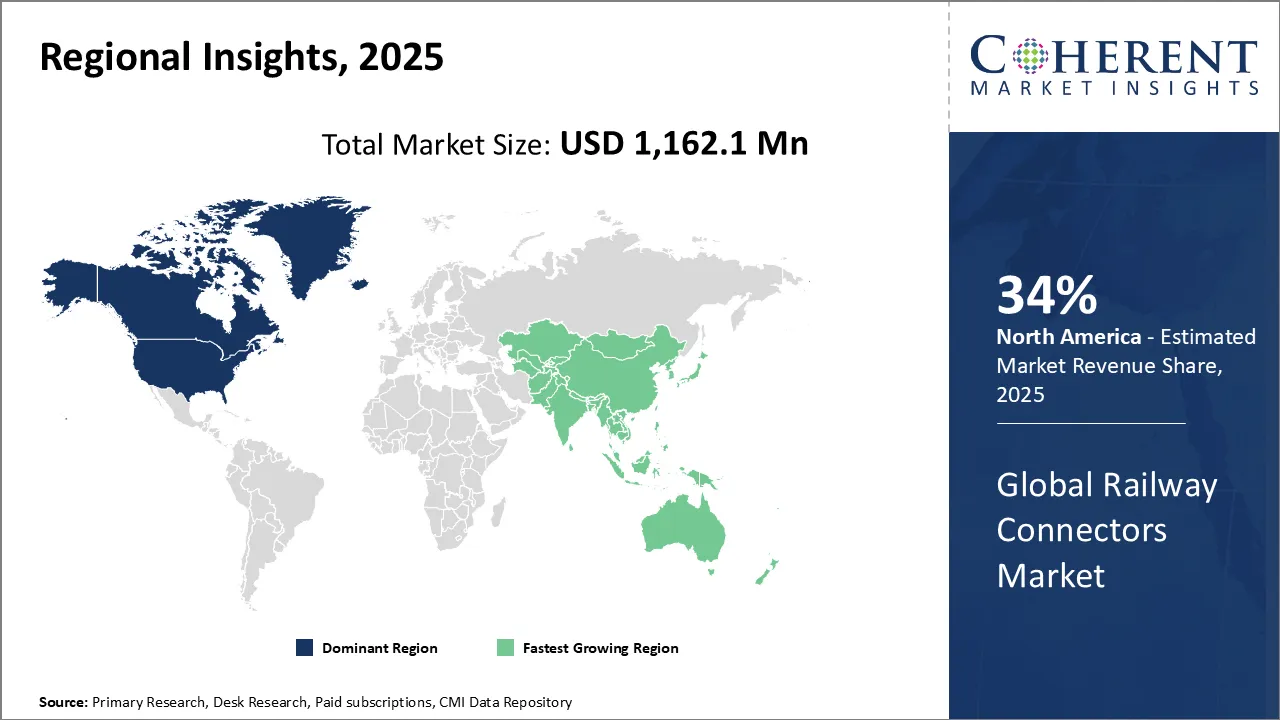
North America Railway Connectors Market Analysis & Trends
North America, holing an estimated share of 34% in global railway connectors market in 2026, due to extensive modernization of rail infrastructure, including high-speed rail projects, metro expansions, and freight corridor upgrades. The ongoing electrification of rail networks and the adoption of digital signaling and smart rail systems have increased the need for high-performance connectors capable of handling both electrical power and data signals efficiently. Stringent safety and regulatory standards further drive demand for reliable connectors that can operate under extreme environmental conditions.
Additionally, rising passenger and freight traffic necessitates the deployment of new trains and rolling stock, boosting the requirement for advanced connectors. Technological advancements, such as IoT integration, real-time monitoring, and predictive maintenance systems, also contribute to the market’s growth, making North America a key region for railway connectors market demand.
For instance, in June 2026, Siemens Mobility unveiled the Charger B+AC, North America's first battery-electric passenger locomotive. Manufactured in the U.S., this advanced rail solution is designed to operate at speeds up to 125 mph under overhead catenary power and can run up to 100 miles on battery power alone. The Charger B+AC seamlessly transitions between power sources, making it ideal for networks with partial electrification. This innovation expands Siemens' portfolio of alternative propulsion technologies, which includes battery-electric, hydrogen-powered, and hybrid locomotives.
Asia Pacific Railway Connectors Market Analysis & Trends
Asia Pacific, holding a projected share of 20.3% in 2026, exhibit the fastest growth in the railway connectors market, due to several factors. Rapid urbanization and population growth in countries such as China, India, and Japan are driving the expansion of metro, light rail, and high-speed rail networks. Governments and private operators are investing heavily in modernizing existing rail infrastructure and introducing new lines to meet increasing passenger and freight transport demands. The shift toward electrification of railways and adoption of advanced signaling, communication, and data transmission systems is further boosting the need for reliable and high-performance railway connectors. Additionally, industrial growth, rising disposable incomes, and increasing tourism are contributing to higher passenger volumes, which necessitates robust, safe, and efficient rail connectivity solutions. These factors collectively make Asia-Pacific a key growth hub, significantly driving Railway Connectors Market demand in the region.
For instance, Indonesia is urging China to invest in expanding its high-speed rail network, following the success of the Jakarta-Bandung line, known as "Whoosh." The government is conducting a feasibility study to extend the line eastward to Surabaya, reducing the journey time from eight hours to four. The extension aims to enhance economic integration across Java and boost trade. Indonesia also presented three major railway projects at a Shanghai expo, including urban rail systems in Bandung and the future capital, Nusantara.
Railway Connectors Market Outlook Country-Wise
The U.S. Railway Connectors Market Trends
The U.S. rail network is holding a market share of 23.1% and modernizing with increasing investments in high-speed rail, commuter trains, and metro systems. Advanced railway infrastructure projects and the adoption of smart train technologies are driving the need for reliable connectors for power, signaling, and data transmission.
The U.K. Railway Connectors Market Trends
The U.K. continues to growth with 4.7% market share and upgrades its railway infrastructure, including electrification of lines, metro expansions, and adoption of modern train control systems. These developments require robust connectors for both legacy and modern train systems.
For instance, in July 2026, the £100 million electrification of the Wigan to Bolton railway line has been completed, marking a significant milestone in the UK's rail infrastructure. Enables electric trains to operate along the 6.5-mile route. The project involved the installation of 21 kilometers of power lines, erection of 414 new overhead line equipment stanchions, and extensive upgrades to bridges, level crossings, and station platforms.
China Railway Connectors Market Trends
China’s holds the market share of 15% growing with its rapid expansion of high-speed rail and urban transit networks has created a massive demand for railway connectors. The country’s focus on advanced rail technologies and large-scale infrastructure projects is a key growth driver.
For instance, in July 2026, China unveiled a groundbreaking maglev train capable of reaching speeds up to 600 km/h (373 mph), marking a significant advancement in high-speed rail technology. The train, developed by China Railway Rolling Stock Corporation (CRRC), was showcased at the 17th Modern Railways exhibition in Beijing. Its aerodynamic design and advanced engineering aim to reduce travel times between major cities.
GCC Countries Railway Connectors Market Trends
While rail networks in the GCC are relatively new with the market share of 0.5%, projects like the Riyadh Metro and other regional transit initiatives are gradually increasing the demand for railway connectors for power distribution and signaling systems.
For instance, in May 2026, Riyadh has issued a tender for the construction of Metro Line 7, a new 22.5 km route connecting the city’s western and southern districts. The project is part of the Riyadh Public Transport Project (RPTP), which aims to enhance urban mobility and reduce traffic congestion. The tender includes the design, construction, and commissioning of the line, which will feature 10 stations and is expected to serve over 300,000 passengers daily.
Market Report Scope
Railway Connectors Market Report Coverage
| Report Coverage | Details | ||
|---|---|---|---|
| Base Year: | 2025 | Market Size in 2026: | USD 1,229.5 Mn |
| Historical Data for: | 2020 To 2024 | Forecast Period: | 2026 To 2033 |
| Forecast Period 2026 to 2033 CAGR: | 5.8% | 2033 Value Projection: | USD 1,824.4 Mn |
| Geographies covered: |
| ||
| Segments covered: |
| ||
| Companies covered: | Amphenol Sine Systems, ITT Inc., Molex Incorporated, Glenair and Belden Inc. | ||
| Growth Drivers: |
| ||
| Restraints & Challenges: |
| ||
Railway Connectors Market Driver
- Increasing utilization of ERTMS (European Rail Traffic Management System)
The increasing utilization of ERTMS (European Rail Traffic Management System) is a key driver for the Railway Connectors Market. ERTMS is designed to standardize signaling, control, and communication systems across European rail networks, improving safety, interoperability, and operational efficiency. Implementation of ERTMS requires advanced connectors for reliable transmission of power, data, and signaling information between trains and trackside equipment. High-performance connectors ensure that communication between train control systems, onboard electronics, and trackside sensors remains uninterrupted, even under harsh environmental conditions. As more countries adopt ERTMS to modernize rail infrastructure and enhance network efficiency, the demand for robust, durable, and high-speed connectors is increasing, further boosting the Railway Connectors Market growth.
For instance, in August 2025, RailNetEurope (RNE) is conducting the European Transport Market Study (ETMS) to support strategic capacity planning for Europe's rail network. This study aims to provide data-driven insights into long-term mobility trends, assisting infrastructure managers and stakeholders in optimizing existing rail capacity and planning future infrastructure. The ETMS will integrate outcomes from previous Rail Freight Corridor (RFC) studies and extend its scope to include passenger traffic.
- Increasing production of locomotives
The increasing production of locomotives is a significant driver for the Railway Connectors Market, as each new locomotive requires multiple connectors for power distribution, signaling, and data transmission. With the expansion of passenger and freight rail networks worldwide, manufacturers are ramping up locomotive production to meet rising transportation demand. This surge directly boosts the demand for reliable and durable railway connectors, ensuring seamless electrical and communication systems across trains. As a result, companies supplying advanced connectors are positioned to capture a larger portion of the market, enhancing their Railway Connectors Market share and strengthening their presence in regions investing heavily in rail infrastructure.
According to Press Information Bureau, India Surpasses the US and Europe by Producing 1,681 Locomotives for the Financial Year 2024-25.
- Government initiatives for the implementation of modern and faster rail transports
Government initiatives to implement modern and faster rail transport systems are significantly boosting the Railway Connectors Market. Countries across North America, Europe, and Asia are investing heavily in high-speed rail networks, metro expansions, and electrification projects to improve urban mobility and reduce carbon emissions. These developments require advanced railway connectors to ensure reliable power distribution, signal transmission, and data communication across trains and rail infrastructure. Additionally, governments are supporting research and development of smart rail systems that integrate automation, real-time monitoring, and predictive maintenance technologies, further increasing the demand for robust and efficient connectors. As a result, these public policies and infrastructure programs are driving growth, adoption, and innovation in the Railway Connectors Market research, making it a critical segment within the broader transportation technology industry.
In August 2025, India's railway infrastructure is undergoing a significant transformation with the inauguration of 103 redeveloped stations under the Amrit Bharat Station Scheme, spanning 86 districts across 18 states and union territories. This Rs 1,100 crore initiative aims to modernize regional transportation hubs, enhancing passenger amenities, accessibility, and operational efficiency. Additionally, the establishment of Vande Bharat train coach manufacturing in Bhopal aligns with the "Make in India" philosophy, fostering indigenous production and employment opportunities.
Analyst Opinion (Expert Opinion)
The Railway Connectors Market value is poised for strategic transformation driven by the increasing electrification of rail networks and the push for higher operational efficiency across global transportation corridors. Passenger train systems are emerging as the most critical segment, particularly in regions such as the United States, China, and Europe, where urban rail and intercity high-speed networks are expanding rapidly. For instance, the U.S. accounts for approximately 23.1% of the global demand for railway connectors, reflecting substantial modernization initiatives in metro and commuter rail infrastructure.
China’s emphasis on high-speed rail expansion, contributing roughly 15% of the global demand, underscores the need for high-reliability connectors capable of supporting faster train operations and automated control systems. In Europe, the demand for connectors tailored for metro and light rail applications is being accelerated by stringent safety standards and the adoption of modular train designs.
Technological sophistication is increasingly shaping procurement decisions. Modern railway connectors are no longer viewed as mere interface components but as critical enablers for data communication, power transmission, and real-time monitoring across rolling stock systems. Advanced materials and miniaturized designs are being adopted to ensure resilience against vibration, temperature fluctuations, and electromagnetic interference, particularly in high-speed rail corridors. Companies supplying connectors with integrated monitoring capabilities are gaining competitive advantage, as seen in deployments by leading European rail operators such as SNCF and Deutsche Bahn.
Speak to the analyst
Want personalized insights?
Take the findings above to one of our principal consultants, or have the report rebuilt around the segments, geographies and competitors you actually track.
Key Developments
- In January 2025, Binder introduced advanced M12-X-coded connectors tailored for the evolving rail and transport sectors. As digitalization accelerates, these connectors are designed to support high-speed Ethernet communication, camera-based monitoring systems, and passenger infotainment services. The M12-X series ensures robust data transmission in challenging environments, meeting the stringent demands of modern transportation infrastructure.
Market Segmentation
- By Type (Revenue, USD Mn, 2021 - 2033)
- Power Connectors
- Data Connectors
- Modular Connectors
- Others
- By Design (Revenue, USD Mn, 2021 - 2033)
- Circular
- Rectangular
- By Physical Application (Revenue, USD Mn, 2021 - 2033)
- Rolling Stock
- Engine Monitoring
- Infrastructure & Signaling
- Roof/Pantograph
- Air Conditioning System
- Trackside Safety Systems
- Others
- By Function (Revenue, USD Mn, 2021 - 2033)
- Signalling
- Communication
- Power distribution
- By Rail Type (Revenue, USD Mn, 2021 - 2033)
- Light Rails/Trams
- Metro
- Passenger Train
- Cargo Train
- By Region (Revenue, USD Mn, 2021 - 2033)
- North America
- U.S.
- Canada
- Latin America
- Brazil
- Argentina
- Mexico
- Rest of Latin America
- Europe
- Germany
- U.K.
- Spain
- France
- Italy
- Russia
- Rest of Europe
- Asia Pacific
- China
- India
- Japan
- Australia
- South Korea
- ASEAN
- Rest of Asia Pacific
- Middle East
- GCC Countries
- Israel
- Rest of Middle East
- Africa
- South Africa
- North Africa
- Central Africa
- North America
- Railway Connectors Market Companies
- Amphenol Sine Systems
- ITT Inc.
- Molex Incorporated
- Glenair
- Belden Inc.
Sources
Primary Research Interviews from the following stakeholders
Stakeholders
- Interviews with railway operators, rolling stock manufacturers, train maintenance service providers, signaling and electrification companies, infrastructure planners, and procurement heads across leading global markets.
Specific Stakeholders
- Electrical and signaling leads at national and regional rail operators
- Rolling stock engineers and product managers at train manufacturers
- Maintenance and operations managers at metro and urban transit networks
- Procurement and supply chain heads at rail component suppliers
- System integrators and consultants for railway electrification and signaling projects
- Product managers at electrical and connector OEMs
Databases
- World Trade Organization (WTO) Trade Statistics
- UN Comtrade Database
- Ministry of Railways, India
- Bureau of Economic Analysis (U.S.)
- Eurostat
- China Customs Statistics
- Korea Customs Service Data Portal
- Japan External Trade Organization (JETRO)
- Directorate General of Commercial Intelligence and Statistics (DGCIS), India
Magazines
- Railway Gazette International
- International Railway Journal
- Rail Engineer
- Railway Age
- Metro Report International
- Modern Railways
- Progressive Railroading
Journals
- IEEE Transactions on Transportation Electrification
- Journal of Rail and Rapid Transit (SAGE)
- Transportation Research Record Journal of the Transportation Research Board
- IET Electric Power Applications
- Journal of Rail Transport Planning & Management
Newspapers
- The Wall Street Journal – Transport & Infrastructure
- The Economic Times – Rail & Logistics
- The Hindu Business Line – Transportation & Industry
- Financial Times – Rail & Infrastructure
- Nikkei Asia – Transportation & Supply Chain
- Railway Gazette News
Associations
- International Union of Railways (UIC)
- Institute of Electrical and Electronics Engineers (IEEE) – Rail Sector
- American Public Transportation Association (APTA)
- Rail Safety and Standards Board (RSSB), UK
- Confederation of Indian Industry (CII) – Transport & Infrastructure Forum
- Association of American Railroads (AAR)
- European Rail Infrastructure Managers (EIM)
Public Domain Sources
- Ministry of Railways (Government of India)
- National Institute of Standards and Technology (NIST), U.S.
- Ministry of Economy, Trade and Industry (METI), Japan
- U.S. Federal Railroad Administration (FRA)
- NITI Aayog – Transport & Logistics Reports
- India Investment Grid – Rail & Transport Sector
- EU Single Market Observatory – Transport & Infrastructure Reports
- Reserve Bank of India (RBI) – Transport & Infrastructure Financing Reports
Proprietary Elements
- CMI Data Analytics Tool, and Proprietary CMI Existing Repository of information for last 8 years
Get access to 250+ pages report
Every segment, forecast, competitor profile and data table behind the analysis above — available for instant download.
- ESOMAR Member
- ISO 9001:2015 Certified
- D-U-N-S Registered
- GDPR & CCPA Compliant
Missing comfort of reading report in your local language? Find your preferred language:
Transform your Strategy with Exclusive Trending Reports
Frequently Asked Questions
The global Railway Connectors Market size was valued at USD 1,229.5 Mn in 2026 and is expected to reach USD 1,824.4 Mn in 2033.
The market is expected to exhibit a CAGR of 5.8% during the forecast period (2026-2033).
The increasing adoption of ERTMS (European Rail Traffic Management System) which is utilized for railway traffic management and railway communication is expected to drive the growth of the market during the forecast period.
North America held the largest share in the market in 2026, accounting for 34% share in terms of value.
Major companies operating in the global railway connectors market include Amphenol Sine Systems, ITT Inc., Molex Incorporated, Glenair and Belden Inc.
Railway connectors are electrical or electronic components enabling power, signal, and data transmission in trains and railway systems.
Major segments include type, design, physical application, function, and rail type.