

Household Induction Cooktops Market Size and Forecast – 2026 to 2033
Household Induction Cooktops Market is estimated to be valued at USD 29.86 Bn in 2026 and is expected to reach USD 61.99 Bn in 2033, exhibiting a compound annual growth rate (CAGR) of 11.0% from 2026 to 2033.
Key Takeaways
- Based on Product, Free-standing (portable) household induction cooktops segment is expected to dominate the global market in 2026, due to their affordability, ease of use, and flexibility, especially in small or shared living spaces.
- Based on Region, Europe dominated the global household induction cooktops market in 2026 with a 38. 6% market share due to strong consumer preference for energy-efficient and eco-friendly appliances.
Market Overview
The increasing emphasis on energy-efficient and safe cooking options is resulting in the rapid expansion of the household induction cooktops market. Blending smart technology and innovative product designs, the overall user experience is now significantly improved. Furthermore, the increased urbanization, smaller household sizes, and disposable income enable the households of developing regions to increasingly buy induction cooktops. There is also a push towards electrification from the regulators, along with bans on gas stoves, which is also hastening the adoption of induction cooktops. Induction cooktops are continuously being developed. Major players are still investing in the quantity of R&D in order to develop induction cooktops that are more advanced and equipped with features that meet consumer desires.
Current Events and Its Impact
Current Events | Description and its impact |
Geopolitical and Regulatory Trends |
|
Economic and Digital Infrastructure Trends |
|
Technology Trends and Enterprise Demands |
|
Role of Artificial Intelligence
Household Induction Cooktops are also being increasingly influenced by Artificial Intelligence, which enhances cooking accuracy, safety, and ease of use through smart automation. AI-enabled cooktops can dynamically adjust temperature/speed in real-time, provide guided cooking assistance based on cookware types and recipe needs, and learn the recipe process and distance check so that it can avoid accidents.
In February 2025, GE Appliances released their AI-powered induction cooktops with voice control and adaptive cooking algorithms to learn the users cooking preferences so that it can provide optimized use.
- Current Industry Events of 2026
- Market Size Estimation
- Regional Breakdown
- Competitive Landscape
- Customer Intelligence
- Segmental Analysis
- Pricing Analysis
- Key Market Drivers, Challenges & Future Trends
- Customized Insights Section
Segmental Insights
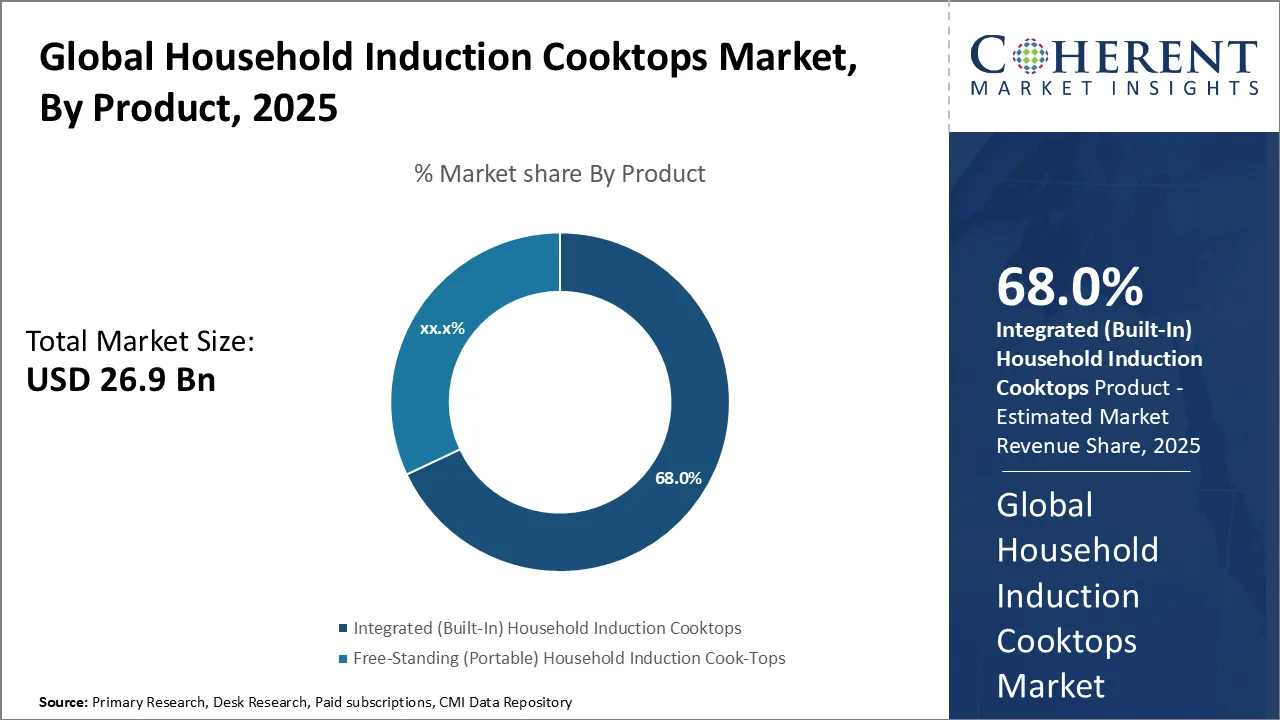
Household Induction Cooktops Market Insights, By Product - Integrated (Built-In) Household Induction Cooktops Dominate Due To Increased Consumer Demand
Integrated (Built-In) Household Induction Cooktops segment is expected to dominate with 69% share in the global market in 2026, largely driven by lifestyle changes and consumer preferences. Built-in induction cooktops are increasingly favored in modern modular kitchens, where aesthetics, seamless integration, and space optimization are key purchasing factors. Their sleek design not only enhances kitchen interiors but also offers advanced features such as multi-zone cooking, touch controls, and smart connectivity.
Rising urbanization and higher disposable incomes are encouraging households to invest in premium, long-term kitchen appliances, making built-in cooktops an attractive choice. Additionally, government incentives for energy-efficient appliances and the growing awareness of sustainability are pushing consumers toward advanced induction technology, where integrated models dominate the premium segment.
In October 2024, South Korean brand Daewoo expanded its presence in India by introducing two cutting-edge induction cooktops: the Push-Button and Touch-Button models. Both deliver 2,000 W of power, feature a durable, easy-to-clean micro-crystal plate, offer multiple cooking modes, a 4-hour start timer, and an auto-switch safety feature. The Touch-Button variant adds a sleek, intuitive interface. Both models include a 1-year PCB warranty, underscoring reliability.
Regional Insights
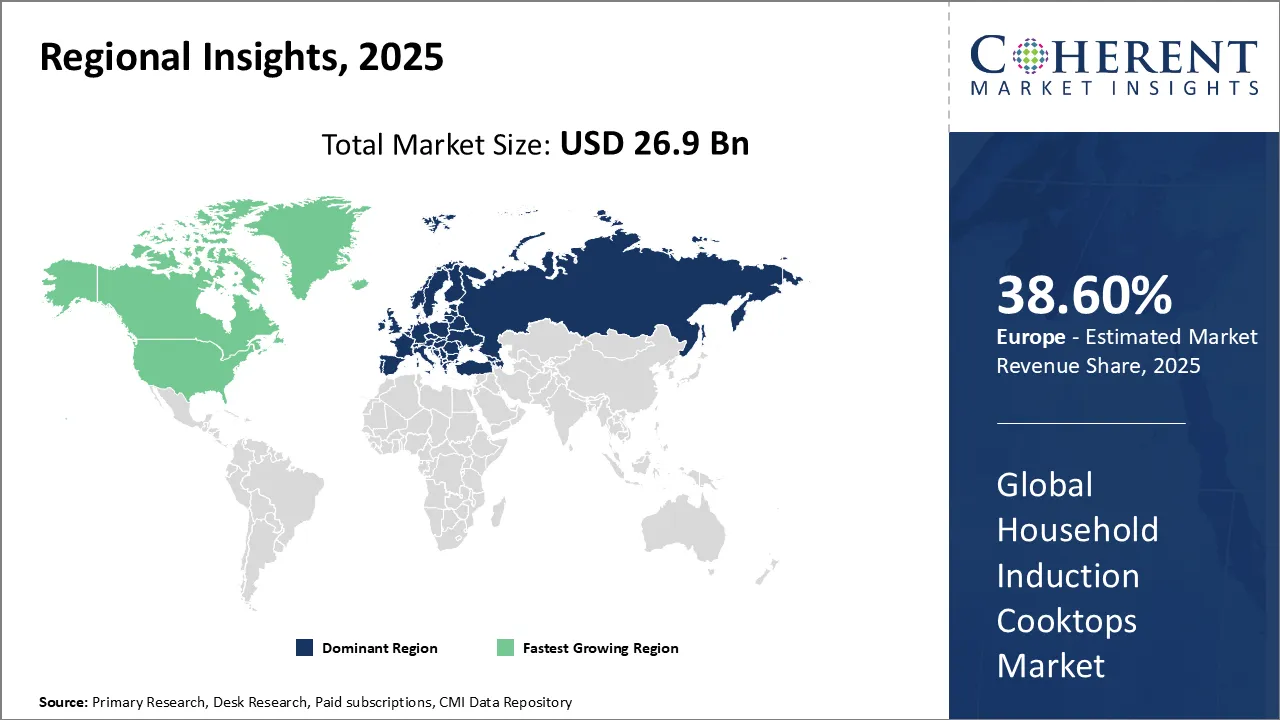
Europe Household Induction Cooktops Market Analysis & Trends
Europe dominated the global household induction cooktops market in 2026 with a 38.6% market share due to strong consumer preference for energy-efficient and eco-friendly appliances. The region's high electricity costs have driven adoption of induction cooktops, which are more efficient than gas or traditional electric stoves. Strict environmental regulations and government incentives further support this trend. Additionally, high urbanization and modern kitchen designs make induction cooktops a popular choice. Well-established brands and widespread product availability across Europe also contribute to market dominance.
In January 2026, Bosch, a leading German home appliance brand, reported a double-digit growth in induction cooktop sales in 2024 across Europe, particularly in Germany, France, and the Netherlands. The company attributed this to rising consumer demand for energy-efficient cooking solutions and increasing regulatory restrictions on gas appliances.
North America Household Induction Cooktops Market Analysis & Trends
North America is the fastest-growing region in the household induction cooktops market, driven by growing energy efficiency and sustainability awareness. The growing bans and restrictions on gas stoves, including those in California and New York, are providing momentum by pushing consumers toward electric and induction cooking. Rising focus on and adoption of smart home appliances also help stimulate demand for technologically advanced induction cooktops.
In February 2024, Whirlpool Corporation announced a collaboration with BORA, a European downdraft ventilation specialist, to introduce induction downdraft cooktop technology to North America. This partnership aims to integrate BORA's advanced downdraft ventilation system with Whirlpool's JennAir and KitchenAid induction cooktops, offering consumers a sleek, range hood-free cooking experience.
Household Induction Cooktops Market Outlook Country-Wise
United States Household Induction Cooktops Market Trends
The U.S. is the fastest-growing market, driven by the increasing number of policies that electrify the supply of energy to homes and increasing consumer demand for smart appliances in the context of high energy efficiency. California and New York states are eliminating gas connections for all or some new homes, pushing the transition to electric and induction cooking. Broad kitchen renovations and focus on smart home use will continue to indicate strong growth potential in this category, with major manufacturers such as Whirlpool and GE Appliances expanding their induction offerings.
In June 2026, GE Appliances launched the GE Profile™ 30” Smart Slide-In Induction and Convection Range, manufactured at its LaFayette, Georgia plant. This ENERGY STAR® certified range offers advanced features like Power Boil burners, a versatile Griddle Zone, and Cookware Detection for safety. It also includes built-in Wi-Fi connectivity, allowing users to control the oven remotely via smartphone or tablet.
China Household Induction Cooktops Market Trends
China continues to be a major market, given the size of its population, rapid urbanization, and raising middle-class incomes. The widespread take-up of compact and portable induction cooktops, particularly in densely populated urban apartments, leads the world, propelled by local manufacturers such as Midea and Haier, who currently dominate the market with affordable induction stovetops that are loaded with features.
In March 2024, Haier Smart Home launched its new line of AI-enabled induction cooktops equipped with smart sensors and voice control features. These models are designed to optimize cooking efficiency and enhance safety, targeting the growing middle-class urban population seeking advanced and convenient kitchen appliances. The launch coincided with Haier’s expansion into second-tier Chinese cities, aiming to capture a larger market share amid increasing urbanization and rising incomes.
Market Report Scope
Household Induction Cooktops Market Report Coverage
| Report Coverage | Details | ||
|---|---|---|---|
| Base Year: | 2025 | Market Size in 2026: | USD 29.86 Bn |
| Historical Data for: | 2020 To 2024 | Forecast Period: | 2026 To 2033 |
| Forecast Period 2026 to 2033 CAGR: | 11.0% | 2033 Value Projection: | USD 61.99 Bn |
| Geographies covered: |
| ||
| Segments covered: |
| ||
| Companies covered: | AB Electrolux, Daewoo Electronics Corporation, Whirlpool Corporation, Haier Group, LG Electronics, Panasonic Corporation, Philips Electronics, Videocon Industries Limited, Robert Bosch Gmbh, Fisher & Paykel Appliances Holdings Ltd., Stoves Appliance Company (Glen Dimplex Home Appliances Ltd.), and Miele & Cie. Kg. | ||
| Growth Drivers: |
| ||
| Restraints & Challenges: |
| ||
Market Dynamics
Global Household Induction Cooktops Market Drivers
Shifting Inclination Towards Technological Advancements
The household induction cooktops market is increasingly shaped by consumer preference for advanced technologies that enhance cooking efficiency, safety, and convenience. Modern induction cooktops are now equipped with features such as touch controls, precise temperature regulation, automatic shut-off, child locks, and multi-zone cooking capabilities. Leading brands are also introducing models with smart connectivity, allowing integration with home automation systems and remote operation via mobile apps.
This growing adoption of technologically advanced appliances is directly impacting the household induction cooktops market share, as consumers move away from conventional gas and electric cooktops in favor of induction-based solutions. The inclination toward innovation reflects not only a desire for faster and safer cooking but also aligns with sustainability goals, as induction cooktops are more energy-efficient and environmentally friendly.
In February 2025, Samsung unveiled a broad array of next-generation home appliances at KBIS 2025, spotlighting its “Screens Everywhere” approach via Bespoke AI models such as the 4-Door Flex Refrigerator with AI Family Hub+, the AI Laundry Combo™, and the Slide-in Induction Range. The standout LCD interfaces serve as intuitive smart-home control hubs via Bixby, Knox and SmartThings, building on its “AI for All” vision introduced at CES.
Global Household Induction Cooktops Market Trends:
Sustainability and Energy Efficiency is Driving the Market Growth
One of the most appealing features of induction cooktops is their high level of energy efficiency. When compared to electric and gas cooktops, induction cooktops are one of the most energy-efficient appliances since the energy used is transferred to the food.
Rapidly growing digitalization and expansion of e-commerce due to increasing usage of the internet are expected to have a positive impact on the market of household induction cooktops. An increase in the young adult population who often use e-commerce for purchasing goods further drives the online sale of induction cooktops. In addition to this, ease of transaction and various discounts offered by the online platform is further boosting the online sale of household induction cooktops, thereby fueling the market growth.
Global Household Induction Cooktops Market Opportunity
The household induction cooktops market forecast highlights multiple growth opportunities in the coming years. Rising consumer focus on energy efficiency and sustainability is driving households to adopt eco-friendly cooking solutions. Smart induction cooktops with IoT integration, app-based controls, and energy monitoring are creating strong opportunities for premium product segments. Emerging markets such as India, Brazil, and Southeast Asia present untapped potential, where rising disposable incomes and urbanization are expected to accelerate adoption. Additionally, government incentives promoting energy-efficient appliances, along with the trend of modular kitchens, will further fuel future household induction cooktops market expansion.
Recent Development
- In February 2025, At KBIS 2025, Fire Magic, a luxury outdoor kitchen brand of RH Peterson Co., unveiled its first-ever built-in Outdoor Induction Cooktop. The 1,800-watt unit, engineered for quick heating and energy efficiency, offers precise temperature control from 150 °F to 450 °F in 10 °F increments and integrates seamlessly into outdoor kitchens at 13.4″ by 12.6″. Key features include touch controls, pan-size recognition, LED display, voltage protection, and a stainless-steel cover.
- In September 2024, Midea Group introduced the Celestial Flex Series, marking the debut of kitchen appliances utilizing Ki wireless power transfer technology. This series includes a blender, steamer, and kettle that function when placed on an induction plate, eliminating the need for cords. This innovation reflects the industry's focus on enhancing convenience and flexibility in kitchen appliances.
- In July 2024, TTK Prestige launched its latest innovation, the 2000-watt stainless-steel induction cooktop, designed for the modern Indian kitchen. The appliance offers faster cooking and up to 25% energy savings compared to conventional stoves. It features a convenient Indian menu setting and an auto pressure-cooking or “whistle-counter” function, allowing users to preset pressure cooker whistles before it automatically switches to keep-warm mode, eliminating guesswork.
- In January 2024, At CES 2024 in Las Vegas, Thermador, a premium appliance brand under BSH Home Appliances, received the CES Innovation Award in the Home Appliances category for its 36‑inch Pro Harmony® Liberty® Induction Range.
Analyst View
- The household induction cooktops market is in a growth phase, driven by increasing consumer interest with respect to safe, energy-efficient, smart cooking options. Urbanization and smaller households will lead to the wider adoption of induction cooktops compared to gas and electric stoves, especially in the Europe and North America. Current market data shows that the portable induction cooktop category has been growing year-on-year at a rate of 12%, worldwide. Therefore, the consumer preference for type of cooking appliance has clearly shifted to a flexible, portable cooking appliance rather than the traditional cooking appliances widely available thus far.
- However, there are still challenges to be overcome in the market, such as high price points of induction cooktops, and consumer reluctance as a result of limited awareness and education in certain emerging markets. Conversely, advancements in production methods like the integration of AI-based temperature controls along with smart home ecosystems are enhancing product value. Manufacturers like Whirlpool and Midea, are the exception and are effectively innovating their models and expanding their lineups producing more feature-rich induction cooktops.
- Additionally, regulatory pushes to phase out gas stoves in regions like California and parts of Europe are accelerating electrification trends in kitchens. Combined with advancements in energy efficiency standards and consumer emphasis on sustainability, these factors are expected to further propel market expansion. Industry experts anticipate that ongoing improvements in affordability and connectivity will continue to drive widespread adoption over the next decade.
Speak to the analyst
Want personalized insights?
Take the findings above to one of our principal consultants, or have the report rebuilt around the segments, geographies and competitors you actually track.
Market Segmentation
- By Product (Revenue, USD Bn, 2021 - 2033)
- Free-Standing (Portable) Household Induction Cook-Tops
- Integrated (Built-In) Household Induction Cooktops
- Global Household Induction Cooktops Market, By Region (Revenue, USD Bn, 2021 - 2033)
- North America
- U.S.
- Canada
- Latin America
- Brazil
- Argentina
- Mexico
- Rest of Latin America
- Europe
- Germany
- U.K.
- Spain
- France
- Italy
- Russia
- Rest of Europe
- Asia Pacific
- China
- India
- Japan
- Australia
- South Korea
- ASEAN
- Rest of Asia Pacific
- Middle East
- GCC Countries
- Israel
- Rest of Middle East
- Africa
- South Africa
- North Africa
- Central Africa
- North America
- Company Profiles
- AB Electrolux
- Daewoo Electronics Corporation
- Whirlpool Corporation
- Haier Group
- LG Electronics
- Panasonic Corporation
- Philips Electronics
- Videocon Industries Limited
- Robert Bosch Gmbh
- Fisher & Paykel Appliances Holdings Ltd.
- Stoves Appliance Company (Glen Dimplex Home Appliances Ltd.)
- Miele & Cie. Kg.
Sources
Primary Research Interviews
- Induction cooktop manufacturers and OEMs
- E-commerce platform executives and online retailers
- Kitchen appliance distributors and wholesalers
- Consumer electronics retail chain managers
- Others
Databases
- Euromonitor International
- IBISWorld Industry Reports
- Statista Consumer Market Outlook
- Grand View Research Database
- Others
Magazines
- Home & Kitchen Magazine
- Consumer Reports
- Kitchen & Bath Business
- Appliance Retailer Magazine
- Others
Journals
- Journal of Food Engineering
- International Journal of Consumer Studies
- Energy Efficiency Journal
- Others
Newspapers
- The Wall Street Journal
- Financial Times
- Reuters Business News
- Bloomberg Technology
- Others
Associations
- Association of Home Appliance Manufacturers (AHAM)
- Consumer Electronics Association (CEA)
- International Electrotechnical Commission (IEC)
- Kitchen Cabinet Manufacturers Association (KCMA)
- Others
Public Domain Sources
- U.S. Census Bureau Economic Data
- International Trade Administration Reports
- Energy Star Program Database
- European Commission Energy Efficiency Reports
- Others
Proprietary Elements
- CMI Data Analytics Tool
- Proprietary CMI Existing Repository of information for last 8 years
*Definition: Household induction cooktops are kitchen appliances that use electromagnetic technology to heat cookware placed on top of them. They work by creating a magnetic field that induces an electric current in the cookware, generating heat to cook food. Induction cooktops are typically flat, smooth surfaces that are easy to clean and operate, and they offer a range of temperature settings to cook different types of food.
Get access to 250+ pages report
Every segment, forecast, competitor profile and data table behind the analysis above — available for instant download.
- ESOMAR Member
- ISO 9001:2015 Certified
- D-U-N-S Registered
- GDPR & CCPA Compliant
Missing comfort of reading report in your local language? Find your preferred language:
Transform your Strategy with Exclusive Trending Reports
Frequently Asked Questions
The Household Induction Cooktops Market is estimated to be valued at USD 29.86 Bn in 2026, and is expected to reach USD 61.99 Bn by 2033.
The CAGR of the Household Induction Cooktops Market is projected to be 11.0% from 2026 to 2033.
The increasing adoption of technological advancements in kitchen appliances is expected to drive market growth during the forecast period.
The development of low-power-consuming induction cooktops is estimated to offer lucrative opportunities for players in the near future.
The increasing popularity of ovens and microwaves is expected to act as a restraining factor for the market.
Major players operating in the market include AB Electrolux, Daewoo Electronics Corporation, Whirlpool Corporation, Haier Group, LG Electronics, Panasonic Corporation, Philips Electronics, Videocon Industries Limited, Robert Bosch Gmbh, Fisher & Paykel Appliances Holdings Ltd., Stoves Appliance Company (Glen Dimplex Home Appliances Ltd.), and Miele & Cie. Kg.