

HMI Turbine Control System Market Size and Forecast — 2026-2033
The Global HMI Turbine Control System Market is estimated to be valued at USD 6.07 Bn in 2026 and is expected to reach USD 8.46 Bn by 2033, exhibiting a compound annual growth rate (CAGR) of 5.7% from 2026 to 2033.
Key Takeaways of the Global HMI Turbine Control System Market:
- The gas turbine control system segment is expected to contribute 37.5% share of the global HMI turbine control system market in 2026 due to increasing demand for efficient and clean energy generation.
- The speed control segment is expected to account for 38.8% share of the market in 2026, due to its importance in optimizing operational efficiency.
- Asia Pacific is expected to lead the market, holding a share of 37.5% in 2026 on account of the growing vibrant power generation industry and adoption of advanced technologies across major industries.
- North America is anticipated to be the fastest-growing region, with a market share of 26.5% in 2026 driven by rapid industrialization and ongoing energy reforms across developing economies.
Market Overview:
The market for HMI turbine control systems has been expanding significantly over the past few years due to the growing adoption of automation across different end-use industries like power generation, oil & gas, and metal & mining. The trend in the HMI turbine control system market has been very positive over the recent times. The demand for efficient turbine control solutions has increased considerably among turbine operators to optimize operations and reduce downtime. Various technological advancements like advanced human-machine interfaces, analytics capabilities, and remote monitoring solutions have also been driving the growth of this market.
Currents Events and Their Impact
Current Events | Description and its impact |
Integration of AI and IoT in HMI Systems |
|
Modernization of Aging Power Infrastructure |
|
Insights, By Product
HMI Turbine Control System Market Insights, By Product - Growing Demand for Clean Energy Drives Gas Turbine Control Systems
The gas turbine control system segment is expected to contribute 37.5% share of the global HMI turbine control system market in 2026 due to the increasing demand for efficient and clean energy generation. Gas turbines are widely used to power generators that produce electricity with lower carbon emissions than traditional coal and natural gas plants. They are also increasingly being deployed in combined heat and power applications to provide both power and thermal energy in an efficient manner.
Gas turbines, which can operate on natural gas or other low-carbon fuels, have emerged as a crucial technology in this transition. According to the International Energy Agency (IEA), the global natural gas demand is expected to grow by 1.6% annually until 2030, driven primarily by the power generation sector (IEA, 2021). This increasing reliance on gas turbines for electricity production necessitates advanced control systems, such as HMI turbine control systems, to optimize performance, efficiency, and emissions reduction.
Insights, By Function
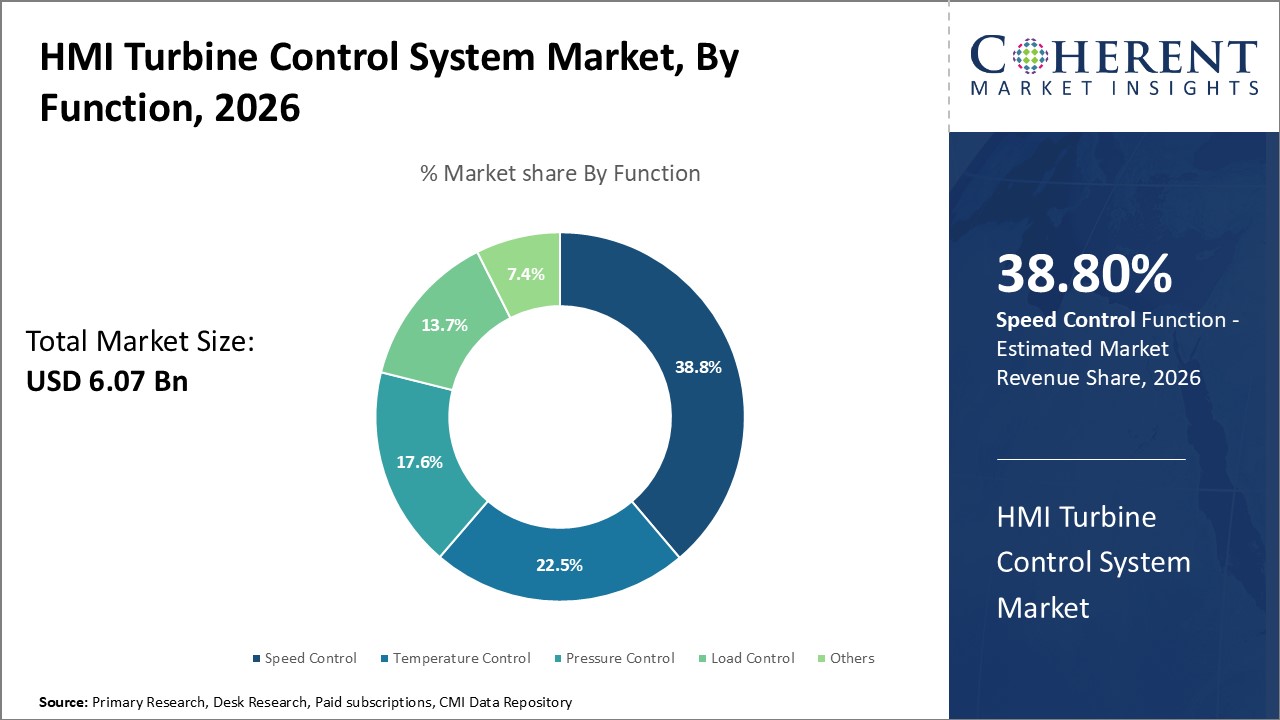
HMI Turbine Control System Market Insights, By Function - Speed Control is Key for Optimizing Turbine Performance
Speed control segment is expected to account for 38.8% share of the market in 2026, due to its importance in optimizing operational efficiency. Turbines must maintain tight speed tolerances within their operating ranges for stable power generation. Advanced speed control capabilities are especially critical for variable speed turbines used in applications like wind and hydro power. Speed is directly linked to the output power, torque and load on turbines. Minimizing speed fluctuations reduces mechanical wear and tear while improving output consistency. Speed sensors and regulators allow control systems to closely monitor and regulate rotational velocity according to generation requirements. They help stabilize grid frequency during output adjustments too.
Regional Insights
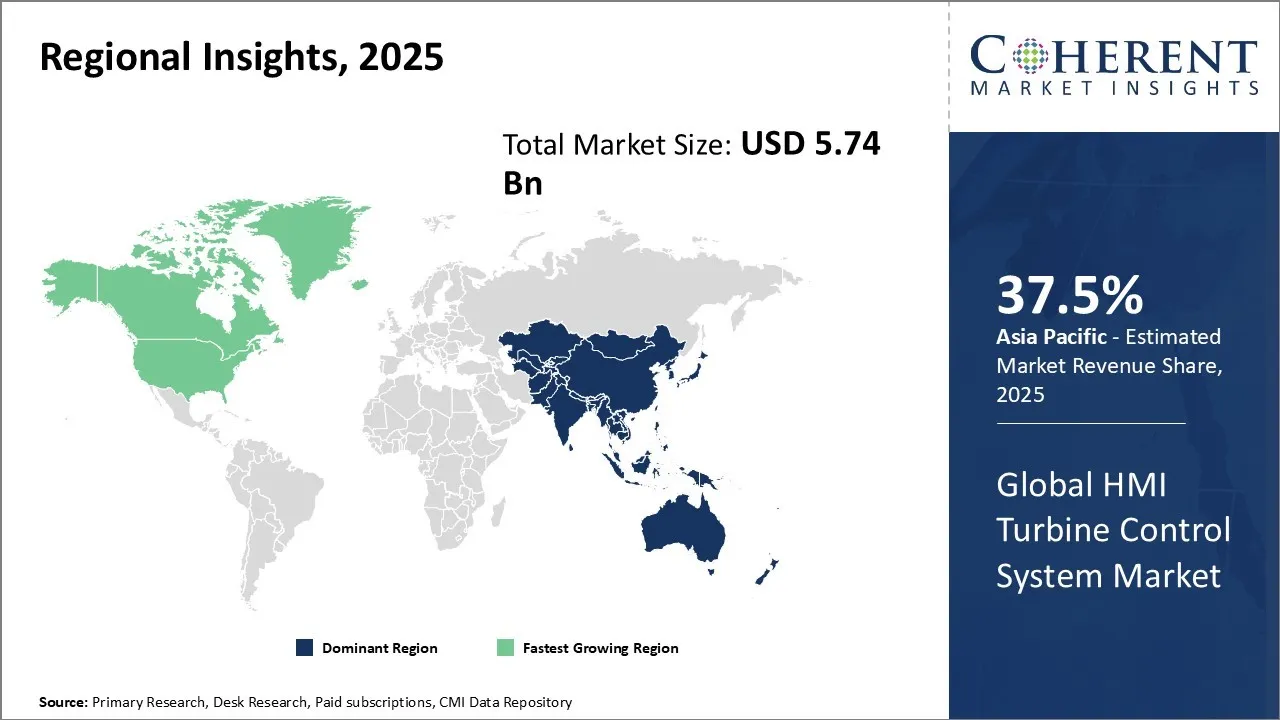
Asia Pacific HMI Turbine Control System Market Analysis and Trends
The Asia Pacific region is expected to dominate the HMI turbine control system market, accounting for 37.5% of the market share in 2026. This can be attributed to the vibrant power generation industry and adoption of advanced technologies across major industries. With heavy investments in modernizing aging power infrastructures, Japan and China have emerged as early adopters of digital turbine control systems for improved efficiency and optimization. Supported by strong government incentives for renewable projects and private sector investments, major players like General Electric and Siemens have established widespread operations to cater to domestic demand as well as expand exports.
North America HMI Turbine Control System Market Analysis and Trends
North America is expected to exhibit the fastest growth in the HMI turbine control system market with having 26.5% share of the market in 2026, driven by rapid industrialization and ongoing energy reforms across developing economies. Countries like the U.S. and Canada are witnessing a massive build-out of both conventional and renewable energy capacities to meet their ballooning power needs. This has spawned favorable conditions for control system providers to gain projects and boost local manufacturing capabilities.
HMI Turbine Control System Market Outlook for Key Countries
China HMI Turbine Control System Market Trends
China HMI turbine control system market continues to grow dynamically on the back of the country's ambitious plans to strengthen and diversify its energy mix. Chinese firms like Harbin Electric and Dongfang Electric are actively collaborating with global leaders to acquire critical know-how for developing independent control solutions. Foreign vendors are enhancing in-country R&D and services through collaborative partnerships to capitalize on the world's largest market.
India HMI Turbine Control System Market Trends
India HMI turbine control system market is witnessing robust expansion alongside increasing efforts to ramp up renewable power capacities. To boost indigenous manufacturing and maximize energy savings, major projects are now mandating the use of advanced control technologies. This has prompted global suppliers as well as Indian conglomerates, such as Larsen & Toubro, to bolster their local footprint and solutions through technology transfers and acquisitions.
Germany HMI Turbine Control System Market Trends
Germany continues to lead innovations in the HMI turbine control system domain, supported by strong research capabilities and a vibrant machinery industry. Key companies in the nation like Siemens and Bosch Rexroth are continuously working on upgrading product portfolios to meet the demands of an evolving energy landscape that is emphasizing renewable and distributed generation. Collaborations with startups and engineering services are helping German players extend their technological leadership globally.
U.K. HMI Turbine Control System Market Trends
The U.K. HMI turbine control system market is backed by capacity additions across various power sources and ongoing digitalization efforts to modernize aging infrastructure. Major local integrators are partnering with global control specialists to deliver turnkey projects, both within the country and for overseas markets. At the same time, the competitive supplier base includes prominent British control design firms competing globally through continuous focus on custom offerings and aftersales support.
End User Feedback and Unmet Needs
- Utilities and Independent Power Producers (IPPs) have widely endorsed the intuitive graphical dashboards and real-time diagnostics enabled by modern HMI systems. In particular, the integration of HMI platforms with Supervisory Control and Data Acquisition (SCADA) systems has enhanced situational awareness and reduced response times during grid fluctuations or equipment failures. In 2023, a major European EnBW Energie Baden-Württemberg AG, implemented Schneider Electric’s EcoStruxure HMI within its gas-fired power plants. Operators reported a 28% reduction in human error incidents during peak load periods, attributing it to the simplified touchscreen workflows and visualized process alerts.
- Small and medium-sized utility providers report difficulty justifying investment in full-featured HMI systems due to high upfront licensing and deployment costs, especially when scalability to smaller assets is limited. Integration with existing industrial protocols (e.g., Modbus, Profibus) remains a pain point. Additionally, limited local technical support in emerging markets constrains issue resolution, leading to prolonged downtimes.
Market Players, Key Development, and Competitive Intelligence
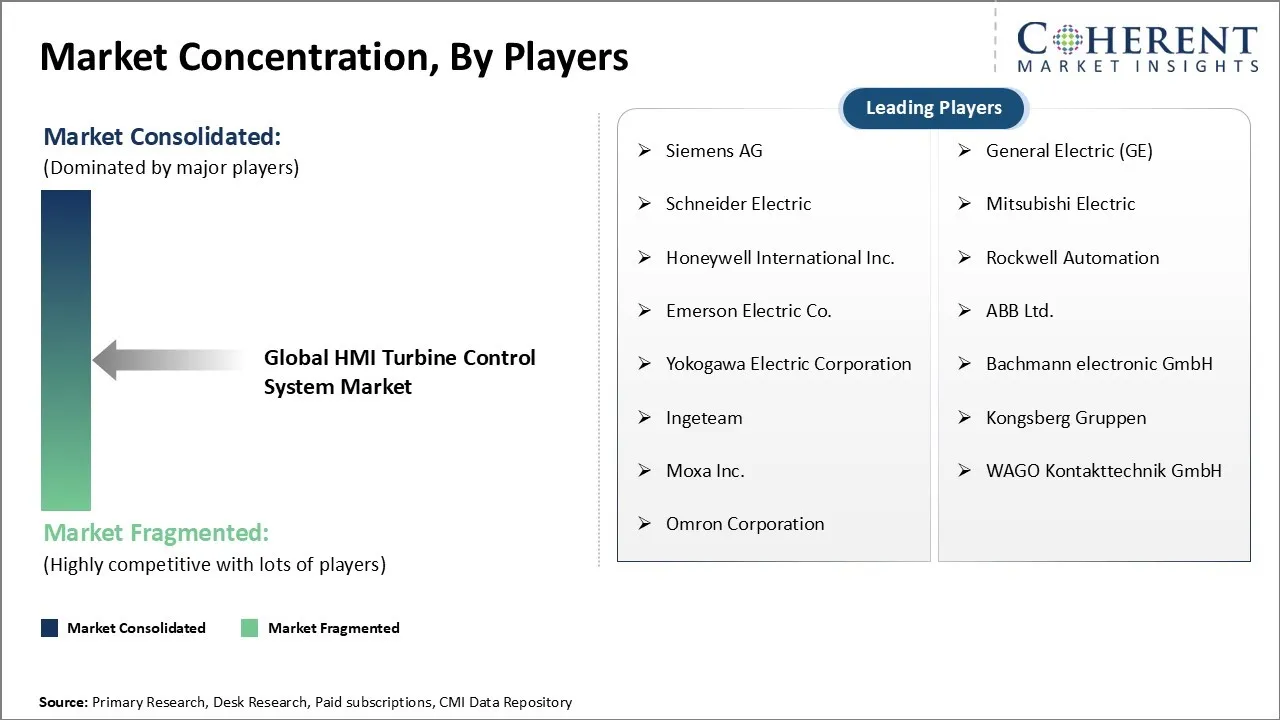
HMI Turbine Control System Market Key Developments:
- In April 2024, Valmet delivered an advanced control system for a steam turbine to the Energie AG waste recycling plant in Wels, Austria. The system integrated seamlessly with existing infrastructure, incorporating turbine automation into Valmet’s DNA automation platform without requiring additional hardware.
- In May 2024, Rockwell announced plans to establish an advanced manufacturing facility in Chennai, Tamil Nadu. The new unit, located in the Sholinganallur Elcot Special Economic Zone, aims to enhance supply chain agility and support sustainability initiatives across the Asia-Pacific region. This strategic expansion aligns with Rockwell’s broader goal of integrating its global manufacturing operations to better meet rising regional demands.
Top Strategies Followed by Global HMI Turbine Control System Market Players
- Established Players: Leading companies Siemens Energy and GE Vernova invest over 5% of annual revenue in R&D to develop advanced HMI systems, including AI-powered condition monitoring and predictive maintenance tools.
- For instance, Siemens integrates its HMI platforms directly into OEM turbines and partners with OEMs like Mitsubishi Power for collaborative development.
- Mid-Level Players: Firms such as Rockwell Automation and Yokogawa Electric focus on affordable, scalable HMI solutions for small and mid-sized turbine operators. Their partnerships with sensor providers and engineering firms enable enhanced data analytics capabilities.
- For example, Rockwell, has expanded its production footprint in Asia to meet growing regional demand.
- Small-Scale Players: Specialists like Iconics and Skkynet target niche applications, offering portable or modular HMI systems for remote wind or hydro sites.
- For example, Iconics differentiate using cloud-enabled dashboards and AR/VR integration. Iconics, for example, offers 3D HMI solutions for real-time turbine visualization in isolated areas.
- Current Industry Events of 2026
- Market Size Estimation
- Regional Breakdown
- Competitive Landscape
- Customer Intelligence
- Segmental Analysis
- Pricing Analysis
- Key Market Drivers, Challenges & Future Trends
- Customized Insights Section
Market Report Scope
HMI Turbine Control System Market Report Coverage
| Report Coverage | Details | ||
|---|---|---|---|
| Base Year: | 2025 | Market Size in 2026: | USD 6.07 Bn |
| Historical Data for: | 2020 To 2024 | Forecast Period: | 2026 To 2033 |
| Forecast Period 2026 to 2033 CAGR: | 5.7% | 2033 Value Projection: | USD 8.46 Bn |
| Geographies covered: |
| ||
| Segments covered: |
| ||
| Companies covered: | Siemens AG, General Electric (GE), Schneider Electric, Mitsubishi Electric, Honeywell International Inc., Rockwell Automation, Emerson Electric Co., ABB Ltd., Yokogawa Electric Corporation, Bachmann electronic GmbH, Ingeteam, Kongsberg Gruppen, Moxa Inc., WAGO Kontakttechnik GmbH, and Omron Corporation | ||
| Growth Drivers: |
| ||
| Restraints & Challenges: |
| ||
Market Dynamics
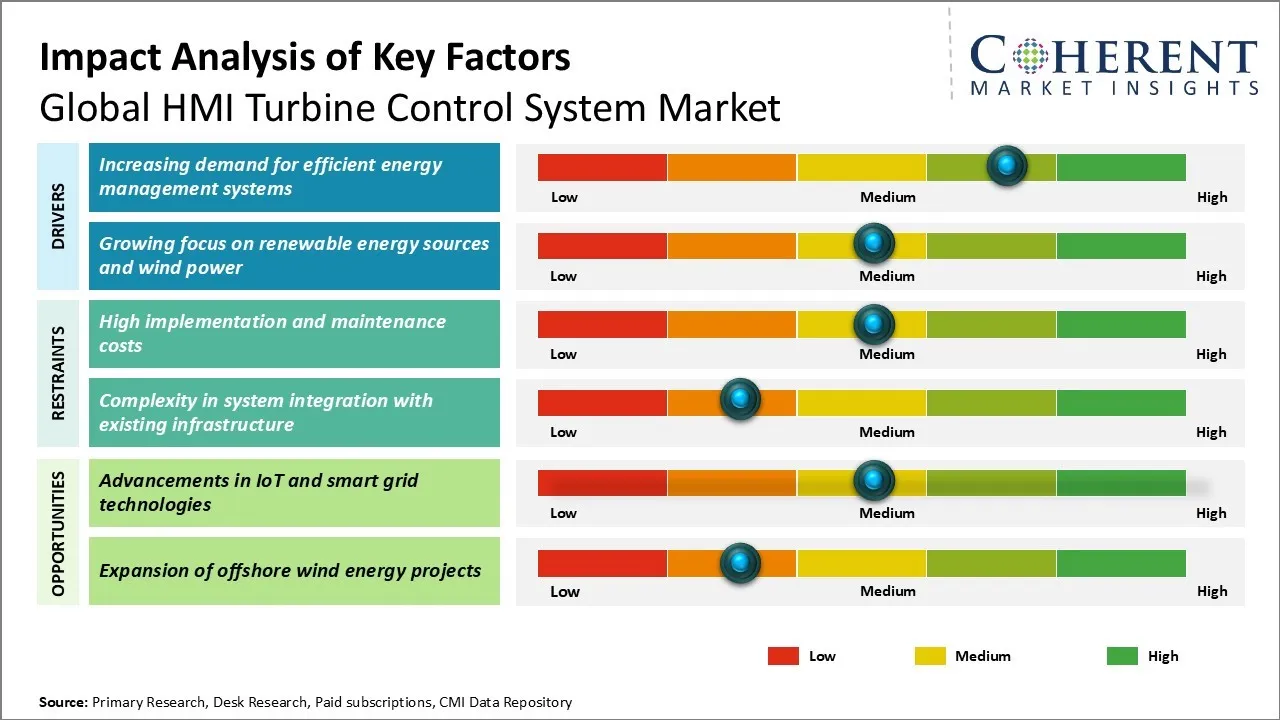
HMI Turbine Control System Market Driver - Increasing demand for efficient energy management systems
The global HMI turbine control system market is being driven by the increasing demand for efficient energy management systems across various industries worldwide. Turbine control systems help improve the overall efficiency of turbines by precisely controlling and monitoring their operation. With rising energy costs and focus on reducing carbon footprint, industries are increasingly adopting advanced control systems that can optimize turbine performance.
HMI turbine control solutions provide real-time visibility into turbine operations and enable automatic balancing of loads to maximize output. For instance, according to the International Energy Agency (IEA), in 2022, renewable energy capacity additions increased by 45% globally, reaching a record-breaking 280 gigawatts. This surge in renewable energy adoption, particularly in wind and solar power, necessitates the implementation of sophisticated control systems to ensure optimal performance and grid integration.
HMI Turbine Control System Market Opportunity - Advancements in IoT and smart grid technologies
The global HMI turbine control system market has a major growth opportunity arising from advancements in Internet of Things (IoT) and smart grid technologies. Integration of IoT capabilities in HMI systems allows remote monitoring of turbine operations with real-time analytics capabilities. This helps power operators to gather intricate performance data from turbines operating across different plant locations remotely. Similarly, adopting smart grid technologies like AI and machine learning in HMI turbine control systems enables more efficient operations through self-diagnosis of issues and predictive maintenance. Such data-driven digital advancements improve visibility, help reduce downtime and optimize output.
For instance, the International Energy Agency (IEA) reported in 2021 that the adoption of IoT in the energy sector has the potential to reduce power generation costs by up to 25% and improve the efficiency of wind and solar power plants by 10% to 20%. The increasing demand for clean energy and the need for efficient power generation are further fueling the adoption of IoT in turbine control systems.
Analyst Opinion (Expert Opinion)
- The HMI turbine control system market is experiencing notable momentum, driven by the rapid modernization of power generation infrastructure, particularly in developing economies. The transition toward smart grids and renewable energy integration is creating a sustained demand for advanced control systems capable of enhancing operational efficiency and safety. Technological innovations—such as real-time analytics, cloud-based supervisory control and data acquisition (SCADA) systems, and predictive maintenance capabilities—are redefining the scope of HMI in turbine control.
- Regulatory mandates related to emissions and energy efficiency are compelling utilities and independent power producers (IPPs) to adopt intelligent control systems to ensure compliance while optimizing performance. The rise in global electricity demand, coupled with aging infrastructure in key markets like North America and Europe, also necessitates retrofitting initiatives that include HMI system upgrades.
Speak to the analyst
Want personalized insights?
Take the findings above to one of our principal consultants, or have the report rebuilt around the segments, geographies and competitors you actually track.
Market Segmentation
- Product Insights (Revenue, USD Bn, 2021 - 2033)
- Gas Turbine Control System
- Steam Turbine Control System
- Wind Turbine Control System
- Hydro Turbine Control System
- Others
- Function Insights (Revenue, USD Bn, 2021 - 2033)
- Speed Control
- Temperature Control
- Pressure Control
- Load Control
- Others
- Regional Insights (Revenue, USD Bn, 2021 - 2033)
- North America
- U.S.
- Canada
- Latin America
- Brazil
- Argentina
- Mexico
- Rest of Latin America
- Europe
- Germany
- U.K.
- Spain
- France
- Italy
- Russia
- Rest of Europe
- Asia Pacific
- China
- India
- Japan
- Australia
- South Korea
- ASEAN
- Rest of Asia Pacific
- Middle East
- GCC Countries
- Israel
- Rest of Middle East
- Africa
- South Africa
- North Africa
- Central Africa
- North America
- Key Players Insights
- Siemens AG
- General Electric (GE)
- Schneider Electric
- Mitsubishi Electric
- Honeywell International Inc.
- Rockwell Automation
- Emerson Electric Co.
- ABB Ltd.
- Yokogawa Electric Corporation
- Bachmann electronic GmbH
- Ingeteam
- Kongsberg Gruppen
- Moxa Inc.
- WAGO Kontakttechnik GmbH
- Omron Corporation
Sources
Primary Research Interviews:
- Turbine OEM Engineers and System Designers
- Industrial Automation Experts
- HMI and SCADA System Integrators
- Power Plant Operators and Maintenance Heads
Stakeholders:
- HMI System Manufacturers (e.g., Siemens, ABB, Rockwell Automation)
- Turbine Control System Providers
- SCADA and PLC Vendors
- Utility Companies and Independent Power Producers (IPPs)
- Government and Regulatory Energy Departments
Databases:
- Frost & Sullivan
- Technavio
Magazines:
- Automation World
- Control Engineering
- Power Engineering International
- Hydrocarbon Processing
Journals:
- IEEE Transactions on Industrial Informatics
- Journal of Process Control
- International Journal of Electrical Power & Energy Systems
- Energy Reports
Newspapers
- The Wall Street Journal – Technology & Energy Section
- Financial Times – Industry & Infrastructure
- The Economic Times – Energy World
Associations:
- International Society of Automation (ISA)
- Electric Power Research Institute (EPRI)
- Control System Integrators Association (CSIA)
- American Society of Mechanical Engineers (ASME) – Turbomachinery Division
Public Domain Sources:
- U.S. Department of Energy (DOE)
- International Energy Agency (IEA)
- Energy Information Administration (EIA)
- Global Wind Energy Council (GWEC)
- World Bank – Energy Sector Reports
Proprietary Elements:
- CMI Data Analytics Tool, Proprietary CMI Existing Repository of information for last 8 years
Get access to 250+ pages report
Every segment, forecast, competitor profile and data table behind the analysis above — available for instant download.
- ESOMAR Member
- ISO 9001:2015 Certified
- D-U-N-S Registered
- GDPR & CCPA Compliant
Missing comfort of reading report in your local language? Find your preferred language:
Transform your Strategy with Exclusive Trending Reports
Frequently Asked Questions
The global HMI turbine control system market is estimated to be valued at USD 6.07 Bn in 2026 and is expected to reach USD 8.46 Bn by 2033.
The CAGR of the global HMI turbine control system market is projected to be 5.7% from 2026 to 2033.
Increasing demand for efficient energy management systems and growing focus on renewable energy sources and wind power are the major factors driving the growth of the global HMI turbine control system market.
High implementation and maintenance costs and complexity in system integration with existing infrastructure are the major factors hampering the growth of the global HMI turbine control system market.
In terms of product, the gas turbine control system segment is estimated to dominate the market revenue share in 2026.
Siemens AG, General Electric (GE), Schneider Electric, Mitsubishi Electric, Honeywell International Inc., Rockwell Automation, Emerson Electric Co., ABB Ltd., Yokogawa Electric Corporation, Bachmann electronic GmbH, Ingeteam, Kongsberg Gruppen, Moxa Inc., WAGO Kontakttechnik GmbH, and Omron Corporation are the major players.
Asia Pacific is expected to lead the global HMI turbine control system market in 2026.