

Global Hybrid Packaging Market Size and Forecast – 2026 To 2033
The Global Hybrid Packaging Market is estimated to be valued at USD 45.22 Bn in 2026 and is expected to reach USD 73.57 Bn by 2033, exhibiting a compound annual growth rate (CAGR) of 7.2% from 2026 to 2033. This growth reflects increasing demand for innovative packaging solutions that combine multiple materials to improve product protection, shelf life, sustainability, and consumer appeal across food and beverage, pharmaceuticals, personal care, electronics, and industrial applications.
Hybrid packaging is gaining stronger commercial relevance as brands shift toward recyclable flexible films, paper-based barriers, mono-material laminates, and lightweight structures that reduce material usage while maintaining sealing strength, barrier performance, and high-speed packaging compatibility. For instance, in August 2025, ProAmpac commercialized its ProActive Recycle-Ready polyolefin-based platform for high-speed chunk cheese packaging, offering clarity, puncture resistance, shelf-life protection, and recycle-ready performance for dairy applications. This highlights the growing shift toward sustainable hybrid packaging formats that can meet both operational and circular packaging requirements. (Source: ProAmpac)
Key Takeaways of the Global Hybrid Packaging Market
- Plastic based hybrid materials are expected to hold 38.2 % share in 2026, supported by their balance of durability, lightweighting, sealability, and compatibility with recyclable mono-material structures. In June 2025, Dow launched INNATETF 220 Precision Packaging Resin for high-performance BOPE flexible packaging, supporting design-for-recyclability and Private Client Resources (PCR) integration. (Source: Dow)
- Flexible hybrid packaging is expected to account for 35.4 % share in 2026, owing to its material efficiency, lower transport weight, and ability to combine barrier performance with shelf appeal. In February 2026, Amcor enabled the commercialization of Agropur Grand Cheddar recycle-ready dairy packaging using AmPrima Plus, highlighting flexible packaging’s source-reduction and cost benefits. (Source: Amcor)
- Barrier enhanced hybrid packaging is expected to capture 30.3 % share in 2026, as food, beverage, and healthcare brands require longer shelf life, moisture control, and product protection. In August 2025, Mondi ramped up Functional Barrier Paper Ultimate for instant coffee, tea, seasonings, cereal bars, and bouillon cubes, strengthening sustainable high-barrier paper-based formats. (Source: Mondi)
- Asia Pacific is expected to lead with 40.50 % share in 2026, supported by large-scale food and beverage consumption, expanding aseptic packaging capacity, and strong manufacturing localization. SIG’s India aseptic carton plant investment of about USD 69.47million during 2023–2025, targeting up to 4 billion packs annually, reflects regional packaging demand depth.
- North America is expected to hold 27.8 % share in 2026, with growth supported by producer responsibility laws, recyclable packaging mandates, and brand-led material redesign. California’s SB 54 EPR program, effective through permanent regulations filed on May 1, 2026, shifts end-of-life responsibility to producers and encourages recyclable packaging design. (Source: State of California)
- Sustainable Packaging Becomes Compliance-Led: Recyclable/sustainable hybrid packaging is gaining commercial importance as regulations push brands toward circular material systems. The EU’s Packaging and Packaging Waste Regulation 2025/40 entered into force on February 11, 2025, requiring all packaging placed on the EU market to become recyclable in an economically viable way by 2030. (Source: European Commission)
- Intelligent Packaging Moves Toward Retail Efficiency: Active and intelligent hybrid packaging is becoming a strategic innovation area for freshness, traceability, inventory accuracy, and waste reduction. In February 2026, Avery Dennison launched AD IdentiFreshRFID inlays for bakery, meat, deli, and produce, enabling real-time inventory visibility and stronger fresh food management across retail supply chains. (Source: Avery Dennison Corporation)
Segmental Insights
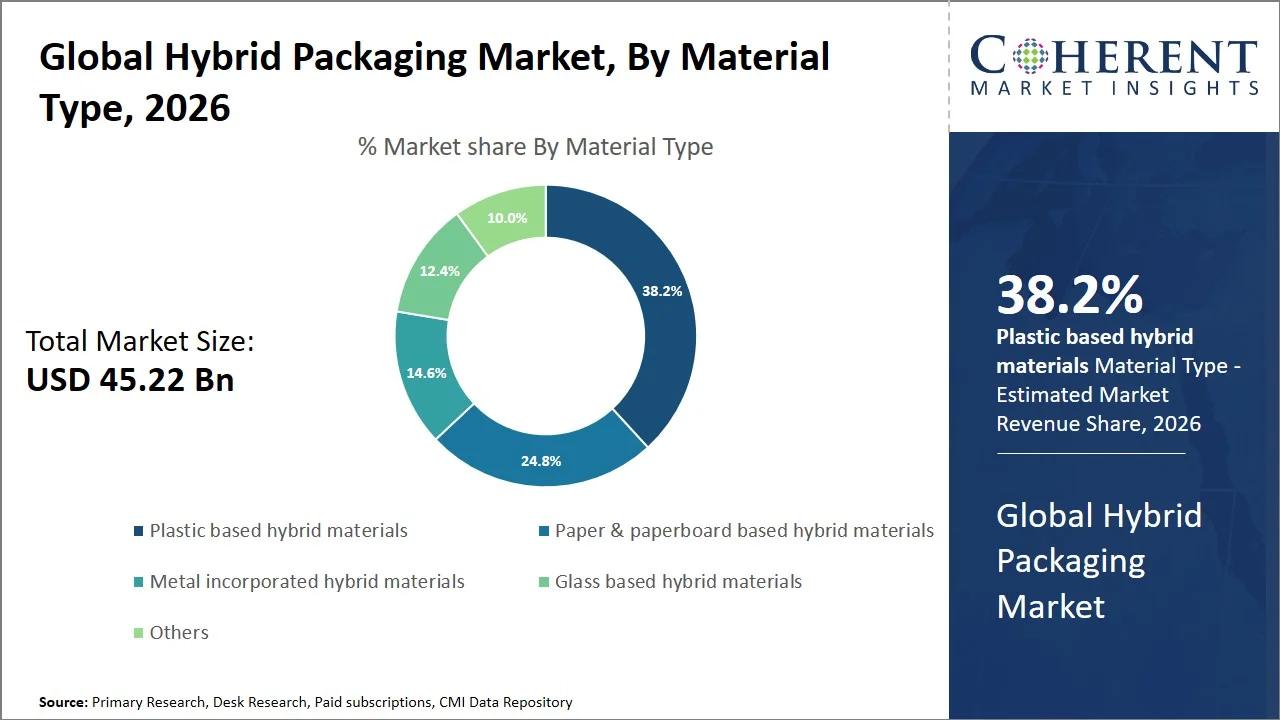
Why Do Plastic Based Hybrid Materials Dominate the Global Hybrid Packaging Market?
Plastic based hybrid materials are expected to dominate the global hybrid packaging market with 38.2% share in 2026, as they offer a strong balance of flexibility, toughness, sealing strength, moisture resistance, and compatibility with high-speed packaging lines. The segment benefits from strong demand across food, personal care, cleaning products, agricultural inputs, and healthcare packaging where shelf stability and product protection are critical. On the supply side, polymer producers are improving PE- and PP-based structures to replace difficult-to-recycle multi-material laminates while maintaining barrier and mechanical performance. ExxonMobil showcased several packaging case studies at Plastico Brasil 2025, including recyclable mono-material PE pouches, PE barrier pouches, thermoformed PE packaging, and films using recycled content, supporting the shift toward plastic-based hybrid structures with improved circularity. (Source: Exxon Mobil Corporation)
- Current Industry Events of 2026
- Market Size Estimation
- Regional Breakdown
- Competitive Landscape
- Customer Intelligence
- Segmental Analysis
- Pricing Analysis
- Key Market Drivers, Challenges & Future Trends
- Customized Insights Section
Why Does Flexible Hybrid Packaging Represent the Largest Packaging Format Segment in the Global Hybrid Packaging Market?
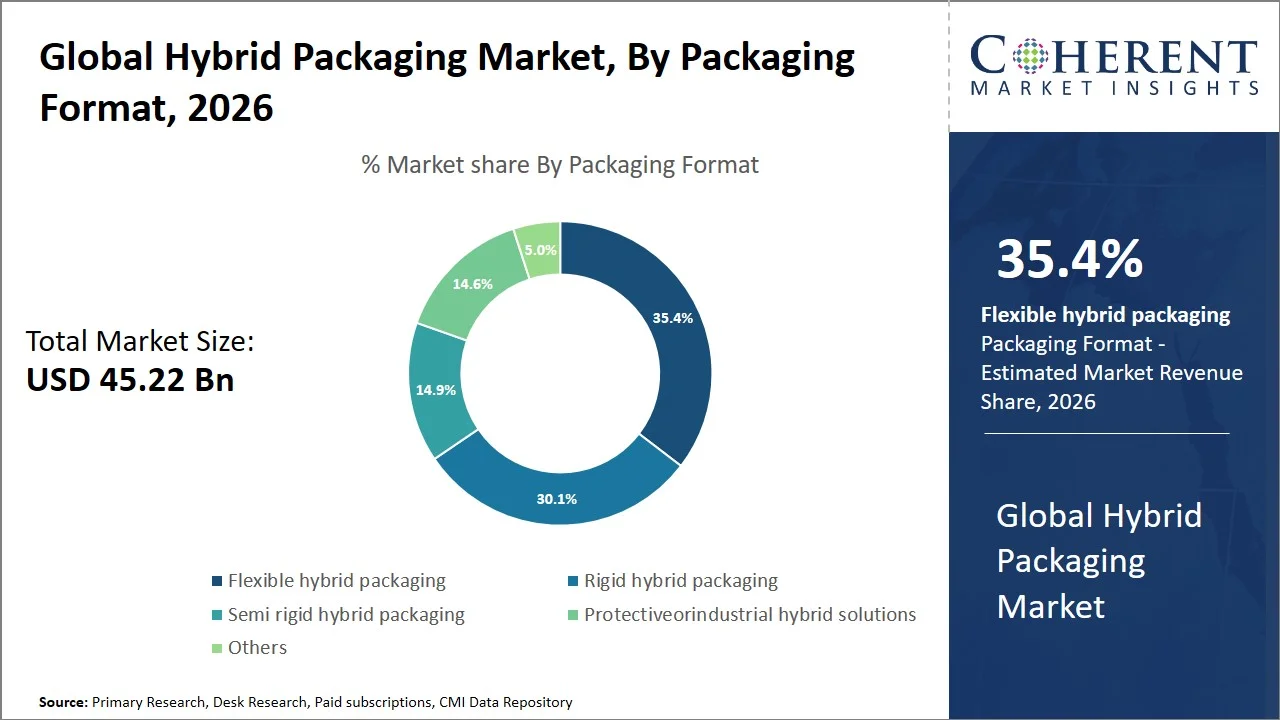
Flexible hybrid packaging is expected to hold 35.4% share in 2026, mainly because brands prefer formats that reduce material use, lower logistics weight, improve shelf presentation, and support portioned or resealable packs. Demand is especially strong in dairy, snacks, dry foods, pet food, detergents, and personal care, where converters need packaging that can run efficiently on filling lines while protecting product quality. Technology development is strengthening this segment through recycle-ready films, low-temperature sealing layers, puncture resistance, and better clarity for retail visibility. In July 2025, Amcor and Mediacor launched the AmPrima 2-liter refill pouch for Nana home-care products, reducing plastic use by up to 80% compared with two 1-liter PET bottles and lowering packaging carbon footprint by up to 64%. The pouch is also designed for e-commerce durability, reflecting how flexible hybrid packaging is moving toward refill-ready, lightweight, and commercially scalable applications. (Source: Amcor)
Why Does Barrier Enhanced Hybrid Packaging Dominate the Global Hybrid Packaging Market by Packaging Feature?
Barrier enhanced hybrid packaging is expected to account for 30.3% share in 2026, as brand owners need packaging that protects oxygen-sensitive, moisture-sensitive, and aroma-sensitive products without compromising recyclability. This segment is highly relevant for nuts, pet food, dairy, instant foods, coffee, powdered products, pharmaceuticals, and premium personal care items where spoilage, leakage, oxidation, and loss of freshness directly affect product value. Supply-side innovation is focused on mono-material barrier laminates, de-inking coatings, oxygen barrier layers, and sealant films that can replace traditional PET/foil/PE structures. In September 2025, Borouge, Siegwerk, and TPN Food Packaging launched a fully recyclable mono-material PE barrier stand-up pouch for oxygen-sensitive dry products, using advanced oxygen barrier and de-inking coatings while maintaining stiffness, seal integrity, printability, and high-speed production performance. (Source: Siegwerk Druckfarben AG & Co. KGaA)
Currents Events and their Impact
Current Events | Description and its Impact |
European Union Packaging and Packaging Waste Regulation Strengthens Recyclability Rules (February 2025 onward) |
|
California SB 54 Permanent Packaging EPR Regulations Take Effect (May 2026) |
|
India Expands EPR Coverage for Paper, Glass, Metal, and Plastic Packaging (2024 onward) |
|
Global Hybrid Packaging Market Dynamics
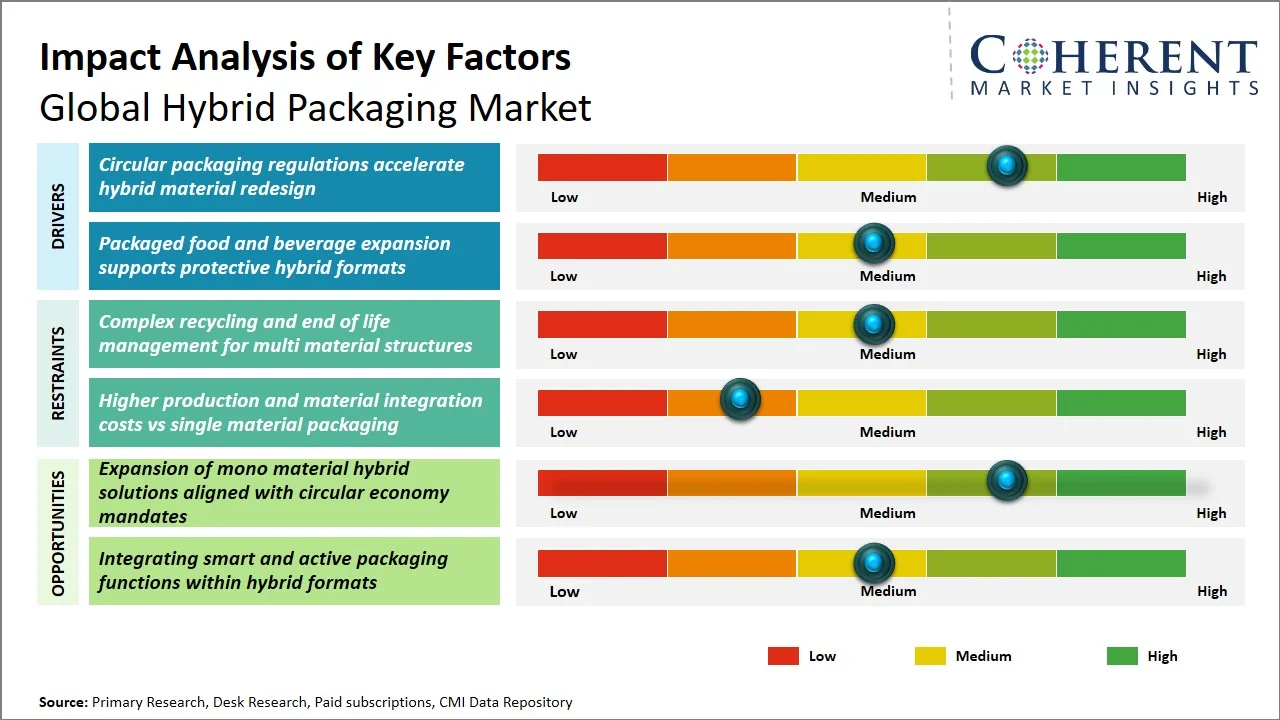
Market Drivers
- Circular packaging regulations accelerate hybrid material redesign: The global hybrid packaging market is being strongly supported by tightening packaging waste rules, which are pushing brand owners to redesign multi-material formats into recyclable, reusable, or lower-waste structures. This is especially important for hybrid packaging because it combines plastic, paper, metal, coatings, and barrier layers, making recyclability a key commercial requirement. The EU Packaging and Packaging Waste Regulation sets requirements across the full packaging life cycle, including product design, waste handling, and recyclability, creating pressure on FMCG, food, beverage, healthcare, and personal care companies to shift toward compliant hybrid formats. This regulatory push is increasing investment in mono-material films, paper-based barriers, recyclable laminates, and lower-carbon packaging systems.
- Packaged food and beverage expansion supports protective hybrid formats: Rising consumption of packaged beverages, dairy, sauces, ready-to-drink products, and shelf-stable foods is increasing the demand for hybrid packaging that can protect freshness, extend shelf life, reduce leakage, and support high-speed filling operations. Food and beverage brands require packaging that combines structural strength, oxygen protection, moisture control, lightweighting, and attractive shelf visibility, making hybrid formats commercially valuable. Supply-side investment is also strengthening adoption, as packaging producers expand local manufacturing close to high-growth consumption markets. In February 2025, SIG opened its first aseptic carton plant in India with a US$ 104.20 million investment, completed in 20 months, strengthening its presence in one of the fastest-growing food and beverage packaging markets. (Source: Synthetically Generated Information (SGI))
Emerging Market Trends
- Paper-Based Barrier Structures Gain Commercial Momentum: Paper-based barrier hybrid packaging is emerging as a key trend as brands try to reduce dependence on aluminum foil and fossil-based plastic layers while maintaining product protection. This trend is commercially important because it supports lower carbon packaging, improves renewable material content, and helps converters serve food and beverage applications that still require oxygen, light, and moisture protection. Hybrid packaging innovation is moving toward simplified material structures where paperboard provides rigidity, polymers support sealing, and advanced barriers protect shelf life
- Smart and Intelligent Packaging Moves Beyond Premium Use Cases: Active and intelligent hybrid packaging is moving from niche adoption toward wider commercial use as retailers and food brands focus on freshness, traceability, inventory accuracy, and waste reduction. Technologies such as RFID, freshness indicators, sensors, blockchain, and AI-enabled monitoring can add measurable value to hybrid packaging by turning packs into data-enabled assets across supply chains. This trend is relevant for fresh food, meat, bakery, pharmaceuticals, and high-value consumer goods where spoilage, counterfeiting, stock loss, and product recalls create direct financial risks.
Regional Insights
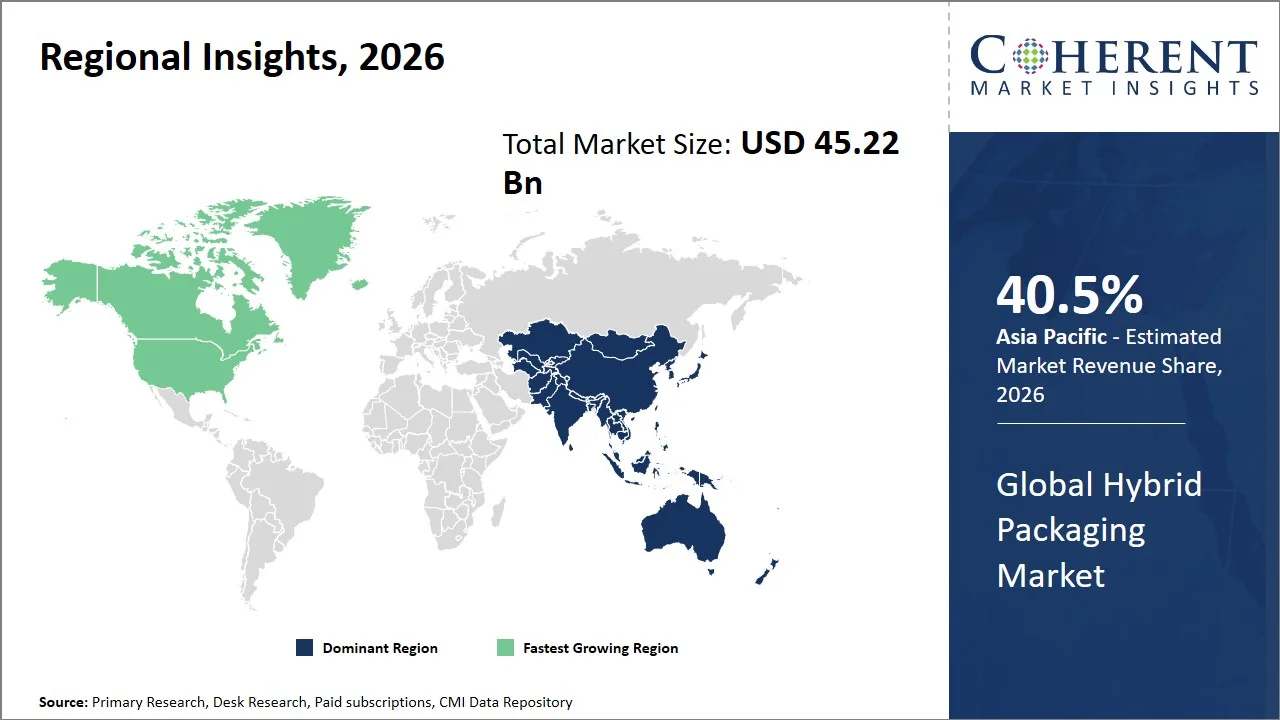
Why Does Asia Pacific Dominate the Global Hybrid Packaging Market?
Asia Pacific is expected to dominate the global hybrid packaging market with 40.50% share in 2026, supported by large food and beverage consumption, expanding packaged goods production, strong converter networks, and fast adoption of sustainable barrier formats. The region has a major advantage in manufacturing scale, cost-efficient material processing, and growing demand from dairy, ready-to-drink beverages, snacks, personal care, and healthcare packaging. Hybrid packaging adoption is also supported by the shift from aluminum and difficult-to-recycle laminates toward paper-based barriers, mono-material films, and recyclable coated structures. In February 2026, Tetra Pak expanded paper-based barrier packaging to high-speed A3/Speed lines in Asia, with Maeil Dairies becoming the first producer globally to implement the solution for soya beverage packaging.
Why is North America the Fastest Growing Region in the Global Hybrid Packaging Market?
North America is expected to be the fastest growing region and account for 27.8% share in 2026, driven by strict packaging waste rules, rapid food-contact material reformulation, strong retail sustainability commitments, and advanced recycling infrastructure development. The region is seeing faster adoption of recyclable flexible films, PFAS-free paperboard coatings, refill-ready packs, and mono-material hybrid structures due to regulatory and brand-level pressure. The U.S. and Canada also have strong demand from processed foods, pet care, personal care, e-commerce, and healthcare packaging. In July 2025, Oregon launched its Plastic Pollution and Recycling Modernization Act, the first U.S. extended producer responsibility program for packaging and paper products. The law requires producers of packaging, paper products, and food serviceware to fund recycling system improvements and ensure materials are recycled responsibly. This is expected to accelerate packaging redesign and support higher adoption of recyclable, mono-material, and lower-impact hybrid packaging formats across North America. (Source: Oregon Department)
Global Hybrid Packaging Market Outlook for Key Countries
Why is the U.S. a Strong Market for Hybrid Packaging?
The U.S. is a key country in the global hybrid packaging market due to its large packaged food industry, advanced retail supply chains, strong healthcare packaging demand, and increasing regulatory focus on food-contact safety. Hybrid packaging suppliers in the country are focusing on recyclable paperboard coatings, mono-material flexible structures, barrier films, and PFAS-free grease-resistant formats. This is commercially important because food brands need packaging that protects freshness while meeting stricter chemical safety expectations. In February 2024, the U.S. Food and Drug Administration announced that grease-proofing substances containing PFAS were no longer being sold for food-contact use in the U.S. market. This directly supports the shift toward alternative paper-based and coated hybrid packaging solutions. (Source: U.S. Food and Drug Administration)
Is Japan a Favorable Market for Advanced Hybrid Packaging Solutions?
Japan is important in the global hybrid packaging market because of its strong base in high-barrier films, precision converting, aseptic packaging, premium food packaging, and sustainable material innovation. Japanese packaging companies are actively developing mono-material, paper-based, and barrier-coated structures that reduce plastic and aluminum use while maintaining shelf life and product protection. The country’s mature convenience food, beverage, and personal care sectors create strong demand for compact, lightweight, and high-performance packaging. A recent development includes TOPPAN’s June 2026 announcement of Japan’s first light-shielding paper-based aseptic carton, with plans to establish a supply system capable of producing 30 million packs per year by mass production in autumn 2026. This highlights Japan’s role in advanced hybrid packaging commercialization (Source: TOPPAN Holdings Inc)
Why is India Emerging as a High-Growth Market for Hybrid Packaging?
India is emerging as a key growth market for hybrid packaging driven by increasing consumption of packaged foods, rapid expansion of the pharmaceutical sector, rising e-commerce activity, and growing demand from FMCG and personal care industries. The country benefits from a well-established packaging manufacturing ecosystem, including flexible films, paperboard, and specialty materials, enabling cost-effective production and supply chain localization. Demand for hybrid packaging is also increasing as brands seek packaging formats that combine sustainability with strong barrier and durability performance. In September 2024, UFlex announced the expansion of its sustainable packaging portfolio, including advanced recyclable flexible packaging solutions designed for food and consumer goods applications, supporting the growing adoption of hybrid and resource-efficient packaging formats across India. (Source: UFlex Limited)
Why Does Germany Lead Sustainable Hybrid Packaging Innovation in Europe?
Germany is a key country in the global hybrid packaging market due to its strict packaging compliance system, advanced recycling infrastructure, strong food and personal care industries, and leadership in packaging engineering. Hybrid packaging suppliers operating in Germany must increasingly design structures that are compatible with sorting and recycling systems, especially where paper, plastic, coatings, and barrier layers are combined. This encourages the use of recyclable mono-material films, fiber-based structures, and renewable raw materials. In 2025, the Central Agency Packaging Register published the updated minimum standard for determining packaging design recyclability, prepared in agreement with the German Environment Agency. This standard supports practical recycling-based design and strengthens Germany’s role as a regulatory benchmark for packaging innovation. (Source: Zentrale Stelle)
Why is Brazil Becoming an Important Market for Hybrid Packaging in Latin America?
Brazil is important in the global hybrid packaging market because it has a large consumer goods base, growing food and beverage processing sector, and expanding demand for affordable, lightweight, and recyclable packaging. Hybrid packaging is relevant for dairy, meat, snacks, household products, agriculture-linked goods, and personal care, where durability and shelf-life protection are essential. Regulatory changes are also increasing pressure on companies to improve collection, recycling, and material traceability. In October 2025, Brazil published Decree No. 12.688, establishing a reverse logistics system for plastic packaging across manufacturers, importers, distributors, and traders. This is expected to encourage recyclable plastic-based hybrid packaging, improved post-consumer material use, and stronger circular packaging models in Latin America. (Source: Seven Editora (SE))
Regulatory Landscape - Global Hybrid Packaging Market
Region / Country | Regulation / Regulatory Focus | Market Impact |
Europe / European Union | EU Packaging and Packaging Waste Regulation (PPWR) focuses on recyclable packaging, packaging waste reduction, recycled-content use, reuse targets, and packaging minimization. | This regulation is expected to reshape hybrid packaging design across Europe by pushing producers to simplify complex plastic-paper, coated paperboard, and multilayer structures. It supports higher adoption of recyclable mono-material films, paper-based barriers, recycled-content plastic layers, and packaging formats compatible with collection and recycling systems. |
North America / U.S. | California SB 54 Packaging EPR Regulation introduces extended producer responsibility for packaging and single-use plastic food service ware. | This increases producer accountability for post-consumer packaging waste and encourages recyclable, lightweight, and lower-waste packaging formats. Hybrid packaging suppliers serving North America may need to improve recyclability, reduce non-recyclable layers, and align material choices with EPR reporting and recovery requirements. |
U.S. | FDA Food-Contact Packaging and PFAS Phase-Out restricts grease-proofing substances containing PFAS in food-contact paper and paperboard packaging. | This is expected to accelerate the shift toward PFAS-free coatings, alternative grease barriers, water-resistant paperboard layers, and safer food-contact hybrid packaging. The impact will be strong in fast food, bakery, takeout, pet food, and ready-to-eat food packaging applications. |
India | Plastic Waste Management Rules and EPR Guidelines for Plastic Packaging require registration, traceability, and fulfillment of EPR obligations by producers, importers, and brand owners. | India’s EPR framework is expected to increase demand for recyclable flexible packaging, compliant plastic-paper structures, recycled-content packaging, and improved waste recovery systems. Hybrid packaging manufacturers may need stronger documentation, material traceability, and end-of-life planning to serve FMCG, food, beverage, and healthcare brands. |
Germany | German Packaging Act and ZSVR Minimum Standard for Recyclability require producers to register packaging and assess recyclability based on practical recycling systems. | Germany’s strict recyclability standards are expected to influence hybrid packaging redesign across Europe. Suppliers need to ensure that coatings, adhesives, labels, inks, barrier layers, and multilayer structures do not reduce recyclability. This supports investment in fiber-based packaging, recyclable films, and simplified material combinations. |
Japan | Containers and Packaging Recycling Law / Sorted Collection and Recycling Framework promotes reduction, sorted collection, and recycling of containers and packaging waste. | Japan’s regulatory framework supports lightweight, compact, recyclable, and resource-efficient packaging structures. For hybrid packaging, this encourages better material separation, lower excess packaging, recyclable paper-plastic formats, and high-performance packaging suitable for premium food, beverage, personal care, and convenience retail applications. |
How are recyclable barrier and compostable flexible packaging technologies creating new growth opportunities in the global hybrid packaging market?
Technological advancement in recyclable barrier films, compostable coatings, mono-material structures, and paper-compatible functional layers is creating new growth opportunities in the global hybrid packaging market . Brands are increasingly seeking packaging that can provide moisture resistance, oxygen protection, seal strength, and product safety while also meeting recycling or composting requirements. This is opening opportunities across food, beverage, fresh produce, dry foods, personal care, and e-commerce packaging. For instance, in April 2026, BASF expanded its certified compostable ecovio portfolio with new grades for flexible barrier packaging, enabling manufacturers to tailor barrier performance and end-of-life options such as organics recycling or paper recycling based on application needs. This supports wider adoption of sustainable hybrid packaging formats (Source: BASF)
Market Players, Key Development, and Competitive Intelligence
Key Developments
- In May 2026, Agfa and Hybrid Software announced a collaboration to bring full variable data capability to digital folding carton production. The integration combines Hybrid Software’s packaging design, prepress, and workflow software with Agfa’s digital printing solutions.
- In November 2025, TOPPAN and its India-based subsidiary, TSF installed a hybrid manufacturing line capable of producing both BOPP and BOPE films on the same machine. The line is expected to increase TSF’s film production capacity by around 40%.
- In September 2025, Sealed Air launched the AUTOBAG 850HB Hybrid Bagging Machine for paper and poly mailers. The machine can run both curbside recyclable paper and traditional poly mailers, enabling fulfillment operations to switch materials without slowing throughput.
Competitive Landscape
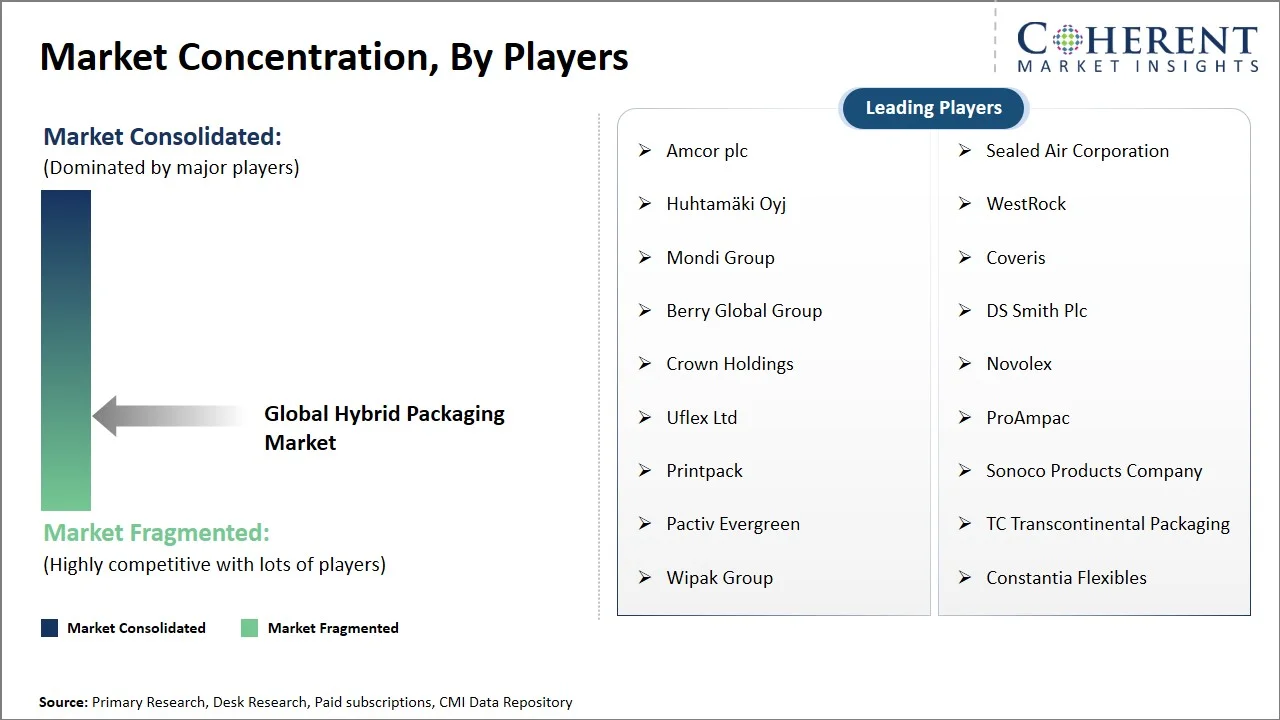
The global hybrid packaging market is moderately fragmented, with global packaging majors and regional converters competing on material innovation, recyclability, barrier performance, cost efficiency, and end-use customization. Competition is shaped by the ability of companies to combine plastic, paperboard, coatings, films, adhesives, and barrier layers into packaging formats that deliver product protection while meeting sustainability and regulatory requirements. Leading players are investing in recyclable mono-material structures, paper-based barrier solutions, recycled-content packaging, lightweight flexible formats, and food-contact safe coatings. Strategic partnerships with food, beverage, healthcare, personal care, and e-commerce brands are expected to remain important for commercial-scale adoption.
Key focus areas include
- Development of recyclable mono-material and paper-based hybrid packaging structures with strong barrier performance
- Integration of PFAS-free coatings, recycled-content polymers, and low-carbon materials to meet food-contact and sustainability regulations
- Expansion of flexible and barrier packaging production capacity to serve food, beverage, healthcare, and FMCG brands
- Investment in intelligent packaging, RFID-enabled labeling, traceability, and anti-counterfeit features for high-value end uses
- Geographic expansion across Asia Pacific, North America, and Europe to align with local EPR, recycling, and packaging waste regulations
- Collaboration with brand owners and retailers to redesign packaging for recyclability, shelf-life extension, logistics efficiency, and consumer convenience
Market Report Scope
Hybrid Packaging Market Report Coverage
| Report Coverage | Details | ||
|---|---|---|---|
| Base Year: | 2025 | Market Size in 2026: | USD 45.22 Bn |
| Historical Data for: | 2020 To 2024 | Forecast Period: | 2026 To 2033 |
| Forecast Period 2026 to 2033 CAGR: | 7.2% | 2033 Value Projection: | USD 73.57 Bn |
| Geographies covered: |
| ||
| Segments covered: |
| ||
| Companies covered: | Amcor plc, Sealed Air Corporation, Huhtamäki Oyj, WestRock, Mondi Group, Coveris, Berry Global Group, DS Smith Plc, Crown Holdings, Novolex, Uflex Ltd, ProAmpac, Printpack, Sonoco Products Company, Pactiv Evergreen, TC Transcontinental Packaging, Wipak Group, and Constantia Flexibles | ||
| Growth Drivers: |
| ||
| Restraints & Challenges: |
| ||
Analyst Opinion / Expert Opinion
- The global hybrid packaging market is expected to witness steady long-term growth, supported by rising demand for packaging formats that combine product protection, material efficiency, recyclability, and shelf-life extension. Increasing use of hybrid structures across food and beverage, healthcare, personal care, consumer electronics, and industrial applications is expected to strengthen adoption. As regulations around packaging waste, recyclability, and food-contact safety become stricter, demand for recyclable barrier films, paper-based hybrid materials, and mono-material packaging solutions is likely to grow consistently.
- The highest market opportunities are expected in Asia Pacific, where large-scale food and beverage consumption, expanding FMCG production, rising packaged food penetration, and growing local manufacturing capacity support strong demand. North America is expected to create faster growth opportunities due to strict EPR regulations, PFAS-related food packaging changes, and strong brand commitments toward recyclable and lower-waste packaging formats. Countries such as the U.S., India, Japan, Germany, and Brazil are expected to remain important demand centers for sustainable hybrid packaging innovation.
- To gain competitive advantage, market participants should focus on recyclable mono-material films, paper-based barrier structures, PFAS-free coatings, lightweight flexible formats, and intelligent packaging technologies. Companies that can provide strong barrier performance, food safety, recyclability, high-speed packaging compatibility, and cost efficiency will be better positioned. Partnerships with food, beverage, healthcare, personal care, and e-commerce brands will be critical to accelerate commercial adoption and strengthen long-term competitiveness.
Speak to the analyst
Want personalized insights?
Take the findings above to one of our principal consultants, or have the report rebuilt around the segments, geographies and competitors you actually track.
Market Segmentation
- Material Type Insights (Revenue, USD Bn, 2021 - 2033)
- Plastic based hybrid materials
- Paper & paperboard-based hybrid materials
- Metal incorporated hybrid materials
- Glass based hybrid materials
- Others
- Packaging Format Insights (Revenue, USD Bn, 2021 - 2033)
- Flexible hybrid packaging
- Rigid hybrid packaging
- Semi rigid hybrid packaging
- Protective/ Industrial hybrid solutions
- Others
- Packaging Feature Insights (Revenue, USD Bn, 2021 - 2033)
- Barrier enhanced hybrid packaging
- Recyclable/ sustainable hybrid packaging
- High performance protective hybrid packaging
- Active & intelligent hybrid packaging
- Others
- End-use Industry Insights (Revenue, USD Bn, 2021 - 2033)
- Food & beverage
- Pharmaceuticals & healthcare
- Consumer electronics & appliances
- Personal care & cosmetics
- Industrial & automotive
- Others
- Regional Insights (Revenue, USD Bn, 2021 - 2033)
- North America
- U.S.
- Canada
- Latin America
- Brazil
- Argentina
- Mexico
- Rest of Latin America
- Europe
- Germany
- U.K.
- Spain
- France
- Italy
- Russia
- Rest of Europe
- Asia Pacific
- China
- India
- Japan
- Australia
- South Korea
- ASEAN
- Rest of Asia Pacific
- Middle East
- GCC Countries
- Israel
- Rest of Middle East
- Africa
- South Africa
- North Africa
- Central Africa
- North America
- Key Players Insights
- Amcor plc
- Sealed Air Corporation
- Huhtamäki Oyj
- WestRock
- Mondi Group
- Coveris
- Berry Global Group
- DS Smith Plc
- Crown Holdings
- Novolex
- Uflex Ltd
- ProAmpac
- Printpack
- Sonoco Products Company
- Pactiv Evergreen
- TC Transcontinental Packaging
- Wipak Group
- Constantia Flexibles
Sources
Primary Research Interviews
- Packaging R&D heads and material innovation managers from hybrid packaging manufacturers
- Flexible packaging converters and laminated packaging solution providers
- Paperboard, plastic film, metalized film, coating, adhesive, and barrier material suppliers
- Sustainability and regulatory compliance professionals from packaging companies
- Procurement heads from food & beverage, healthcare, personal care, consumer electronics, and FMCG companies
- Packaging automation and machinery providers serving flexible, rigid, and semi-rigid packaging formats
- Executives and product managers from recyclable, paper-based, and Barrier Enhanced packaging companies
Stakeholders
- Hybrid packaging manufacturers and packaging converters
- Flexible packaging, rigid packaging, and protective packaging solution providers
- Raw material suppliers
- Plastic resin and polymer producers
- Paper and paperboard manufacturers
- Aluminum foil and metalized film suppliers
- Glass packaging material suppliers
- Barrier coating, ink, adhesive, and additive suppliers
- Packaging machinery and automation solution providers
- Recycling, waste management, and circular packaging solution providers
- End-use Sectors
- Food & beverage companies
- Pharmaceuticals and healthcare product manufacturers
- Consumer electronics and appliance companies
- Personal care and cosmetics brands
- Industrial and automotive product manufacturers
- E-commerce and logistics companies
- Retail and private-label brands
Regulatory & Government Bodies
- European Commission – Packaging and Packaging Waste Regulation
- U.S. Food and Drug Administration (FDA) – Food-contact packaging regulations
- U.S. Environmental Protection Agency (EPA) – Packaging waste and chemical safety guidelines
- CalRecycle – California SB 54 Packaging EPR Program
- Central Pollution Control Board (CPCB), India – Plastic Packaging EPR
- Food Safety and Standards Authority of India (FSSAI) – Food packaging standards
- German Central Agency Packaging Register (ZSVR)
- Japan Ministry of the Environment
- Brazilian Ministry of the Environment and Climate Change
Databases
- UN Comtrade Database
- World Bank Data
- OECD Environment Statistics
- Eurostat Packaging Waste Statistics
- U.S. EPA Facts and Figures about Materials, Waste and Recycling
- CPCB EPR Plastic Packaging Portal
- ZSVR Packaging Register Database
- FAOSTAT Food and Agriculture Database
- FDA Inventory of Effective Food Contact Substance Notifications
- European Chemicals Agency (ECHA) Database
Industry News Sources
- Packaging Europe
- Packaging World
- Flexible Packaging Magazine
- Labels & Labeling
- Sustainable Packaging News
- Plastics Today
- Resource Recycling
- Recycling Today
- Packaging Gateway
- Food Packaging Forum
Newspapers
- Financial Times
- The Economic Times
- The Hindu BusinessLine
- Business Standard
- Valor Econômico
- Handelsblatt
- The Japan Times
Journals
- Packaging Technology and Science
- Journal of Cleaner Production
- Resources, Conservation and Recycling
- Waste Management
- Sustainable Materials and Technologies
- Food Packaging and Shelf Life
- Journal of Applied Packaging Research
- Polymers
- Coatings
- Materials Today Sustainability
Associations
- World Packaging Organisation (WPO)
- Flexible Packaging Association (FPA)
- European Organization for Packaging and the Environment (EUROPEN)
- Sustainable Packaging Coalition (SPC)
- Fibre Box Association (FBA)
- Flexible Packaging Europe (FPE)
- Confederation of Paper Industries (CPI)
- Indian Institute of Packaging (IIP)
- Plastics Industry Association
- Association of Plastic Recyclers (APR)
Proprietary Elements
- CMI Data Analytics Tool, Proprietary CMI Existing Repository of information for last 10 years.
Get access to 250+ pages report
Every segment, forecast, competitor profile and data table behind the analysis above — available for instant download.
- ESOMAR Member
- ISO 9001:2015 Certified
- D-U-N-S Registered
- GDPR & CCPA Compliant
Missing comfort of reading report in your local language? Find your preferred language:
Transform your Strategy with Exclusive Trending Reports
Frequently Asked Questions
The CAGR of the Global Hybrid Packaging Market is projected to be 7.2% from 2026 to 2033.
The market is estimated at USD 45.22 billion in 2026 and projected to reach USD 73.57 billion by 2033.
The U.S. can be positioned as a leading of flexible packaging products, supported by its large packaging manufacturing base, strong flexible packaging industry, and high demand from food, beverage, healthcare, and e-commerce sectors
Yes, it is profitable due to steady demand from food, beverage, healthcare, e-commerce, and FMCG sectors, along with rising adoption of recyclable and barrier packaging formats.
In terms of material type, plastic based hybrid materials are estimated to dominate the market revenue share in 2026.
Increasing regulatory and brand demand for recyclable and sustainable multi material packaging and rising adoption in food & beverage and pharmaceutical sectors for performance and shelf life benefits are the major factors driving the growth of the Global Hybrid Packaging Market.
Complex recycling and end of life management for multi material structures and higher production and material integration costs vs single material packaging are the major factors hampering the growth of the Global Hybrid Packaging Market.