

Global Flexible Packaging Paper Market Size and Forecast – 2026-2033
According to Coherent Market Insights, the global flexible packaging paper market is estimated to be valued at USD 8.45 Bn in 2026 and is expected to reach USD 13.05 Bn by 2033, expanding at a compound annual growth rate (CAGR) of 6.4% from 2026 to 2033.
Key Takeaways of the Flexible Packaging Paper Market
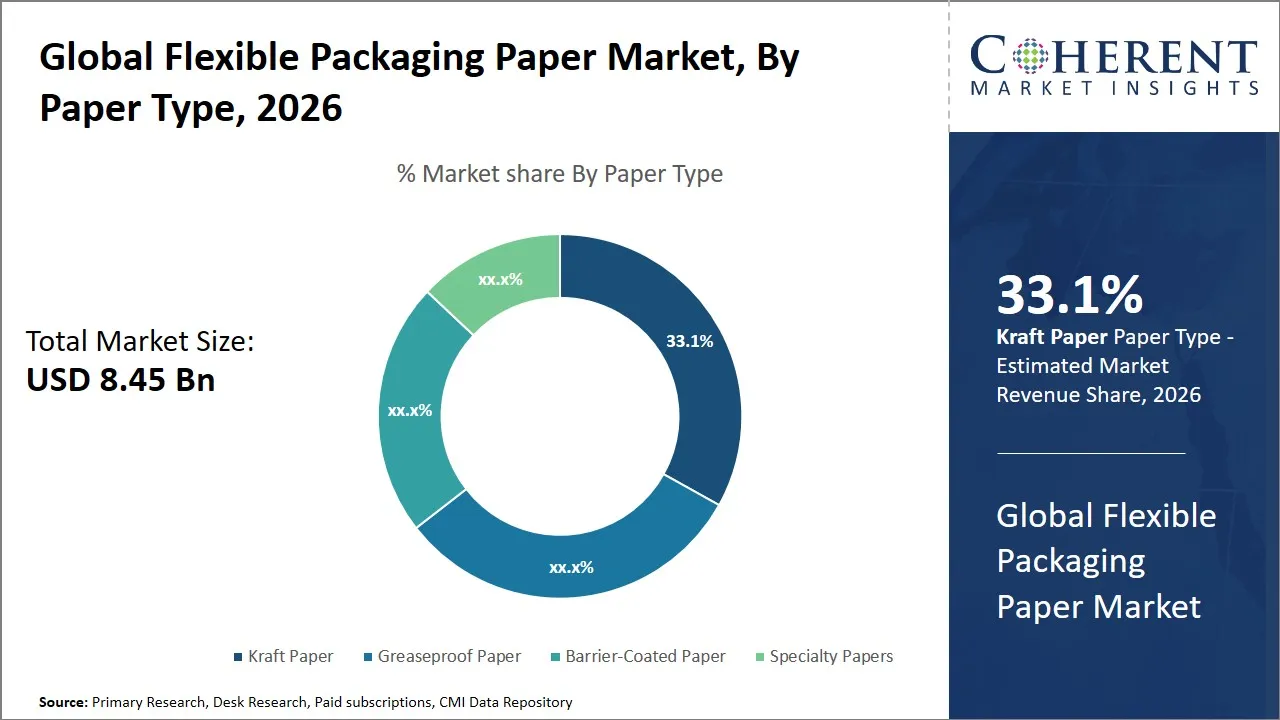
- Kraft paper segment is expected to hold 33. 1% of the global flexible packaging paper market share in 2026.
- The food & beverage segment is estimated to account for 31. 9% of the flexible packaging paper market share in 2026.
- The single-layer segment is projected to hold 45. 7% of the market share in 2026.
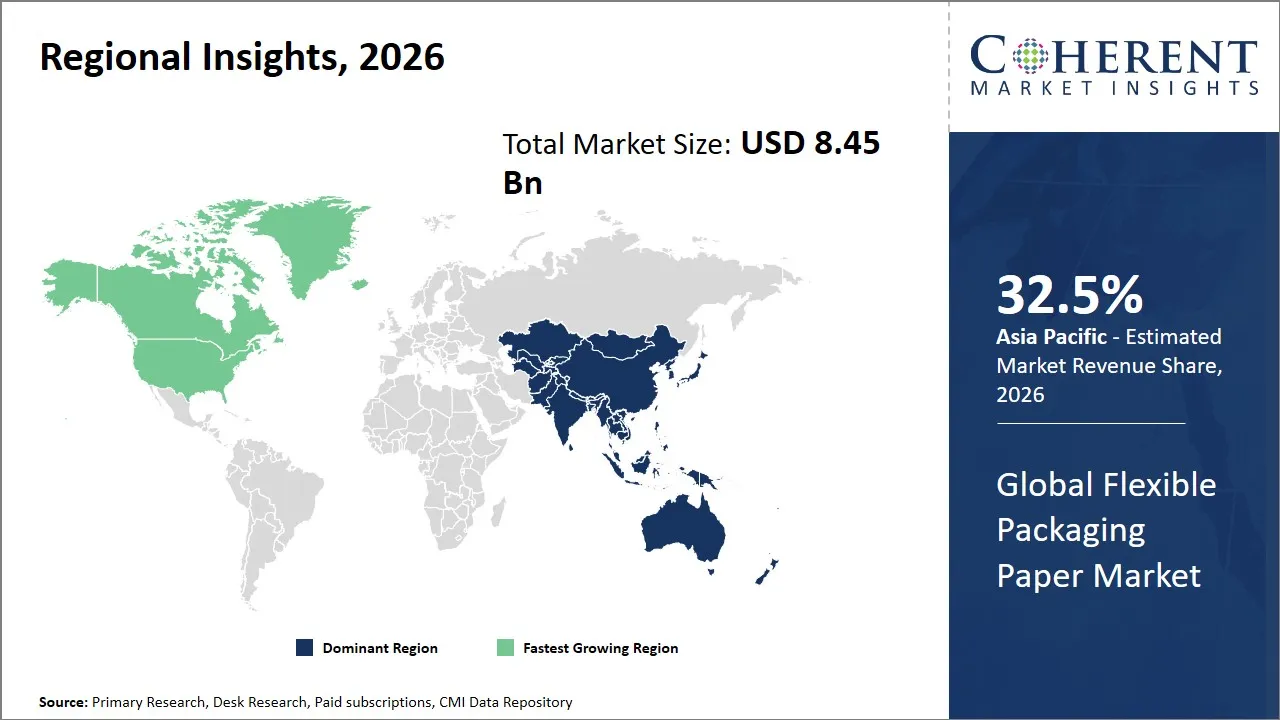
- The Asia Pacific region is expected to lead the market with a 32. 5% share in 2026.
- The North America region is set to grow the fastest, capturing a 19. 3% share in 2026.
Market Overview
- Emerging trends in the flexible packaging paper market emphasize sustainability and technological advancements. Manufacturers are focusing on developing high-barrier papers that extend product shelf life while reducing plastic usage.
- Additionally, consumer preference is shifting towards recyclable and compostable packaging, encouraging companies to adopt environmentally responsible practices.
- Digital printing technologies are also gaining traction, allowing for customization and shorter production runs, which further propels market growth and aligns with the dynamic needs of brand owners and consumers.
Current Events and Its Impact
Current Events | Description and its Impact |
Sustainability & Regulatory Shifts (EPR, Labeling, Plastic Reduction Policies) |
|
Rapid M&A Activity in Packaging Sector |
|
Segmental Insights
- Current Industry Events of 2026
- Market Size Estimation
- Regional Breakdown
- Competitive Landscape
- Customer Intelligence
- Segmental Analysis
- Pricing Analysis
- Key Market Drivers, Challenges & Future Trends
- Customized Insights Section
Why Does the Kraft Paper Segment Dominate the Flexible Packaging Paper Market in 2026?
Kraft paper segment is expected to contribute 33.1% of the global flexible packaging paper market share in 2026, owing to its superior strength, versatility, and eco-friendly characteristics. due to its outstanding strength, flexibility, and its environmentally friendly features. The chemical pulping process involves the production of kraft paper by eliminating impurities, and the end product is a stable fiber structure. This renders it very tear free and burst free, which is key in the flexible packaging that is needed to protect products during transportation and handling. It is brown and unbleached, which is also attractive to environmentally friendly brands, especially since sustainable packaging is becoming more popular around the world.
The growing need to have sustainable and recyclable packaging materials has a great influence on the increased use of Kraft paper in flexible packaging. A large number of manufacturers and consumers are moving towards the use of Kraft paper due to its biodegradation and composability properties that are consistent with the current trend of decreasing plastic waste. Also, Kraft paper can be used with a great variety of coatings and barrier technologies, which increases its usability in different industries.
An example will be Kraft paper which can be laminated or covered with moisture-resistant layers easily without affecting the integrity of the structure of the paper. The flexibility enables it to suit the needs of the industries like food and beverage, personal care, and also industrial packaging where the protection is as important as the environmental impact.
Food & Beverage Dominates the Global Flexible Packaging Paper Market
The food & beverage segment is projected to capture 31.9% of the global flexible packaging paper market share in 2026, propelled by the evolving consumer demand for convenience, freshness, and extended shelf life. With flexible packaging solutions, the protection against contamination and spoilage is very high and this is assets that are accorded high esteem in food packaging. The packaging papers in this industry are frequently designed to ensure that the products are not spoilt under different storage conditions such as exposure to moisture, change in temperatures and mechanical effects during the logistics.
The increase in the consumption of the ready to eat meals, on-the-go meals and take away foods has necessitated manufacturers to embrace the use of flexible packaging papers which facilitate easy handling and transportation. Moreover, the green packaging materials are appealing to the health-conscious customers because they find sustainable packaging to be an indicator of product cleanliness and safety. This has increased the use of paper-based flexible package as an alternative to the traditional plastic film in the food and beverage packaging.
Why Does the Single-Layer Barrier Technology Used in the Global Flexible Packaging Paper Market?
The single-layer segment is expected to hold 45.7% in the flexible packaging paper market share in 2026, driven by its straightforward design, ease of manufacturing, and cost-effectiveness. The simplest approach is single-layered coating or treatment to provide fundamental barriers to moisture, oxygen and grease, which satisfy the simplest functional needs of flexible packaging, and does not require the intricacies of multi-layers lamination. This easiness manifests into the speedy production cycles and minimized cost of materials that are appealing to the packaging manufacturers who seek to maximize on the profit margins.
The barrier technology that is most popular is single-layer barrier technology, which is adequate in situations where there is a need to protect the product at moderate levels of defense, e.g., by dry food packaging, bakery products, and personal care products. The capability to apply barrier coating on Kraft or greaseproof paper substrates improves the efficiency of materials by cutting down the number of layers required to provide useful functionality. This reduces manufacturing and logistical costs as well as primary recycling and waste management, as the packaging is made of fewer composite materials.
Regional Insights
Asia Pacific Flexible Packaging Paper Market Analysis and Trends
The Asia Pacific region is projected to lead the market with a 32.5% share in 2026, driven by the extensive manufacturing ecosystem, rapid industrialization, and vast consumer base. There are countries in the world like China, India and Japan that are highly equipped with supply chain infrastructure and this encourages the production and distribution of flexible packaging paper products on a large scale. The policies of the government on sustainable packaging and environmental policies have boosted the use of environmentally friendly packaging solutions, which have further enhanced the market.
Asia Pacific also enjoys the advantage of having a high number of leading companies such as UPM-Kymmene Corporation (having major production units in China), International Paper and Nippon Paper Industries. The products are oriented towards innovation of biodegradable and recyclable flexible packaging papers which serve the increasing demand of the food, pharmaceutical, and consumer goods industries. Trade dynamics depict increased exports in the region and to Europe and North America enhancing the statuses of the areas as a hub of packaging.
North America Flexible Packaging Paper Market Analysis and Trends
The North America region is expected to exhibit the fastest growth in the market contributing 19.3% share in 2026, to increasing consumer awareness about sustainable packaging and rigorous environmental policies promoting recyclable materials. Both the U.S. and Canada possess strong research and development capability to come up with improved flexible paper materials with enhanced barrier properties and durability. The leading companies in the industry like WestRock Company, Sealed Air Corporation and Graphic Packaging International are actively engaging in sustainable innovations and capacity expansions.
In addition to this, the government incentives and rules to minimize plastic wastes have increased the transition of traditional plastic packaging to flexible paper. The developed retail and food sector, in combination with the changing customers tastes towards eco-friendly packages, drives the market growth to an accelerated pace. There are also the activities of strong import-exports activities especially to Europe and Asia Pacific, in the North America that contributes to the availability and market introduction of the flexible packaging paper products
Flexible Packaging Paper Market Outlook for Key Countries
China Flexible Packaging Paper Market Trends
China’s flexible packaging paper market remains central to Asia Pacific’s packaging industry due to its extensive manufacturing base and robust supply chain infrastructure. Companies such as UPM-Kymmene and Nine Dragons Paper are taking advantage of the availability of raw materials in Chinas and the high technologies to produce and serve both domestic and global markets.
The focus of the governments regarding the models of the circular economy, and the strict environmental regulations, helps increase the investments in the sustainable flexible packaging solutions. Moreover, the demand of the product packaging paper products based on cost-effectiveness and convenience increases with the growing food processing and e-commerce industries in China.
Is the U.S. Poised for Continued Leadership in the Flexible Packaging Paper Market?
The U.S. holds the market leadership in the flexible packaging paper market majorly by the innovation and sustainability motivation. WestRock and Graphic Packaging are two major companies that put much emphasis on the development of recyclable and compostable flexible paper products. The high demand of the environmentally friendly packaging, as well as federal regulations to curb plastic pollution, drive market dynamics.
The country’s mature retail, food, and pharmaceutical industries consistently require advanced packaging solutions, fueling product diversification and investment. Additionally, collaborations between industry stakeholders and government bodies help foster sustainable packaging standards.
Germany Flexible Packaging Paper Market Trends
The Germany flexible packaging paper market has an advantage of being a frontier in the environmental policies and sustainable manufacturing in Europe. Such companies as Mondi Group and Smurfit Kappa are well represented, which promotes innovation in the sphere of sustainable flexible packaging materials in accordance with EU requirements in waste reduction and recyclability. The strong automotive, food and pharmaceutical industries in the country have a high demand of high quality flexible packaging solution, which further strengthens the market. Germanys are concerned with the implementation of the principles of the circular economy in packaging and raising awareness of people about the sustainability factor, which triggers further development and technological progress.
India Flexible Packaging Paper Market Trends
The increasing consumer base, rising urbanization and efforts by the government to encourage biodegradable and environmentally friendly packaging alternatives drive the growth of the flexible packaging paper market in India. Other players such as ITC Limited, Ballarpur industries and JK paper are working hard to come up with flexible packaging papers that can suit the changing consumer need of sustainable and affordable packaging solutions. The booming food processing and FMCG industries of Indias are some of the leading sources of demand of flexible packaging papers that are customized in terms of protection and shelf-life extension. The policies encouraging government to reduce plastic waste and adopting sustainable materials attract the further adoption of the market.
Is Brazil Set to Lead the Growth of the Flexible Packaging Paper Market?
The market of Brazil flexible packaging paper is changing and changing with more focus on the aspect of sustainability in the packaging industry. Other companies like Klabin and International paper are important in that they design novel flexible paper products with the aim of serving agricultural, food and beverage markets. The environmental regulations by the governments encourage the use of recyclable packaging materials and this increases the use of paper-based flexible packaging.
Also, the trade relations of Brazil with North America and Europe enable technologies transfer and market growth. The trend towards flexible packaging papers is also being increased by the rising consumer awareness regarding the effects of packaging on the environment.
Brand & Retail Sustainability Mandates
Brand / Retailer | Sustainability Mandate | Packaging Type / Materials Adopted |
Unilever | Achieving 100% recyclable or reusable packaging by 2025 | Paper-based packaging, compostable materials |
Nestlé | Zero net greenhouse gas emissions by 2050 | Paper, biodegradable coatings, recyclable paper packaging |
PepsiCo | 100% recyclable or compostable packaging by 2025 | Paper packaging, reduced plastic content |
Food Safety & Regulatory Compliance Impact
Category | Compliance Requirement / Regulatory Factor | Impact on Market / Industry | Implications for Flexible Packaging Paper |
Food Contact Material Standards | Paper/board intended for food contact must meet uniform formation, free from contaminants, and comply with specified standards (e.g., IS 6622, IS 7161) | Mandatory compliance increases material quality standards; reduces entry of low‑cost, non‑food‑grade paper | Drives adoption of certified food‑grade flexible papers (coated/laminated) |
Migration Limits & Inks Standards | Ban of harmful chemicals in inks (e.g., phthalates, toluene) and migration limits control | Reformulation of coatings & inks increases R&D and unit cost | Shifts demand to compliant kitchen‑safe and low‑migration print technologies |
Market Players, Key Development, and Competitive Intelligence
Key Development
- In December 2025, ProAmpac acquired TC Transcontinental Packaging for USD 1.5 Bn. The deal continues an M&A streak for ProAmpac as it plans to grow even bigger in flexible packaging.
Top Strategies Followed by Global Flexible Packaging Paper Market Players
Player Type | Strategic Focus | Example |
Established Market Leaders | Heavy investment in R&D and innovation | For example, Mondi Group, which is a global player in the flexible packaging industry, which has been emphasizing on sustainable paper-based packaging solutions that can satisfy the environmental requirements as well as the consumer needs of more environmentally friendly products. An example of the packaging solution they have introduced that is innovative is their Paper with Plastic packing where the outer layer is made of paper and a plastic barrier is used to ensure products such as snacks and beverages are not spoilt. |
Mid-Level Players | Cost-effective solutions with balanced quality | For example, Amcor, who is a major player in the packaging industry, deals in affordable paper packaging solutions that combine sustainability and affordability to the consumers in the middle market. An example is the flexible paper-based packaging by Amcor that makes use of affordable paper with environmentally friendly contents, and thus, this product is affordable and can serve an increased number of customers. |
Small-Scale Players | Niche specialization & innovative variants | For example, BioPak, a small player in the packaging sector, specializing in environmentally-friendly packaging, and making products out of biodegradable and compostable paper to serve the foodservice industry. They adopt new methods such plant-based coating and water-based inks used to print and this is attractive to the green consumer segment. |
Market Report Scope
Flexible Packaging Paper Market Report Coverage
| Report Coverage | Details | ||
|---|---|---|---|
| Base Year: | 2025 | Market Size in 2026: | USD 8.45 Bn |
| Historical Data for: | 2020 To 2024 | Forecast Period: | 2026 To 2033 |
| Forecast Period 2026 to 2033 CAGR: | 6.4% | 2033 Value Projection: | USD 13.05 Bn |
| Geographies covered: |
| ||
| Segments covered: |
| ||
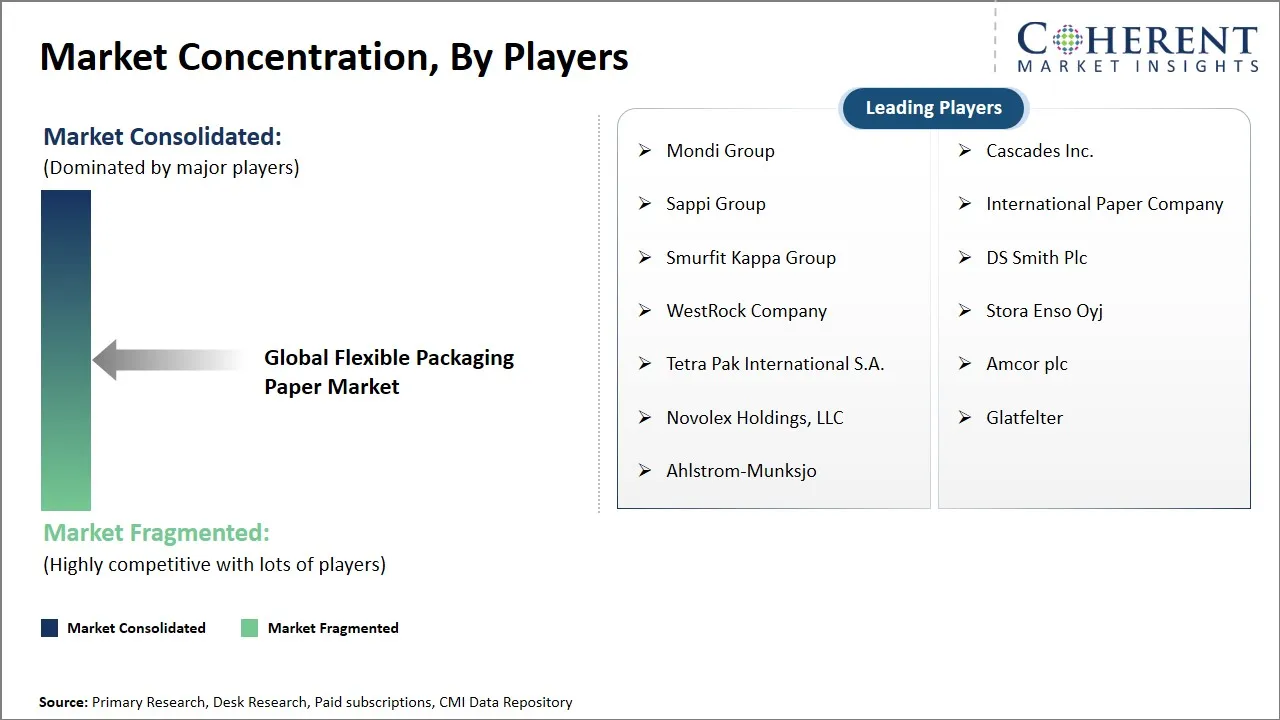
| Companies covered: | Mondi Group, Cascades Inc., Sappi Group, International Paper Company, Smurfit Kappa Group, DS Smith Plc, WestRock Company, Stora Enso Oyj, Tetra Pak International S.A., Amcor plc, Novolex Holdings, LLC, Glatfelter, and Ahlstrom-Munksjo | ||
| Growth Drivers: |
| ||
| Restraints & Challenges: |
| ||
Flexible Packaging Paper Market Dynamics
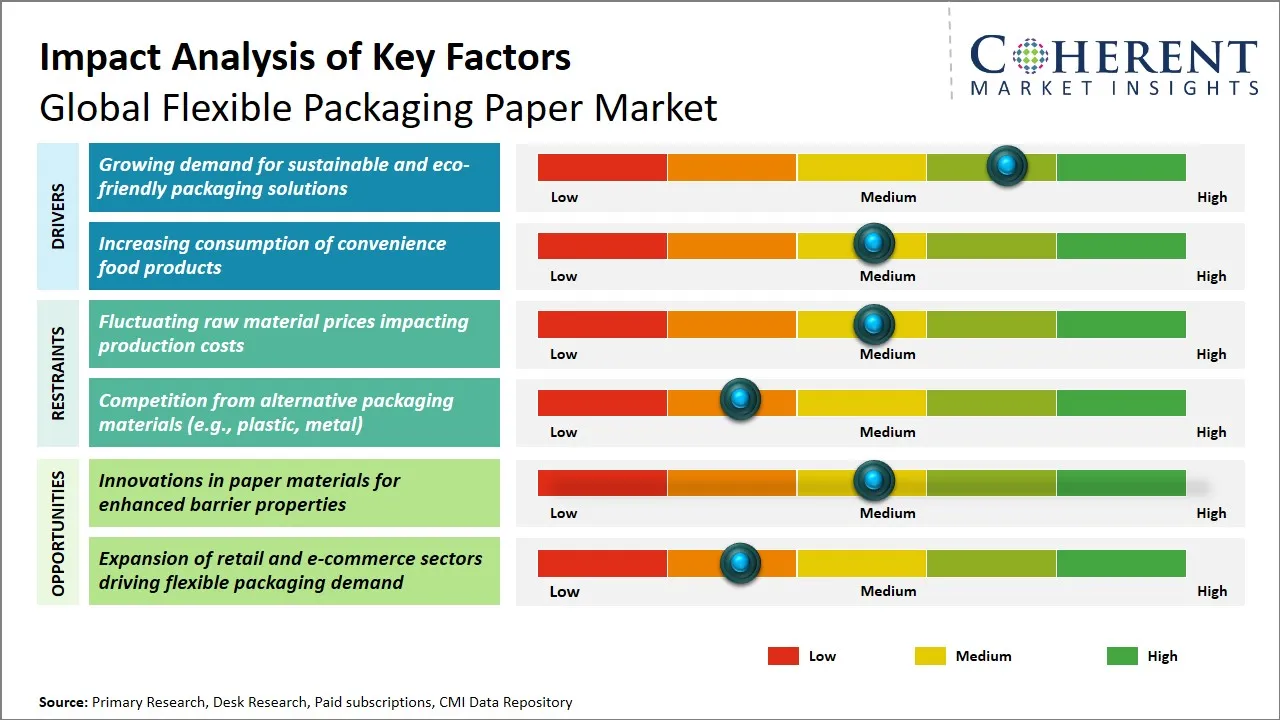
Flexible Packaging Paper Market Driver - Growing Demand for Sustainable and Eco-Friendly Packaging Solutions
The rising consumer and business awareness on the issue of environmental sustainability is largely propelling the flexible packaging paper demand. With stricter regulations on plastic waste in every part of the world and the emphasis on environmental issues growing, industries are also striving to find an alternative that could minimally impact their ecological footprint. Flexible packaging paper is biodegradable and recyclable, and presents an appealing alternative to the traditional packaging material containing plastics. Brands are focusing on the use of eco-friendly packaging materials to advance their sustainability commitment, brand perception and sustainability expectations of consumers of greener brands.
For example, Unilever has undertaken the move to make all of its packaging recyclable, reusable, or compostable by the year 2025. This commitment has resulted to a transition towards paper-based package such as flexibles packaging paper which is seen as sustainable towards the company’s sustainability objectives.
(Source: https://www.unilever.com/sustainability/plastics/)
Flexible Packaging Paper Market Opportunity - Innovations in Paper Materials for Enhanced Barrier Properties
The market opportunity of the global flexible packaging paper market is high due to the on-going innovations of paper materials used to develop better barrier properties. With the rising consumer interest in environmentally friendly and sustainable packaging options, producers are paying more attention to creating paper materials that have better properties of resistance to moisture, oxygen, grease, and other external contaminants without having to resort to thick layers of plastic. Muscle technologies like coating with nanoparticles, bi-based barriers and multi-layering lamination processes are allowing the creation of flexible packaging papers that are more durable and functional.
Indicatively, the Belgium-based paper manufacturer Papeteries de Genval has come up with a new piece of paper product known as EcoBarrier which is a paper product endowed with better moisture and grease resistive qualities. This greener paper is manufactured by the use of bio-based finishes rather than the normal plastic laminating materials, hence making it an excellent example of the upsurge in the need of high-performance paper solutions in the flexible packaging.
Analyst Opinion (Expert Opinion)
- The market of flexible packaging paper is showing a strong growth in the market with the rising demands of consumer inclination on sustainable packaging solution in many sectors, especially in food and beverage products. The Global Packaging Innovations Conference (2023) and the Sustainable Packaging Summit (2022) have highlighted some of the most important innovations in the field of sustainable packaging, with such companies as Mondi Group and Smurfit Kappa leading the sphere of the creation of environmentally friendly packaging papers that would preserve the integrity of products and would cause less harm to the environment.
- The recent entry of Mond is into the recyclable paper-based packaging proves that the company takes an active step toward satisfying the needs of its consumers in the field of sustainability without losing the functionality capabilities. The conferences deliberated on the need to adopt biodegradable materials and minimize plastic wastes as evidence that the industry is eco-friendly. Nonetheless, issues like the necessity of barrier properties that are equal to plastic and excessive costs of fabrication were often cited as impediments to the wider use.
- Companies with innovative material science priorities and partners with brands interested in sustainable solutions have a high chance of gaining a competitive advantage. Finally, the development of the flexible packaging paper market will be dependent on its capacity to respond to the consumer expectations and regulatory pressure of the packaging solutions on sustainability and performance.
Speak to the analyst
Want personalized insights?
Take the findings above to one of our principal consultants, or have the report rebuilt around the segments, geographies and competitors you actually track.
Market Segmentation
- Paper Type Insights (Revenue, USD Bn, 2021 - 2033)
- Kraft Paper
- Greaseproof Paper
- Barrier-Coated Paper
- Specialty Papers
- Application Insights (Revenue, USD Bn, 2021 - 2033)
- Food & Beverage
- Pharmaceutical
- Personal Care
- Industrial
- Barrier Technology Insights (Revenue, USD Bn, 2021 - 2033)
- Single-Layer
- Multi-Layer Barrier
- Laminated
- Specialty-Coated
- Coating Type Insights (Revenue, USD Bn, 2021 - 2033)
- Polyethylene Coating
- Wax Coating
- Silicone Coating
- Water-Based Barrier
- Regional Insights (Revenue, USD Bn, 2021 - 2033)
- North America
- U.S.
- Canada
- Latin America
- Brazil
- Argentina
- Mexico
- Rest of Latin America
- Europe
- Germany
- U.K.
- Spain
- France
- Italy
- Russia
- Rest of Europe
- Asia Pacific
- China
- India
- Japan
- Australia
- South Korea
- ASEAN
- Rest of Asia Pacific
- Middle East
- GCC Countries
- Israel
- Rest of Middle East
- Africa
- South Africa
- North Africa
- Central Africa
- North America
- Key Players Insights
- Mondi Group
- Cascades Inc.
- Sappi Group
- International Paper Company
- Smurfit Kappa Group
- DS Smith Plc
- WestRock Company
- Stora Enso Oyj
- Tetra Pak International S.A.
- Amcor plc
- Novolex Holdings, LLC
- Glatfelter
- Ahlstrom-Munksjo
Sources
Primary Research Interviews
- CEO – Leading Barium Carbonate Producer (e.g., Solvay or Chemical Products Corp equivalent)
- Supply Chain Director – Major Barium Chemicals Distributor
- Production Lead – Specialty Barium Compounds Manufacturer
- Sustainability Officer – Barium Mineral Certification Authority
Stakeholders
- Manufacturers
- End-use Sectors
- Glass Industry (Flat Glass, Container Glass)
- Ceramics & Tiles Producers
- Oil & Gas Drilling (Barite Derivatives)
- Regulatory & Certification Bodies (e.g., EPA for barium compounds, REACH compliance in EU)
- E-commerce Platforms and Retailers (Alibaba, Industrial Suppliers, Sigma-Aldrich)
- Technology Integration Players: Advanced ceramics and frit producers using barium carbonate
Databases
- UN Comtrade Database
- India Import Export (EXIM) Database
- USGS Mineral Commodity Summaries (Barium)
- Eurostat Trade Statistics for Chemicals
Magazines
- Chemical Processing Magazine – Trends in barium chemicals supply
- Glass International – Barium in glass manufacturing innovations
- Ceramics World Review – Applications in ceramic glazes
- Industrial Minerals – Market dynamics for barium carbonate
- Oil & Gas Journal – Barite and barium use in drilling fluids
Journals
- Journal of Materials Science – Barium carbonate in ceramics durability
- Resources Policy – Global barium supply chain analysis
- Journal of Hazardous Materials – Environmental impact of barium processing
- Chemical Engineering Journal – Synthesis and purification techniques
- Minerals Engineering – Extraction and refining of barium ores
Newspapers
- The Wall Street Journal – Global chemical demand for barium compounds
- The Guardian – Sustainability in mining barium carbonate
- Business Standard (India) – Barium chemical imports and Asia market growth
- Chemical Week – Supply disruptions in barium production
- Reuters – Price volatility in industrial minerals like barium
Associations
- International Barite Association
- Barium Chemicals Producers Group
- Glass Packaging Institute
- Tile Council of North America
- European Chemical Industry Council (Cefic)
- Green Chemistry Institute
Public Domain Sources
- EPA – Guidelines for barium compounds handling
- European Commission – REACH regulations on barium carbonate
- World Health Organization – Safety standards for barium exposure
- USGS – Barium statistics and trade assessments
- OECD – Chemical trade and sustainability reports for barium
Proprietary Elements
- CMI Data Analytics Tool, Proprietary CMI Existing Repository of information for last 8 years.
Get access to 250+ pages report
Every segment, forecast, competitor profile and data table behind the analysis above — available for instant download.
- ESOMAR Member
- ISO 9001:2015 Certified
- D-U-N-S Registered
- GDPR & CCPA Compliant
Missing comfort of reading report in your local language? Find your preferred language:
Transform your Strategy with Exclusive Trending Reports
Frequently Asked Questions
The global flexible packaging paper market is estimated to be valued at USD 8.45 Bn in 2026 and is expected to reach USD 13.05 Bn by 2033.
The CAGR of global flexible packaging paper market is projected to be 6.4% from 2026 to 2033.
Growing demand for sustainable and eco-friendly packaging solutions and increasing consumption of convenience food products are the major factors driving the growth of the global flexible packaging paper market.
Fluctuating raw material prices impacting production costs and competition from alternative packaging materials (e.g., plastic, metal) are the major factors hampering the growth of the global flexible packaging paper market.
In terms of paper type, kraft paper is estimated to dominate the market revenue share in 2026.
Paper is more recyclable but less effective in moisture/oxygen barriers and often more expensive.
Bio-based barrier coatings, recyclable mono-material designs, and digital printing.