

Industrial Labels Market Size and Forecast — 2026 - 2033
The Global Industrial Labels Market size is estimated to be valued at USD 8.5 billion in 2026 and is expected to reach USD 14.7 billion by 2033, exhibiting a compound annual growth rate (CAGR) of 8.2% from 2026 to 2033.
Overview
The global industrial labels market is experiencing steady growth due to rising demand from manufacturing, logistics, automotive, electronics, pharmaceuticals, and food packaging industries. Industrial labels are used for product identification, barcode tracking, safety warnings, branding, and regulatory compliance. Growth in e-commerce, warehouse automation, and supply chain digitization is increasing the need for durable and high-performance labeling solutions. Technological advancements such as RFID labels, smart labels, and eco-friendly materials are further driving market expansion. Asia-Pacific leads the market because of rapid industrialization and manufacturing growth, while North America and Europe focus on innovation, sustainability, and advanced labeling technologies across multiple industrial applications.
Key Takeaways
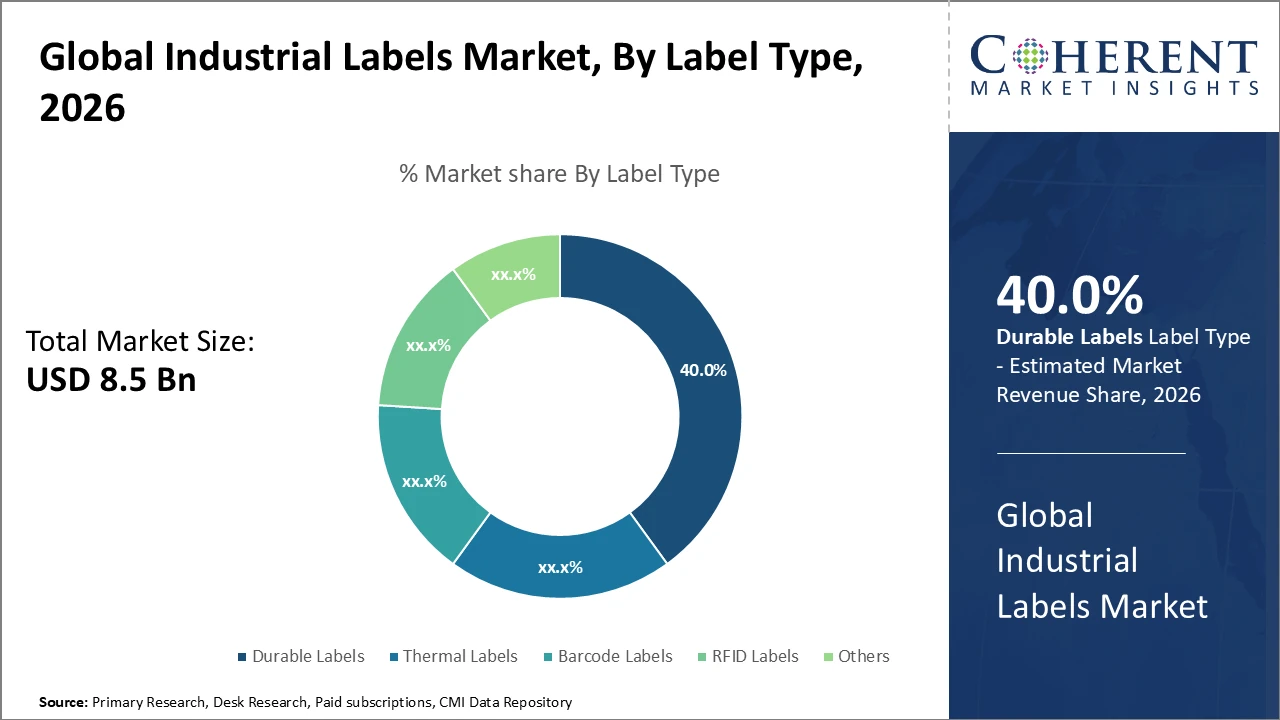
Durable labels dominate the segment with a 40% market share, due to their reliability in harsh industrial environments. Thermal and RFID labels are rapidly gaining adoption for precise data capture and asset management.
Automotive is the leading application segment, contributing nearly 30% of market revenue, supported by industrial automation and compliance requirements. Electronics and pharmaceuticals follow closely with growing demand for innovative labeling solutions.
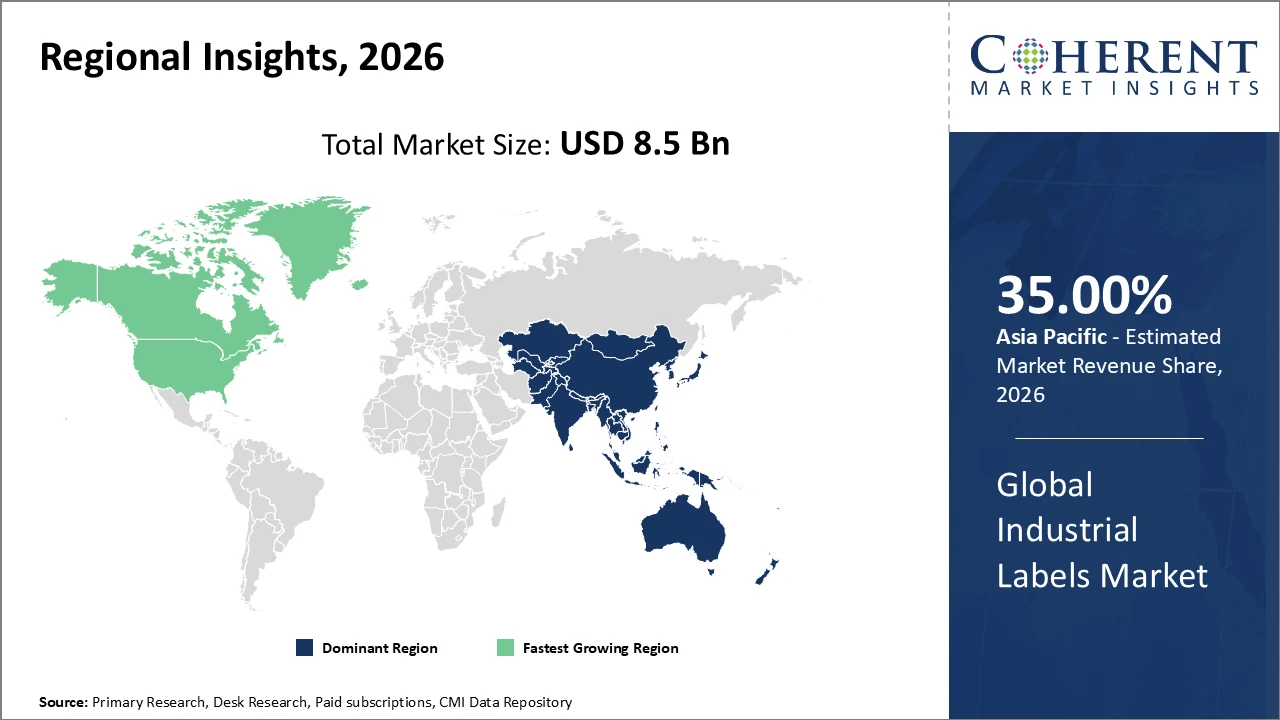
Asia Pacific holds the largest market share at around 35%, driven by rapid industrialization and expanding manufacturing capacity, while North America exhibits the fastest CAGR due to advanced technology adoption and regulatory support.
Europe is focusing on sustainable and high-performance labeling solutions, reflecting industry trends toward eco-friendly materials and durable products.
Industrial Labels Market Segmentation Analysis
Industrial Labels Market Insights, By Label Type
Durable Labels dominate the market with a 40% share, valued for their resistance to abrasion, chemicals, and extreme temperatures, crucial in automotive, chemical, and heavy manufacturing sectors. RFID Labels are the fastest-growing subsegment, driven by IoT adoption and rising demand for asset tracking and automated processes in logistics and warehousing. Thermal Labels support on-demand printing and operational efficiency in supply chains, while Barcode Labels remain essential for inventory management and retail applications.
Industrial Labels Market Insights, By Application
The Automotive segment leads the Industrial Labels market, driven by strict regulatory compliance and the adoption of smart manufacturing, which require durable and precise labels capable of withstanding fluids, vibration, and temperature extremes. Pharmaceuticals are the fastest-growing application, fueled by traceability, anti-counterfeiting, and patient safety regulations, increasing demand for RFID and tamper-evident labels. Electronics exhibit steady growth, supported by miniaturized, high-precision labeling needs in consumer and industrial electronics manufacturing. Logistics and Warehousing maintain consistent demand through barcode and RFID solutions for inventory management.
Industrial Labels Market Insights, By Material
Polyester labels dominate the Industrial Labels market, prized for their durability, chemical resistance, and high-temperature tolerance, making them essential in automotive, electronics, and chemical sectors. Their long-lasting performance in harsh environments secures a substantial market share. Polypropylene labels are the fastest-growing subsegment, valued for flexibility, moisture resistance, and cost efficiency, driving adoption in pharmaceuticals and logistics. Paper labels continue to serve cost-sensitive applications with moderate durability requirements, while vinyl labels are preferred for outdoor and heavy industrial uses due to weather resilience.
Industrial Labels Market Trends
The market is increasingly adopting smart labels with RFID and QR codes, with North American logistics hubs reporting an 18% rise in usage since 2024.
Environmental sustainability is driving demand for recyclable label substrates in Europe, with a 22% increase in adoption over two years due to stricter regulations.
Advancements in digital printing enable on-demand, low-volume label production, promoting flexible and efficient manufacturing across supply chains.
Industrial Labels Market Insights, By Geography
Asia Pacific Industrial Labels Market Analysis and Trends
In Asia Pacific, the Industrial Labels market is experiencing rapid growth, driven by robust industrialization and expanding manufacturing hubs, particularly in China and India, which together contribute over 35% of global market revenue. The region benefits from diverse industrial sectors, government initiatives like ‘Make in India’ and ‘Made in China 2025’, and rising export-oriented production. Demand for durable, high-performance, and smart labels is increasing across automotive, electronics, and pharmaceuticals. Leading companies such as UPM Raflatac and Nippon Carbide Industries have scaled up production capacities, strengthened distribution networks, and introduced innovative labeling solutions, consolidating the region’s dominance and future growth prospects.
North America Industrial Labels Market Analysis and Trends
North America demonstrates the fastest growth in the Industrial Labels market, with a CAGR exceeding 9% from 2024 to 2026. This expansion is fueled by the rapid adoption of automation and smart labeling technologies, including RFID and QR code integration, across manufacturing, logistics, and pharmaceutical sectors. Strict regulatory frameworks, such as FDA and OSHA labeling requirements, further drive demand for durable, compliant, and traceable labels. Key players like Avery Dennison and Zebra Technologies are leading innovation, offering advanced label solutions that enhance operational efficiency and regulatory adherence, thereby reinforcing North America’s status as a high-growth, technologically advanced market.
Industrial Labels Market Outlook for Key Countries
USA Industrial Labels Market Analysis and Trends
The U.S. Industrial Labels market is driven primarily by automotive, pharmaceutical, and logistics sectors, where precision and durability are critical. Industrial automation investments rose by 14% in recent years, boosting demand for smart labeling solutions, including RFID and QR code-enabled labels. Leading U.S. companies have expanded portfolios with advanced, compliant labels, enhancing traceability and securing government and commercial contracts. Environmental regulations have further encouraged adoption of sustainable materials, such as recyclable and low-VOC substrates.
Germany Industrial Labels Market Analysis and Trends
Germany’s Industrial Labels market benefits from a strong industrial base, particularly in automotive and electronics sectors, accounting for around 20% of Europe’s label revenue in 2026. The market growth is fueled by demand for durable, high-performance labels capable of withstanding extreme conditions and ensuring compliance with safety standards. German manufacturers have embraced digital printing, RFID, and real-time tracking technologies, enhancing production flexibility and traceability. Additionally, stringent regulatory requirements on product safety and sustainability drive adoption of eco-friendly and tamper-evident labels. Collectively, these factors support a robust 10% CAGR, establishing Germany as a leading European hub for industrial labeling innovation.
Analyst Opinion
In 2025, several industrial parks in Asia Pacific expanded label manufacturing units by 15%, boosting output and reducing lead times, directly supporting market growth.
Rising demand from sectors like pharmaceuticals and automotive drove imports of advanced labeling materials, with specialty resin-based labels growing by 12% in 2024, enhancing market share across regions.
Raw material cost increases for synthetic substrates raised label prices by 5% in 2026, but production efficiencies allowed competitive pricing, sustaining revenue growth.
Customized labels with RFID and QR codes saw a 20% adoption increase in Europe’s automotive industry since 2024, highlighting innovation’s role in market expansion.
- Current Industry Events of 2026
- Market Size Estimation
- Regional Breakdown
- Competitive Landscape
- Customer Intelligence
- Segmental Analysis
- Pricing Analysis
- Key Market Drivers, Challenges & Future Trends
- Customized Insights Section
Market Scope
| Report Coverage | Details | ||
|---|---|---|---|
| Base Year: | 2025 | Market Size in 2026: | USD 8.5 billion |
| Historical Data for: | 2020 To 2024 | Forecast Period: | 2026 To 2033 |
| Forecast Period 2026 to 2033 CAGR: | 8.2% | 2033 Value Projection: | USD 14.7 billion |
| Geographies covered: |
| ||
| Segments covered: |
| ||
| Companies covered: | CCL Industries Inc., 3M Company, UPM Raflatac, Essentra PLC, FLEXcon Company Inc., Multi-Colour Corporation, Schreiner Group, Brady Corporation | ||
| Growth Drivers: |
| ||
Industrial Labels Market Growth Factors
Increasing automation in manufacturing has driven demand for high-performance labels that resist chemicals and abrasion. The automotive sector’s adoption of durable labels rose 15% in 2025, coinciding with greater industrial robot deployment. Regulatory requirements for traceability and compliance in pharmaceuticals and food logistics fueled a 10% revenue growth in 2024. Innovations in smart labeling, including RFID-embedded solutions, enabled new applications in warehouse automation, reshaping market dynamics. Additionally, rising investments in industrial modernization across emerging economies have broadened market reach, with Asia Pacific accounting for over 35% of global industrial label revenue in 2026, reflecting robust regional growth.
Industrial Labels Market Development
In January 2026, SATO Corporation announced the Southeast Asia launch of its next-generation flagship industrial label printers, the CL4-SXR and CL6-SXR, strengthening its advanced auto-ID and labeling solutions portfolio.
Key Players
Leading Companies of the Market
CCL Industries Inc.
3M Company
UPM Raflatac
Essentra PLC
FLEXcon Company Inc.
Multi-Colour Corporation
Schreiner Group
Brady Corporation
Forward-looking strategies in the Industrial Labels market include Avery Dennison’s expansion into sustainable label materials, which contributed to a 7% revenue increase in 2025. Similarly, Brady Corporation’s integration of digital printing technologies enhanced customization capabilities, enabling tailored solutions for diverse industrial applications and resulting in a 10% market share growth by 2026. These strategic initiatives underscore the emphasis on innovation, sustainability, and customer-centric solutions, positioning companies to capture emerging opportunities across sectors such as automotive, pharmaceuticals, and logistics, while strengthening their competitive standing in a rapidly evolving global market.
Industrial Labels Market Future Outlook
The Industrial Labels market is poised for steady growth driven by increasing adoption of smart labeling technologies, regulatory compliance requirements, and the expanding industrial and logistics sectors. Future trends indicate a shift toward RFID and IoT-enabled labels, offering real-time tracking, improved asset management, and enhanced operational efficiency. Sustainability will also shape the market, with biodegradable and recyclable materials gaining preference to meet environmental standards. Emerging applications in pharmaceuticals, chemicals, and electronics will further fuel demand. By 2033, continuous technological innovations, coupled with digital supply chain integration, are expected to strengthen the market’s global footprint and drive substantial revenue growth.
Industrial Labels Market Historical Analysis
The Industrial Labels market has witnessed steady growth over the past decade, driven by increasing industrialization, globalization of supply chains, and stringent regulatory requirements across sectors such as manufacturing, chemicals, and pharmaceuticals. Historically, pressure-sensitive and adhesive labels dominated due to their versatility and cost-effectiveness, while RFID and barcode labels gained traction in the mid-2010s with rising automation in logistics and inventory management. Europe and North America led early adoption owing to mature industrial bases and compliance mandates, while Asia Pacific gradually expanded through rapid manufacturing growth. The market’s historical trajectory reflects a consistent shift toward durable, compliant, and technologically advanced labeling solutions.
Sources
Primary Research Interviews:
Engineers, R&D managers, and product developers from companies manufacturing industrial labels, adhesives, and printing technologies.
Technical specialists from logistics, manufacturing, and warehousing operations using barcode, RFID, and compliance labels.
Industry experts from firms providing labeling automation solutions, IoT-based tracking, and digital printing technologies.
Magazines:
Label & Narrow Web – Insights on printing technologies, adhesive innovations, and market trends in industrial labeling.
Packaging World – Updates on industrial packaging labels, compliance requirements, and technological developments.
Flexo & Gravure Global – Reports on label printing methods, materials, and application innovations.
Journals:
Journal of Manufacturing Processes – Studies on labeling integration in manufacturing and industrial automation.
Packaging Technology and Science – Research on durable labels, adhesives, and industrial labeling efficiency.
Journal of Applied Polymer Science – Insights on label material properties, adhesives, and sustainability trends.
Newspapers:
The Wall Street Journal – Company strategies, mergers, and investments in industrial label manufacturers.
Financial Times – Market trends, regulatory updates, and global labeling technology demand.
Reuters – News on industrial label innovations and company expansions.
Bloomberg – Corporate performance and market insights in industrial labeling and packaging.
Associations:
International Label & Packaging Industry Association (TLMI/FINAT) – Standards, guidelines, and industry events for industrial labels.
Association for Packaging and Processing Technologies (PMMI) – Best practices, compliance, and innovation in labeling machinery and materials.
International Organization for Standardization (ISO) – Guidelines for labeling quality, durability, and safety standards.
Get access to 250+ pages report
Every segment, forecast, competitor profile and data table behind the analysis above — available for instant download.
- ESOMAR Member
- ISO 9001:2015 Certified
- D-U-N-S Registered
- GDPR & CCPA Compliant
Missing comfort of reading report in your local language? Find your preferred language:
Transform your Strategy with Exclusive Trending Reports
Frequently Asked Questions
Leading companies include Schreiner Group, CCL Industries, Brady Corporation, and 3M Company, all actively expanding product portfolios and technological capabilities.
The market is projected to grow from USD 8.5 billion in 2026 to approximately USD 14.7 billion by 2033, driven by industrial automation, regulatory compliance, and adoption of smart labeling solutions.
The automotive sector offers the largest growth opportunity due to stringent labeling requirements, increasing automation, and adoption of durable and smart label technologies.
Trends will focus on smart labeling technologies, sustainable materials, and digital printing innovations, accelerating adoption across logistics, manufacturing, and pharmaceuticals.
The competitive landscape is driven by technological innovation, product customization, and competitive pricing, while challenges include raw material volatility, regulatory compliance, and regional differences.
Companies prioritize strategic partnerships, mergers and acquisitions, and R&D investments to enhance product offerings, expand into emerging markets, and meet evolving industrial demands.