

Cosmetic Tubes Market Size and Share Analysis- 2026 To 2033
The global Cosmetic Tubes market is projected to grow at a CAGR of 4.7% and is expected to reach USD 3.19 Bn by 2026, and USD 4.39 Bn in 2033. The main drivers are mainly due to the increasing demand for convenient and portable cosmetic packaging, increased consumption of skincare and personal care products, growing preference for sustainable and recyclable packaging materials and continuous innovations in tube designs and dispensing solutions. According to Cosmetics Europe, the European cosmetics and personal care market grew to €110 Bn in retail sales in 2025. Skin care was the largest category at €32.3 Bn, followed by toiletries at €26.4 Bn and hair care at €20.3 Bn.
Key Takeaways
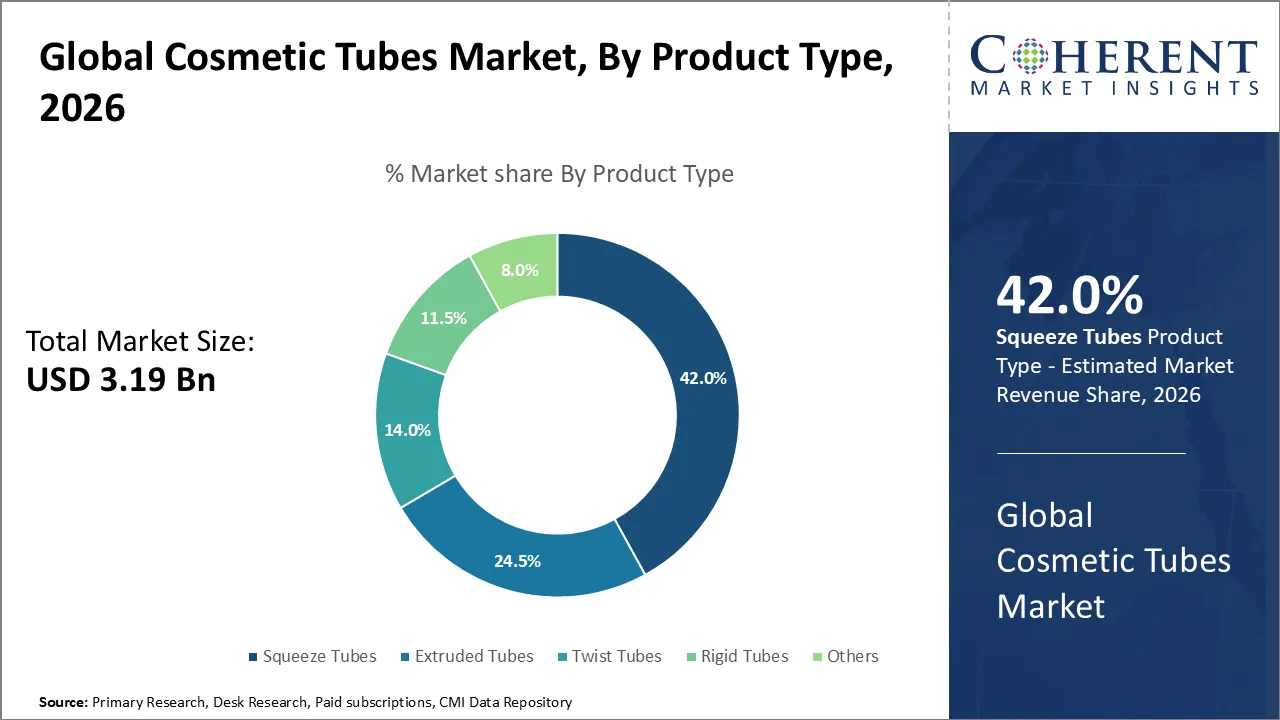
- The squeeze tubes segment is likely to dominate the market with 42.0% in 2026. The segment’s growth is owing to convenient dispensing, portability, ease of use, controlled product application, and widespread utilization for creams, lotions, gels, cleansers, and other cosmetic formulations. Colgate-Palmolive India’s latest 2025-26 Annual & ESG Report shows that it has deployed 2 Bn recyclable tubes, which is a recent real-world indicator that recyclable tube technology has moved beyond pilot-scale implementation to mass-market deployment.
- The plastic segment is expected to lead with 63.5% in 2026. The segment is expected to grow due to lightweight, design flexibility, suitability with different cosmetic formulations, cost-effective manufacturing and suitability for squeezable packaging. Oriflame Cosmetics said that in 2025 21% by weight of the polyethylene (PE) used in its extruded tubes was recycled content, highlighting the increasing use of recycled plastic directly in cosmetic tube packaging.
- The skin care segment is expected to lead with 35.5% in 2026. The segment’s growth is owing to the extensive use of tubes for facial creams, moisturizers, sunscreens, cleansers, serums, masks, and dermatological skincare formulations. The demand base is strong, L’Oréal estimates the global beauty market to be over €290 Bn in 2025, with skincare being the largest product category at 39%. L'Oréal also said its Dermatological Beauty division was up 5.5% like-for-like in 2025, showing continued momentum in skincare and dermocosmetics.
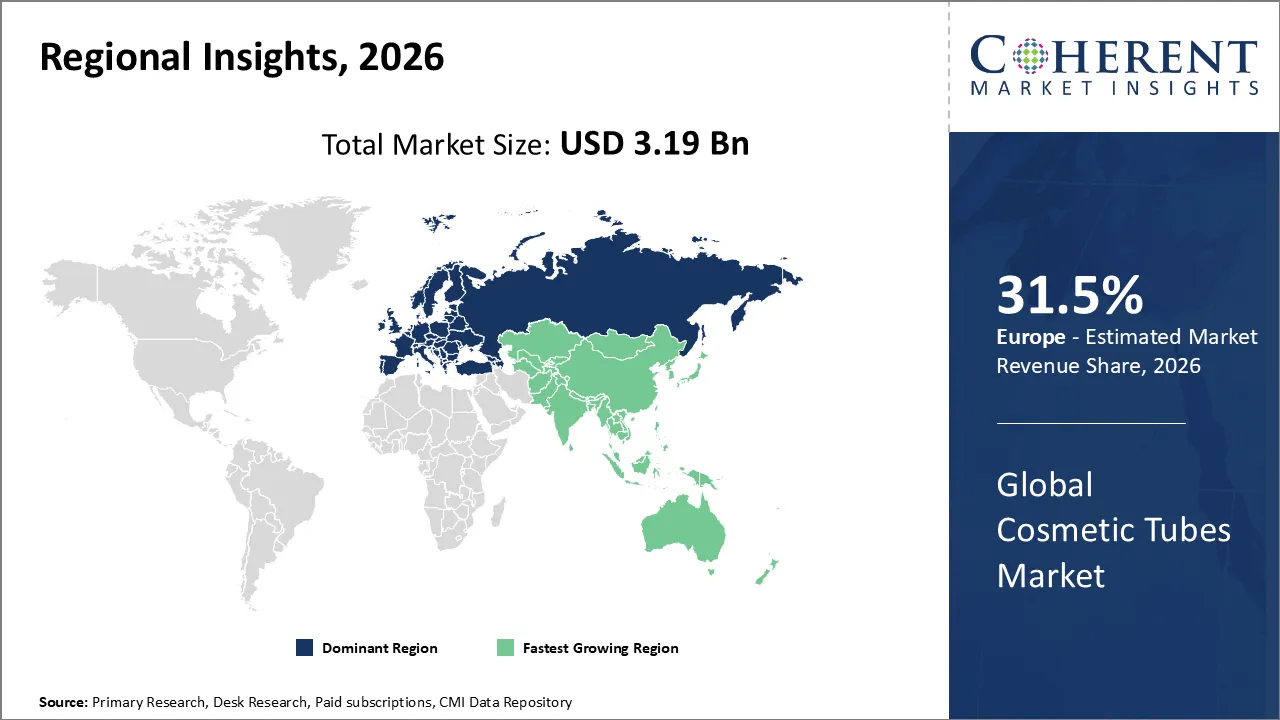
- Europe is anticipated to hold the largest share of 31.5% in 2026. The region’s existing cosmetics manufacturing base, high consumption of premium skincare and personal care products, a strong presence of global beauty companies and rising emphasis on packaging innovation and sustainability are the drivers of growth. L'Oreal said European sales rose 4.4% like-for-like in 2025 to 14.86 Bn euros, accounting for 33.7% of total sales. The wider European beauty market accounted for around 25% of the almost 300-Bn-euro global beauty market in 2025.
Market Drivers
Growing Adoption of Circular and Resource-Efficient Cosmetic Packaging is Accelerating Tube Innovation
Beauty companies are moving beyond traditional packaging to refillable, reusable, recyclable and resource-efficient designs. This is leading tube manufacturers to develop lighter structures, PCR-based tubes, lower-weight closures and mono-material solutions that can meet both product-performance and circularity requirements.
Beiersdorf reported that 32% of the materials used in its products and packaging were recycled or bio-based in 2025 and it wants to lift that to 70% by 2030. These commitments are opening doors for cosmetic tube suppliers who can provide packaging made with recyclable, lightweight, PCR-containing, and renewable materials that does not compromise barrier performance or product integrity.
Current Events and Their Impact on the Cosmetic Tubes Market
Current Event | Description and its Impact |
EU Packaging and Packaging Waste Regulation Enters into Application (2026) |
|
California Implements SB 54 Packaging Producer Responsibility Regulations (2026) |
|
- Current Industry Events of 2026
- Market Size Estimation
- Regional Breakdown
- Competitive Landscape
- Customer Intelligence
- Segmental Analysis
- Pricing Analysis
- Key Market Drivers, Challenges & Future Trends
- Customized Insights Section
Segmental Insights
Why are Squeeze Tubes Acquiring the Largest Share?
On the basis of product type, the squeeze tubes segment is projected to account for the largest Cosmetic Tubes Market share of 42.0% in 2026. The segment’s growth is owing to easy and controlled dispensing, lightweight construction, portability, product evacuation efficiency, and suitability for high-volume skincare, haircare, sun-care, and other cream and gel formulations.
Recent commercial activity provides direct evidence of the growing importance of advanced tube formats. EPL reported in its 2024–25 Integrated Annual Report that its recyclable Platina tubes and NeoSeam technology together accounted for approximately one-third of its portfolio. The company also commercialized new tube applications such as dual-tone facial creams and dry hair gels, demonstrating the extension of tube packaging into differentiated beauty and personal-care formulations.
In February 2026, Neopac presented its new NeoDose Solo at Paris Packaging Week 2026. Designed for skincare, dermocosmetics and foundation formulations, the solution consists of a mono-PE airless pump paired with a recyclable Polyfoil MMB high-barrier squeeze tube.
Why is Plastic Acquiring the Largest Share?
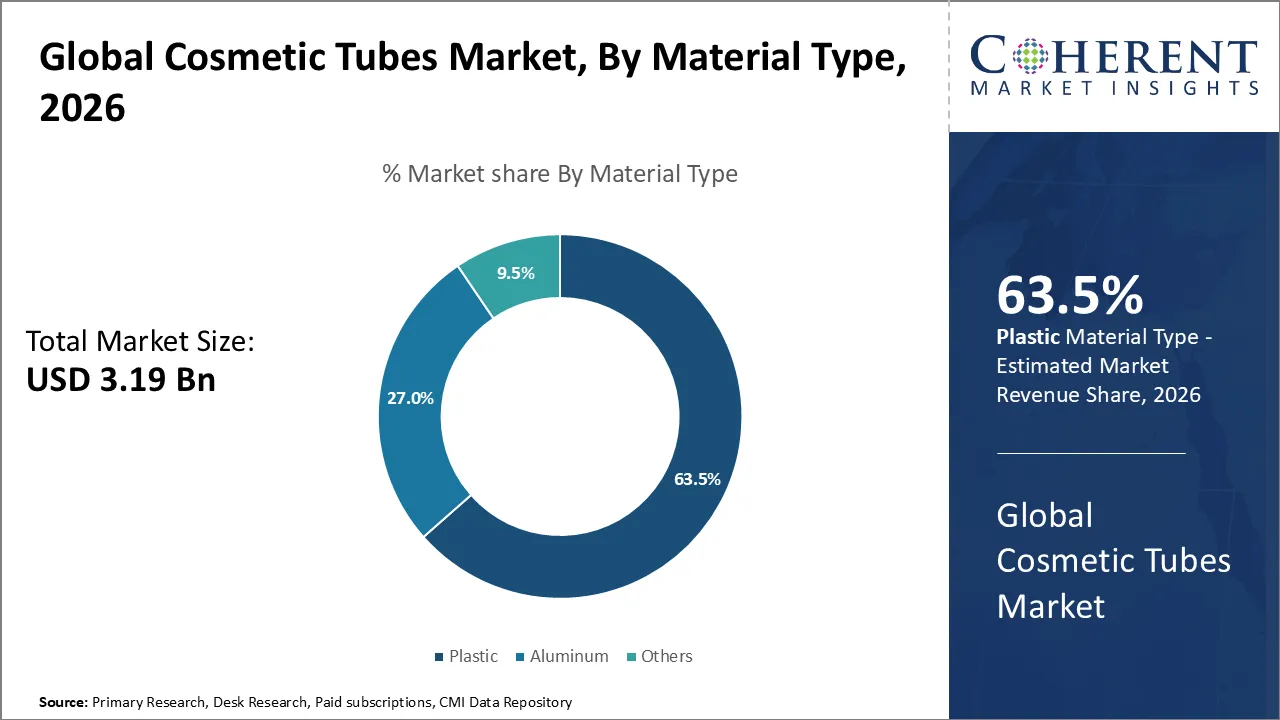
On the basis of material, the plastic segment is projected to account for the largest Cosmetic Tubes Market share of 63.5% in 2026. Growth in this segment is driven by the ability to squeeze plastic, its light weight, flexibility in manufacturing, relatively low cost, durability and compatibility with high-volume cosmetic formulations. The growing availability of PCR resins and recyclable mono-material structures is also helping plastic retain its position while meeting sustainability requirements.
The Estée Lauder Companies reported that 72% of its product packaging was recyclable, refillable, reusable, recycled or recoverable in its fiscal 2025 sustainability disclosures. The company is also aiming for at least 50% non-virgin petroleum content in plastic packaging and at least 25% PCR material in packaging by 2030, demonstrating a move away from traditional virgin plastic to circular plastic packaging instead of full material substitution.
In September 2026, EPL introduced r-Platina ME, its latest PCR tube-packaging solution targeted at beauty, personal care and skincare applications. The new structure incorporates more than 30% post-consumer recycled (PCR) plastic in the tube body while providing a premium metallic appearance.
Why is Skin Care Acquiring the Largest Share?
On the basis of application, the skin care segment is projected to account for the largest Cosmetic Tubes Market share of 35.5% in 2026. The segment’s growth is owing to extensive tube usage for moisturizers, facial cleansers, sunscreens, hand creams, body creams, treatment gels, dermatological products, and other topical formulations. Frequent product launches and expansion of dermocosmetic portfolios are further increasing the number of formulations requiring functional dispensing packaging.
A recent industry indicator comes from Beiersdorf, which saw organic growth of 3.7% in its skin care business in 2025, despite a slowing global skincare market. More significantly, Derma sales climbed 11.7% to €1.49 billion, marking the fifth consecutive year of double-digit growth.
In June 2026, Cosmogen & Asquan’s 19 mm Dropper Tube was selected by Maria Galland Paris for the launch of its 382 Pure’Comfort Targeted Pimple Corrector. The package integrates tube storage with a dropper-inspired dispensing system and a ball-shaped applicator for controlled application directly onto targeted areas of skin.
Cosmetic Tubes Market Trends
- Light-weight and material-efficient cosmetic tubes are on the rise as beauty brands look to reduce packaging weight without compromising functionality and premium esthetics. In October 2025, Neopac launched its UltraLite tube, which offers up to 78% plastic reduction compared to standard tubes and is still recyclable in existing PE streams. The solution is designed specifically for cosmetics, OTC and oral-care applications.
- The increasing use of PCR and mono-material tube structures is reshaping cosmetic packaging as manufacturers move away from complex multilayer structures toward recycling-ready alternatives. Albéa has developed tube configurations containing up to 60% PCR, while its caps can incorporate up to 70% PCR. Its combination of a 100% PCR extruded sleeve with the lightweight EcoFusion Top can deliver approximately 57% recycled content in the complete tube, while remaining recycling-ready in the HDPE stream.
- The growing emphasis on premium decoration and differentiation is encouraging cosmetic tube manufacturers to combine sustainability with high-end visual effects. At Cosmoprof India 2025, UFlex showcased its Flexitubes portfolio using reverse rotogravure printing and 360-degree decoration, allowing cosmetic brands to achieve high-definition imagery and premium finishes while using advanced tube structures.
Regional Insights
Europe Dominates Owing to its Large Cosmetics Industry and Strong Sustainable Packaging Transition
The Europe region accounts for 31.5% of the Cosmetic Tubes Market share in 2026. The region’s dominance is owing to its large cosmetics and personal-care manufacturing base, high consumption of skincare products, presence of leading beauty brands and packaging manufacturers, and rapid transition toward recyclable, lightweight, and PCR-based cosmetic tubes.
In February 2026, Cosmetics Europe reported that its Commit for Our Planet initiative included 41 companies representing more than one-third of the European cosmetics market by turnover. Participating companies were increasing recycled-material usage in packaging as the industry prepared for requirements under the EU Packaging and Packaging Waste Regulation (PPWR).
Asia Pacific Cosmetic Tubes Market Trends
Asia Pacific is expected to be the fastest-growing region in the Cosmetic Tubes Market over the forecast period. The region’s growth is owing to increasing cosmetics consumption, expanding middle-income populations, rapid development of domestic beauty brands, growing skincare penetration, e-commerce expansion, and increasing demand for convenient and affordable packaging across China, India, Japan, South Korea, and Southeast Asia.
China provides a strong recent demand indicator. According to China’s National Bureau of Statistics, retail sales of cosmetics by enterprises above the designated size reached RMB 465.3 billion in 2025, increasing 5.1% year-on-year. The momentum extended into 2026, with cosmetics retail sales increasing 4.5% year-on-year during January–February 2026 to RMB 75.3 billion.
In January 2026, China-based Runk launched a new generation of cosmetic packaging tubes for facial cleansers, sunscreens, eye creams, hand creams, lotions and treatment products. The company added to the variety of material options in PE, PCR-PE, PP and multilayer structures and improved the tubes with optimized squeeze control, sealing performance and formula compatibility.
Strong Beauty-Care Consumption and Skincare Growth are Supporting the Cosmetic Tubes Market in Germany
The Germany cosmetic tubes market is supported by the country’s large beauty and personal-care industry, increasing consumption of skincare, strong domestic manufacturing base and growing demand for recyclable and material-efficient packaging. Tubes are especially relevant for skin & face care, hair care, oral care, hand care, sun care and dermatological products.
According to the German Cosmetic, Toiletry, Perfumery and Detergent Association (IKW) reported that Germany's beauty and home-care industry generated €35.6 billion in sales in 2025, an increase of 2.9% year-on-year, with domestic sales up 5.5% to €23.9 billion. More importantly for cosmetic tubes, skin and facial care recorded 11.1% growth in 2025, while hair-care products increased 8.1%. These categories represent important end markets for squeeze and dispensing tubes.
China Cosmetic Tubes Market Trends
China is expected to witness strong growth in the Cosmetic Tubes Market over the forecast period. Growth is supported by a large domestic beauty-manufacturing ecosystem, rising skincare and sun-care demand, rising cosmetics consumption and China’s extensive manufacturing capacity for plastic, laminated, aluminum, PCR and bio-based cosmetic tubes.
China's domestic capability to manufacture cosmetic packaging is also increasing. Lisson Group, based in Guangzhou, presented its sustainable packaging portfolio at Professional Beauty India 2026 in July 2026, including laminated, aluminum, plastic and bio-based cosmetic tubes. The company operates more than 15 manufacturing facilities and employs over 1,280 professionals, with capabilities spanning mold design, injection molding, decoration, mass production and global logistics.
Who are the Major Companies in Cosmetic Tubes Industry
Some of the major key players in Cosmetic Tubes Market are Albea S.A., Amcor Limited, Essel Propack Ltd., Sonoco Products Company, World Wide Packaging LLC, Montebello Packaging, VisiPak Inc., IntraPac International Corporation, and CCL Industries Inc.
Key News
- In April 2026, Amcor announced that new production capacity for its DecoFusion hybrid tube technology at Easthampton, Massachusetts, had been fully commissioned and was production-ready.
- In June 2026, CCL Industries acquired Sleever International, expanding CCL's specialty packaging capabilities. Although this is not a conventional squeeze-tube launch, the transaction is relevant to the broader cosmetics and personal-care packaging landscape because CCL serves the Home & Personal Care and consumer packaging markets globally.
Cosmetic Tubes Market
Cosmetic Tubes Market Report Coverage
Report Coverage | Details | ||
Base Year: | 2025 | Market Size in 2026: | USD 3.19 Bn |
Historical Data for: | 2020 to 2024 | Forecast Period: | 2026 to 2033 |
CAGR: | 4.7% | 2033 Value Projection: | USD 4.39 Bn |
Geographies covered: |
| ||
Segments covered: |
| ||
Companies covered: | Albea S.A., Amcor Limited, Essel Propack Ltd., Sonoco Products Company, World Wide Packaging LLC, Montebello Packaging, VisiPak Inc., IntraPac International Corporation, and CCL Industries Inc. | ||
Growth Drivers: |
| ||
Restraints & Challenges: |
| ||
Analyst Opinion
- The Cosmetic Tubes Market is increasingly shifting from conventional packaging toward recyclable, PCR-based, and mono-material tube structures as beauty brands balance sustainability requirements with product protection and premium appearance. In February 2026, EPL reported that sustainable tube formats accounted for 38% of its sales, indicating that sustainable tubes are moving beyond pilot projects toward meaningful commercial adoption.
- The proliferation of skincare, haircare, sun-care and specialized treatment products is making beauty and cosmetics a more significant growth engine for tube manufacturers. EPL reported more than 20% growth in its Beauty & Cosmetics business for the fourth consecutive quarter through February 2026, while non-oral applications had grown to represent 53% of its total portfolio. This is indicative of growing diversification in tube demand outside the traditional oral-care applications.
- Tube packaging is expected to remain key in skincare due to its versatility across formulations and dispensing requirements. Beiersdorf said that NIVEA, Eucerin, Hansaplast, Florena and other brands have over 200 products in tube formats, including face care, cleansing, hand creams, body lotions, shower products and hair treatments. This provides strong evidence of the broad commercial use of tubes across established beauty and personal-care portfolios.
Speak to the analyst
Want personalized insights?
Take the findings above to one of our principal consultants, or have the report rebuilt around the segments, geographies and competitors you actually track.
Market Segmentation
- By Product Type (Revenue, USD Bn, 2021-2033)
- Squeeze Tubes
- Twist Tubes
- Rigid Tubes
- Extruded Tubes
- Others
- By Material Type (Revenue, USD Bn, 2021-2033)
- Aluminum
- Plastic
- Others
- By Application (Revenue, USD Bn, 2021-2033)
- Oral Care
- Hair Care
- Skin Care
- Make-up
- Others
- By Region (Revenue, USD Bn, 2021-2033)
- North America
- U.S.
- Canada
- Latin America
- Brazil
- Mexico
- Argentina
- Rest of Latin America
- Europe
- Germany
- U.K.
- France
- Italy
- Spain
- Russia
- Rest of Europe
- Asia Pacific
- China
- India
- Japan
- Australia
- South Korea
- ASEAN
- Rest of Asia Pacific
- Middle East
- GCC
- Israel
- Rest of Middle East
- Africa
- South Africa
- Central Africa
- North Africa
- North America
Sources
Primary Research Interviews
- Cosmetic tube manufacturers
- Cosmetic and personal care packaging suppliers
- Plastic, aluminum, and laminate material suppliers
- Packaging design and product development professionals
- Sustainability and circular packaging expert
- Procurement managers from cosmetics and personal care companies
- Skincare, haircare, oral care, and make-up product manufacturers
- Distributors and converters of cosmetic packaging
- Key opinion leaders (KOLs) in cosmetic and sustainable packaging
Databases
- Eurostat
- World Bank
- UN Comtrade Database
- International Trade Centre (ITC) Trade Map
- U.S. Census Bureau
- European Commission – Eurostat PRODCOM
- OECD Data
Magazines
- Beauty Packaging
- Packaging Europe
- Packaging World
- Global Cosmetic Industry (GCI)
- Premium Beauty News
- Packaging South Asia
Journals
- Packaging Technology and Science
- Journal of Cleaner Production
- Resources, Conservation & Recycling
- Sustainable Production and Consumption
- International Journal of Cosmetic Science
- Journal of Packaging Technology and Research
Newspapers
- Financial Times
- The Wall Street Journal
- Reuters
- The Economic Times
- Handelsblatt
Associations
- European Tube Manufacturers Association (ETMA)
- Cosmetics Europe
- European Association of Plastics Recycling and Recovery Organisations (EPRO)
- Association of Plastic Recyclers (APR)
- Flexible Packaging Association (FPA)
- International Tube Association (ITA)
- German Cosmetic, Toiletry, Perfumery and Detergent Association (IKW)
Public Domain Sources
- Company Annual Reports and Sustainability Reports
- Company Investor Presentations and Earnings Releases
- Cosmetic tube manufacturer product catalogs and technical datasheets
- European Commission packaging and waste regulations
- Government trade, manufacturing, and cosmetics industry statistics
- RecyClass recyclability assessments and design guidelines
- Patent databases such as WIPO, USPTO, and Google Patents
- Publicly available sustainability and packaging innovation reports
- Product launches, press releases, and manufacturing expansion announcements
Proprietary Elements
- CMI Data Analytics Tool
- Proprietary CMI Existing Repository of Information for the Last 10 Years
Get access to 250+ pages report
Every segment, forecast, competitor profile and data table behind the analysis above — available for instant download.
- ESOMAR Member
- ISO 9001:2015 Certified
- D-U-N-S Registered
- GDPR & CCPA Compliant
Missing comfort of reading report in your local language? Find your preferred language:
Transform your Strategy with Exclusive Trending Reports
Frequently Asked Questions
The Cosmetic Tubes Market is expected to reach approximately USD 4.39 Bn in 2033, increasing from USD 3.19 Bn in 2026.
Major players operating in the global Cosmetic Tubes Market include Albea S.A., Amcor Limited, Essel Propack Ltd., Sonoco Products Company, World Wide Packaging LLC, Montebello Packaging, VisiPak Inc., IntraPac International Corporation, and CCL Industries Inc.
High raw material costs and stringent packaging regulations are the key factors hampering growth of the Cosmetic Tubes Market.
The increasing demand for convenient and portable cosmetic packaging and rising consumption of skincare and personal care products are key factors driving growth of the Cosmetic Tubes Market.
The Cosmetic Tubes Market is anticipated to grow at a CAGR of 4.7% between 2026 and 2033.
Among regions, Europe is expected to account for the largest market share in the global Cosmetic Tubes Market, accounting for 31.5% in 2026.
Cosmetic tubes are packaging formats designed to store, protect, dispense, and facilitate the application of cosmetic and personal care formulations, including creams, lotions, gels, cleansers, sunscreens, and other topical products. The market includes squeeze tubes, twist tubes, rigid tubes, extruded tubes, and other tube formats.