

Release Liners Market Size and Trends
The release liners market is estimated to be valued at USD 31.11 Bn in 2026 and is expected to reach USD 48.99 Bn by 2033, exhibiting a compound annual growth rate (CAGR) of 6.7% from 2026 to 2033.
Key Takeaways
- Based on Substrates, the Film segment is anticipated to account for 85.9% of the market share in 2026, owing to its convenience and wide applicability across different industries.
- Based on Labelling Technology, the In-Mold segment is anticipated to hold 33.7% of the release liners market share in 2026, owing to its technical superiority and design flexibility.
- Based on Application, the Cloth Envelopes & Packaging segment is expected to hold 32.8% share of the market in 2026, owing to its wide scope of applications.
- Based on Region, North America holds the largest market share of 35.0% for the release liners market growth in 2026. While, Asia Pacific is anticipated to be the fastest growing region during the forecast period.
Market Overview
The release liners market is experiencing steady growth, driven by rising demand in industries such as packaging, labeling, electronics, and healthcare. These liners, which are essential for applications involving pressure-sensitive adhesives, play a crucial role in product protection, efficient handling, and automation. Key growth sectors include e-commerce packaging, medical dressings, tapes, and industrial assembly processes. Material innovations, such as the shift from paper to film-based substrates like PET and BOPP and coatings like silicone are enhancing liner performance. Furthermore, sustainability efforts, including closed-loop recycling programs by players like Avery Dennison and UPM Raflatac, are reshaping the market landscape. As industries push for efficiency and eco-friendly materials, the release liners market demand is set to expand steadily through the next decade.
Current Events and their Impact on the Release Liners Market
Current Event | Description and Its Impact |
Regulatory Shifts in Key Markets |
|
Sustainability-Driven Material Innovations |
|
Export-Import Analysis of Release Liners
From September 2023 to August 2024 (TTM), there were 15 global export shipments of Release Liner classified under HSN Code 39209999. These shipments originated from 5 exporters and were delivered to 11 different buyers. Notably, in August 2024 alone, only one such shipment was recorded worldwide.
The majority of these exports were destined for Brazil, the United Arab Emirates, and Taiwan. On a global scale, the leading exporters of Release Liner under HSN Code 39209999 are India, China, and Italy. India tops the list with 281 shipments, significantly ahead of China with 10 shipments and Italy with 6.
Between October 2023 and September 2024 (TTM), India imported 487 shipments of Release Liner from 78 international exporters, catering to 46 Indian buyers. This reflects a 59% increase compared to the previous 12-month period. Specifically, in September 2024, India received 60 shipments, marking a 150% increase year-over-year from September 2023, and a 25% rise from August 2024. India primarily sources its Release Liner imports from China, the United States, and Italy.
- Current Industry Events of 2026
- Market Size Estimation
- Regional Breakdown
- Competitive Landscape
- Customer Intelligence
- Segmental Analysis
- Pricing Analysis
- Key Market Drivers, Challenges & Future Trends
- Customized Insights Section
Segmental Insights
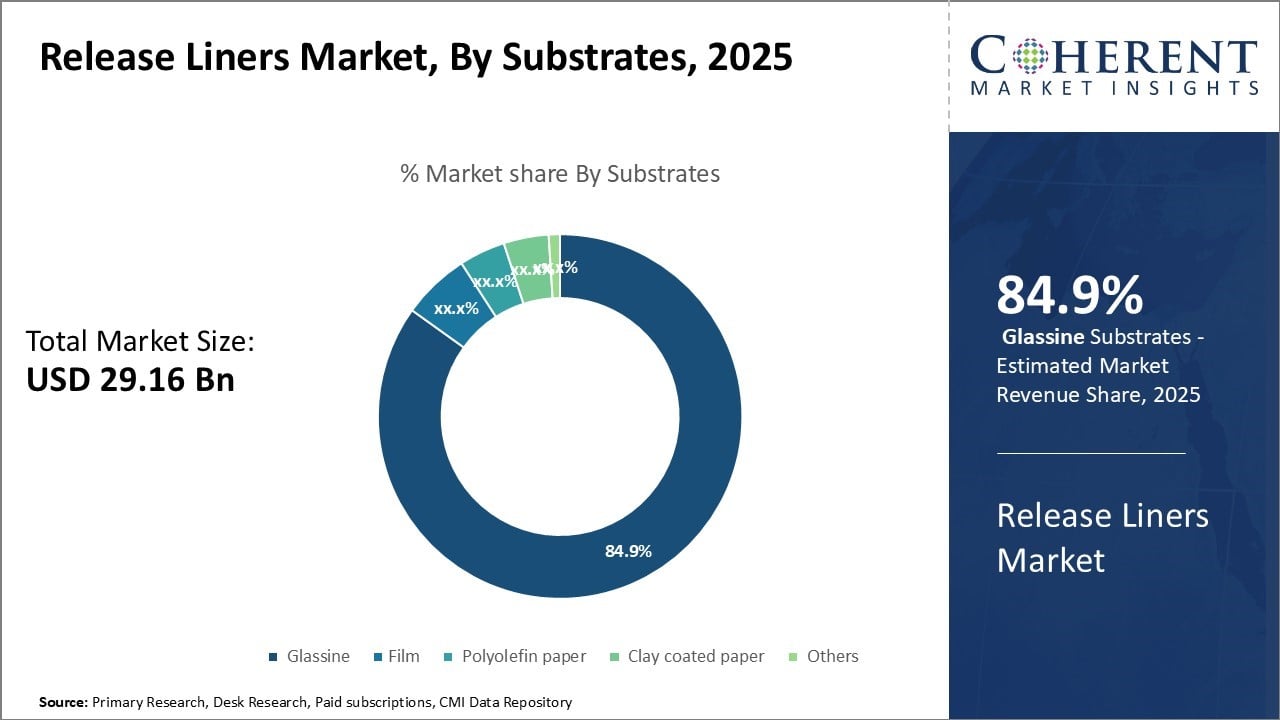
Release Liners Market Insights, By Substrates: Convenience and wide applicability drive the film segment’s dominance
In terms of substrates, film segment is expected to contribute 85.9% share of the market in 2026, owing to its convenience and wide applicability across different industries. Film provides a smooth and glossy surface ideal for high resolution printing. It can be easily cut into various shapes and sizes to suit diverse labelling needs. Being thin and lightweight, film improves packaging efficiency by reducing material costs. It can withstand extremes of temperature and humidity better than paper, ensuring the labels last longer. The non-porous property of film protects printed content from damage by water, chemicals, or abrasion. Its excellent durability allows film labels to be conveniently peeled and reapplied multiple times if required. Plastic film is compatible with both digital and conventional printing technologies. Its barrier properties help preserve the freshness of packaged food and other perishable products. Owing to such superior functional characteristics, film has emerged as the substrate of choice for various labelling applications.
In July 2025, Techlan Ltd introduced Re‑Liner™ Embossed PE Film, a sustainable, high‑performance silicone release liner designed for industrial and commercial applications. The new embossed polyethylene film features a textured surface that enhances air release, reducing bubbles and easing adhesive application, while minimizing buildup on the liner. This is further accelerating the release liners market growth.
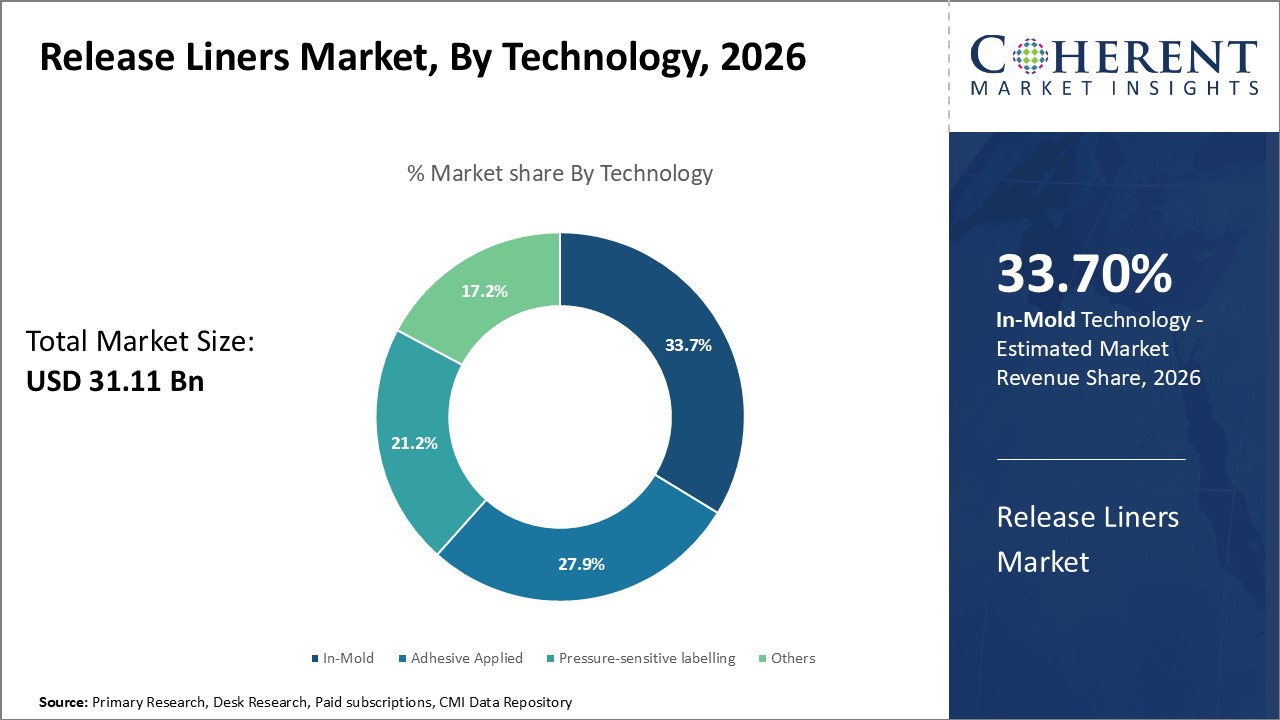
Release Liners Market Insights, By Technology: Technical superiority and design flexibility propel the in-mold segment
In terms of labelling technology, in-mold segment is expected to contribute 33.7% share of the market in 2026, owing to its technical superiority and design flexibility. The in-mold process allows creating labels during plastic molding itself, integrating them seamlessly into packaging components. This eliminates issues of label shrinkage, curling or premature deterioration seen in other technologies. In-mold labels provide crisp, high-resolution graphics on complex contoured surfaces without impairing product aesthetics. They withstand harsh manufacturing environments involving high pressure, temperature, and mechanical stress. The flexible design options allow incorporating tamper-evidence features, compliance codes, and other mandatory information directly onto containers and closures.
In August 2024, Innovia Films, a leading producer of BOPP specialty films, introduced RayoForm™ ELR70, a next‑generation in‑mold film tailored for large-format containers. Featuring a five-layer semi‑cavitated structure with one matte and one gloss side, the film offers reduced density and enhanced stiffness, enabling bigger labels and larger-sheet converting. The product targets applications in paint, food, and industrial sectors seeking durable, high‑performance labeling solutions.
Release Liners Market Insights, By Applications: Wide scope of applications fuels the cloth envelopes & packaging segment dominance
In terms of applications, cloth envelopes & packaging segment is expected to contribute 32.8% share of the market in 2026, owing to its wide scope of applications. Cloth envelopes effectively package various consumer and commercial products needing protection from moisture, dust, or physical damage. Their non-abrasive texture maintains product aesthetics while cotton or synthetic fabric allows the visibility of contents. Moreover, the envelopes are easily printable to add brand messaging or dispatch details. The robust yet lightweight envelopes facilitate cost-effective shipping through regular mail or parcel services. The re-closable feature allows repeated opening-closing without wastage. Cloth packaging finds diverse uses across accessories, textiles, electronics, and several small part shipments. Its breathability maintains freshness of herbs, teas, and other consumables.
For instance, a cooperative of artisans in Karnataka is revolutionizing the packaging industry by manufacturing eco-friendly, fully biodegradable paper-based envelopes and parcels. The initiative supports rural livelihoods, empowers women, and addresses the growing demand for plastic-free packaging in India. Such initiatives are contributing to the release liners market revenue.
Regional Insights
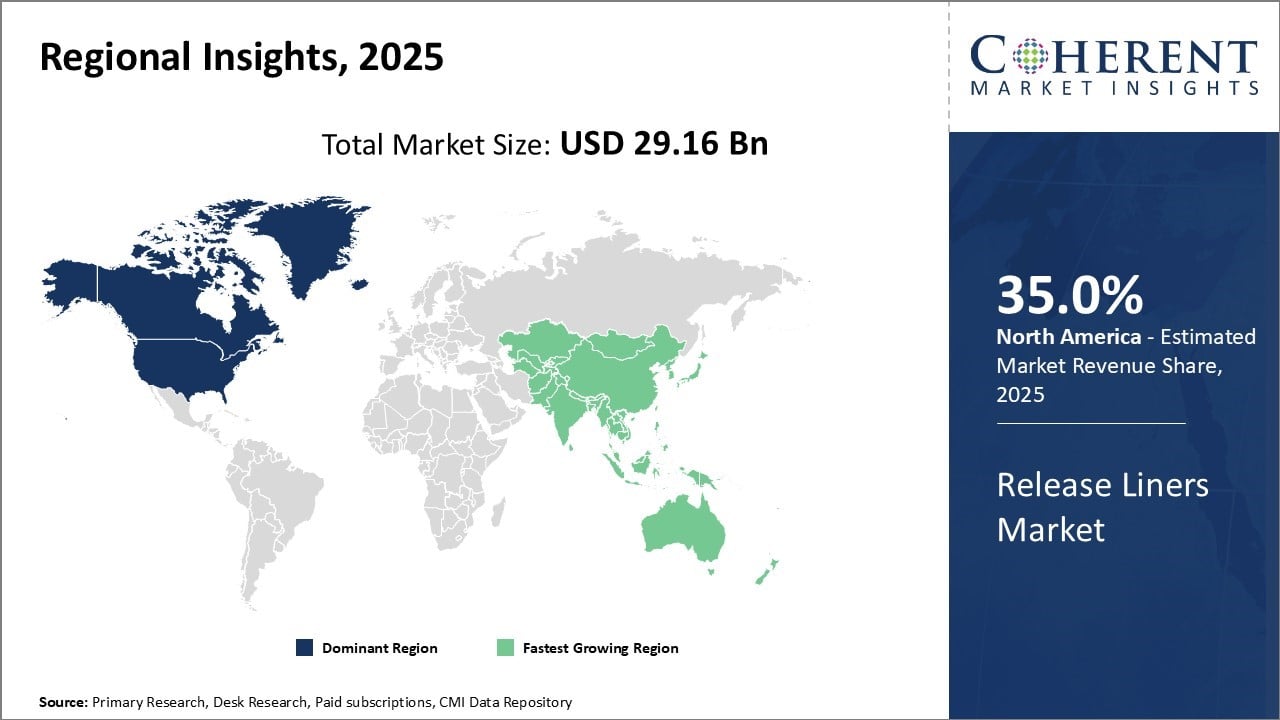
North America Release Liners Market Analysis & Trends
North America has remained the dominant region in the global release liners market over the past few years. The region is expected to account for 35.0% of the market share in 2026. The region is home to some of the largest producers and consumers of release liners globally. Being an early adopter of new technologies, the substrate and label industries in the U.S. and Canada have driven significant release liners market demand. Strong presence of the food and beverage sectors, where release liners find widespread applications, has further augmented the North America market. Availability of raw materials and a stable economic environment have encouraged manufacturers to set up factories within the region. This has made North America a net exporter of release liners to other key markets.
For instance, at Labelexpo Americas 2024, Lecta launched facestock and release liner products tailored specifically for North American labeling needs, including recycled-fiber grades like “Recy,” reinforcing innovation in sustainable liner materials.
Asia Pacific Release Liners Market Analysis & Trends
The Asia Pacific region has emerged as the fastest growing market for release liners in recent times riding on swift industrialization across developing nations. Rapid growth of the packaging industry along with increasing consumer goods consumption has boosted the regional demand. Countries like China, India, and Indonesia are global manufacturing hubs and have seen their label and substrate sectors expand multifold. This has translated to the higher uptake of release liners used in various labeling applications. Ease of raw material sourcing and low production costs have attracted many international players to establish facilities within Asia Pacific. Also, strong focus of regional governments towards boosting domestic manufacturing has created a conducive environment for the industry.
For instance, In May 2026, Jindal Poly Films Ltd., a leading flexible packaging player, announced a significant investment of ₹700 crore (~USD 84 million) to expand its manufacturing capacity at the Nashik facility. This includes new production lines for BOPP, PET, and CPP films, increasing annual output by 42,000 tonnes of BOPP, 55,000 tonnes of PET, and 18,000 tonnes of CPP. These films are essential substrates for pressure‑sensitive labels, adhesive tapes, and packaging solutions, applications that heavily rely on release liners.
Release Liners Market Outlook Country-Wise
The U.S. Release Liners Market Trends
The United States represents one of the most mature and technologically advanced markets in the global release liners industry, driven by its well-established sectors such as pressure-sensitive labeling, medical device manufacturing, and the automotive industry. As a leading consumer of high-performance adhesives and labeling technologies, the U.S. consistently demands advanced release liner solutions that offer durability, cleanliness, and compatibility with automated processing systems.
China Release Liners Market Trends
China leads the release liners market as the world’s largest packaging and labeling hub. Rapid e-commerce growth, led by platforms like Alibaba, drives high demand for pressure-sensitive labels. Its strong electronics and manufacturing base further fuels use in industrial adhesives, tapes, and die-cut components. Growing healthcare demand for medical tapes and wound dressings also contributes. Supported by initiatives like Made in China 2026 and low-cost production, China remains central to global demand for release liners across label stock, electronics, and medical sectors.
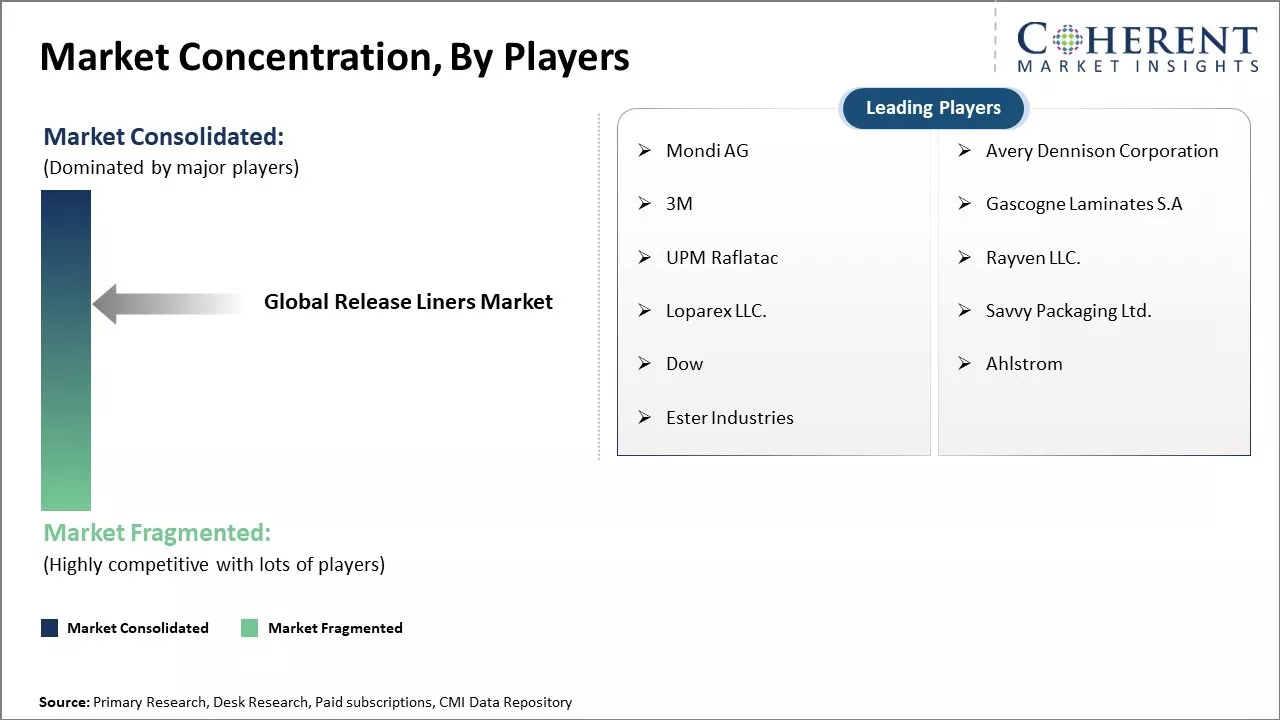
Market Concentration and Competitive Landscape
Release Liners Industry News
- In April 2025, Elkem ASA’s Silicones division launched two groundbreaking products—SILCOLEASE® RE POLY 11362 and RE POLY 368 for release liners, labels, and tapes. They offer a dramatic 70 % reduction in carbon footprint, aligning with growing sustainability targets in flexible packaging and adhesive applications.
- In October 2024, PAC Worldwide has launched its patent-pending Fixed Release Liner for the WicketPAC® flat poly mailer, revolutionizing the packing process by eliminating the need to peel and discard liners. The liner, attached to the wicket header, remains intact throughout packaging enabling a safer, cleaner, and faster workflow. This innovation boosts fulfillment speeds by up to 20%, reduces clutter and safety risks, and is ideal for high-volume e-commerce, distribution, and courier operations.
- In August 2024, TLMI and CELAB North America have joined forces to launch the Liner Recycling Initiative (LRI), a unified effort to develop recycling solutions for silicone‑coated label release liners. LRI’s long-term goal is a nationwide program for recycling silicone-coated label release liners, leveraging combined expertise to accelerate market-ready solutions.
Market Report Scope
Release Liners Market Report Coverage
| Report Coverage | Details | ||
|---|---|---|---|
| Base Year: | 2025 | Market Size in 2026: | USD 31.11 Bn |
| Historical Data for: | 2020 To 2024 | Forecast Period: | 2026 To 2033 |
| Forecast Period 2026 to 2033 CAGR: | 6.7% | 2033 Value Projection: | USD 48.99 Bn |
| Geographies covered: |
| ||
| Segments covered: |
| ||
| Companies covered: | Mondi AG, Avery Dennison Corporation, 3M, Gascogne Laminates S.A, UPM Raflatac, Rayven LLC., Loparex LLC., Savvy Packaging Ltd., Dow, Ahlstrom, and Ester Industries | ||
| Growth Drivers: |
| ||
| Restraints & Challenges: |
| ||
Release Liners Market Driver
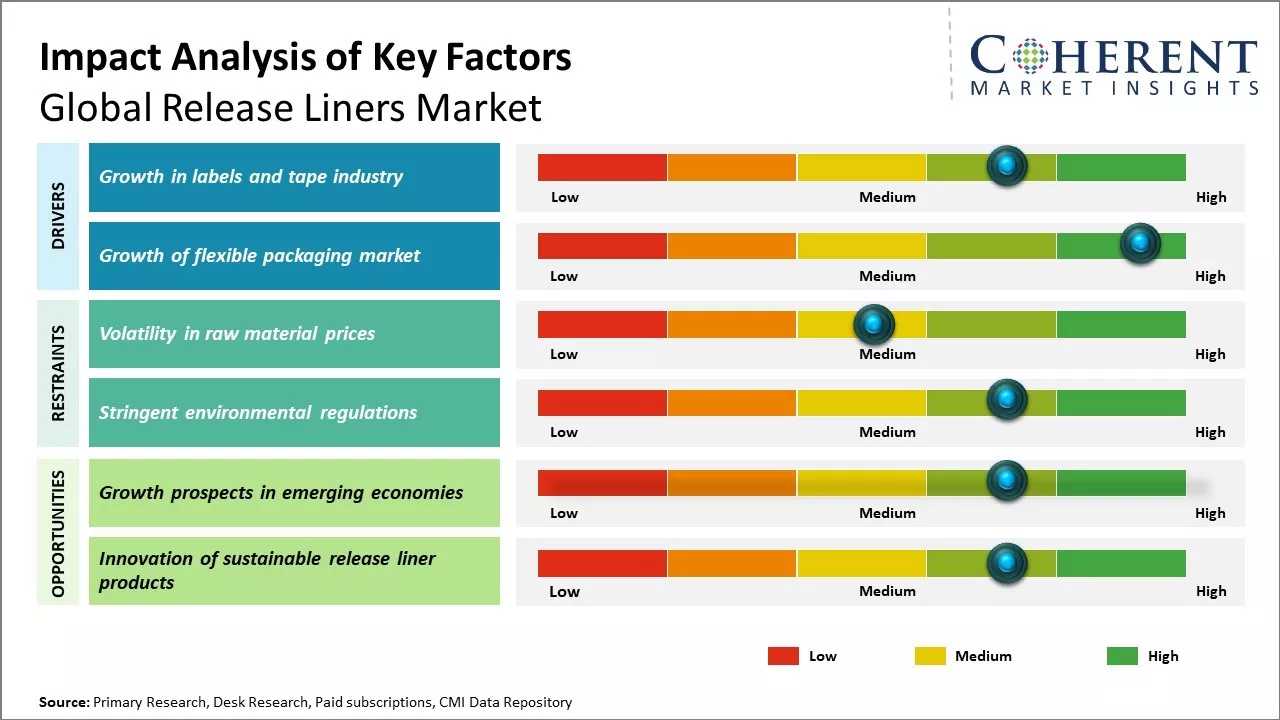
- Growth in labels and tape industry
The labeling and tape industry has seen significant growth over the past decade owing to the increasing demand from various end-use industries like food and beverages, consumer durables, pharmaceuticals, etc. New product launches, branding, and marketing activities across different industries have fueled the need for innovative labels and tapes. As these labels and tapes require a stable and protective surface which can hold the ink and last for longer periods without smudging or tearing apart, the demand for high-quality release liners has increased substantially.
Key players in the labeling and tapes market are focusing on advanced labeling solutions in order to enhance their brand visibility and customer connect. Self-adhesive labels having liner support have become immensely popular. The food industry in particular has increased the application of labels on their products to communicate important details regarding ingredients, best before dates, manufacturing locations, nutritional information, scannable codes, and certifications. A similar trend is observed in the pharmaceutical industry as well where detailed labeling is mandatory as per international quality standards. Since these labels demand a smooth and durable backing/substrate onto which they can be laminated, the sales of polycoated and super calendered liners have multiplied. Even manufacturing sites have ramped up the in-house labeling of dispatch boxes, pallets, and containers for better inventory management using customized printed labels backed with liners, which is further propelling the release liners market revenue.
- Growth of flexible packaging market
The flexible packaging industry is witnessing phenomenal growth on account of increasing preferences of brand owners and consumers towards consumer-friendly packages. Compared to rigid forms of packaging, flexible packages are light-weight, take less space for storage and transportation while maintaining product protection. They can be easily printed, laminated, and converted into pouches, bags, wraps, and sachets using modern machinery. Flexible packages especially find widespread applications in food packaging where they are used as bread bags, candy wrappers, snack bags, cold meat packages, coffee packaging, etc.
As flexible packaging primarily relies on film and paper layers laminated or coated together, release liners play a pivotal role in the converting process. Most flexible packaging structures utilize multilayer films comprising of sealant, base, and release layers. During the lamination of different film layers, release liners are used to carry the top film/coating to the lamination nip without it adhering to the previous layer or to the cast roll.
Analyst Opinion (Expert Opinion)
- The release liners market value is approaching a structural inflection point, driven by strategic innovation across material science, sustainability, and value chain efficiency.
- The most transformative development in recent years is the convergence of sustainability mandates with performance requirements. For instance, the shift toward recyclable and compostable liners is not just a regulatory response but a differentiator for manufacturers. Avery Dennison’s investment in PET liner recycling infrastructure in Europe is a case in point; this initiative alone is expected to divert over 20,000 tons of liner waste annually. Such efforts not only support circular economy goals but also serve as procurement drivers for sustainability-conscious converters and brand owners.
- Moreover, the industry’s reliance on glassine and clay-coated papers is being actively challenged by the emergence of film-based liners, especially in high-speed automated dispensing applications. PET liners, while costlier, are outperforming in precision-critical industries such as electronics assembly and automotive OEMs, where dimensional stability and low humidity absorption are non-negotiable. According to industry interviews, over 40% of new product development trials in the automotive tape sector in North America now include filmic liners as a baseline option up from under 10% five years ago.
- Another under-discussed yet crucial vector of change lies in the impact of linerless technology. Although adoption remains constrained to specific label formats, its implications for logistics and sustainability are significant. Multinational retailers and CPG companies are piloting linerless systems not only to reduce waste but also to achieve leaner operations in high-throughput warehousing environments.
Speak to the analyst
Want personalized insights?
Take the findings above to one of our principal consultants, or have the report rebuilt around the segments, geographies and competitors you actually track.
Market Segmentation
- Substrates Insights (Revenue, USD Bn, 2026 - 2033)
- Film
- Glassine
- Polyolefin paper
- Clay coated paper
- Others
- Labelling Technology Insights (Revenue, USD Bn, 2026 - 2033)
- Adhesive Applied
- In-Mold
- Pressure-sensitive labelling
- Others
- Applications Insights (Revenue, USD Bn, 2026 - 2033)
- Cloth Envelopes & Packaging
- Graphic Arts
- Hygiene
- Industrial
- Medical
- Pressure-sensitive label stock
- Others
- Regional Insights (Revenue, USD Bn, 2026 - 2033)
- North America
- U.S.
- Canada
- Latin America
- Brazil
- Argentina
- Mexico
- Rest of Latin America
- Europe
- Germany
- U.K.
- Spain
- France
- Italy
- Russia
- Rest of Europe
- Asia Pacific
- China
- India
- Japan
- Australia
- South Korea
- ASEAN
- Rest of Asia Pacific
- Middle East & Africa
- GCC Countries
- Israel
- Rest of Middle East & Africa
- North America
- Key Players Insights (Revenue, USD Bn, 2021 - 2033)
- Mondi AG
- Avery Dennison Corporation
- 3M
- Gascogne Laminates S.A
- UPM Raflatac
- Rayven LLC.
- Loparex LLC.
- Savvy Packaging Ltd.
- Dow
- Ahlstrom
- Ester Industries
Sources
Primary Research Interviews from the following stakeholders
Stakeholders
- Interviews with release liner converters, substrate manufacturers, adhesive formulators, packaging technologists, label stock producers, sustainability heads, and procurement managers across diverse industries and regions.
Specific Stakeholders
- Sourcing managers and R&D heads at FMCG and personal care brands
- Operations and packaging managers at food & beverage firms
- Label and packaging technologists at pharmaceutical companies
- Automotive material engineers and supply chain heads
- Procurement heads at e-commerce and logistics firms
- Product heads and plant managers at pressure-sensitive label stock manufacturers and silicone coating firms
- Procurement and compliance heads at hygiene product manufacturers
Databases
- UN Comtrade Database
- World Trade Organization (WTO) Trade Statistics
- Directorate General of Commercial Intelligence and Statistics (DGCIS), India
- Eurostat – Industrial Production & Trade
- US Census Bureau – Adhesive & Label Manufacturing Data
- China Customs Statistics
- Ministry of Chemicals and Fertilizers, India
- National Bureau of Statistics of China
- Department for Promotion of Industry and Internal Trade (DPIIT), India
- Japan External Trade Organization (JETRO)
Magazines
- Packaging World
- Labels & Labeling
- Flexo Magazine
- Converters Quarterly
- Adhesives & Sealants Industry (ASI) Magazine
- PrintWeek
- Label & Narrow Web
- Plastics News
Journals
- Journal of Coatings Technology and Research
- International Journal of Adhesion and Adhesives
- Journal of Packaging Technology and Research
- Surface and Coatings Technology (Elsevier)
- Journal of Applied Polymer Science
- Journal of Cleaner Production – Packaging & Waste Streams Section
Newspapers
- The Economic Times – Packaging & FMCG Reports
- The Hindu Business Line – Industrial Materials & Chemicals
- Business Standard – Manufacturing and Sustainability
- Financial Times – Packaging Innovation & Global Supply Chain
- Nikkei Asia – Chemicals and Polymers Supply Trends
- South China Morning Post – Industry & Manufacturing
Associations
- Pressure Sensitive Tape Council (PSTC)
- Tag & Label Manufacturers Institute (TLMI)
- Label Manufacturers Association of India (LMAI)
- Association for Roll-to-Roll Converters
- Silicone Elastomers Council
- Flexible Packaging Association (FPA)
- Indian Flexible Packaging & Folding Carton Manufacturers Association (IFCA)
- European Adhesive Tape Association (AFERA)
Public Domain Sources
- Central Pollution Control Board (India) – Plastic Waste & Recycling Guidelines
- Ministry of Environment, Forest and Climate Change (India) – EPR Compliance Data
- Ministry of Economy, Trade and Industry (METI), Japan – Label and Packaging Reports
- U.S. Environmental Protection Agency (EPA) – Industrial Waste and Recycling Insights
- National Institute of Industrial Engineering (NITIE), India – Packaging Studies
- Department of Chemicals and Petrochemicals, India
- European Chemicals Agency (ECHA) – Silicone and Coating Material Data
- Reserve Bank of India (RBI) – Sectoral Manufacturing and Exports Reports
Proprietary Elements
- CMI Data Analytics Tool, Proprietary CMI Existing Repository of information for last 8 years
*Definition: The release liners market comprises products that temporarily protect the adhesive surface of pressure-sensitive label stocks and tapes until the product is ready for application to a surface. Release liners have a silicone coating that allows labels and tapes to be easily removed without effecting the adhesive. Major applications of release liners include labels, tapes, medical products, industrial tapes and hygiene products. The global release liners market has been growing steadily due to increased demand from industries such as food and beverages, automotive and electronics. Key players in this market focus on manufacturing eco-friendly and high-quality release liners.
Get access to 250+ pages report
Every segment, forecast, competitor profile and data table behind the analysis above — available for instant download.
- ESOMAR Member
- ISO 9001:2015 Certified
- D-U-N-S Registered
- GDPR & CCPA Compliant
Missing comfort of reading report in your local language? Find your preferred language:
Transform your Strategy with Exclusive Trending Reports
Frequently Asked Questions
The Release Liners Market is estimated to be valued at USD 31.11 Bn in 2026, and is expected to reach USD 48.99 Bn by 2033.
The CAGR of the Release Liners Market is projected to be 6.7% from 2026 to 2033.
Growth in labels and tape industry and growth of flexible packaging market are the major factors driving the growth of the global release liners market.
Volatility in raw material prices and stringent environmental regulations are the major factors hampering the growth of the global release liners market.
In terms of substrates, film is estimated to dominate the market revenue share in 2026.
Mondi AG, Avery Dennison Corporation, 3M, Gascogne Laminates S.A, UPM Raflatac, Rayven LLC., Loparex LLC., Savvy Packaging Ltd., Dow, Ahlstrom, and Ester Industries are the major players.
North America is expected to lead the global release liners market.