

Fresh Meat Packaging Market Analysis & Forecast: 2026-2033
Fresh Meat Packaging Market is estimated to be valued at USD 2,728.3 Mn in 2026 and is expected to reach USD 3,968.8 Mn in 2033, exhibiting a compound annual growth rate (CAGR) of 5.5% from 2026 to 2033.
Key Takeaways
- By Material Type, the Polyethylene (PE) segment is projected to hold a leading share of 40.2% in the global fresh meat packaging market in 2026, driven by its versatility, cost-effectiveness, and strong barrier properties that help maintain meat freshness and extend shelf life.
- By Packaging Technology, Modified Atmosphere Packaging (MAP) is expected to dominate in 2026, due to its ability to extend shelf life, preserve color and texture, and reduce spoilage, making it highly preferred for beef, poultry, and seafood products.
- By Meat Type, poultry is expected to hold a significant share in 2026, supported by rising consumption driven by affordability, high protein content, and convenience.
- By Region, North America is estimated to hold a dominant 33.3% share of the global fresh meat packaging market in 2026, supported by strong retail and foodservice demand, advanced packaging infrastructure, and adoption of high-barrier packaging technologies.
- Asia Pacific is projected to experience significant growth in the coming years, fueled by increasing meat consumption, expanding retail and foodservice sectors, and rising adoption of advanced packaging solutions such as MAP and vacuum packaging.
Market Overview
The Global Fresh Meat Market continues on a steady upward trajectory, spurred by a persistent consumer preference for high-protein, fresh, and minimally processed foods. According to the Agriculture and Horticulture Development Board (AHDB), a marked shift in the UK, where alarm surrounding ultra-processed foods (UPFs) has hardened. A striking 94% of the surveyed population report familiarity with the term, and 64% express a pronounced distaste for the category. Such widespread apprehension is no longer theoretical; it is actively reframing shopping habits, prompting shoppers to opt for fresh, unprocessed meats in growing numbers and to question the value of processed variants.
Current Events and Its Impact on the Global Fresh Meat Market
Event | Description and Impact |
Global Supply Chain Disruptions and Raw Material Shortages |
|
Stringent Food Safety and Regulatory Changes |
|
Sustainability Revolution and Circular Economy Initiatives |
|
Pricing Analysis
Fresh meat packaging prices vary by material, technology, and region, ranging from $0.02 per unit for basic polyethylene (PE) bags to over $2.50 per unit for premium vacuum-sealed packs. Flexible packaging like multi-layer PE films ($0.08–$0.25) and MAP trays ($0.25–$1.20) command higher prices due to extended shelf life. Rigid EPS trays cost $0.08–$0.25, with absorbent pads adding $0.03–$0.10. For instance, Sealed Air Cryovac Mirabella MAP trays ($0.65–$0.85) are widely adopted in North America for poultry, offering high-barrier protection and retail-ready presentation.
- Current Industry Events of 2026
- Market Size Estimation
- Regional Breakdown
- Competitive Landscape
- Customer Intelligence
- Segmental Analysis
- Pricing Analysis
- Key Market Drivers, Challenges & Future Trends
- Customized Insights Section
Role of Artificial Intelligence (AI) in Fresh Meat Packaging Industry
AI plays a transformative role in the fresh meat packaging industry by enhancing efficiency, safety, and sustainability. It helps design advanced packaging materials that extend shelf life by protecting meat from oxygen, moisture, and temperature fluctuations. AI-driven quality control systems detect contamination or spoilage in real-time, ensuring food safety. Machine learning algorithms also optimize packaging processes, reducing material waste and energy consumption.
In July 2025, Nestlé and IBM Research announced q a partnership to develop a generative AI tool that accelerates the creation of sustainable, high-barrier food packaging. The AI, using advanced chemical modeling, is designed to suggest new material formulations that protect food from moisture, oxygen, and temperature changes—major factors in spoilage—while meeting performance, safety, and environmental standards.
Segmental Insights
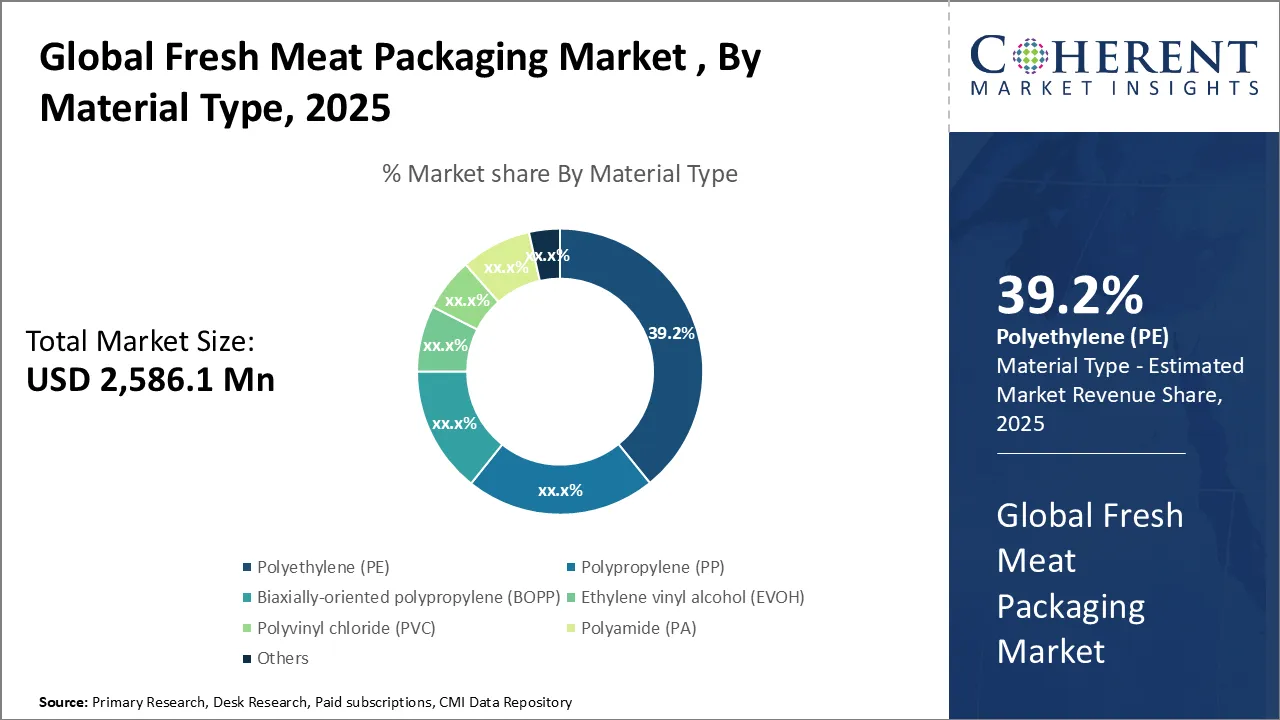
Global Fresh Meat Packaging Market Insights, By Material Type – Polyethylene (PE) Segment Leads with 40.2% Share in 2026
The Polyethylene (PE) segment is expected to hold a leading share of 39.2% in the global fresh meat packaging market in 2026. Its dominance is driven by its versatility, cost-effectiveness, and strong barrier properties that help maintain meat freshness and extend shelf life. PE is widely used in films, trays, and vacuum packaging, making it the preferred choice for both large-scale processors and retailers.
Other packaging materials, such as polypropylene (PP), polyethylene terephthalate (PET), and biodegradable alternatives, serve niche or specialty applications where higher strength, transparency, or sustainability is required. Manufacturers are also innovating with multi-layer PE films and antimicrobial coatings to enhance preservation and meet evolving consumer demands.
In October 2024, Klöckner Pentaplast (KP) introduced two new recyclable barrier flow wrap films: KP FlexiFlow EH 155 R and KP FlexiFlow PH 255 R. These films reduce packaging weight by up to 75% compared to traditional options, marking a major advancement in sustainable food packaging. The KP FlexiFlow PH 255 R is composed of over 93% polypropylene (PP), while the KP FlexiFlow EH 155 R contains more than 95% polyethylene (PE), both exceeding recyclability standards. Such innovations are proliferating the fresh meat packaging market revenue.
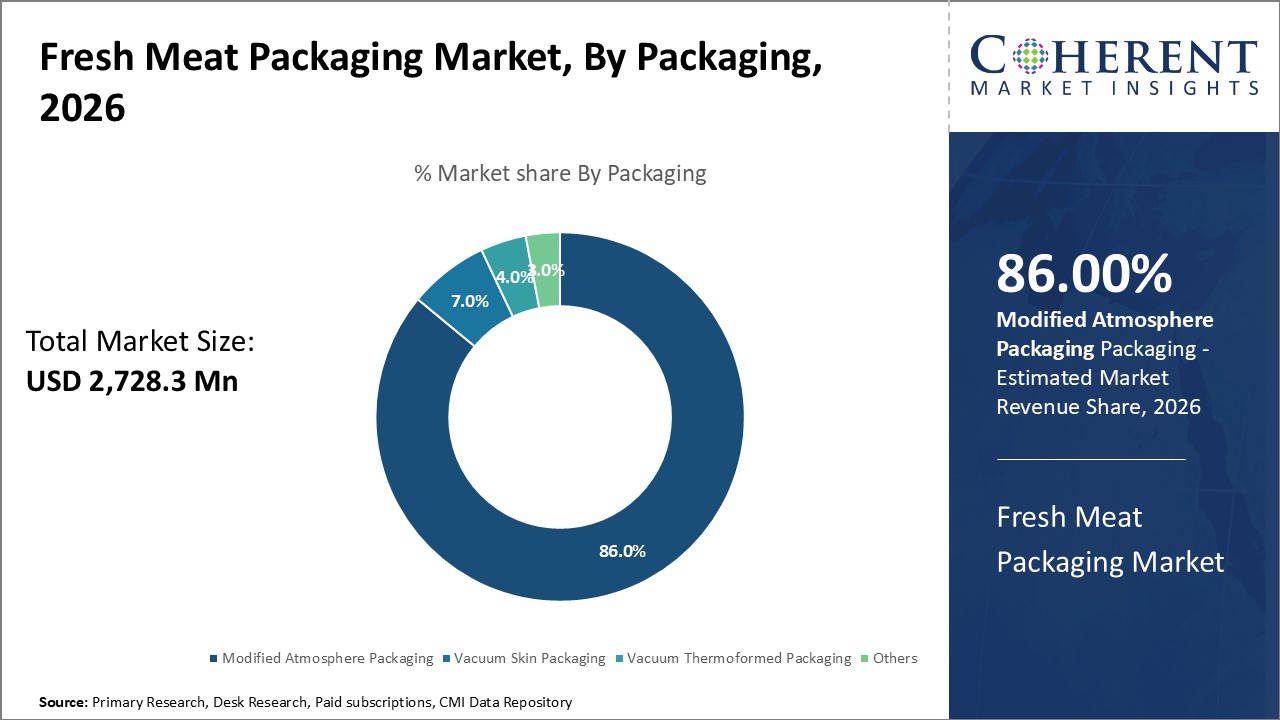
Global Fresh Meat Packaging Market Insights, By Packaging Technology – Modified Atmosphere Packaging (MAP) Segment Leads
The Modified Atmosphere Packaging (MAP) segment is expected to dominate the global fresh meat packaging market in 2026. MAP helps extend shelf life by replacing oxygen in the package with a controlled gas mixture, reducing spoilage and maintaining product freshness. Its effectiveness in preserving color, texture, and taste has made it the preferred choice for beef, poultry, and seafood processors.
In January 2026, Cirkla launched the world’s first molded fiber Modified Atmosphere Packaging (MAP) trays, cutting plastic waste by about 86%. Designed for meat and frozen foods, these trays provide a high-performance, sustainable alternative to conventional plastic packaging.
Global Fresh Meat Packaging Market Insights, By Meat Type – Poultry Segment Holds Significant Share
Among meat types, poultry is expected to hold a significant share of the fresh meat packaging market in 2026. Rising poultry consumption, driven by affordability, high protein content, and convenience, is boosting demand for efficient packaging solutions. In 2024, poultry meat consumption in India exceeded four million metric tons. This is further propelling the fresh meat packaging market share.
Other meat types, including beef, pork, seafood, and others, continue to contribute strongly to market growth. Beef and pork demand is supported by retail and foodservice sectors, while seafood requires specialized packaging such as MAP and vacuum technologies to maintain freshness and prevent spoilage during transportation.
Global Fresh Meat Packaging Market: Regional Insights
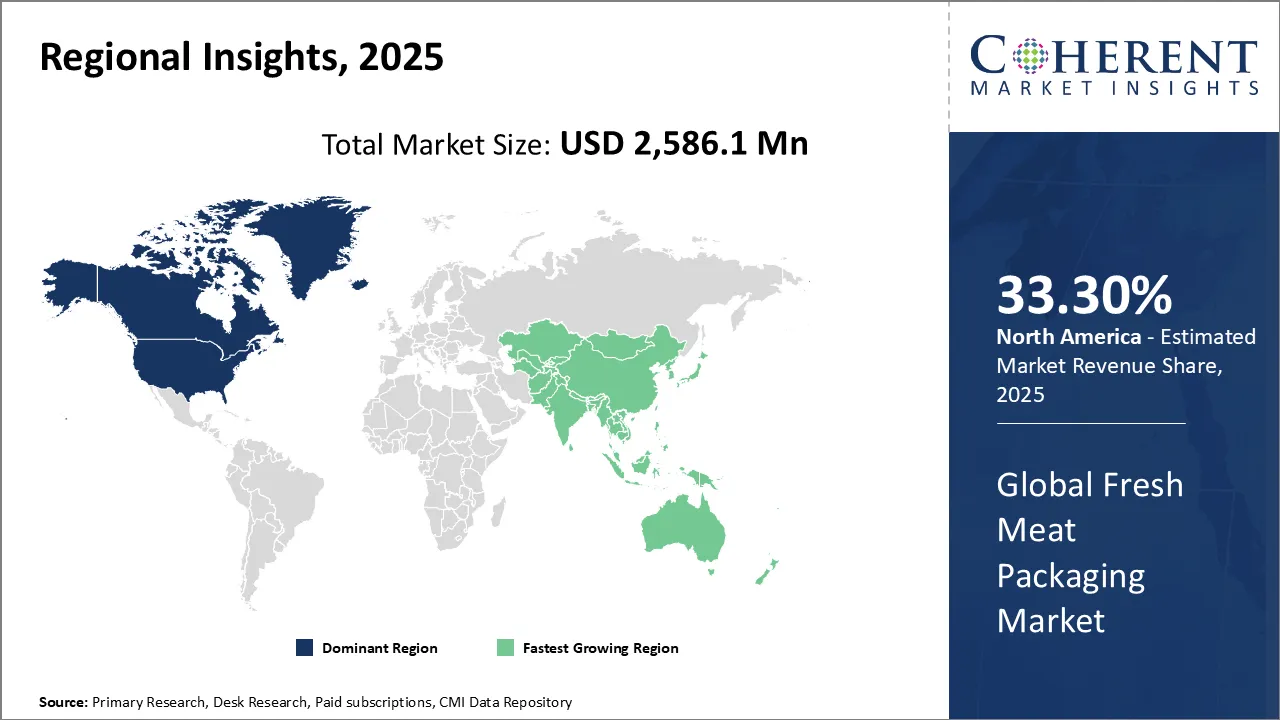
North America Fresh Meat Packaging Market Analysis and Trends
North America is estimated to hold a dominant 33.30% share of the global fresh meat packaging market in 2026 and is expected to maintain this leading position throughout the forecast period. This growth is driven by early adoption of advanced packaging technologies among meat producers and significant investments in research and development.
For instance, in 2024, Winpak Ltd., a leading packaging company, announced plans to expand its modified atmosphere packaging facility in Winnipeg, Manitoba, with capital expenditures projected between $110 million and $120 million. This expansion aims to meet the growing demand for high-barrier packaging solutions that extend shelf life and ensure food safety.
Asia Pacific Fresh Meat Packaging Market Analysis and Trends
Asia Pacific is projected to experience significant growth in the fresh meat packaging market over the coming years. Rapid industrialization, rising urban populations, and increasing consumer demand for convenience and food safety are key drivers in countries such as China, India, and Japan. For instance, Sealed Air's CRYOVAC® Brand Packaging offers a range of solutions for fresh meat packaging, including vacuum skin packaging and preformed trays, which are widely used in the Asia Pacific region.
Global Fresh Meat Packaging Market Outlook Country Wise
Canada Fresh Meat Packaging Market Trends
The Canada acquires the prominent share in the North American market with early adoption of modern packaging technologies and strong R&D capabilities. Investments by leading meat processors and packaging companies continue to drive market innovation and efficiency. In October 2024, Maple Leaf Foods launched Canada Packers Inc., a premium brand that honors its heritage while embracing modern meat production. Combining traditional expertise with innovative practices, the new venture offers high-quality, ethically sourced pork and poultry products.
China Fresh Meat Packaging Market Trends
China is a key growth market in Asia Pacific, supported by rapid urbanization, expanding retail chains, and increasing demand for packaged meat products. For instance, in 2024, Guangzhou Qiandama, a rapidly expanding fresh meat retail chain in China with over 3,700 outlets, leveraged smart refrigerators, digital payments, and strict freshness standards to meet growing urban demand for convenient, safe, and packaged meat products, exemplifying the country’s booming fresh meat packaging market.
India Fresh Meat Packaging Market Trends
India's fresh meat packaging market is expanding due to growing food processing activities, rising disposable income, and increasing awareness of food safety standards. For instance, in August 2024, Jindal Poly Films announced a significant investment of ₹700 crore to expand its Nashik facility. The expansion aims to install new production lines for biaxially oriented polypropylene (BOPP), polyethylene terephthalate (PET), and cast polypropylene (CPP) films.
Market Report Scope
Fresh Meat Packaging Market Report Coverage
| Report Coverage | Details | ||
|---|---|---|---|
| Base Year: | 2025 | Market Size in 2026: | USD 2,728.3 Mn |
| Historical Data for: | 2020 To 2024 | Forecast Period: | 2026 To 2033 |
| Forecast Period 2026 to 2033 CAGR: | 5.5% | 2033 Value Projection: | USD 3,968.8 Mn |
| Geographies covered: |
| ||
| Segments covered: |
| ||
| Companies covered: | Amcor plc, Berry Global Inc., WINPAK LTD, Sealed Air, Coveris | ||
| Growth Drivers: |
| ||
| Restraints & Challenges: |
| ||
Global Fresh Meat Packaging Market Drivers
- Need for increasing shelf-life of the meat product
The rising need for increasing shelf-life of the meat product is primarily fueling the market growth of fresh meat packaging. Barrier films and advanced packaging technology such as vacuum and map-enabled to increase the extended shelf life of fresh meat products by approximately 12x. Moreover, this packaging technology also improves the visual appearance of the meat products which is further expected to propel the market growth of fresh meat packaging.
- Need to reduce the carbon footprint
Growing demand for flexible packaging solutions due to rising concern over sustainability and the need to reduce the carbon footprint is projected to foster the market growth of fresh meat packaging. Flexible packaging solution reduces raw materials consumption, energy consumption, and reduce wastage, in turn, promote environmental sustainability compared to rigid packaging. This factor is projected to augment the market growth of fresh meat packaging.
Analyst Viewpoint
- The global fresh meat packaging market is experiencing strong growth, driven by shifting consumer preferences toward convenient, ready-to-cook protein options and stringent food safety regulations that necessitate advanced packaging solutions. Rising urbanization and increasingly busy lifestyles are fueling demand for pre-packaged fresh meat products that offer longer shelf life, enhanced convenience, and improved product safety. Heightened awareness of foodborne illnesses is further encouraging retailers and processors to adopt innovative packaging technologies that preserve product quality throughout the supply chain.
- Nevertheless, the market faces key challenges. Escalating raw material costs for packaging, coupled with environmental concerns over plastic waste, are creating pressure on manufacturers. Regulatory mandates promoting recyclable and sustainable packaging are compelling companies to invest in eco-friendly alternatives, which may affect profit margins in the short term.
- Regionally, North America remains a dominant market, underpinned by a well-established cold chain infrastructure, high meat consumption rates, and advanced retail distribution networks. In contrast, the Asia-Pacific region is emerging as the fastest-growing market, driven by rising disposable incomes, evolving dietary patterns favoring protein-rich diets, and expanding modern retail formats in emerging economies such as India and China. The burgeoning middle-class population in these countries is increasingly seeking premium packaged meat products, offering lucrative expansion prospects for market players.
Global Fresh Meat Packaging Market: Recent Developments
- In March 2025, Sealed Air introduces biodegradable meat packaging: Sealed Air, a U.S.-based packaging solutions provider, unveiled a compostable meat tray that maintains shelf life comparable to traditional plastic alternatives. This innovation addresses growing environmental concerns and regulatory mandates for recyclable and sustainable packaging, positioning the company as a sustainability leader in the fresh meat segment.
- July 2024, Amcor expands packaging production capacity in Asia-Pacific: Amcor announced a $120 million investment to expand its fresh meat packaging facilities in India and China, increasing output by 50,000 tons/year. This expansion supports rising demand from modern retail and e-commerce channels, strengthens supply chains, and improves regional market penetration.
- September 2024, Innovia Films launches low-VOC, recyclable packaging: Innovia Films introduced a next-generation fresh meat wrap with reduced volatile organic compound (VOC) emissions and enhanced recyclability. This product meets rising consumer demand for eco-friendly packaging while complying with tightening environmental regulations, reinforcing sustainability commitments among key suppliers.
Market Segmentation
- Global Fresh Meat Packaging Market, By Material Type (Revenue, USD Mn, 2021 - 2033)
- Polyethylene (PE)
- Polypropylene (PP)
- Biaxially-oriented polypropylene (BOPP)
- Ethylene vinyl alcohol (EVOH)
- polyvinyl chloride (PVC)
- Polyamide (PA)
- Others
- Global Fresh Meat Packaging Market, By Packaging Technology (Revenue, USD Mn, 2021 - 2033)
- Modified Atmosphere Packaging
- Vacuum Skin Packaging
- Vacuum Thermoformed Packaging
- Others
- Global Fresh Meat Packaging Market, By Meat Type (Revenue, USD Mn, 2021 - 2033)
- Beef
- Pork
- Poultry
- Seafood
- Others
- Global Fresh Meat Packaging Market, By Region (Revenue, USD Mn, 2021 - 2033)
- North America
- U.S.
- Canada
- Europe
- U.K.
- Germany
- Italy
- France
- Spain
- Nordic
- Benelux
- Russia
- Poland
- Rest of Europe
- Asia Pacific
- China
- India
- ASEAN
- South Korea
- Rest of Asia Pacific
- Latin America
- Brazil
- Mexico
- Rest of Latin America
- Middle East & Africa
- GCC
- South Africa
- Rest of Middle East & Africa
- North America
- Global Fresh Meat Packaging Market Key Companies
- Bemis Company, Inc.
- Berry Plastic Group
- Winpack Ltd.
- Sealed Air Corp.
- Coveris Holdings S.A.
Sources
Primary Research Interviews
- Fresh meat packaging manufacturers and suppliers
- Food processing companies and meat producers
- Packaging technology providers and equipment manufacturers
- Retail chain executives and procurement managers
- Others
Databases
- Food and Agriculture Organization (FAO) Statistical Database
- USDA National Agricultural Statistics Service
- Euromonitor International Food & Nutrition Database
- IBISWorld Industry Research Database
- Others
Magazines
- Packaging World Magazine
- Food Processing Magazine
- Meat + Poultry Magazine
- Flexible Packaging Magazine
- Others
Journals
- Journal of Food Engineering
- Packaging Technology and Science
- Food Control Journal
- Others
Newspapers
- Food Business Magazine
- The Wall Street Journal (Food & Agriculture section)
- Financial Times (Consumer Goods coverage)
- Reuters (Agriculture & Food news)
- Others
Associations
- Packaging Machinery Manufacturers Institute (PMMI)
- International Association of Packaging Research Institutes (IAPRI)
- North American Meat Institute (NAMI)
- European Fresh Meat Exporters Association
- Others
Public Domain Sources
- FDA Food Code and Packaging Guidelines
- European Food Safety Authority (EFSA) publications
- World Health Organization (WHO) food safety reports
- National Institute of Standards and Technology (NIST) databases
- Others
Proprietary Elements
- CMI Data Analytics Tool
- Proprietary CMI Existing Repository of information for last 8 years
*Definition: Fresh meat packaging is a packaging solution that is used to package and protect fresh meat products. Fresh meat packaging solutions aid to deliver protection against contamination and provide convenient handling. This packaging solution further are used to increase the shelf life of the fresh meat product.
Get access to 250+ pages report
Every segment, forecast, competitor profile and data table behind the analysis above — available for instant download.
- ESOMAR Member
- ISO 9001:2015 Certified
- D-U-N-S Registered
- GDPR & CCPA Compliant
Missing comfort of reading report in your local language? Find your preferred language:
Transform your Strategy with Exclusive Trending Reports
Frequently Asked Questions
The Fresh Meat Packaging Market is estimated to be valued at USD 2,728.3 Mn in 2026, and is expected to reach USD 3,968.8 Mn by 2033.
Major players operating in the market include Bemis Company, Inc., Berry Plastic Group, Winpack Ltd., Sealed Air Corp., Coveris Holdings S.A.
Among material types, the polyethylene segment dominated the market in 2026 with a 48.5% market share in terms of value, followed by the biaxially-oriented polypropylene (BOPP) segment.
The need for increased shelf-life of the meat product and to reduce the carbon footprint are the key factors driving the growth of the market.
The CAGR of the Fresh Meat Packaging Market is projected to be 5.5% from 2026 to 2033.
Among regions, North America dominated the market in 2026, accounting for 33.3% share in terms of volume.