

Bag-in-Box Container Market Analysis & Forecast: 2026-2033
Bag-in-Box Container Market is estimated to be valued at USD 4.56 Bn in 2026 and is expected to reach USD 6.91 Bn in 2033, exhibiting a compound annual growth rate (CAGR) of 6.1% from 2026 to 2033.
Key Takeaways
- By End‑Use, food and beverage industry is set to lead the Bag-in-Box container market in 2026, capturing approximately 45% of the total share. Growth is attributed by increasing preference for efficient, tamper-evident, and cost-effective packaging solutions.
- Europe is expected to lead the global Bag-in-Box market, accounting for approximately 37% share by 2026.
Market Overview
The global Bag-in-Box Container Market is witnessing robust growth, fuelled by increasing demand for cost-effective, space-saving, and sustainable liquid packaging across food, beverage, and industrial sectors. The format’s extended shelf life and reduced carbon footprint make it ideal for wine, dairy, sauces, and concentrates. Food and beverage applications dominate market share due to bulk handling efficiency. Europe leads regionally, supported by advanced logistics and eco-regulations. Rising e-commerce and consumer preference for convenience continue to propel innovation and global market expansion.
Current Events and its Impact on the Bag-in-Box Container Market
Current Event | Description and its impact |
Technological Advancements and Product Innovations |
|
Strategic Collaborations and Capacity Expansion |
|
Regulatory Policies and Sustainability Mandates |
|
Pricing Analysis: Bag-in-Box Container Market
The pricing structure of the Bag-in-Box container market is influenced by several key factors including raw material costs, customization level, packaging size, and barrier technology. Polyethylene (PE) and ethylene vinyl alcohol (EVOH) films are commonly used materials, and their price volatility directly impacts overall costs.
Typically, Bag-in-Box solutions are priced lower per liter compared to rigid packaging alternatives, especially in bulk volumes, making them a cost-effective choice for manufacturers. However, aseptic liners, multi-layer barriers, and dispensing valves can increase unit prices by 10–20%. Larger volume bags (5L to 20L) offer better economies of scale, widely favoured in the food and beverage sector.
Additionally, sustainable and recyclable variants command a premium, driven by growing environmental regulations and consumer demand. Regional pricing also varies Europe tends to have higher average prices due to strict compliance costs, while Asia Pacific offers lower production and labour expenses, enabling more competitive pricing.
- Current Industry Events of 2026
- Market Size Estimation
- Regional Breakdown
- Competitive Landscape
- Customer Intelligence
- Segmental Analysis
- Pricing Analysis
- Key Market Drivers, Challenges & Future Trends
- Customized Insights Section
Demand for Sustainable and Eco-Friendly Options: Bag-in-Box Container Market
The demand for sustainable and eco-friendly packaging solutions is significantly shaping the Bag-in-Box container market. These containers are inherently more sustainable than traditional rigid packaging, offering lower carbon footprints due to lightweight materials, reduced transportation emissions, and efficient storage.
Brands are increasingly shifting to recyclable and biodegradable materials for bag liners and outer cartons, in line with global environmental regulations and circular economy goals. Consumer preference is also driving this change, especially in regions like Europe and North America, where eco-conscious purchasing is on the rise. Many manufacturers are adopting mono-material films and plant-based resins to enhance recyclability and reduce plastic usage.
Additionally, Bag-in-Box systems minimize product waste through efficient dispensing and extended shelf life, further reinforcing their environmental advantage. As industries from beverages to homecare prioritize sustainable practices, eco-friendly Bag-in-Box solutions are expected to witness accelerated demand throughout the forecast period.
Bag-in-Box Container Market Trends
- Rapidly Growing demand for food and Beverages industry
The growth of the online food retail sector, the rise in the trend of eating out, particularly in developing countries, and other factors have all contributed to the expansion of the food and beverage industry. Due to the benefits mentioned above, the bag-in-box packaging is widely used in the food and beverage industry. Additionally, the automotive industry frequently uses bag-in-box packaging to deliver vital fluids like lubricants and motor oil used by cars.
Additionally, the personal care and hygiene products sector uses bag-in-box packaging for items such as shampoo, detergent, and other comparable items. Additionally, a rise in disposable income, population growth, and business-friendly government policies in many nations all contribute significantly to the acceleration of industrialization. As a result, it is anticipated that the growth of all the aforementioned industries, which make extensive use of bag-in-box containers, will fuel the market's expansion over the coming years 2025-2032.
- Increased Demand for sustainable packaging
Packaging extends the product's shelf life and improves its shelf presence in addition to keeping it safe during transportation. As it is a sustainable packaging method that uses less plastic and more paperboard, which is readily recyclable, bag-in-box technology has gained popularity in the industry. Furthermore, as it is essentially a flat packaging, it takes up less space than a bottle and is therefore simpler to transport.
Additionally, it can be used for packing a variety of dry and liquid products across the industry, including products for storing chemicals, motor oil, lubricants, wine, juices, and other liquid consumer products.
Segmental Insights
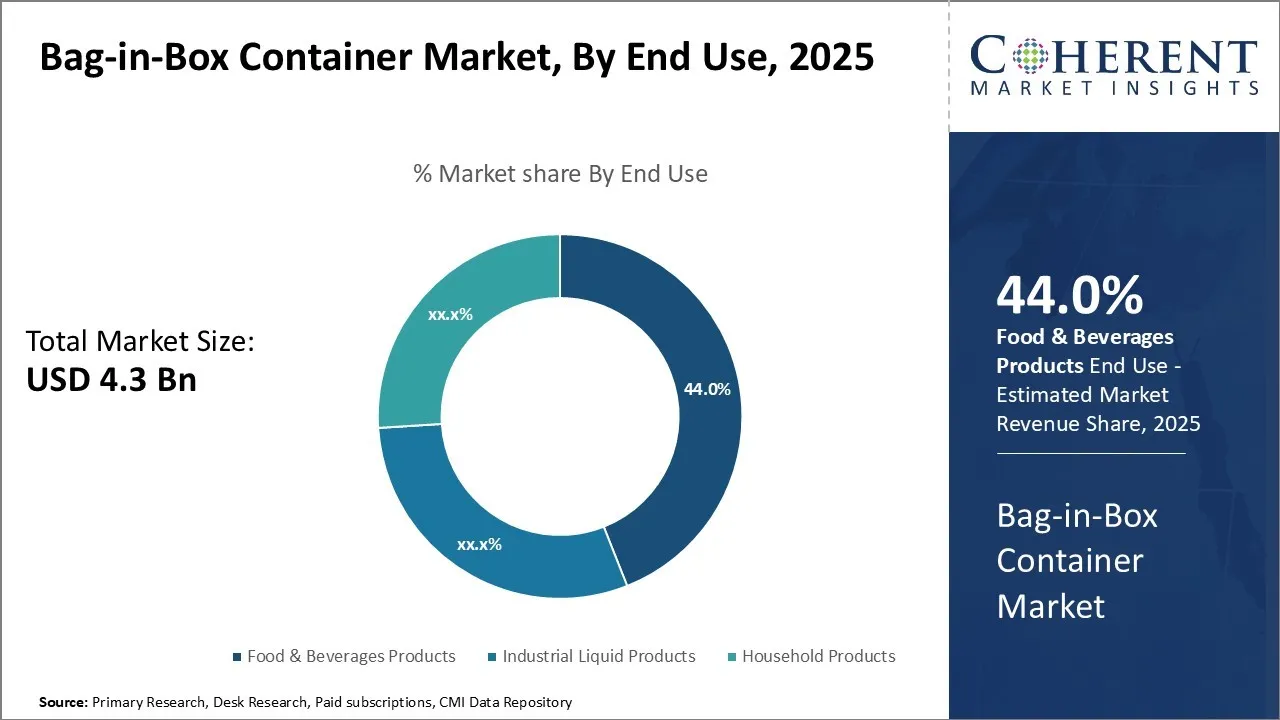
Global Bag-in-Box Container Market Insights, By End Use
The food and beverage industry is projected to dominate the global Bag-in-Box container market in 2026, accounting for approximately 45.0% of the total market share. This leadership is driven by the industry's growing demand for efficient, tamper-evident, and cost-effective packaging, particularly for bulk liquid products such as wine, fruit juices, dairy, edible oils, and sauces.
Bag-in-Box systems offer significant advantages including extended product shelf life, minimal oxidation, lower transportation costs, and environmental benefits due to reduced material usage and higher fill efficiencies. These features make them especially suitable for commercial and institutional foodservice operations, retail chains, and ready-to-drink product lines.
In parallel, the Bag-in-Box container market for liquid detergents is also gaining traction, as household and industrial cleaning product manufacturers adopt this format for its controlled dispensing and sustainable packaging benefits. The ongoing rise of private-label offerings, expansion of e-commerce platforms, and increasing consumer preference for sustainable and easy-to-use packaging further strengthen this segment's dominance.
As demand for convenience and shelf-stable liquid food and non-food products continues to grow, the food, beverage, and homecare sectors are expected to sustain their leading positions well beyond 2025.
Regional Insights
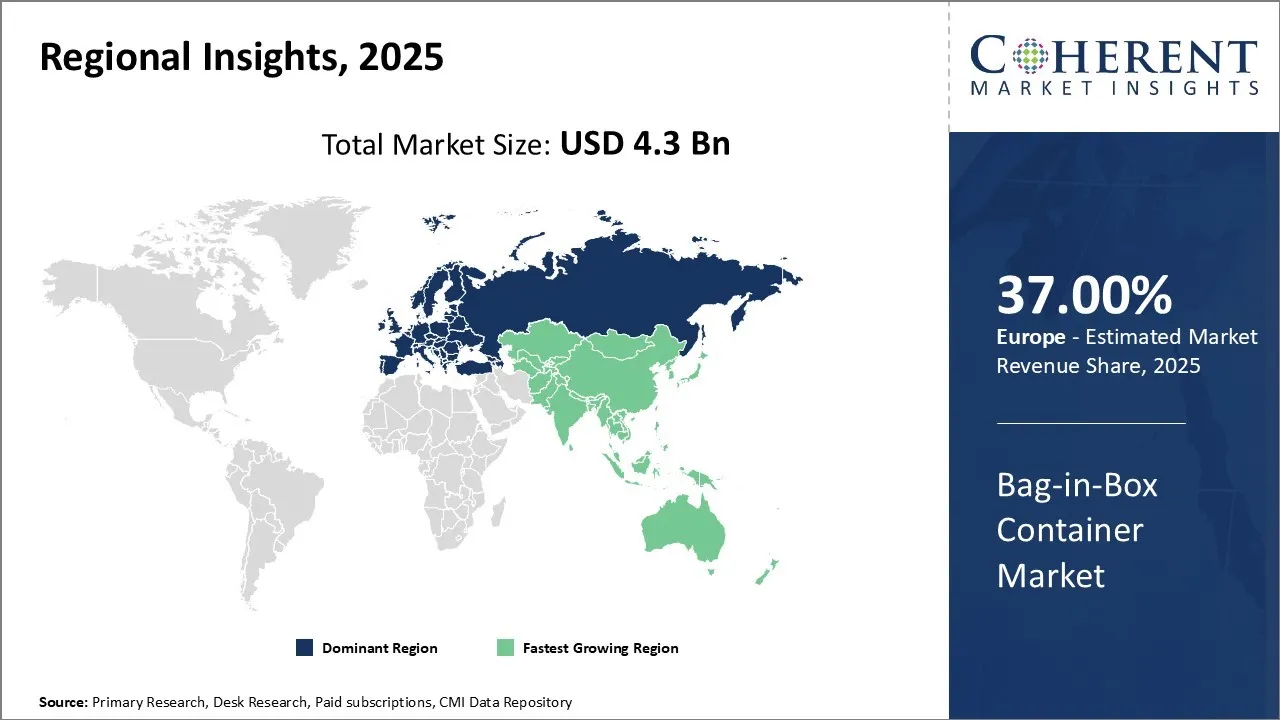
Europe Bag-in-Box Container Market Trends and Analysis
Europe is anticipated to dominate the global Bag-in-Box container market, securing approximately 37.00% of the total market share by 2026. This leadership position is primarily supported by the region’s well-established packaged food and beverage sector, robust cold-chain infrastructure, and stringent environmental regulations that favour lightweight, sustainable packaging alternatives.
Consumer adoption of Bag-in-Box formats is particularly strong across wine, dairy products, and ready-to-drink beverages, driven by both convenience and environmental awareness. The widespread presence of recycling infrastructure, combined with the popularity of refill and return schemes in countries like Germany, France, and the Nordics, further reinforces market penetration.
In addition to food and beverages, the Bag-in-Box container market with cosmetics is emerging as a promising niche, as European beauty brands explore sustainable packaging for liquid products such as lotions, creams, and hair treatments. These formats reduce product waste, extend shelf life, and align with the region’s eco-conscious consumer base. As sustainability continues to shape consumer choices and regulatory standards, Europe is well-positioned to maintain its dominance in the Bag-in-Box market throughout the forecast period.
Bag-in-Box Container Market Dominating Countries
Germany
Germany leads the Bag-in-Box container market in Europe, playing a key role in the region’s projected 37% global share by 2026. A mature packaged beverage industry, especially in wine and dairy, supports widespread adoption of Bag-in-Box formats. Strict sustainability legislation—such as bans on single-use plastics and a strong recycling infrastructure drive demand for eco-friendly packaging.
German manufacturers are pioneering innovations like aseptic liners and recyclable materials, enhancing convenience and reducing waste. With government support for circular economy practices and consumer preferences aligning toward green solutions, Germany continues to spearhead sustainable growth in the European Bag-in-Box market.
France
France stands out as a major contributor to the Bag-in-Box container market in Europe, driven by its long-standing wine culture and early adoption of alternative packaging formats. Bag-in-Box wine has become a mainstream choice for both retail and hospitality due to its extended shelf life and lower environmental footprint.
National recycling policies and consumer acceptance of refillable packaging reinforce its position. French producers are integrating smart dispensing technologies and lightweight materials to meet sustainability goals. With rising demand for eco-conscious, bulk liquid packaging, France remains central to innovation and volume in the regional Bag-in-Box sector.
Market Report Scope
Bag-in-Box Container Market Report Coverage
| Report Coverage | Details | ||
|---|---|---|---|
| Base Year: | 2025 | Market Size in 2026: | USD 4.56 Bn |
| Historical Data for: | 2020 To 2024 | Forecast Period: | 2026 To 2033 |
| Forecast Period 2026 to 2033 CAGR: | 6.1% | 2033 Value Projection: | USD 6.91 Bn |
| Geographies covered: |
| ||
| Segments covered: |
| ||
| Companies covered: | Key players active in the global bag-in-box container market are Smurfit Kappa Group, DS Smith, Amcor Limited, Liqui-Box, Scholle IPN, CDF Corporation, Vine Valley Ventures LLC, Parish Manufacturing Inc., TPS Rental Systems Ltd, and Optopack Ltd. | ||
| Growth Drivers: |
| ||
| Restraints & Challenges: |
| ||
Analyst Viewpoint: Bag-in-Box Container Market
- The global Bag-in-Box container market is poised for robust growth, driven by increasing demand across food & beverages, household products, and industrial liquid packaging. Analysts highlight Europe as a dominant region, supported by mature cold-chain systems, strong environmental regulations, and high consumer acceptance of sustainable packaging.
- Industry experts underline the rising shift toward sustainable and cost-efficient solutions as a defining market trend. Bag-in-Box systems are gaining popularity due to their reduced material usage, extended shelf life, and compatibility with recyclable and biodegradable materials. This trend is further reinforced by the surge in e-commerce and private label offerings, where convenient and eco-friendly packaging provides a competitive edge.
- While the market faces hurdles such as raw material volatility and recycling infrastructure disparities across regions, the long-term outlook remains positive. Advancements in aseptic packaging, smart dispensing technologies, and regulatory support for lightweight, low-carbon packaging will continue to shape the market’s evolution.
Bag-in-Box Container Market: Key Development
- In February 2024 – Smurfit Kappa announced a €54 million (USD 59 million) investment in a bag-in-box plant located in Alicante, Spain. This investment is set to strengthen the sustainability of both the plant’s operations and the company’s product portfolio.
- February 2024 – Aran Group announced the completion of the acquisition of a majority stake in IBA Germany from previous owner Liquid Concept GmbH (LC).
- January 2024 – WestRock Company announced plans to build a new corrugated box plant in Pleasant Prairie, Wisconsin, to meet the growing demand from customers in the Great Lakes region. Construction is estimated to cost approximately USD 140 million and expected to be partially offset by property sales.
- November 2023 – Smurfit Kappa developed a recyclable film that has similar properties to nylon, in terms of strength and resilience but, unlike nylon, is recyclable and commonly used in bag-in-box products, particularly in the US.
- December 2023 – LIQUI MOLY introduced a bag-in-box packaging for six of its popular motor oils. The bag will offer various benefits, such as significantly less plastic, thanks to recyclable cardboard packaging and more storage space for customers due to space-saving, easily stackable dimensions.
Market Segmentation
- Global Bag-in-Box Container Market, By Material Type (Revenue, USD Bn, 2021 - 2033)
- Low-Density Polyethylene
- Ethylene Vinyl Acetate
- Ethylene Vinyl Alcohol
- Others
- Global Bag-in-Box Container Market, By (Revenue, USD Bn, 2021 - 2033) End-use
- Alcoholic Beverages
- Non-alcoholic Beverages
- Liquid Food
- Food & Beverages Products
- Household Products
- Industrial Liquid Products
- Global Bag-in-Box Container Market, By Order type (Revenue, USD Bn, 2021 - 2033)
- Customized Order
- Standard Order
- Global Bag-in-Box Container Market, By Region (Revenue, USD Bn, 2021 - 2033)
- North America
- U.S.
- Canada
- Latin America
- Brazil
- Argentina
- Mexico
- Rest of Latin America
- Europe
- Germany
- U.K.
- Spain
- France
- Italy
- Russia
- Rest of Europe
- Asia Pacific
- China
- India
- Japan
- Australia
- South Korea
- ASEAN
- Rest of Asia Pacific
- Middle East
- GCC Countries
- Israel
- Rest of Middle East
- Africa
- South Africa
- North Africa
- Central Africa
- North America
- Company Profiles
- Smurfit Kappa Group
- DS Smith
- Amcor Limited
- Liqui-Box
- Scholle IPN
- CDF Corporation
- Vine Valley Ventures LLC
- Parish Manufacturing Inc.
- TPS Rental Systems Ltd.
- Optopack Ltd.
Sources
The Stakeholders Consulted
- Foodservice packaging manufacturers and converters
- Quick-service and fast-casual restaurant operators
- Institutional foodservice providers (schools, hospitals, catering firms)
- Retail chains and grocery packaging procurement heads
- Sustainability and waste management consultants
- Regulatory and environmental compliance advisors
- Packaging engineers and materials scientists
- Public health and sanitation agencies
Databases Opened
- U.S. Food and Drug Administration (FDA) – Food Packaging Guidelines
- Environmental Protection Agency (EPA) – Sustainable Materials Management Data
- Food and Agriculture Organization (FAO) – Packaging Trends and Food Waste Metrics
- India Brand Equity Foundation (IBEF) – Foodservice and Packaging Insights
Magazines & Trade Publications
- Packaging World
- Foodservice Equipment Reports
- Quick Service Restaurant (QSR) Magazine
- Packaging Strategies
- Nation’s Restaurant News – Sustainability & Operations Section
Scientific and Industry Journals
- Journal of Packaging Technology and Research
- International Journal of Hospitality Management
- Waste Management Journal
- Food Control
- Resources, Conservation & Recycling
Newspapers & Media Outlets
- The Wall Street Journal – Retail & Consumer Goods
- Bloomberg – Packaging & Sustainability News
- Reuters – Global Food and Retail Trends
- The Economic Times – Foodservice & FMCG Reports
- Business Standard – Packaging & Waste Management
Associations and Regulatory Bodies
- U.S. Environmental Protection Agency (EPA)
- European Commission – Packaging and Packaging Waste Directive (PPWD)
- Foodservice Packaging Institute (FPI)
- Sustainable Packaging Coalition (SPC)
- Bureau of Indian Standards (BIS) – Packaging and Hygiene Standards
Public Domain Sources
- U.S. Census Bureau – Foodservice and Retail Trade Data
- European Environment Agency (EEA) – Packaging Waste and Recovery Rates
- Ministry of Environment, Forest and Climate Change (India) – Plastic Waste Rules
- World Bank Open Data – Municipal Waste and Consumption Trends
- International Renewable Energy Agency (IRENA) – Bio-based Materials and Circular Economy
Proprietary Research Elements
- CMI Food & Packaging Analytics Tool
- Proprietary CMI Repository of Foodservice Disposables Data (2017–2025)
- CMI Expert Interviews and Transcripts (focused on material innovation, sustainability, and regional packaging demand)
Get access to 250+ pages report
Every segment, forecast, competitor profile and data table behind the analysis above — available for instant download.
- ESOMAR Member
- ISO 9001:2015 Certified
- D-U-N-S Registered
- GDPR & CCPA Compliant
Missing comfort of reading report in your local language? Find your preferred language:
Transform your Strategy with Exclusive Trending Reports
Frequently Asked Questions
The Bag-in-Box Container Market size is estimated to be valued at USD 4.56 Bn in 2026, and is expected to reach USD 6.91 Bn by 2033.
Global market is estimated to reach USD 5.73 Bn by 2033.
Key players active in the global bag-in-box container market are Smurfit Kappa Group, DS Smith, Amcor Limited, Liqui-Box, Scholle IPN, CDF Corporation, Vine Valley Ventures LLC, Parish Manufacturing Inc., TPS Rental Systems Ltd, and Optopack Ltd.
High cost of bag-in-box and Availability of alternative is expected to hamper the growth of the market during the forecast period.
Rapidly Growing demand for food and Beverages industry and increased demand for sustainable packaging is fuelling the growth of the global bag-in-box container market in the region.
The CAGR of the Bag-in-Box Container Market is projected to be 6.1% from 2026 to 2033.
Among region, Europe is expected to hold a dominant position in the market over the forecast period.