

Honeycomb Packaging Market Analysis & Forecast
Honeycomb Packaging Market is estimated to be valued at USD 18.97 Bn in 2026 and is expected to reach USD 32.60 Bn in 2033, exhibiting a compound annual growth rate (CAGR) of 8.0% from 2026 to 2033.
Key Takeaways
- By Packaging Type, the exterior packaging segment is projected to dominate the global honeycomb packaging market, accounting for a substantial 44% share in 2026.
- Asia Pacific is anticipated to lead the global honeycomb packaging market with 34% of the total share in 2026.
North America is poised to hold around 24% shares in the global honeycomb market during the forecast period.
Market Overview
The global Honeycomb Packaging Market is experiencing robust growth, fuelled by increasing demand for sustainable, lightweight, and durable packaging solutions across various industries. Honeycomb structures, made from paper or cardboard, offer superior strength-to-weight ratio, making them ideal for both exterior and interior packaging. Growth is also driven by growing usage in various sectors such as automotive, electronics, and e-commerce sectors seeking eco-friendly alternatives to plastic.
Current Events and its Impact on the Honeycomb Packaging Market
Current Event | Description and its impact |
Technological Advancements in Sustainable Packaging Materials |
|
Rising Demand for Eco-Friendly and Cost-Effective Packaging |
|
Expansion of Circular Economy Initiatives by FMCG and Retail Giants |
|
Pricing Analysis: Honeycomb Packaging Market
The pricing dynamics in the global honeycomb packaging market are influenced by several factors, including raw material costs (such as paperboard and kraft paper), energy prices, customization levels, and regional supply-demand trends. In 2025, rising costs of recycled paper and adhesives, along with increased logistics expenses, are placing upward pressure on unit pricing, especially in regions with high import dependence for raw materials.
Sustainability mandates and growing consumer demand for eco-friendly packaging are pushing manufacturers to adopt premium biodegradable materials and processes, which can elevate initial production costs. Customization for specific industrial applications—such as die-cut inserts or multi-layer cores for electronics and automotive parts—also contributes to price variations.
However, scaling production volumes, investments in automated machinery, and increased use of recycled inputs are helping balance overall costs. Price competitiveness is particularly evident in Asia Pacific, where strong local production and raw material access support more affordable pricing, making the region a key hub for global exports.
- Current Industry Events of 2026
- Market Size Estimation
- Regional Breakdown
- Competitive Landscape
- Customer Intelligence
- Segmental Analysis
- Pricing Analysis
- Key Market Drivers, Challenges & Future Trends
- Customized Insights Section
Technological Advancement: Honeycomb Packaging Market
Technological innovation is driving significant transformation in the honeycomb packaging market by improving structural performance, sustainability, and production efficiency. Advanced die-cutting and automatic lamination systems are enabling high-speed manufacturing of uniform honeycomb structures, reducing labor costs and material wastage. New bonding technologies using water-based and biodegradable adhesives are supporting the industry’s shift toward eco-friendly packaging solutions.
Innovations in digital design and computer-aided engineering (CAE) allow manufacturers to simulate load-bearing capacity, compression strength, and edge protection for various applications—from automotive parts to consumer electronics. This ensures optimal material utilization while maintaining protective performance.
Next generation packaging integration is also emerging, with embedded sensors or QR codes used to track package conditions during shipping, particularly for high-value or sensitive goods. Additionally, 3D printing is being explored for prototyping and customized inserts, enhancing flexibility in low-volume production runs.
These technological advances are helping manufacturers deliver lightweight, recyclable, and cost-effective packaging that aligns with evolving regulatory and environmental expectations.
Sustainability Initiatives by Government and Organizations: Honeycomb Packaging Market
Governments and organizations worldwide are actively promoting sustainability in the honeycomb packaging market by encouraging the use of recyclable, biodegradable, and renewable materials. Regulatory bodies in the EU and North America have implemented policies such as the Circular Economy Action Plan and Extended Producer Responsibility (EPR) frameworks, which mandate the reduction of single-use plastics and promote sustainable packaging alternatives like honeycomb structures. In India and China, public-private partnerships are fostering eco-friendly packaging innovation, with subsidies and tax benefits for companies adopting paper-based and recyclable materials.
Major corporations, especially in the e-commerce, automotive, and electronics sectors, are pledging to shift toward 100% recyclable or compostable packaging.
For example, Amazon and IKEA have incorporated honeycomb board solutions to reduce plastic use and lower carbon emissions in shipping. These initiatives are driving R&D investment and encouraging widespread adoption of honeycomb packaging, aligning environmental goals with long-term economic efficiency.
Honeycomb Packaging Market
- Increasing demand for eco-friendly solutions
Honeycomb packaging is the modern trend in numerous packaging industries, it is the major sustainable packaging solution and also has better options for the packaging of products than other packaging solutions, especially plastic packaging which can lead to unnecessary junk that pollutes the environment and ecosystem.
This packaging are biodegradable and won’t cause any harm to the environment. This packaging can be easily recycled. These benefits can aid the products in making an eco-friendly brand image that attracts more customers. Therefore, all these factors surged the demand for honeycomb packaging, which is expected to drive the market's growth.
In May 2025, The Better India featured a Mumbai-based family startup, EcoCushion Paper, producing 100 % recyclable honeycomb paper as an eco-friendly alternative to plastic bubble wrap. Their innovative packaging reportedly reduces storage space by 80%, demonstrating strong consumer demand and growing awareness amid India’s single-use plastic ban efforts.
- Surging usage of honeycomb packaging in packaging industry
Packaging is probably the largest application for the honeycomb packaging market. In conveying or shipping products, honeycomb packaging is extensively used due to its high durability, which protects products from damage. Honeycomb packaging refers to strong paperboard packaging solutions, which are majorly used for transportation.
Honeycomb packaging works as protective packaging solution for numerous products such as furniture, FMCG, electronics, products, and many others. Thus, the surging usage of honeycomb packaging in the packaging industry is expected to drive market growth.
Segmental Insights
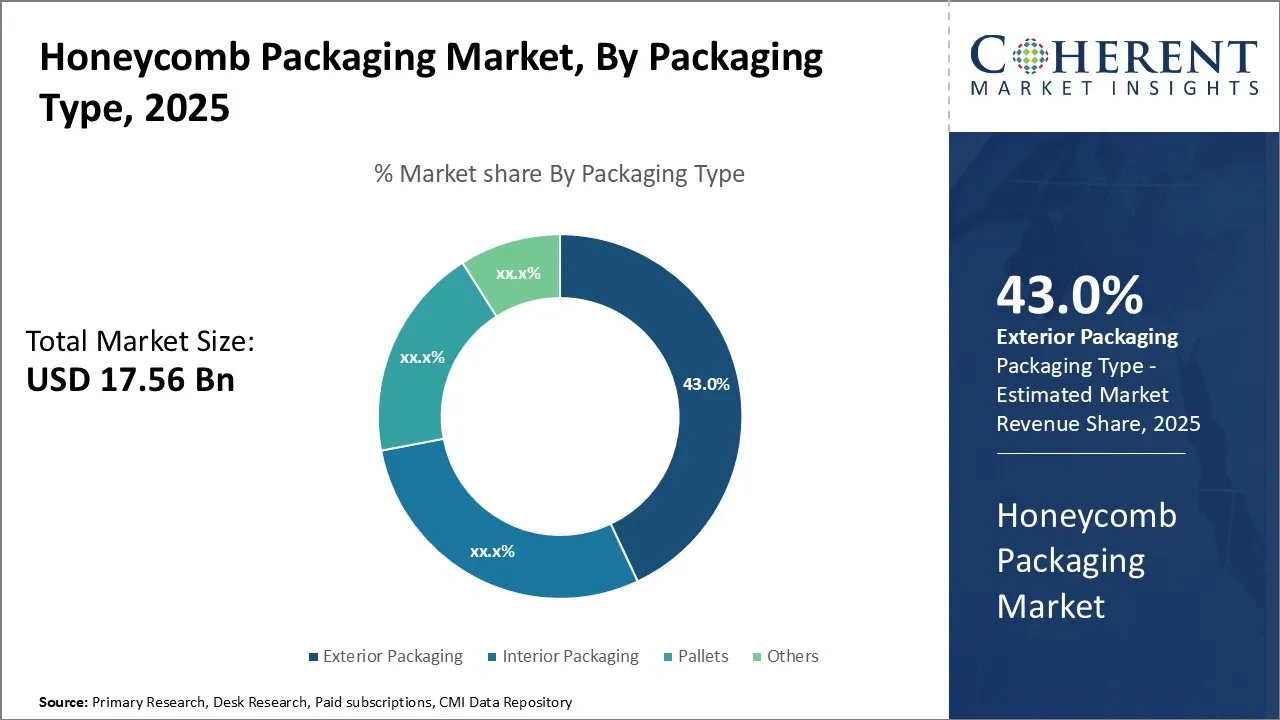
Honeycomb Packaging Market Insights, By Packaging Type
The exterior packaging segment is projected to dominate the global honeycomb packaging market, accounting for a substantial 44.0% share. This leadership stems from the material’s extensive use in protecting heavy, fragile, and high-value goods during transportation. Honeycomb panels, known for their excellent strength-to-weight ratio, cushioning capabilities, and edge protection, are increasingly utilized for packaging automotive parts, electronics, home appliances, and furniture.
The growing demand for sustainable and recyclable packaging materials across industries is accelerating the shift from plastic and foam-based solutions to honeycomb-based exterior packaging. Its cost-effectiveness, ease of customization, and reduced environmental impact make it particularly attractive to manufacturers seeking eco-friendly alternatives that align with global regulatory trends.
The rise in global trade, e-commerce fulfilment, and export logistics is also reinforcing demand for robust and lightweight exterior packaging solutions. As businesses prioritize sustainability and damage prevention, the exterior packaging segment continues to play a central role in driving honeycomb packaging market growth.
Other key segments include interior packaging (29%), pallets (19%), and others (9%), each contributing to niche use-cases such as internal cushioning, load stabilization, and custom inserts. However, the dominance of the exterior packaging segment reflects the urgent need for scalable, sustainable solutions in high-volume industrial and consumer supply chains.
Honeycomb Packaging Market: Regional Insights
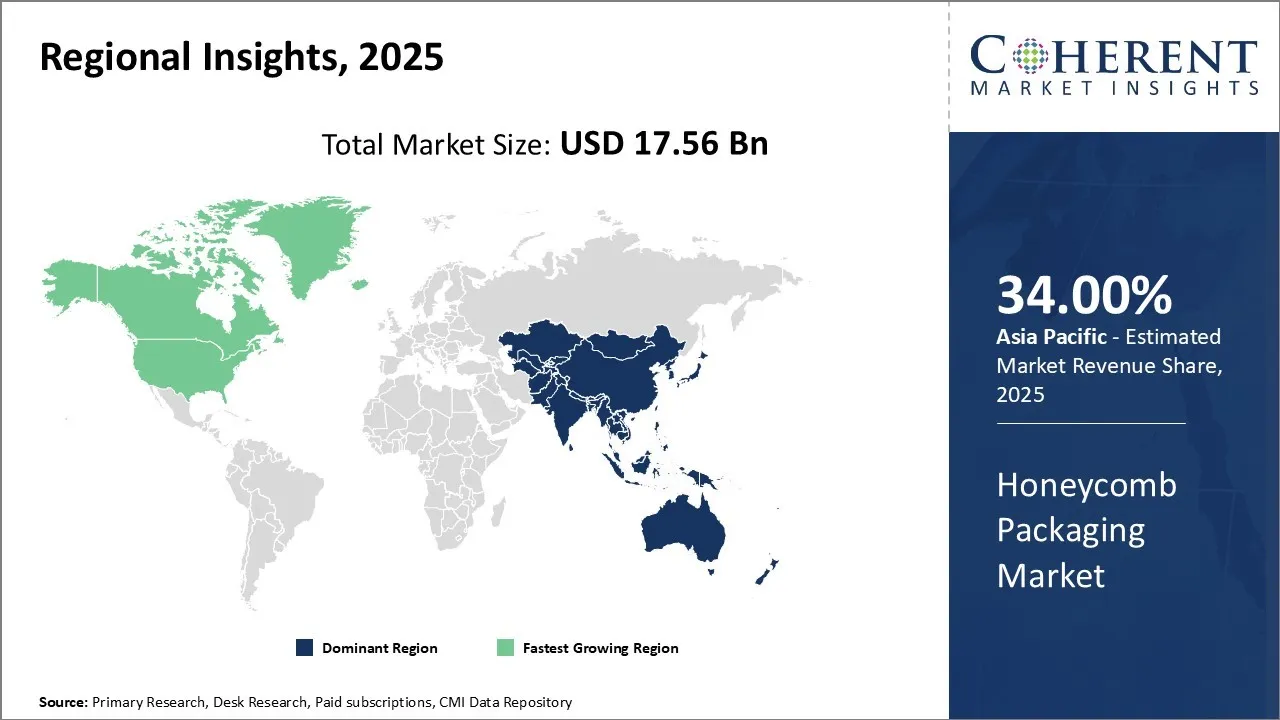
Asia Pacific Honeycomb Packaging Market Trends and Analysis
Asia Pacific is anticipated to lead the global honeycomb packaging market, accounting for 34.00% of the total share in 2026. This dominance is fueled by rapid industrial expansion, robust growth in e-commerce, and increasing manufacturing exports in major economies like China, India, and Southeast Asian nations. Honeycomb packaging is gaining widespread adoption in this region as an eco-friendly alternative to wood, plastic, and foam, especially in industries such as electronics, automotive, and consumer goods.
The region’s focus on cost-efficient logistics, lightweight materials, and recyclable solutions aligns with global sustainability trends. Government initiatives promoting green packaging and the rising demand for damage-resistant materials for long-distance shipping further accelerate market growth. Asia Pacific’s evolving supply chain infrastructure makes it a key hub for scalable, sustainable packaging solutions.
North America Honeycomb Packaging Market Trends and Analysis
North America holds 24% of the global honeycomb packaging market share in 2026, driven by strong demand from the automotive, aerospace, and electronics sectors. Companies are shifting toward sustainable, biodegradable packaging to align with corporate ESG goals and meet growing consumer and regulatory expectations.
The U.S. and Canada are adopting honeycomb materials in industrial applications due to their superior strength, cushioning, and recyclability. Policies supporting waste reduction, along with innovation in recyclable protective packaging, reinforce North America's position as a leading market for eco-conscious packaging technologies.
Market Report Scope
Honeycomb Packaging Market Report Coverage
| Report Coverage | Details | ||
|---|---|---|---|
| Base Year: | 2025 | Market Size in 2026: | USD 18.97 Bn |
| Historical Data for: | 2020 To 2024 | Forecast Period: | 2026 To 2033 |
| Forecast Period 2026 to 2033 CAGR: | 8.0% | 2033 Value Projection: | USD 32.60 Bn |
| Geographies covered: |
| ||
| Segments covered: |
| ||
| Companies covered: | ACH Foam Technologies, BASF SE, DS Smith Plc, Huhtamaki Group, Lsquare Eco-Products Pvt. Ltd., Packaging Corporation of America, Sealed Air Corporation, Sonoco Products Company, Smurfit Kappa Group, and WestRock Company. | ||
| Growth Drivers: |
| ||
| Restraints & Challenges: |
| ||
Analyst Viewpoint – Honeycomb Packaging Market
- Analysts generally hold a favourable outlook on the global honeycomb packaging market, citing its rapid adoption as a sustainable alternative to traditional plastic and wood-based packaging. The market is being driven by rising environmental awareness, increasing e-commerce activity, and the need for lightweight, recyclable materials that reduce shipping costs and carbon footprints.
- Analysts highlight the material's excellent strength-to-weight ratio, cushioning ability, and design flexibility as key advantages in sectors such as automotive, electronics, and furniture.
- Experts point to strong government support for green packaging solutions and growing corporate sustainability mandates as critical enablers. Technological innovations—such as automated honeycomb panel production and customizable die-cut solutions—are enhancing manufacturing efficiency and expanding usage in high-volume applications. Analysts also note that expanding urban logistics and export activity are creating new opportunities for honeycomb exterior and interior packaging.
- Regionally, Asia Pacific is viewed as the fastest-growing market due to industrial expansion and sustainability initiatives in China, India, and Southeast Asia. Meanwhile, North America and Europe are leading in innovation and regulatory adoption. Future growth will be influenced by circular economy efforts, infrastructure investments in sustainable packaging, and continuous innovation in material science and design adaptability.
Honeycomb Packaging Market: Key Development
- In January 2024, Corrugated giant Smurfit Kappa is pushing its honeycomb Hexacomb solution in the automotive sector.
- April 2023, A U.S.-based packaging company, Novolex, announced the launch of its Power Prep packaging, specifically designed for fresh food. Power Prep uses non-fluorinated oil-and-grease-resistant paper, which is laminated using a honeycomb pattern to create an insulated layer.
- July 2022, Dufaylite launched thermally-insulated box liners and inserts developed from recycled paper honeycomb. The company aims to offer a paper-based substitute to solutions manufactured with polystyrene and lamb wool. As claimed by the company, the inserts provide all the insulation and protection required for everyday products.
- May 2022, Alkindo Naratama Tbk (ALDO) announced the introduction of a green product substitute for the first plastic bubble wrap in Indonesia, Hexcel Wrap.
Market Segmentation
- Global Honeycomb Packaging Market, By Packaging Type (Revenue, USD Bn, 2021 - 2033)
- Exterior Packaging
- Interior packaging
- Pallets
- Others
- Global Honeycomb Packaging Market By End-use industry (Revenue, USD Bn, 2021 - 2033)
- Automotive
- Consumer goods
- Food and beverages
- Furniture
- Industrial goods
- Others
- Global Honeycomb Packaging Market By Region (Revenue, USD Bn, 2021 - 2033)
- North America
- U.S.
- Canada
- Europe
- U.K.
- Germany
- Italy
- France
- Russia
- Rest of Europe
- Asia Pacific
- China
- India
- Japan
- ASEAN
- Australia
- South Korea
- Rest of Asia Pacific
- Latin America
- Brazil
- Mexico
- Rest of Latin America
- Middle East
- GCC
- Israel
- Rest of Middle East
- Africa
- Northern Africa
- Central Africa
- South Africa
- North America
- Company Profiles
- BASF S.E.
- ACH Foam Technologies
- DS Smith Plc
- Huhtamaki Group
- Lsquare Eco-Products Pvt. Ltd.
- Packaging Corporation of America
- Sealed Air Corporation
- Sonoco Products Company
- Smurfit Kappa Group
- WestRock Company
Sources
The Stakeholders Consulted
- Packaging engineers and material scientists
- Manufacturers and suppliers of honeycomb packaging solutions
- Sustainability and waste management consultants
- Regulatory bodies and environmental compliance advisors
- Research institutions focused on sustainable materials and industrial packaging
- Government infrastructure, logistics, and export development agencies
- End-users across sectors such as automotive, electronics, consumer goods, e-commerce, and industrial equipment
Databases Opened
- U.S. Environmental Protection Agency (EPA) – Sustainable Materials Management Database
- Ministry of Commerce and Industry (India) – Packaging Industry Reports
- World Bank Open Data – Manufacturing & Sustainability Metrics
- UN Comtrade – International Trade Data for Packaging Materials
Magazines & Trade Publications
- Packaging World
- Sustainable Packaging News
- Packaging Europe
- Industrial Packaging Magazine
- Modern Materials Handling – Packaging Logistics Section
Scientific and Industry Journals
- Journal of Packaging Technology and Research
- Packaging Technology and Science
- Materials Today Sustainability
- International Journal of Production Economics (Packaging & Logistics)
- Journal of Cleaner Production
Newspapers & Media Outlets
- The Wall Street Journal – Logistics & Manufacturing
- Bloomberg – Global Trade & Industrial Materials
- Reuters – Packaging and Sustainable Materials Coverage
- The Economic Times – Packaging & Supply Chain Innovation
- Business Standard – Eco-Friendly Manufacturing and Industrial Trends
Associations and Regulatory Bodies
- International Organization for Standardization (ISO) – ISO 18601 Family on Packaging and Environment
- Forest Stewardship Council (FSC)
- Sustainable Packaging Coalition (SPC)
- Central Pollution Control Board (CPCB), India
- Bureau of Indian Standards (BIS) – Packaging Standards Division
Public Domain Sources
- European Commission – Packaging and Packaging Waste Directive Reports
- U.S. Department of Commerce – Packaging Industry Reports
- International Renewable Energy Agency (IRENA) – Bio-based and Circular Economy Materials
- World Bank – Waste Management and Circular Economy Reports
Proprietary Research Elements
- CMI Data Analytics Tool
- Proprietary CMI Repository of Market Intelligence (covering packaging trends and performance metrics for over 8 years)
- CMI Expert Interviews and Transcripts (focused on packaging engineers, manufacturers, and industrial sustainability experts)
Get access to 250+ pages report
Every segment, forecast, competitor profile and data table behind the analysis above — available for instant download.
- ESOMAR Member
- ISO 9001:2015 Certified
- D-U-N-S Registered
- GDPR & CCPA Compliant
Missing comfort of reading report in your local language? Find your preferred language:
Transform your Strategy with Exclusive Trending Reports
Frequently Asked Questions
The Honeycomb Packaging Market size is estimated to be valued at USD 18.97 Bn in 2026, and is expected to reach USD 32.60 Bn by 2033.
The global market is estimated to surpass USD 25.6 Bn by 2033.
Major players operating in the market include ACH Foam Technologies, BASF SE, DS Smith Plc, Huhtamaki Group, Lsquare Eco-Products Pvt. Ltd., Packaging Corporation of America, Sealed Air Corporation, Sonoco Products Company, Smurfit Kappa Group, and WestRock Company.
Among end-use industry, the automotive segment held a dominant position in the market, in 2026 and is expected to retain its dominance over the forecast period.
Increasing demand for eco-friendly solutions and surging usage of honeycomb packaging in the packaging industry are the key factors driving the market.
The CAGR of the Honeycomb Packaging Market is projected to be 8.0% from 2026 to 2033.
Among regions, Asia Pacific was the dominant market accounting for a market share of 34% in 2026.