

Reusable Plastic Containers Market Analysis & Forecast: 2026-2033
The reusable plastic containers market was valued at USD 442.9 Mn in 2026 and is expected to reach USD 833.9 Mn by 2033, exhibiting a CAGR of 9.5% during the forecast period (2026-2033).
Key Takeaways
- Based on Type, the bulk containers segment is expected to lead the market with 42% share in 2026.
- Based on Application, the vegetable segment is expected to hold 27% share in 2026.
- Based on Region, Europe is set to lead the reusable plastic containers market with 38% share in 2026. While, Asia Pacific is anticipated to be the fastest growing region.
Market Overview
Reusable plastic containers (RPC) have become increasingly popular in the transportation of food and beverages around the world. Totes, boxes, bulk containers, sleeves, and other reusable plastic containers are all examples of reusable plastic containers. Reusable plastic containers are rapidly displacing paper corrugated boxes as a means of transporting foods, beverages, and other items. End users benefit from RPCs because they are recyclable, durable (weather resistant), safe, and reusable.
These benefits are expected to drive the reusable plastic container market growth in the coming years. Due to its cost-effectiveness, non-reactivity with food, beverages, and cosmetics, it is light weight, and hassle-free process cycle reusable plastic has emerged as a viable alternative to packaging materials such as glass, paper, wood, metal, and others.
Current Events and their Impacts on the Reusable Plastic Containers Market
Current Event | Description and its Impact |
Accelerating Environmental Regulations and Sustainability Mandates |
|
Technological Advancements in Materials and Manufacturing |
|
Which Departments Are Leading Reusable Plastic Container Adoption with Measurable Data Insights?
Department / Sector | Adoption Use Case | Data & Statistics |
Agriculture | Transporting vegetables, fruits, and eggs from farms to markets | RPCs reduce food waste by up to 20% in fresh produce supply chains |
Food & Beverage Retail | Distribution of fresh produce, dairy, and meat to supermarkets | Over 60% of fresh produce in EU & NA retail uses RPCs |
Logistics & Warehousing | Bulk storage and movement of goods in pooling systems | Pooling systems cut logistics costs by 15–25% |
Automotive | Transporting components and spare parts | Adoption in automotive supply chains growing at >10% annually |
Electronics | Handling delicate components during manufacturing and distribution | Electronics sector accounts for ~8–10% of RPC demand |
Pharmaceuticals | Distribution of medicines and medical supplies | RPCs reduce contamination risk by up to 30% compared to cardboard |
Hospitality & Catering | Storage and transport of food items for hotels and events | Catering industry adoption rising. |
Industrial Manufacturing | Movement of raw materials and semi-finished goods | Industrial RPC usage expected to reach US$ 150 Mn by 2030 |
- Current Industry Events of 2026
- Market Size Estimation
- Regional Breakdown
- Competitive Landscape
- Customer Intelligence
- Segmental Analysis
- Pricing Analysis
- Key Market Drivers, Challenges & Future Trends
- Customized Insights Section
Segmental Insights
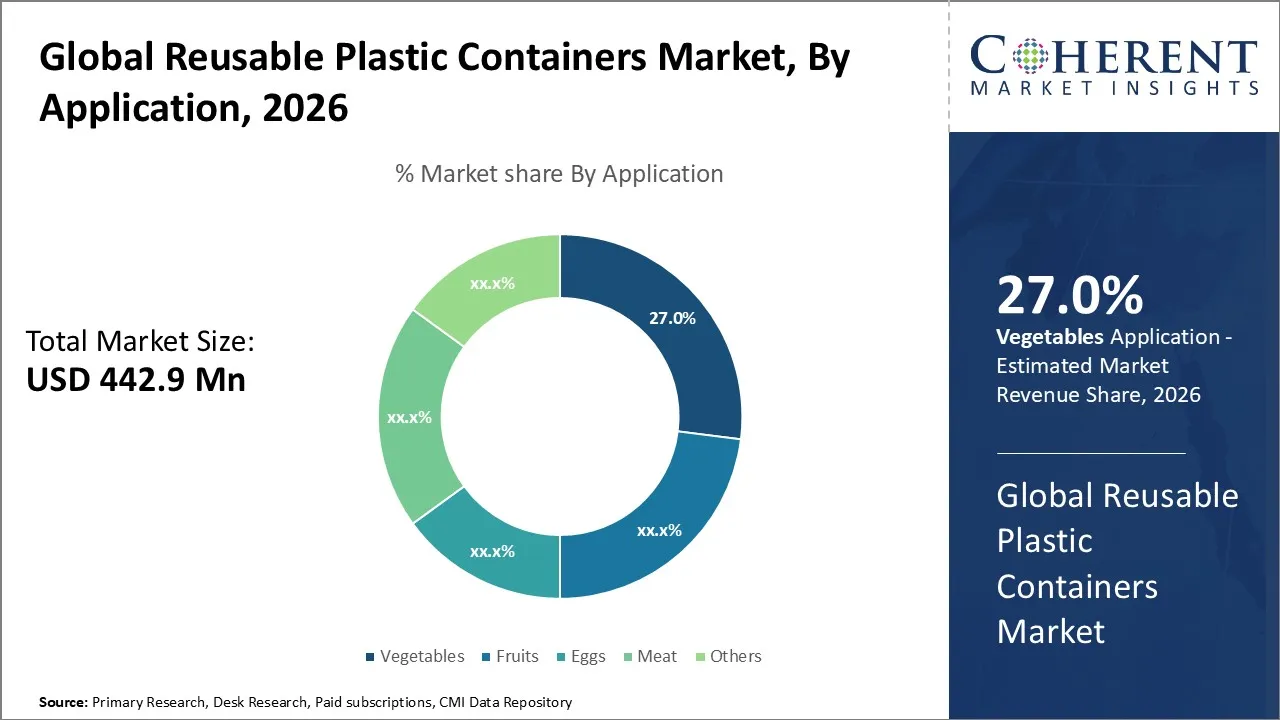
Reusable Plastic Containers Market Insights, By Application - Vegetables lead, supported by global demand for fresh produce distribution
In terms of application, the vegetable segment is expected to hold 27% share in 2026. High consumption volumes, perishability, and the need for efficient cold chain logistics make RPCs the preferred packaging solution. Their long life, ability to be stacked, and ability to reduce on waste make them very popular, especially in Asia Pacific and Europe.
For instance, in December 2025, Metsä Spring made uncoated fiber punnets to package fruits and vegetables. The goal is to replace single-use plastics with fiber-based solutions that can be recycled. These punnets make the logistics of fresh produce more environmentally friendly by giving retailers and growers eco-friendly packaging that helps the circular economy while still being strong and safe for food.
Reusable Plastic Containers Market Insights, By Type - Bulk containers dominate due to efficiency in large-scale logistics
In terms of type, the bulk containers segment is expected to lead the market with 42% share in 2026. Bulk containers are the best choice for moving a large quantity of goods at once. They are used widely in logistics, farming, and industrial supply chains because they last a long time and save money. Since they can be stacked and used again, they are preferred choice for high-volume distribution networks.
For instance, in March 2025, Tetra Pak and Schoeller Allibert made transport crates from recycled beverage cartons, which helped make bulk logistics more environmentally friendly. These reusable plastic containers are meant for large-scale distribution and replace more than 50,000 traditional crates in Sweden. They show how innovative circular economy practices can be and make the bulk container segment of reusable packaging stronger.
Regional Insights
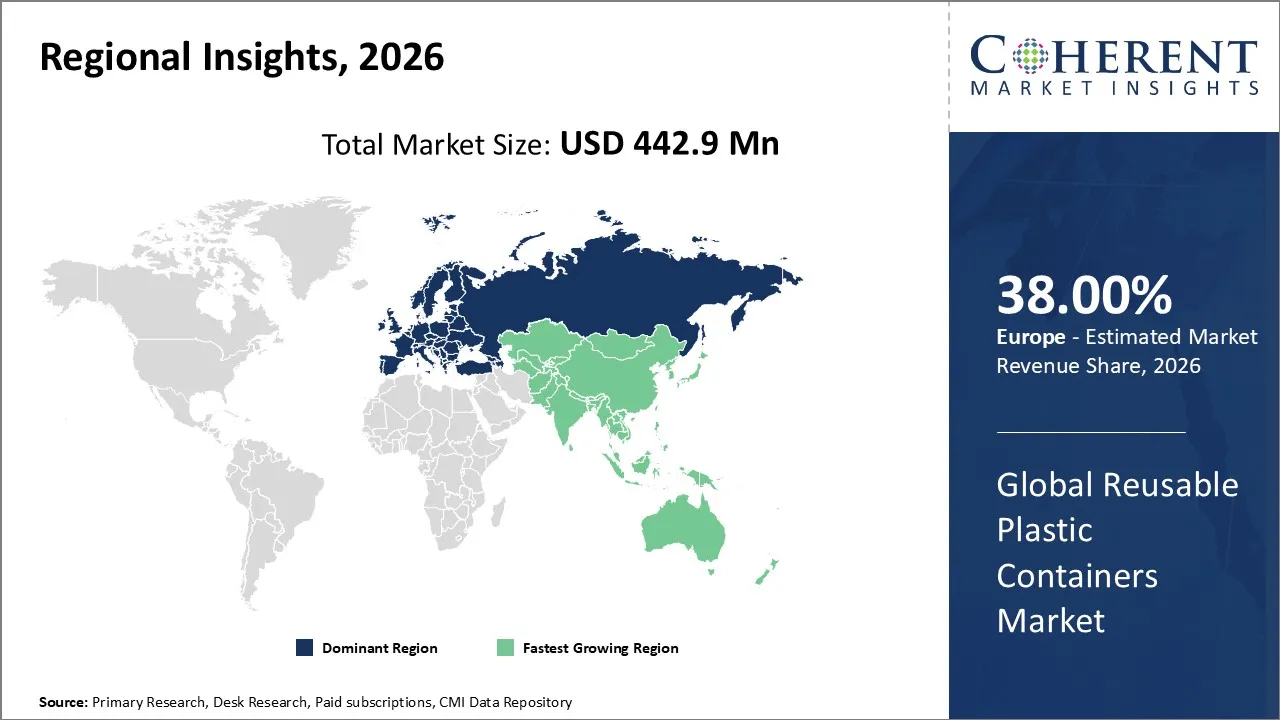
Europe Reusable Plastic Containers Market Analysis & Trends
By 2026, Europe is expected to possess the largest share of the Reusable Plastic Containers Market, with almost 38% of the total. Strict rules about sustainability, bans on single-use plastics, and strong use in retail and farming all help growth. Europe is the leader in reusable solutions because of government support for circular economy projects and consumers’ preference for eco-friendly packaging.
For instance, in January 2026, Duni started a project in Munich to make reusable containers for restaurants and catering services. The program replaces single-use packaging with food containers that can be returned, which helps the goals of sustainability and the circular economy. The project encourages the use of reusable plastic containers in the hospitality industry by reducing waste and encouraging reuse.
Asia Pacific Reusable Plastic Containers Market Analysis & Trends
Asia Pacific is expected to exhibit the fastest growth, due to e-commerce is booming, cities are growing, and disposable incomes are rising. RPCs are helping with the logistics of fresh produce, the growth of the cold chain, and trends in sustainable packaging across a wide range of industries. China and India are the leaders in adoption.
For instance, in April 2025, to reduce plastic waste and improve its circular economy, Indonesia is promoting reuse programs. The plan focuses on using reusable systems in all fields, such as packaging and logistics, and reusable plastic containers are seen as essential tools. Indonesia wants to reduce pollution, save resources, and speed up the process of changing the economy in a way that is good for the environment by encouraging reuse.
Reusable Plastic Containers Market Outlook Country-Wise
Germany Reusable Plastic Containers Market Trends
In 2026, demand for reusable plastic containers in Germany will be high because of strict EU rules on sustainability, bans on single-use plastics, and strong use in agriculture and retail. Germany's advanced logistics system and focus on circular economy practices make RPCs necessary for reducing waste, improving supply chains, and reaching eco-friendly packaging goals.
For instance, in March 2025, In German REWE stores, CU Mehrweg and Seeberger have started a trial of reusable packaging that allows customers return containers for nuts and dried fruits. Customers can bring back the packaging to be cleaned and used again, which cuts down on waste from single-use items. The program encourages sustainability and the use of reusable plastic containers in the distribution of food in stores.
Japan Reusable Plastic Containers Market Trends
Japan's strong focus on sustainability, efficient logistics, and food safety will drive demand for reusable plastic containers in 2026. Japan's busy cities and high-tech cold chain systems need packaging that is strong, clean, and can be used again. Government programs that encourage circular economy practices are speeding up the use of RPCs even more.
Market Report Scope
Reusable Plastic Containers Market Report Coverage
| Report Coverage | Details | ||
|---|---|---|---|
| Base Year: | 2025 | Market Size in 2026: | USD 442.9 Mn |
| Historical Data for: | 2020 To 2024 | Forecast Period: | 2026 To 2033 |
| Forecast Period 2026 to 2033 CAGR: | 9.5% | 2033 Value Projection: | USD 833.9 Mn |
| Geographies covered: |
| ||
| Segments covered: |
| ||
| Companies covered: | Menasha Corporation, IFCO, Schoeller Allibert, Myers Industries, DS Smith, Rehrig Pacific Company, Nefab Group, IPL Plastics, Vetropack Holding, and Schütz GmbH & Co. KGaA. | ||
| Growth Drivers: |
| ||
| Restraints & Challenges: |
| ||
Reusable Plastic Containers Market Driver
Expansion of E-commerce
The reusable plastic containers market share has grown significantly because online shopping is growing quickly and businesses want packaging that is strong, stackable, and good for the environment. RPCs reduces damage during shipping, make the most of cargo space, and lower logistics costs. They are a must-have for modern supply chains all over the world since they can be recycled and follow rules for sustainability.
Sustainability and Regulatory Pressure
The reusable plastic containers market demand is growing because of stricter environmental rules and bans on single-use plastics. RPCs are a legal, long-term solution that cuts down on waste and carbon footprints. Companies that aim to meet global sustainability goals opt for them as they are durable and recyclable, which fits with the goals of the circular economy.
Reusable Plastic Containers Market Opportunity
Cold Chain and Fresh Produce Logistics
The expansion of cold chain logistics and fresh produce distribution offers strong Reusable Plastic Containers Market forecast potential. RPCs make sure that products are safe, cut down on waste, and make the best use of cargo space. They are necessary for sustainable food supply chains because they last a long time and work well with automated warehouses, driving the adoption across agriculture and retail around the world.
Analyst Opinion (Expert Opinion)
- Increasingly food distribution networks are using reusable plastic containers. Statistics show that more than 60% of fresh produce in organized retail chains in Europe and North America is now transported in reusable crates. This cuts down on waste from single-use packaging and makes the supply chain work better.
- According to industry reports, reusable containers can lower logistics costs by up to 25% compared to disposable packaging. They can also extend the shelf life of perishable goods by 2 to 3 days as they are better ventilated and durable. This makes them a popular choice for large-scale agricultural and retail operations.
Speak to the analyst
Want personalized insights?
Take the findings above to one of our principal consultants, or have the report rebuilt around the segments, geographies and competitors you actually track.
Recent Developments
- In January 2026, Amcor has started a program in Ottawa to use reusable packaging for food service and catering throughout the city. The project replaces single-use packaging with containers that can be returned, which helps with goals for sustainability and the circular economy. Amcor encourages the use of reusable plastic containers in hotels and restaurants in cities by promoting reuse.
- In January 2026, The CoHo reusable container program at UC Davis in Davis, California, brings back food containers that can be used repeatedly to all the dining places on campus. The initiative works with Friendlier to get rid of single-use packaging, cut down on waste, and promote sustainability. It makes it easier for schools to use reusable plastic containers, which helps the circular economy and encourages students to come up with new ideas.
Market Segmentation
- By Type
- Bulk Containers
- Handheld Storage Containers
- Others
- By Application
- Vegetables
- Fruits
- Eggs
- Meat
- Others
- By Region
- North America
- U.S.
- Canada
- Latin America
- Brazil
- Argentina
- Mexico
- Rest of Latin America
- Europe
- Germany
- U.K.
- Spain
- France
- Italy
- Russia
- Rest of Europe
- Asia Pacific
- China
- India
- Japan
- Australia
- South Korea
- ASEAN
- Rest of Asia Pacific
- Middle East & Africa
- GCC Countries
- Israel
- Rest of Middle East & Africa
- North America
- Competitive Section
- Menasha Corporation
- IFCO
- Schoeller Allibert
- Myers Industries
- DS Smith
- Rehrig Pacific Company
- Nefab Group
- IPL Plastics
- Vetropack Holding
- Schutz GmbH & Co. KGaA
Sources
Primary Research Interviews
- Reusable Plastic Container Manufacturers
- Returnable Packaging Pooling Service Providers
- Logistics & Supply Chain Managers
- Warehouse Automation and Material Handling Experts
- Retail & FMCG Packaging Procurement Managers
- Sustainability and Circular Packaging Consultants
- Others
Databases
- Bloomberg Terminal
- Euromonitor International
- Others
Magazines
- Packaging World
- Plastics News
- Sustainable Packaging News
- Supply Chain Digital
- Modern Materials Handling
- Others
Journals
- Packaging Technology and Science
- Journal of Cleaner Production
- Resources, Conservation and Recycling
- Waste Management
- International Journal of Logistics Management
- Others
Newspapers
- Financial Times
- The Wall Street Journal
- Reuters
- Bloomberg News
- The Economic Times
- Others
Associations
- Reusable Packaging Association (RPA)
- Association of Plastic Recyclers (APR)
- Sustainable Packaging Coalition (SPC)
- Plastics Industry Association (PLASTICS)
- International Safe Transit Association (ISTA)
- Others
Public Domain Sources
- U.S. Environmental Protection Agency (EPA)
- European Environment Agency (EEA)
- Eurostat
- U.S. Census Bureau
- OECD
- Others
Proprietary Elements
- CMI Data Analytics Tool
- Proprietary CMI Existing Repository of Information for the Last 8 Years
Get access to 250+ pages report
Every segment, forecast, competitor profile and data table behind the analysis above — available for instant download.
- ESOMAR Member
- ISO 9001:2015 Certified
- D-U-N-S Registered
- GDPR & CCPA Compliant
Missing comfort of reading report in your local language? Find your preferred language:
Transform your Strategy with Exclusive Trending Reports
Frequently Asked Questions
The global Reusable Plastic Containers Market size was valued at USD 442.9 Mn in 2026 and is expected to reach USD 833.9 Mn in 2033.
The expansion of e-commerce industries and sustainability and regulatory pressure is expected to drive the market growth.
Cube shaped packaging in logistics chains is one of the growing trends in the reusable plastic containers industry.
Storage space requirement and potential loss of material of reusable plastic are key factors hampering the market growth.
Major players operating in the market include Menasha Corporation, IFCO, Schoeller Allibert, Myers Industries, DS Smith, Rehrig Pacific Company, Nefab Group, IPL Plastics, Vetropack Holding, and Schütz GmbH & Co. KGaA.