

Makeup Packaging Market Analysis & Forecast: 2026-2033
Makeup Packaging Market is estimated to be valued at USD 9,876.7 Mn in 2026 and is expected to reach USD 15,704.8 Mn in 2033, exhibiting a compound annual growth rate (CAGR) of 6.9% from 2026 to 2033.
Key Takeaways
- By Material, Plastic Division is projected to account for the largest share 53.0% of the global makeup packaging market in 2026. Its dominance is primarily driven by its versatility, lightweight nature, and cost-efficiency.
- Asia Pacific is poised to dominate the global makeup packaging market with an estimated 38.00% share in 2026. This leadership is attributed to a flourishing cosmetics industry, growing millennial population, and strong regional demand for both luxury and mass-market beauty products.
- Europe is the fastest growing region with 26% shares in the global market during the forecast period, owing to rising adoption of sustainable packaging solutions.
- North America is holding third position in the global market with 20% shares in 2026, owing to high volume of cosmetics products all around the world.
Market Overview
The global Makeup Packaging Market is experiencing steady growth, driven by rising cosmetics consumption, evolving beauty trends, and increasing demand for sustainable and premium packaging formats. Key material segments include plastic, glass, metal, and others, with plastic holding the majority share due to its affordability and design flexibility. Innovation in eco-friendly, refillable, and customized packaging solutions is reshaping the competitive landscape.
Current Events and its Impact on the Makeup Packaging Market
Current Event | Description and its impact |
Latest Launches and Approvals |
|
Strategic Collaborations and Capacity Expansion |
|
Policy Shifts and Market Implications |
|
Pricing Analysis – Makeup Packaging Market
The pricing dynamics of the global makeup packaging market are influenced by material costs, design complexity, branding, and sustainability trends. Plastic remains the most cost-effective and widely used material, accounting for over 50% of the market in 2025, due to its lightweight nature, versatility, and scalability. However, rising consumer demand for sustainable packaging is pushing brands toward more sustainable alternatives like glass, metal, and biodegradable materials, which often come at a premium price.
Luxury makeup brands typically invest in high-end, customized packaging with intricate designs and multi-layered finishes, significantly increasing unit costs. In contrast, mass-market brands prioritize cost-efficiency and high-volume production, maintaining more affordable packaging formats.
Regionally, Asia Pacific leads with competitive manufacturing and lower labour costs, making it a key hub for cost-effective production. However, increasing regulatory pressures and sustainability requirements are expected to drive moderate price increases across all segments, particularly for recyclable and refillable packaging solutions.
- Current Industry Events of 2026
- Market Size Estimation
- Regional Breakdown
- Competitive Landscape
- Customer Intelligence
- Segmental Analysis
- Pricing Analysis
- Key Market Drivers, Challenges & Future Trends
- Customized Insights Section
Demand for Sustainable and Eco-Friendly Material – Makeup Packaging Market
The global makeup packaging market is experiencing a significant shift toward sustainable and eco-friendly materials, driven by increasing consumer awareness, regulatory mandates, and brand sustainability goals. Consumers, especially millennial and Gen Z, are actively seeking cosmetic products that align with their environmental values, prompting brands to adopt greener packaging alternatives.
Materials such as biodegradable plastics, recycled paperboard, glass, and metal are gaining traction as replacements for traditional single-use plastics. Innovations in refillable, reusable, and compostable packaging formats are also reshaping product design strategies. Leading beauty brands are introducing packaging lines made from post-consumer recycled (PCR) plastics and plant-based polymers, reinforcing their commitment to sustainability.
An emerging trend within this space is the development of makeup packaging by two-tone lip balms, which requires innovative compartmentalized and precision-moulded packaging solutions. These dual-shade balms are gaining popularity for their aesthetic appeal and multifunctionality, encouraging brands to create visually striking, yet eco-conscious, packaging formats that cater to both functionality and sustainability.
Moreover, government regulations in regions like Europe and North America are pushing manufacturers to reduce plastic waste and improve recyclability. This growing demand for sustainable packaging is not only enhancing brand reputation but also setting new industry standards for responsible consumption and circular economy practices.
Technological Advancements – Makeup Packaging Market
Technological advancements are reshaping the makeup packaging market, enabling brands to deliver enhanced functionality, sustainability, and aesthetic appeal. Smart packaging technologies, such as QR codes and NFC-enabled labels, are being integrated to offer personalized consumer experiences, product authentication, and ingredient transparency.
3D printing is revolutionizing prototyping and customization, allowing brands to rapidly design unique packaging solutions tailored to niche segments and limited-edition launches. In addition, innovations in airless packaging systems are improving product shelf life and reducing waste by ensuring minimal residue remains in containers.
Sustainable technology is also playing a pivotal role, with developments in biodegradable and recyclable materials, such as bio-based plastics and compostable films, helping companies reduce their environmental footprint. Automated manufacturing processes and precision moulding techniques are improving efficiency, consistency, and design flexibility.
Makeup Packaging Market Trends
- Rising demand for makeup products in the developing economies
Usage of colour makeup in commercial establishments is comparatively higher than in households. This trend is expected to remain and is expected to drive the demand for makeup packaging during the forecast period. In emerging economies improving economic conditions, coupled with an increasing emphasis on grooming, is the primary driver influencing the demand for makeup packaging.
In July 10, 2025, Gerresheimer downgraded its revenue outlook for 2025, citing “ongoing weak demand in the cosmetic packaging glass segment,” particularly for moulded glass used in cosmetic and oral-liquid containers. This reflects challenges in the packaging side of the makeup and personal-care market, prompting calls from investors to divest underperforming glass packaging operations.
- Changing demographics and evolving consumer taste and buying preferences
Changing demographics and evolving consumer taste and buying preferences have accelerated the demand for cosmetic ingredients worldwide. This trend is anticipated to trigger the cosmetic packaging market growth. Also, the rising consumer spending on overall wellbeing and appearance should bolster the demand for cosmetic products, which will enhance consumer experience. These trends are likely to drive the use of customized as well as specialized packaging, which will then augment market growth during the forecast period.
In May 6, 2025, The Times of India reported that ‘mini’ beauty product packs small-sized packaging formats are gaining significant popularity among Indian consumers seeking affordability and a variety of makeup options. This trend is expanding consumer engagement with makeup packaging through trial-sized offerings.
Segmental Insights
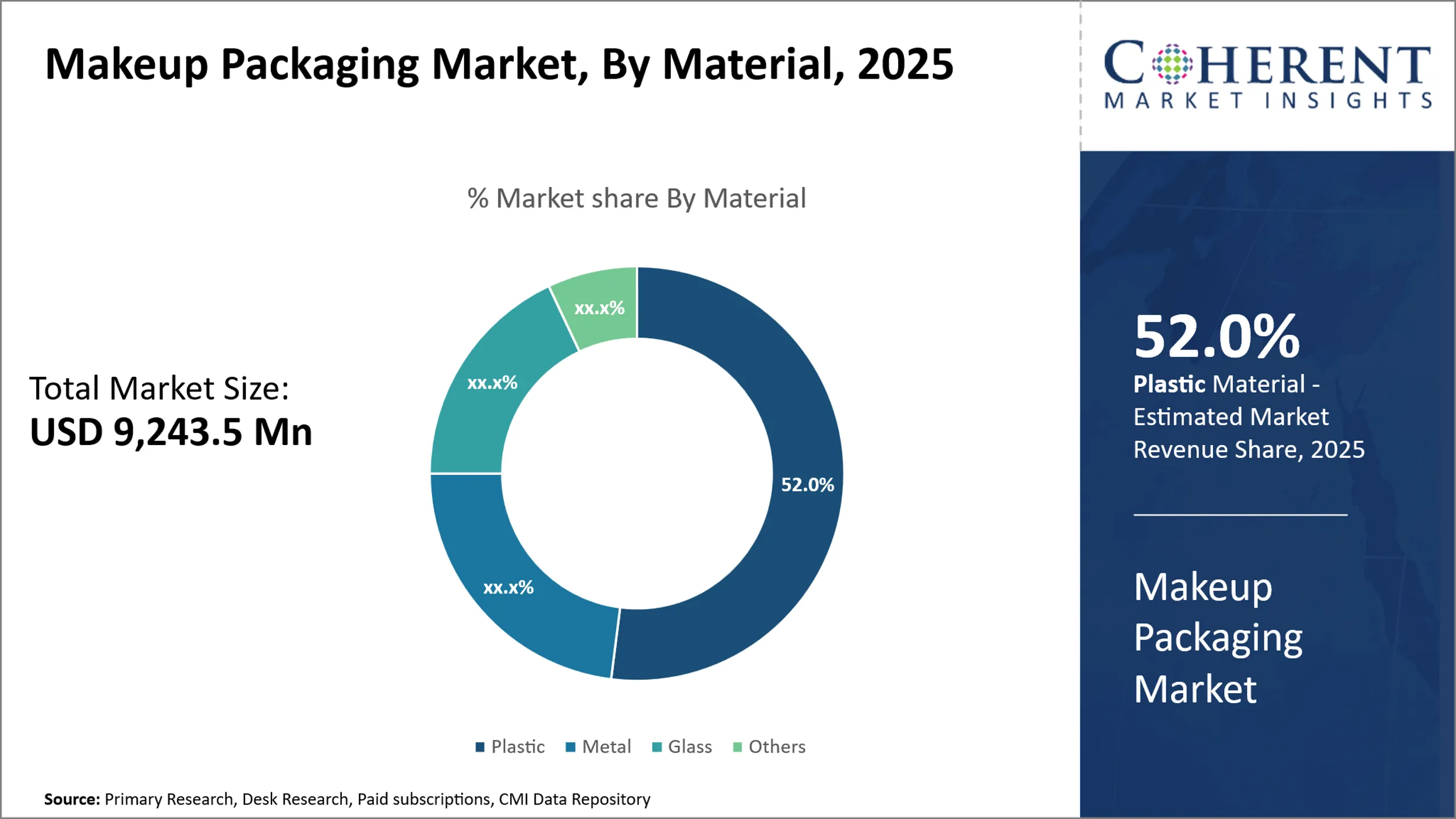
Global Makeup Packaging Market Insights, By Material
Plastic is projected to dominate the global makeup packaging market, accounting for 53.0% of the total market share in 2026. This dominance stems from its lightweight nature, cost-effectiveness, and high adaptability across packaging formats such as compacts, tubes, sticks, and pump bottles. Its compatibility with mass production and customization enables widespread use across both premium and mass-market cosmetics.
Despite growing environmental concerns, the segment is witnessing innovations in recyclable polymers, post-consumer recycled (PCR) plastics, and biodegradable formulations, which are helping mitigate sustainability challenges. Refillable plastic-based packaging is also gaining traction among environmentally conscious consumers, especially in regions like North America and Europe.
Additionally, the makeup packaging market with magnetic closures is emerging as a premium segment within plastic packaging, offering enhanced user experience, secure sealing, and a luxurious aesthetic appeal. Magnetic closures are increasingly being adopted in compact cases, lipstick tubes, and palettes to improve functionality and product differentiation.
Regional Insights
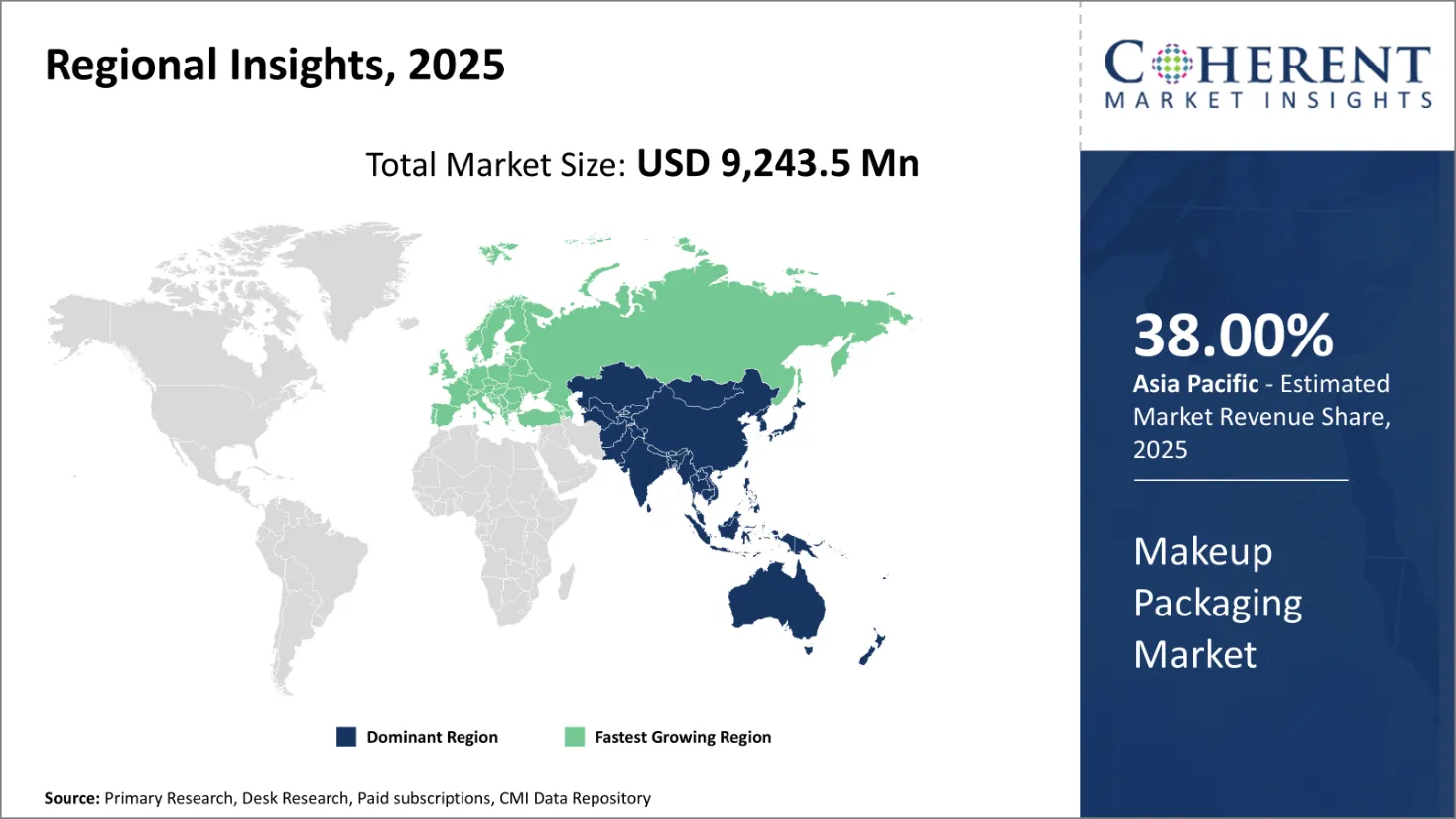
Asia Pacific Makeup Packaging Market Trends and Analysis
Asia Pacific is poised to lead the global makeup packaging market with a projected 38.00% share in 2026, underscoring its position as the most dynamic and fastest-growing region. This regional dominance is driven by a thriving cosmetics industry, rapid urbanization, and a rising young consumer base with increasing disposable income and interest in personal grooming.
Countries such as China, Japan, and South Korea are at the forefront of innovation, with strong domestic manufacturing capabilities and global influence through popular K-beauty and J-beauty trends. The widespread adoption of digital retail channels and social media marketing is further accelerating product launches and consumer engagement.
Regional brands are embracing sustainable packaging solutions, such as refillable containers and biodegradable materials, to align with shifting consumer preferences. These efforts, coupled with high-volume production, customization capabilities, and government support for sustainable manufacturing, firmly establish Asia Pacific as the global hub for innovation and growth in makeup packaging.
Makeup packaging market Dominating Countries
China
China leads the global makeup packaging market within the Asia Pacific region, supported by its large-scale manufacturing ecosystem, rapidly expanding cosmetics industry, and strong domestic demand. The country accounts for the largest share of Asia Pacific’s projected 38% market share in 2026, driven by increasing beauty consciousness among younger demographics and the proliferation of both international and home-grown beauty brands.
China's government policies favour sustainable manufacturing and encourage eco-friendly packaging solutions, such as recyclable plastics and biodegradable alternatives. With a booming e-commerce landscape and aggressive digital marketing strategies, beauty brands in China are launching innovative, customizable, and premium-looking packaging formats to capture consumer attention. The country’s dominance is reinforced by high-volume production capabilities, competitive pricing, and continual investment in design and automation.
South Korea
South Korea plays a pivotal role in shaping the global makeup packaging market, owing to its trend-setting K-beauty industry and innovation-first approach. Renowned for sleek, functional, and visually appealing packaging, South Korean brands prioritize consumer experience and sustainability in packaging design.
With a strong focus on R&D and aesthetics, the country is a hub for new packaging technologies, including airless pumps, refillable compacts, and smart applicators. Government support for green technology and export-focused policies continue to boost Korea’s presence in global markets. As international demand for K-beauty products grows, South Korea remains a key influencer and contributor to packaging trends and volume in the global makeup packaging landscape.
Market Report Scope
Makeup Packaging Market Report Coverage
| Report Coverage | Details | ||
|---|---|---|---|
| Base Year: | 2025 | Market Size in 2026: | USD 9,876.7 Mn |
| Historical Data for: | 2020 To 2024 | Forecast Period: | 2026 To 2033 |
| Forecast Period 2026 to 2033 CAGR: | 6.8% | 2033 Value Projection: | USD 15,704.8 Mn |
| Geographies covered: |
| ||
| Segments covered: |
| ||
| Companies covered: | Albéa S.A., AptarGroup, Inc., Axilone USA, ShyaHsin Packaging (China) Co., Ltd., Lumson SpA, Toly Group, Cosmopak Corp., Yoshida Industries Co., Ltd., Mitani Valve Co Ltd., HCP Packaging (Shanghai) Co. Ltd., Quadpack Industries, S.A., Kolmar Laboratories, Inc., and others. | ||
| Growth Drivers: |
| ||
| Restraints & Challenges: |
| ||
Analyst Viewpoint – Makeup Packaging Market
- The global makeup packaging market is positioned for steady growth, driven by surging demand for personalized beauty products, rising cosmetic consumption among millennial, and increasing emphasis on brand aesthetics. Analysts highlight a significant shift toward sustainable and refillable packaging formats, driven by evolving consumer values and regulatory mandates across regions.
- Technological innovations such as smart packaging, biodegradable materials, and 3D printing are seen as key enablers of product differentiation, customization, and eco-conscious design. Advanced printing techniques, lightweight barrier coatings, and multifunctional applicators are also enhancing user experience and product integrity. Analysts emphasize that brands investing in tech-integrated and recyclable solutions are gaining a competitive edge.
- Despite volatility in raw material prices and regulatory pressure on plastics, the market outlook remains positive. Strategic partnerships between beauty brands and packaging innovators, along with expanding e-commerce and influencer-led marketing, are expected to boost product variety, sustainability efforts, and long-term market value globally.
Makeup Packaging Market: Key Development
- In May 2025, Mary Kay released lotion packaging made with approximately 94% post-consumer recycled (PCR) plastic. This enhances the brand’s green positioning and pressures competitors to adopt higher recycled-content standards.
- In April 2025, Axiology introduced its Zero‑Trace line, featuring lipstick and lip balm tubes made from mycelium-seed composites that decompose within 45 days and support local biodiversity. This paradigm-shifting innovation transforms packaging’s end‑of‑life into ecological gain, setting a new standard in sustainability for beauty brands.
- In February 2025, Alchemie unveiled its Responsive Foundation, using plant-based chromatic polymers and AI-optimized sensors that adapt to user’s skin pH, temperature, and lighting. Smart packaging fused with responsive formulas elevates personalization and functionality expectations in prestige makeup.
- In November 2024 at Cosmopack Asia, Meiyume presented smart packaging with NFC and QR codes to enable product authentication, digital content, and refill options. This marks a shift toward interactive packaging that enhances consumer engagement and combats counterfeit products.
- In September 2024, several beauty brands began adopting bamboo, molded-fiber, and wood-based composite packaging across select skincare and cosmetic lines. These materials signal a pivot to mainstream biodegradable designs, aligning brand strategies with growing eco-conscious consumer sentiment.
Market Segmentation
- Global Makeup Packaging Market, By Material (Revenue, USD Mn, 2021 - 2033)
- Glass
- Metal
- Plastics
- Others (Paper, etc.)
- Global Makeup Packaging Market, By Product Type (Revenue, USD Mn, 2021 - 2033)
- Lip Stick Containers & Tubes
- Lip Gloss Containers & Tubes
- Cosmetic Pen
- Powder Dispensers
- Cushion
- Bottle With Cap
- Bottle With Pump
- Compact
- Face Stick
- Tube
- Jar with Cap
- Mascara Packaging
- Global Makeup Packaging Market, By Application (Revenue, USD Mn, 2021 - 2033)
- Lip Care
- Eye Care
- Skin Care
- Global Makeup Packaging Market, By Region (Revenue, USD Mn, 2021 - 2033)
- North America
- U.S.
- Canada
- Europe
- U.K.
- Germany
- Italy
- France
- Russia
- Rest of Europe
- Asia Pacific
- China
- India
- Japan
- ASEAN
- Australia
- South Korea
- Rest of Asia Pacific
- Latin America
- Brazil
- Mexico
- Rest of Latin America
- Middle East
- UAE
- Saudi Arabia
- Oman
- Qatar
- Bahrain
- Kuwait
- Rest of Middle East
- Africa
- Northern Africa
- Central Africa
- South Africa
- North America
- Key Players Insights
- Albéa S.A
- AptarGroup, Inc.
- Axilone USA
- ShyaHsin Packaging (China) Co., Ltd.
- Lumson SpA
- Toly Group
- Cosmopak Corp.
- Yoshida Industries Co., Ltd.
- Mitani Valve Co Ltd.
- HCP Packaging (Shanghai) Co. Ltd.
- Quadpack Industries, S.A
- Kolmar Laboratories, Inc.
Sources
The Stakeholders Consulted
- Packaging engineers and product designers at cosmetics manufacturers
- Manufacturers and suppliers of cosmetic containers, closures, and dispensers
- Sustainability consultants and materials scientists
- Procurement heads of beauty and personal care brands
- Regulatory compliance officers and product safety auditors
- Research institutions specializing in polymers, biodegradable materials, and design innovation
- Government bodies related to trade, packaging waste management, and environmental protection
- End-users across segments such as skincare, color cosmetics, fragrance, and haircare
Databases Opened
- U.S. Food and Drug Administration (FDA) – Cosmetic Packaging Regulations
- European Commission – Cosmetics Regulation & Packaging Waste Directive
- Japan Ministry of Health, Labour and Welfare – Standards for Packaging in Cosmetics
- World Bank Open Data – Trade and Manufacturing Indicators
- UN Comtrade Database – Trade Statistics for Cosmetic Containers
Magazines & Trade Publications
- CosmeticsDesign.com
- Packaging World
- Global Cosmetics News
- Beauty Packaging Magazine
- Premium Beauty News
- Sustainable Packaging News
Scientific and Industry Journals
- International Journal of Cosmetic Science
- Journal of Packaging Technology and Research
- Cosmetics & Toiletries Journal
- Packaging Technology and Science
- Journal of Cleaner Production
Newspapers & Media Outlets
- The Wall Street Journal – Consumer Goods & Retail
- Bloomberg – Beauty Industry News
- Reuters – Global Packaging & FMCG Markets
- The Economic Times – FMCG & Retail Sector
- Business Standard – Trade & Environment Sections
Associations and Regulatory Bodies
- U.S. Environmental Protection Agency (EPA) – Packaging Waste & Plastics
- Cosmetic, Toiletry and Perfumery Association (CTPA), UK
- Personal Care Products Council (PCPC), U.S.
- Bureau of Indian Standards (BIS) – Packaging Norms
- Sustainable Packaging Coalition
- International Organization for Standardization (ISO) – Packaging Standards
Public Domain Sources
- European Chemicals Agency (ECHA) – Packaging Substance Guidelines
- U.S. Environmental Protection Agency (EPA) – Plastics and Waste Reduction Reports
- European Environmental Agency (EEA) – Circular Economy in Cosmetics Packaging
- International Trade Centre (ITC) – Global Packaging and Export Trends
- UNEP – Reports on Sustainable Packaging Initiatives
Proprietary Research Elements
- CMI Data Analytics Tool
- Proprietary CMI Repository of Market Data (covering past 8 years)
- CMI Expert Interviews and Transcripts (focused on cosmetic packaging innovation, sustainability trends, and consumer behavior)
Get access to 250+ pages report
Every segment, forecast, competitor profile and data table behind the analysis above — available for instant download.
- ESOMAR Member
- ISO 9001:2015 Certified
- D-U-N-S Registered
- GDPR & CCPA Compliant
Missing comfort of reading report in your local language? Find your preferred language:
Transform your Strategy with Exclusive Trending Reports
Frequently Asked Questions
The Makeup Packaging Market size is estimated to be valued at USD 9,876.7 Mn in 2026, and is expected to reach USD 15,704.8 Mn by 2033.
The global makeup packaging market is estimated to surpass USD 15,704.8 Mn by 2033.
Major players operating in the market include Albéa S.A., AptarGroup, Inc., Axilone USA, ShyaHsin Packaging (China) Co., Ltd., Lumson SpA, Toly Group, Cosmopak Corp., Yoshida Industries Co., Ltd., Mitani Valve Co Ltd., HCP Packaging (Shanghai) Co. Ltd., Quadpack Industries, S.A., Kolmar Laboratories, Inc., and others.
Fluctuating prices of raw material is one of the major factors that is expected to hamper growth of the market.
Rising demand for makeup products in the developing economies and changing demographics and evolving consumer taste and buying preferences are the major factors that are expected to propel growth of the market.
The CAGR of the Makeup Packaging Market is projected to be 6.8% from 2026 to 2033.
Among regions, Asia Pacific accounted for the largest market share of 38% in 2026 in the market.