

Global IoT Gateway Market Size and Forecast – 2026 To 2033
The global IoT gateway market is expected to grow from USD 3 Bn in 2026 to USD 9 Bn by 2033, registering a compound annual growth rate (CAGR) of 8.4% from 2026 to 2033. The global IoT gateway market is driven by expansion of smart city infrastructure and connected utilities. On July 7, 2025, Siemens announced a collaboration agreement with Microsoft to transform access to Internet of Things (IoT) data for buildings. The collaboration will enable interoperability between Siemens' digital building platform, Building X, and Microsoft Azure IoT Operations enabled by Azure Arc.
Key Takeaways of the Global IoT Gateway Market
- The hardware segment is expected to account for 48.0 % of the global IoT gateway market share in 2026. Growth in connected healthcare and remote patient monitoring is driving the growth of the segment. On January 8, 2026, Empatica announced that its EmbraceMini received 510(k) clearance from the U.S. Food and Drug Administration (FDA).
- The cloud segment is estimated to capture 56.0 % of the market share in 2026. Increasing demand for secure device to cloud communication is majorly driving the growth of the segment. On June 10, 2025, Cisco launched Hybrid Mesh Firewall to extend Zero Trust security from enterprise networks to branch offices, industrial sites, and IoT environments.
- The ethernet segment is estimated to capture 28.0 % of the market share in 2026. Rapid rollout of private 5G and Wi-Fi 6 industrial networks is driving the growth of the segment. On February 4, 2025, AT&T announced it is extending its voice core relationship with Nokia in a multi-year expansion deal that will support the U.S. operator in delivering on its vision of securely providing customer-focused networks and automation that drive new services, faster deployment times, and operational efficiencies.
- North America is expected to dominate the IoT gateway market in 2026 with a market share of 38.0 %. Growing deployment of connected transportation infrastructure in North America is driving the growth of the regional market. On May 6, 2026, Kapsch TrafficCom was awarded a contract to expand the SB Express Lanes network in San Bernardino County, California, U.S.
- Asia Pacific is expected to account for 30.0 % of the market share in 2026 and is projected to record the fastest growth over the forecast period. Integration of digital twin technologies with industrial gateways across Asia Pacific is driving the growth of the regional market. In March 2026, Mitsubishi Electric (Japan) developed a new edge digital twin technology for CNC machine tools that performs real-time machining error compensation directly through edge computing integrated with industrial control systems.
- AI Powered Edge Intelligence Becoming a Core Gateway Feature: AI accelerators and machine learning capabilities are being embedded into IoT gateways at an ever-increasing pace. They support real-time data filtering, predictive analytics, anomaly detection, and automated decision-making at the edge, thereby reducing cloud dependency and improving response times for industrial automation, healthcare, and smart infrastructure applications.
- Growing Adoption of Multi-Protocol and Software Defined Connectivity: Manufacturers are building gateways that can accommodate multiple industrial communication protocols such as MQTT, OPC UA, Modbus, BACnet, CAN, Zigbee, LoRaWAN, and private 5G infrastructure via software-defined architectures, enabling interoperability across diverse IoT ecosystems.
Segmental Insights
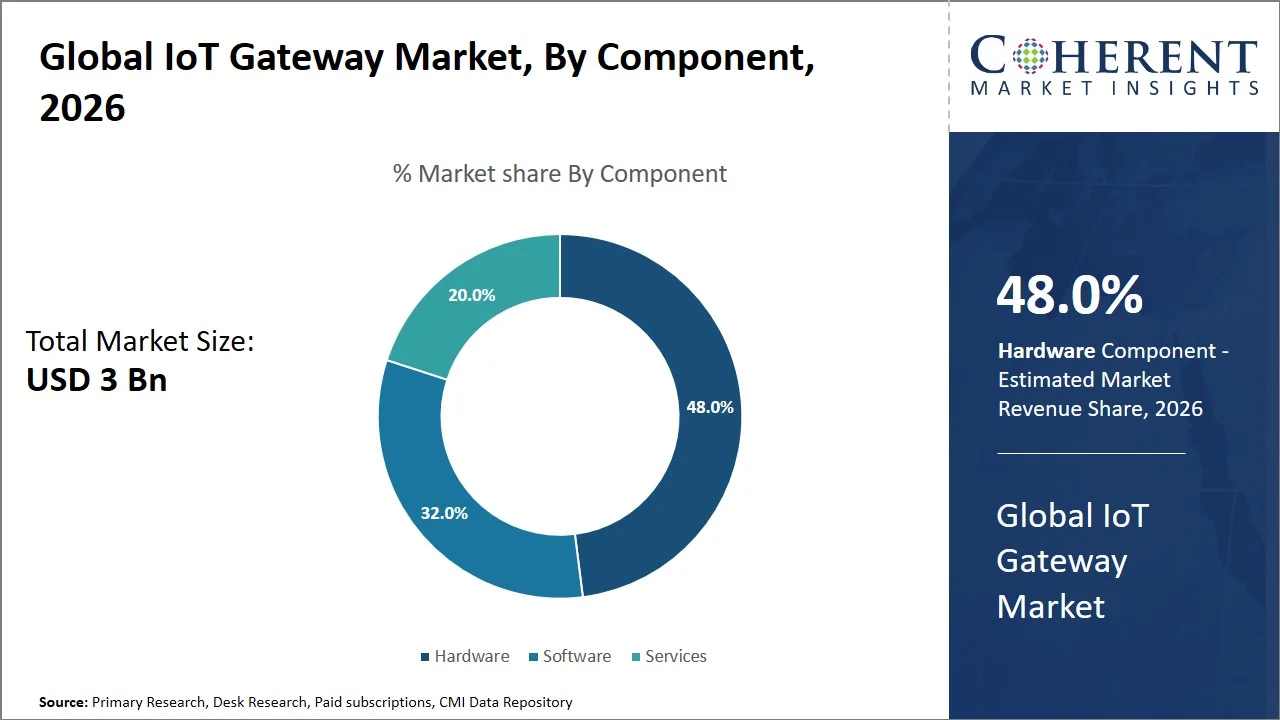
Why Does Hardware Dominate the Global IoT Gateway Market?
The hardware segment is expected to account for 48.0% of the global IoT gateway market share in 2026. Hardware accounts for the largest share of the global IoT gateway market because every IoT deployment requires a physical gateway to connect field devices, industrial equipment, sensors, and machines with enterprise networks and cloud platforms. These gateways are a critical component in manufacturing, energy, transportation, healthcare and smart city applications, regardless of the software or services deployed, with basic functions such as protocol conversion, edge data processing, device management and secure communication. On April 21, 2026, Siemens announced significant expansions to its Industrial Edge ecosystem, accelerating data and AI integration and releasing enhanced cybersecurity functionalities. These enable a seamless integration of IT and Operational Technology environments, optimize processes and reduce operational disruptions.
- Current Industry Events of 2026
- Market Size Estimation
- Regional Breakdown
- Competitive Landscape
- Customer Intelligence
- Segmental Analysis
- Pricing Analysis
- Key Market Drivers, Challenges & Future Trends
- Customized Insights Section
Why is Cloud the Most Preferred Deployment Type?
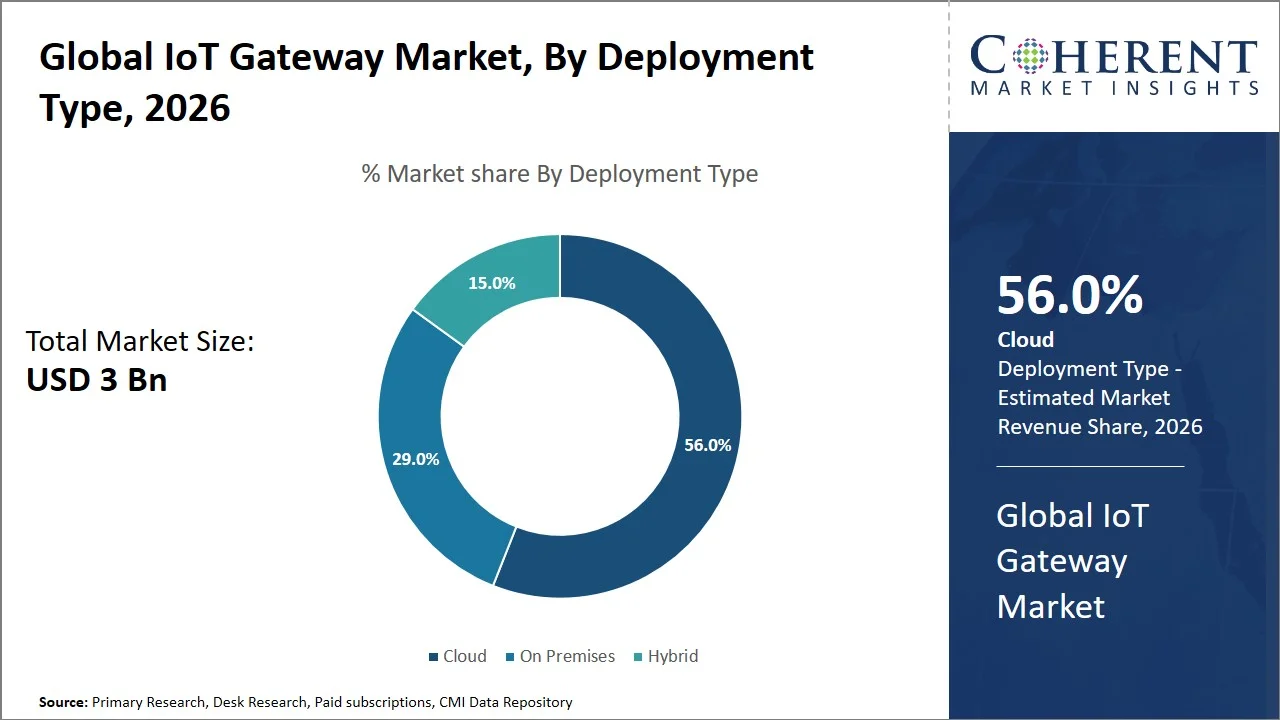
The cloud segment is expected to account for 56.0% of the global IoT gateway market share in 2026. Cloud deployment is highly favored since it helps to manage thousands of geographically-distributed IoT gateways and connected devices in a centralized manner from a single platform. It enables organizations to track gateway performance remotely, deploy software updates, manage security policies and scale connected infrastructure without large investments in on-premises hardware. It is ideal for large scale industrial, smart city, logistics and enterprise IoT deployments. On February 22, 2024, Dell Technologies also announced additional capabilities to its NativeEdge platform, including enhanced zero-touch provisioning and centralized lifecycle management that enable enterprises to remotely onboard, configure, update and monitor thousands of edge gateways from a single cloud-based management console across manufacturing, retail and logistics environments.
Ethernet Dominates the Global IoT Gateway Market
The ethernet segment is expected to account for 28.0% of the global IoT gateway market share in 2026. Ethernet continues to be the most favored type of connectivity as it enables highly dependable, low-latency and high-bandwidth communication needed for mission-critical industrial IoT applications. Its robust wired topology provides reliable data transfer between sensors, controllers, gateways and enterprise systems, and supports deterministic communications, making it the preferred choice for manufacturing plants, power utilities, transportation infrastructure and other environments where network reliability and operational continuity are critical. On April 17, 2025, Belden Inc. announced the launch of its Hirschmann GREYHOUND2000 Standard Switch. Building on Belden’s visionary leadership in the industrial automation space, GREYHOUND2000 sets new standards for 19-inch Ethernet switches. This next-generation switch delivers very high fiber port density and configurable port modules that adapt to various connectivity scenarios.
Current Events and their Impact
Current Events | Description and its Impact |
European Union Cyber Resilience Act (CRA) |
|
European Union NIS2 Directive |
|
Global IoT Gateway Market Dynamics
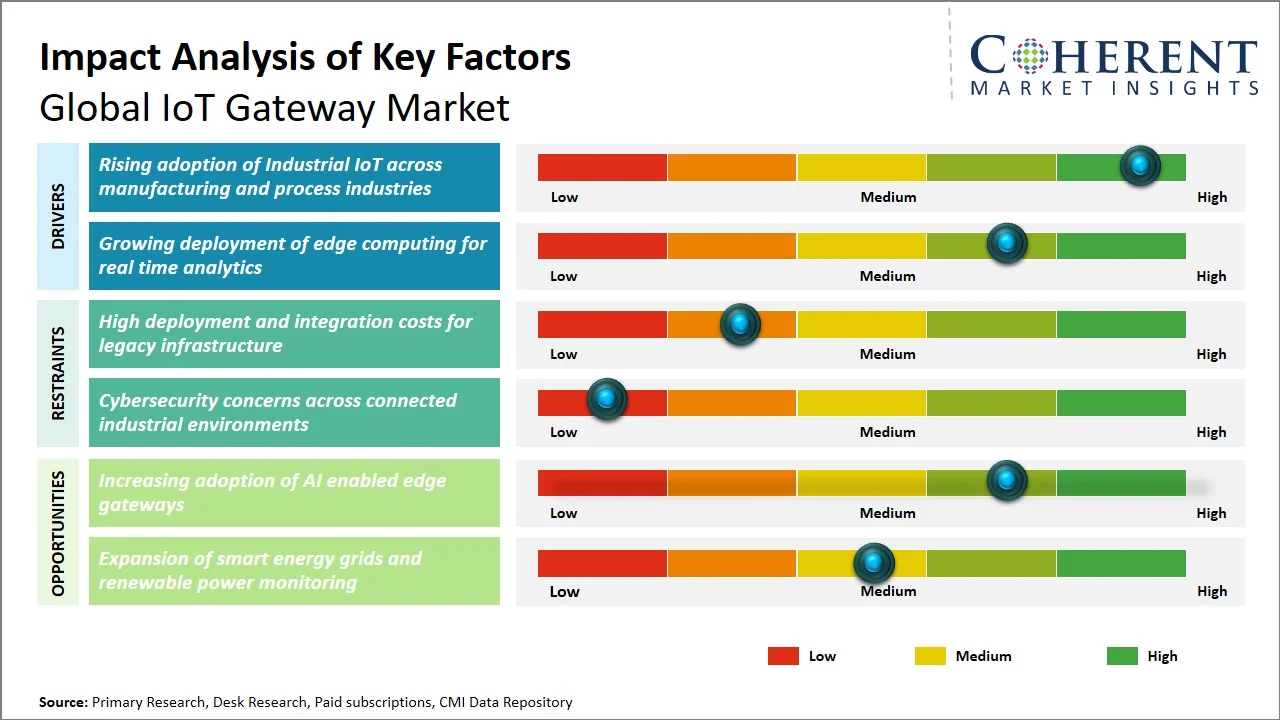
Market Drivers
- Rising adoption of Industrial IoT across manufacturing and process industries: The rising adoption of Industrial IoT across manufacturing and process industries is driving strong demand for IoT gateways, as factories connect machines, sensors, programmable logic controllers, and production equipment into unified digital networks. IoT gateways provide smooth protocol conversion, secure data transmission and edge level processing that enables manufacturers to increase predictive maintenance, production efficiency, asset utilization and operational visibility as well as facilitate large scale industrial automation programs. On April 16, 2026, Schneider Electric, a global energy technology leader, announced its strategic collaboration with Microsoft at Hannover Messe, demonstrating how their combined technologies are enabling manufacturers to modernize operations, accelerate engineering, and strengthen resiliency.
- Growing deployment of edge computing for real time analytics: The growth of IoT gateways is being fueled by the increased usage of edge computing for real-time analytics as they evaluate and process data near the source rather than relying entirely on centralized cloud infrastructure. This significantly reduces latency, lowers network bandwidth requirements, allows for quicker decision-making, and enables mission-critical applications such as autonomous manufacturing, energy management, connected transportation, and industrial process control where immediate responses are required. On November 21, 2025, Advantech presented its strategic vision for AI in Manufacturing with Digital Twins and Physical AI at the 2025 Manufacturing CIO Forum. Through a combination of insightful presentations and live demonstrations, Advantech showcased how scalable Edge AI systems and NVIDIA-accelerated computing platforms are powering the next era of autonomous, intelligent manufacturing, addressing the industry’s growing demand for decentralized, real-time decision-making.
Emerging Trends
- Increasing Integration of Cybersecurity and Zero Trust Architecture: IoT gateway vendors are embedding hardware root of trust, secure boot, Trusted Platform Modules, end-to-end encryption, identity management and Zero Trust security frameworks directly into gateway platforms to counter growing cybersecurity threats across critical infrastructure and industrial IoT deployments.
- Expansion of Containerized Edge Computing Platforms: IoT gateways are evolving into edge computing platforms that can run containerized applications using technologies such as Docker and Kubernetes. This allows enterprises to deploy, update, and manage analytics, AI models, and industrial applications remotely, scaling up operations and decreasing complexity.
Regional Insights
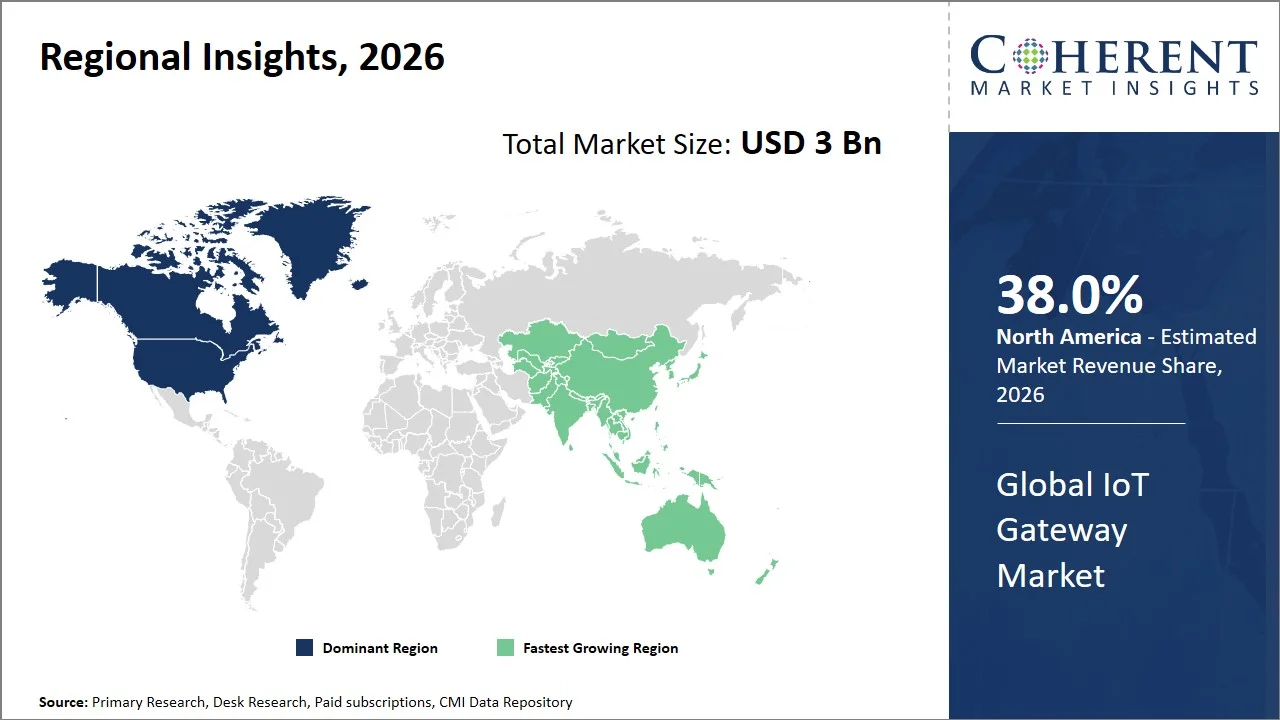
Why is North America a Strong Market for IoT Gateway?
North America is expected to account for a market share of 38.0% in 2026. The IoT gateway market is dominated by the North America region, because to the fast-paced digital transformation of industrial activities and the massive deployment of edge computing infrastructure across the United States and Canada. The region is one of the most concentrated regions for Industrial IoT installations, with manufacturers progressively embedding gateways in smart factories for real time machine monitoring and predictive maintenance. Utilities are installing IoT gateways in advanced metering infrastructure and grid automation projects, and oil and gas operators are employing ruggedized gateways in pipeline monitoring and remote asset management.
Large vendors such as Cisco Systems, Dell Technologies, Hewlett Packard Enterprise, Intel, Lantronix and Digi International have extensive portfolios of IoT gateways and work with cloud vendors such as Microsoft Azure, Amazon Web Services and Google Cloud to connect the edge to the cloud. Verizon Business, AT&T and T-Mobile are continuing to grow private 5G and LTE networks that power industrial gateway deployments, while sectors such as logistics, healthcare and smart buildings are rapidly adopting AI-enabled edge gateways for low-latency analytics.
Why Does the Asia Pacific IoT Gateway Market Exhibit High Growth?
Asia Pacific is projected to account for 30.0% of the global IoT gateway market in 2026 and is expected to register the fastest growth. Asia Pacific is the fastest developing market because of large scale investments in smart manufacturing, increasing semiconductor manufacturing and government-led industrial digitalization projects. China, Japan, South Korea, India, Singapore and Taiwan are using IoT gateways in automobile production, electronics assembly, energy infrastructure, ports and smart cities. China’s “New Infrastructure” push has helped expedite the implementation of industrial internet, while Japan’s Society 5.0 approach and South Korea’s Digital New Deal continue to push connected industrial ecosystems. Industrial gateways are used by Taiwan’s semiconductor manufacturing facilities for equipment monitoring and predictive maintenance and are being deployed across Singapore’s intelligent transport systems, smart utilities and port automation. The rising use of private 5G networks, Wi-Fi 6 and AI-powered edge computing further support the regional demand for powerful multi-protocol IoT gateways.
Global IoT Gateway Market Outlook for Key Countries
Why is the U.S. Emerging as a Major Hub in the IoT Gateway Market?
The U.S. is the largest country market, with broad adoption of Industrial IoT across manufacturing, logistics, defense, healthcare and energy. Industrial gateways are increasingly being adopted by major manufacturers such as General Motors, Ford, Boeing, Lockheed Martin and Tesla to monitor production, integrate robotics and do predictive maintenance. Enterprise edge is supported by gateway-based edge computing platforms such as Amazon Web Services IoT Greengrass, Microsoft Azure IoT Edge and Google Distributed Cloud Edge. Cisco Systems, Dell Technologies, Hewlett Packard Enterprise, Intel and Lantronix are still shipping secure edge gateway solutions suited for AI workloads and industrial automation. Utilities are deploying IoT gateways for smart grid modernization efforts, while warehouse operators and logistics corporations are using gateways for autonomous mobile robots, automated guided vehicles, and real-time asset tracking.
Is China the Next Growth Engine for the IoT Gateway Market?
China is one of the world’s largest markets for IoT gateways due to its vast manufacturing base and growing industrial digitization. Under the country’s Industrial Internet program, thousands of companies have been connected through intelligent production systems that rely on gateways for protocol conversion and edge analytics. Huawei, Inspur, Lenovo and Advantech have large industrial IoT ecosystems that serve projects in manufacturing, mining, transportation and energy. Large car manufacturers such as SAIC Motor, BYD and Geely are increasingly using industrial gateways to connect production lines. The large-scale deployment of standalone 5G networks by China Mobile, China Telecom and China Unicom has pushed the use of AI-enabled edge gateways at ports, steel factories, petrochemical complexes and smart logistics hubs.
Germany IoT Gateway Market Analysis and Trends
Germany continues to be the largest IoT gateway market in Europe because to its strong Industry 4.0 ecosystem and very automated manufacturing industry. Industrial gateways are commonly used in automobile production, machine tools, factory automation and process industries to connect programmable logic controllers, sensors and enterprise software platforms. Siemens, Bosch, Phoenix Contact, Beckhoff Automation and WAGO continue to grow industrial edge computing solutions that combine IoT gateways with digital twin and predictive maintenance applications. Car makers like BMW, Mercedes-Benz, Volkswagen, Audi and Porsche are increasingly relying on industrial gateways to enable connected assembly lines and quality-inspection systems. Germany’s focus on OPC UA, industrial Ethernet and secure machine-to-machine communication further boosts the demand for innovative multi-protocol gateways.
Japan IoT Gateway Market Analysis and Trends
Japan is a prominent market for IoT gateways, due to its advanced robotics, factory automation, semiconductor manufacturing and smart infrastructure initiatives. Toyota, Honda, Nissan, Fanuc, Mitsubishi Electric, Omron, and Yaskawa Electric are among the manufacturers that heavily employ industrial gateways to connect robotic cells, automated production lines, and industrial control systems. The government’s Society 5.0 plan is boosting digital transformation throughout industrial, healthcare, transportation and urban infrastructure. Japanese manufacturers are progressively using AI-enabled edge gateways, machine vision, industrial robots and predictive maintenance solutions to reduce downtime and increase production efficiency. The country’s strength in precision manufacturing and industrial automation continues to drive demand for high-performance, low-latency gateway platforms.
South Korea IoT Gateway Market Analysis and Trends
South Korea is emerging as a highly advanced IoT gateway market. The country is a pioneer in semiconductors, electronics manufacturing, automotive production and statewide 5G deployment. Samsung Electronics, LG Electronics, Hyundai Motor Group, SK Telecom and KT Corporation are actively deploying gateways throughout smart factories, connected production systems and intelligent logistical operations. The government’s K-Smart Factory program has enabled thousands of manufacturing plants to combine industrial IoT devices, AI analytics and edge computing platforms via industrial gateways. Samsung Electronics and SK hynix operate semiconductor fabrication facilities which depend on gateways to continuously monitor equipment and control the environment, and Hyundai Motor Group uses connected manufacturing technology across its car production plants. Growing private 5G deployments in industrial campuses are driving the adoption of secure AI-enabled IoT gateway solutions.
Global IoT Gateway Market - Industrial Protocol Support Analysis (OPC UA, Modbus, PROFINET, EtherNet/IP, CAN)
Industrial Protocol | Primary Application | Estimated Share of Industrial IoT Gateway Support (2025) |
OPC UA | IT/OT integration, SCADA, MES, Cloud connectivity | 88% |
Modbus (RTU/TCP) | Legacy equipment integration and field device communication | 94% |
PROFINET | Real-time factory automation | 72% |
EtherNet/IP | Industrial automation and motion control | 69% |
CAN / CANopen | Embedded machine and vehicle communication | 61% |
How is the Increasing Adoption of AI Enabled Edge Gateways Creating New Growth Opportunities in the IoT Gateway Market?
The growing usage of AI-enabled edge gateways is opening up new business prospects as gateways evolve from basic connectivity devices to intelligent edge computing platforms capable of doing AI inference at the point of data creation. Machine vision inspection in automotive assembly lines, predictive maintenance in rotating equipment, anomaly detection in electrical substations, quality inspection in semiconductor fabrication and video analytics in smart transportation systems are just a few examples of how modern gateways with neural processing units and AI accelerators are being deployed without the need to continuously transmit large volumes of data to the cloud.
Frameworks such as NVIDIA Jetson, Intel OpenVINO, Qualcomm AI Engine, and AMD Ryzen Embedded AI are now being used in industrial gateways to deliver real-time computer vision, sensor fusion, and industrial analytics with millisecond response times. It is driving demand in manufacturing, energy, logistics, healthcare and smart city use cases where low latency, data privacy, reduced bandwidth usage and continuous operation are critical. This is a huge opportunity for vendors that offer high-performance AI-enabled edge gateway solutions with integrated cybersecurity and containerized application support.
On March 18, 2025, NVIDIA announced the NVIDIA AI Data Platform, a customizable reference design that leading providers are using to build a new class of AI infrastructure for demanding AI inference workloads: enterprise storage platforms with AI query agents fueled by NVIDIA accelerated computing, networking and software.
Market Players, Key Development, and Competitive Landscape
Key Developments
- On July 7, 2026, Advantech, a global leader in AIoT and Edge Computing, announced an expanded collaboration with StereoLabs to accelerate high-performance perception for Physical AI and robotics applications. Through this collaboration, Advantech’s robotics platforms—including AFE-A702 and ASR-A702 powered by NVIDIA Jetson Thor, as well as AFE-R750 and ASR-A701 powered by NVIDIA Jetson AGX Orin and NVIDIA Jetson Orin NX.
- On February 21, 2025, Cisco was named Industrial IoT Company of the Year 2025 in the IoT Breakthrough Awards Program. In the award announcement, IoT breakthrough emphasized Cisco’s innovations in industrial cybersecurity and AI readiness, which is of paramount importance for industrial operations.
Competitive Landscape
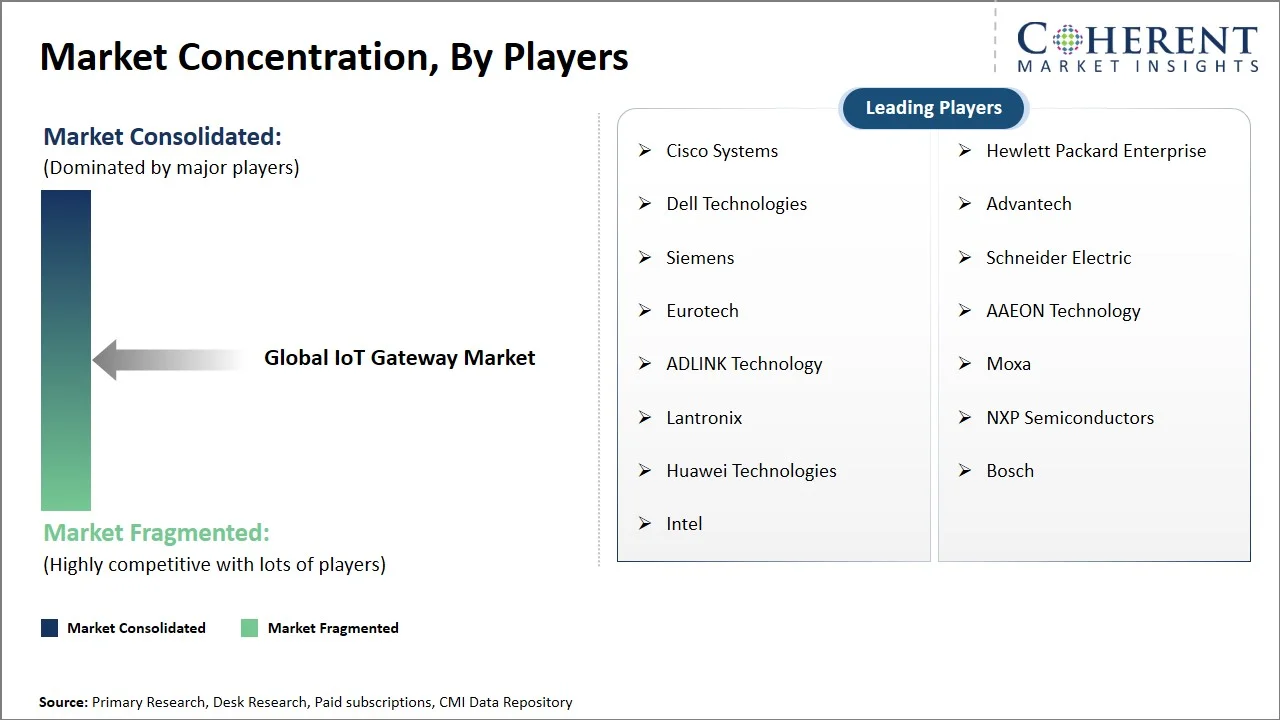
The global IoT gateway market is moderately consolidated, with Cisco Systems, Advantech, Siemens, Hewlett Packard Enterprise, Dell Technologies, Eurotech, Moxa, Lantronix, ADLINK Technology, and Bosch leading innovation through AI-enabled edge computing, industrial connectivity, and cybersecurity. Cisco continues expanding its Industrial Ethernet and IoT gateway portfolio by integrating secure networking, edge intelligence, and hybrid cloud management through Cisco IoT Operations Dashboard. Advantech has enhanced its position with rugged industrial gateways integrated with the WISE-Edge platform and edge AI capabilities for manufacturing and energy applications.
Siemens is focused on Industrial Edge solutions that connect IoT gateways with factory automation, digital twins and industrial AI, especially in the automotive and process industries. Dell Technologies and Hewlett Packard Enterprise are presenting edge-to-cloud architectures using NativeEdge and HPE Edgeline technologies, for remote industrial operations. Moxa and Lantronix continue expanding multi-protocol industrial gateways supporting Modbus, OPC UA, CAN, and MQTT, while Eurotech differentiates itself through Everyware Software Framework for large-scale edge orchestration. Most leading vendors are prioritizing embedded AI accelerators, containerized application deployment, Zero Trust cybersecurity, private 5G compatibility, and lifecycle device management to strengthen their competitive positioning.
Market Report Scope
IoT Gateway Market Report Coverage
| Report Coverage | Details | ||
|---|---|---|---|
| Base Year: | 2025 | Market Size in 2026: | USD 3 Bn |
| Historical Data for: | 2020 To 2024 | Forecast Period: | 2026 To 2033 |
| Forecast Period 2026 to 2033 CAGR: | 8.4% | 2033 Value Projection: | USD 9 Bn |
| Geographies covered: |
| ||
| Segments covered: |
| ||
| Companies covered: | Cisco Systems, Hewlett Packard Enterprise, Dell Technologies, Advantech, Siemens, Schneider Electric, Eurotech, AAEON Technology, ADLINK Technology, Moxa, Lantronix, NXP Semiconductors, Huawei Technologies, Bosch, and Intel | ||
| Growth Drivers: |
| ||
| Restraints & Challenges: |
| ||
Analyst Opinion (Expert Opinion)
- The future of the industry is expected to shift from conventional connectivity gateways toward AI-native edge computing platforms capable of executing computer vision, predictive analytics, and autonomous industrial decision-making locally. Demand will increasingly be driven by gateways that combine AI inference, cybersecurity, container orchestration, and support for multiple industrial communication protocols within a single hardware platform.
- The strongest growth opportunity is expected to emerge in AI-enabled hardware gateways deployed across smart manufacturing applications in China, where large-scale factory digitalization, private 5G deployment, and industrial AI adoption are accelerating simultaneously. Additional high-growth opportunities are expected in semiconductor manufacturing in South Korea, automotive production in Germany, and smart utilities in the U.S., where low-latency edge processing has become a critical operational requirement.
- Market players should focus on building hardware platforms with dedicated AI accelerators, secure-by-design architectures and containerized edge app support, rather than fighting over connection features. Strategic collaborations with hyperscale cloud providers, industrial automation firms, semiconductor manufacturers and private 5G ecosystem partners will be critical to scale business deployments and create long-term distinction in high-value industrial IoT projects.
Speak to the analyst
Want personalized insights?
Take the findings above to one of our principal consultants, or have the report rebuilt around the segments, geographies and competitors you actually track.
Market Segmentation
- Component Insights (Revenue, USD Billion, 2021 - 2033)
- Hardware
- Software
- Services
- Deployment Type Insights (Revenue, USD Billion, 2021 - 2033)
- Cloud
- On Premises
- Hybrid
- Connectivity Type Insights (Revenue, USD Billion, 2021 - 2033)
- Ethernet
- Wi-Fi
- Cellular
- Bluetooth
- Zigbee
- LoRaWAN
- Others
- End User Insights (Revenue, USD Billion, 2021 - 2033)
- Manufacturing
- Energy and Utilities
- Healthcare
- Transportation and Logistics
- Smart Cities
- Retail
- Agriculture
- Oil and Gas
- Others
- Regional Insights (Revenue, USD Billion, 2021 - 2033)
- North America
- U.S.
- Canada
- Latin America
- Brazil
- Argentina
- Mexico
- Rest of Latin America
- Europe
- Germany
- U.K.
- Spain
- France
- Italy
- Russia
- Rest of Europe
- Asia Pacific
- China
- India
- Japan
- Australia
- South Korea
- ASEAN
- Rest of Asia Pacific
- Middle East
- GCC Countries
- Israel
- Rest of Middle East
- Africa
- South Africa
- North Africa
- Central Africa
- North America
- Key Players Insights
- Cisco Systems
- Hewlett Packard Enterprise
- Dell Technologies
- Advantech
- Siemens
- Schneider Electric
- Eurotech
- AAEON Technology
- ADLINK Technology
- Moxa
- Lantronix
- NXP Semiconductors
- Huawei Technologies
- Bosch
- Intel
Sources
Primary Research Interviews
- Industrial Automation System Integrators
- Smart Manufacturing Plant Managers
- Industrial Network Infrastructure Engineers
- Utility Grid Digital Transformation Managers
Magazines
- Embedded Computing Design
- Electronic Design
- Control Engineering
- Automation World
Journals
- IEEE Internet of Things Journal
- Internet of Things (Elsevier)
- Journal of King Saud University – Computer and Information Sciences
Associations
- Industrial Internet Consortium
- Open Connectivity Foundation
- OPC Foundation
- International Society of Automation
Public Domain Sources
- International Telecommunication Union (ITU) IoT Recommendations and Standards
- National Institute of Standards and Technology (NIST)
- European Commission Digital Strategy and Industry 5.0 publications
Proprietary Elements
- CMI Data Analytics Tool
- Proprietary CMI Existing Repository of Information for the Last 10 Years
Get access to 250+ pages report
Every segment, forecast, competitor profile and data table behind the analysis above — available for instant download.
- ESOMAR Member
- ISO 9001:2015 Certified
- D-U-N-S Registered
- GDPR & CCPA Compliant
Missing comfort of reading report in your local language? Find your preferred language:
Transform your Strategy with Exclusive Trending Reports
Frequently Asked Questions
The global IoT gateway market is expected to stand at USD 3 Bn in 2026 and is expected to reach USD 9 Bn by 2033.
The CAGR of the global IoT gateway market is projected to be 8.4% from 2026 to 2033.
Rising adoption of Industrial IoT across manufacturing and process industries and growing deployment of edge computing for real time analytics are the major factors driving the growth of the global IoT gateway market.
High deployment and integration costs for legacy infrastructure and cybersecurity concerns across connected industrial environments are the major factors hampering the growth of the global IoT gateway market.
In terms of component, the hardware segment is estimated to dominate the market revenue share in 2026.
They support real-time AI inference and analytics directly at the edge without relying on the cloud.
Private and public 5G networks enable faster, lower-latency connectivity for industrial IoT gateways.