

Global Jet Fuel Market Size and Forecast – 2026 To 2033
The global jet fuel market is estimated to be valued at USD 259.39 Bn in 2026 and is expected to reach USD 433.15 Bn by 2033, exhibiting a compound annual growth rate (CAGR) of 7.6% from 2026 to 2033. Market growth will be supported by increasing passenger traffic, higher aircraft utilization, airline fleet additions, expanding air-cargo activity, and airport capacity development across major aviation hubs.
Jet fuel suppliers are also investing in refinery integration, storage reliability, fuel-quality assurance, and sustainable aviation fuel blending to meet evolving airline procurement and emissions-compliance requirements. In 2024, the International Civil Aviation Organization reported that scheduled airlines carried 4.7 billion passengers, up 7.9% from 2023, while global aircraft departures increased 5.1% to 37.4 million. This expanding flight base directly strengthens recurring aviation turbine fuel consumption and airport-level supply requirements.
Key Takeaways of the Global Jet Fuel Market
- The Jet A and Jet A1 segment is expected to hold 71.8 % of the global jet fuel market in 2026 because their standardized specifications, aircraft compatibility, refinery availability, and established airport storage systems minimize switching and certification costs. In July 2025, Air bp began supplying Jet-A1 with ExecuJet at Berlin Brandenburg Airport’s general aviation terminal.
- Commercial passenger aviation is expected to account for 67.4 % of the market share in 2026, reflecting its high flight frequency, extensive scheduled networks, large active fleets, and continuous fuel uplift requirements across hub-and-spoke systems. In January 2026, IATA reported that global passenger demand increased 5.3% in 2025 and the industry achieved a record full-year passenger load factor.
- Direct airline supply contracts are expected to capture 46.8 % of the market share in 2026 because large carriers prioritize volume assurance, negotiated pricing formulas, quality control, and coordinated delivery across strategic airport networks. In September 2024, TotalEnergies agreed to supply Air France-KLM with up to 1.5 million tons of sustainable aviation fuel over ten years.
- Asia Pacific is expected to represent 32.7 % of the global jet fuel market in 2026, supported by dense domestic routes, expanding international connectivity, airport capacity additions, and airline fleet growth across China, India, and Southeast Asia. In February 2026, Airbus projected that Asia Pacific would require 19,560 new passenger aircraft, representing 46% of global demand over twenty years.
- Europe is expected to hold 29.4 % of the market share in 2026 and remain the fastest-growing region as binding fuel rules, refinery conversion projects, airport blending systems, and airline decarbonization commitments create structured demand for conventional jet fuel and SAF blends. In February 2025, the European Commission confirmed progress toward the ReFuelEU Aviation requirement for a 2% SAF share at EU airports.
- Sustainable Aviation Fuel (SAF) Portfolio Integration: Sustainable aviation fuel is moving from isolated procurement programs into broader fuel portfolio planning. Suppliers must align feedstock sourcing, refining pathways, certification, blending, and airport delivery while airlines evaluate lifecycle attributes alongside price and availability. This transition favors integrated companies capable of managing traceability, contract complexity, and dependable supply without disrupting established aircraft or refueling infrastructure.
- Resilient Fuel Procurement: Airlines and airports are placing greater strategic value on diversified sourcing, storage access, contractual flexibility, and transparent pricing mechanisms. This changes competition from simple fuel availability toward reliability under disruption. Suppliers with multi-airport coverage, trading capability, inventory visibility, and strong logistics partnerships can secure preferred positions, while buyers increasingly balance long-term agreements with tactical spot-market access.
Segmental Insights
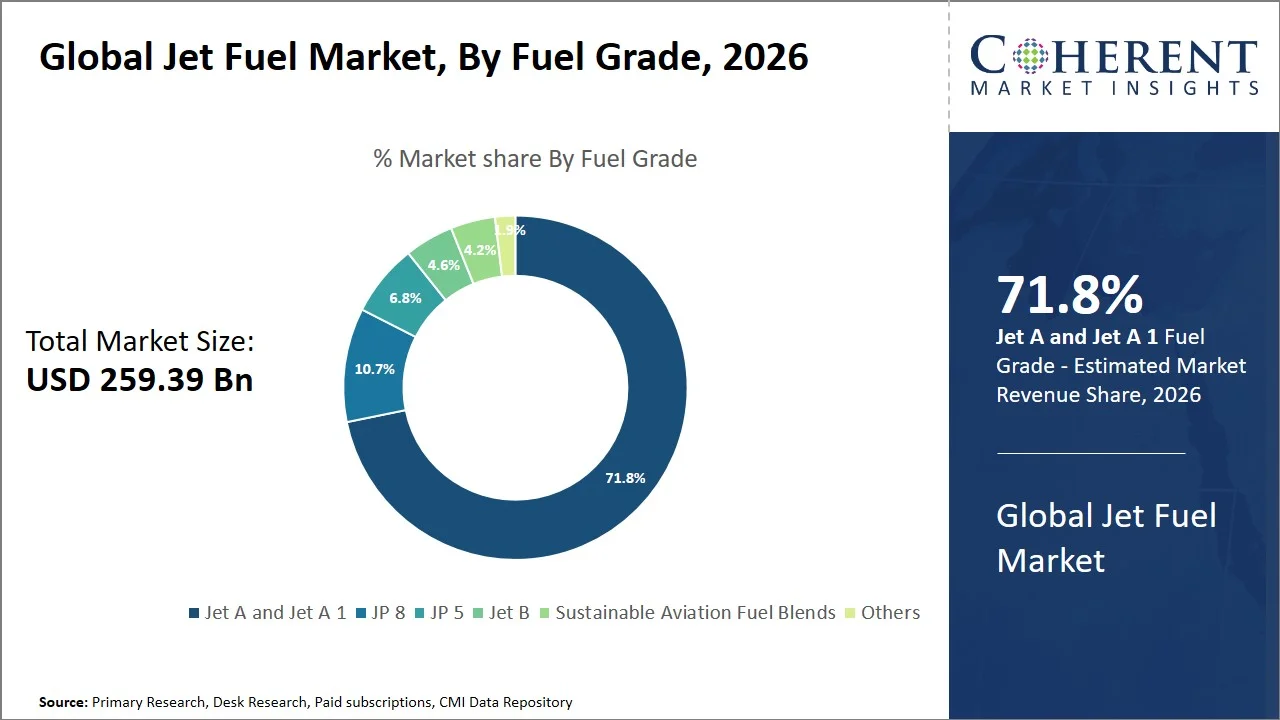
Why Does the Jet A and Jet A1 Segment Dominate the Global Jet Fuel Market?
The Jet A and Jet A1 segment is expected to account for 71.8% of the global jet fuel market in 2026 because they remain the reference kerosene grades for civil turbine aircraft. Jet A supports the large North American fleet, while Jet A1’s lower freezing-point specification suits international and long-haul operations. Refiners, terminals, airport tank farms, pipelines, hydrant systems, and quality-control laboratories are already configured around these grades, limiting the economic case for separate fuel infrastructure. Their compatibility across major aircraft platforms also enables suppliers to pool volumes, maintain inventory turnover, and blend certified sustainable aviation fuel into an established base product. This favors integrated refiners and airport-fueling operators with dependable logistics and testing capability. In April 2026, ENOC Group and Emarat signed a business-continuity agreement covering Jet A1 pipeline transfers, truck loading, emergency coordination, and uninterrupted supply across key UAE aviation hubs.
- Current Industry Events of 2026
- Market Size Estimation
- Regional Breakdown
- Competitive Landscape
- Customer Intelligence
- Segmental Analysis
- Pricing Analysis
- Key Market Drivers, Challenges & Future Trends
- Customized Insights Section
Why Does Commercial Passenger Aviation Represent the Largest Aviation Segment in the Global Jet Fuel Market?
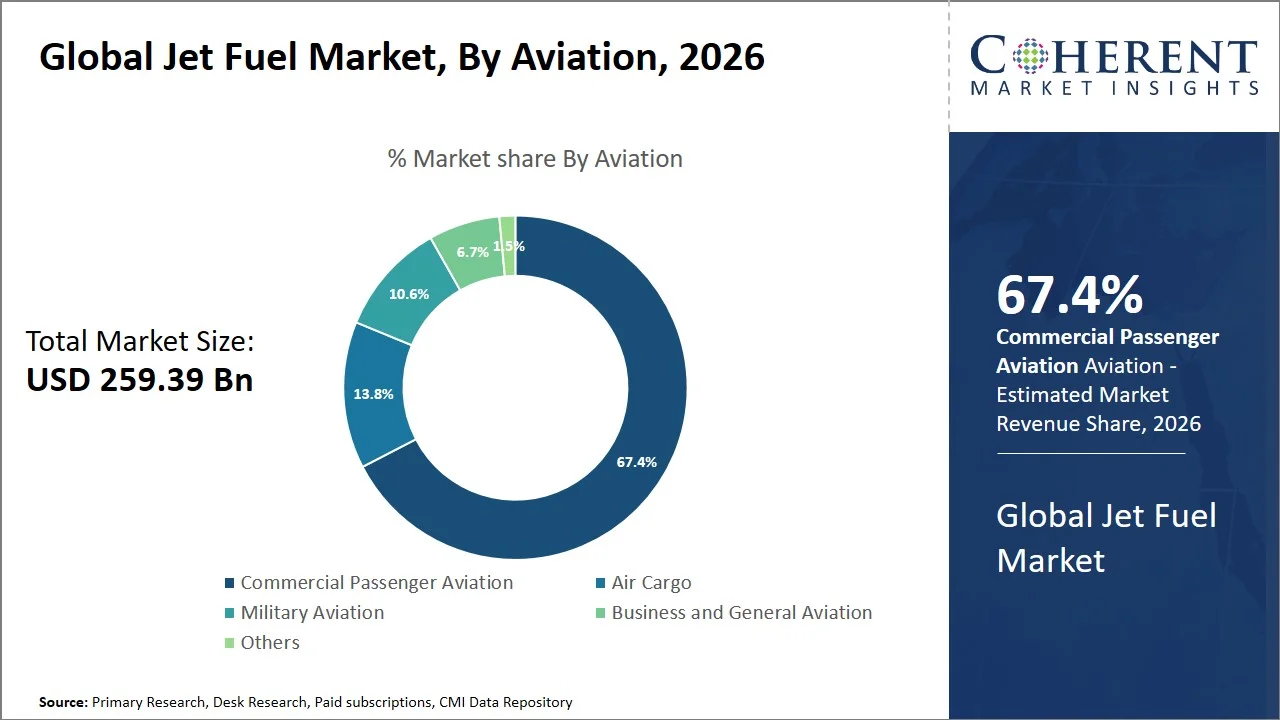
Commercial passenger aviation is expected to represent 67.4% of the global jet fuel market in 2026 because scheduled airlines operate the highest number of recurring departures and concentrate fuel uplift at large hub airports. Narrow-body fleets consume substantial volumes across dense domestic and regional networks, while wide-body services create high-volume requirements on intercontinental routes. Passenger schedules also produce predictable daily and seasonal consumption patterns, enabling airport suppliers to plan storage, hydrant throughput, replenishment, and refinery nominations more efficiently than for irregular aviation users. Fuel producers consequently prioritize gateway airports and airline networks that offer high asset utilization and repeat purchases. Airlines, meanwhile, require procurement strategies that protect route economics from fuel-price volatility. In July 2025, Airports Council International World reported that global passenger traffic exceeded 9.4 billion travellers in 2024, increasing 8.4% year-over-year and moving above pre-pandemic levels.
Why Do Direct Airline Supply Contracts Dominate the Distribution Channel of the Global Jet Fuel Market?
Direct airline supply contracts are expected to hold 46.8% of the global jet fuel market in 2026 because they convert airline flight schedules into forecastable fuel nominations at designated airports. Unlike spot purchases, direct arrangements can integrate delivery windows, specification controls, sustainability attributes, invoice reconciliation, and airport-level allocation into one procurement framework. They also give fuel producers creditworthy offtake visibility, which supports inventory positioning and investment in blending or terminal capacity. For airlines, contract structures can connect conventional jet fuel and sustainable aviation fuel purchases with corporate emissions programs and route-level reporting, making the supplier relationship strategically broader than a basic commodity transaction. In March 2025, JetBlue began regular sustainable aviation fuel supply at New York JFK under a 12-month agreement with World Fuel Services for at least one million gallons of neat fuel, with additional volumes available through corporate participation.
Current Events and their Impact
Current Event | Description and Its Impact |
December 2024 – U.K. Publishes the SAF Mandate Framework |
|
November 2025 – Singapore Announces a Passenger and Cargo SAF Levy |
|
October 2024 – Brazil Enacts the Future Fuel Law |
|
Global Jet Fuel Market Dynamics
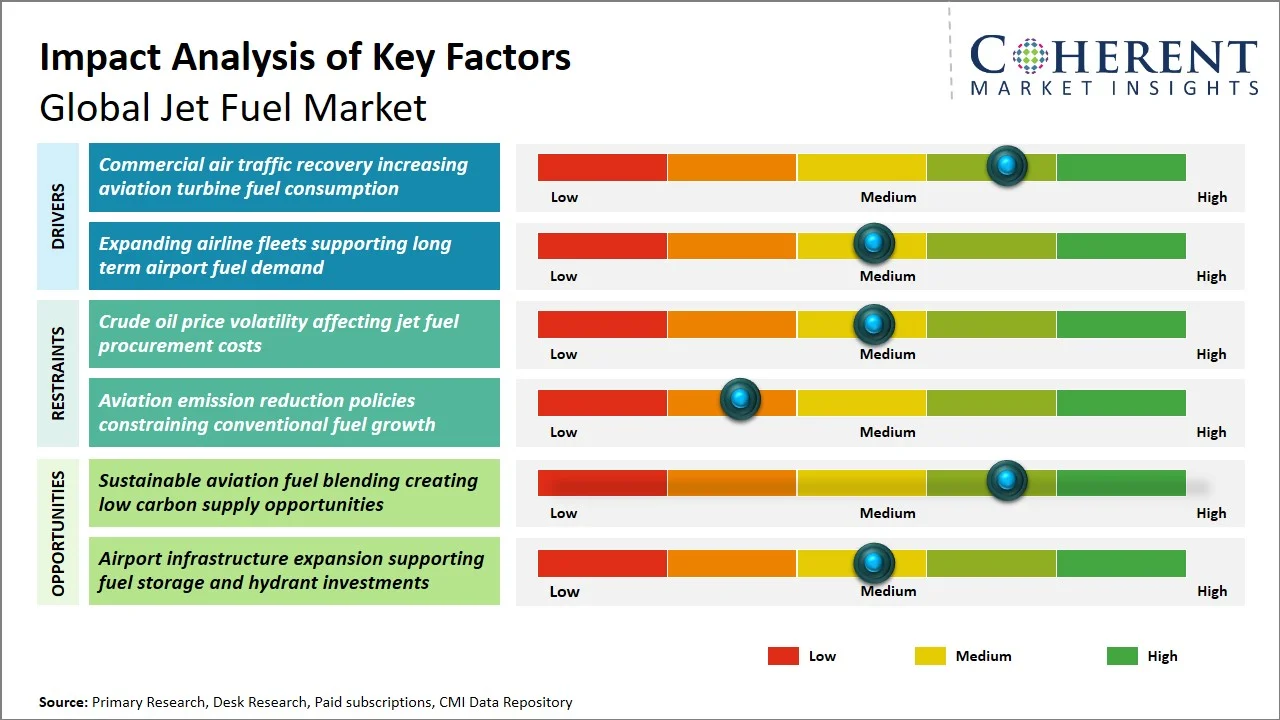
Key Market Drivers
- Commercial Air Traffic Recovery Restores Airport Fuel Throughput: Commercial air traffic recovery is restoring the flight-frequency base that determines daily jet fuel throughput. As airlines rebuild schedules, each additional departure generates repeat uplift demand at origin and hub airports, supporting refinery nominations, terminal replenishment, hydrant utilization, and into-plane service volumes. The effect is commercially important because fuel suppliers benefit not only from higher consumption but also from more predictable inventory cycles and improved utilization of fixed airport infrastructure. Airport fuel consortiums, pipeline operators, traders, and quality-testing providers also gain from denser operating schedules. In May 2026, EUROCONTROL reported that European air traffic grew 4.3% during 2025, with the network averaging more than 30,000 flights per day, confirming that sustained schedule normalization is translating into recurring aviation fuel requirements. This driver favors suppliers with broad airport coverage and sufficient working capital to maintain uninterrupted stocks.
- Airline Fleet Expansion Secures Long-Term Fuel Demand: Airline fleet expansion creates a multi-year jet fuel demand commitment because newly delivered aircraft are deployed across scheduled networks for decades. Additional narrow-body capacity raises uplift frequency on domestic and regional routes, while wide-body additions increase fuel volumes at long-haul gateways. Fleet renewal may improve fuel efficiency per seat, but aggregate consumption can still expand when carriers add routes, frequencies, and available seat capacity faster than efficiency gains reduce burn. Refiners, airport storage operators, fuel marketers, and direct-contract suppliers benefit from clearer demand visibility around airline delivery pipelines and network plans. In January 2026, Boeing and Alaska Airlines announced an order for 105 Boeing 737-10 aircraft and five Boeing 787 Dreamliners, with further options, to support domestic capacity and international expansion. The development illustrates how aircraft orderbooks translate into forward demand for airport fuel access, inventory positioning, and multi-station supply agreements.
Emerging Market Trends
- Refinery Co-processing Becomes a Transitional Scaling Route: Refinery co-processing is becoming a practical bridge between conventional jet fuel operations and dedicated sustainable aviation fuel production. By introducing eligible renewable feedstocks into selected refinery units, producers can use portions of existing processing, hydrogen, storage, and quality-control infrastructure rather than waiting for fully standalone facilities. The model can shorten commercialization timelines and reduce initial capital exposure, but it also requires disciplined feedstock accounting, product segregation, certification, and control of refinery operating conditions. Integrated refiners and technology licensors are positioned to benefit, while greenfield specialists may face stronger competition for early contracted volumes. Over the forecast period, co-processing is likely to support incremental supply where mandates emerge faster than dedicated capacity. Its strategic value will depend on transparent carbon attribution and the ability to preserve jet fuel specification consistency while optimizing output across aviation and road-fuel markets.
- Digital Fuel Orchestration Reshapes Airport Distribution: Airport fuel distribution is moving toward digitally coordinated inventory, custody-transfer, and quality-assurance systems. Suppliers increasingly need a consolidated view of terminal stocks, pipeline movements, truck deliveries, hydrant availability, uplift records, and sustainability documentation rather than managing each function through disconnected processes. Better data integration can reduce reconciliation delays, improve replenishment decisions, detect abnormal losses, and support more accurate airline billing. Airport operators and into-plane service providers gain operational visibility, while fuel marketers can manage working capital and allocation risk more precisely. Technology providers specializing in metering, tank monitoring, scheduling, and secure documentation are likely to gain influence in supplier selection. During the forecast period, digital execution capability may become a differentiator at congested hubs and multi-supplier airports, particularly where conventional fuel and certified lower-carbon blends must be tracked through shared infrastructure.
Regional Insights
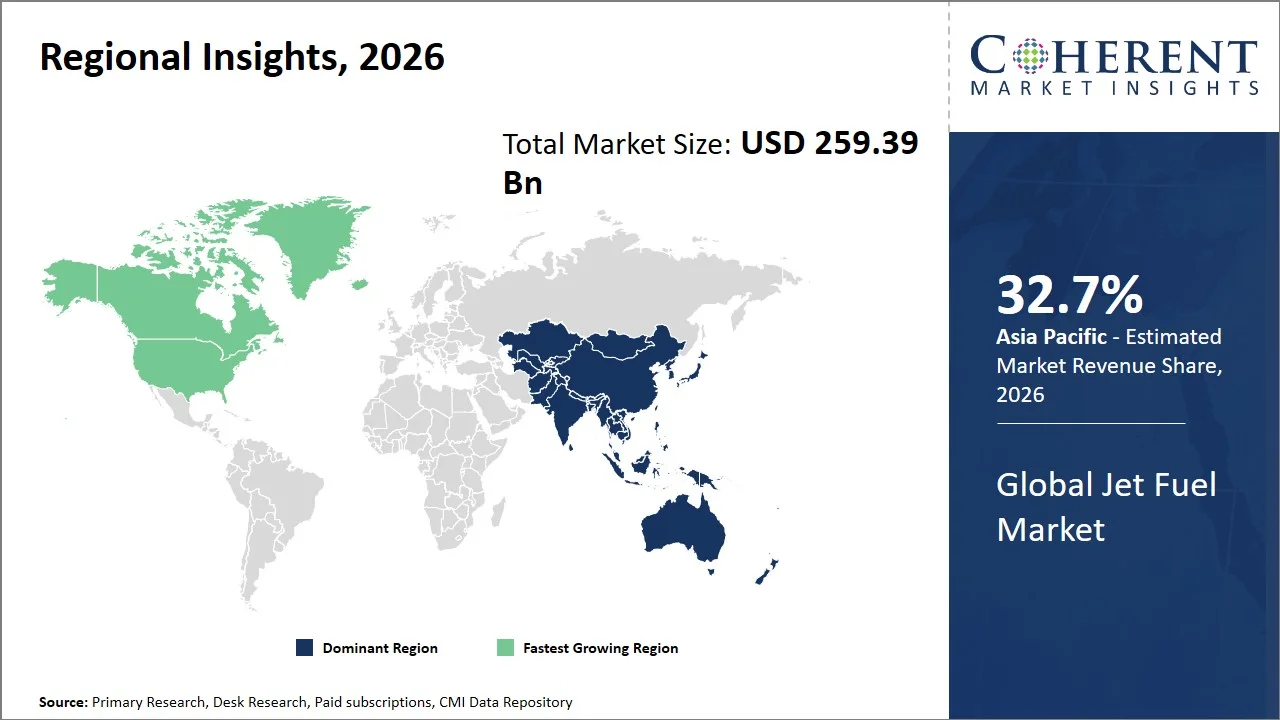
Why Does Asia Pacific Dominate the Global Jet Fuel Market?
Asia Pacific is expected to dominate the global jet fuel market with a 32.7% share in 2026. Its position reflects the concentration of high-frequency domestic routes, long-haul connections, expanding low-cost carrier networks, and major airport hubs across China, India, Japan, Southeast Asia, and Oceania. Commercial passenger aviation and air cargo both create substantial recurring uplift requirements, while new aircraft deliveries and airport capacity additions deepen demand for Jet A and Jet A 1. Regional airlines also depend on reliable fuel procurement because fuel remains a major operating-cost item, encouraging long-term supply agreements and hub-based inventory planning. In July 2026, the Association of Asia Pacific Airlines reported that regional carriers spent US$ 58.3 billion on fuel in 2025, alongside firm passenger and cargo demand, demonstrating the scale of aviation-fuel consumption across the region.
Why is Europe Emerging as the Fastest-Growing Region in the Global Jet Fuel Market?
Europe is expected to be the fastest-growing region in the global jet fuel market, with a 29.4% share in 2026. Growth is supported by dense intra-European traffic, extensive international connectivity, refinery and terminal infrastructure, and an accelerated shift toward sustainable aviation fuel blending. ReFuelEU compliance is changing procurement practices by requiring suppliers, airports, and aircraft operators to document fuel composition and expand access to certified lower-carbon blends. This creates investment opportunities in feedstock sourcing, production capacity, blending, storage, traceability, and airport distribution while preserving substantial demand for conventional jet fuel as the base component. In October 2025, the European Union Aviation Safety Agency reported that 25 suppliers had delivered sustainable aviation fuel to 33 EU airports across 12 Member States, confirming that a regulated regional supply network is moving from pilot activity toward wider commercial implementation.
Global Jet Fuel Market Outlook for Key Countries
Why is the U.S. a Key Market for the Jet Fuel Market?
The U.S. is a key market for jet fuel because it combines one of the world’s largest commercial aviation systems with extensive air cargo, business aviation, military flying, refining capacity, pipelines, storage terminals, and airport hydrant networks. Frequent domestic services generate continuous Jet A consumption, while major international gateways support long-haul uplift volumes. The country is also developing sustainable aviation fuel capacity to complement petroleum-based supply and provide airlines with lower-carbon procurement options without requiring changes to aircraft or fueling infrastructure. This dual conventional-and-renewable supply structure strengthens the U.S. role in technology commercialization, fuel certification, and long-term airline contracting. In January 2025, the U.S. Department of Energy closed a US$ 1.67 billion loan guarantee for Montana Renewables to expand a Great Falls facility expected to produce about 315 million gallons of biofuels annually, mainly sustainable aviation fuel.
Why is India Important in the Global Jet Fuel Market?
India is important in the global jet fuel market because rapid passenger growth, expanding airline fleets, new airport development, and stronger regional connectivity are increasing aviation turbine fuel requirements across metropolitan and secondary-city routes. Domestic traffic creates high-frequency fuel demand, while international expansion raises uplift needs at Delhi, Mumbai, Bengaluru, Hyderabad, and other gateway airports. India also has a strategically relevant refining base and access to agricultural and waste-derived feedstocks that could support domestic sustainable aviation fuel production, reducing future dependence on imported low-carbon fuel. Airline–refiner collaboration will therefore influence certification, pricing, blending, and commercial offtake. In August 2025, IndianOil and Air India signed a memorandum of understanding for sustainable aviation fuel supply after IndianOil obtained ISCC CORSIA certification for production at its Panipat refinery, linking domestic refining capability with airline decarbonization procurement.
Why Does China Support Growth in the Global Jet Fuel Market?
China supports growth in the global jet fuel market through the scale of its airline fleet, dense domestic network, expanding international services, large airport system, and substantial passenger and cargo throughput. Frequent operations between major economic clusters create recurring Jet A1 requirements, while new airports and route additions broaden fuel-storage and into-plane service needs beyond established coastal hubs. China’s refining and logistics capabilities also support large-volume supply, although efficiency targets and environmental policy are encouraging airlines and fuel producers to examine sustainable aviation fuel pathways. The market therefore combines high conventional-fuel consumption with a developing transition opportunity. In April 2026, the Civil Aviation Administration of China reported that the country had 4,574 commercial aircraft, 5,488 scheduled routes, and 270 commercial airports at the end of 2025, illustrating the operating base that sustains national aviation-fuel demand.
Why is Saudi Arabia a Strategic Country in the Jet Fuel Market?
Saudi Arabia is a strategic jet fuel market because aviation is central to tourism expansion, religious travel, international connectivity, cargo development, and the Kingdom’s broader economic diversification program. Large passenger flows through Jeddah, Riyadh, and Dammam support substantial uplift requirements, while airline fleet expansion and new routes increase demand for dependable airport storage and direct supply arrangements. Saudi Arabia also benefits from an integrated hydrocarbons and refining base, giving suppliers advantages in feedstock access, fuel production, logistics coordination, and regional exports. Future sustainable aviation fuel initiatives can build on this established energy infrastructure rather than creating an entirely separate distribution system. In May 2026, the General Authority for Statistics reported that Saudi airports handled 140.9 million passengers and 979,800 flights in 2025, with both domestic and international activity increasing, directly expanding the addressable fuel-consumption base.
Why is Brazil an Important Growth Market for the Jet Fuel Market?
Brazil is an important growth market for jet fuel because its continental geography makes air transport essential for connecting population centers, tourism destinations, industrial regions, and remote areas. A large domestic route network supports recurring conventional aviation kerosene consumption, while international services position São Paulo and Rio de Janeiro as major regional fueling points. Brazil’s established biofuels industry, agricultural feedstock availability, refinery system, and national low-carbon fuel policy also provide a credible foundation for sustainable aviation fuel production. This combination could reduce import exposure, support local value creation, and give airlines additional compliance-oriented procurement choices. In December 2025, Petrobras announced the first deliveries of sustainable aviation fuel produced entirely in Brazil at the Duque de Caxias Refinery, demonstrating that domestic renewable-content jet fuel had progressed from testing toward commercial supply.
Technology Adoption Landscape in the Global Jet Fuel Market
Technology | Adoption Level | Key Application Area | Business Impact |
Hydro processed Esters and Fatty Acids Synthetic Paraffinic Kerosene | High | Converting waste oils, used cooking oil, and animal fats into SAF blending components | Offers the most commercially established SAF pathway but exposes producers to competition for limited lipid feedstocks and pretreatment capacity. |
Renewable Feedstock Co-processing | Medium | Processing eligible biogenic oils alongside petroleum feedstocks in existing refinery units | Reduces initial infrastructure requirements and enables incremental output, although carbon accounting, feedstock limits, and certification remain operational constraints. |
Alcohol-to-Jet Conversion | Medium | Converting low-carbon ethanol or other alcohols into synthetic paraffinic kerosene | Broadens the potential feedstock base and creates opportunities in ethanol-producing countries, but commercial economics depend on alcohol carbon intensity and conversion scale. |
Fischer–Tropsch Biomass- and Waste-to-Liquid Processing | Medium | Transforming synthesis gas derived from municipal waste, forestry residue, or biomass into jet-range hydrocarbons | Supports non-lipid feedstock diversification but requires complex gasification, gas-cleaning, synthesis, and upgrading infrastructure. |
Power-to-Liquid E-kerosene | Low | Combining renewable hydrogen and captured carbon to manufacture synthetic aviation fuel | Provides a long-term pathway with substantial scalability potential, but electricity requirements, hydrogen costs, and capital intensity constrain near-term adoption. |
Automated Airport Fuel Management and Digital Custody Transfer | High | Tank monitoring, hydrant control, metering, delivery scheduling, quality records, and airline invoicing | Improves stock visibility, reduces reconciliation errors, strengthens loss control, and supports auditable handling of conventional fuel and certified SAF blends. |
How are Secondary-Airport SAF Blending and Storage Upgrades Creating New Growth Opportunities in the Global Jet Fuel Market?
Secondary airports represent an underdeveloped opportunity for suppliers that can extend sustainable aviation fuel access beyond major international hubs. Many regional airports already handle conventional Jet A1 efficiently but lack dedicated receipt arrangements, blending procedures, segregated documentation, and predictable lower-carbon fuel demand. Suppliers can capture this opportunity through modular storage upgrades, shared blending services, scheduled truck or pipeline replenishment, and aggregated purchasing programs serving several airlines or business-aviation operators. The model can broaden the customer base without requiring each airport to support a standalone production or terminal complex. Commercial success will depend on certified chain-of-custody systems, fuel-quality controls, demand aggregation, transparent premium allocation, and coordination with airport operators and into-plane providers. Established distributors possess logistics and customer advantages, while specialists can compete through flexible infrastructure design and compliance services. Companies should prioritize airports with concentrated carrier activity, corporate aviation demand, or nearby industrial customers seeking aviation-emissions reductions, while avoiding capital deployment where offtake commitments remain weak.
Market Players, Key Development, and Competitive Landscape
Key Developments
- In November 2025, LanzaJet announced that its Freedom Pines Fuels facility had produced ASTM-compliant jet fuel from ethanol at commercial scale. This is important for the global jet fuel market because it validates alcohol-to-jet processing beyond pilot operations and expands the addressable feedstock pool beyond waste lipids. Commercial proof of the pathway can support licensing, project financing, and SAF capacity development in countries with established ethanol industries.
- In April 2025, Neste began producing sustainable aviation fuel at its renewable-products refinery in Rotterdam after modifying the facility to support up to 500,000 tons of annual SAF production. This is important for the global jet fuel market because it increases commercially available supply near a major European fuel-trading and logistics hub, supporting airline procurement and regulatory compliance without requiring a separate airport-fuel distribution system.
- In February 2025, OMV Petrom began the construction of a sustainable aviation fuel and renewable diesel unit at its Petrobrazi refinery in Romania. The project integrates renewable-fuel production with existing refinery operations and planned green-hydrogen facilities. This is important for the global jet fuel market because it strengthens Southeast European production capability, diversifies the geographic supply base, and demonstrates how conventional refining assets can be repositioned for lower-carbon aviation fuel production.
Competitive Landscape
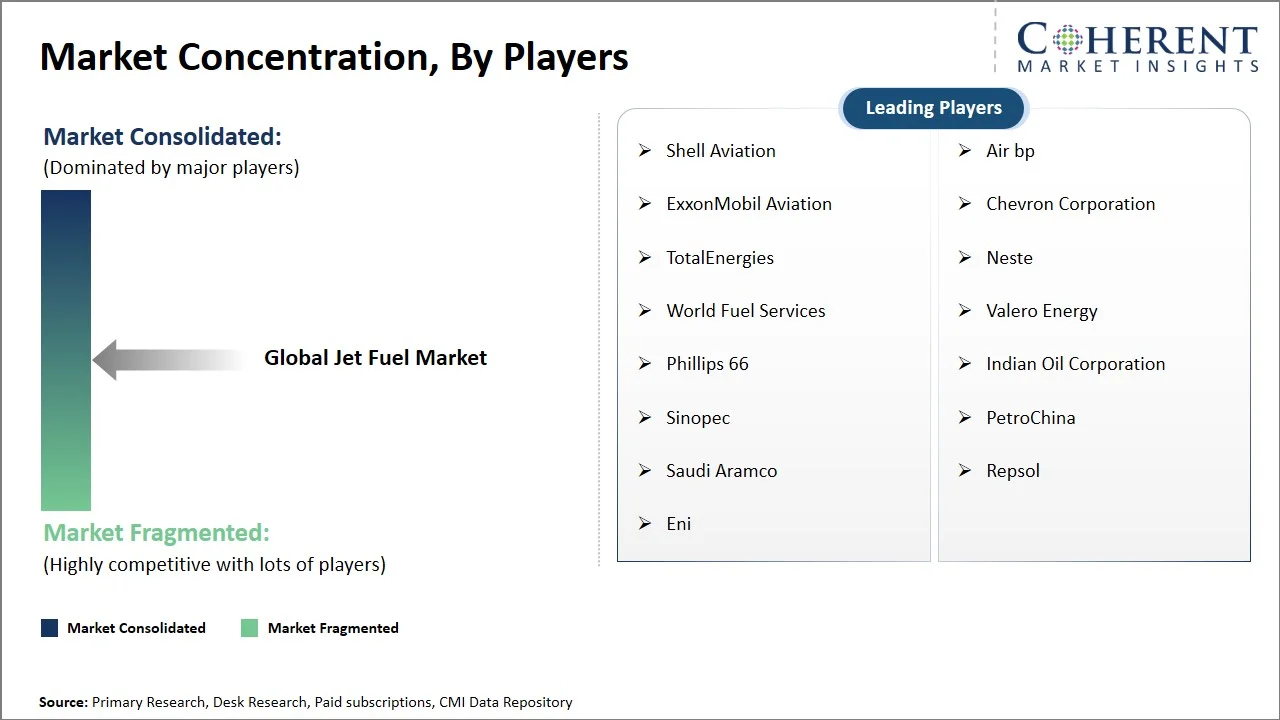
The global jet fuel market is moderately consolidated at the refining and international supply level but fragmented within airport-level distribution and into-plane services. Integrated energy companies, national oil companies, independent refiners, commodity traders, airport fuel consortiums, logistics providers, and specialized SAF producers compete across different stages of the value chain. Conventional fuel competition remains centered on price, specification compliance, credit terms, and uninterrupted delivery, while lower-carbon fuel competition increasingly depends on feedstock access, certification, production-pathway economics, and customer reporting capability.
Key focus areas include
- Supply continuity: Refinery redundancy, diversified import access, terminal inventory, and contingency logistics determine contract resilience.
- Fuel specification assurance: Consistent compliance with aviation turbine fuel standards remains non-negotiable for airlines and airport operators.
- Airport network coverage: Suppliers serving multiple airline stations can negotiate broader contracts and consolidate customer relationships.
- Working-capital strength: Large inventory requirements and volatile crude-product spreads favor companies with strong balance sheets and trading capability.
- Low-carbon pathway flexibility: Producers able to process several renewable feedstocks are better positioned against supply scarcity and price volatility.
- Certification and traceability: Auditable sustainability documentation increasingly influences eligibility, customer acceptance, and regulatory compliance.
- Pricing architecture: Competitors differentiate through indexed formulas, risk-sharing structures, hedging support, and transparent treatment of SAF premiums.
- Regional specialists: Local distributors remain important where airport concessions, domestic refinery relationships, or last-mile delivery access restrict entry by global suppliers.
Market Report Scope
Jet Fuel Market Report Coverage
| Report Coverage | Details | ||
|---|---|---|---|
| Base Year: | 2025 | Market Size in 2026: | USD 259.39 Bn |
| Historical Data for: | 2020 To 2024 | Forecast Period: | 2026 To 2033 |
| Forecast Period 2026 to 2033 CAGR: | 7.6% | 2033 Value Projection: | USD 433.15 Bn |
| Geographies covered: |
| ||
| Segments covered: |
| ||
| Companies covered: | Shell Aviation, Air bp, ExxonMobil Aviation, Chevron Corporation, TotalEnergies, Neste, World Fuel Services, Valero Energy, Phillips 66, Indian Oil Corporation, Sinopec, PetroChina, Saudi Aramco, Repsol, and Eni | ||
| Growth Drivers: |
| ||
| Restraints & Challenges: |
| ||
Analyst Opinion (Expert Opinion)
- The global jet fuel market leadership is likely to shift toward companies that can coordinate production, trading, financing, certification, and airport delivery rather than merely selling refinery output. Capital-light aggregators may gain negotiating power by matching geographically dispersed fuel supply with airline demand and compliance obligations. This could weaken the advantage of asset ownership unless refiners develop stronger commercial platforms and customer-facing risk-management capabilities.
- Approval and operational acceptance of higher sustainable-fuel blend ratios could materially alter distribution economics. A move beyond dependence on conventional blending limits would reduce certain logistical bottlenecks, change tank and product-segregation requirements, and increase the strategic value of pathway-specific engine and fuel validation. Participants with deep certification expertise and close relationships across aircraft, engine, refinery, and regulatory ecosystems would be best positioned.
- Suppliers should prioritize feedstock pretreatment, flexible conversion pathways, hydrogen availability, quality laboratories, and airport-level documentation systems. Capacity investment should be tied to credible offtake rather than policy ambition alone because feedstock costs and airline price sensitivity can compress margins. Companies should avoid excessive exposure to one renewable raw material and pursue regional partnerships that combine production capability with established storage, pipeline, and into-plane access.
Speak to the analyst
Want personalized insights?
Take the findings above to one of our principal consultants, or have the report rebuilt around the segments, geographies and competitors you actually track.
Market Segmentation
- Fuel Grade Insights (Revenue, USD Bn, 2021 - 2033)
- Jet A and Jet A 1
- JP 8
- JP 5
- Jet B
- Sustainable Aviation Fuel Blends
- Others
- Aviation Insights (Revenue, USD Bn, 2021 - 2033)
- Commercial Passenger Aviation
- Air Cargo
- Military Aviation
- Business and General Aviation
- Others
- Distribution Channel Insights (Revenue, USD Bn, 2021 - 2033)
- Direct Airline Supply Contracts
- Airport Fuel Service Providers
- Oil Marketing Companies and Distributors
- Spot Market and Fuel Traders
- Others
- Regional Insights (Revenue, USD Bn, 2021 - 2033)
- North America
- U.S.
- Canada
- Latin America
- Brazil
- Argentina
- Mexico
- Rest of Latin America
- Europe
- Germany
- U.K.
- Spain
- France
- Italy
- Russia
- Rest of Europe
- Asia Pacific
- China
- India
- Japan
- Australia
- South Korea
- ASEAN
- Rest of Asia Pacific
- Middle East
- GCC Countries
- Israel
- Rest of Middle East
- Africa
- South Africa
- North Africa
- Central Africa
- North America
- Key Players Insights
- Shell Aviation
- Air bp
- ExxonMobil Aviation
- Chevron Corporation
- TotalEnergies
- Neste
- World Fuel Services
- Valero Energy
- Phillips 66
- Indian Oil Corporation
- Sinopec
- PetroChina
- Saudi Aramco
- Repsol
- Eni
Sources
Primary Research Interviews
- Jet fuel refiners, aviation fuel suppliers, sustainable aviation fuel producers, airport fuel service providers, traders, distributors, and logistics companies
- Procurement, refinery operations, aviation sales, supply-chain, sustainability, quality-control, regulatory, commercial, and business-development executives
Stakeholders
- Integrated oil companies, national oil companies, independent refiners, and aviation turbine fuel manufacturers
- Commercial airlines, cargo carriers, military aviation operators, business aviation companies, and airport authorities
- Airport fuel consortiums, into-plane service providers, pipeline operators, storage-terminal companies, fuel traders, and SAF producers
- Feedstock suppliers, technology licensors, engineering companies, testing laboratories, and certification agencies
End-use Sectors
- Commercial passenger aviation, air cargo, military aviation, and business and general aviation
- Domestic, regional, and international airline operations
- Airport fueling, defense airbases, private terminals, charter operations, and cargo hubs
- Scheduled, non-scheduled, helicopter, government, emergency, and special-mission aviation
Regulatory & Government Bodies
- International Civil Aviation Organization, U.S. Federal Aviation Administration, and U.S. Environmental Protection Agency
- European Commission, European Union Aviation Safety Agency, and national civil aviation authorities
- UK Department for Transport and UK Civil Aviation Authority
- Civil Aviation Administration of China and Directorate General of Civil Aviation, India
- General Authority of Civil Aviation, Saudi Arabia, ANAC Brazil, and other national energy, transport, customs, and environmental authorities
Databases
- International Civil Aviation Organization Data+, IATA Statistics, Airports Council International World Airport Traffic Database, and EUROCONTROL data
- U.S. Energy Information Administration, Eurostat, JODI Oil Database, and national petroleum statistics
- UN Comtrade, ITC Trade Map, WTO Statistics, and national customs databases
- U.S. Bureau of Transportation Statistics, FAA aviation databases, China Customs, India DGCI&S, and Brazil Comex Stat
- Company filings, refinery-capacity databases, airport traffic records, fuel-pricing databases, airline schedules, tenders, and trade databases
Magazines and Journals
- Aviation Week Network, FlightGlobal, Airport World, and Air Transport World
- Argus Jet Fuel, S&P Global Commodity Insights, and Petroleum Economist
- Journal of Air Transport Management, Fuel, Energy Policy, Applied Energy, and Transportation Research
- International Journal of Sustainable Aviation and aviation-fuel technology publications
Associations
- International Air Transport Association
- Airports Council International
- Airlines for America
- Joint Inspection Group
- Energy Institute
- International Air Cargo Association
- General Aviation Manufacturers Association
- Regional airline, petroleum, refining, airport, and sustainable aviation fuel associations
Public Domain Sources
- Civil aviation, energy, transport, trade, defense, and environmental agencies
- Airport traffic statistics, airline fleet data, refinery production records, fuel-consumption databases, and customs information
- Company annual reports, sustainability reports, investor presentations, product specifications, and official press releases
- Airport fuel tenders, airline procurement documents, fuel-quality manuals, refinery project announcements, and government policy documents
Key Standards and Regulations
- ASTM D1655 specification for aviation turbine fuels
- DEF STAN 91-091 requirements for Jet A1 aviation turbine fuel
- ASTM D7566 specification for aviation turbine fuels containing synthesized hydrocarbons
- ICAO Annex 16 and Carbon Offsetting and Reduction Scheme for International Aviation requirements
- ReFuelEU Aviation Regulation and European sustainable aviation fuel obligations
- UK Sustainable Aviation Fuel Mandate
- U.S. Renewable Fuel Standard, federal SAF incentives, and aviation-fuel environmental requirements
- Joint Inspection Group and Energy Institute standards for fuel handling, storage, testing, and airport distribution
- National fuel-quality, taxation, customs, strategic-reserve, emissions, safety, and airport-operating regulations
Proprietary Elements
- CMI Data Analytics Tool, Proprietary CMI Existing Repository of information for last 10 years.
Get access to 250+ pages report
Every segment, forecast, competitor profile and data table behind the analysis above — available for instant download.
- ESOMAR Member
- ISO 9001:2015 Certified
- D-U-N-S Registered
- GDPR & CCPA Compliant
Missing comfort of reading report in your local language? Find your preferred language:
Transform your Strategy with Exclusive Trending Reports
Frequently Asked Questions
The CAGR of the global jet fuel market is projected to be 7.6% from 2026 to 2033.
The global jet fuel market is estimated to be valued at USD 259.39 billion in 2026 and is expected to reach USD 433.15 billion by 2033
Commercial passenger aviation leads the market due to frequent scheduled flights, extensive airline networks, and recurring fuel uplift requirements at major airports.
Direct airline supply contracts are the leading distribution channel because they provide airlines with reliable fuel availability, negotiated pricing, quality assurance, and coordinated airport delivery.
The integration of sustainable aviation fuel blends is reshaping supplier strategies, refinery investments, airline procurement practices, and airport fuel infrastructure.
Commercial air traffic recovery increasing aviation turbine fuel consumption and expanding airline fleets supporting long term airport fuel demand are the major factors driving the growth of the global jet fuel market.
Crude oil price volatility affecting jet fuel procurement costs and aviation emission reduction policies are the major factors hampering the growth of global jet fuel market.