

Global Luxury Furniture Market Size and Forecast – 2026 To 2033
The Global Luxury Furniture Market is estimated to be valued at USD 34.5 Bn in 2026 and is expected to reach USD 52.56 Bn by 2033, exhibiting a compound annual growth rate (CAGR) of 6.2% from 2026 to 2033. This steady growth reflects increasing consumer demand for premium, high-quality furniture that combines aesthetic appeal, durability, comfort, and exclusivity. The market is gaining momentum from luxury real estate expansion, premium home renovation, branded residences, and rising disposable incomes across emerging economies.
Luxury furniture demand is also being supported by the growing influence of interior designers, architects, and project-based furnishing consultants, especially across residential and hospitality interiors. Consumers are increasingly preferring customized sofas, beds, tables, storage units, and mixed-material furniture made from wood, leather, metal, glass, and stone. A relevant instance is CBRE-ASSOCHAM’s 2025 report, which stated that India’s luxury housing sales grew 85% year-on-year in January to June 2025, with around 7,000 luxury units sold across the top seven cities, indicating strong demand for premium interiors and high-end furniture in emerging markets. (Source: CBRE)
Key Takeaways of the Global Luxury Furniture Market
- Seating furniture is expected to dominate with 31.4 % of the market share in 2026, supported by strong demand for premium sofas, armchairs, loungers, and modular living room collections across luxury homes and hospitality spaces. Poltrona Frau’s 2025 “The Five Seasons” collection expanded its sofa range, reflecting continued innovation in comfort-led luxury seating. (Source: Poltrona Frau S.p.a.)
- Wood is expected to lead the material type segment with 38.7 % of the market share in 2026, as consumers continue to associate solid wood, veneers, and crafted finishes with durability, authenticity, and premium value. In September 2025, Roche Bobois reported that 76% of its new products in 2024 used FSC- or PEFC-certified wood, strengthening sustainable luxury positioning. (Source: Roche Bobois SA)
- The residential segment is expected to account for 56.8 % of the market share in 2026, supported by luxury apartments, villas, penthouses, and premium renovation spending.
- Europe is expected to dominate with 34.6 % of the market share in 2026, supported by Italy, France, Germany, and the U.K.’s strong design heritage, luxury craftsmanship, and premium furniture brands. Salone del Mobile.Milano 2025 attracted more than 302,000 visitors and featured 2,103 exhibitors from 37 countries, highlighting Europe’s continued leadership in the global design landscape. (Source: Federlegno Arredo Eventi SpA)
- North America is anticipated to be the fastest-growing region with 30.8 % of the market share in 2026, supported by premium home renovation, luxury housing upgrades, and strong spending on high-end interiors. Harvard’s Joint Center for Housing Studies projected U.S. homeowner improvement spending to reach USD 518 billion by end-2026, supporting the demand for premium and customized luxury furniture. (Source: Government Accountability Office)
- Bespoke Design Becomes a Purchase Trigger: Customization is becoming central to luxury furniture buying, as affluent customers prefer personalized dimensions, finishes, materials, and design advisory services. B&B Italia offers bespoke one-on-one consultations both in-store and virtually, showing how premium brands are combining interior design expertise with digital access to improve customer experience and project conversion.
- Increasing Use of Luxury Furniture in Hospitality and Branded Real Estate Projects: Luxury hotels, resorts, serviced apartments, and branded residences are increasingly adopting premium furniture to enhance customer experience and strengthen brand identity. High-end seating, bedroom furniture, lounge furniture, and outdoor luxury furniture are widely used in suites, lobbies, restaurants, villas, and leisure spaces. The growing focus on experiential hospitality and premium interior design is widening the application of luxury furniture across commercial and contract-based projects.
Segmental Insights
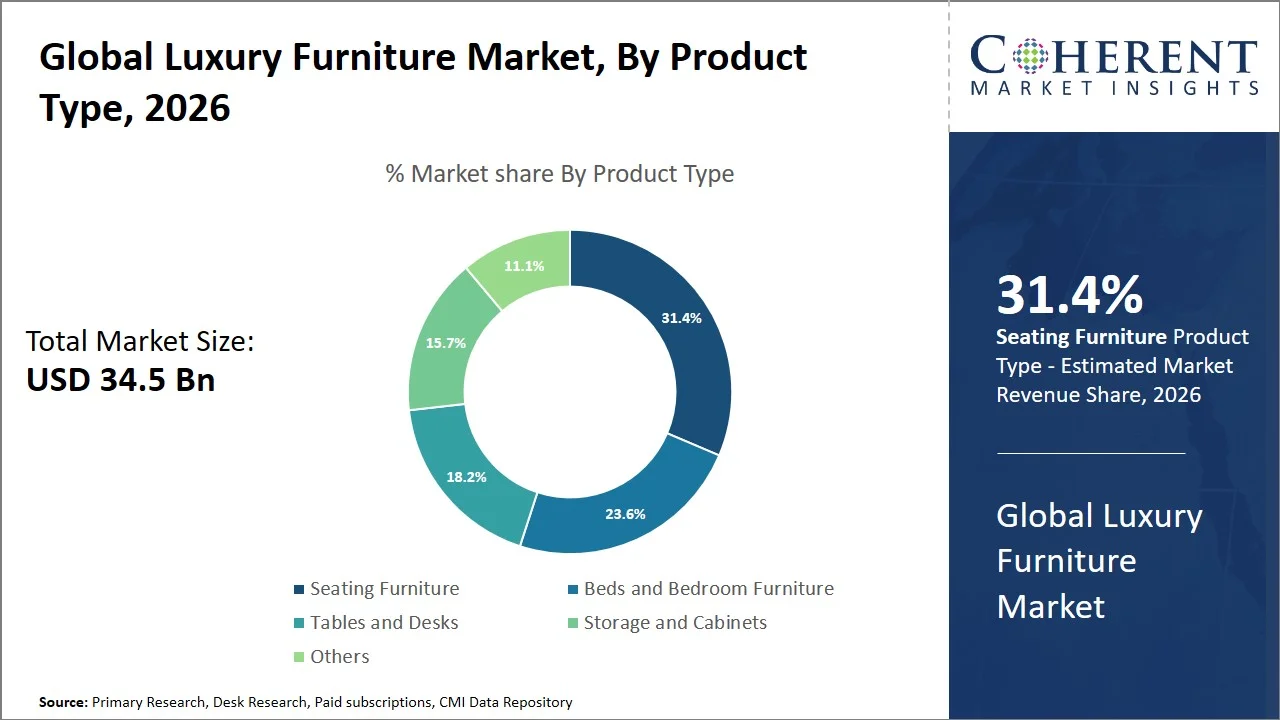
Why Does the Seating Furniture Segment Dominate the Global Luxury Furniture Market?
Seating furniture is expected to dominate the global luxury furniture market with 31.4% of the market share in 2026, as sofas, armchairs, lounge chairs, recliners, and modular seating systems are central to premium living rooms, hotel lounges, villas, and executive spaces. Demand is supported by consumers prioritizing comfort, statement aesthetics, and flexible seating layouts for social and leisure spaces. From the supply side, luxury brands are expanding modular, outdoor, and design-led seating collections with premium upholstery and handcrafted finishes. Seating also has strong relevance across residential, hospitality, commercial, and luxury retail environments. In 2025, Roche Bobois introduced its Outdoor 2025 Collection, focused on bringing indoor-level comfort and design to patios, gardens, and poolside spaces, reinforcing the demand for premium luxury seating beyond indoor applications. (Source: Roche Bobois)
- Current Industry Events of 2026
- Market Size Estimation
- Regional Breakdown
- Competitive Landscape
- Customer Intelligence
- Segmental Analysis
- Pricing Analysis
- Key Market Drivers, Challenges & Future Trends
- Customized Insights Section
Why Does the Wood Segment Represent the Largest Material Type Segment in the Global Luxury Furniture Market?
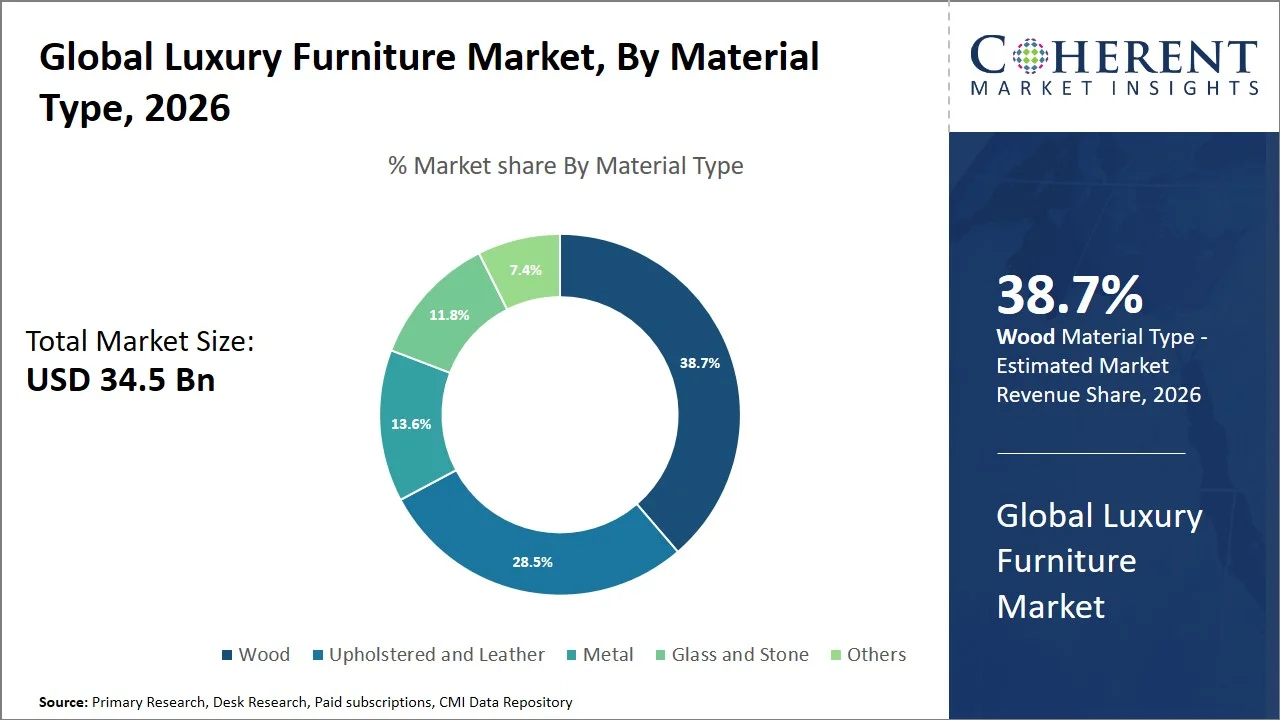
Wood is expected to represent the largest material type segment with 38.7% of the market share in 2026, owing to its strong association with craftsmanship, durability, timeless design, and premium interior value. Luxury buyers prefer solid wood, veneers, carved finishes, and engineered wood combinations because they offer warmth, long life, and design flexibility across classic, modern, and transitional furniture styles. Demand is high across beds, cabinets, dining tables, storage furniture, and decorative furniture, where material authenticity plays a key role in pricing. On the supply side, brands are increasingly focusing on responsibly sourced wood, traceability, and certified forestry practices to align premium positioning with sustainability expectations. In 2025, the Sustainable Furnishings Council and National Wildlife Federation released the Wood Furniture Scorecard, assessing over 100 North American furniture retailers on responsible wood sourcing policies and practices. (Source: Cascale)
Why Does the Residential Segment Dominate the Global Luxury Furniture Market?
The residential segment is expected to dominate the global luxury furniture market with 56.8% of the market share in 2026, as luxury furniture purchases are strongly linked to premium homes, villas, penthouses, branded residences, and high-value renovation projects. Affluent consumers increasingly treat furniture as a long-term lifestyle investment, focusing on comfort, exclusivity, material quality, and customized interior themes. Demand is especially strong for living room seating, bedroom sets, dining furniture, storage systems, and decorative pieces that enhance personal living spaces. Supply-side growth is supported by direct brand consultations, interior designer networks, bespoke collections, and digital visualization tools that help convert high-ticket residential purchases. Savills reported in November 2025, that branded residences are expected to rise from 764 schemes in December 2024 to 910 by the end of 2025, reflecting stronger demand for luxury living environments and premium interiors. (Source: Savills)
Currents Events and their Impact
Current Events | Description and its Impact |
European Union Advances Deforestation-free Sourcing Rules for Wood-based Furniture (2024–2026) |
|
EU Prioritizes Furniture under Sustainable Product Policy Framework (April 2025 onward) |
|
EU General Product Safety Regulation Becomes Applicable (December 2024) |
|
UK Updates Furniture and Furnishings Fire Safety Regulations (October 2025) |
|
(Source: European Commission, European Trade, Standphill India, & UK Government)
Global Luxury Furniture Market Dynamics
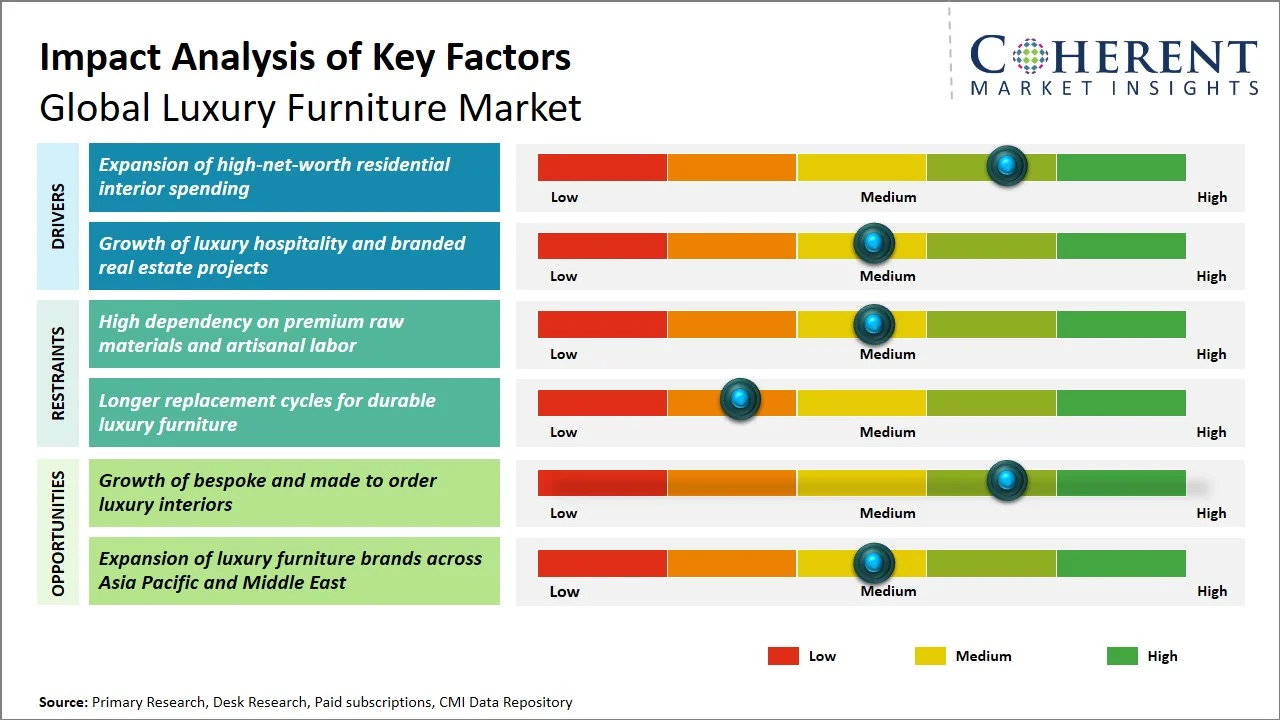
Market Drivers
- Expansion of High-net-worth Residential Interior Spending: The luxury furniture market is being supported by the expanding global base of ultra-high-net-worth individuals, who are increasing spending on premium homes, second residences, villas, and personalized interior environments. Luxury furniture benefits directly from this shift because affluent buyers typically prioritize long-lasting materials, bespoke designs, branded collections, and furniture that reflects lifestyle identity. This strengthens the demand for seating furniture, bedroom furniture, dining tables, storage units, and statement décor across primary and secondary residences. A recent instance is Knight Frank’s 2026 wealth analysis, which reported that the global UHNWI population increased from 551,435 in 2021 to 713,626 in 2026, creating a wider customer base for high-value residential furnishing and interior upgrades. (Source: Knight Frank)
- Growth of Luxury Hospitality and Branded Real Estate Projects: Luxury hospitality and branded residences are creating strong project-based demand for premium furniture used in suites, lounges, villas, restaurants, clubhouses, and serviced apartments. Unlike retail furniture purchases, hospitality and branded real estate projects require bulk procurement, design consistency, durability, and customized furniture packages aligned with brand positioning. This creates recurring opportunities for luxury furniture manufacturers, interior contractors, and design-led suppliers. A recent instance is Marriott International’s 2025 branded residence expansion in EMEA, where it signed nearly 20 branded residence agreements, with nearly two-thirds in the luxury segment. Several projects also recorded strong sales velocity, indicating rising developer and buyer interest in fully designed luxury living environments (Source: PR Newswire)
Emerging Market Trends
- Shift Toward Sustainable and Circular Luxury Furniture: Sustainability is becoming a defining trend in luxury furniture, as premium buyers increasingly expect products to combine exclusivity with responsible sourcing, durability, repairability, and reduced environmental impact. This is pushing manufacturers to use certified wood, recyclable materials, low-emission finishes, modular components, and transparent supply chains. The trend is commercially important because it can improve brand differentiation, support premium pricing, and help companies meet stricter sustainability expectations in Europe and other developed markets. The European Commission’s 2025–2030 Ecodesign for Sustainable Products working plan identifies furniture as a priority product group for future circularity and sustainability requirements, reinforcing the need for longer-lasting and repairable furniture design.
- Rising Importance of Bespoke, Direct, and Experience-led Purchasing: Luxury furniture buyers are moving away from standard catalogue purchases toward personalized, design-assisted, and experience-led buying journeys. This trend is strengthening direct brand channels, flagship studios, virtual consultations, curated showrooms, and designer-led selling models. For luxury furniture brands, this improves control over pricing, brand storytelling, customization, and customer relationships. It also helps convert high-ticket purchases where buyers need confidence in materials, dimensions, finishes, and room compatibility. Bain & Company noted that the high-end furniture and housewares market reached USD 59.17 billion in 2025, while luxury contract work across residential and hospitality remained strong despite softer retail demand, showing the growing importance of curated, project-based luxury furnishing
Regional Insights
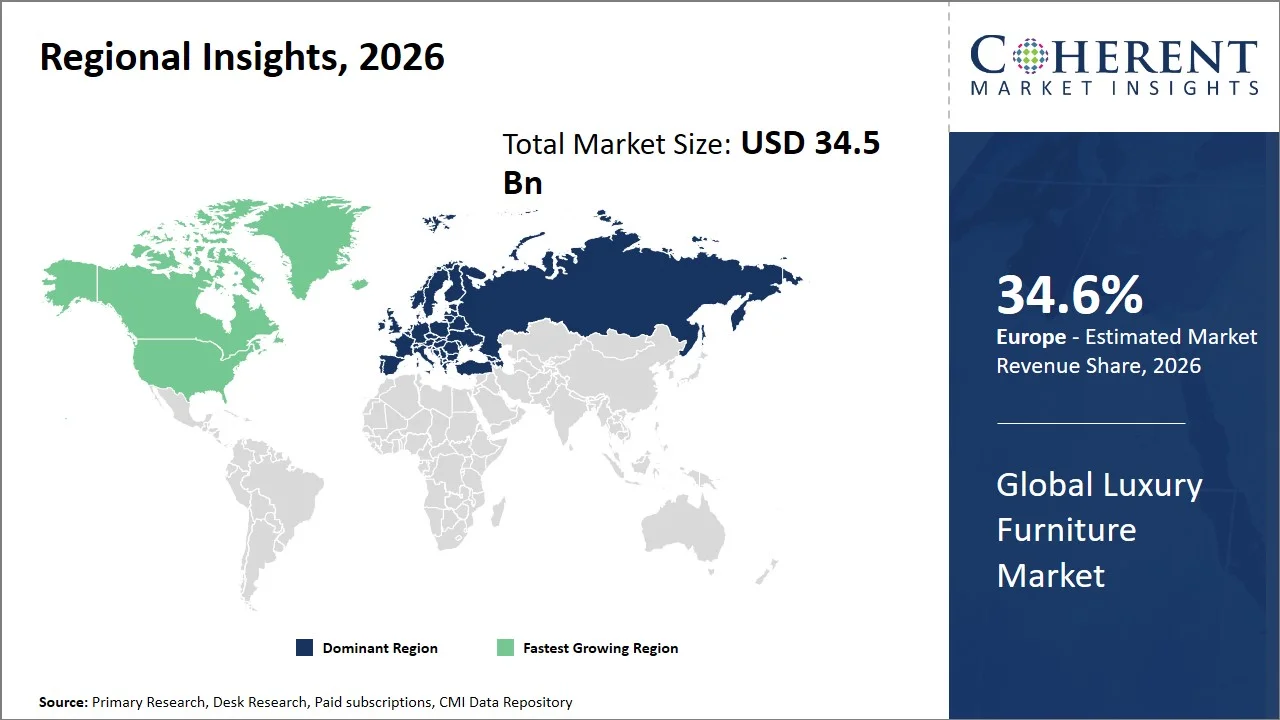
Why Does the Europe Region Dominate the Global Luxury Furniture Market?
Europe is expected to dominate the global luxury furniture market with 34.6% of the market share in 2026, supported by its strong design heritage, premium furniture manufacturing clusters, luxury brand ecosystem, and deep linkage with interior design, architecture, hospitality, and high-end residential projects. Italy, Germany, France, and the U.K. play a central role in shaping global luxury furniture trends through craftsmanship, material innovation, and export-led brand positioning. The region also benefits from high consumer appreciation for designer furniture, sustainable materials, and premium finishing standards. For instance, Salone del Mobile.Milano 2025, which attracted 302,548 attendees and hosted 2,103 exhibitors from 37 countries, strengthening Europe’s role as a leading global hub for design and luxury furniture. (Source: Salone del Mobile)
Why is North America Emerging as the Fastest-Growing Region in the Global Luxury Furniture Market?
North America is projected to be the fastest-growing region with 30.8% of the market share in 2026, supported by high-value home renovation activity, strong luxury housing upgrades, premium retail formats, and mature direct-to-consumer furniture channels. Consumers in the U.S. and Canada are increasingly investing in custom sofas, bedroom furniture, dining sets, outdoor luxury furniture, and designer storage systems to improve lifestyle-oriented living spaces. Growth is also supported by showroom-led selling, interior design services, and omnichannel luxury retail models. A recent example is RH (Restoration Hardware), which continued expanding its Design Gallery network and luxury interior ecosystem in 2025, reflecting sustained high-value demand for premium home furnishings, custom interiors, and experiential retail-driven furniture purchasing across the U.S. This expansion highlights the strengthening role of large-format luxury showrooms and design-led selling in driving premium furniture consumption in North America.
Key Country of Global Luxury Furniture Market
Why is China an Important Consumption and Sourcing Hub in the Global Luxury Furniture Market?
China is important in the global luxury furniture market due to its large furniture manufacturing base, growing urban consumer class, strong e-commerce penetration, and increasing demand for premium home interiors in major cities. The country serves both as a major sourcing hub for global furniture supply chains and as a growing domestic market for high-end residential and designer furniture. Demand is supported by urban households upgrading living spaces, growing interest in branded home products, and digital furniture retailing. A recent indicator from China’s National Bureau of Statistics showed that furniture retail sales by enterprises above designated size reached USD 2.50 billion in August 2025, growing 18.6% year-on-year, while January–August furniture retail sales grew 22.0%. (Source: The State Council of Information Office)
Why is the U.S. Leading Premium Retail and Showroom-led Adoption in the Global Luxury Furniture Market?
The U.S. is one of the most important countries in the global luxury furniture market due to its affluent consumer base, large luxury housing stock, mature home renovation culture, and strong presence of premium furniture retailers. Luxury furniture sales in the country are increasingly influenced by experiential showrooms, in-home design consultation, custom upholstery, and direct brand engagement. The U.S. luxury furniture market also supports demand for indoor and outdoor luxury furniture across large homes, second residences, hospitality properties, and executive interiors. A recent example is Arhaus, which reported that it operated 107 showrooms across 31 states at the end of Q1 2026 and expected 10–14 showroom projects during 2026, indicating continued investment in premium furniture retail infrastructure. (Source: Arhaus Investor Relations)
Why Is India Becoming a High-growth Luxury Residential Furniture Market?
India is becoming increasingly important in the global luxury furniture market due to rapid growth in premium housing, rising high-net-worth consumer spending, and stronger demand for customized interiors in metros such as Delhi-NCR, Mumbai, Bengaluru, Hyderabad, Pune, and Chennai. Luxury furniture demand is closely linked with villas, penthouses, branded residences, and high-value apartment projects where buyers prioritize quality, exclusivity, and interior personalization. Premium developers are also focusing on larger homes, branded amenities, and lifestyle-led interiors, creating demand for seating, bedroom, dining, and storage furniture
Why Germany Continues to Be a Key Manufacturing and Trade Hub in the Luxury Furniture Market?
Germany remains a key country in the global luxury furniture market due to its strong furniture manufacturing capabilities, engineering-oriented production standards, advanced woodworking ecosystem, and trade relevance within Europe. The country is particularly important for premium wooden furniture, kitchen furniture, office furniture, and export-oriented design manufacturing. German suppliers benefit from high material quality, precision manufacturing, and established distribution across European and international markets. Although the industry faced a softer demand environment, its scale and export position remain strategically important. A recent U.S. International Trade Administration report stated that Germany’s furniture industry generated USD 19.03 billion in revenue in 2024, with exports representing around 33% of sales, confirming its continuing role in international furniture trade. (Source: International Trade Administration)
Why is the U.K. Important for Premium Upholstered and Regulated Luxury Furniture Demand?
The U.K. is important in the global luxury furniture market due to its developed premium residential segment, strong interior design culture, luxury hospitality demand, and regulated upholstered furniture market. Demand is concentrated in high-end homes, boutique hotels, luxury apartments, executive offices, and contract interiors where buyers prioritize design, safety compliance, durability, and brand reputation. The country is especially relevant for luxury sofas, armchairs, upholstered beds, and designer seating due to strict product safety expectations.
Technology Adoption Landscape in the Global Luxury Furniture Market
Technology Area | How It Is Used in Luxury Furniture Market | Key Impact on Market | Technology Area |
AI-driven Interior Design & Product Customization Tools | AI-based platforms generate personalized furniture layouts, recommend styles, materials, and optimize room aesthetics based on user inputs and spatial data | Enhances personalization, reduces design time, increases conversion rates for high-value custom orders | AI-driven Interior Design & Product Customization Tools |
AR/VR & Virtual Showrooms | Virtual reality and augmented reality tools allow customers to visualize luxury furniture in real home environments before purchase | Reduces purchase hesitation, improves customer experience, supports high-ticket remote selling | AR/VR & Virtual Showrooms |
CNC Machining & Robotic Woodworking | Automated cutting, carving, polishing, and precision manufacturing for wood, metal, and hybrid furniture designs | Improves craftsmanship precision, reduces production time, enables complex luxury designs at scale | CNC Machining & Robotic Woodworking |
Smart Furniture & IoT Integration | Integration of charging systems, lighting control, posture sensors, and smart home connectivity in premium furniture | Adds functional value to luxury products and supports smart home ecosystem adoption | Smart Furniture & IoT Integration |
Sustainable Material & Traceability Tech | Digital tracking of wood sourcing, eco-certification systems, and low-emission material processing technologies | Strengthens regulatory compliance, supports eco-luxury branding, improves supply chain transparency | Sustainable Material & Traceability Tech |
Digital Configurators & E-commerce Platforms | Online tools allow customers to customize size, material, color, and finish of luxury furniture in real time | Expands direct-to-consumer sales, improves customization efficiency, increases global reach | Digital Configurators & E-commerce Platforms |
3D Printing & Rapid Prototyping | Used for prototype development, design validation, and limited-edition luxury components | Speeds up product innovation cycles and supports bespoke furniture design experimentation | 3D Printing & Rapid Prototyping |
How are technological advancements creating new growth opportunities in the global luxury furniture market?
Technological advancements such as virtual design consultations, digital product visualization, online customization tools, and advanced manufacturing are creating new growth opportunities in the global luxury furniture market . Luxury furniture buyers increasingly prefer personalized products that match room size, material preference, lifestyle aesthetics, and interior themes. Digital tools help brands offer customized sofas, beds, tables, cabinets, and complete room solutions without depending only on physical showroom visits. This improves customer engagement, reduces purchase hesitation, and supports higher-value direct sales. For instance, B&B Italia offers bespoke one-on-one consultations in-store and virtually, allowing customers to access expert design support and personalized furniture planning through digital and physical channels. This reflects how technology-enabled design services are strengthening premium customer experience and expanding adoption of luxury furniture. (Source: B&B ITALIA SPA)
Market Players, Key Development, and Competitive Intelligence
Key Developments
- In May 2026, Poltrona Frau unveiled its 2026 “True Over Time” collection in the U.S. during NYCxDESIGN and ICFF, while transforming its Madison Avenue flagship store in New York into a renewed luxury retail and design experience.
- In November 2025, Molteni&C opened its Chengdu Flagship Store in partnership with Yimei Luxury Home, strengthening its presence in China’s premium interior design market and expanding engagement with architects, designers, and real estate developers.
- In April 2025, RH announced its 2025 platform expansion plan, including the opening of seven new Design Galleries across Oklahoma City, Montreal, Paris, Detroit, Manhasset, San Diego, and Palm Desert, supporting its luxury showroom-led retail growth strategy.
Competitive Landscape
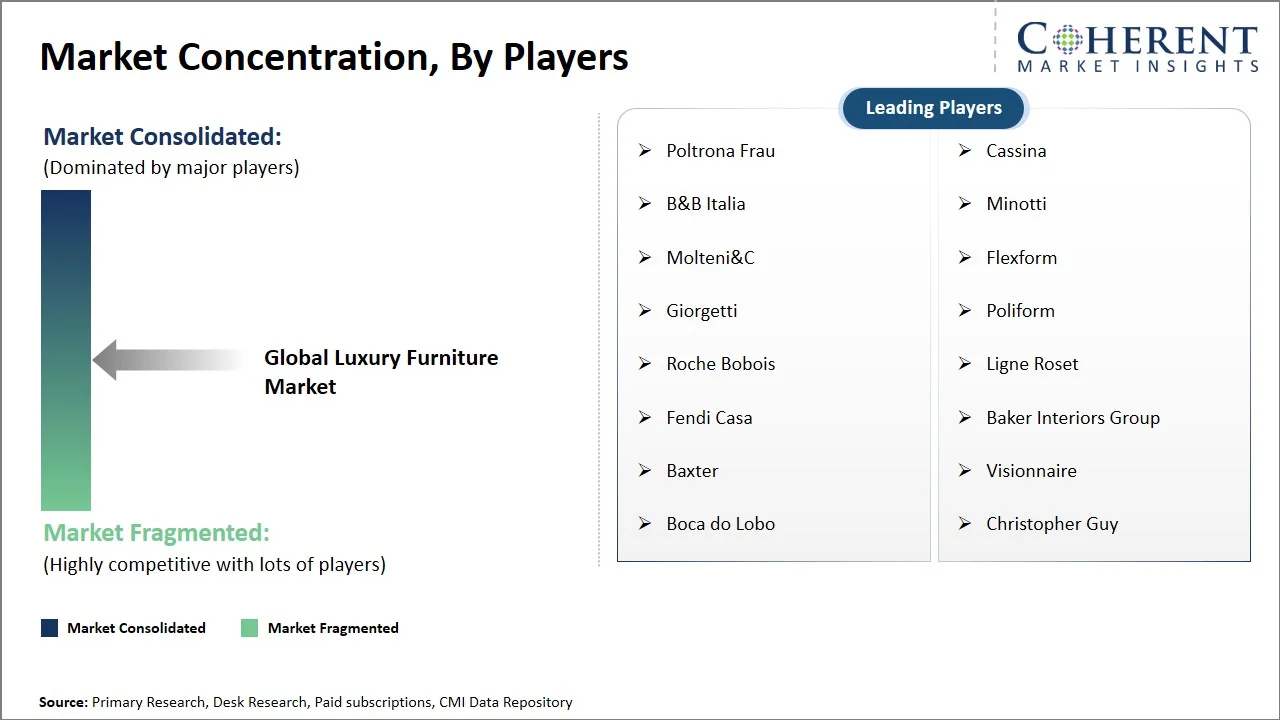
The global luxury furniture market is moderately fragmented, with competition driven by brand heritage, design innovation, material quality, customization capability, showroom presence, and international distribution strength. Leading luxury furniture companies compete through premium product collections, collaborations with renowned designers, flagship store expansion, sustainable sourcing, and direct engagement with architects, interior designers, hospitality developers, and high-net-worth residential buyers. The market includes both established European design houses and premium global retailers, with companies focusing on strengthening brand exclusivity, customer experience, and contract furnishing capabilities.
Key focus areas include
- Development of premium and design-led furniture collections with strong emphasis on seating, bedroom furniture, tables, storage systems, and mixed-material designs
- Expansion of flagship stores, design galleries, and luxury showrooms to improve customer experience, brand visibility, and direct sales conversion
- Growing focus on customization and bespoke furniture solutions to meet demand from luxury homeowners, interior designers, architects, and hospitality projects
- Adoption of sustainable materials and responsible sourcing practices including certified wood, eco-friendly upholstery, recyclable materials, and low-emission finishes
- Strengthening of hospitality, branded residence, and commercial contract furnishing capabilities to capture large-scale project-based demand
- Integration of digital tools such as virtual consultations, online configurators, AR visualization, and e-commerce platforms to support premium customer engagement and omnichannel sales
- Geographic expansion across Asia Pacific, North America, and the Middle East through partnerships, distributors, flagship stores, and luxury retail networks
Market Report Scope
Luxury Furniture Market Report Coverage
| Report Coverage | Details | ||
|---|---|---|---|
| Base Year: | 2025 | Market Size in 2026: | USD 34.5 Bn |
| Historical Data for: | 2020 To 2024 | Forecast Period: | 2026 To 2033 |
| Forecast Period 2026 to 2033 CAGR: | 6.2% | 2033 Value Projection: | USD 52.56 Bn |
| Geographies covered: |
| ||
| Segments covered: |
| ||
| Companies covered: | Poltrona Frau, Cassina, B&B Italia, Minotti, Molteni&C, Flexform, Giorgetti, Poliform, Roche Bobois, Ligne Roset, Fendi Casa, Baker Interiors Group, Baxter, Visionnaire, Boca do Lobo, and Christopher Guy | ||
| Growth Drivers: |
| ||
| Restraints & Challenges: |
| ||
Analyst Opinion (Expert Opinion)
- The global luxury furniture market is expected to grow steadily over the long term, supported by rising spending on premium residential interiors, increasing demand for customized furniture, and expansion of luxury hospitality and branded real estate projects. Consumers are increasingly preferring furniture that combines design value, durability, comfort, and exclusivity.
- The strongest opportunities are expected in Europe, North America, China, and India. Europe will continue to benefit from its established design heritage and premium furniture manufacturing base, while North America is expected to gain from luxury home renovation and direct showroom-led sales. China and India are likely to offer strong growth potential due to rising affluent consumers and premium housing development.
- To gain a competitive advantage, market participants should focus on bespoke furniture design, sustainable material sourcing, digital visualization tools, flagship store expansion, and hospitality contract furnishing capabilities. Strong relationships with architects, interior designers, luxury real estate developers, and hotel operators will be critical for improving project-based sales and long-term brand positioning.
Speak to the analyst
Want personalized insights?
Take the findings above to one of our principal consultants, or have the report rebuilt around the segments, geographies and competitors you actually track.
Market Segmentation
- Product Type Insights (Revenue, USD Bn, 2021 - 2033)
- Seating Furniture
- Beds and Bedroom Furniture
- Tables and Desks
- Storage and Cabinets
- Others
- Material Type Insights (Revenue, USD Bn, 2021 - 2033)
- Wood
- Upholstered and Leather
- Metal
- Glass and Stone
- Others
- End-use Industry Insights (Revenue, USD Bn, 2021 - 2033)
- Residential
- Hospitality
- Commercial Offices
- Luxury Retail and Public Spaces
- Others
- Distribution Channel Insights (Revenue, USD Bn, 2021 - 2033)
- Direct
- Indirect
- Regional Insights (Revenue, USD Bn, 2021 - 2033)
- North America
- U.S.
- Canada
- Latin America
- Brazil
- Argentina
- Mexico
- Rest of Latin America
- Europe
- Germany
- U.K.
- Spain
- France
- Italy
- Russia
- Rest of Europe
- Asia Pacific
- China
- India
- Japan
- Australia
- South Korea
- ASEAN
- Rest of Asia Pacific
- Middle East
- GCC Countries
- Israel
- Rest of Middle East
- Africa
- South Africa
- North Africa
- Central Africa
- North America
- Key Players Insights
- Poltrona Frau
- Cassina
- B&B Italia
- Minotti
- Molteni&C
- Flexform
- Giorgetti
- Poliform
- Roche Bobois
- Ligne Roset
- Fendi Casa
- Baker Interiors Group
- Baxter
- Visionnaire
- Boca do Lobo
- Christopher Guy
Sources
Primary Research Interviews
- Senior executives and product managers from luxury furniture manufacturers
- Interior designers, architects, and luxury residential design consultants
- Procurement heads from luxury hotels, resorts, serviced apartments, and branded residences
- Dealers, distributors, and showroom managers of premium and luxury furniture brands
- Raw material suppliers dealing in premium wood, leather, upholstery, metal, glass, stone, and marble
- Real estate developers involved in luxury apartments, villas, penthouses, and branded residence projects
- E-commerce and omnichannel retail managers operating in premium home furnishing categories
Stakeholders
- Luxury furniture manufacturers and premium home furnishing brands
- Interior design studios, architects, and project consultants
- Raw material suppliers, including certified wood, leather, upholstery fabric, metal, glass, and stone suppliers
- Furniture component manufacturers and contract furniture producers
- Luxury furniture distributors, dealers, flagship stores, and multi-brand showrooms
- Online luxury furniture platforms and home décor retailers
End-use Sectors
- Residential homes, villas, apartments, penthouses, and branded residences
- Luxury hotels, resorts, serviced apartments, and boutique hospitality properties
- Commercial offices, executive spaces, and corporate lounges
- Luxury retail stores, premium showrooms, and public spaces
- Interior design and architecture-led contract projects
- Real estate developers and project-based furnishing contractors
Regulatory & Standards Bodies
- European Commission – EU Deforestation Regulation and Ecodesign for Sustainable Products Regulation
- U.S. Consumer Product Safety Commission (CPSC)
- U.S. Environmental Protection Agency (EPA) – formaldehyde emission standards for composite wood products
- Bureau of Indian Standards (BIS) – Furniture Quality Control Orders
- UK Office for Product Safety and Standards (OPSS) – Furniture and Furnishings Fire Safety Regulations
- Forest Stewardship Council (FSC)
- Programme for the Endorsement of Forest Certification (PEFC)
- Business and Institutional Furniture Manufacturers Association (BIFMA)
Databases
- UN Comtrade Database
- International Trade Centre (ITC) Trade Map
- Eurostat
- World Bank Data
- OECD Data
- U.S. Census Bureau
- National Bureau of Statistics of China
- India Ministry of Statistics and Programme Implementation (MoSPI)
- UN Habitat Urban Data
- U.S. International Trade Administration
Journals
- Journal of Interior Design
- International Journal of Design
- Forest Products Journal
- Journal of Cleaner Production
- Sustainability
- Resources, Conservation & Recycling
- Wood Material Science & Engineering
- Journal of Retailing and Consumer Services
Newspapers
- Financial Times
- The Wall Street Journal
- The Economic Times
- South China Morning Post
- Business Standard
- Mint
Associations
- European Furniture Industries Confederation (EFIC)
- American Home Furnishings Alliance (AHFA)
- British Furniture Confederation (BFC)
- Furniture Industry Research Association (FIRA)
- Confederation of Indian Industry (CII)
- Retailers Association of India (RAI)
- National Retail Federation (NRF)
- International Interior Design Association (IIDA)
- American Society of Interior Designers (ASID)
- Hospitality Financial and Technology Professionals / hospitality industry associations
Public Domain Sources
- European Commission – Sustainable Products, Deforestation-free Products, and Packaging Regulations
- U.S. EPA – Composite Wood Products Formaldehyde Emission Standards
- U.S. CPSC – Consumer Product Safety Guidelines
- UK Government – Furniture and Furnishings Fire Safety Regulations
- Bureau of Indian Standards – Furniture Quality Control Orders
- World Bank – Urbanization, income, and household expenditure indicators
- OECD – Household income and consumer expenditure data
- UN Comtrade – Furniture import and export trade flows
- Eurostat – Furniture production, trade, and consumption statistics
- National statistical offices for country-level housing, retail, and furniture data
Proprietary Elements
- CMI Data Analytics Tool, Proprietary CMI Existing Repository of information for last 10 years.
Get access to 250+ pages report
Every segment, forecast, competitor profile and data table behind the analysis above — available for instant download.
- ESOMAR Member
- ISO 9001:2015 Certified
- D-U-N-S Registered
- GDPR & CCPA Compliant
Missing comfort of reading report in your local language? Find your preferred language:
Transform your Strategy with Exclusive Trending Reports
Frequently Asked Questions
The CAGR of the global luxury furniture market is projected to be 6.2% from 2026 to 2033.
The global luxury furniture market is estimated to be valued at USD 34.5 Bn in 2026 and is expected to reach USD 52.56 Bn by 2033.
In terms of product type, seating furniture is estimated to dominate the market revenue share in 2026.
Expansion of high-net-worth residential interior spending and growth of luxury hospitality and branded real estate projects are the major factors driving the growth of the Global Luxury Furniture Market.
High dependency on premium raw materials and artisanal labor and longer replacement cycles for durable luxury furniture are the major factors hampering the growth of the global luxury furniture market.
Poltrona Frau, Cassina, B&B Italia, Minotti, Molteni&C, Flexform, Giorgetti, Poliform, Roche Bobois, Ligne Roset, Fendi Casa, Baker Interiors Group, Baxter, Visionnaire, Boca do Lobo, and Christopher Guy are the major players.
Europe is expected to lead the global luxury furniture market in 2026.