

Beauty Devices Market Size & Trends
Beauty Devices Market is estimated to be valued at USD 155.42 Bn in 2026 and is expected to reach USD 227.59 Bn in 2033, exhibiting a compound annual growth rate (CAGR) of 5.6% from 2026 to 2033.
Key Takeaways
- Based on Device Type, the Hair Removal Devices segment is projected to account for 22% of the market share in 2026, due to rising consumer preference for at-home personal care solutions.
- Based on Application, the Home segment is set to capture the largest market share in 2026, due to growing consumer preference for convenience, privacy, and cost-effectiveness.
- Based on Region, North America is expected to lead the global beauty devices market in 2026, with a 40% While, Asia Pacific is anticipated to be the fastest growing region in the beauty devices market during the forecast period.
Market Overview
The beauty devices market is witnessing robust growth driven by increasing consumer awareness around personal care, rising disposable income, and the growing demand for non-invasive aesthetic treatments. Beauty devices, such as cleansing brushes, hair removal tools, acne treatment devices, anti-aging and skin tightening tools are increasingly being used both in professional settings like dermatology clinics and spas, as well as at home.
The market is also being propelled by technological advancements such as LED therapy, radiofrequency, ultrasound, and microcurrent technologies, which offer effective and convenient skincare solutions. Additionally, the rise of skin health concerns such as acne, hyperpigmentation, and premature aging, particularly among millennials and Gen Z consumers, is contributing to higher adoption rates.
The expansion of e-commerce platforms and influencer-driven marketing strategies are further accelerating product penetration across emerging economies. With rising beauty devices market demand, the industry is shifting toward personalized skincare and smart beauty technology, making it poised for significant growth in the coming years.
Current Events and Its Impact
Current Event | Description and Its Impact |
EU Cosmetics Regulation Revision and Safety Standards |
|
Global Economic Pressures and Consumer Behavior Shifts |
|
Role of Artificial Intelligence (AI) into Beauty Devices Market
Integration of Artificial Intelligence (AI) is significantly transforming the beauty devices market by enhancing personalization, efficacy, and user experience. AI-powered devices can analyze individual skin conditions using facial scanning technology and deliver tailored treatments, such as adjusting light intensity in LED therapy or optimizing cleansing cycles based on skin type. Smart beauty mirrors, AI apps, and connected devices provide real-time feedback and progress tracking, making at-home beauty routines more effective. Moreover, AI is helping brands in product development through consumer behavior analysis and predictive trends, driving innovation and more targeted device launches in the market.
L’Oréal has introduced Perso, the world’s first AI-powered device for personalized skincare and cosmetics. Developed by the L’Oréal Technology Incubator, this revolutionary 6.5-inch device delivers on-the-spot, customized skincare and makeup formulas tailored to each individual’s unique needs. Powered by advanced Artificial Intelligence, Perso continuously evolves, learning from users’ skin conditions and preferences to refine its formulations over time.
- Current Industry Events of 2026
- Market Size Estimation
- Regional Breakdown
- Competitive Landscape
- Customer Intelligence
- Segmental Analysis
- Pricing Analysis
- Key Market Drivers, Challenges & Future Trends
- Customized Insights Section
Segmental Insights
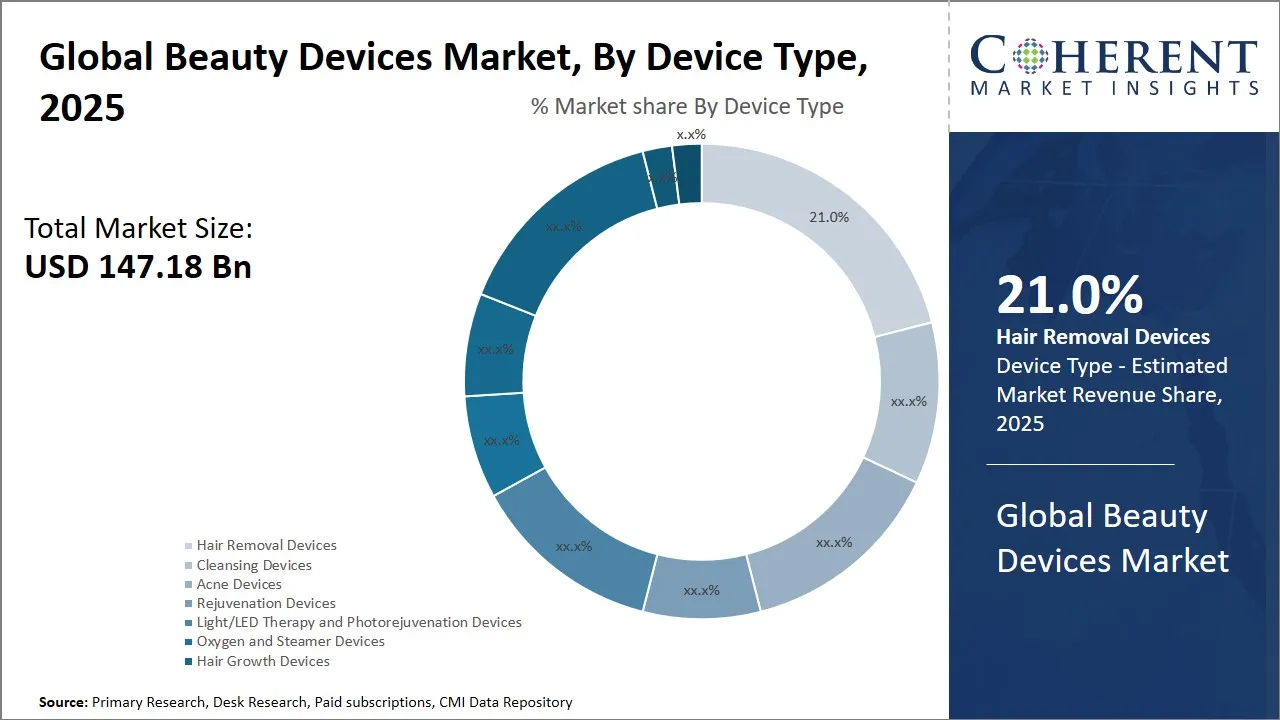
Beauty Devices Market Insights, By Device Type - Hair Removal Devices Acquires the Largest share owing to the Rising Consumer Preference for At-Home Personal Care
In terms of device type, the hair removal devices segment is expected to contribute 22% share of the market in 2026, due to rising consumer preference for at-home personal care solutions. With growing awareness of aesthetics and grooming, especially among younger populations and working professionals, more individuals are investing in convenient, cost-effective alternatives to salon treatments. Technological advancements have led to the development of user-friendly, efficient, and safe laser and IPL-based devices that cater to a broader range of skin types and tones.
Additionally, the influence of social media, beauty influencers, and increased visibility of grooming routines has helped normalize hair removal practices across genders. The medical community’s support for FDA-approved devices for home use has also strengthened consumer trust. These factors collectively contribute to the increasing beauty devices market growth for hair removal solutions globally.
In October 2024, DermRays, a leader in at‑home beauty technology, unveiled next‑generation laser hair removal device, the V8S Pro. This advanced 810 nm diode model builds on the success of DermRays’ home laser device line, offering a larger treatment area, higher energy output and smarter user interface for more effective and user‑friendly hair reduction.
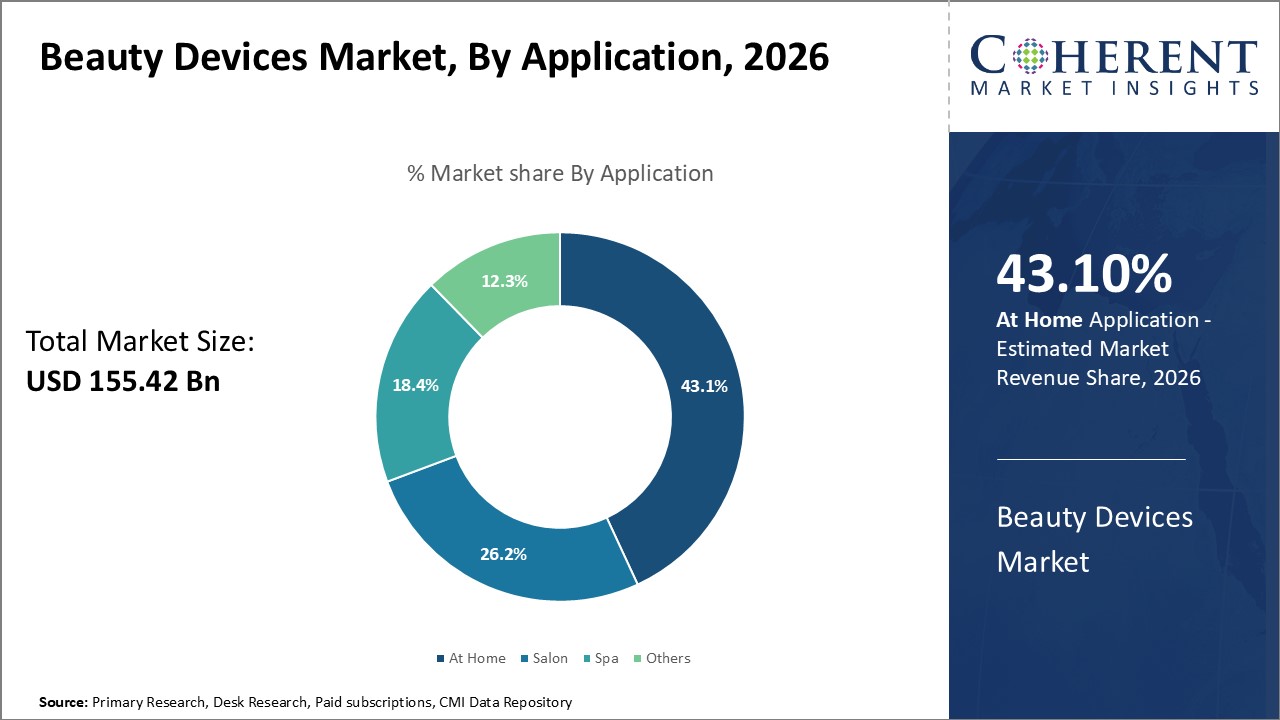
Beauty Devices Market Insights, By Application - Home Segment Holds the Dominant share owing to the Growing Consumer Preference for Convivence & Privacy
In term of application, the home segment is expected to hold the largest share of the market in 2026, due to growing consumer preference for convenience, privacy, and cost-effectiveness. Many individuals are opting for at-home beauty treatments to avoid the time and expense of visiting salons or dermatology clinics. Advancements in technology have led to the availability of compact, user-friendly, and safe beauty devices designed specifically for home use, such as LED light therapy tools, facial cleansing brushes, and laser hair removal devices. Additionally, increasing consumer awareness and confidence in performing basic skincare routines independently is further driving the adoption of beauty devices for home applications. This shift aligns with the broader trend of personal wellness and self-care, making home-use beauty devices a rapidly growing segment.
In April 2025, L’Oréal introduced Lancôme Rénergie Nano‑Resurfacer. The at‑home device uses patented nanochip technology, featuring around 400 ultra‑precise silicon nano‑tips to create invisible micro‑pathways on the skin, mimicking microneedling without pain or downtime. It is designed to be used with Lancôme’s Rénergie H.C.F. Triple Serum, it doubles the serum’s anti‑ageing efficacy across wrinkles, fine lines, firmness and tone. Such innovations are proliferating the beauty devices market revenue.
Regional Insights
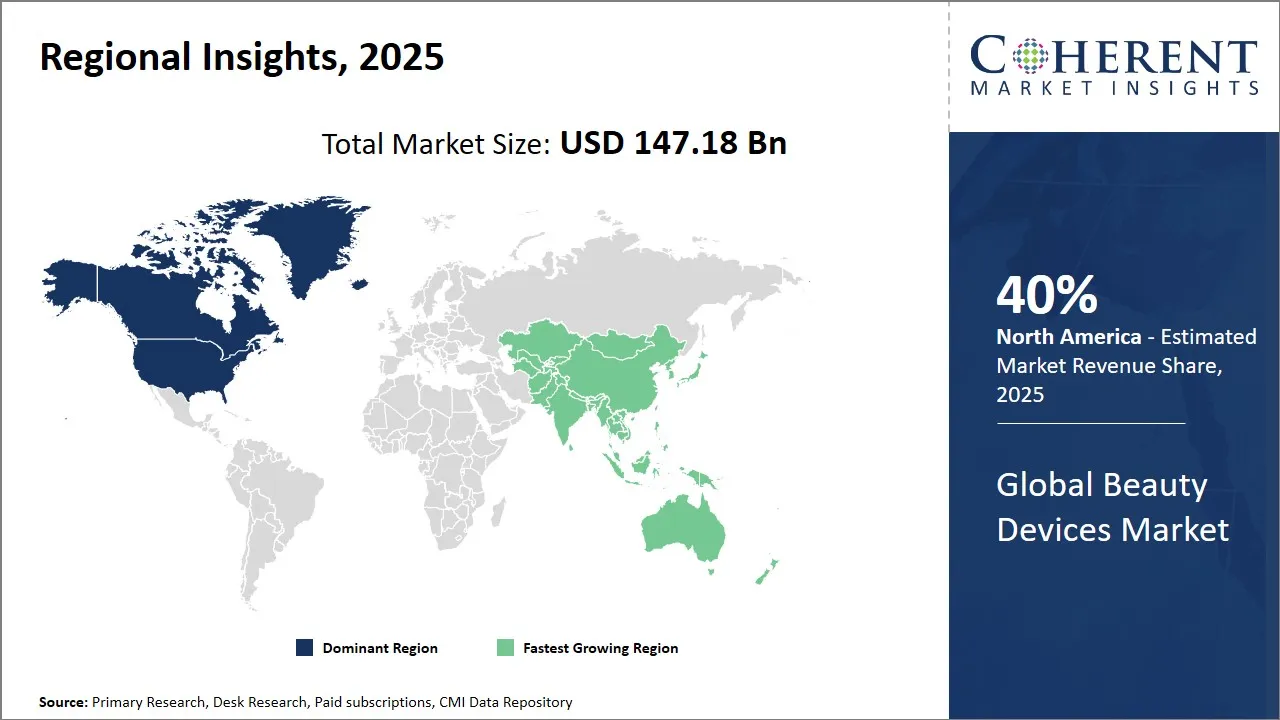
North America Beauty Devices Market Analysis & Trends
North America region is projected to lead the market with 40% share in 2026, driven by a combination of high consumer spending on personal care and continuous technological innovation. Consumers in the U.S. and Canada are increasingly investing in advanced beauty solutions such as anti-aging tools, acne treatment devices, and skin rejuvenation technologies. The rising demand is also supported by the preference for non-invasive, at-home treatments, especially among aging demographics looking for convenient alternatives to clinical procedures.
For instance, in February 2026, L’Oréal Groupe opened its new North America Research & Innovation (R&I) Center in Clark, New Jersey, marking a $160 million investment in its U.S. operations. The 250,000‑square‑foot campus, the company’s largest R&I site outside France, employs over 600 scientists focused on product innovation across hair care, skincare, and cosmetics, including brands like Maybelline, CeraVe, Redken, and Kiehl’s.
Asia Pacific Beauty Devices Market Analysis & Trends
Asia Pacific region is expected to exhibit the fastest growth in the beauty devices market during the forecast period, driven by rising disposable incomes and increasing consumer awareness of advanced skincare solutions. Countries like China, Japan, South Korea, and India are witnessing a surge in the adoption of beauty technology, particularly among millennials and Gen Z who are highly influenced by digital platforms and social media trends. The popularity of K-beauty, along with a growing focus on personal grooming and appearance, is accelerating the use of devices such as facial cleansing brushes, LED therapy tools, and hair removal systems. Moreover, the aging population in nations like Japan and South Korea is contributing to the demand for anti-aging and wrinkle-reducing devices. Local manufacturing strengths, expanding e-commerce channels, and government support for innovation are further making these devices more affordable and accessible. Collectively, these factors are strengthening the beauty devices market growth across Asia Pacific.
For instance, in May 2026, Sephora launched Haus Labs by Lady Gaga across Asia Pacific, including Australia, New Zealand, Hong Kong SAR, Malaysia, Philippines, Singapore, and Thailand, making the full range of 125 vegan, cruelty‑free products available exclusively through its brick‑and‑click network. The move strengthens Sephora's prestige beauty portfolio now approaching 250 brands in the region, with innovative HausTech‑Powered™ formulations like Triclone Skin Tech Foundation and hybrid lip oils.
Beauty Devices Market Outlook Country-Wise
China Beauty Devices Market Trends
China is a key driver of the beauty devices market, fueled by rising disposable income, tech-savvy consumers, and a strong e-commerce ecosystem. Social media platforms like Douyin and RED significantly influence beauty trends, boosting the popularity of at-home devices such as LED masks, facial rollers, and hair removal tools. The growing focus on skincare, anti-aging, and convenience has made China a leading market for beauty-tech innovation and adoption.
In February 2026, the Ordinary entered the Chinese market through an exclusive partnership with Sephora. Twenty-four products, including localized and newly developed items, are now available—among them a reformulated glycolic acid toner designed to meet local regulations.
South Korea Beauty Devices Market Trends
South Korea is a global leader in skincare innovation, driving early adoption of advanced beauty technologies. Tech-savvy consumers favor smart, portable devices that offer salon-like results at home. Popular products include LED therapy tools, pore cleaners, and personalized skincare gadgets. Strong R&D, the rise of K-beauty tech, and integration with digital platforms have made South Korea both a key consumer and global trendsetter in the beauty devices market.
In April 2026, Dyson unveiled the newest version of its Airwrap styler in South Korea, marking its first release worldwide. This updated model provides quicker, more convenient styling, enhanced versatility, and twice the air pressure compared to the previous version.
The U.S. Beauty Devices Market Trends
The beauty devices market in the United States is growing rapidly due to high personal care awareness, a strong presence of premium brands, and rising at-home beauty routines. Consumers increasingly prefer convenient, tech-enabled solutions for skincare, driving demand for anti-acne, skin rejuvenation, and hair removal devices. The trend toward self-care and minimally invasive treatments continues to fuel innovation and adoption across the country.
Market Report Scope
Beauty Devices Market Report Coverage
| Report Coverage | Details | ||
|---|---|---|---|
| Base Year: | 2025 | Market Size in 2026: | USD 155.42 Bn |
| Historical Data for: | 2020 To 2024 | Forecast Period: | 2026 To 2033 |
| Forecast Period 2026 to 2033 CAGR: | 5.6% | 2033 Value Projection: | USD 227.59 Bn |
| Geographies covered: |
| ||
| Segments covered: |
| ||
| Companies covered: | L’Oreal Group, Nu Skin Enterprise, Inc., Panasonic Corporation, Home Skinovations, Ltd., PhotoMedex, Inc., Carol Cole Company, Procter & Gamble Company, Koninklijke Philips N.V., TRIA Beauty, Inc., and AmorePacific Group | ||
| Growth Drivers: |
| ||
| Restraints & Challenges: |
| ||
Market Dynamics
Beauty Devices Market Drivers
Increasing aging population
Increasing aging population is a prime factor fuelling the global beauty devices market growth. Aging is associated with the loss of the fibrous tissue. The skin layer starts reducing vascular and glandular networks, which leads to wrinkles, pigmentation, and sagging of the skin. According to the World Health Organization, by 2030, 1 in 6 people in the world will be aged 60 years or over. At this time the share of the population aged 60 years and over will increase from 1 billion in 2020 to 1.4 billion. By 2050, the world’s population of people aged 60 years and older will double (2.1 billion). The number of persons aged 80 years or older is expected to triple between 2020 and 2050 to reach 426 million.
Increasing awareness regarding personal hygiene
Increasing awareness regarding personal hygiene is propelling the global beauty devices market growth. A rise in the urban population coupled with the increasing penetration of personal care products across emerging nations is also expected to foster the market growth. Also, rapid adoption of such products among consumers due to effectiveness and benefits offered by these products are further anticipated to augment the global beauty devices market growth.
Beauty Devices Market Trends
Increasing preferences for at-home beauty devices
Increasing preferences for at-home beauty devices that are easy to use for acne and hair removal is one of the growing market trends. At-home beauty devices are portable and easy to use. They are gaining huge demand due to an increasing availability of home solutions. These devices are witnessing tremendous demand on the account of a rise in young population and middle age population around the globe.
Changing lifestyle coupled with growing disposable income
Changing lifestyle coupled with growing disposable income is projected to bolster the global beauty devices market growth. Improving living of standard and constantly changing fashion trends are two other major factors propelling the global beauty devices market growth. Also, an increasing number of working women is further creating demand for such devices, thereby fuelling the global beauty devices market growth.
Analyst Opinion (Expert Opinion)
The beauty devices market value is undergoing a transformative evolution driven the confluence of three critical forces: hyper-personalization, diagnostic precision, and AI-assisted performance. In my assessment, the market’s future will be shaped less by traditional segmentation (e.g., skincare vs. haircare) and more by the intelligence and adaptability of the devices themselves. What we are witnessing is the migration of clinical-grade solutions into the palms of consumers, a profound shift in how beauty is accessed, delivered, and measured.
One of the most notable developments is the adoption of smart diagnostic devices that leverage AI and sensor-based analytics to provide real-time skin assessments. For instance, L’Oréal’s Perso and Opte devices have set a new benchmark by combining smartphone integration, data analytics, and customized formulation. These devices go beyond simple surface care; they analyze hydration, pore visibility, pigmentation, and even ambient environmental factors to deliver tailored treatments. This integration of machine learning and user-specific dermatological input is not only enhancing efficacy but also building deep consumer loyalty through data-driven results.
Equally compelling is the emergence of at-home energy-based treatment devices that mirror clinical technologies. Radiofrequency (RF), LED, microcurrent, and ultrasonic technologies, once restricted to dermatologist clinics, are now available in portable formats. The NuFACE Trinity, for example, uses microcurrent stimulation to improve facial contouring and reduce fine lines, features that have driven widespread traction in markets such as South Korea, Japan, and increasingly in the U.S. The clinical outcomes of such devices have been well-documented in published dermatological trials, indicating significant improvements in elasticity and dermal density over consistent usage periods.
From a regional innovation standpoint, Asia, particularly South Korea and China, has become the epicenter of beauty tech advancement. South Korean brands are not merely adopting smart technologies; they are designing entire ecosystems. The marriage of beauty apps, home-use hardware, and ingredient-based customization is being perfected in this region. Notably, Amorepacific’s IOPE Lab offers a 3D-printed mask based on facial scans, an innovation that redefines the concept of “custom skincare.” These markets are not followers; they are defining the R&D narrative for global players.
Speak to the analyst
Want personalized insights?
Take the findings above to one of our principal consultants, or have the report rebuilt around the segments, geographies and competitors you actually track.
Key Developments
- In July 2025, JMOON entered the U.S. market with the debut of its flagship NouvelleSkin Facial Toning Device at Cosmoprof North America 2025. The advanced beauty‑tech gadget introduces the brand’s proprietary Transdermal Collagen Light Technology, which aims to redefine at‑home skin rejuvenation by outperforming traditional radiofrequency (RF) treatments.
- In May 2025, CLASSYS, a leading Korean medical aesthetic device maker, secured European Union CE certification under the new Medical Device Regulation (MDR) for its radiofrequency-based anti-aging system Volnewmer, becoming the first company to gain CE MDR approval for an RF aesthetic device in Europe.
- In January 2025, L’Oréal launched its breakthrough Cell BioPrint device at CES 2025 in Las Vegas, promising a personalized skincare revolution. The tabletop “mini lab” analyzes biomarkers from cheek-collected skin cells in just five minutes, revealing users’ biological skin age, sensitivity to ingredients like retinol, and potential concerns such as dark spots or enlarged pores. Developed in partnership with Korean biotech firm NanoEnTek, the device combines microfluidic lab‑on‑a‑chip technology and L’Oréal’s Longevity Integrative Science.
- In March 2023, BeautyHealth unveiled its digitally connected Hydrafacial™ Syndeo™ device into Europe and Asia. Syndeo merges Hydrafacial’s patented vortex-fusion technology with cloud-based software, enabling providers to personalize treatments using client history and preference data, gesture-controlled interface, and LED light therapy integration.
Market Segmentation
- Global Beauty Devices Market, By Device Type (Revenue, USD Bn, 2021 - 2033)
- Hair Removal Devices
- Cleansing Devices
- Acne Devices
- Rejuvenation Devices
- Light/LED Therapy and Photorejuvenation Devices
- Oxygen and Steamer Devices
- Hair Growth Devices
- Skin Dermal Devices
- Cellulite Reduction Devices
- Others
- Global Beauty Devices Market, By Application (Revenue, USD Bn, 2021 - 2033)
- Salon
- Spa
- At Home
- Others
- Global Beauty Devices Market, By Region (Revenue, USD Bn, 2021 - 2033)
- North America
- U.S.
- Canada
- Latin America
- Brazil
- Argentina
- Mexico
- Rest of Latin America
- Europe
- Germany
- U.K.
- Spain
- France
- Italy
- Russia
- Rest of Europe
- Asia Pacific
- China
- India
- Japan
- Australia
- South Korea
- ASEAN
- Rest of Asia Pacific
- Middle East
- GCC Countries
- Israel
- Rest of Middle East
- Africa
- South Africa
- North Africa
- Central Africa
- North America
- Company Profiles
- L’Oreal Group
- Nu Skin Enterprise, Inc.
- Panasonic Corporation
- Home Skinovations, Ltd.
- PhotoMedex, Inc.
- Carol Cole Company
- Procter & Gamble Company
- Koninklijke Philips N.V.
- TRIA Beauty, Inc.
- AmorePacific Group.
Sources
Primary Research Interviews from the following stakeholders
Stakeholders
- Interviews with skincare device manufacturers, dermatologists, estheticians, cosmetic retailers, salon/spa operators, R&D scientists, regulatory affairs managers, and consumer behavior analysts across major global markets.
Specific Stakeholders
- Product innovation heads at personal care device brands
- Procurement and merchandising heads at beauty retail chains
- Heads of dermatology and cosmetology departments in hospitals and skincare clinics
- Salon/spa managers and franchise owners
- Regulatory compliance officers handling device approvals and certifications
- Industrial designers and engineers involved in IoT/AI-enabled beauty device R&D
- Social media content creators and beauty influencers focusing on home-use devices
Databases
- World Health Organization (WHO) – Global Health Observatory
- UN Comtrade Database
- World Bank Open Data – Healthcare and Demographics
- Eurostat – Personal Care and Medical Devices Sector
- U.S. Food and Drug Administration (FDA) – Medical Device Classification
- Ministry of Health, Labour and Welfare (Japan)
- Korean Ministry of Food and Drug Safety (MFDS)
- National Medical Products Administration (NMPA), China
- Directorate General of Commercial Intelligence and Statistics (DGCIS), India
Magazines
- Allure (Beauty Tech section)
- Vogue Business – Beauty Innovation
- BeautyMatter
- Happi Magazine (Household and Personal Products Industry)
- Cosmetics Business – Devices & Tools Segment
- Skin Inc. Magazine
- Global Cosmetic Industry (GCI) Magazine
- NewBeauty (Technology & Tools coverage)
Journals
- Journal of Cosmetic Dermatology
- International Journal of Cosmetic Science
- Journal of Dermatological Treatment
- Clinical, Cosmetic and Investigational Dermatology
- Journal of Biomedical Optics
- IEEE Journal of Translational Engineering in Health and Medicine
Newspapers
- The Wall Street Journal – Personal Tech & Wellness
- Financial Times – Beauty and Wellness Reports
- The Hindu Business Line – Beauty, Retail & Lifestyle
- South China Morning Post – Health & Wellness Tech
- The Economic Times – Personal Care & Consumer Goods
- Nikkei Asia – Consumer Electronics & Lifestyle Products
Associations
- Personal Care Products Council (PCPC)
- International Society of Dermatology (ISD)
- Asia-Pacific Society for Cosmetic Dermatology
- Society of Cosmetic Scientists (SCS)
- International Spa Association (ISPA)
- Confederation of Indian Industry (CII) – Personal Care Division
- Japan Cosmetic Industry Association (JCIA)
Public Domain Sources
- Ministry of Health and Family Welfare (MoHFW), India
- National Institute of Health (NIH), U.S.
- Ministry of Economy, Trade and Industry (METI), Japan
- NITI Aayog – Health and Wellness Initiatives
- Korea Health Industry Development Institute (KHIDI)
- European Commission – Health and Digital Market Insights
- U.S. International Trade Commission (USITC) – Cosmetic Devices Trade Data
- Reserve Bank of India (RBI) – Consumer Goods & Services Reports
Proprietary Elements
- CMI Data Analytics Tool, and Proprietary CMI Existing Repository of information for last 8 years
Get access to 250+ pages report
Every segment, forecast, competitor profile and data table behind the analysis above — available for instant download.
- ESOMAR Member
- ISO 9001:2015 Certified
- D-U-N-S Registered
- GDPR & CCPA Compliant
Missing comfort of reading report in your local language? Find your preferred language:
Transform your Strategy with Exclusive Trending Reports
Frequently Asked Questions
The Beauty Devices Market is estimated to be valued at USD 155.42 Bn in 2026, and is expected to reach USD 227.59 Bn by 2033.
The CAGR of the Beauty Devices Market is projected to be 5.6% from 2026 to 2033.
Increasing awareness regarding personal hygiene and increasing aging population is fuelling growth of the market.
The hair removal devices segment is the leading component segment in the market.
Side- effects associated with Beauty Devices is the major factors restraining growth of the market.
Beauty devices target wrinkles, acne, dark spots, dullness, enlarged pores, sagging skin, uneven texture, and oil control issues.
Beauty devices offer convenience and affordability but may not match clinical results; ideal for maintenance, not major skin corrections.