

Global Medical Grade Chitosan Market Size and Forecast – 2026 To 2033
The global medical grade chitosan market is expected to grow from USD 430.5 Mn in 2026 to USD 921.9 Mn by 2033, registering a compound annual growth rate (CAGR) of 11.5% from 2026 to 2033. The market for medical grade chitosan is poised for significant expansion, fueled by the increasing adoption of advanced wound care biomaterials that enhance tissue regeneration and accelerate healing.
According to the U.S. Centers for Medicare & Medicaid Services (CMS), Medicare spending on skin substitute products increased from USD 256 million in 2019 to more than USD 10 billion in 2024, highlighting the rapidly growing demand for advanced wound care therapies and biomaterial-based treatment solutions.
Key Takeaways of the Global Medical Grade Chitosan Market
- Animal based is projected to hold 87.4 % of the global medical grade chitosan market share in 2026, making it the dominant origin segment across North America due to the well-established regulatory framework governing animal-derived biomaterials for medical devices. For instance, the U.S. Food and Drug Administration (FDA) has issued guidance aligned with ISO 22442 for medical devices containing animal-derived materials, outlining stringent requirements for sourcing, handling, traceability, and viral safety. These regulatory standards continue to support the widespread use of purified animal-derived chitosan in medical-grade applications.
- Drug delivery is projected to hold 26.7 % of the global medical grade chitosan market share in 2026, making it the dominant application segment across North America owing to the strong regulatory support for advanced drug delivery and regenerative therapeutics. For instance, in April 2024, the U.S. FDA issued draft guidance on the use of human- and animal-derived materials in the manufacture of cell and gene therapy and tissue-engineered medical products, reinforcing quality and safety requirements for biomaterials used in advanced therapeutic platforms. This regulatory framework supports broader adoption of medical-grade chitosan in innovative drug delivery systems.
- North America maintains its dominance with an estimated share of 32.3 % in 2026, bolstered by the region's robust regulatory framework for advanced biomaterials and medical devices. For instance, in September 2025, the U.S. Food and Drug Administration (FDA) launched the Home as a Health Care Hub initiative to accelerate the adoption of innovative medical technologies and patient-centric healthcare solutions. Such initiatives are expected to encourage the development and commercialization of advanced biomaterial-based products including medical-grade chitosan for wound care and drug delivery.
- Asia Pacific is expected to exhibit the fastest growth with an estimated contribution of 26.8 % share in 2026, driven by increasing government support for domestic medical device manufacturing and biomaterials innovation. For instance, in June 2026, India's Department of Pharmaceuticals invited proposals under the Scheme for Strengthening the Medical Device Industry (SMDI), introducing the Medical Device Clinical Studies Support Scheme to strengthen clinical research and accelerate commercialization of innovative medical technologies. The initiative is expected to create favorable opportunities for medical-grade biomaterials, including chitosan-based products.
- Growing adoption of bioresorbable biomaterials in implantable medical devices: The increasing preference for bioresorbable materials in implantable medical devices is driving the demand for medical-grade chitosan due to its excellent biocompatibility and controlled biodegradation. Chitosan is being incorporated into absorbable wound matrices, tissue scaffolds, and implant coatings to eliminate the need for secondary removal procedures while supporting natural tissue regeneration.
- Expansion of fungal-derived medical-grade chitosan for next-generation therapeutics: The commercialization of fungal-derived medical-grade chitosan presents a significant growth opportunity by offering a highly consistent, shellfish-free alternative with reduced allergenicity. Its scalable production and suitability for advanced drug delivery, cell therapies, and regenerative medicine applications are expected to accelerate adoption among pharmaceutical and medical device manufacturers.
Segmental Insights
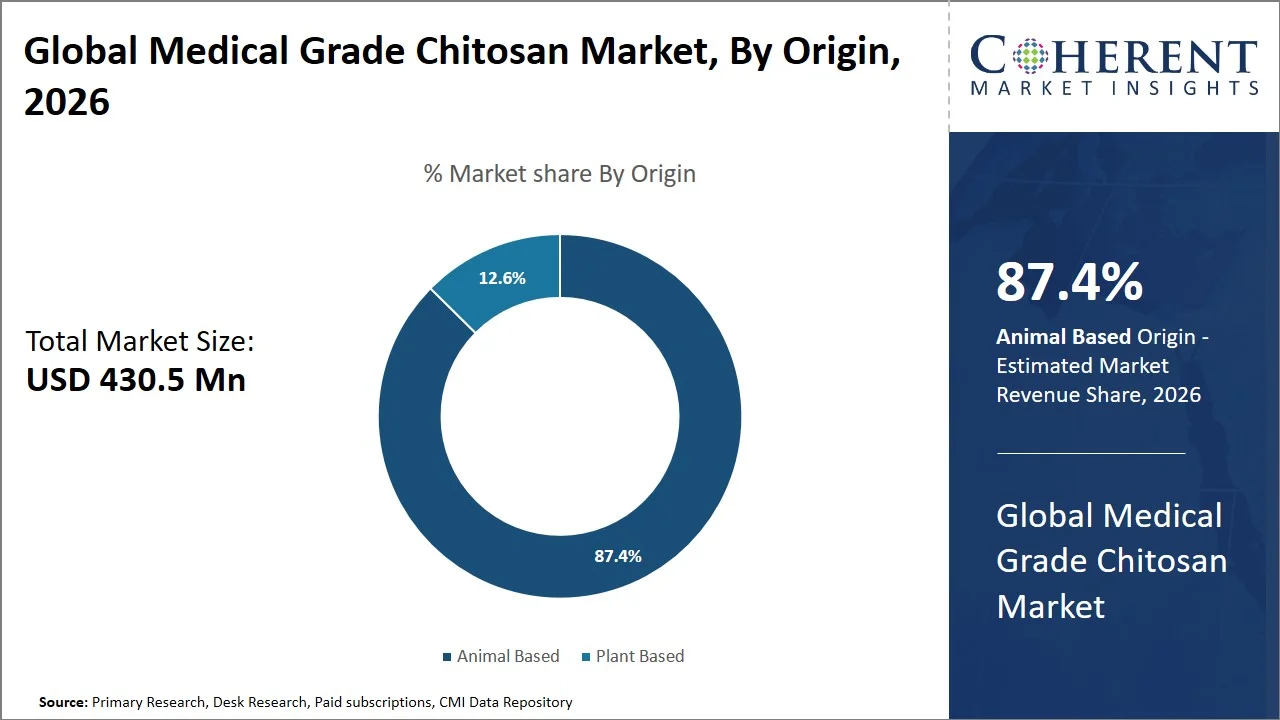
Why Does the Animal Based Segment Dominate the Global Medical Grade Chitosan Market?
Animal based is projected to hold a market share of 87.4% in 2026, primarily attributed to its readily availability from crustacean shells, reliable purity and well accepted clinical results across bio-medicine sector. Its biocompatibility, bio-degradability and hemostasis properties have helped its prevalent use on patients as wound dressings, tissue regeneration scaffold and as carriers for many drugs. For instance, in August 2023, the U.S. Food and Drug Administration (FDA) granted 510(k) clearance (K212766) to Maxiocel Chitosan Wound Dressing under the device classification "Wound Dressing with Animal-Derived Material(s)." This clearance supports ongoing regulatory acceptance and commercialization of animal derived medical grade chitosan for advanced wound care applications.
- Current Industry Events of 2026
- Market Size Estimation
- Regional Breakdown
- Competitive Landscape
- Customer Intelligence
- Segmental Analysis
- Pricing Analysis
- Key Market Drivers, Challenges & Future Trends
- Customized Insights Section
Why Does Drug Delivery Represent the Largest Application Segment in the Medical Grade Chitosan Market?
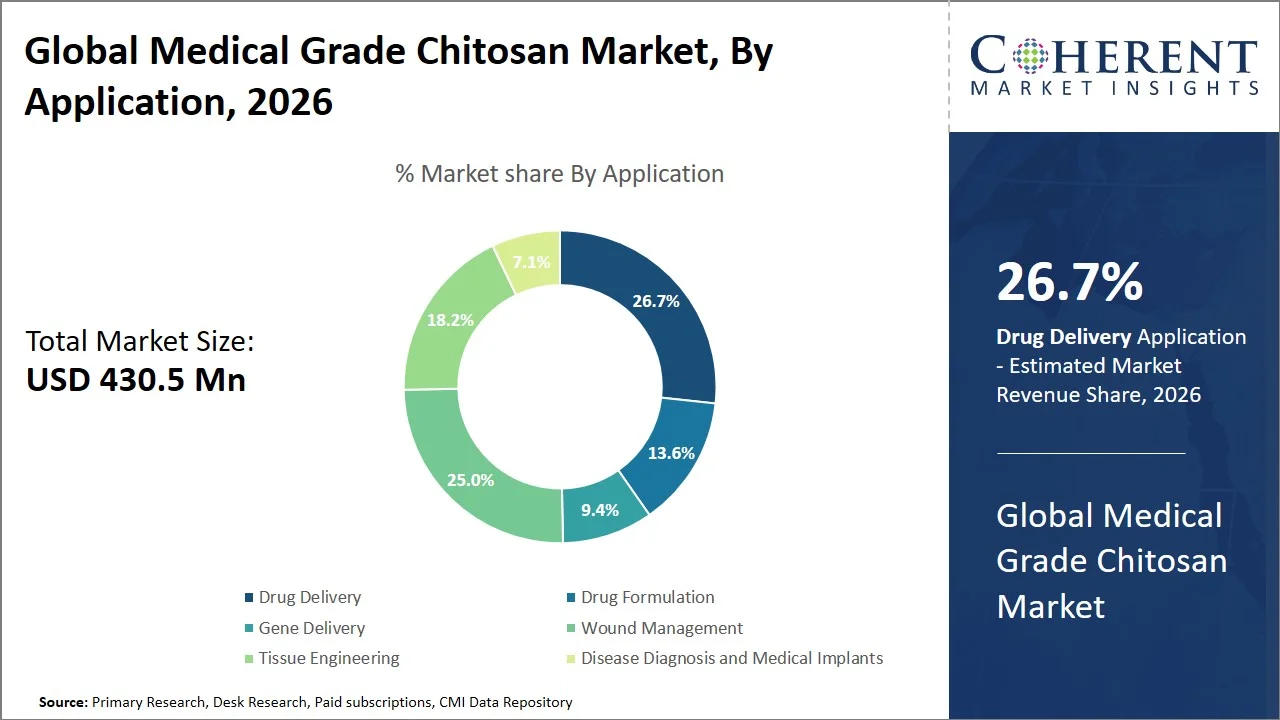
Drug delivery is projected to hold a market share of 26.7% in 2026, due to the enhanced mucoadhesive, biodegradation, and permeability–promoting abilities, thereby improving oral bioavailability of therapeutics. It allows targeted drug delivery for oral, nasal, ophthalmic and transdermal applications for better oral absorption and controlled/sustained release. Its versatility and potential to safeguard highly sensitive biomolecules, while acting as suitable scaffolds for nano- and microparticle formations, are thus expected to continue to spur uptake and development in precision medicine and biologics. For instance, in May 2025, MDPI published a systematic review on chitosan nanoparticle-based drug delivery system for targeted delivery of drugs, proteins, genes and vaccines, which highlights the growing translational and commercial potential of medical grade chitosan in sophisticated pharmaceutical formulations.
Current Events and their Impact
Current Events | Description and its Impact |
U.S. FDA Issues Final Guidance on Chemical Analysis for Biocompatibility Assessment of Medical Devices (September 2025) |
|
European Commission Declares First Four EUDAMED Modules Fully Functional (November 2025) |
|
Global Medical Grade Chitosan Market Dynamics
Market Drivers
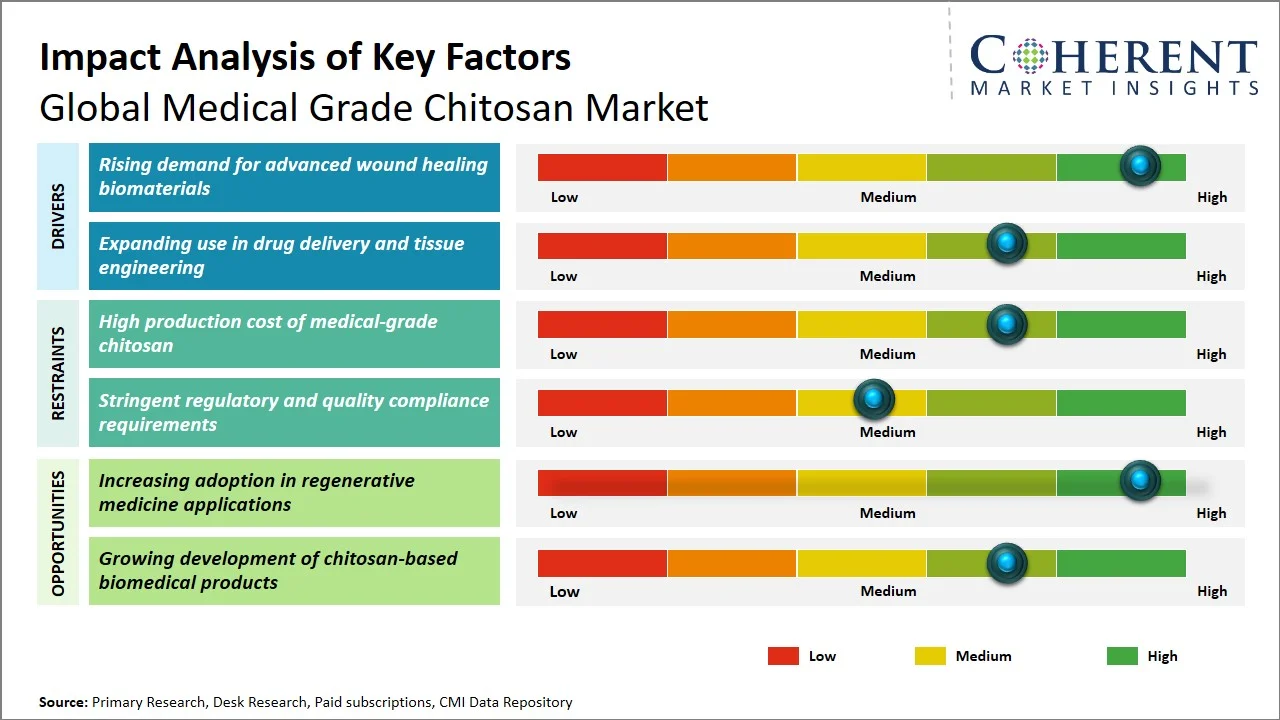
- Rising demand for advanced wound healing biomaterials: The increasing incidence of chronic and complex wounds is driving the adoption of advanced bioactive wound dressings, positioning medical-grade chitosan as a preferred biomaterial due to its hemostatic, antimicrobial, and tissue-regenerative properties. Continuous innovation in chitosan-based hydrogels, films, and absorbable dressings is further supporting its integration into modern wound management. For instance, in October 2025, the U.S. FDA granted 510(k) clearance to Hemastyl wound dressing, reflecting sustained regulatory support for advanced wound care technologies and reinforcing the demand for high-performance biomaterials used in wound healing.
- Expanding use in drug delivery and tissue engineering: The expanding application of medical-grade chitosan in drug delivery and tissue engineering is driving the market growth due to its excellent biocompatibility, biodegradability, mucoadhesive properties, and ability to enable controlled drug release. Its increasing use in nanoparticles, hydrogels, and tissue scaffolds is supporting the development of next-generation therapeutics and regenerative medicine solutions. For instance, in January 2026, the U.S. Food and Drug Administration (FDA) approved Grafapex (K250215), a resorbable chitosan-based wound matrix indicated for the management of chronic and acute wounds, highlighting the growing regulatory acceptance of chitosan-based biomaterials for advanced therapeutic applications.
Emerging Trends
- Integration of Medical-Grade Chitosan in 3D Bioprinting: Medical-grade chitosan is increasingly being incorporated into bioinks for 3D bioprinting due to its excellent biocompatibility and gel-forming properties. The trend is enabling the development of patient-specific tissue constructs, cartilage substitutes, and complex regenerative medicine applications.
- Development of Multifunctional Chitosan-Based Antimicrobial Coatings: Manufacturers are increasingly developing chitosan-based antimicrobial coatings for medical devices, surgical instruments, and implant surfaces to reduce healthcare-associated infections. Combining chitosan with bioactive agents and nanomaterials is enhancing antimicrobial efficacy while improving device biocompatibility and longevity.
Regional Insights
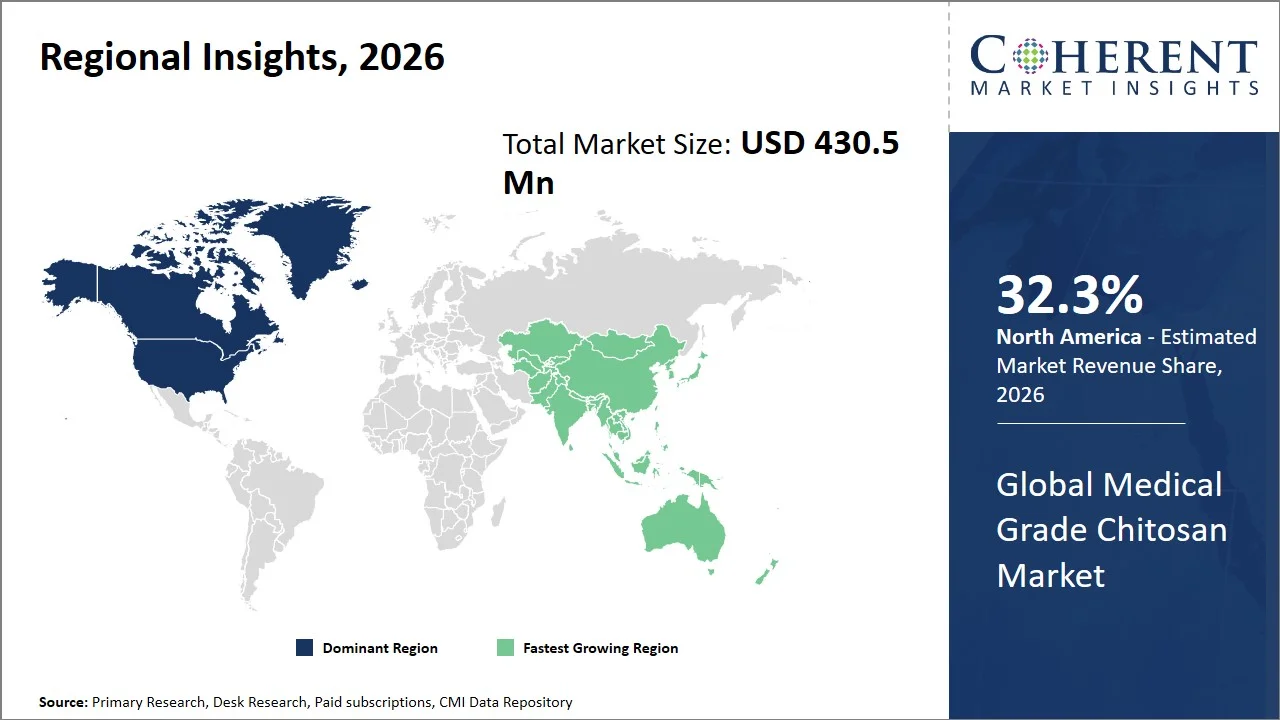
Why is North America a Strong Market for Medical Grade Chitosan?
North America leads the global medical grade chitosan market, accounting for an estimated 32.3% share in 2026, due to the availability of superior healthcare infrastructure and high adoption of expensive biomaterials. The region also witnesses well-established research activities in regenerative medicine and drug delivery. Government policies, clearly defined regulations, such as the U.S. FDA pathways, support the development of biomaterials into biocompatible medical materials.
For instance, the U.S. Food and Drug Administration (FDA) Total Product Life Cycle (TAP) program helps support innovation of new medical devices and allows developers of these innovative products that are made of new biomaterials, such as sophisticated wound-care products and regenerative medicine technologies to reach commercial markets more quickly. Moreover, the region has well-built infrastructure for manufacturing efficient and steady supply chains for medical grade chitosan, further strengthening the region’s leadership in the market.
Why Does the Asia Pacific Medical Grade Chitosan Market Exhibit High Growth?
The Asia Pacific medical grade chitosan market is expected to exhibit the fastest growth with an estimated contribution of 26.8% share to the global market in 2026, attributed to an increasing pharmaceutical and medical device production as well as rising global consumption of advanced wound healing products. The increased government supported policies, targeting toward building domestic industrial infrastructure and luring foreign investment in bio-medical components, are providing a conducive environment for the region’s market expansion.
For instance, the Production Linked Incentive (PLI) Scheme for Manufacturing of Medical Devices by the Government of India is designed to offer financial incentives for domestic manufacturing, diminish dependency on imports and foster investments in high-tech medical devices, thus underpinning the ecosystem for innovative biomaterials and medical-grade chitosan products. Furthermore, expanding healthcare infrastructure as well as the demand for researching biomaterials and cost-effective production processes further expedite the utilization of medical grade chitosan.
Global Medical Grade Chitosan Market Outlook for Key Countries
Why is the U.S. Leading Innovation and Adoption in the Medical Grade Chitosan Market?
The U.S. dominates the medical grade chitosan market due to a well-resourced ecosystem related to advanced biomaterials with biotech companies, medical device manufacturers and R&D institutes working together for faster commercialization of products. The strong competency in bioresorbable implants and regenerative medicine and precision drug delivery has increased the clinical usage of high-quality chitosan in diverse therapeutics. Well-developed translation research and contract manufacturing ecosystem facilitates faster commercialization of novel upcoming generation chitosan-based products.
Is Japan a Favorable Market for Medical Grade Chitosan?
Japan is one of the most promising markets for the medical grade chitosan market owing to its proficient knowledge in the biomaterials research sector, regenerative medicines, and expertise in advanced drug formulation technology. The country has a proficient development capacity of bio-degradable, bioresorbable medical devices and, tissue engineering applications. These products and advancements support and enhance the deployment of medical-grade chitosan. In addition, the extensive knowledge on biomaterial engineering and new-age drug delivery will boost the integration of medical grade chitosan in top medical applications and pharmaceuticals.
Is China Emerging as a Key Growth Hub for the Medical Grade Chitosan Market?
China is positioned as a key growth hub in the global medical grade chitosan market due to country’s capabilities in biomaterials production coupled with strong biotechnology and medical devices sector development. China is reinforcing its stronghold in high-purity medical-grade chitosan through vast marine resources availability, optimized scaling for processing technology coupled with rising allocation to regenerative medicine and modern advanced wound treatment.
Why Does Germany Top the European Medical Grade Chitosan Market?
Germany leads the Europe medical grade chitosan market owing to its leadership in developing high-performance biomaterials, advanced medical devices and translational biomedical research. The country's leadership in bioresorbable implants, tissue engineering and micro-medicine would accelerate the development and application of medical-grade chitosan in high-value medical field. Meanwhile, the stringent GMP manufacturing process established over the past decades by the medical device providers in the country further strengthen its leadership in the European market.
Is the Medical Grade Chitosan Market Developing in India?
India is a high-potential market for medical grade chitosan driven by its growing bio-pharma sector, increasing use of sophisticated wound healing solutions, and a rise in research investments on regenerative medicine applications. India is expected to capitalize on its marine resources base and a gradual improvement of high purity biomaterial production in order to enable in-country supply of medical grade chitosan. The development of home-made medical devices and improved medical delivery systems is expected to spur more applications in the chitosan biomedical field.
Evolution of Medical Grade Chitosan Applications
Application Area | Current Applications (2020–2025) | Future Evolution (2026–2033) |
Wound Care | Hemostatic dressings, wound gels | Smart bioactive wound matrices with controlled drug release |
Drug Delivery | Oral, nasal and topical delivery systems | Targeted nanocarriers and precision therapeutics |
Tissue Engineering | Bone and cartilage scaffolds | 3D bio printed tissues and organ regeneration |
Medical Devices | Surgical films and anti-adhesion barriers | Antimicrobial implant coatings and bioresorbable devices |
Regenerative Medicine | Cell culture matrices | Stem cell delivery and personalized regenerative therapies |
How is the increasing adoption in regenerative medicine applications creating new growth opportunities in the medical grade chitosan market?
The growing adoption of regenerative medicine presents significant opportunities for the medical-grade chitosan market, driven by chitosan's excellent biocompatibility, biodegradability, and ability to support cell proliferation and tissue regeneration. This biomaterial can be increasingly adopted in the use of medical tissue-engineered scaffolds, hydrogel and regenerative wound matrix, expanding its role in next-generation therapeutic applications. For instance, in September 2025, the U.S. Food and Drug Administration (FDA) announced draft guidance titled “Expedited Programs for Regenerative Medicine Therapies for Serious Conditions.” The guidelines outline improved regulatory pathways to guide regenerative medicine including biomaterial-based treatments such as the chitosan–based tissue engineering technology.
Market Players, Key Development, and Competitive Landscape
Key Developments
- In February 2026, Humedix signed an exclusive commercialization agreement with DOUM Corporation for ARCHE, a wound dressing based on low-molecular-weight, water-soluble chitosan. The product utilizes proprietary chitosan technology to promote tissue regeneration while providing antibacterial, antifungal, and anti-inflammatory benefits. The agreement is expected to expand the commercial adoption of advanced chitosan-based wound care solutions in South Korea and strengthen the medical grade chitosan market.
- In May 2025, Forward Science launched PerioStōm, a U.S. FDA-cleared, non-drug oral wound dressing powered by medical-grade chitosan microspheres for use following periodontal procedures such as scaling and root planning. The product utilizes the antimicrobial, anti-inflammatory, and anti-biofilm properties of chitosan to protect oral mucosa and promote post-procedural healing, highlighting the expanding commercialization of medical-grade chitosan in advanced wound care and regenerative dentistry.
Competitive Landscape
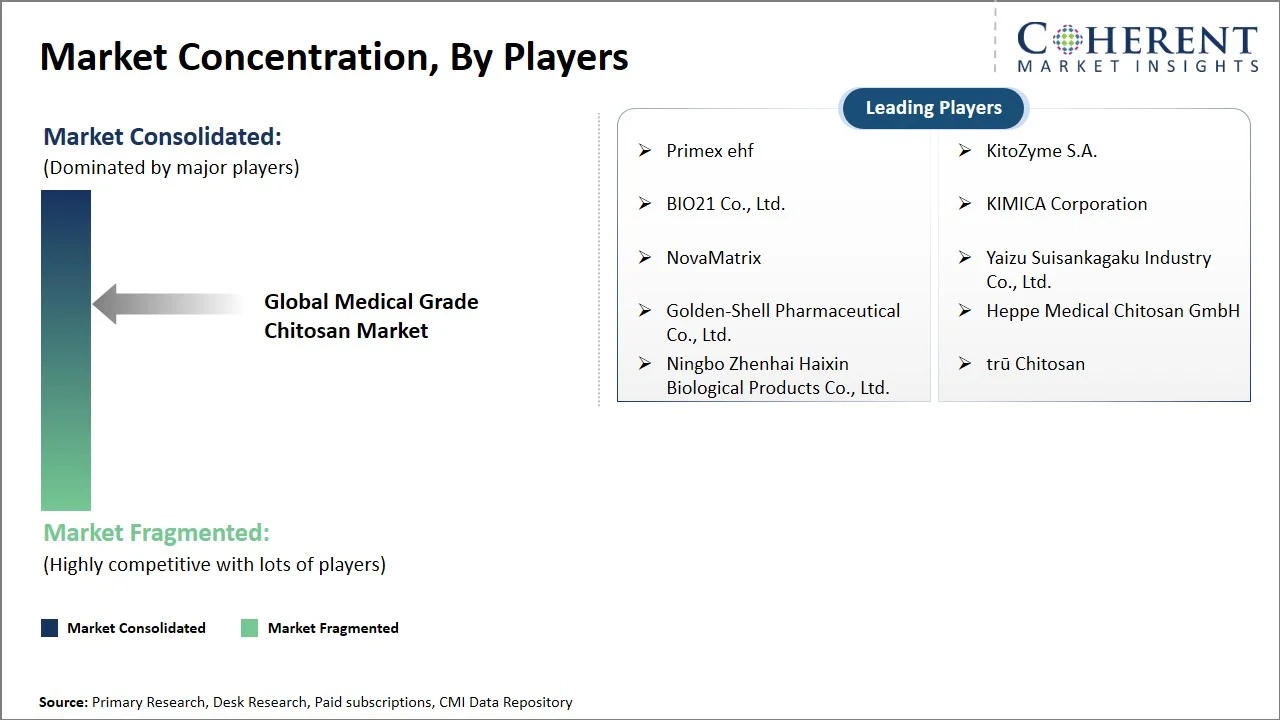
The global medical grade chitosan market is moderately consolidated, with competition centered on high-purity chitosan production, regulatory compliance, and application-specific product innovation. Leading manufacturers are strengthening their market positions through investments in advanced purification technologies, strategic collaborations with medical device and pharmaceutical companies, and expansion of GMP-compliant manufacturing capabilities. The market is also witnessing increased focus on sustainable sourcing and the development of value-added chitosan formulations for biomedical applications. Key focus areas include:
- Development of high-purity, GMP- and pharmacopeia-compliant medical-grade chitosan
- Strategic collaborations with pharmaceutical and medical device manufacturers
- Expansion of advanced applications in wound care, drug delivery, and regenerative medicine
- Investment in sustainable production technologies and next-generation chitosan formulations
Market Report Scope
Medical Grade Chitosan Market Report Coverage
| Report Coverage | Details | ||
|---|---|---|---|
| Base Year: | 2025 | Market Size in 2026: | USD 430.5 Mn |
| Historical Data for: | 2020 To 2024 | Forecast Period: | 2026 To 2033 |
| Forecast Period 2026 to 2033 CAGR: | 11.5% | 2033 Value Projection: | USD 921.9 Mn |
| Geographies covered: |
| ||
| Segments covered: |
| ||
| Companies covered: | Primex ehf, KitoZyme S.A., BIO21 Co., Ltd., KIMICA Corporation, NovaMatrix, Yaizu Suisankagaku Industry Co., Ltd., Golden-Shell Pharmaceutical Co., Ltd., Heppe Medical Chitosan GmbH, Ningbo Zhenhai Haixin Biological Products Co., Ltd., and trū Chitosan | ||
| Growth Drivers: |
| ||
| Restraints & Challenges: |
| ||
Analyst Opinion (Expert Opinion)
- The future outlook for the medical grade chitosan market is expected to evolve from a niche biomaterial segment into a critical component of next-generation healthcare solutions, driven by advancements in regenerative medicine, precision drug delivery, and advanced wound care. As regulatory frameworks mature and clinical evidence supporting chitosan-based products continues to expand, adoption is likely to accelerate across both pharmaceutical and medical device applications.
- The maximum opportunities will probably exist within advanced wound care applications across North America, supported by increasing adoption of bioactive wound dressings, a favorable regulatory environment, and continued innovation in biomaterial-based therapies. Additionally, drug delivery applications in Asia Pacific, particularly Japan and South Korea, present significant long-term potential owing to strong pharmaceutical R&D capabilities and increasing investment in advanced biomaterials.
- In order to obtain a competitive advantage, market participants should focus on developing high-purity, GMP-compliant chitosan with consistent quality, expand strategic collaborations with pharmaceutical and medical device manufacturers, and invest in application-specific product innovation for regenerative medicine and targeted drug delivery. Strengthening regulatory capabilities, generating robust clinical evidence, and diversifying into fungal-derived chitosan will further enhance market differentiation and long-term competitiveness.
Speak to the analyst
Want personalized insights?
Take the findings above to one of our principal consultants, or have the report rebuilt around the segments, geographies and competitors you actually track.
Market Segmentation
- Origin Insights (Revenue, USD Mn, 2021 - 2033)
- Animal Based
- Plant Based
- Application Insights (Revenue, USD Mn, 2021 - 2033)
- Drug Delivery
- Drug Formulation
- Gene Delivery
- Wound Management
- Tissue Engineering
- Disease Diagnosis and Medical Implants
- Regional Insights (Revenue, USD Mn, 2021 - 2033)
- North America
- U.S.
- Canada
- Latin America
- Brazil
- Argentina
- Mexico
- Rest of Latin America
- Europe
- Germany
- U.K.
- Spain
- France
- Italy
- Russia
- Rest of Europe
- Asia Pacific
- China
- India
- Japan
- Australia
- South Korea
- ASEAN
- Rest of Asia Pacific
- Middle East
- GCC Countries
- Israel
- Rest of Middle East
- Africa
- South Africa
- North Africa
- Central Africa
- North America
- Key Players Insights
- Primex ehf
- KitoZyme S.A.
- BIO21 Co., Ltd.
- KIMICA Corporation
- NovaMatrix
- Yaizu Suisankagaku Industry Co., Ltd.
- Golden-Shell Pharmaceutical Co., Ltd.
- Heppe Medical Chitosan GmbH
- Ningbo Zhenhai Haixin Biological Products Co., Ltd.
- trū Chitosan
Sources
Primary Research Interviews
- Medical grade chitosan manufacturers and raw material suppliers
- Biomedical material scientists and tissue engineering researchers
- Wound care product manufacturers
- Pharmaceutical formulation and drug delivery experts
- Medical device R&D and regulatory affairs executives
- Hospital procurement managers and wound care specialists
Stakeholders
- Medical grade chitosan manufacturers
- Pharmaceutical companies
- Medical device companies
- Contract Development and Manufacturing Organizations (CDMOs)
- Biotechnology companies
- Academic and research institutions
- End-use Sectors
- Pharmaceutical companies
- Medical device manufacturers
- Hospitals and specialty wound care centers
- Tissue engineering and regenerative medicine institutes
- Biotechnology companies
- Contract research organizations (CROs)
- Regulatory & Health Bodies
- U.S. Food and Drug Administration (FDA)
- European Medicines Agency (EMA)
- European Commission – Medical Devices (EU MDR/EUDAMED)
- Pharmaceuticals and Medical Devices Agency (PMDA), Japan
- National Medical Products Administration (NMPA), China
- Central Drugs Standard Control Organization (CDSCO), India
Databases
- ClinicalTrials.gov
- FDA 510(k) Premarket Notification Database
- FDA De Novo Database
- FDA PMA Database
Magazines
- Medical Product Outsourcing (MPO)
- Pharmaceutical Manufacturing
- Medical Design & Outsourcing
- Advanced Science News
- European Pharmaceutical Review
Journals
- Carbohydrate Polymers
- International Journal of Biological Macromolecules
- Biomaterials
- Acta Biomaterialia
- Journal of Biomedical Materials Research
Associations
- Controlled Release Society (CRS)
- Tissue Engineering and Regenerative Medicine International Society (TERMIS)
- Society For Biomaterials (SFB)
- European Society for Biomaterials (ESB)
- Advanced Medical Technology Association (AdvaMed)
- Alliance for Regenerative Medicine (ARM)
Public Domain Sources
- U.S. Food and Drug Administration (FDA)
- European Medicines Agency (EMA)
- European Commission (Medical Devices)
- National Institutes of Health (NIH)
- ClinicalTrials.gov
- World Health Organization (WHO)
Proprietary Elements
- CMI Data Analytics Tool, Proprietary CMI Existing Repository of information for last 10 years.
Get access to 250+ pages report
Every segment, forecast, competitor profile and data table behind the analysis above — available for instant download.
- ESOMAR Member
- ISO 9001:2015 Certified
- D-U-N-S Registered
- GDPR & CCPA Compliant
Missing comfort of reading report in your local language? Find your preferred language:
Transform your Strategy with Exclusive Trending Reports
Frequently Asked Questions
The global medical grade chitosan market is estimated to be valued at USD 430.5 Mn in 2026 and is expected to reach USD 921.9 Mn by 2033.
Animal based dominates due to its abundant raw material availability, established extraction processes, and widespread regulatory acceptance for biomedical and pharmaceutical applications.
Medical grade chitosan is a highly purified, biocompatible biopolymer used in wound care, drug delivery, tissue engineering, and other medical applications.
The CAGR of the global medical grade chitosan market is projected to be 11.5% from 2026 to 2033.
Rising demand for advanced wound healing biomaterials, and expanding use in drug delivery and tissue engineering are the major factors driving the growth of the global medical grade chitosan market.
High production cost of medical-grade chitosan, and stringent regulatory and quality compliance requirements are the major factors hampering the growth of the global medical grade chitosan market.
In terms of application, drug delivery is estimated to dominate the market revenue share in 2026.