

Global Memristors Market Size and Forecast: 2026-2033
The global memristors market is expected to grow from USD 29.15 Bn in 2026 to USD 160 Bn by 2033, registering a compound annual growth rate (CAGR) of 28.0% from 2026 to 2033. The global memristors market is driven by the growing expansion of data centers and cloud computing infrastructure. For instance, on May 13, 2025, NTT DATA, a global digital business and technology services leader, announced the accelerated expansion of its Global Data Centers division, securing land across North America, Europe, and Asia over the past six months to support nearly a gigawatt of planned data center capacity. (Source: NTT)
Key Takeaways of the Global Memristors Market
- The molecular and ionic film memristor segment is expected to account for 56.0% of the global memristors market share in 2026. Growing adoption of molecular memristors in IoT devices for power efficient edge computing is a major factor for the growth of the segment. On March 17, 2026, AT&T and Cisco announced a significant step forward in the evolution of AI‑driven IoT, combining intelligent networking, edge AI compute, and zero‑trust security to enable real‑time decision‑making. (Source: AT&T)
- The electronics segment is estimated to capture 34.0 % of the market share in 2026. Growing use of memristors in smartphones for improved memory and storage efficiency is driving the growth of the electronics segment overall. On May 7, 2026, Qualcomm launched the new Snapdragon 6 Gen 5 and Snapdragon 4 Gen 5 chipsets with upgrades focused on gaming, AI cameras, smoother performance, and better battery life. (Source: India Today)
- Asia Pacific is expected to dominate the memristors market in 2026 with a market share of 51.0 %. Expansion of the semiconductor industry in the region and development of modern facilities are driving the memristors market in Asia Pacific. On June 13, 2024, Pall Corporation held its opening ceremony for a new state-of-the-art manufacturing facility in Singapore that will serve regional and global customers within the growing semiconductor industry. (Source: Pall Corporation)
- North America is expected to account for 26.0 % share in 2026 and is projected to record the fastest growth over the forecast period. North America is experiencing a steady development in hypercale data center expansion, which is increasing the demand for memristors. On October 1, 2024, Equinix, Inc. announced the signing of a joint venture partnership with GIC and Canada Pension Plan Investment Board (CPP Investments), with the intent to raise over USD 15 billion in capital together with its partners. Driven by increasing artificial intelligence (AI) and cloud growth, the venture is intended to accelerate the Equinix xScale data center portfolio. (Source: Equinix)
- AI and Neuromorphic Computing Adoption: Memristors are increasingly being used in neuromorphic computing systems due to its ability to replicate synaptic function in the human brain. This makes them very ideal for low-power artificial intelligence (AI) hardware, edge AI devices, and brain-inspired computing architecture
- Expansion in Edge Computing and IoT Devices: The rise of new Internet of Things (IoT) device ecosystems and edge computing use cases is pushing the need for small and low power memory solutions. Memristors allow real-time processing with low power consumption, which suitable for smart sensors, wearable electronics, autonomous systems and linked devices.
Segmental Insights
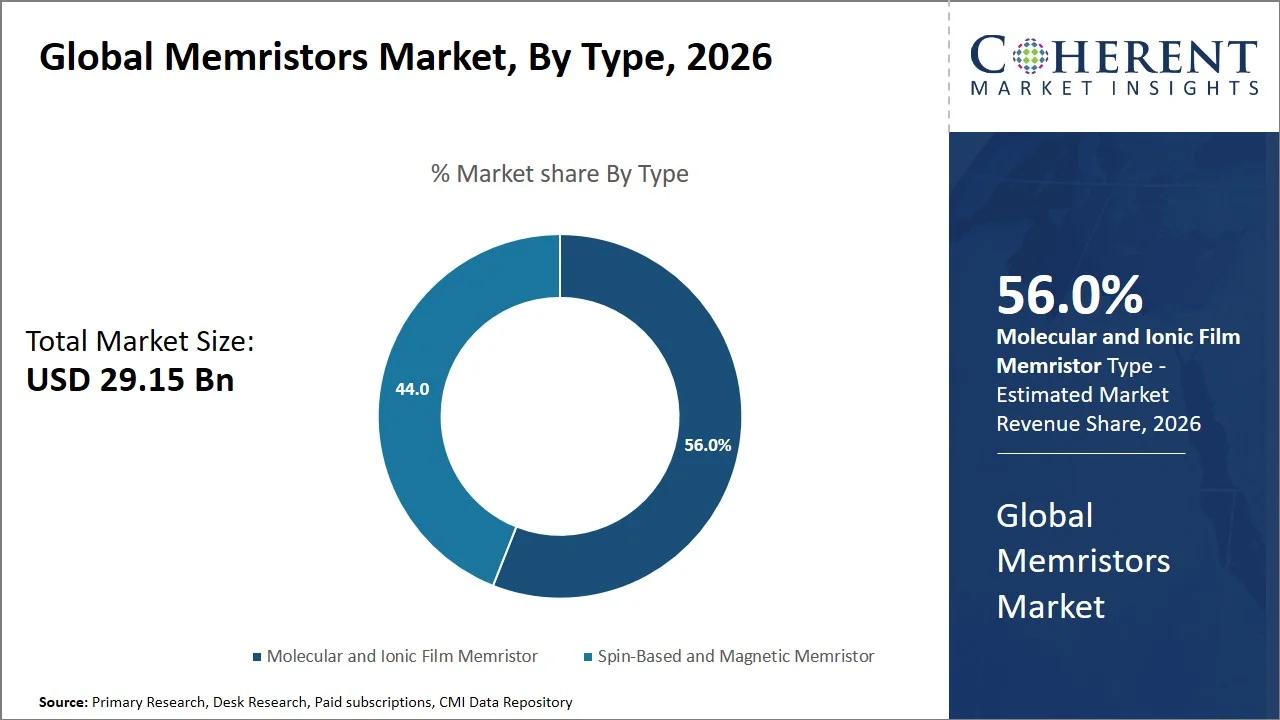
Why Does the Molecular and Ionic Film Memristor Segment Dominate the Global Memristors Market?
The molecular and ionic film memristor segment is expected to account for 56.0% of the global memristors market share in 2026. Molecular and ionic film memristors are the market leaders of the worldwide memristors market because to their better scalability and low power operation. These memristors may be fabricated at nanoscale dimensions, with great switching efficiency and low energy consumption making them very ideal for next-generation applications such as AI accelerators, neuromorphic computing and tiny IoT devices.
In addition, ongoing research and development activities are expected to enhance the reach of the market even more in the upcoming years. On March 20, 2026, researchers from the University of Cambridge, U.K., developed a hafnium oxide (HfOₓ)-based memristor with ionic migration control using strontium and titanium doping, enabling smooth resistance switching at extremely low currents. The device achieved neuron-like behavior with up to 70% AI energy reduction potential due to reduced ionic switching losses and stable conductance states. (Source: University of Cambridge)
- Current Industry Events of 2026
- Market Size Estimation
- Regional Breakdown
- Competitive Landscape
- Customer Intelligence
- Segmental Analysis
- Pricing Analysis
- Key Market Drivers, Challenges & Future Trends
- Customized Insights Section
Why is Electronics the Most Crucial End User?
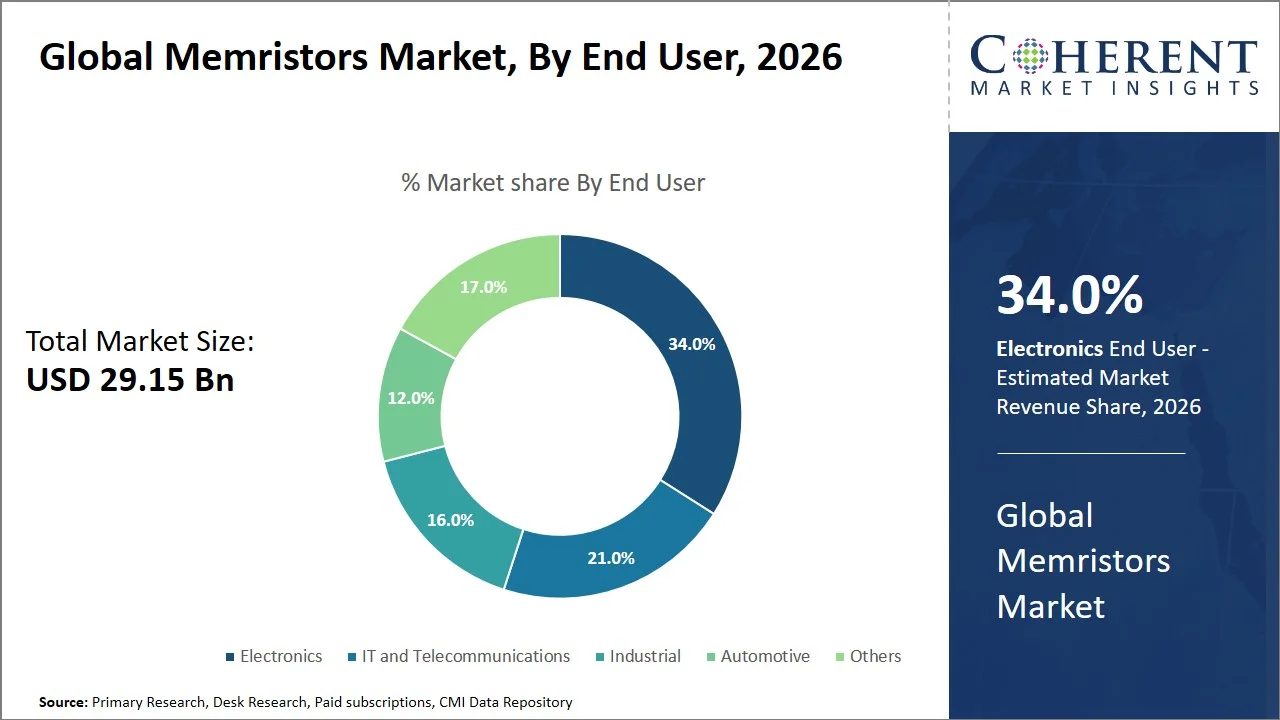
The electronics segment is expected to account for 34.0% of the global memristors market share in 2026. The electronics industry is becoming the most important end user of the global memristors market, driven by the rising need for high-performance and energy-efficient memory solutions in modern electronic gadgets. Memristors provide tremendous advantages over traditional memory technologies for the growing demand for quicker data processing, compact storage, and lower power consumption in smartphones, laptops, wearable devices, smart sensors, and consumer electronics.
On January 1, 2025, Weebit Nano licensed its resistive random-access memory (ReRAM or RRAM) technology to tier-1 semiconductor supplier, Onsemi. Under the terms of the agreement, Weebit ReRAM IP will be integrated into onsemi’s Treo platform, to provide embedded non-volatile memory (NVM) to smart devices. (Source: Weebit Nano)
Currents Events and their Impact
Current Events | Description and its Impact |
India’s Digital Personal Data Protection (DPDP) Rules, 2025 |
|
U.S. AI Diffusion Export Control Framework (2025) |
|
(Source: Press Information Bureau, Federal Register)
Memristors Market Dynamics
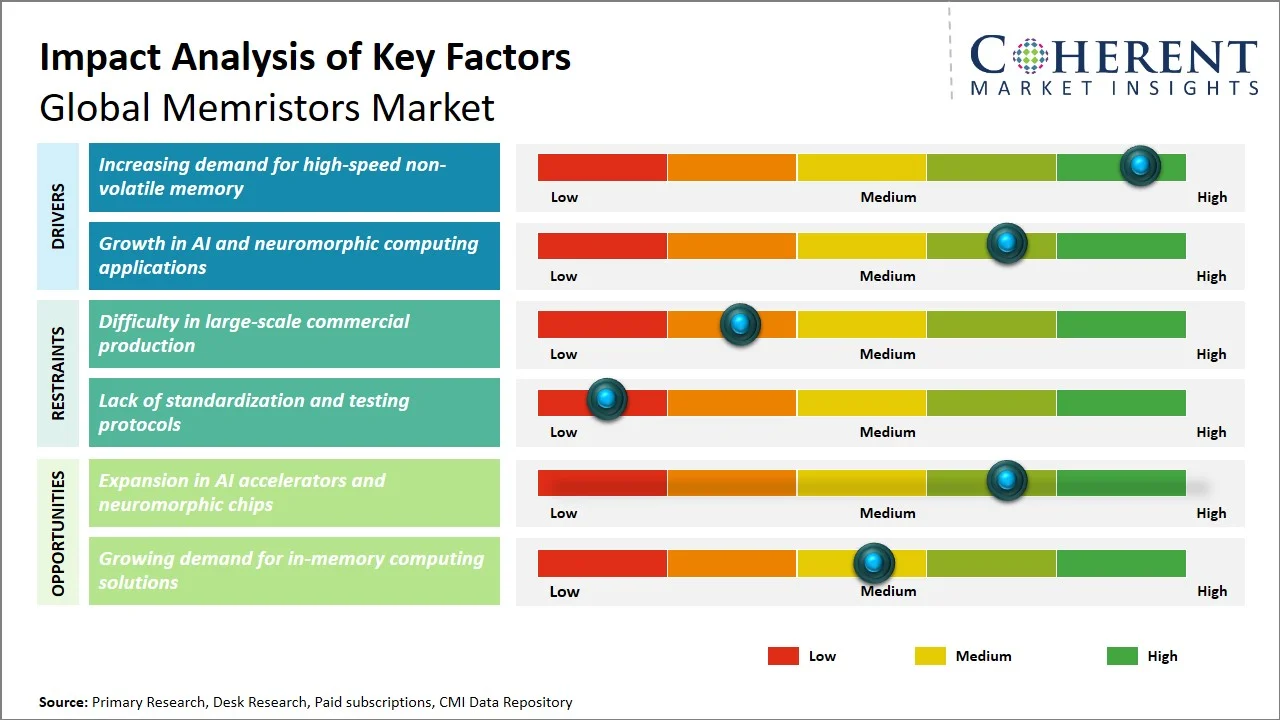
Market Drivers
- Increasing demand for high-speed non-volatile memory: Rising demand for high-speed non-volatile memory is a key driver of the worldwide memristors market, as industries seek faster, more energy-efficient and high-density data storage solutions. Unlike conventional memory technologies, memristors have fast switching speeds, low power consumption and the ability to keep data even when power is disconnected, making them particularly ideal for AI systems, consumer electronics, data centers, automotive electronics and IoT devices. The increased demand for real-time data processing and small form factor memory architectures further promotes their usage throughout the advanced computing applications. On December 29, 2025, Weebit Nano announced it has licensed its resistive random-access memory (ReRAM) technology to Texas Instruments. Under the terms of the agreement, Weebit’s ReRAM technology will be integrated into TI’s advanced process nodes for embedded processing semiconductors. Weebit ReRAM is a low-power, cost-effective NVM that has proven excellent retention at high temperatures and has been qualified for AEC-Q100 150°C operation. (Source: Weebit Nano)
- Growth in AI and neuromorphic computing applications: Significant growth in the worldwide memristors market is driven by the increased adoption of AI and neuromorphic computing applications, since memristors are able to effectively imitate the synaptic functions of the human brain with high efficiency and low power consumption. They are suitable for advanced AI hardware, machine learning systems, and brain-inspired computing architectures because they can process and store data simultaneously. The use of memristor technology is growing rapidly as the demand for quicker and energy-efficient AI processing in edge devices, robots and autonomous systems increases. On October 21, 2025, Axelera AI announced Europa, an AI processor unit (AIPU) that sets a new performance and price standard for multi-user generative AI and computer vision applications. Europa’s combination of processing power, energy and thermal efficiency, compact packaging, and multiple form factor options make it ideal for compute-intensive, multi-modal AI inference applications from the edge to enterprise servers. (Source: Axelera)
Emerging Trends
- Integration of Memristors in Flexible and Wearable Electronics: Memristor technology is gradually being included into flexible electronic devices and wearable systems because of its compactness, light weight and low energy requirements. The increased need for smart wearables, electronic skin and flexible gadgets for medical monitoring is prompting manufacturers to produce bendable and very durable memristor-based memory components.
- Advancements in Hybrid Memory Architectures: Industry and research labs are working on hybrid memory systems that integrate memristors with existing technologies such as CMOS, DRAM, and resistive RAM. These hybrid architectures improve the computational speed, storage economy and the system stability and are particularly attractive for next generation computing platforms and high-performance electronics.
Regional Insights
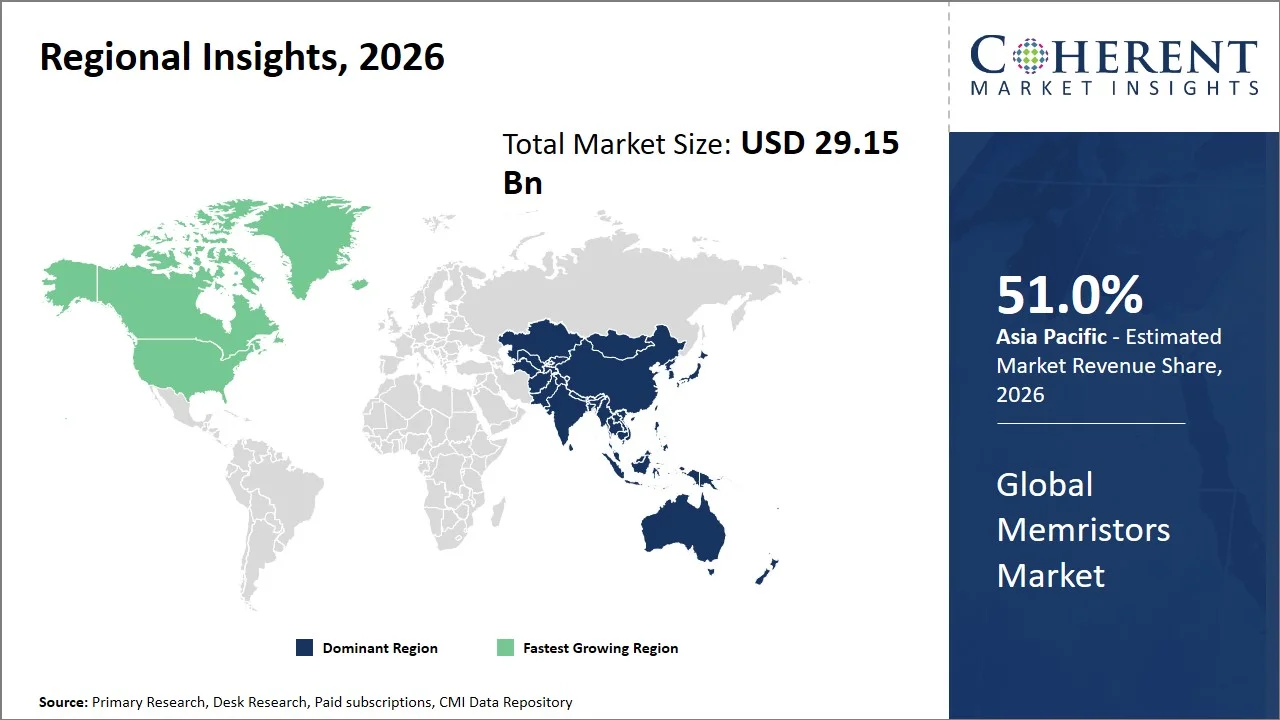
Why is Asia Pacific a Strong Market for Memristors?
Asia Pacific is expected to account for a market share of 51.0% in 2026. Asia Pacific is emerging as a major center for memristor R&D and early commercialization, fueled by the region’s strong semiconductor ecosystems in South Korea, Japan, China and Taiwan. For example, South Korea’s KAIST research center has been busy building oxide-based memristor prototypes for neuromorphic devices, while China’s Tsinghua University has shown off large-scale memristor crossbar arrays for AI acceleration. The region has strong, government-backed semiconductor programs and large-scale electronics manufacturing ecosystems that facilitate rapid prototyping and integration into modern computing hardware.
In addition, the Asia Pacific region is witnessing robust growth in the semiconductor industry. For instance, on December 1, 2025, Merck inaugurated its Semiconductor Solutions megasite in Kaohsiung, Taiwan. With this investment, the company is strengthening its global supply chain resilience while deepening its leading role in the semiconductor ecosystem. (Source: Merck)
Why Does the North America Memristors Market Exhibit High Growth?
North America is projected to account for 26.0% of the global memristors market and is expected to register the fastest growth. In North America, U.S. institutions and tech companies are at the forefront of advanced memristor research and AI hardware integration. HP Labs (U.S.) pioneered ideas for the commercialization of memristors, while research groups at Stanford University and MIT are actively working on the development of memristor-based neuromorphic processors for AI workloads. Other companies, such as IBM Research, are also working on resistive memory technology for in-memory computing systems. The region also benefits from strong venture capital investment and defense-linked R&D programs, which help speed development.
Moreover, the growth of micro-edge data centers in the region and increasing integration of edge-computing platforms is driving the demand for memristors in North America. For instance, on November 3, 2025, Cisco announced Cisco Unified Edge, an integrated computing platform for distributed AI workloads. From retail stores to healthcare facilities to factory floors, Cisco Unified Edge brings together computing, networking, storage, and security closer to the data for real-time AI inferencing and agentic workloads. (Source: Cisco)
Why is China Emerging as a Major Hub in the Memristors Market?
China is pushing hard on memristor development, due to state-backed programs and major academic-industry partnerships. Chinese Academy of Sciences and Fudan University have created high-density memristor arrays for AI inference acceleration and edge computing devices. Chinese chipmakers are also moving to use resistive memory technology for next-generation AI processors to lessen dependence on foreign memory providers. Commercialization of home-grown AI infrastructure and smart city applications is a major focus.
Is the U.S. the Next Growth Engine for the Memristors Market?
The U.S. continues to lead the world in memristor innovations, especially in neuromorphic computing and next-generation AI computers. HP Labs translated the memristor theory into actual circuits and businesses such as Intel and IBM are studying memristor-like resistive switching for in-memory computing architectures. The U.S. is also leading the charge on high-end, application-oriented development, with DARPA-funded efforts exploring memristor-based hardware for real-time learning systems in defense and autonomous applications.
Japan Memristors Market Analysis and Trends
Japan is developing memristors with a focus on precise engineering and materials innovation, especially in institutions like RIKEN and NEC. Japanese researchers have shown memristor devices using transition metal oxides for ultra-stable memory applications for robotics and industrial automation systems. The country’s robust semiconductor equipment industry, including companies like Tokyo Electron, offers advanced fabrication techniques that are necessary for scaling up memristor production.
Taiwan’s world-leading semiconductor manufacturing ecosystem plays a key role in memristor commercialization. Companies like TSMC are building improved process nodes with the integration of new memory technologies, while research organizations like Industrial Technology Research Institute (ITRI) are producing memristor-based non-volatile memory prototypes. Taiwan’s expertise in foundry services is a critical enabler to expand memristor technology from lab-size breakthroughs to mass production for global semiconductor clients.
Global Memristors Market - Compute-in-Memory (CIM) Adoption Rates in AI Hardware
AI Hardware Segment | CIM Adoption Rate (2025) | CIM Adoption Rate (2026 Forecast) |
AI Edge Devices (IoT, wearables, smartphones) | ~18–22% | ~30–38% |
AI Accelerators (GPU/ASIC alternative architectures) | ~10–15% | ~25–35% |
Neuromorphic Computing Chips | ~20–25% | ~35–45% |
Data Center AI Infrastructure | ~5–8% | ~15–22% |
Embedded Automotive & Industrial AI chips | ~12–18% | ~25–30% |
How is Expansion in AI Accelerators and Neuromorphic Chips Creating New Growth Opportunities in the Memristors Market?
The increased adoption of AI accelerators and neuromorphic circuits is creating a huge opportunity for the growth of the memristors market as these technologies need memory components that can process and store information at the same time while consuming ultra-low power. The memristors are ideal for this job because they mimic the synaptic function. Therefore, they allow for efficient in-memory computing and parallel data processing. To overcome the limitations of traditional Von Neumann systems and accelerate the adoption and commercialization of memristor technologies, companies developing AI accelerators for edge AI, autonomous systems, and high-performance computing are increasingly considering memristor-based architectures.
On April 17, 2024, Intel announced that it has built the world's largest neuromorphic system. Code-named Hala Point, this large-scale neuromorphic system, initially deployed at Sandia National Laboratories, utilizes Intel’s Loihi 2 processor, aims at supporting research for future brain-inspired artificial intelligence (AI), and tackles challenges related to the efficiency and sustainability of AI. (Source: Intel)
Market Players, Key Development, and Competitive Intelligence
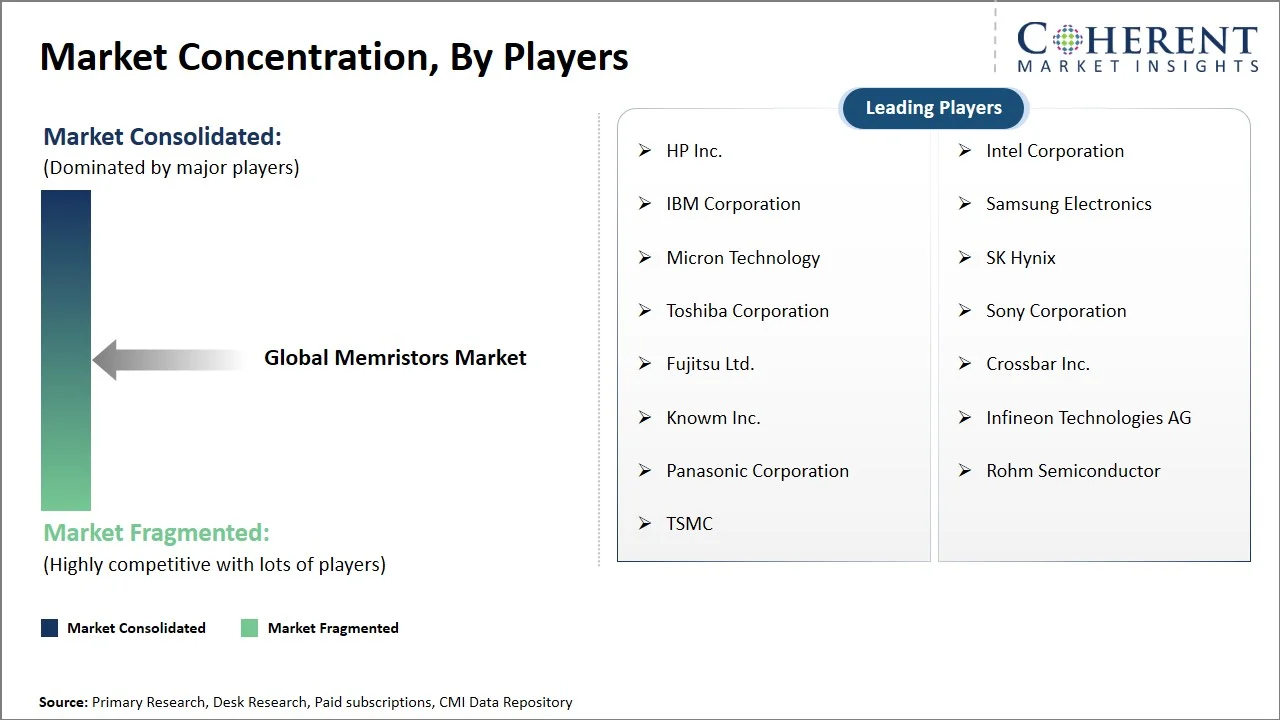
Key Developments
- On February 2, 2026, SAIMEMORY, a wholly-owned SoftBank subsidiary based in Tokyo, Japan, signed a collaborative agreement with Intel to advance the commercialization of Z-Angle Memory (ZAM), a next-generation memory technology. Aiming to create prototypes in the fiscal year ending March 31, 2028 (FY2027), and achieve commercialization in FY2029, SAIMEMORY will conduct research and development on innovative memory architectures and manufacturing technologies.
- On May 1, 2025, Weebit Nano Limited and semiconductor foundry, DB HiTek announced that their collaboration will hold the first demonstration of DB HiTek’s Bipolar-CMOS-DMOS (BCD) silicon integrating Weebit’s Resistive Random-Access Memory (ReRAM) non-volatile memory (NVM) technology at PCIM 2025
Competitive Landscape
The global memristors industry is driven by intense research and collaboration. Semiconductor firms, research institutions, and new deep-tech startups dominate the competitive landscape. Robust cooperation from organizations like HP Labs, IBM Research, Intel and different university affiliated spin-offs and active participation from Asian semiconductor ecosystems such as China, Japan, South Korea and Taiwan. Strategic collaborations between academics and industry are being developed to hasten commercialization, and competition is focused mostly on improving the stability, scalability, and integration of devices with existing CMOS-based manufacturing processes. The commercialization of the market is still in the initial stage, the intensity of innovation is considerable, and the large-scale production has not yet been fully realized.
Market Report Scope
Memristors Market Report Coverage
| Report Coverage | Details | ||
|---|---|---|---|
| Base Year: | 2025 | Market Size in 2026: | USD 29.15 Bn |
| Historical Data for: | 2020 To 2024 | Forecast Period: | 2026 To 2033 |
| Forecast Period 2026 to 2033 CAGR: | 28.0% | 2033 Value Projection: | USD 160 Bn |
| Geographies covered: |
| ||
| Segments covered: |
| ||
| Companies covered: | HP Inc., Intel Corporation, IBM Corporation, Samsung Electronics, Micron Technology, SK Hynix, Toshiba Corporation, Sony Corporation, Fujitsu Ltd., Crossbar Inc., Knowm Inc., Infineon Technologies AG, Panasonic Corporation, Rohm Semiconductor, and TSMC | ||
| Growth Drivers: |
| ||
| Restraints & Challenges: |
| ||
Analyst Opinion (Expert Opinion)
- Wide applications of memristors as a basic technology for next-gen computer architectures, especially in AI-driven and neuromorphic systems is a trend that is widely seen in the memristors industry. Memristors have the potential to upset conventional memory hierarchies since they can do both storing and computation in the same device. However, commercialization obstacles are being realized such as fabrication uniformity, endurance improvement and cost-effective mass production. However, despite these limitations, ongoing R&D and government-supported semiconductor projects are likely to steadily enhance market readiness and speed acceptance in niche high-performance applications.
- Developments in AI computing, edge intelligence and energy-efficient data processing systems are projected to have a major impact on the future outlook of the memristors industry. With the maturity of fabrication techniques and dependability of devices, fast integration into neuromorphic processors, smart sensors and next generation memory architectures is expected. Long-term demand is also projected to be driven by increased deployment in autonomous systems, IoT ecosystems and high-performance computing infrastructure. As semiconductor manufacturing skills evolve and expand, memristors are expected to evolve from experimental devices to commercially viable solutions for memory and computation throughout time.
Speak to the analyst
Want personalized insights?
Take the findings above to one of our principal consultants, or have the report rebuilt around the segments, geographies and competitors you actually track.
Market Segmentation
- Type Insights (Revenue, USD Bn, 2021 - 2033)
- Molecular and Ionic Film Memristor
- Titanium Dioxide Memristor
- Polymeric Memristor
- Others
- Spin-Based and Magnetic Memristor
- Spintronic Memristor
- Spin Torque Transfer MRAM
- Molecular and Ionic Film Memristor
- End User Insights (Revenue, USD Bn, 2021 - 2033)
- Electronics
- IT and Telecommunications
- Industrial
- Automotive
- Others
- Regional Insights (Revenue, USD Bn, 2021 - 2033)
- North America
- U.S.
- Canada
- Latin America
- Brazil
- Argentina
- Mexico
- Rest of Latin America
- Europe
- Germany
- U.K.
- Spain
- France
- Italy
- Russia
- Rest of Europe
- Asia Pacific
- China
- India
- Japan
- Australia
- South Korea
- ASEAN
- Rest of Asia Pacific
- Middle East
- GCC Countries
- Israel
- Rest of Middle East
- Africa
- South Africa
- North Africa
- Central Africa
- North America
- Key Players Insights
- HP Inc.
- Intel Corporation
- IBM Corporation
- Samsung Electronics
- Micron Technology
- SK Hynix
- Toshiba Corporation
- Sony Corporation
- Fujitsu Ltd.
- Crossbar Inc.
- Knowm Inc.
- Infineon Technologies AG
- Panasonic Corporation
- Rohm Semiconductor
- TSMC
Sources
Primary Research Interviews
- Memristor Technology Developers and Engineers
- Semiconductor Industry Executives
- Memory Device Manufacturers
- Neuromorphic Computing Specialists
Magazines
- Electronic Design Magazine
- Semiconductor Today
- IEEE Spectrum Magazine
- EE Times Magazine
Journals
- Nature Nanotechnology
- IEEE Transactions on Electron Devices
- Advanced Electronic Materials
Associations
- Semiconductor Industry Association (SIA)
- IEEE Electron Devices Society
- SEMI (Semiconductor Equipment and Materials International)
- International Technology Roadmap for Semiconductors (ITRS)
Public Domain Sources
- USPTO Patent Database
- Government Technology Reports
- University Research Publications
- International Standards Organization (ISO) Publications
Proprietary Elements
- CMI Data Analytics Tool
- Proprietary CMI Existing Repository of information for last 10 years
Get access to 250+ pages report
Every segment, forecast, competitor profile and data table behind the analysis above — available for instant download.
- ESOMAR Member
- ISO 9001:2015 Certified
- D-U-N-S Registered
- GDPR & CCPA Compliant
Missing comfort of reading report in your local language? Find your preferred language:
Transform your Strategy with Exclusive Trending Reports
Frequently Asked Questions
The global memristors market is expected to stand at USD 29.15 Bn in 2026 and is expected to reach USD 160 Bn by 2033.
The CAGR of the global memristors market is projected to be 28.0% from 2026 to 2033.
Increasing demand for high-speed non-volatile memory and growth in AI and neuromorphic computing applications are the major factors driving the growth of the global Memristors market.
Difficulty in large-scale commercial production and lack of standardization and testing protocols are the major factors hampering the growth of the global memristors market.
In terms of type, the molecular and ionic film memristor segment is estimated to dominate the market revenue share in 2026.
HP Inc., Intel Corporation, IBM Corporation, Samsung Electronics, Micron Technology, SK Hynix, Toshiba Corporation, Sony Corporation, Fujitsu Ltd., Crossbar Inc., Knowm Inc., Infineon Technologies AG, Panasonic Corporation, Rohm Semiconductor, and TSMC are the major players.
Asia Pacific is expected to lead the global memristors market in 2026.