

Global Micro Battery Market Size & Forecast – 2026 To 2033
The Global Micro Battery Market is estimated to be valued at USD 1,012.6 Mn in 2026 and is expected to reach USD 2,155.9 Mn by 2033, exhibiting a compound annual growth rate (CAGR) of 11.4% from 2026 to 2033. Market growth is supported by the increasing integration of compact, lightweight, and energy-efficient power sources into wearable healthcare devices, connected sensors, medical electronics, hearables, and other space-constrained products.
Manufacturers of micro battery are prioritizing higher energy density, longer operating life, rapid charging, and smaller battery footprints. In May 2025, WHOOP launched the WHOOP 5.0 and WHOOP MG wearables in a design that was 7% smaller than the previous generation while providing 14-day battery life, demonstrating how device miniaturization and extended operation are increasing performance requirements for compact battery technologies.
Key Takeaways of the Global Micro Battery Market
- Button and coin batteries are expected to hold 39.6 % of the global micro battery market in 2026, supported by standardized dimensions, long shelf life, and broad use in medical monitors, smart tags, watches, and keyless systems. In June 2025, Murata Manufacturing Co. agreed to transfer its micro primary battery business, including coin lithium and silver oxide batteries to Maxell, Ltd. highlighting strategic consolidation around this format.
- Primary batteries are projected to account for 57.8 % of the market share in 2026, reflecting low self-discharge, maintenance-free operation, and dependable standby performance. In May 2026, Energizer announced its Ultimate Child Shield coin lithium batteries in three standard 20 mm formats—CR2032, CR2025, and CR2016—with respective thicknesses of 3.2 mm, 2.5 mm, and 1.6 mm. The batteries feature ingestion-burn protection, Color Alert technology, a non-toxic bitter coating, and child-resistant packaging.
- The 10 to 100 mAh segment is expected to represent 42.8 % of the market share in 2026, supporting compact designs without materially restricting operating duration or wireless functionality. In February 2026, Samsung introduced the Galaxy Buds4 series, with the Buds4 Pro using a 57 mAh rated earbud battery, demonstrating sustained OEM demand within this capacity range.
- Asia Pacific is expected to dominate with 33.8 % of the market share in 2026, supported by concentrated electronics manufacturing, advanced materials expertise, and established supply chains across Japan, South Korea, and China. In June 2024, Japan-based TDK announced a new CeraCharge solid-state battery material designed for wearables, hearing aids, and smartwatches, reinforcing the region’s technology leadership.
- North America is expected to hold 30.8 % of the market share in 2026 while recording the fastest growth, supported by medical-device innovation, connected-sensor development, and commercialization activity. In April 2025, Panasonic Energy established Panasonic Energy Sales Company of America in Texas, expanding regional commercial coverage for lithium primary and secondary batteries and related battery solutions.
- Solid-State Miniaturization: Solid-state micro batteries are progressing toward design-in opportunities across the wearables, medical devices, and industrial sensors. Their compact architecture, thermal stability, and compatibility with surface-mount manufacturing can reduce device thickness and simplify assembly. Suppliers that achieve consistent production yields and scalable output will gain stronger access to premium applications where safety, customization, and energy density outweigh initial cost considerations.
- Application-Specific Battery Integration: Competition is shifting from standardized cell supply toward co-development with device manufacturers. Battery geometry, discharge profile, charging behavior, and packaging increasingly require optimization for each product architecture. This creates opportunities for suppliers offering rapid prototyping, certification support, and customized interconnections, while increasing switching costs and strengthening long-term relationships with wearable, healthcare, IoT, and smart-label customers.
Segmental Insights
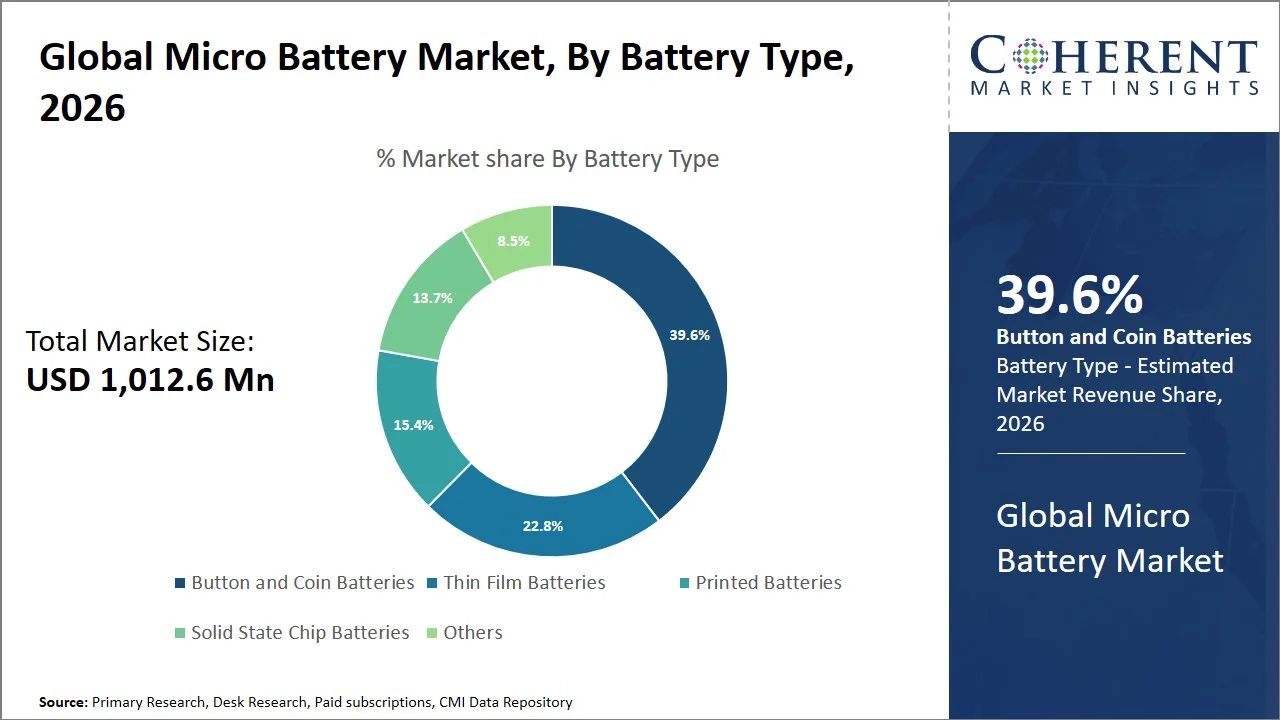
Why Do Button and Coin Batteries Dominate the Global Micro Battery Market?
Button and coin batteries are expected to account for 39.6% of the global micro battery market in 2026. Their leadership reflects the large installed base of compact devices designed around established coin-cell footprints, allowing manufacturers to source interchangeable cells without redesigning battery compartments or power-management architecture. Mature automated production, broad chemistry availability, predictable voltage output, and extensive retail distribution also reduce procurement risk for OEMs and replacement buyers. These batteries remain highly relevant in smart locks, vehicle access devices, medical measuring equipment, calculators, watches, and compact sensors where space efficiency and simple field replacement are essential. In June 2026, VARTA announced expanded performance labeling across selected lithium and alkaline button batteries, including CR2430, CR2450, LR44, CR2032, CR2025, and CR2016 formats, indicating continued portfolio investment in established micro-battery platforms.
- Current Industry Events of 2026
- Market Size Estimation
- Regional Breakdown
- Competitive Landscape
- Customer Intelligence
- Segmental Analysis
- Pricing Analysis
- Key Market Drivers, Challenges & Future Trends
- Customized Insights Section
Why Do Primary Batteries Represent the Largest Rechargeability Segment in the Global Micro Battery Market?
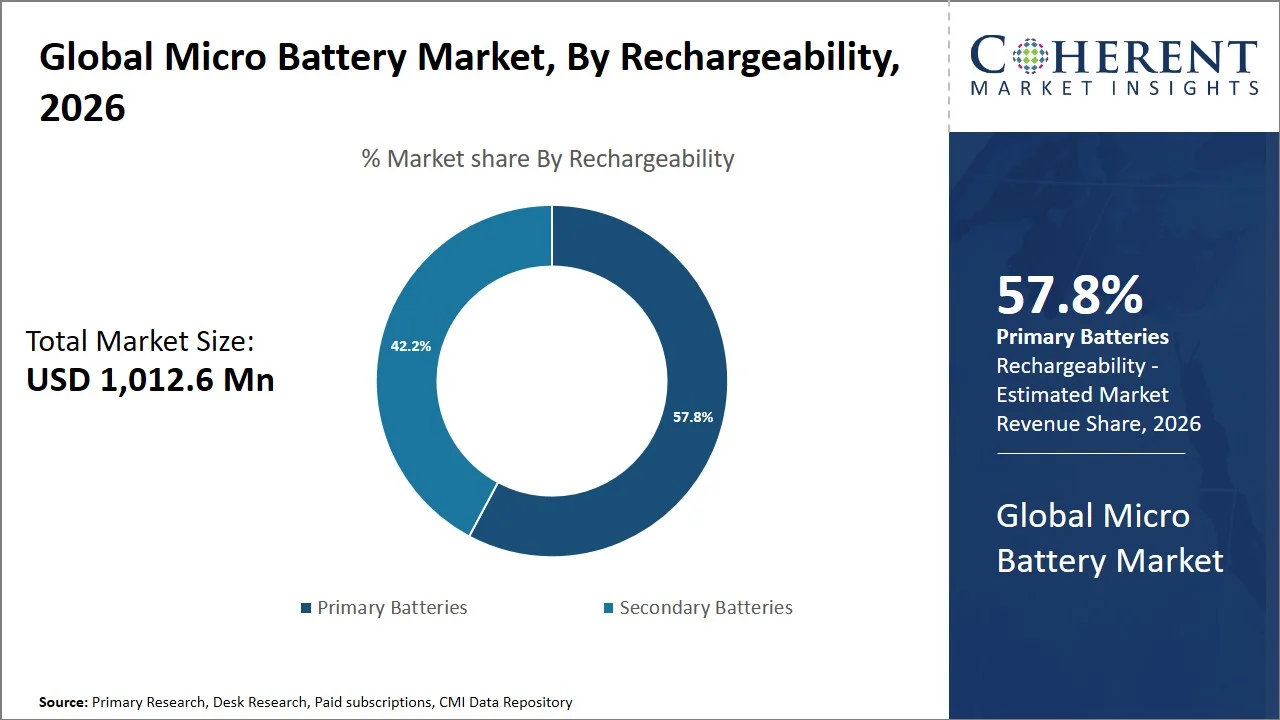
Primary batteries are projected to represent 57.8% of the global micro battery market in 2026. The segment benefits from device architectures that prioritize low component count, immediate activation, and economical replacement over repeated charging. Removing charging ports, protection circuits, and charging-management electronics lowers bill-of-material costs and permits thinner or sealed product designs. This is particularly valuable for asset trackers, remote controls, diagnostic devices, safety sensors, electronic tags, and intermittently operated consumer products whose operating profiles do not justify rechargeable systems. Primary cells also support aftermarket revenue because users can restore device operation through standardized replacement rather than specialist servicing. In January 2025, the U.S. Consumer Product Safety Commission confirmed that Apple had modified AirTag packaging, battery-compartment warnings, and Find My replacement instructions to meet Reese’s Law requirements, demonstrating the continuing commercial scale and regulatory importance of replaceable primary micro batteries.
Why Does the 10 to 100 mAh Segment Dominate the Global Micro Battery Market?
The 10 to 100 mAh segment is expected to command 42.8% of the global micro battery market in 2026. This capacity range provides sufficient energy for continuous wireless connectivity, sensing, audio processing, and user-interface functions while preserving the compact dimensions required by wearable and hearable devices. It also gives product engineers greater flexibility to integrate active noise cancellation, microphones, biometric sensing, and short-duration high-current functions without moving to larger cells that would compromise ergonomics. Suppliers can serve this range through established lithium-ion pouch, miniature cylindrical, and compact solid-state configurations, supporting diverse OEM form factors and charging designs. In December 2024, Huawei unveiled the FreeBuds Pro 4, whose official specifications list a 55 mAh battery in each earbud, illustrating how mid-range micro-battery capacity supports premium audio functions within highly constrained product volumes.
Global Micro Battery Market Dynamics
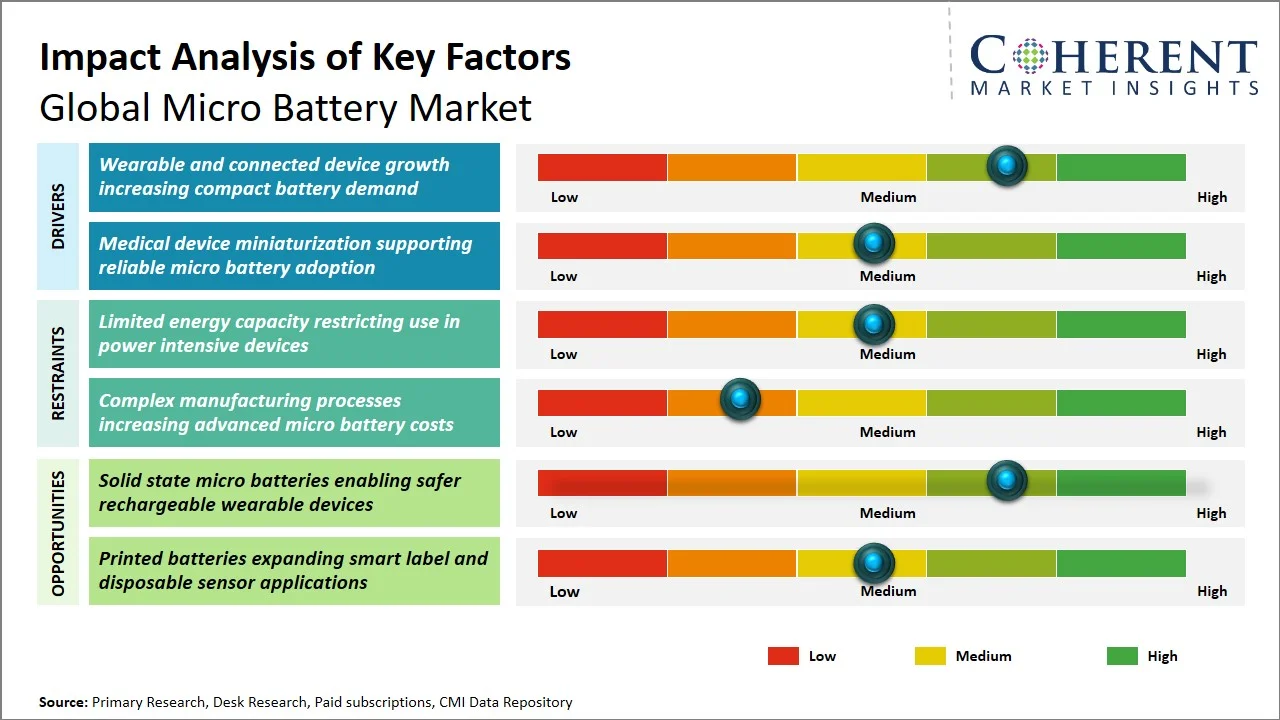
Key Market Drivers
- Wearable and Connected Device Proliferation is Raising the Value of Compact Power Systems: Wearable devices are evolving from basic activity trackers into always-connected health, communication, location, and safety platforms. This expands the battery requirement from simple standby power to sustained support for sensors, wireless radios, displays, and on-device processing within increasingly thin enclosures. Micro battery suppliers therefore benefit not only from unit growth but also from higher-value demand for improved energy density, faster charging, and stable performance under frequent cycling. Hearables, smartwatches, connected rings, and professional wearable monitors are particularly important because battery dimensions directly influence comfort, weight, and product differentiation. In September 2025, Apple introduced Apple Watch Ultra 3 with satellite connectivity, 5G capabilities, expanded health functions, and longer battery life, illustrating how added functionality increases pressure on compact energy-storage design.
- Medical Device Miniaturization Is Increasing Demand for Long-Life, High-Reliability Micro Batteries: Implantable and body-worn medical devices require batteries that occupy minimal volume while maintaining predictable discharge, low leakage, packaging compatibility, and long operating life. Demand is strengthening across leadless pacemakers, insertable cardiac monitors, drug-delivery systems, neurostimulation devices, hearing products, and continuous diagnostic wearables. For manufacturers, the battery is becoming a design-enabling component because reducing its footprint can support fewer invasive procedures, improved patient comfort, and longer replacement intervals. Supply-side requirements are correspondingly stringent, with qualification focused on traceability, process consistency, hermetic sealing, and validated lifecycle performance. In February 2026, Medtronic announced that its Swiss operations had produced 10 million implantable devices and highlighted its leadless pacemaker, which combines a highly compact form with battery life exceeding 15 years.
Emerging Market Trends
- Solid-State Architectures are Moving Micro Batteries Closer to Electronic Components: The market is gradually shifting from batteries treated as separate packaged parts toward energy-storage elements designed for direct integration with printed circuit boards, semiconductor packages, and miniaturized sensor modules. Solid electrolytes, ceramic structures, and thin-film deposition can support non-flammable designs, low leakage, compact footprints, and compatibility with surface-mount assembly. This direction is commercially important because it can reduce connector count, simplify device architecture, and free internal space for sensing or communication functions. Adoption will initially concentrate in premium medical, industrial IoT, and specialist wearable applications where reliability and miniaturization justify higher component costs. As manufacturing yields improve, integrated solid-state micro batteries are likely to move into broader high-volume electronics. Suppliers able to provide design libraries, qualification data, and assembly-compatible formats will be positioned more strongly than firms offering cells as undifferentiated standalone components.
- Flexible and Application-Shaped Power Sources are Redefining Product Design: Printed and ultrathin batteries are enabling product developers to move beyond rigid cylindrical and coin-cell geometries. Battery layers can increasingly be shaped around the available space in smart labels, skin patches, electronic cards, disposable sensors, and compact tracking devices, allowing power to follow the product architecture rather than dictate it. This trend can accelerate adoption in applications where conventional battery thickness, weight, or form factor has prevented commercialization. It also creates opportunities for roll-to-roll manufacturing, localized production, and closer collaboration between battery suppliers, substrate specialists, and device converters. However, commercial success will depend on achieving consistent capacity, moisture protection, shelf stability, and scalable encapsulation at acceptable cost. The strongest suppliers will compete through application engineering and manufacturability, not merely nominal energy density, because customers require power solutions that can be integrated into existing printing, lamination, and packaging workflows.
Current Events and their Impact
Current Events | Description and its Impact |
April 2026 – European Commission Consultation on Battery Removability Exemptions |
|
November 2025 – UK Government Review of Emerging Button-Battery Safety Technologies |
|
September 2024 – U.S. Reese’s Law Labeling Requirements Became Applicable |
|
Regional Insights
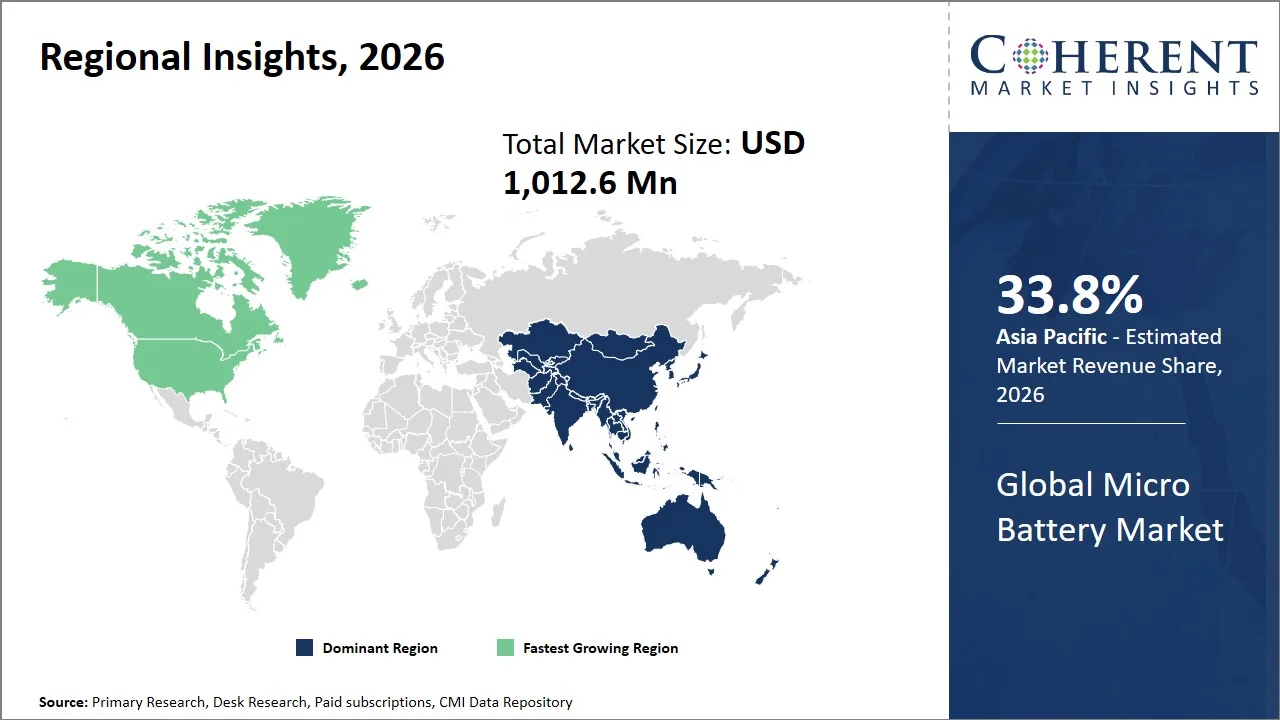
Why Does Asia Pacific Dominate the Global Micro Battery Market?
Asia Pacific is expected to account for 33.8% of the global micro battery market in 2026. Its leadership reflects the region’s concentration of consumer electronics assembly, battery-material processing, semiconductor packaging, and high-volume component manufacturing. This proximity allows device manufacturers to shorten qualification cycles, coordinate customized cell formats, and manage costs across button, thin-film, printed, and rechargeable micro batteries. Demand is reinforced by extensive wearable, hearable, smart-card, medical-electronics, and industrial-sensor ecosystems, where frequent product upgrades create recurring battery design opportunities. Regional suppliers also benefit from mature export channels and the capability to move specialized technologies into volume production. In May 2025, The People’s Republic of China issued an implementation plan targeting more than 85% numerical control across key electronic-information manufacturing processes by 2027 and specifically encouraged the adoption of smart wearable products, strengthening the regional production environment for compact power components.
Why is North America Emerging as the Fastest-Growing Region in the Global Micro Battery Market?
North America is projected to hold 30.8% of the global micro battery market in 2026 and emerge as the fastest-growing region. Expansion is centered on high-value applications rather than commodity cell volume, particularly continuous health monitoring, connected diagnostics, defense sensors, asset tracking, and premium wearable electronics. The region’s medical-device developers and semiconductor companies require batteries with validated service life, compact packaging, secure wireless support, and application-specific discharge characteristics. Established regulatory pathways and clinical commercialization capabilities also help move battery-powered devices from prototypes into professionally deployed products. In May 2025, the U.S. Food and Drug Administration cleared AeviceMD, a battery-operated wearable system that records pediatric lung sounds and transfers information through a connected digital platform. The clearance demonstrates how regulated wearable adoption can translate into demand for dependable rechargeable micro power systems.
Global Micro Battery Market Outlook for Key Countries
Why is the U.S. a Key Market for the Global Micro Battery Market?
The U.S. is a key micro battery market because it combines premium consumer-device demand with a large commercial base for remote monitoring, implantable therapies, connected diagnostics, and industrial IoT. Battery suppliers can access customers that prioritize reliability, certification support, miniaturized packaging, and long-term product availability over the lowest unit price. The medical-technology ecosystem is particularly important because continuous glucose monitors, leadless pacemakers, insertable monitors, and wearable sensors require small power sources that operate predictably within tightly controlled form factors. Domestic product design also influences specifications subsequently adopted by global contract manufacturers. In April 2025, Abbott reported that its FreeStyle Libre continuous glucose monitoring systems were used by approximately seven million people and highlighted Aveir leadless pacemakers containing built-in batteries and electrodes. This commercial scale supports sustained demand for qualified micro batteries across disposable, rechargeable, and implanted healthcare platforms.
Why Does China Support Growth in the Global Micro Battery Market?
China supports growth in the micro battery market through its combination of large-scale electronics production, dense supplier networks, high domestic consumption, and global export capability. Manufacturers can source electrodes, separators, packaging materials, circuit components, and automated assembly equipment within established industrial clusters, improving cost control and product-development speed. Demand extends beyond smartphones to smartwatches, location trackers, electronic labels, medical wearables, connected meters, and low-power IoT nodes. The country is also moving toward more intelligent and traceable production, which can improve consistency for small cells where dimensional tolerances and leakage performance are critical. In May 2026, China’s State Council Information Office reported that more than 160 million wearable terminals were equipped with BeiDou positioning capabilities by the end of 2025. This installed base illustrates the scale of connected devices capable of supporting domestic micro battery consumption and export-oriented production.
Why is Germany a Strategic Country in the Global Micro Battery Market?
Germany is a strategic micro battery market because demand is concentrated in technically demanding medical, industrial, automotive-electronics, and precision-sensor applications. Customers typically require stable voltage, extended storage or cycle life, robust traceability, and compliance with stringent European safety and environmental requirements. Germany’s engineering and applied-research network supports customized battery integration into diagnostic wearables, condition-monitoring sensors, semiconductor modules, and equipment requiring dependable backup power. This favors suppliers capable of co-development, validation, and specialty production rather than standardized cell sales alone. Germany also provides an important route into wider European OEM qualification programs. In February 2026, Fraunhofer IKTS presented printed and flexible sensor materials, ceramic solid-state battery concepts, microprinting processes, and biocompatible printed electrodes at LOPEC in Munich. These capabilities strengthen Germany’s position in developing flexible, compact, and application-specific power systems.
Why is South Korea Important in the Global Micro Battery Market?
South Korea is important to the global micro battery market because battery development is closely connected with its semiconductor, display, consumer-electronics, and advanced-material capabilities. Wearables, hearables, compact healthcare devices, and smart sensors require joint optimization of processors, displays, wireless modules, and power systems; South Korea’s integrated technology ecosystem supports this type of co-engineering. Local research increasingly focuses on reducing battery size and extending operating time through energy harvesting and adaptive power management. This can create demand for smaller rechargeable cells used as storage buffers rather than sole power sources. In July 2025, KAIST announced a wireless wearable platform combining ambient-light harvesting, battery-status-based power selection, and in-sensor computing for continuous health monitoring. The development indicates how South Korean innovation may shift micro battery specifications toward hybrid architectures, lower power loads, and longer autonomous operation.
Why is Japan an Important Growth Market for the Global Micro Battery Market?
Japan remains an important growth market for micro batteries because it combines established electrochemical expertise with advanced ceramics, precision manufacturing, and rigorous quality-control practices. Japanese suppliers serve applications where leakage resistance, temperature tolerance, long storage life, and consistent discharge are critical, including medical equipment, real-time clocks, industrial electronics, smart cards, and compact wearables. The country is also well positioned in semi-solid and ceramic-based rechargeable technologies that can support thinner devices and surface-mount integration. Suppliers generally compete through reliability, specialized formats, and long-term OEM support rather than aggressive commodity pricing. In November 2025, NGK began selling five EnerCera ultra-thin rechargeable battery models through an electronic-components platform serving Japan, Europe, and the U.S. The expansion improved access to ceramic micro batteries for wearable, healthcare, and backup-power product development.
Technology Adoption Landscape in the Global Micro Battery Market
Technology | Adoption Level | Key Application Area | Business Impact |
Lithium Button and Coin Cell Technology | High | Watches, medical meters, keyless systems, sensors, and memory backup | Established production scale and standardized sizes support competitive pricing, replacement availability, and dependable long-term supply. |
Rechargeable Lithium-ion and Lithium-polymer Microcells | High | Hearables, smartwatches, connected rings, and portable medical wearables | High energy density and repeated charging support feature-rich devices, although protection circuitry and thermal management remain necessary. |
Thin-Film Solid-State Batteries | Medium | Implantable devices, industrial sensors, real-time clocks, and compact IoT nodes | Solid electrolytes improve safety and form-factor flexibility while supporting longer service life in space-constrained applications. |
Printed and Flexible Batteries | Medium | Smart labels, electronic cards, skin patches, packaging sensors, and disposable diagnostics | Printing-based production enables thin, shaped, and potentially scalable batteries for applications unsuitable for rigid cells. |
Surface-Mount Ceramic Micro Batteries | Medium | Semiconductor packages, circuit boards, sensor modules, and power backup | Assembly compatibility can reduce connectors, automate installation, lower device footprint, and improve system reliability. |
Energy-Harvesting and Microbattery Hybrid Systems | Low to Medium | Remote industrial sensors, asset trackers, environmental monitors, and autonomous IoT devices | Harvested light, heat, vibration, or radio-frequency energy can extend battery life and reduce maintenance and replacement expenditure. |
How are Integrated Solid-State Batteries and Autonomous Sensors Creating New Growth Opportunities in the Global Micro Battery Market?
The strongest expansion opportunity lies in powering devices that must operate for long periods without frequent charging, replacement, or maintenance. Miniature solid-state batteries combined with low-power electronics and energy-harvesting modules can enable autonomous medical monitors, industrial sensors, smart labels, security devices, and environmental tracking systems. This changes the commercial role of the micro battery from a replaceable consumable into an embedded reliability component. Suppliers can capture greater value by offering application-specific voltage profiles, custom footprints, high-pulse capability, reflow-compatible packaging, and lifecycle validation rather than competing only on cell price.
The opportunity also supports premiumization because end users are willing to pay more when longer service intervals reduce field labor, device downtime, or clinical intervention. Manufacturing scale-up will require improved thin-film deposition, automated inspection, encapsulation, and high-yield wafer or roll-based processing. Companies that establish co-development relationships with semiconductor, medical-device, and sensor manufacturers can secure earlier design wins, longer supply agreements, and stronger barriers to substitution.
Market Players, Key Development, and Competitive Landscape
Recent Developments
- In April 2026, ITEN and XPANCEO announced a proof of concept for a smart contact lens, incorporating a customized solid-state ceramic microbattery. The program addressed encapsulation, thermal control, overvoltage protection, wireless power interaction, and integration into a soft lens substrate. This is important for the micro battery market because it demonstrates the potential to commercialize power sources for highly constrained wearable and healthcare interfaces.
- In December 2025, Ilika commenced shipments of prototype Stereax M300 solid-state micro batteries to customers. The development marked progress from manufacturing transfer and process qualification toward customer evaluation. This is important for the micro battery market because customer shipments allow device developers to validate mm-scale batteries for implantable medical devices, industrial sensors, and other applications requiring compact, rechargeable, and low-leakage power.
Competitive Landscape
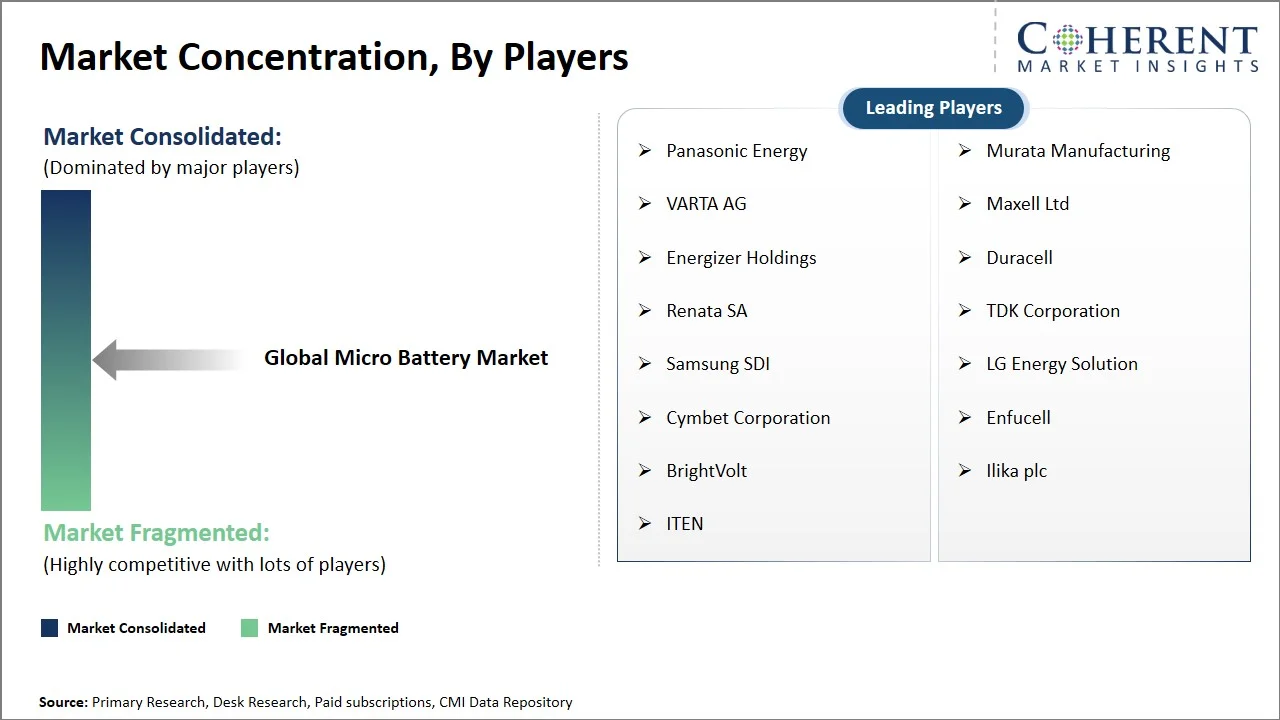
The global micro battery market combines established battery manufacturers with specialist solid-state, thin-film, printed-battery, and medical-power technology companies. Competition is relatively fragmented across advanced formats, although conventional button and coin batteries are supported by larger manufacturers with established production and distribution networks. Supplier selection increasingly depends on application engineering, qualification capability, manufacturing consistency, and long-term supply assurance.
Key focus areas include
- Product quality and differentiation: Companies compete through energy density, voltage stability, leakage resistance, shelf life, cycle life, and discharge performance.
- Miniaturization capability: Suppliers seek to reduce cell thickness and footprint without compromising usable capacity, durability, or safety.
- Manufacturing efficiency: Automated coating, deposition, printing, stacking, encapsulation, and testing processes are essential for improving yields and reducing unit costs.
- Pricing competitiveness: Mature battery formats face strong price pressure, while specialty solid-state and medical-grade products command premium pricing based on performance and qualification.
- Capacity and supply reliability: OEM customers favor suppliers that can support long product lifecycles, predictable delivery schedules, and geographically diversified manufacturing.
- Certifications and compliance: Safety testing, transport certification, quality-management systems, traceability, and market-specific labeling requirements influence customer approval.
- Customization and design support: Application-specific dimensions, electrical profiles, terminals, packaging, and integration assistance can secure early-stage OEM design wins.
- Strategic supply agreements: Long-term development contracts, licensing arrangements, semiconductor integration partnerships, and contract manufacturing relationships support commercialization and scale.
Market Report Scope
Micro Battery Market Report Coverage
| Report Coverage | Details | ||
|---|---|---|---|
| Base Year: | 2025 | Market Size in 2026: | USD 1,012.6 Mn |
| Historical Data for: | 2020 To 2024 | Forecast Period: | 2026 To 2033 |
| Forecast Period 2026 to 2033 CAGR: | 11.4% | 2033 Value Projection: | USD 2,155.9 Mn |
| Geographies covered: |
| ||
| Segments covered: |
| ||
| Companies covered: | Panasonic Energy, Murata Manufacturing, VARTA AG, Maxell Ltd, Energizer Holdings, Duracell, Renata SA, TDK Corporation, Samsung SDI, LG Energy Solution, Cymbet Corporation, Enfucell, BrightVolt, Ilika plc, and ITEN | ||
| Growth Drivers: |
| ||
| Restraints & Challenges: |
| ||
Analyst Opinion (Expert Opinion)
- The market’s next competitive phase will be determined by integration capability rather than cell miniaturization alone. Future leaders will be suppliers that can align battery chemistry, package design, charging architecture, thermal behavior, and assembly processes with the customer’s complete electronic system. This will move value creation toward engineering partnerships and away from interchangeable component sales. Solid-state, printed, and hybrid energy-harvesting systems could transform the market by enabling product categories that conventional batteries cannot serve efficiently. These technologies are expected to create new design possibilities in smart patches, autonomous sensors, connected packaging, implantable devices, and highly compact human–machine interfaces.
- Commercialization risk remains concentrated around manufacturing yield, encapsulation, qualification time, and cost. A technology may perform well in laboratory testing but remain unsuitable for high-volume deployment if production variability, moisture sensitivity, charging limitations, or integration complexity cannot be controlled.
- Market participants should prioritize a limited number of high-value applications rather than pursue every miniature-device category simultaneously. Medical implants, premium wearables, maintenance-sensitive industrial sensors, and semiconductor-integrated backup power offer stronger differentiation and customer retention. Competitive advantage will depend on early OEM engagement, application-specific testing, reliable scale-up, regulatory readiness, and secure access to specialized materials.
Speak to the analyst
Want personalized insights?
Take the findings above to one of our principal consultants, or have the report rebuilt around the segments, geographies and competitors you actually track.
Market Segmentation
- Battery Type Insights (Revenue, USD Mn, 2021 - 2033)
- Button and Coin Batteries
- Thin Film Batteries
- Printed Batteries
- Solid State Chip Batteries
- Others
- Rechargeability Insights (Revenue, USD Mn, 2021 - 2033)
- Primary Batteries
- Secondary Batteries
- Capacity Insights (Revenue, USD Mn, 2021 - 2033)
- Below 10 mAh
- 10 to 100 mAh
- Above 100 mAh
- Application Insights (Revenue, USD Mn, 2021 - 2033)
- Wearable Electronics
- Medical Devices
- IoT Devices and Smart Sensors
- Consumer Electronics
- Smart Cards and Electronic Labels
- Others
- Regional Insights (Revenue, USD Mn, 2021 - 2033)
- North America
- U.S.
- Canada
- Latin America
- Brazil
- Argentina
- Mexico
- Rest of Latin America
- Europe
- Germany
- U.K.
- Spain
- France
- Italy
- Russia
- Rest of Europe
- Asia Pacific
- China
- India
- Japan
- Australia
- South Korea
- ASEAN
- Rest of Asia Pacific
- Middle East
- GCC Countries
- Israel
- Rest of Middle East
- Africa
- South Africa
- North Africa
- Central Africa
- North America
- Key Players Insights
- Panasonic Energy
- Murata Manufacturing
- VARTA AG
- Maxell Ltd
- Energizer Holdings
- Duracell
- Renata SA
- TDK Corporation
- Samsung SDI
- LG Energy Solution
- Cymbet Corporation
- Enfucell
- BrightVolt
- Ilika plc
- ITEN
Source
Primary Research Interviews
- Manufacturers of coin, button, thin-film, printed, solid-state, and rechargeable micro batteries
- Suppliers of electrodes, electrolytes, separators, substrates, current collectors, encapsulation materials, and battery-management components
- Product development and engineering executives from wearable electronics, medical devices, hearing aids, smart cards, electronic labels, and IoT sensor companies
- Battery technology specialists involved in solid-state, flexible, printable, and miniaturized energy-storage systems
- OEMs, contract manufacturers, distributors, battery assemblers, and electronic-component suppliers
- Regulatory, product-safety, quality-assurance, and environmental-compliance professionals
Stakeholders
- Micro battery manufacturers
- Electrode, electrolyte, separator, casing, and packaging-material suppliers
- Semiconductor, sensor, display, and electronic-component manufacturers
- Original Equipment Manufacturers (OEMs) and electronics design companies
- Contract manufacturers and battery-assembly service providers
- Distributors, wholesalers, dealers, and electronic-component retailers
- Battery testing, certification, recycling, and waste-management companies
- End-use Sectors
- Wearable electronics and smart devices
- Medical devices and healthcare monitoring equipment
- Hearing aids and assistive devices
- Internet of Things sensors and wireless devices
- Smart cards, banking cards, and security tokens
- Electronic shelf labels and smart packaging
- Consumer electronics and portable devices
- Automotive electronics and tire-pressure monitoring systems
- Industrial sensors and condition-monitoring equipment
- Regulatory & Government Bodies
- International Electrotechnical Commission (IEC)
- International Organization for Standardization (ISO)
- U.S. Consumer Product Safety Commission (CPSC)
- U.S. Environmental Protection Agency (EPA)
- U.S. Department of Energy (DOE)
- European Chemicals Agency (ECHA)
- European Commission
- European Environment Agency (EEA)
- Ministry of Economy, Trade and Industry (METI), Japan
- Korea Agency for Technology and Standards (KATS)
- Bureau of Indian Standards (BIS)
- National Development and Reform Commission (NDRC), China
Databases
- UN Comtrade Database
- International Trade Centre Trade Map
- U.S. International Trade Commission DataWeb
- Eurostat and EU PRODCOM
- World Bank Open Data
- OECD Data Explorer
- United Nations Industrial Development Organization databases
- Japan METI Statistics
- Korea Statistical Information Service
- China National Bureau of Statistics
- U.S. Census Bureau and International Trade Administration databases
- European Chemicals Agency substance and regulatory databases
Magazines
- Battery Power Online
- Batteries International
- Electronic Design
- EE Times
- Power Electronics News
- Semiconductor Engineering
- Medical Device Network
- Printed Electronics World
- Electronics Weekly
Journals
- Journal of Power Sources
- Energy Storage Materials
- Advanced Energy Materials
- ACS Applied Energy Materials
- Batteries & Supercaps
- Electrochimica Acta
- Nano Energy
- Solid State Ionics
- Journal of Energy Storage
- Nature Energy
Newspapers
- Financial Times – Technology and Energy
- The Wall Street Journal – Technology and Manufacturing
- Nikkei Asia – Electronics and Battery Technology
- The Economic Times – Electronics and Energy Storage
- South China Morning Post – Technology and Manufacturing
Associations
- Battery Council International
- European Portable Battery Association
- Rechargeable Battery Association
- Japan Battery Association
- Korea Battery Industry Association
- China Industrial Association of Power Sources
- India Energy Storage Alliance
- SEMI
- IPC – Association Connecting Electronics Industries
- Consumer Technology Association
Public Domain Sources
- International Energy Agency
- U.S. Department of Energy
- National Renewable Energy Laboratory
- U.S. Environmental Protection Agency
- U.S. Consumer Product Safety Commission
- European Commission
- European Chemicals Agency
- Eurostat
- International Electrotechnical Commission
- Japan Ministry of Economy, Trade and Industry
- Korea Statistical Information Service
- United Nations Comtrade Database
- World Bank
- OECD
Proprietary Elements
- CMI Data Analytics Tool, Proprietary CMI Existing Repository of information for last 10 years.
Get access to 250+ pages report
Every segment, forecast, competitor profile and data table behind the analysis above — available for instant download.
- ESOMAR Member
- ISO 9001:2015 Certified
- D-U-N-S Registered
- GDPR & CCPA Compliant
Missing comfort of reading report in your local language? Find your preferred language:
Transform your Strategy with Exclusive Trending Reports
Frequently Asked Questions
The CAGR of the global micro battery market is projected to be 11.4% from 2026 to 2033.
The global micro battery market is estimated to be valued at USD 1,012.6 million in 2026 and is expected to reach USD 2,155.9 million by 2033.
Micro batteries are widely used in wearable electronics, medical devices, IoT sensors, hearing aids, smart cards, electronic labels, and compact consumer electronics.
Solid-state batteries, thin-film batteries, printed batteries, flexible battery designs, and energy-harvesting integration are shaping product innovation in the global micro battery market.
Expanding adoption of smart healthcare devices, autonomous sensors, connected packaging, miniaturized electronics, and maintenance-free IoT systems are creating significant growth opportunities.
Wearable and connected device growth increasing compact battery demand and medical device miniaturization supporting reliable micro battery adoption are the major factors driving the growth of the global micro battery market.
Limited energy capacity restricting use in power intensive devices and complex manufacturing processes increasing advanced micro battery costs are the major factors hampering the growth of the global micro battery market.