

Industrial Greases Market Size and Trends - 2026 to 2033
The global industrial greases market is estimated to be valued at USD 5.07 Bn in 2026 and is expected to reach USD 6.49 Bn by 2033, exhibiting a compound annual growth rate (CAGR) of 3.6% from 2026 to 2033.
Key Takeaways
- Based on Type of Based Oil, the Mineral Oil-Based Greases segment is expected to dominate the market with 35.8% share in 2026, owing to its affordable cost and reliable performance
- Based on Thickener Type, the Lithium-Based Grease segment is expected to hold 21.7% share in 2026, aided by stringent environmental regulations.
- Based on End-use Industry, the Automotive & Transportation segment is projected to account for 23.8% share in 2026, owing to the massive transportation infrastructure demand.
- Based on Region, Asia Pacific is set to dominate the industrial greases market with 39.9% share in 2026. While, Europe is anticipated to be the fastest growing region.
Market Overview
Industrial greases are used for lubricating various machine parts and reducing friction in different industrial applications such as construction, metal processing, and general manufacturing. Proper lubrication helps extend equipment life and reduces maintenance and replacement costs.
As industrialization increases across developing regions of Asia Pacific, the Middle East, and Africa, the demand for industrial greases from various end-use industries is expected to rise. Furthermore, the use of advanced greases that can withstand high temperatures and pressures is gaining traction in heavy duty applications such as mining and construction equipment.
Current Events and Its Impacts on the Industrial Greases Market
Current Event | Description and its Impacts |
Global Supply Chain Disruptions and Raw Material Shortages |
|
Accelerating Industrial Automation and Manufacturing Renaissance |
|
Industrial Greases Trade Summary – 2025
Aspect | Details |
Top Exporting Countries | Vietnam, United States, Ukraine |
Top Importing Countries | Vietnam, Ukraine, Peru |
Common HS Codes | 271019 (Petroleum oils), 340399 (non-petroleum lubricants), 340319 (Other) |
Recorded Shipments | Over 2,600 shipments globally |
Trade Activity Notes | Vietnam is active in both importing and exporting |
- Current Industry Events of 2026
- Market Size Estimation
- Regional Breakdown
- Competitive Landscape
- Customer Intelligence
- Segmental Analysis
- Pricing Analysis
- Key Market Drivers, Challenges & Future Trends
- Customized Insights Section
Segmental Insights
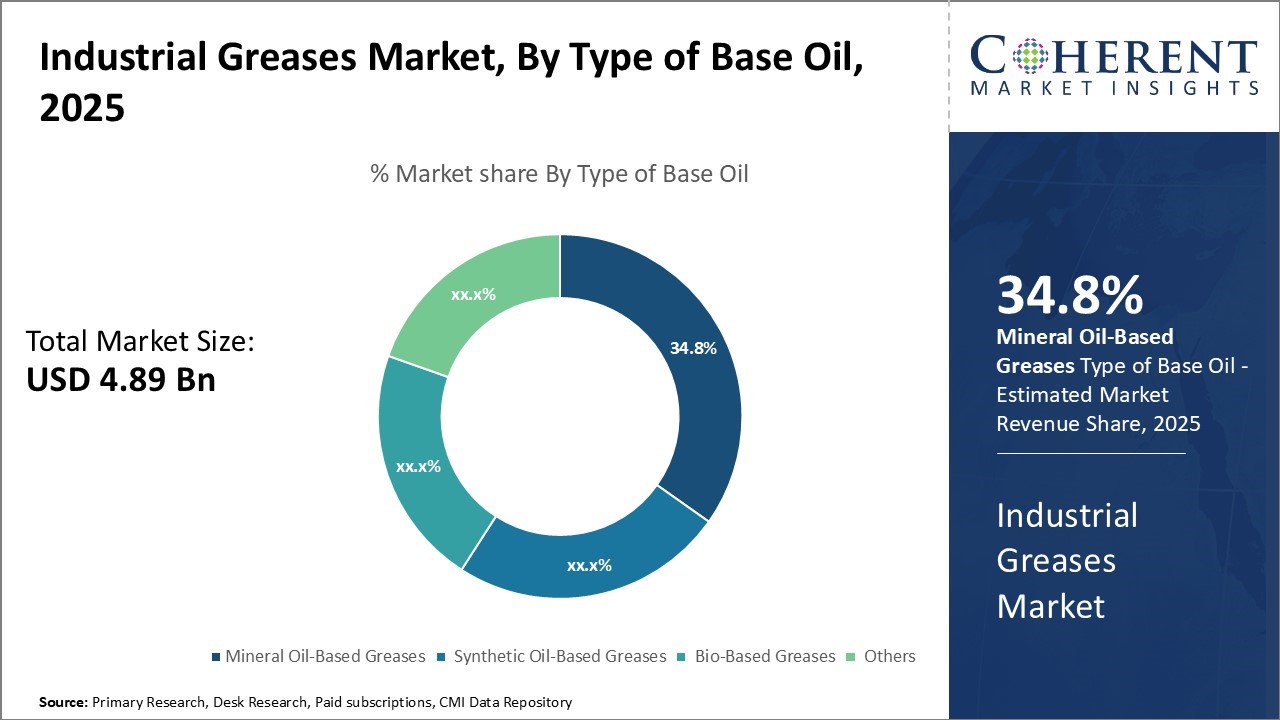
Industrial Greases Market Insights, By Type of Base Oil - Affordability and Performance Drive the Usage of Mineral Oil-Based Greases
In terms of type of base oil, mineral oil-based greases segment is estimated to contribute the highest market share of 35.8% in 2026, owing to its affordable cost and reliable performance. Being derived from crude oil, mineral base oils have traditionally been the most widely used option for industrial greases. The raw material and production costs for mineral oil remains relatively stable compared to others.
For instance, in May 2026, Graphene Manufacturing Group (GMG) launched G® Lubricant, a graphene-based concentrate designed to enhance mineral and synthetic engine oils. The additive improves fuel efficiency and reduces emissions, with tests showing up to 13% fuel savings and 27% NOx reduction. G® Lubricant marks a breakthrough in advanced lubrication for internal combustion engines.
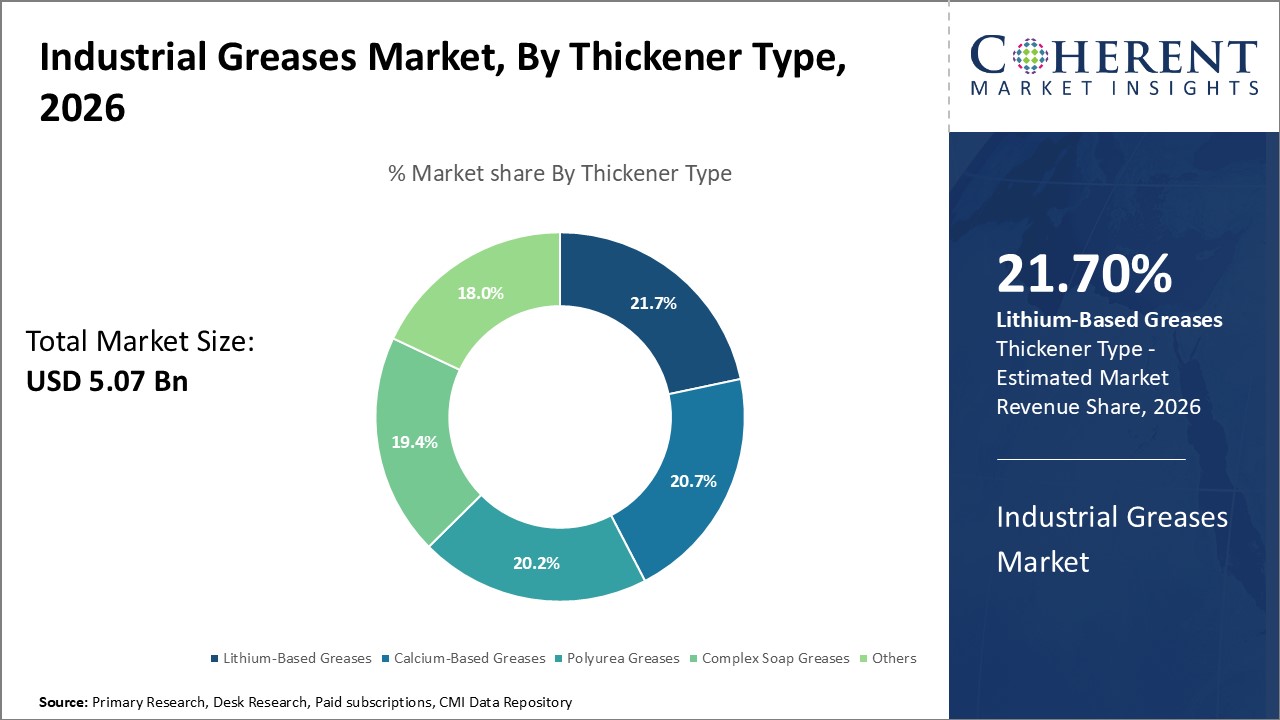
Industrial Greases Market Insights, By Thickener Type - Environmental Regulations Boost Demand for Lithium-Based Greases
In terms of thickener type, lithium-based greases segment is estimated to contribute the highest market share of 21.7% in 2026, aided by stringent environmental regulations. Lithium complex greases have emerged as a popular alternative to conventional calcium and aluminum soap thickeners due to their improved characteristics. Their enhanced thermal stability, water resistance, and high load-carrying capacity make them ideal for demanding industrial applications.
For instance, in September 2026, Lubrizol introduced HybriCal™, a lithium-free grease thickener technology based on anhydrous calcium. Designed to meet NLGI’s High-Performance Multiuse (HPM) standards, HybriCal™ offers faster production, lower energy use, and avoids lithium hydroxide’s regulatory risks. It provides a sustainable alternative to lithium-based greases for industrial lubrication applications.
Industrial Greases Market Insights, By End-use Industry - Mass transportation needs boost automotive & transportation segment growth
In terms of end-use industry, automotive & transportation segment is estimated to contribute the highest market share of 23.8% in 2026, owing to the massive transportation infrastructure demand. This surge in vehicle flow, alongside investment in infrastructure upgrades, has amplified the demand for high-performance automotive components and materials including lubricants and specialized coatings essential for vehicle longevity and efficiency.
For instance, in June 2025, FUCHS Lubricants unveiled a specialized grease formulated for electric power steering systems and automotive gears. Engineered to meet the demands of modern vehicle components, the grease ensures low friction, high thermal stability, and long-lasting performance. This launch supports evolving automotive technologies, particularly in electric and hybrid vehicles, with precision lubrication solutions.
Regional Insights
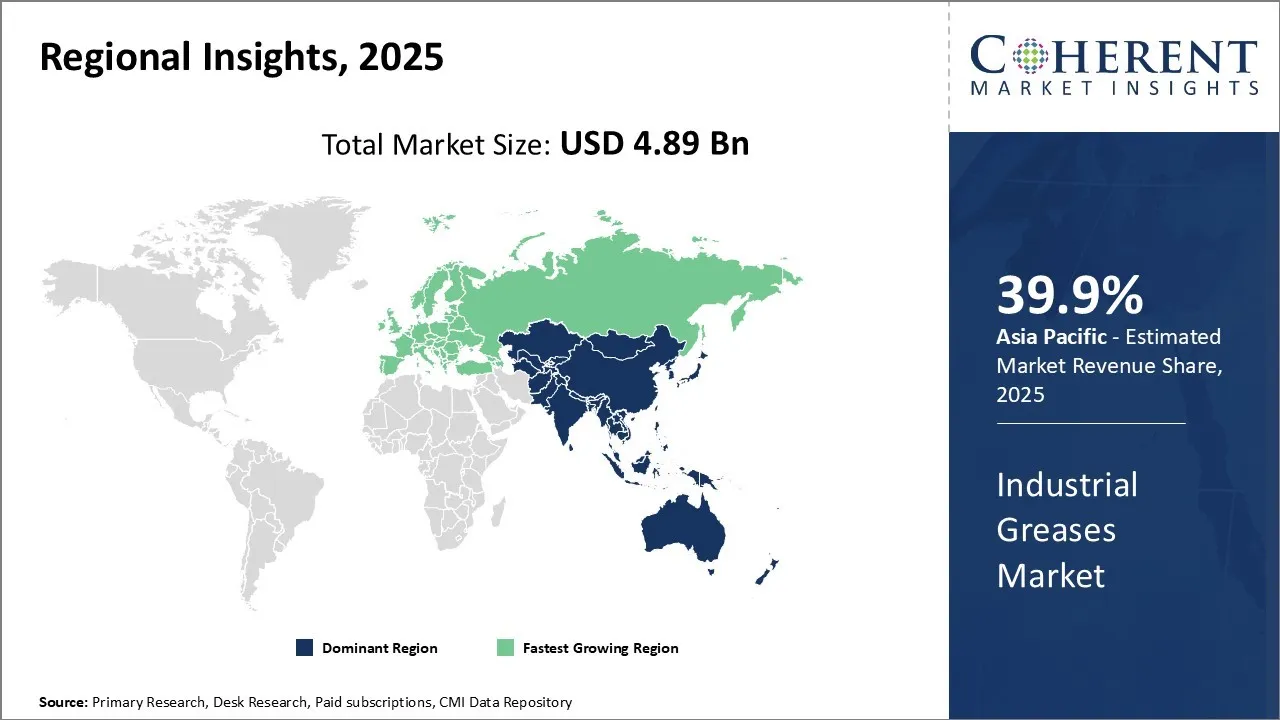
Asia Pacific Industrial Greases Market Analysis & Trends
Asia Pacific is expected to dominate the market in 2026 with an estimated share of 39.9%. Strong government support towards industrial development and adoption of advanced lubrication technologies have created a favorable environment for this market in the region.
For instance, in July 2026, Shell expanded its grease production facility in Indonesia, aiming to meet growing demand across sectors like automotive, manufacturing, and heavy industry. The move enhances Shell’s capacity to produce high-performance industrial greases used in machinery, bearings, and other critical components, supporting regional and global supply chains.
Europe Industrial Greases Market Analysis & Trends
Europe exhibits the fastest growth due to rapid industrialization and increasing manufacturing activities across countries like the U.K. and Germany. Massive investments in infrastructure projects and manufacturing sectors are driving the demand for industrial greases in Europe.
For instance, in October 2026, NTN-SNR launched a new range of bearing lubricants, drawing on over a century of expertise in tribology. Developed in France, the lineup includes greases and oils tailored for industrial and automotive applications, offering enhanced durability under high loads and extreme conditions. This innovation supports global demand for advanced lubrication solutions.
Industrial Greases Market Outlook for Key Countries
The U.S. Industrial Greases Market Trends
The U.S. industrial greases market is characterized by the presence of prominent grease manufacturers and wide application in automotive and mining industries. Companies like Shell and ExxonMobil are focusing on the development of high-performance greases to meet evolving industry needs.
For instance, in September 2026, America Clean Fuel Corp announced to launch a 1,000 barrels-per-day lubricant blending facility in Texas. The plant will produce a range of lubricants, potentially including industrial greases, to meet growing demand across automotive and manufacturing sectors. This expansion supports regional supply chains and advances domestic lubricant production capabilities.
China Industrial Greases Market Trends
China's industrial greases market growth is supported by rising mechanization, expanding auto sector, and increasing local grease production. Leading domestic players, such as CNPC and Sinopec, are investing in R&D and manufacturing facilities to cater to the growing industrial base.
For instance, in November 2026, Evonik doubled its production capacity for long-chain polyamides at its Shanghai facility in China. These high-performance polymers are used in automotive, industrial, and lubricant applications, including specialty greases. The expansion supports growing demand in Asia and reinforces Evonik’s commitment to advanced materials for high-temperature and high-load environments.
Germany Industrial Greases Market Trends
Germany continues to lead the European market owing to a strong manufacturing sector and emphasis on quality and innovation. Key Germany-based companies including Fuchs and Kluber are spearheading advancements in grease formulations.
For instance, in October 2026, OKS Spezialschmierstoffe and Klüber Lubrication merged under Freudenberg Chemical Specialities, combining nearly 150 years of expertise in specialty lubricants. The integration strengthens their global presence and product offerings, including industrial greases for maintenance and OEM applications. Operating in nearly 100 countries, the merger enhances innovation and service in high-performance lubrication solutions.
India Industrial Greases Market Trends
India's industrial greases market is witnessing rapid development on the back of government's 'Make in India' initiative and shifting of production bases to the country. Local grease suppliers are gearing up to fulfill the demand from various end-use industries.
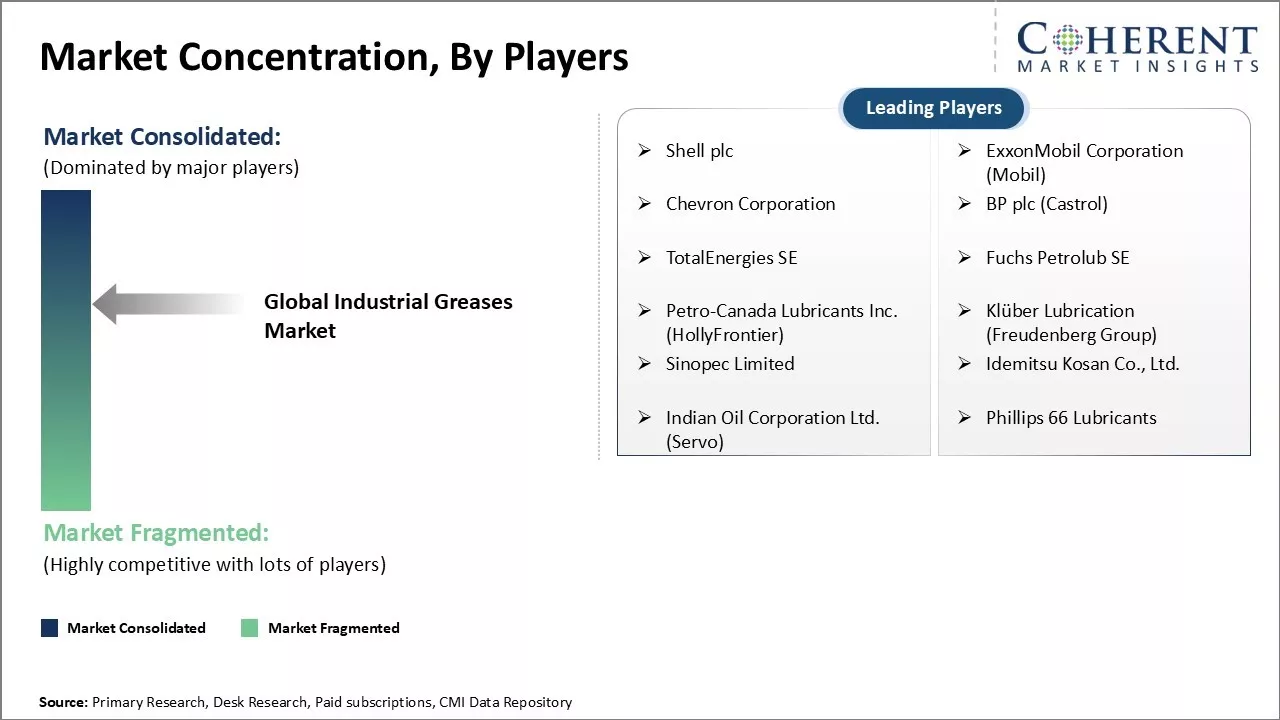
Market Concentration and Competitive Landscape
Market Report Scope
Industrial Greases Market Report Coverage
| Report Coverage | Details | ||
|---|---|---|---|
| Base Year: | 2025 | Market Size in 2026: | USD 5.07 Bn |
| Historical Data for: | 2020 To 2024 | Forecast Period: | 2026 To 2033 |
| Forecast Period 2026 to 2033 CAGR: | 3.6% | 2033 Value Projection: | USD 6.49 Bn |
| Geographies covered: |
| ||
| Segments covered: |
| ||
| Companies covered: | Shell plc, ExxonMobil Corporation (Mobil), Chevron Corporation, BP plc (Castrol), TotalEnergies SE, Fuchs Petrolub SE, Petro-Canada Lubricants Inc. (HollyFrontier), Klüber Lubrication (Freudenberg Group), Sinopec Limited, Idemitsu Kosan Co., Ltd., Indian Oil Corporation Ltd. (Servo), and Phillips 66 Lubricants | ||
| Growth Drivers: |
| ||
| Restraints & Challenges: |
| ||
Industrial Greases Market Driver
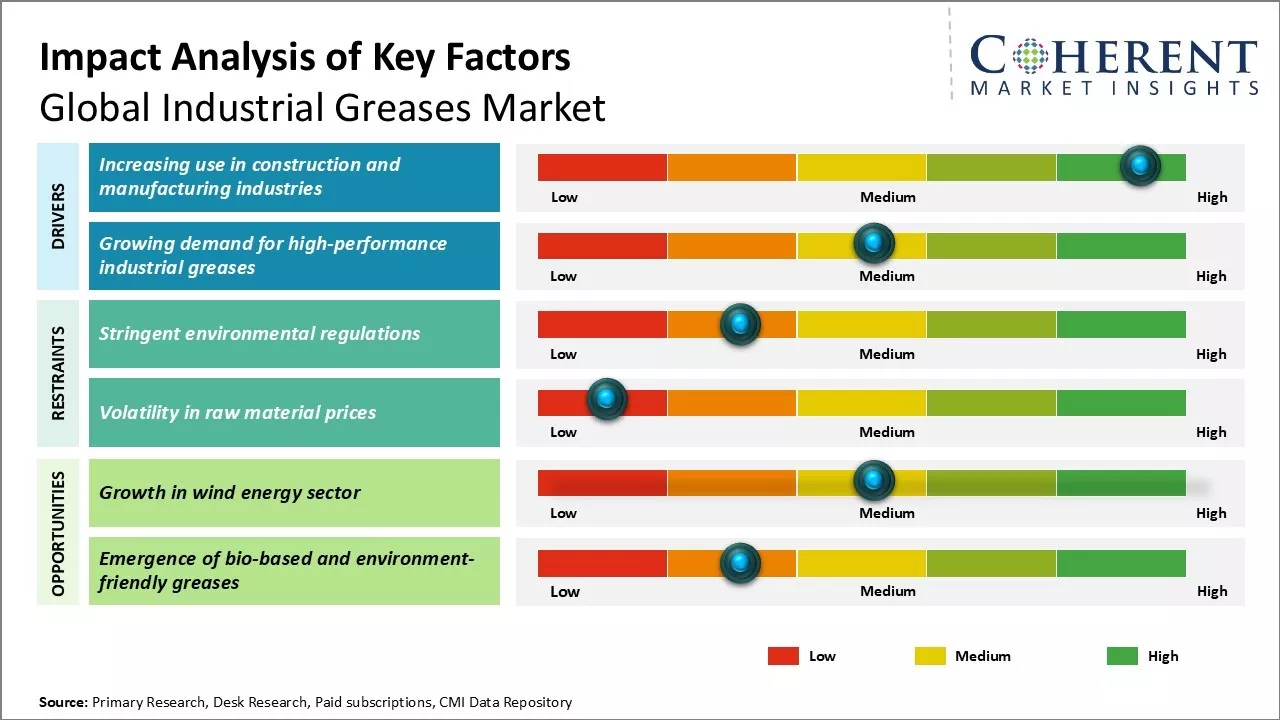
Increasing use in construction and manufacturing industries
The rising demand in construction and manufacturing sectors is significantly boosting the industrial greases market share. Heavy machinery, conveyors, and rotating equipment in these industries require reliable lubrication to minimize wear and extend service life. As infrastructure projects and automated manufacturing expand globally, the need for high-performance greases, especially those with extreme pressure and temperature resistance is surging. Manufacturers are responding with specialized formulations tailored for harsh environments and longer maintenance intervals. Marketing strategies now emphasize sustainability, efficiency, and OEM approvals to appeal to industrial buyers. This trend positions industrial greases as critical components in operational reliability and cost-effective maintenance.
Industrial Greases Market Opportunity
Growth in wind energy sector
The rapid expansion of the wind energy sector is driving significant growth in the industrial greases market forecast. Wind turbines operate under extreme conditions, high loads, variable speeds, and harsh climates, making specialized greases essential for gearboxes, bearings, and pitch systems. Manufacturers are developing advanced formulations with superior water resistance, oxidation stability, and long re-lubrication intervals to meet these demands. Marketing efforts now highlight sustainability, long-term performance, and OEM approvals to align with the renewable energy industry's goals. As global investments in wind power surge, industrial grease suppliers are poised to capture increased market share through innovation and targeted application solutions.
For instance, according to the Energy Monitor data reported in July 2024, the Chinese government aims to have over 200 GW of onshore wind capacity installed by the end of 2025.
Industrial Greases Industry News
- In June 2025, Perma USA and UE Systems announced a groundbreaking partnership integrating ultrasonic sensors with automatic grease dispensers. This innovation enables condition-based lubrication for industrial equipment, enhancing reliability and reducing maintenance costs. The technology targets sectors like manufacturing and utilities, offering smarter grease application and predictive maintenance capabilities for rotating machinery.
- In May 2025, Clariant showcased its latest synthetic lubricant innovations at Inter-Lubric China 2025. The company presented advanced ester and PAG-based base stocks and additives designed for high-performance industrial lubricants. These solutions aim to enhance wear protection, oxidation stability, and sustainability, supporting demanding applications across manufacturing, energy, and environmentally sensitive sectors.
- In January 2024, Shell Lubricants completed the acquisition of the U.K.-based MIDEL and MIVOLT Shell plc, previously known as Royal Dutch Shell, one of the largest integrated oil and gas companies in the world. The company is a key player in the energy sector, involved in various activities including exploration, production, refining, and marketing of oil and natural gas, as well as renewable energy initiatives.
Key Takeaways from Analyst
The industrial greases market value is undergoing a structural shift from price-based competition to differentiation through performance, sustainability, and specialization. Manufacturers with advanced formulations and certified environmental credentials are securing stronger margins, as buyers increasingly prefer products validated under OECD/ASTM biodegradability standards, particularly in sectors such as marine, forestry, and public infrastructure. Lithium-based greases still dominate, but demand for synthetic and non-lithium formulations is expanding, driven by high-temperature, water-resistant, and PFAS-free performance needs.
Innovation momentum is evident in new product lines for electric vehicles, wind turbines, and motion-control applications. For example, FUCHS and Klüber Lubrication have launched specialized greases for e-mobility and hydrogen engine systems, demonstrating how R&D investment directly influences OEM partnerships. Global leaders like Shell leverage their distribution scale and technical services—such as lubrication audits and predictive relubrication to strengthen customer retention.
Sustainability is now a commercial necessity: verified biodegradability and eco-label certifications increasingly determine procurement eligibility. Suppliers that fail to validate such claims risk exclusion from regulated contracts. Over the next few years, profitability will hinge on innovation-led strategies combining product performance, technical service, and environmental compliance, transforming greases from commodity materials into precision-engineered, value-added solutions that extend equipment life and reduce total ownership costs.
Market Segmentation
- Type of Base Oil Insights (Revenue, USD Bn, 2026 - 2033)
- Mineral Oil-Based Greases
- Synthetic Oil-Based Greases
- Bio-Based Greases
- Others
- Thickener Type Insights (Revenue, USD Bn, 2026 - 2033)
- Lithium-Based Greases
- Calcium-Based Greases
- Polyurea Greases
- Complex Soap Greases
- Others
- End-use Industry Insights (Revenue, USD Bn, 2026 - 2033)
- Automotive & Transportation
- Construction and Mining Equipment
- Steel and Metal Processing
- Food and Beverage Industry
- Marine and Aerospace
- Others
- Regional Insights (Revenue, USD Bn, 2026 - 2033)
- North America
- U.S.
- Canada
- Latin America
- Brazil
- Argentina
- Mexico
- Rest of Latin America
- Europe
- Germany
- U.K.
- Spain
- France
- Italy
- Russia
- Rest of Europe
- Asia Pacific
- China
- India
- Japan
- Australia
- South Korea
- ASEAN
- Rest of Asia Pacific
- Middle East
- GCC Countries
- Israel
- Rest of Middle East
- Africa
- South Africa
- North Africa
- Central Africa
- Key Players Insights
- Shell plc
- ExxonMobil Corporation (Mobil)
- Chevron Corporation
- BP plc (Castrol)
- TotalEnergies SE
- Fuchs Petrolub SE
- Petro-Canada Lubricants Inc. (HollyFrontier)
- Klüber Lubrication (Freudenberg Group)
- Sinopec Limited
- Idemitsu Kosan Co., Ltd.
- Indian Oil Corporation Ltd. (Servo)
- Phillips 66 Lubricants
Sources
Primary Research Interviews from the following stakeholders
Stakeholders
- Interviews with grease & lubricant manufacturers, OEM lubrication engineers, industrial maintenance managers, reliability engineers, plant operations heads, procurement heads, third-party lubrication service providers, grease distributors/stockists, tribology test labs, and standards/quality managers across leading global markets.
Specific stakeholders
- R&D/Product managers at major grease manufacturers (e.g., Shell, ExxonMobil, Chevron, FUCHS, Klüber Lubrication, Lubrizol, Valvoline).
- Reliability, maintenance and lubrication engineers at heavy industries (e.g., Tata Steel, ArcelorMittal, POSCO, Nucor).
- Maintenance and fleet managers at transport & logistics operators (e.g., Port of Rotterdam operations, Maersk, Indian Railways maintenance depots).
- Maintenance/engineering leads at mining & construction OEMs and users (e.g., Caterpillar service centers, Komatsu fleet managers).
- Engineering and MRO heads at power plants and utilities (thermal, hydro, gas-fired).
- Maintenance and plant managers at chemical, pulp & paper, and food & beverage manufacturers.
- Tribologists and lab managers at independent test houses and university tribology groups.
- Asset managers and reliability leads at aviation & aerospace MROs (e.g., airlines’ MRO divisions, Bombardier/GE Aviation maintenance groups).
- Procurement heads at industrial distributors and MRO marketplaces.
- Regulatory & quality managers at standards bodies and certification labs.
- Field service technicians and condition-monitoring providers (vibration/oil analysis service companies).
Databases
- UN Comtrade Database
- World Trade Organization (WTO) Trade Statistics
- U.S. International Trade Commission (USITC) HTS & trade data
- Eurostat (trade & industry statistics)
- China Customs Statistics
- Korea Customs Service Data Portal
- Japan External Trade Organization (JETRO) trade & industry reports
- Directorate General of Commercial Intelligence & Statistics (DGCIS), India
- U.S. Bureau of Economic Analysis / U.S. Census (manufacturing & trade)
- India Ministry of Commerce & Industry trade statistics
Trade magazines & industry press
- Lubes’n’Greases
- Machinery Lubrication
- Lubrication Engineering
- International Oil & Gas Review / Oil & Gas Journal (relevant industrial lubrication sections)
- Industrial Maintenance & Plant Engineering (IMPO) titles
- Processing / Plant engineering trade magazines (e.g., Plant Services)
- Chemical Week (industrial chemicals & additives coverage)
- World Pumps (for rotating equipment lubrication coverage)
Academic & Technical Journals
- Tribology International
- Wear (Elsevier)
- ASME Journal of Tribology
- Lubrication Science (IOP)
- Tribology Letters
- Journal of Engineering Tribology (Proc. IMechE)
- Journal of Petroleum Technology (selected lubrication/additives papers)
- Surface & Coatings Technology (for grease additives/coating interactions)
Newspapers & Business Press
- The Wall Street Journal – Industry & Energy sections
- Financial Times – Industry & Commodities reporting
- Nikkei Asia – Chemicals & Manufacturing supply-chain coverage
- The Economic Times / Business Standard (India) – industry & petrochemicals news
- Bloomberg – commodities, oil & corporate developments
Associations, Standards & Technical Bodies
- Society of Tribologists and Lubrication Engineers (STLE)
- European Lubricating Grease Institute (ELGI)
- ASTM International (committees on greases, e.g., ASTM D02)
- ISO (ISO TC 39 / related committees for lubricants and testing)
- SAE International (automotive lubrication standards)
- API (American Petroleum Institute) – base oils & additive standards
- International Organization for Standardization (relevant oil/grease standards)
- Bureau of Indian Standards (BIS) committees on lubricants (where applicable)
Public-Domain & Government Sources
- U.S. Energy Information Administration (EIA) – crude & base-oil feedstock trends (impacting grease raw materials)
- European Chemicals Agency (ECHA) – regulatory listings, REACH implications for additives
- U.S. Environmental Protection Agency (EPA) – regulations affecting waste oil/used grease handling
- Ministry of Commerce & Industry / Department of Industrial Policy (country-level manufacturing statistics)
- National standards organizations (BIS, ANSI, JISC) – specification & testing references
- Customs / trade authorities (national portals for import/export tariffs and volumes)
- Port authorities and logistics statistics (for trade flow context)
Proprietary Elements
- CMI Data Analytics Tool
- Proprietary CMI Existing Repository of information for last 8 years
Get access to 250+ pages report
Every segment, forecast, competitor profile and data table behind the analysis above — available for instant download.
- ESOMAR Member
- ISO 9001:2015 Certified
- D-U-N-S Registered
- GDPR & CCPA Compliant
Missing comfort of reading report in your local language? Find your preferred language:
Transform your Strategy with Exclusive Trending Reports
Frequently Asked Questions
The Industrial Greases Market is estimated to be valued at USD 5.07 Bn in 2026, and is expected to reach USD 6.49 Bn by 2033.
The CAGR of the Industrial Greases Market is projected to be 3.6% from 2026 to 2033.
Increasing use in construction and manufacturing industries and growing demand for high-performance industrial greases are the major factors driving the market growth.
Stringent environmental regulations and volatility in raw material prices are the major factors hampering the growth of the market.
In terms of type of base oil, mineral oil-based greases segment is estimated to dominate the market revenue share in 2026.
Shell plc, ExxonMobil Corporation (Mobil), Chevron Corporation, BP plc (Castrol), TotalEnergies SE, Fuchs Petrolub SE, Petro-Canada Lubricants Inc. (HollyFrontier), Klüber Lubrication (Freudenberg Group), Sinopec Limited, Idemitsu Kosan Co., Ltd., Indian Oil Corporation Ltd. (Servo), and Phillips 66 Lubricants are the major players.
Asia Pacific is expected to lead the global industrial greases market in 2026.