

Global Multi-Factor Authentication Market Size and Forecast – 2026 To 2033
The global multi-factor authentication market is expected to grow from USD 23 Bn in 2026 to USD 54 Bn by 2033, registering a compound annual growth rate (CAGR) of 13% from 2026 to 2033. The global multi-factor authentication market is driven by the expansion of cloud computing and software as a service applications. For instance, on June 10, 2026, Oracle Corporation announced another record quarter with strong revenue growth across its Cloud Infrastructure and Cloud Applications businesses. Total quarterly revenues increased by 21% to USD 19.2 billion, reflecting broad-based demand for Oracle Corporation's industry-leading cloud technology and applications suites.
Key Takeaways of the Global Multi-Factor Authentication Market
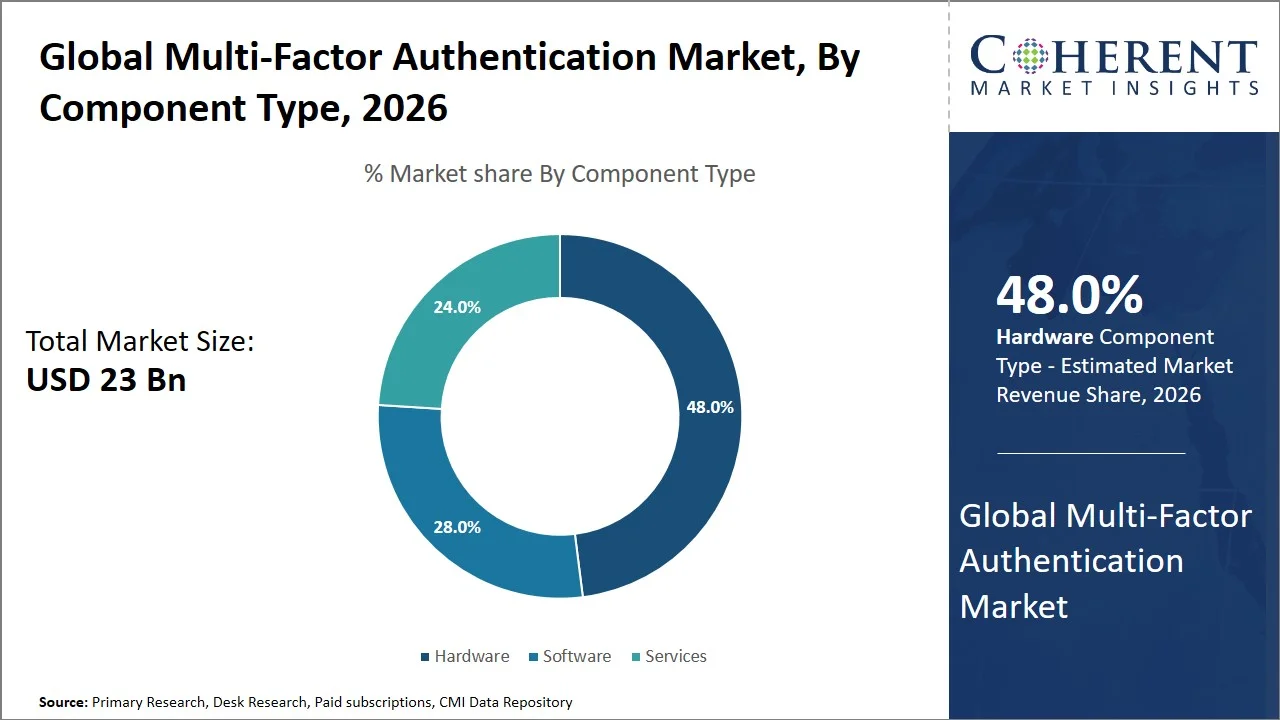
- The hardware segment is expected to account for 48.0 % of the global multi-factor authentication market share in 2026. Increasing development of identity and access management is driving the growth of the segment. On September 30, 2025, SailPoint, Inc initiated its 2025 Navigate series by announcing its vision for the future of enterprise security. This vision is underpinned by the SailPoint Platform, which delivers identity-first, data-first security with AI intelligence guiding how enterprises govern access, detect risks and respond to evolving threats.
- The cloud segment is estimated to capture 57.0 % of the market share in 2026. Rising remote and hybrid workforce adoption is majorly driving the growth of the segment. On May 7, 2026, Airtel Business, built Airtel Secure Workforce, India’s first-ever, fully-managed and unified Zero Trust Architecture (ZTA) security platform with an end-to-end, compliance-ready security stack for enterprises.
- The password-based authentication segment is estimated to capture 31.0 % of the market share in 2026. Increasing regulatory compliance requirements and Fast Identity Online passkey developments are driving the growth of the segment. On February 14, 2025, Thales announced the launch of OneWelcome FIDO Key Lifecycle Management, a new solution to help large organizations successfully deploy and manage FIDO security passkeys at scale.
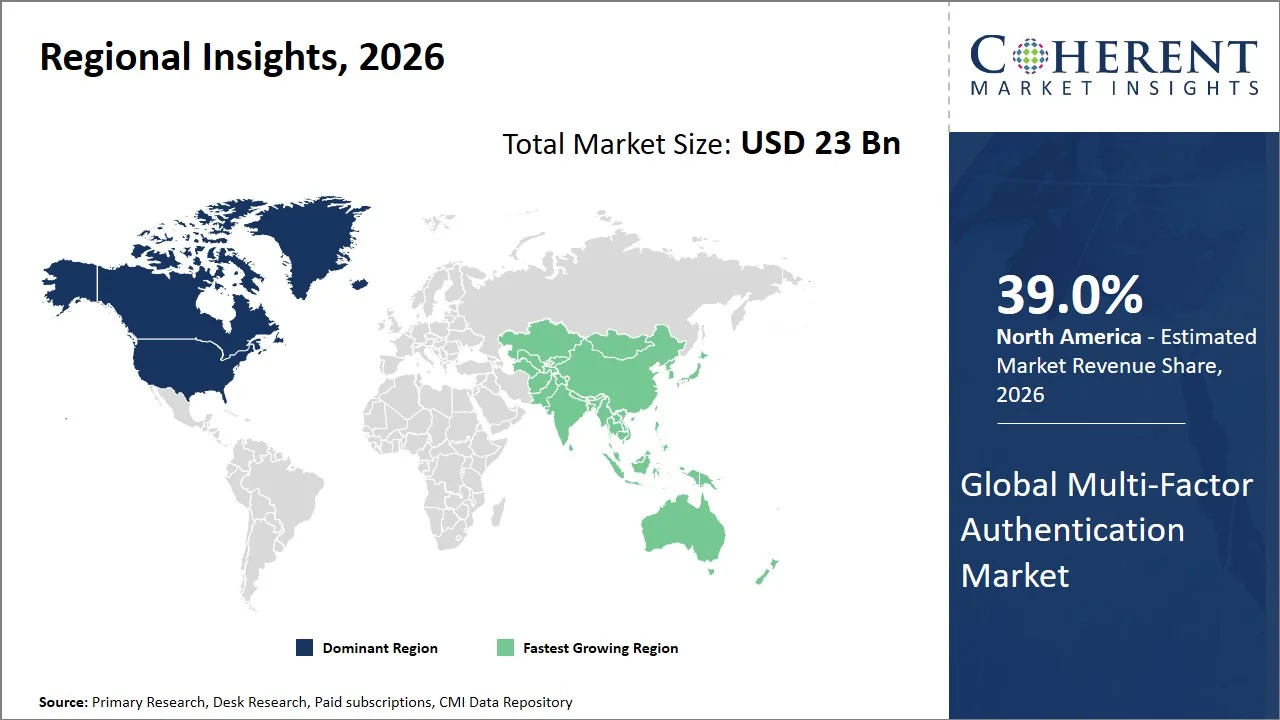
- North America is expected to dominate the multi-factor authentication market in 2026 with a market share of 39.0 %. Rising deployment of cloud native identity platforms in North America is driving the growth of the regional market. On August 26, 2025, Okta announced the acquisition of Axiom Security, integrating identity-centric privileged access management, SaaS security posture management, and cloud infrastructure protection into its Identity Security Fabric to strengthen cloud-native identity capabilities for enterprise customers.
- Asia Pacific is expected to account for 30.0 % of the market share in 2026 and is projected to record the fastest growth over the forecast period. Increasing need for biometric authentication solutions in Asia Pacific is driving the growth of the regional market. On February 19, 2026, PhonePe announced the launch of biometric authentication for UPI payments, enabling a faster and more seamless ‘one-touch’ payment experience for its users.
- Rapid adoption of passwordless authentication technologies: Organizations are moving away from traditional passwords to passkeys, biometric authentication and hardware security keys to improve security and user comfort. This trend mitigates risks from phishing, stolen credentials and password reuse, and provides faster, more secure access across commercial and consumer apps.
- Growing integration of artificial intelligence into authentication platforms: Artificial intelligence is being incorporated into multi-factor authentication solutions to enable adaptive risk-based authentication, behavioral analytics, and continuous identity verification. This allows the authentication systems to dynamically analyze the login risk and invoke further verification only when suspicious behaviors are identified.
Segmental Insights
Why Does Hardware Dominate the Global Multi-Factor Authentication Market?
The hardware segment is expected to account for 48.0% of the global multi-factor authentication market share in 2026. The hardware segment is dominating the global multi-factor authentication market because to its high security against phishing, credential theft, and remote cyber-attacks. Physical authentication devices like security keys, smart cards and others store cryptographic credentials in tamper-resistant components, making them far more difficult to compromise than software-based authentication systems. For organizations in heavily regulated industries such as banking, government, defense and healthcare, hardware authentication is still a requirement as it offers strong identity assurance and compliance to the needs of strict cybersecurity regulations, and minimizes the risk of unauthorized access to sensitive systems and data. On April 30, 2026, Yubico announced an industry-first collaboration with OpenAI. This move allows users to purchase a new 2-pack set of custom YubiKeys as part of OpenAI’s Advanced Account Security program, enabling them to secure their ChatGPT accounts with security keys, containing the strongest hardware-backed passkeys.
- Current Industry Events of 2026
- Market Size Estimation
- Regional Breakdown
- Competitive Landscape
- Customer Intelligence
- Segmental Analysis
- Pricing Analysis
- Key Market Drivers, Challenges & Future Trends
- Customized Insights Section
Why is Cloud the Most Preferred Deployment Type?
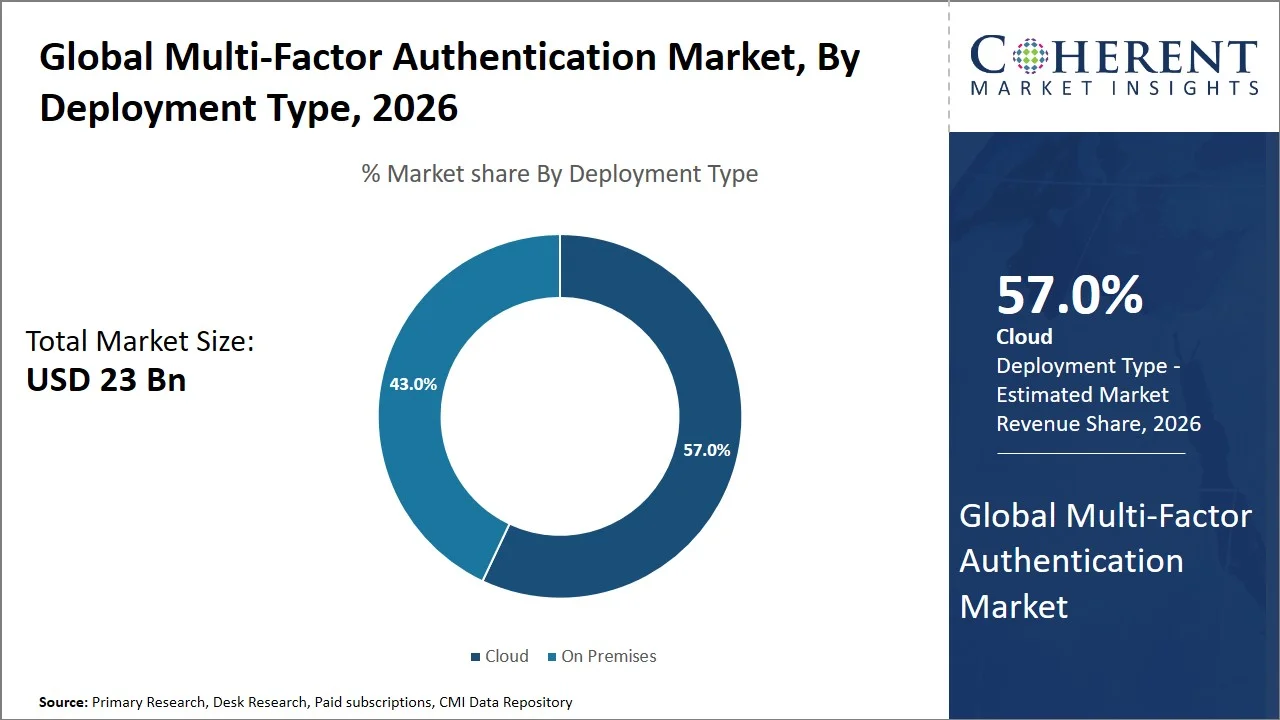
The cloud segment is expected to account for 57.0% of the global multi-factor authentication market share in 2026. Cloud deployment is the most popular because it allows enterprises to deploy multi-factor authentication to scattered people, applications and devices quickly without requiring a lot of on-premises infrastructure. Cloud-based platforms offer centralized management, automatic software upgrades, scalable authentication services, and easy connection with cloud apps and identity providers, and remote work environments. This deployment architecture minimizes operational costs, simplifies administration, and allows organizations to swiftly adjust authentication policies as cybersecurity risks and workforce needs continue to grow. On April 29, 2026, Okta announced the general availability of Okta for AI Agents, extending its cloud-native identity platform to securely authenticate, govern, and manage AI agents throughout their lifecycle in enterprise cloud environments.
Password-Based Authentication Dominates the Global Multi-Factor Authentication Market
The password-based authentication segment is expected to account for 31.0% of the global multi-factor authentication market share in 2026. Password-based authentication is the most widely used authentication factor because of its deep integration with current enterprise systems, consumer apps and digital services across almost every industry. Most organizations already have username and password infrastructures in place, so adding multi-factor authentication solutions with secondary verification methods such as one-time passwords, biometrics or hardware tokens can be implemented with little disturbance.
Despite the growing trend towards passwordless authentication, its widespread use continues to be driven by enormous user familiarity, low implementation costs and compatibility with legacy systems. On March 4, 2026, Bitwarden announced capability for logging into Windows with passkeys stored in the Bitwarden vault. The new feature extends authentication beyond browsers and programs to the operating system login experience, providing phishing-resistant authentication straight to Windows 11 devices.
Currents Events and their Impact
Current Events | Description and its Impact |
European Union Cyber Resilience Act |
|
Reserve Bank of India Authentication Mechanisms for Digital Payment Transactions Directions 2025 |
|
Multi-Factor Authentication Market Dynamics
Market Drivers
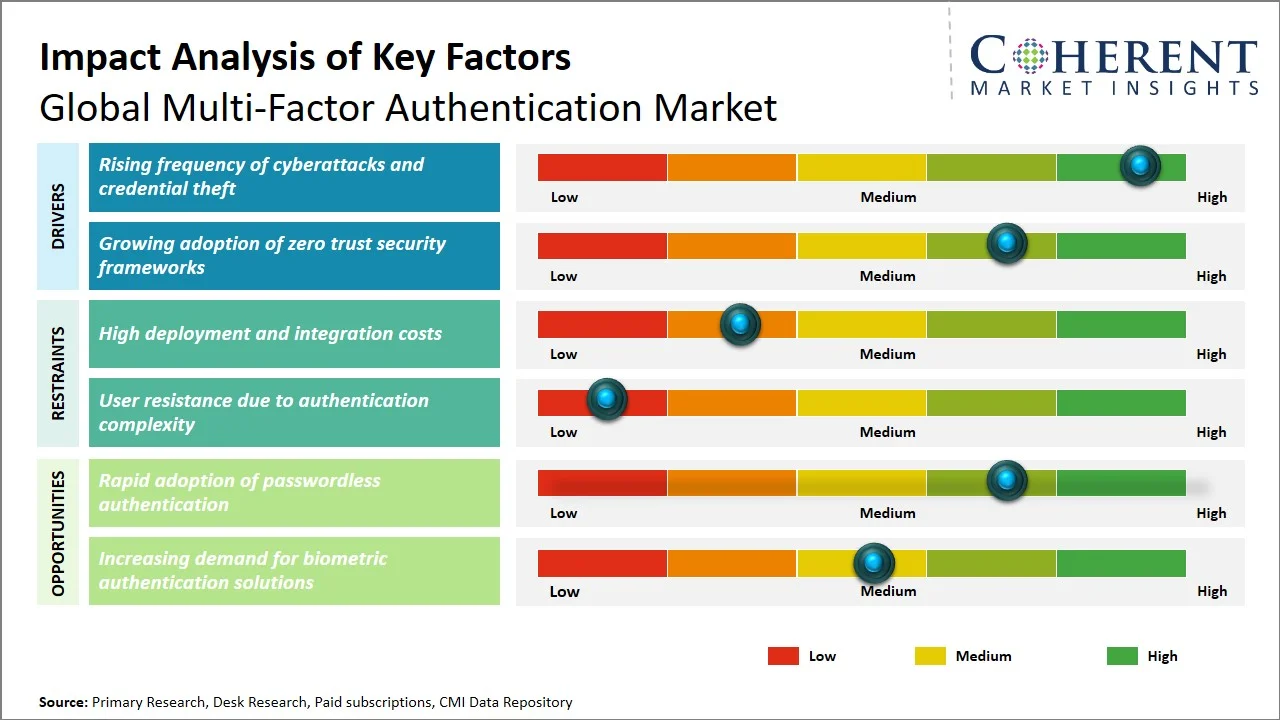
- Rising frequency of cyberattacks and credential theft: The increasing frequency of cyber-attacks and credential theft is a key factor driving the growth of the global multi-factor authentication market, as organizations are increasingly facing sophisticated phishing campaigns, ransomware attacks, credential stuffing, and account takeover attempts. Multi-factor authentication is becoming a core component of enterprise identity security strategies as corporations, financial institutions, healthcare providers, and government organizations strengthen access controls to protect sensitive data and mission-critical systems beyond traditional password-based security. The cost of a data breach, in terms of money and reputation, continues to mount, as do regulatory requirements, therefore investment in advanced authentication systems continues to increase in the public and commercial sectors. On June 17, 2026, Fortinet published an alert that warns of an active credential-harvesting campaign targeting FortiGate firewalls and VPN devices by leveraging previously obtained credentials and brute-forcing to achieve illegal access. This further highlights the need for phishing resistant multi-factor authentication.
- Growing adoption of zero trust security frameworks: The increasing adoption of zero trust security frameworks is fueling the demand for multi-factor authentication as enterprises are shifting their cybersecurity focus from perimeter-based protection to continuous identity verification. Zero trust is a security model that mandates all users, devices and apps be validated and authorized before gaining access to an organization’s resources. As enterprises transition to cloud services, hybrid work environments and remote IT infrastructures, multi-factor authentication has become an integral component of zero trust architectures to assist organizations reduce the risk of illegal access and improve their overall cybersecurity resilience. On June 10, 2026, Zscaler, Inc. announced a significant expansion of the Zscaler Zero Trust SASE solution with the introduction of its ZAgent Framework and additional innovations designed to secure every communication, from browser to workload, on one cloud-native architecture.
Emerging Trends
- Expansion of phishing-resistant authentication standards: Organizations are speeding up the deployment of FIDO, WebAuthn and hardware-backed authentication credentials to address the development of sophisticated phishing attacks. These standards remove the need for shared secrets and enable improved identity assurance for users accessing cloud services and enterprise applications.
- Increasing convergence of identity security with cloud-native platforms: Multi-factor authentication is being tightly linked with identity and access management, privileged access management and zero trust security frameworks supplied through cloud-native platforms. The connection offers centralized policy management, seamless user authentication, and consistent security enforcement across hybrid and multi-cloud systems.
Regional Insights
Why is North America a Strong Market for Multi-Factor Authentication?
North America is expected to account for a market share of 39.0% in 2026. The North America region is the most mature multi-factor authentication market, driven by obligatory cybersecurity mandates from federal agencies, financial institutions and critical infrastructure operators. Phishing-resistant authentication adoption has been accelerated by the U.S. government through federal zero trust initiatives and major enterprises like Microsoft, Cisco, Okta, Duo Security and IBM continue to deploy passkey-based authentication, FIDO2 security keys and AI-driven adaptive authentication platforms. The region also has strong cloud usage and widespread deployment of identity and access management systems across industries such as banking, healthcare, defense and technology.
Why Does the Asia Pacific Multi-Factor Authentication Market Exhibit High Growth?
Asia Pacific is projected to account for 30.0% of the global multi-factor authentication market and is expected to register the fastest growth. The growth of the region can be attributed to rapid digital transformation, increasing occurrences of cybercrime and government-driven digital identification programs. Countries including China, India, Japan, South Korea, Singapore and Australia are increasing authentication requirements for digital payments, e-government services and cloud infrastructure. Regional organizations (NEC Corporation and Huawei) are increasingly using biometric authentication, mobile authentication applications and passwordless login technologies, while banking institutions continue to improve consumer authentication to fight online fraud and account takeover threats.
Global Multi-Factor Authentication Market Outlook for Key Countries
Why is the U.S. Emerging as a Major Hub in the Multi-Factor Authentication Market?
The dominance of the U.S. in the worldwide multi-factor authentication market is attributed to constant innovation and stringent cybersecurity standards. Federal agencies are deploying zero trust architectures that require phishing-resistant authentication. And top suppliers such as Microsoft, Cisco, Okta, Ping Identity and Yubico are accelerating passkey and hardware security key deployments. Big banks, hospitals and cloud service providers are ditching old SMS authentication in favor of FIDO2-based authentication, biometric verification and risk-based adaptive authentication to better secure identities against sophisticated cyber threats.
Is China the Next Growth Engine for the Multi-Factor Authentication Market?
China has become one of the major adopters of multi-factor authentication. Biometric authentication, facial recognition, and hardware-backed identity verification are now embedded in the enterprise cloud platforms and consumer digital ecosystems of major technology companies like as Huawei, Alibaba Cloud, Tencent Cloud, and Huawei Cloud. Government rules on cybersecurity and increased investment in domestic cybersecurity technologies are pushing firms to include identity verification in financial services, manufacturing, telecommunications and public sector organizations.
Germany Multi-Factor Authentication Market Analysis and Trends
Germany remains an important market in Europe with robust cybersecurity compliance standards and a highly digitalized industrial base. Manufacturing enterprises, automobile industries and financial institutions are increasingly relying on hardware security keys, smart cards and biometric authentication to secure operational technology environments and enterprise networks. The country’s focus on data protection under European cybersecurity rules has increased investment in identity governance, privileged access management and phishing-resistant authentication in public and private businesses.
Japan Multi-Factor Authentication Market Analysis and Trends
Japan has one of the most advanced enterprise authentication infrastructures as it focuses on digital governance and corporate cybersecurity. NEC, Fujitsu, Hitachi and NTT Communications offer biometric authentication, palm vein recognition, facial recognition and identity management solutions in financial services, transportation, healthcare and government sectors. Japanese companies are also increasing the adoption of passkeys and multi-factor verification with zero trust architectures to enhance cloud security while enabling highly linked digital workplaces.
U.K. Multi-Factor Authentication Market Analysis and Trends
The U.K. continues to advocate for the implementation of multi-factor authentication through cybersecurity rules for the financial sector and the advice issued by the National Cyber Security Centre to promote phishing-resistant authentication. HSBC, Barclays, Lloyds and NatWest are among the major banks to have rolled out biometric authentication, secure mobile authentication and hardware-based consumer verification for digital banking services. Microsoft Entra ID, Okta and Ping Identity solutions are progressively being deployed across enterprises in financial services, healthcare and government to offer zero trust access control and secure hybrid work environments.
Global Multi-Factor Authentication Market - Biometric Authentication Adoption By Authentication Modality
Authentication Modality | Adoption Share (%) |
Fingerprint Recognition | 39 |
Facial Recognition | 30 |
Voice Recognition | 12 |
Iris Recognition | 9 |
Palm Vein Recognition | 6 |
Behavioral Biometrics | 4 |
How is the Rapid Adoption of Passwordless Authentication Creating New Growth Opportunities in the Multi-Factor Authentication Market?
Rapidly growing adoption of passwordless authentication is one of the major growth opportunities in the multi-factor authentication market, forcing organizations to move away from insecure password-based systems to safer authentication methods such as passkeys, biometrics, hardware security keys, and device-based credentials. This change decreases the danger of phishing, credential theft and password reuse, and improves the user experience with faster, frictionless login. Major technology providers like Microsoft, Google, Apple and enterprise identity vendors are expanding support for FIDO2 and passkey standards, and businesses in banking, healthcare, government, retail and manufacturing are increasing investment in next-generation identity security platforms. This is driving sustained demand for advanced multi-factor authentication solutions and related identity management services.
On May 7, 2026, the FIDO Alliance announced more than 5 billion passkeys are in active usage around the globe, and that workforce deployment is now mainstream, with corporations fast installing passwordless authentication for their staff.
Market Players, Key Development, and Competitive Landscape
Key Developments
- On May 26, 2026, Yubico announced the certification of the next generation of its YubiKey 5 FIPS Series,now FIPS 140-3 validated with Certificate #5291. Published by the National Institute of Standards and Technology (NIST), this milestone represents the latest evolution in cryptographic module validation and reinforces Yubico’s leadership in delivering hardware-backed phishing-resistant authentication.
- On May 1, 2025, Microsoft announced new enterprise passkey enhancements for Microsoft Entra, including broader support for passkey adoption initiatives and expanded passwordless sign-in capabilities through its participation in the FIDO Alliance Passkey Pledge.
Competitive Landscape
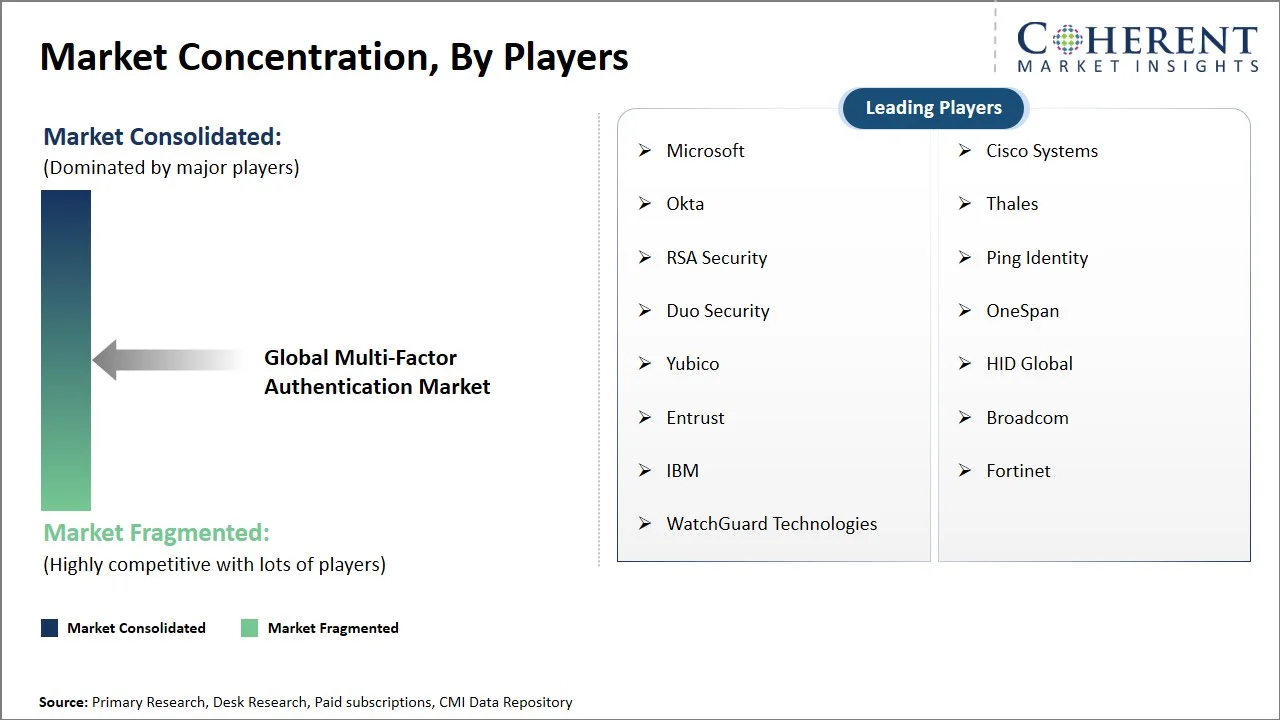
The global multi-factor authentication market is highly competitive, with established cybersecurity vendors, identity management specialists, cloud platform providers, and authentication hardware manufacturers continually innovating and forming strategic alliances to broaden their product portfolios. Microsoft, Okta, Cisco Duo, Ping Identity, Thales, RSA Security, Yubico, HID Global, Entrust, and OneSpan are strengthening their positions in the market by using passkeys, FIDO2 authentication, adaptive risk engines, artificial intelligence and cloud-native identity management embedded in unified security platforms. Competition is increasingly centered on delivering phishing-resistant authentication, seamless integration with zero trust architectures, passwordless authentication, and identity governance capabilities, while acquisitions and technology collaborations continue to accelerate product differentiation across enterprise, government and regulated industry deployments.
Market Report Scope
Multi-Factor Authentication Market Report Coverage
| Report Coverage | Details | ||
|---|---|---|---|
| Base Year: | 2025 | Market Size in 2026: | USD 23 Bn |
| Historical Data for: | 2020 To 2024 | Forecast Period: | 2026 To 2033 |
| Forecast Period 2026 to 2033 CAGR: | 13% | 2033 Value Projection: | USD 54 Bn |
| Geographies covered: |
| ||
| Segments covered: |
| ||
| Companies covered: | Microsoft, Cisco Systems, Okta, Thales, RSA Security, Ping Identity, Duo Security, OneSpan, Yubico, HID Global, Entrust, Broadcom, IBM, Fortinet, and WatchGuard Technologies | ||
| Growth Drivers: |
| ||
| Restraints & Challenges: |
| ||
Analyst Opinion (Expert Opinion)
- The multi-factor authentication market is being transformed by the transition from conventional authentication techniques to phishing-resistant and passwordless identity verification solutions. Competitive differentiation will likely be based on the ability to deliver unified identity systems blending adaptive authentication, privileged access management, artificial intelligence and continuous risk assessment over a single cloud-native architecture. There is also a greater demand for companies that offer interoperability with current enterprise identity ecosystems, compliance with international authentication standards and scalable deployment across hybrid and multi-cloud settings.
- The future of the multi-factor authentication market is likely to be driven by the extensive deployment of passkeys, hardware-backed credentials, decentralized digital identities and artificial intelligence-led continuous authentication rather than traditional one-time password approaches. Organizations are pursuing a single cyber resilience strategy, which is expected to drive further integration with identity governance, endpoint security and security operations platforms.
- Expansion into machine identity protection, Internet of Things authentication and secure authentication for autonomous systems is also expected to open up new application areas. Continuous innovation in biometric technologies and cryptographic authentication standards is expected to further transform enterprise identity security over the coming decade.
Speak to the analyst
Want personalized insights?
Take the findings above to one of our principal consultants, or have the report rebuilt around the segments, geographies and competitors you actually track.
Market Segmentation
- Component Type Insights (Revenue, USD Billion, 2021 - 2033)
- Hardware
- Software
- Services
- Deployment Type Insights (Revenue, USD Billion, 2021 - 2033)
- Cloud
- On Premises
- Authentication Type Insights (Revenue, USD Billion, 2021 - 2033)
- Password-Based Authentication
- Passwordless Authentication
- Biometric Authentication
- Smart Card Authentication
- OTP Authentication
- Token-Based Authentication
- End User Insights (Revenue, USD Billion, 2021 - 2033)
- BFSI
- Government
- Healthcare
- IT and Telecom
- Retail and E Commerce
- Manufacturing
- Education
- Energy and Utilities
- Others
- Regional Insights (Revenue, USD Billion, 2021 - 2033)
- North America
- U.S.
- Canada
- Latin America
- Brazil
- Argentina
- Mexico
- Rest of Latin America
- Europe
- Germany
- U.K.
- Spain
- France
- Italy
- Russia
- Rest of Europe
- Asia Pacific
- China
- India
- Japan
- Australia
- South Korea
- ASEAN
- Rest of Asia Pacific
- Middle East
- GCC Countries
- Israel
- Rest of Middle East
- Africa
- South Africa
- North Africa
- Central Africa
- North America
- Key Players Insights
- Microsoft
- Cisco Systems
- Okta
- Thales
- RSA Security
- Ping Identity
- Duo Security
- OneSpan
- Yubico
- HID Global
- Entrust
- Broadcom
- IBM
- Fortinet
- WatchGuard Technologies
Sources
Primary Research Interviews
- Chief Information Security Officers (CISOs)
- Identity & Access Management (IAM) Solution Providers
- Cybersecurity Consultants & Analysts
- Enterprise IT & Network Security Managers
Magazines
- SC Magazine (Cybersecurity)
- Dark Reading
- Infosecurity Magazine
- CSO Online
Journals
- Journal of Cybersecurity (Oxford Academic)
- IEEE Transactions on Information Forensics and Security
- International Journal of Information Security
Associations
- FIDO Alliance (Fast Identity Online)
- Cloud Security Alliance (CSA)
- Information Systems Security Association (ISSA)
- International Association of Privacy Professionals (IAPP)
Public Domain Sources
- U.S. National Institute of Standards and Technology (NIST) – Digital Identity Guidelines
- European Union Agency for Cybersecurity (ENISA) Publications
- U.S. Cybersecurity and Infrastructure Security Agency (CISA) Reports
- World Economic Forum – Cybersecurity Reports
Proprietary Elements
- CMI Data Analytics Tool
- Proprietary CMI Existing Repository of Information for Last 10 Years
Get access to 250+ pages report
Every segment, forecast, competitor profile and data table behind the analysis above — available for instant download.
- ESOMAR Member
- ISO 9001:2015 Certified
- D-U-N-S Registered
- GDPR & CCPA Compliant
Missing comfort of reading report in your local language? Find your preferred language:
Transform your Strategy with Exclusive Trending Reports
Frequently Asked Questions
The global multi-factor authentication market is expected to stand at USD 23 Bn in 2026 and is expected to reach USD 54 Bn by 2033.
The CAGR of the global multi-factor authentication market is projected to be 13% from 2026 to 2033.
Passkeys are cryptographic credentials that enable secure and phishing-resistant user authentication across supported devices.
Adaptive authentication evaluates user behavior and login risk in real time to determine the appropriate level of authentication required.
Rising frequency of cyberattacks and credential theft and growing adoption of zero trust security frameworks are the major factors driving the growth of the global multi-factor authentication market.
High deployment and integration costs and user resistance due to authentication complexity are the major factors hampering the growth of the global multi-factor authentication market.
In terms of component type, the hardware segment is estimated to dominate the market revenue share in 2026.