

Global Nano Hydroxyapatite Toothpaste Market Size and Forecast – 2026 To 2033
Global Nano Hydroxyapatite Toothpaste Market is estimated to be valued at USD 498.9 Mn in 2026 and is expected to reach USD 1,695.9 Mn by 2033, growing at a compound annual growth rate (CAGR) of 19.10% from 2026 to 2033. This growth reflects increasing consumer awareness of preventive oral care, greater interest in enamel remineralization, and the availability of specialized mineral-based toothpaste formulations.
In October 2025, researchers published a study in the Journal of Dentistry evaluating eight toothpaste formulations using 160 enamel specimens. All tested products demonstrated significant improvements in enamel surface microhardness, although remineralization performance varied across formulations. There were significant improvements in enamel surface microhardness for all tested products, with varying remineralization performance. The results show the promise of hydroxyapatite toothpaste and the need for clinically substantiated formulation development to further differentiate products and instill consumer confidence.
Key Takeaways of the Global Nano Hydroxyapatite Toothpaste Market
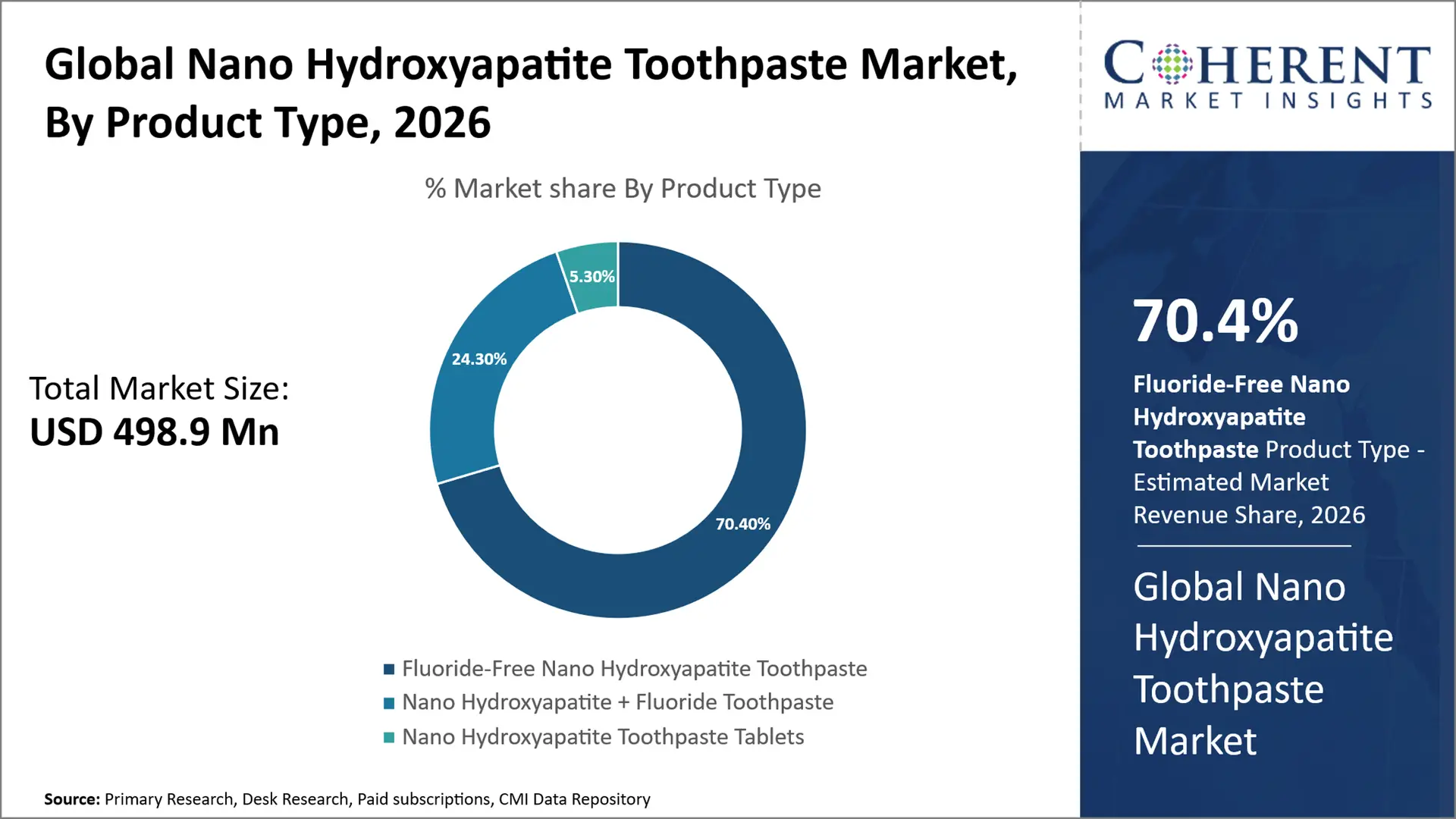
- Fluoride-Free Nano Hydroxyapatite Toothpaste is the expected share winner of the global nano hydroxyapatite toothpaste market with an estimated CAGR of 18.5% and is expected to account for 70.4% of the global market in 2026. The dominance is explained by the fact that they are popular with consumers because they provide enamel remineralization and clarity of ingredients. To provide more options to consumers, Davids Health Sciences introduced its new Fluoride-free Hydroxi Whitening + Enamel Health Unflavored Toothpaste in July 2026.
- Whitening & Polishing is expected to register an estimated CAGR of 18.0% and contribute 40.8% to the global nano hydroxyapatite toothpaste revenue in 2026. Everyday stain removal that doesn't involve aggressive bleaching has become increasingly popular, offering opportunities for multifunctional toothpaste. SANGI announced in December 2025 it had been inducted into Japan's cosme Best Cosmetics Awards 2025, with its nano-hydroxyapatite-based APAGARD SERENA toothpaste being awarded Hall of Fame status.
- Adults are expected to achieve an estimated 18.7% CAGR, representing 80.7% of global nano hydroxyapatite toothpaste market revenue in 2026. They are a significant contributor, as they are regular buyers of preventive dental care, maintenance for orthodontics, and dental plaque management. A clinical trial was published in June 2026 by the researchers at Manipal Academy of Higher Education in Dente 91, a Nano-Hydroxyapatite and Lactoferrin formulation for adult orthodontic patients.
- USD 15–30 toothpaste products are forecast to expand at an estimated 19.8% CAGR, capturing 54.7% of global nano hydroxyapatite toothpaste market revenue in 2026. This price range is a balance of specialized mineral formulations and premium positioning. Bastét has already introduced its first toothpaste in France in June 2026, which has a 10% nano-hydroxyapatite content, creating a premium oral care proposition with a differentiated formulation and 100% recyclable aluminium packaging.
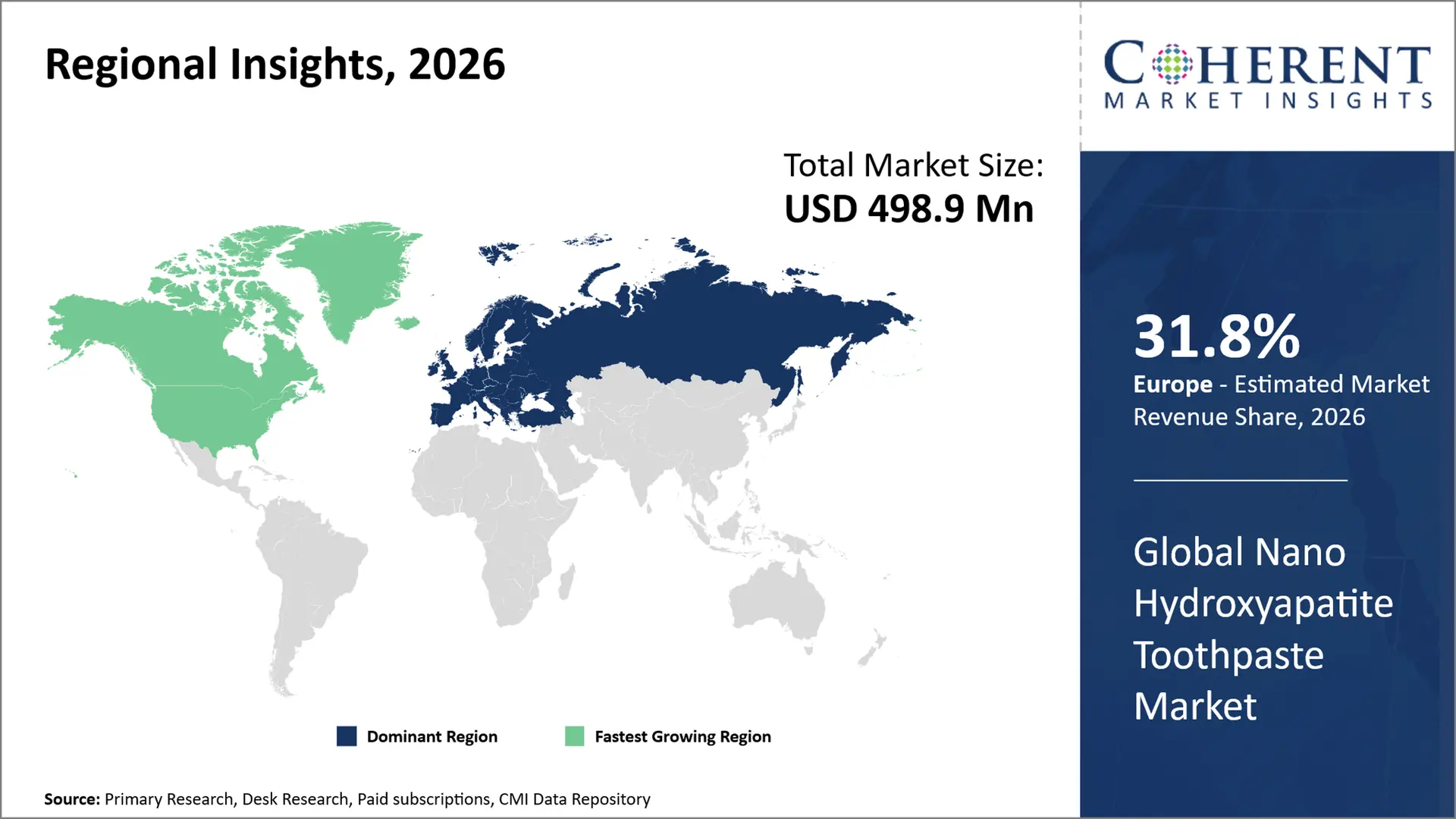
- Europe is forecast to record an estimated 17.6% CAGR, while retaining the largest regional share of 31.8% in 2026. Support for product development includes established oral care manufacturers, specialized dental distribution and ingredient safety assessments. In July 2025, the European Commission released an opinion by the SCCS on the safety of specified nano-hydroxyapatite particles in toothpaste at up to 29.5%.
- North America is projected to register the fastest regional CAGR of approximately 22.4%, accounting for 27.4% of global nano hydroxyapatite toothpaste market revenue in 2026. The availability of specialist oral care formulations and a widening range of products developed by dentists will drive up uptake. In July 2026, U.S.-based Ultradent Products launched Opalescence Fluoride Free Whitening Toothpaste, which features 10.5% nano-hydroxyapatite and xylitol.
Segmental Insights
Why Does Fluoride-Free Nano Hydroxyapatite Toothpaste Dominate the Global Nano Hydroxyapatite Toothpaste Market?
Fluoride-free nano hydroxyapatite toothpaste is expected to account for 70.4% of global nano hydroxyapatite toothpaste market revenue in 2026. It is because its leadership brings the delivery of enamel care based on minerals into the everyday consumer routine of brushing their teeth twice a day, without asking consumers to change their oral care habits. Manufacturers have the option to produce various flavors, textures and packagings, but keep the fluoride-free formula the same. They are also more readily available in the market, where they are sold through well-known retail stores, making them more accessible to people than other specialized products. In March 2025, Boka announced the rollout of their fluoride-free nano-hydroxyapatite toothpaste line to select Target stores and Target.com, with the addition of their Ela Mint and Refresh Mint Whitening lines. This expansion is an example of how products can be made more visible and assist in repeat purchase in retail outlets other than those specializing in oral care.
- Current Industry Events of 2026
- Market Size Estimation
- Regional Breakdown
- Competitive Landscape
- Customer Intelligence
- Segmental Analysis
- Pricing Analysis
- Key Market Drivers, Challenges & Future Trends
- Customized Insights Section
Why Does Whitening & Polishing Represent the Largest Primary Benefit Segment in the Global Nano Hydroxyapatite Toothpaste Market?
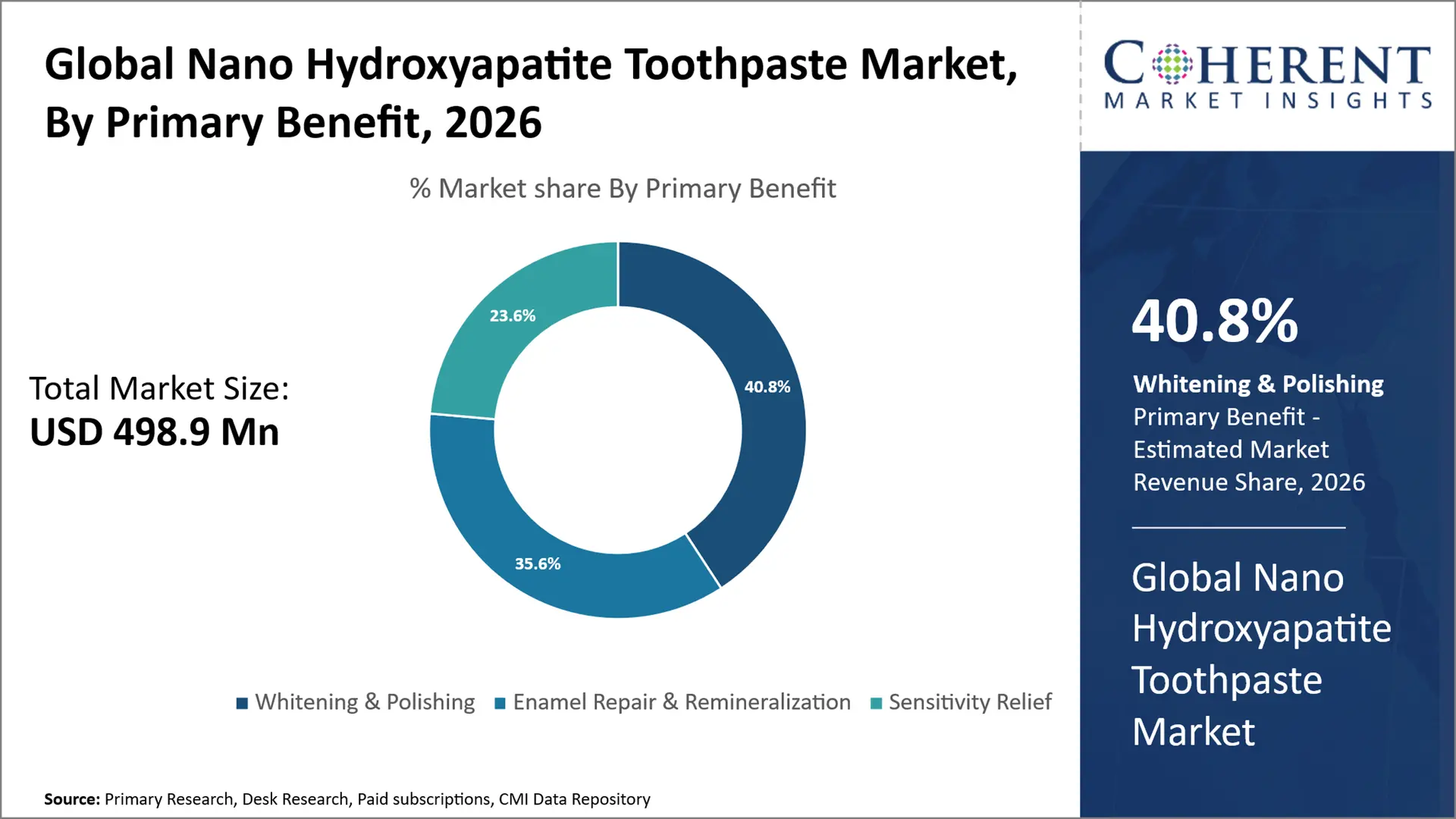
Whitening & Polishing is projected to capture 40.8% of global nano hydroxyapatite toothpaste market revenue in 2026, supported by its relevance to everyday cosmetic dental care. Coffee, tea and tobacco can stain teeth and whitening toothpaste can be used as a part of a normal brushing routine by consumers who are afraid of staining. Surface discoloration can be addressed by allowing manufacturers to add the mineral to a compatible polishing agent, while marketing the mineral as an added bonus. This provides the opportunity for differentiated formulations in which the peroxide bleaching agents are not the main bleaching agents. Wings Pharma's Orasore Whitening Toothpaste, was promoted in June 2026 that included nano-hydroxyapatite to support the enamel, and surface stain remover ingredients. The product demonstrates the ability of manufacturers to meet cosmetic and preventive oral care needs in a single product, thus enhancing its consumer appeal.
Why Do Adults Dominate the Target Consumer Segment of the Global Nano Hydroxyapatite Toothpaste Market?
Adults are expected to account for 80.7% of global nano hydroxyapatite toothpaste revenue in 2026, reflecting their diverse dental care requirements across different life stages. Some special toothpaste will benefit beyond just daily cleaning habits due to age-related tooth wear, exposed dentin and periodontal treatment needs. Selected formulations and specific dental advice from manufacturers can help meet these needs and help differentiate in adult oral care. A randomized clinical study of 24 patients after scaling and root planning was conducted in April of 2026. The study revealed that the post-treatment dentin hypersensitivity was decreased by the use of nano-hydroxyapatite toothpaste and the early results were favourable in comparison to calcium sodium phosphosilicate toothpaste. The results of this study lend credence to the commercial potential of nano-hydroxyapatite products for older adults who need extra support after periodontal surgery.
Current Events and their Impact
Current Event | Description and Its Impact |
March 2024 – European Commission Restricts Nano-Hydroxyapatite Use in Cosmetics |
|
July 2025 – U.S. Advertising Self-Regulatory Review of Nano-Hydroxyapatite Claims |
|
September 2026 – European Commission Proposes Revised Nano-Hydroxyapatite Restrictions |
|
Global Nano Hydroxyapatite Toothpaste Market Dynamics
Key Market Drivers
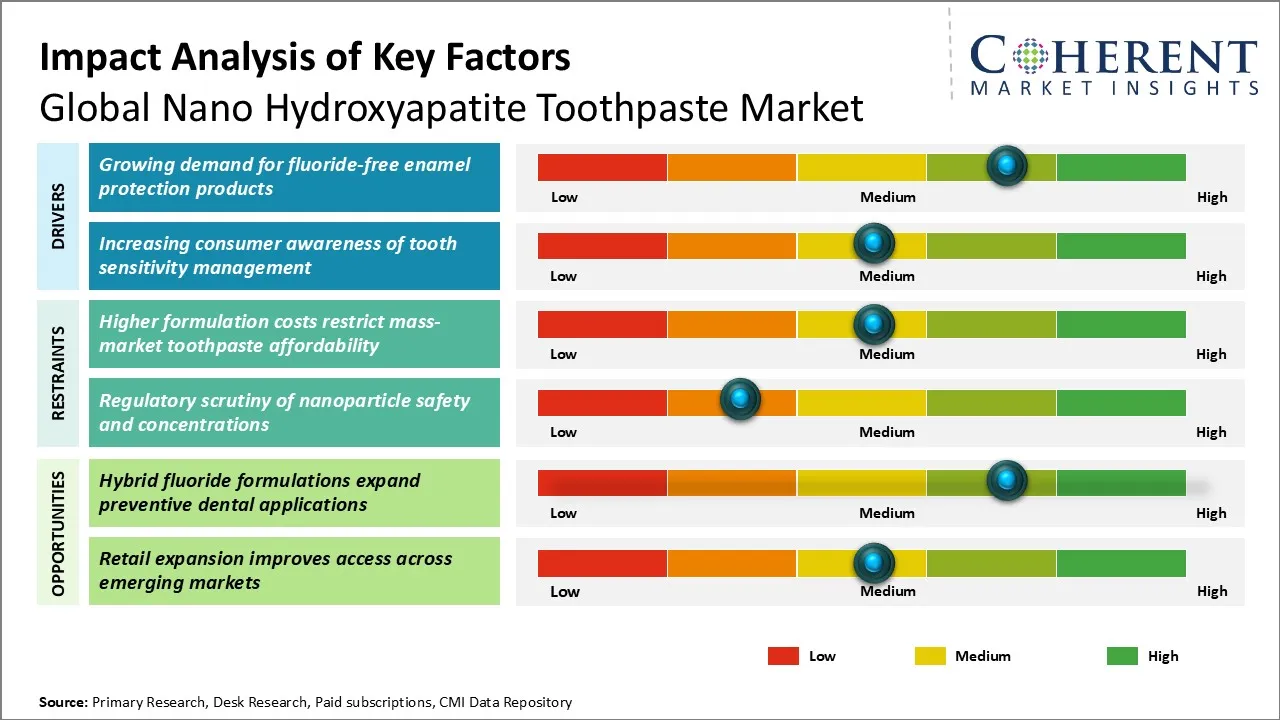
- Growing demand for fluoride-free enamel protection products: This interest in alternative products to fluoride toothpaste represents a new market niche for biomimetic enamel care products. The nano-hydroxyapatite formulations provide a chance for manufacturers to market oral care products based on surface protection for the enamel and daily maintenance of the teeth. This change is positive for specialty toothpaste manufacturers and ingredient suppliers who are creating new differentiated fluoride-free toothpaste. MySmile launched the Nano-Hydroxyapatite Toothpaste in the U.S. in September 2025, targeted at remineralization and sensitivity care, fluoride-free. The launch is a good illustration of the mineral formulations making their way into the mainstream of digital retail channels.
- Increasing consumer awareness of tooth sensitivity management: Since tooth sensitivity often requires specific toothpaste to manage the exposed dentinal tubules and discomfort associated with the sensitivity, consumers are becoming more aware of this need. Nano-hydroxyapatite provides a mineral-deposition method which can help to lower sensitivity, providing the opportunity for oral care companies to create differentiated desensitising products. Clinical studies can also complement the professional recommendations and more precise positioning of the product. A systematic review of 13 randomized clinical trials with 609 participants were published in July 2026, suggesting short-term sensitivity benefits from nano-hydroxyapatite toothpaste, but showing benefits for fluoride in some longer-term outcomes.
Emerging Market Trends
- Integration of Oral Microbiome Support into Mineral-Based Toothpaste: Manufacturers are looking at nano-hydroxyapatite combined with oral microbiome support ingredients. The product development now extends beyond the replacement of minerals to the daily oral care functions.
Impact: This may lead to the need for ingredient systems that are compatible and higher complexity in formulation development. It could also expand testing criteria to prove benefits other than standard cleaning.
Relevance to the Market: Specialist oral care brands may push for multifunctional products for those who want all-in-one preventative care. Formulation compatibility and plausible efficacy claims will be important differentiators during the forecast period.
- Transition Toward Waterless and Refillable Nano-Hydroxyapatite Toothpaste Formats: Waterless toothpaste tablets are now on the market as an alternative delivery mechanism for Nano-Hydroxyapatite toothpaste. They need to be carefully controlled for their development when it comes to mineral distribution, hardness of the tablet, disintegration and exposure to moisture.
Impact: These formats are likely to decrease the amount of packaging used as well as shipping weight, while creating new challenges in manufacturing and shelf-life. Special compression equipment and protective packaging may be required for producers.
Relevance to the Market: The opportunities for Refill oriented business models include sustainable oral care brands and contract manufacturers. But sustained supply and an adequate brushing experience will make it more widely adopted by consumers.
Key Restraining Factors
- Limited Product-Specific Clinical Evidence: The limited clinical evidence for the use of nano-hydroxyapatite products in oral care make comparisons difficult due to variations in the concentration of the nanos in the products, formulation composition, treatment duration, and clinical testing methods. Inferences to the performance of the finished toothpaste formulation from evidence presented in favor of one or more ingredients does not imply any inferences of the performance of the other ingredients. Manufacturers will therefore need to invest in testing for their products to support claims. These conditions can require a higher investment and reduce the chances for smaller brands to participate in performance marketing.
- Formulation Stability and Standardized Raw Material Quality: Maintaining consistent nano-hydroxyapatite dispersion throughout toothpaste production presents a technical challenge. Formulation consistency and product performance may be influenced by particle aggregation, variations in mineral purity and interactions with other ingredients. The manufacturers need to have proper particle specification, process control and stability testing. These provisions involve higher qualification costs for suppliers and can limit the manufacturer who does not have the expertise of formulation or reliable supply of standard nano-hydroxyapatite.
Regional Insights
Why Does Europe Dominate the Global Nano Hydroxyapatite Toothpaste Market?
Europe is expected to account for 31.8% of the global nano hydroxyapatite toothpaste market in 2026, supported by its established specialty oral care industry and access to advanced mineral formulation capabilities. European manufacturers enjoy the advantage of being able to source ingredients, have cosmetic formulation skills, and are able to distribute via pharmacies and dental care retailers. Embrace also opportunities for differentiated toothpaste formulations when consumers are looking for enamel-focused products. In October 2026, S3 Sensitivity Science released a toothpaste featuring nano-hydroxyapatite, biomimetic hydroxyapatite, potassium nitrate and fluoride. The product was developed by proven oral care experts, assisted by practicing dentists, showcasing Europeans' expertise in commercializing specialised mineral formulations. Further investment in formulation R&D and product quality should bolster the region's share of premium preventive oral care.
Why Is North America Emerging as the Fastest-Growing Region in the Global Nano Hydroxyapatite Toothpaste Market?
North America is projected to represent 27.4% of global nano hydroxyapatite toothpaste market revenue in 2026 and register the fastest regional growth through 2033. Oral hygiene start-ups established by dentists have started to market innovative dental care products with mineral ingredients that offer unique patient experiences in the region as well. To appeal to purchasers outside of the "traditional" toothpaste segment, manufacturers are turning to new flavor variations, products that target certain age groups, and combinations of ingredients for multiple uses. U.S.-based SuperMouth has released its limited edition Dubai Chocolate Toothpaste, which contains nano-hydroxyapatite and comes in two different flavors: fluoride containing and fluoride free, in April 2026. This is an example of the way that specialised formulations can be targeted towards consumer preferences, not just dental use. This product differentiation could be used to help with greater brand recognition and higher positioning.
Global Nano Hydroxyapatite Toothpaste Market Outlook for Key Countries
Why Is the U.S. a Key Market for the Global Nano Hydroxyapatite Toothpaste Market?
The U.S. will be a major market in the global nano hydroxyapatite toothpaste market, as the market players can formulate the products as per the specific needs of the consumer. Demand opportunities run from sensitivity management and mineral-based dental care to customised oral hygiene practices. The existing DTC system among the country enables smaller brands to launch differentiated products and not rely solely on traditional retail channels. For example, RiseWell's PRO Hydroxyapatite Toothpaste is a fluoride-free product that contains a combination of nano-hydroxyapatite and micro-hydroxyapatite. This is just an example of the possibilities that mineral combinations can offer in the commercial arena when aimed at consumers with specific needs for enamel care. Clear ingredient specifications and competitive pricing may help manufacturers build on customer loyalty and market share in the U.S. specialty oral care segment.
Why Is Japan Important in the Global Nano Hydroxyapatite Toothpaste Market?
Japan has a strategic position in the global nano hydroxyapatite toothpaste market as it has a long-standing experience with oral care using minerals and the expertise to develop specialized products. Hydroxyapatite use in toothpaste formulations for addressing enamel maintenance, surface smoothness, and cosmetic dental care has been tried by the Japanese manufacturers. This emphasizes the need for multi-functional products that combine the daily cleaning with specific oral health benefits. OraPearl Plus is an example of such an approach, with a formula containing medicinal hydroxyapatite and other ingredients for oral hygiene, gum care and sensitivity. In addition, the brand offers laboratory assessments of the surface properties of enamel and nanoparticulate hydroxyapatite. Japan’s mature specialty oral care market presents opportunities for formulation licensing, premium product development and international distribution.
Why Is Germany a Strategic Country in the Global Nano Hydroxyapatite Toothpaste Market?
Germany is a major player in the global nano hydroxyapatite toothpaste market, driven by its focus on clinical evidence, well-established oral care manufacturers, and dental research institutions. Their commercial environment favors suppliers that can demonstrate ingredient quality, formulation consistency and measurable product performance. But manufacturers must be careful to distinguish between claims for cosmetic enamel care positioning and clinically substantiated prevention of cavities. In January 2025, the revised S3 guideline on caries prevention in Germany was published, stating that the reviewed evidence did not justify a formal recommendation on the use of nano-hydroxyapatite in caries prevention. This points out the necessity of further clinical research for product manufacturers looking to achieve professional acceptance. In the German evidence-based dental care market companies that invest in independently substantiated formulations can achieve a more distinct position.
Why Does China Support Growth in the Global Nano Hydroxyapatite Toothpaste Market?
China is becoming a major hub for the development, manufacture and formulation of mineral-based oral care products. The domestic research institutions, ingredient processing capabilities and established toothpaste production infrastructure provide a foundation for the development of formulations of hydroxyapatite. The combination of material engineering, mass production and product testing can be of benefit to the manufacturers. In May 2026, Perfect Group announced its collaboration with the National Engineering Research Center for Nanotechnology to develop Blue Crystal hydroxyapatite technology for toothpaste for sensitivity. This collaboration reflects China’s growing interest in mineral engineering and differentiated toothpaste formulations. Further development of controlled particle production and standardization of material specifications will enhance the country’s competitiveness in the manufacturing of specialized nano hydroxyapatite oral care.
Consumer Purchasing Behavior and Product Positioning Landscape in the Global Nano Hydroxyapatite Toothpaste Market
Key Market Parameter | Consumer Preference and Purchasing Behavior | Commercial Impact | Market Relevance |
Ingredient Transparency and Label Awareness | Consumers assess the levels of nano-hydroxyapatite, fluoride and the ingredients of the toothpaste, and whether there are any artificial additives, before they buy toothpaste. | Encourages manufacturers to provide transparent ingredient labeling and clear product information. | Supports brand differentiation among ingredient-conscious oral care consumers. |
Benefit-Specific Product Selection | As for selecting toothpaste, buyers consider their oral hygiene needs like enamel remineralization, sensitivity relief, and whitening. | It opens the door to specific product portfolios, instead of universal toothpaste formulations. | Promotes product diversification in specialty oral care applications. |
Premium Pricing and Perceived Product Value | Consumers compare the price of a specialized toothpaste with the expected benefits for oral care, quality of ingredients, and the period of product usage. | Encourages manufacturers to position the product as premium but price it for repeat purchases. | Supports commercial opportunities within the USD 15–30 price range. |
Age-Specific Oral Care Preferences | Parents look at whether an ingredient is suitable, how it tastes and whether it can be used for their child’s age, whereas adults focus on keeping their enamel healthy and on the cosmetic benefits. | Allows for the development of separate toothpaste portfolios for adults and children. | Supports customer segmentation and age-specific product positioning. |
Influence of Dental Professionals and Product Reviews | Professional recommendations, clinical evidence and customer reviews influence the purchase of specialized mineral-based toothpaste. | Encourages the allocation of resources for consumer education, professional engagement and product substantiation. | Boosts credibility and customer confidence for new oral care brands. |
Repeat Purchasing and Brand Switching Behavior | Taste, texture, perceived effectiveness, price and availability of a product influence its continued use and the willingness to switch brands. | Encourages customer retention for manufacturers through consistent product quality, subscriptions and multipacks. | Establishes brand loyalty and recurring revenue in the long term. |
How Are Post-Whitening Aftercare Programs Creating New Growth Opportunities in the Global Nano Hydroxyapatite Toothpaste Market?
Post-whitening oral care is a major opportunity for the manufacturers in the nano hydroxyapatite toothpaste market to develop dedicated maintenance products for temporary sensitivity and care of enamel surface after cosmetic dental procedures. For those who have professional whitening treatments, dedicated home-care routines that maintain comfort and support continued oral hygiene may be necessary.
Manufacturers can target dental clinics, cosmetic dentistry practices and specialty oral care distributors with professionally positioned aftercare kits. Such products could provide the right formulations of nano-hydroxyapatite, along with other oral hygiene aids and clear instructions for use. They also need to have reliable distribution plans and pricing that reflects their professional positioning and does not discourage repeat purchases.
Specialist oral care companies that already have dental distribution relationships and clinical expertise will likely benefit the most. The contract manufacturers could leverage additional opportunities by providing customized formulations for the professional dental brands. This would create a unique revenue opportunity outside of the normal daily toothpaste sales.
Market Players, Key Developments, and Competitive Intelligence
Key Developments
- In July 2026, SURI launched its Restore Gel Refillable Toothpaste, incorporating nano-hydroxyapatite, a reusable bottle made from 50% recycled plastic, and plant-based compostable refills. This development combines mineral-based oral care with sustainable packaging, creating opportunities for recurring refill purchases and environmentally differentiated toothpaste products.
- In July 2026, Hismile reported that its nano-hydroxyapatite-based Tooth Armour Toothpaste Serum had become the highest-selling fluoride-free toothpaste by revenue at Chemist Warehouse Australia, based on IQVIA data covering May 27 to July 15, 2026. This commercial milestone demonstrates the retail potential of alternative toothpaste formats.
- In March 2026, GuruNanda introduced its Sensitive Toothpaste containing nano-hydroxyapatite, micro-hydroxyapatite, white turmeric, and 5% potassium nitrate. The launch strengthens the company's specialized sensitivity care portfolio and demonstrates the commercial potential of combining mineral-based enamel support with established desensitizing ingredients in fluoride-free toothpaste formulations.
Competitive Landscape
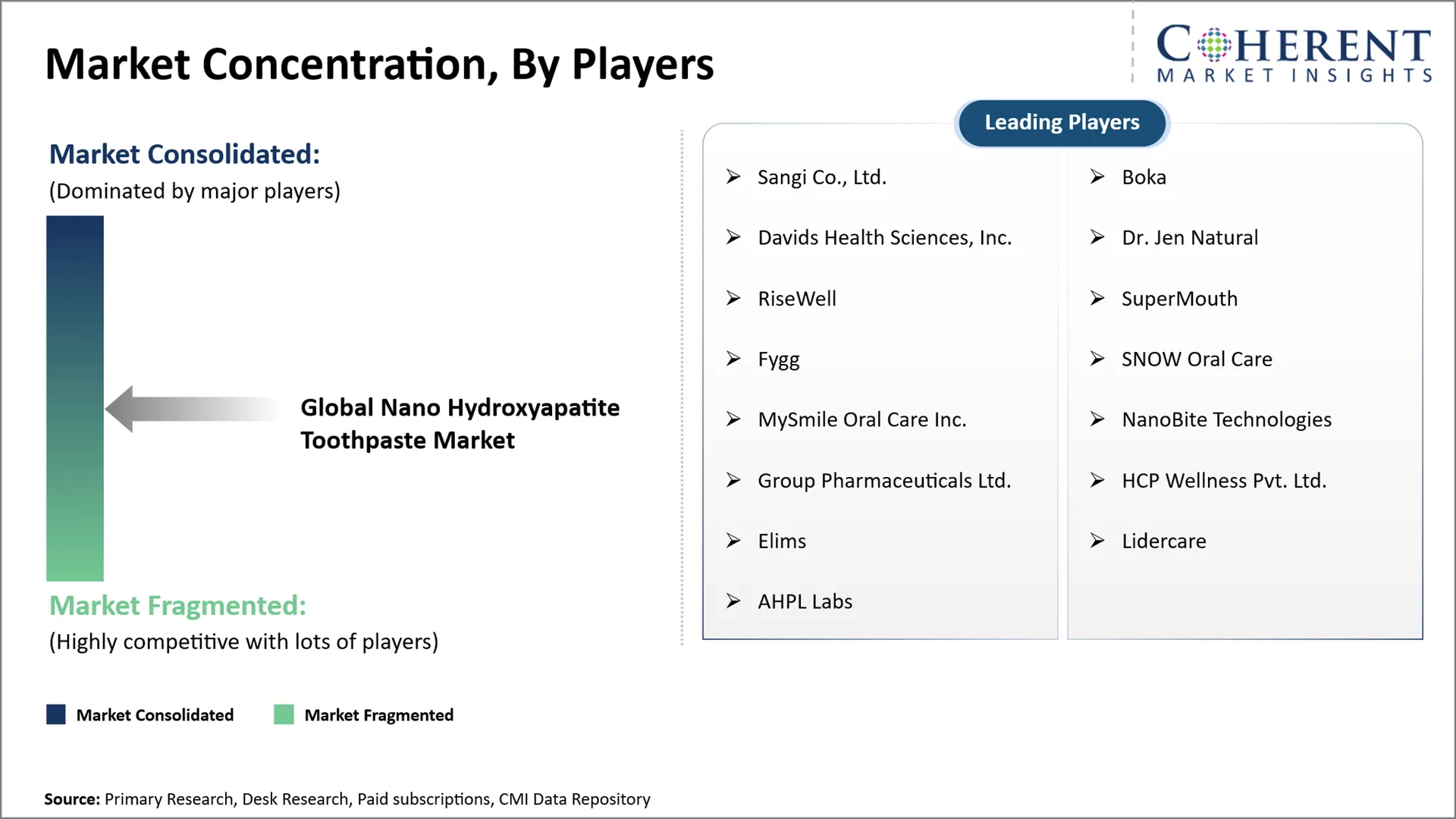
The global nano hydroxyapatite toothpaste market appears to be fragmented with established oral care manufacturers, specialized mineral toothpaste brands, and emerging direct-to-consumer companies. The main battlegrounds are formulation performance, pricing, product differentiation, and consumer trust. Regional specialists contribute through localized products while contract manufacturers enable the development of private labels. Commercially, consistent raw material quality, regulatory compliance and reliable distribution continue to be important requirements.
Key competitive focus areas include
- Mineral Quality Assurance: Maintaining raw material specifications and particle characteristics uniformity.
- Product Performance: Credible proof of enamel care, whitening and sensitivity benefits.
- Formulation Differentiation: Ability to provide compatible ingredient combinations for specific oral care applications.
- Pricing Strategy: Balancing specialized formulations with affordable repeat-purchase pricing.
- Supplier Reliability: Securing stable supply of nano-hydroxyapatite and manufacturing capacity.
- Regulatory Compliance: Monitoring ingredient restrictions, product efficacy claims and labeling.
- Distribution Development: Improving access through pharmacy, dental professionals and organized retail.
- Private-Label Manufacturing: Providing customized formulations for emerging oral care brands.
Market Report Scope
Global Nano Hydroxyapatite Toothpaste Market Report Coverage | |||
Report Coverage | Details | ||
Base Year | 2025 | Market Size in 2026: | USD 498.9 Mn |
Historical Data For: | 2020 to 2024 | Forecast Period: | 2026 to 2033 |
Forecast Period 2026 To 2033 CAGR: | 19.10% | 2033 Value Projection: | USD 1,695.9 Mn |
Geographies covered: |
| ||
Segments covered: |
| ||
Companies covered: | Sangi Co., Ltd., Boka, Davids Health Sciences, Inc., Dr. Jen Natural, RiseWell, SuperMouth, Fygg, SNOW Oral Care, MySmile Oral Care Inc., NanoBite Technologies, Group Pharmaceuticals Ltd., HCP Wellness Pvt. Ltd., Elims, Lidercare, AHPL Labs | ||
Growth Drivers: | Growing demand for fluoride-free enamel protection products | ||
Restraints & Challenges: | Higher formulation costs restrict mass-market toothpaste affordability | ||
Analyst Opinion (Expert Opinion)
- Future Market Direction: The global nano hydroxyapatite toothpaste market is expected to transition from a niche specialty category to a more structured consumer oral care segment. As distribution expands, manufacturers will have to manage retailer expectations regarding sales velocity, availability of inventory and profitability of the product. Brands that can deliver competitive economics across multiple sales channels may ultimately fare better than those that depend primarily on premium positioning and digital marketing.
- Transformative Trend or Disruption: Growing involvement from specialized mineral ingredient suppliers might change the market’s competitive landscape. Suppliers may increasingly provide proprietary formulation systems or license technologies directly to toothpaste manufacturers, reducing the need for brands to develop every formulation from scratch. This shift could change the commercial leverage to companies that have the ingredient processing expertise, manufacturing know-how and formulation intellectual property, while putting pressure on brands with limited technical capabilities.
- Strategic Priorities, Risks, and Recommendations: Manufacturers should prioritize dependable mineral sourcing, controlled formulation development, and disciplined product portfolio expansion. Investment decisions should reflect the intended customer application, regional compliance requirements, and realistic repeat-purchase economics. Companies should also evaluate contract manufacturing partnerships to limit capital exposure during early expansion. Avoiding excessive investment in unsupported performance claims or undifferentiated product variations will be important for maintaining profitability and reducing commercial risk.
Speak to the analyst
Want personalized insights?
Take the findings above to one of our principal consultants, or have the report rebuilt around the segments, geographies and competitors you actually track.
Market Segmentation
- Product Type Insights (Revenue, USD Mn, 2021 - 2033)
- Fluoride-Free Nano Hydroxyapatite Toothpaste
- Nano Hydroxyapatite + Fluoride Toothpaste
- Nano Hydroxyapatite Toothpaste Tablets
- Primary Benefit Insights (Revenue, USD Mn, 2021 - 2033)
- Whitening & Polishing
- Enamel Repair & Remineralization
- Sensitivity Relief
- Target Consumer Insights (Revenue, USD Mn, 2021 - 2033)
- Adults
- Children
- Price Range Insights (Revenue, USD Mn, 2021 - 2033)
- Below USD 15
- USD 15–30
- Above USD 30
- Distribution Channel Insights (Revenue, USD Mn, 2021 - 2033)
- Online Retail & Direct-to-Consumer
- Supermarkets & Hypermarkets
- Pharmacies & Drugstores
- Specialty Oral Care Stores
- Dental Clinics & Professional Channels
- Regional Insights (Revenue, USD Mn, 2021 - 2033)
- North America
- U.S.
- Canada
- Latin America
- Brazil
- Argentina
- Mexico
- Rest of Latin America
- Europe
- Germany
- U.K.
- Spain
- France
- Italy
- Russia
- Rest of Europe
- Asia Pacific
- China
- India
- Japan
- Australia
- South Korea
- ASEAN
- Rest of Asia Pacific
- Middle East
- GCC Countries
- Israel
- Rest of Middle East
- Africa
- South Africa
- North Africa
- Central Africa
- North America
- Key Players Insights
- Sangi Co., Ltd.
- Boka
- Davids Health Sciences, Inc.
- Dr. Jen Natural
- RiseWell
- SuperMouth
- Fygg
- SNOW Oral Care
- MySmile Oral Care Inc.
- NanoBite Technologies
- Group Pharmaceuticals Ltd.
- HCP Wellness Pvt. Ltd.
- Elims
- Lidercare
- AHPL Labs
Sources
Primary Research Interviews
- Nano hydroxyapatite toothpaste manufacturers and contract manufacturers
- Nano-hydroxyapatite ingredient suppliers and formulation specialists
- Oral care brands and product development teams
- Dentists, dental hygienists, and oral health researchers
- Retailers, pharmacy distributors, and e-commerce specialists
Stakeholders
- Oral care and toothpaste manufacturers
- Nano-hydroxyapatite and calcium phosphate suppliers
- Dental care product formulation companies
- Toothpaste tube, tablet, and packaging manufacturers
- Retailers, wholesalers, importers, and private-label companies
End-use Sectors
- Residential Consumers: Daily preventive and cosmetic oral care
- Pediatric Oral Care: Age-appropriate toothpaste applications
- Dental Clinics: Professionally recommended oral care products
- Specialty Oral Care: Enamel maintenance and sensitivity management
Product Applications
- Enamel repair and remineralization
- Teeth whitening and surface stain removal
- Dentinal hypersensitivity management
- Fluoride-free preventive oral care
- Daily plaque management and oral hygiene
Regulatory and Industry Bodies
- U.S. Food and Drug Administration (FDA)
- European Commission
- Scientific Committee on Consumer Safety (SCCS)
- Bureau of Indian Standards (BIS)
- Central Drugs Standard Control Organization (CDSCO)
- International Organization for Standardization (ISO)
- National Medical Products Administration (NMPA), China
Databases
- UN Comtrade and ITC Trade Map – Dentifrices Trade (HS 330610)
- Eurostat – Oral Hygiene Product Trade Statistics
- PubMed and ClinicalTrials.gov – Clinical Research
- Google Trends – Nano Hydroxyapatite Toothpaste Consumer Searches
- Company Annual Reports and Investor Presentations
- Retail Pricing and E-commerce Product Listings
Magazines and Journals
- Journal of Dentistry
- Clinical Oral Investigations
- BMC Oral Health
- Journal of Dental Research
- International Journal of Dental Hygiene
- Cosmetics & Toiletries
Associations
- American Dental Association (ADA)
- FDI World Dental Federation
- International Association for Dental, Oral, and Craniofacial Research (IADR)
- Cosmetics Europe
- Personal Care Products Council (PCPC)
- Indian Dental Association (IDA)
Public Domain Sources
- Nano hydroxyapatite toothpaste product catalogs and specifications
- Enamel remineralization and sensitivity relief studies
- Ingredient safety and particle characterization assessments
- Toothpaste formulation patents and manufacturing disclosures
- Product launches and distribution expansions
- Company financial reports and investor presentations
- Retail pricing, consumer reviews, and trade statistics
Key Standards and Regulations
- EU Cosmetics Regulation (EC) No. 1223/2009 – Cosmetic Product Safety
- EU Regulation 2024/858 – Nano-Hydroxyapatite Restrictions
- U.S. Modernization of Cosmetics Regulation Act (MoCRA), 2022
- U.S. FDA OTC Monograph M021 – Anticaries Drug Products, Where Applicable
- India Cosmetics Rules, 2020
- BIS IS 6356:2021 – Toothpaste Specifications
- ISO 11609:2026 – Dentifrices Requirements and Testing
- ISO 22716:2007 – Cosmetic Good Manufacturing Practices (GMP)
Proprietary Elements
- CMI Data Analytics Tool
- Proprietary research repository, supported by primary interviews, nano-hydroxyapatite formulation benchmarking, product performance evaluation, consumer preference analysis, pricing assessment, distribution mapping, market sizing, regulatory assessment, and competitive intelligence
Get access to 250+ pages report
Every segment, forecast, competitor profile and data table behind the analysis above — available for instant download.
- ESOMAR Member
- ISO 9001:2015 Certified
- D-U-N-S Registered
- GDPR & CCPA Compliant
Frequently Asked Questions
The CAGR of the global nano hydroxyapatite toothpaste market is projected to be 19.10% from 2026 to 2033.
The global nano hydroxyapatite toothpaste market is estimated to be valued at USD 498.9 Mn in 2026 and is expected to reach USD 1,695.9 Mn by 2033.
Nano hydroxyapatite toothpaste supports enamel remineralization, tooth sensitivity relief, surface stain removal, and preventive oral care.
Nano hydroxyapatite toothpaste supports mineral deposition on tooth surfaces, while conventional fluoride toothpaste strengthens enamel through fluoride-assisted remineralization.
Ingredient concentration, raw material purity, formulation composition, clinical testing, packaging, and brand positioning influence product pricing.
Manufacturers focus on product portfolio diversification, clinical validation, private-label manufacturing, strategic partnerships, and differentiated brand positioning.
Growing demand for fluoride-free enamel protection products and Increasing consumer awareness of tooth sensitivity management are the major factor driving the growth of global nano hydroxyapatite toothpaste market.