

Global Natural Gas Fueling Station Market Size and Forecast – 2026 To 2033
The Global Natural Gas Fueling Station Market is estimated to be valued at USD 2,804.4 Mn in 2026 and is expected to reach USD 4,713.6 Mn by 2033, exhibiting a compound annual growth rate (CAGR) of 7.7% from 2026 to 2033.
Market expansion is supported by investments in CNG, LNG, and biomethane refueling infrastructure, fleet-transition programs, and regulations encouraging lower-emission transportation fuels. In 2025, Snam reported that its CNG, LNG, and biomethane network had reached 96 operating refueling stations, 12 more than in 2023, with plans to expand to as many as 137 stations by 2027, demonstrating continued commercial investment in natural gas mobility infrastructure.
Key Takeaways of the Global Natural Gas Fueling Station Market
- Compressed natural gas is expected to hold 76.4 % of the global natural gas fueling station market in 2026 because its ambient-temperature storage, established vehicle base, and suitability for urban fleets reduce deployment and operating complexity versus LNG. In February 2025, TotalEnergies signed a 10-year LNG supply agreement with GSPC that will also feed CNG vehicle service stations in India.
- Fast fill stations are expected to capture 52.8 % of the global natural gas fueling station market in 2026 because commercial operators prioritize diesel-like refueling times, high vehicle throughput, and predictable turnaround at freight corridors and logistics hubs. In June 2024, Clean Energy Fuels opened Southern California stations in San Bernardino and Perris with dedicated fast-fill lanes serving heavy-duty trucks and fleet vehicles.
- Public stations are expected to represent 58.6 % of the market share in 2026, supported by multi-user utilization, broader geographic coverage, and the ability to aggregate demand from logistics fleets, buses, delivery vehicles, and private motorists. In June 2025, Gasum opened its Førde, Norway, biogas station to both logistics operators and the public, offering compressed and liquefied fueling.
- Asia Pacific is expected to account for 43.8 % of the global natural gas fueling station market in 2026 because large natural-gas vehicle populations, dense city-gas networks, and policy-backed station construction create strong utilization economics. In January 2026, India’s Ministry of Petroleum and Natural Gas reported that the country’s CNG station network had expanded to more than 8,477 outlets.
- Europe is expected to hold 22.6 % of the market share in 2026 while emerging as the fastest-growing region, supported by freight decarbonization, biomethane availability, cross-border corridor planning, and infrastructure interoperability. In April 2024, the EU Alternative Fuels Infrastructure Regulation became applicable, requiring minimum coverage of publicly accessible liquefied-methane refueling points for heavy-duty vehicles across TEN-T networks.
- Renewable Gas Integration into Fueling Infrastructure: Station operators are increasingly designing assets to dispense biomethane and renewable natural gas through infrastructure originally developed for fossil CNG or LNG. This compatibility protects installed capital, supports fleet decarbonization commitments, and creates differentiated fuel portfolios. Competitive advantage will shift toward operators that secure traceable feedstock, manage fuel certification, and offer customers credible lifecycle-emissions documentation alongside reliable availability.
- Fleet-Anchored Network Models for Station Development: New station investment is moving toward anchor-fleet agreements that secure baseline throughput before construction. This approach improves financing confidence, guides site selection, and reduces early-stage utilization risk. Operators can combine public access with contracted fleet volumes, while equipment suppliers benefit from modular compressor, storage, and dispenser configurations. The model may favor integrated developers capable of bundling fuel supply, maintenance, data monitoring, and long-term service commitments.
Segmental Insights
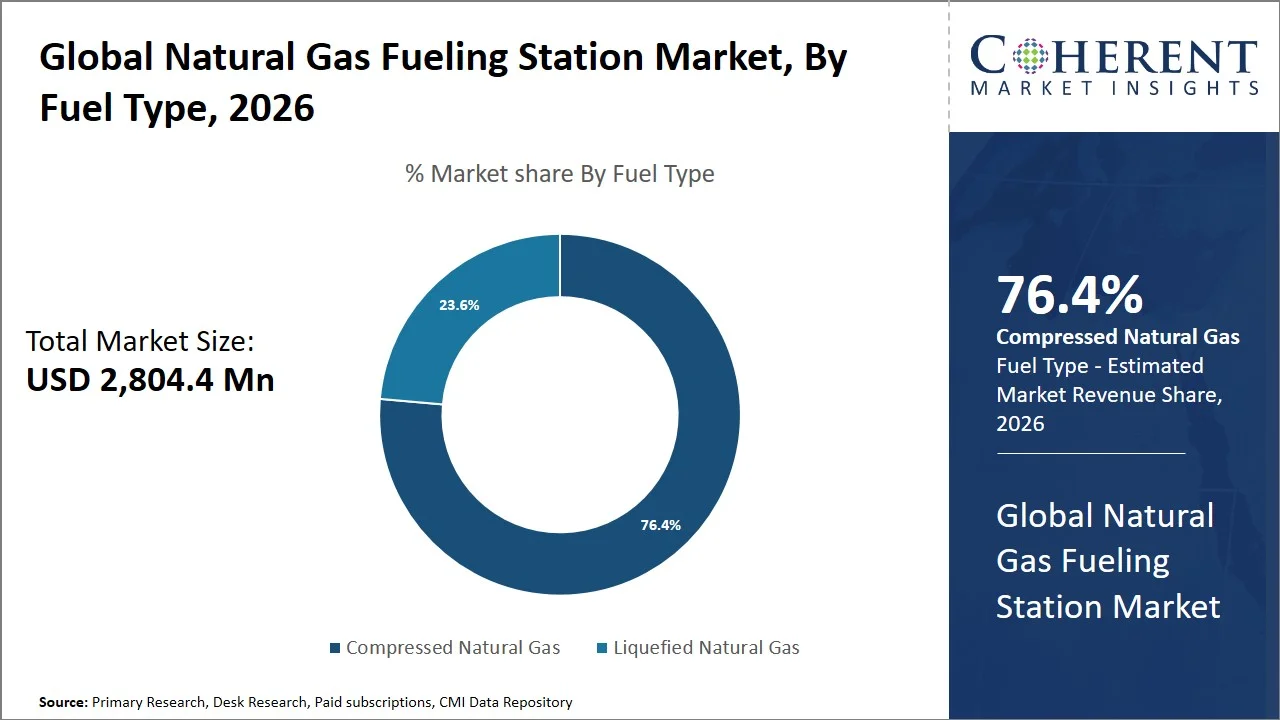
Why Does Compressed Natural Gas Dominate the Global Natural Gas Fueling Station Market?
Compressed natural gas is expected to account for 76.4% of the global natural gas fueling station market in 2026 because it can be supplied through established gas-distribution networks and dispensed without cryogenic storage. CNG stations serve the broadest vehicle base, including city buses, taxis, refuse trucks, delivery vans, municipal fleets, and light commercial vehicles. Standardized compressors, dryers, cascade storage, and dispensers are available from multiple regional suppliers, supporting competitive installation and maintenance economics. Fleet operators also value predictable refueling procedures and the ability to use either depot or public infrastructure. This scale benefits compressor manufacturers, engineering contractors, city-gas distributors, and station operators through recurring equipment and service demand. In April 2026, New Flyer announced an order from San Diego Metropolitan Transit System for 73 additional CNG transit buses, reinforcing sustained infrastructure utilization by high-mileage public fleets.
- Current Industry Events of 2026
- Market Size Estimation
- Regional Breakdown
- Competitive Landscape
- Customer Intelligence
- Segmental Analysis
- Pricing Analysis
- Key Market Drivers, Challenges & Future Trends
- Customized Insights Section
Why Do Fast Fill Stations Represent the Largest Station Type Segment in the Global Natural Gas Fueling Station Market?
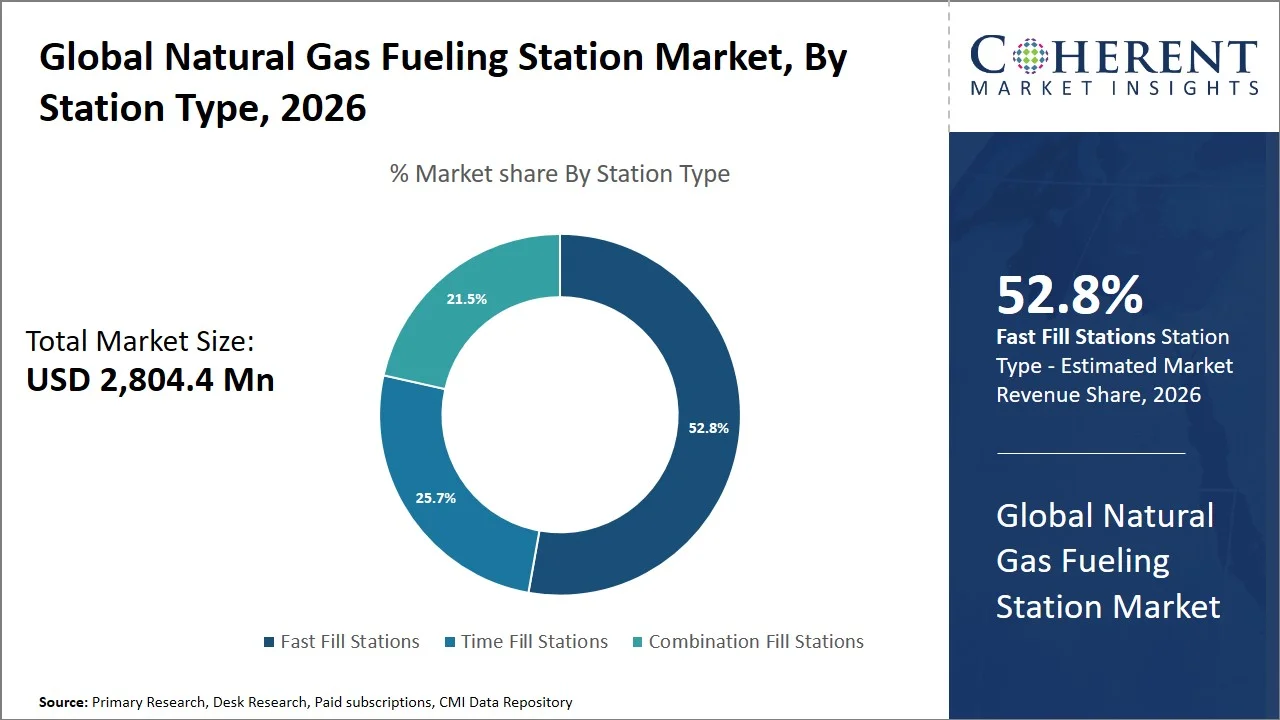
Fast fill stations are expected to represent 52.8% of the global natural gas fueling station market in 2026 because they provide a refueling experience suited to vehicles that cannot remain parked for extended periods. High-pressure cascade storage and priority-control systems deliver gas rapidly after compression, enabling taxis, buses, long-haul trucks, and mixed commercial fleets to return to service with limited dwell time. The format is particularly valuable at public forecourts, motorway corridors, and high-throughput depots where vehicle queues directly affect customer productivity. Although fast-fill systems require greater compression and storage investment than time-fill configurations, higher daily throughput can improve equipment utilization and fuel-sales potential. Dispenser, compressor, control-system, and maintenance providers consequently gain access to larger-value projects. In June 2024, Gas Networks Ireland and Flogas opened a self-service BioCNG station in Dublin supported by Ireland’s network of high-capacity fast-fill CNG facilities and designed to refuel up to 50 heavy trucks daily.
Why Do Public Stations Dominate the Station Access Category of the Global Natural Gas Fueling Station Market?
Public stations are expected to hold 58.6% of the global natural gas fueling station market in 2026 because they aggregate demand from multiple fleets and individual vehicle operators rather than relying on one captive customer. Open access improves route flexibility, supports intercity travel, and lowers the infrastructure barrier for small transport companies unable to finance private stations. Locations near freight corridors, bus terminals, logistics parks, and urban mobility hubs can serve diverse vehicle classes while accepting fleet cards and retail payments. The model also allows station owners to spread compressor, storage, safety, and staffing costs across a wider customer base. Fuel retailers and gas distributors can strengthen utilization by securing anchor fleets without excluding third-party users. In July 2024, NNPC Limited commissioned 12 CNG stations simultaneously in Abuja and Lagos and announced plans for more than 100 CNG sites, expanding access to automotive natural gas in Nigeria.
Current Events and their Impact
Current Event | Description and Its Impact |
April 2024 – EU Alternative Fuels Infrastructure Regulation becomes applicable |
|
July 2025 – U.S. advances the termination of the Section 30C refueling-property credit |
|
March–April 2026 – India accelerates CNG and CBG station licensing |
|
Global Natural Gas Fueling Station Market Dynamics
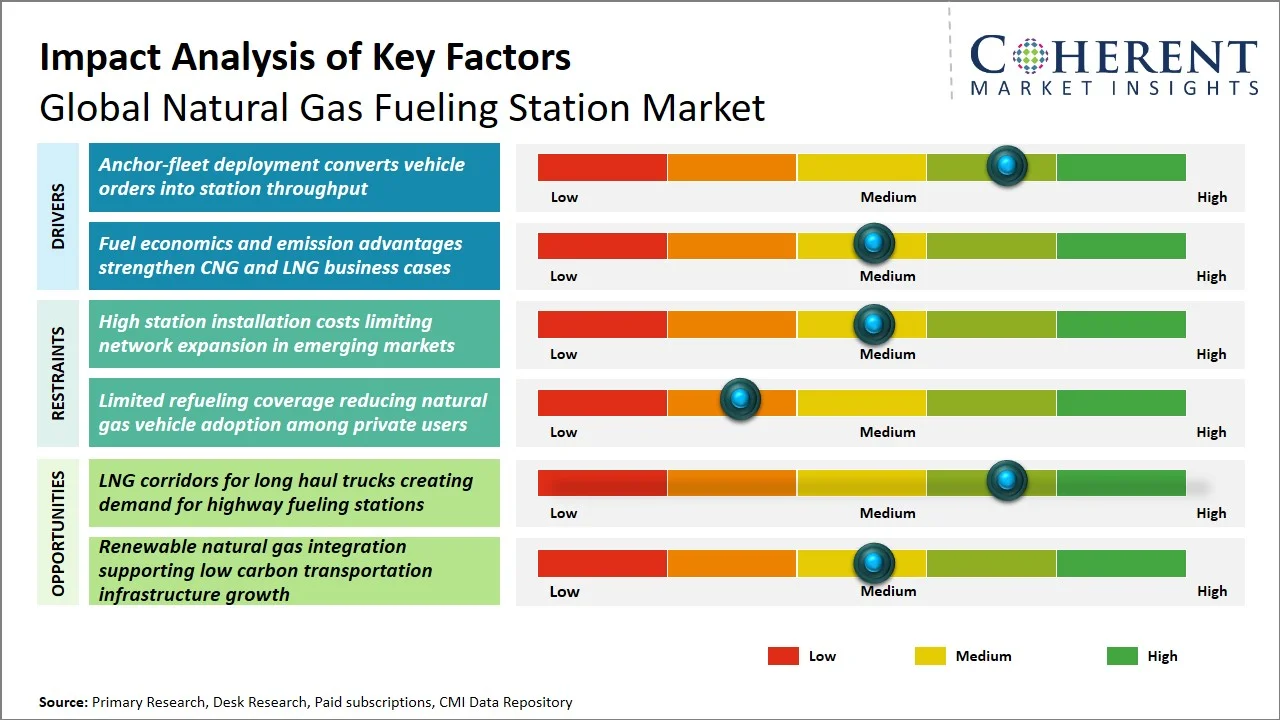
Key Market Drivers
- Anchor-fleet deployment converts vehicle orders into station throughput: Commercial fleets create dependable base-load demand that can justify station investment more effectively than dispersed private motorists. Transit agencies, refuse operators, food distributors, parcel carriers, and long-haul fleets consume fuel repeatedly on predictable routes, allowing developers to size compressors, storage, dispensers, and maintenance coverage against contracted throughput. This improves asset utilization, shortens the payback period, and supports public-access stations near depots and freight corridors. Equipment suppliers, station operators, gas distributors, fleet-leasing companies, and service contractors benefit as vehicle orders translate into recurring fuel and uptime requirements. In July 2025, Hexagon Agility received an order for natural-gas fuel systems for 60 Cummins X15N-powered trucks after a six-month pilot by a leading U.S. consumer-goods manufacturer, with the fleet expected to cover more than eight million miles annually.
- Fuel economics and emission advantages strengthen CNG and LNG business cases: Fuel-price visibility and lower local-pollutant emissions make CNG and LNG commercially relevant where diesel exposure is high and vehicle duty cycles are difficult to electrify. Station developers can secure demand by combining long-term gas procurement, fleet contracts, and high-throughput dispensing, while operators gain an alternative that can reduce energy expenditure without materially changing route productivity. The mechanism is strongest for taxis, buses, refuse vehicles, regional haulage, and heavy trucks that return to base or operate on defined corridors. Gas marketers, city-gas distributors, equipment manufacturers, and fleet owners benefit when supply agreements reduce price volatility and improve station economics. In February 2025, TotalEnergies signed a ten-year agreement to supply GSPC with LNG from 2026, with part of the gas designated for Indian CNG vehicle service stations, strengthening fuel availability for transport networks.
Emerging Market Trends
- Modular Multi-Energy Forecourts are Replacing Fixed Single-Fuel Designs: Natural gas stations are increasingly adopting modular layouts that allow CNG, LNG, biomethane, electricity, or hydrogen capacity to be added as fleet demand develops. This approach lowers upfront investment risk and enables operators to reuse land, utilities, access routes, and customer facilities. Procurement decisions will increasingly consider expansion flexibility, permitting adaptability, system interoperability, and lifetime conversion costs alongside initial equipment prices.
- Uptime Data is Becoming Part of the Fueling Contract: Fleet customers increasingly expect remote diagnostics, real-time visibility, rapid fault resolution, and assured dispensing capacity before committing vehicles to a station. This is strengthening the demand for telemetry-enabled equipment, automated alerts, centralized monitoring, and performance-based maintenance contracts. Vendor selection will increasingly depend on guaranteed uptime, cybersecurity, spare-parts availability, response times, and the ability to manage multiple stations as an integrated network.
Regional Insights
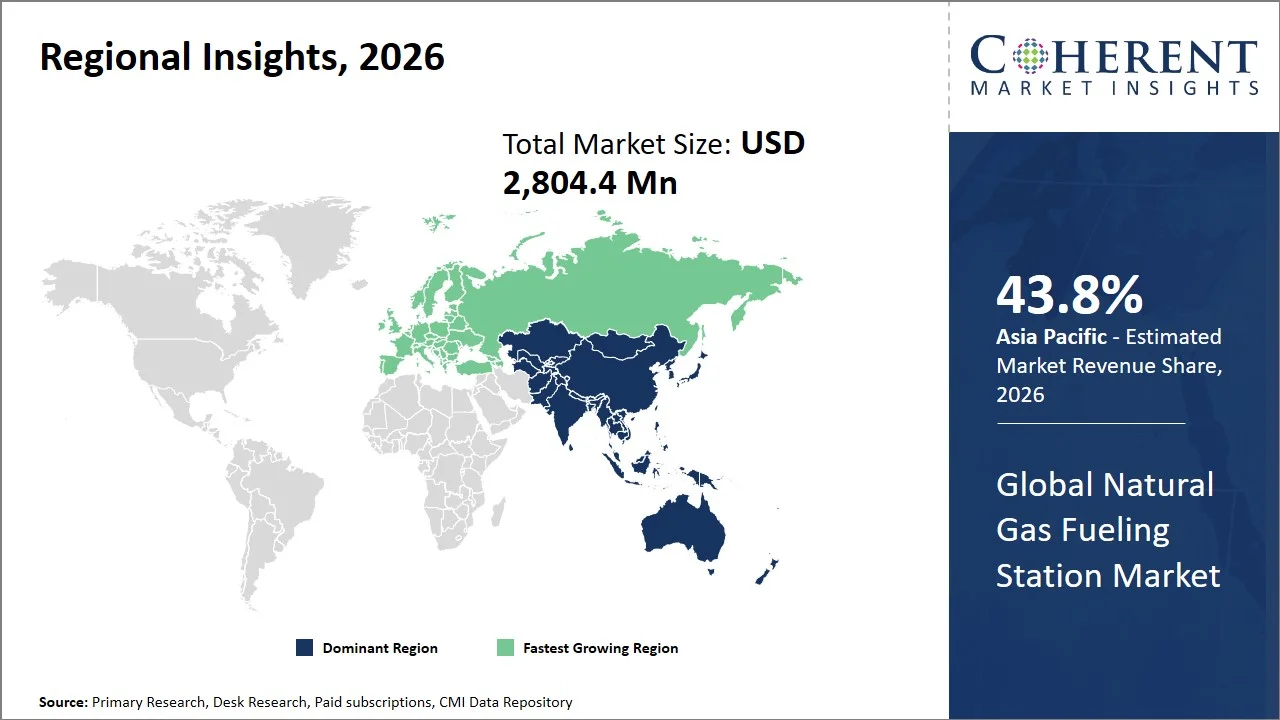
Why Does Asia Pacific Dominate the Global Natural Gas Fueling Station Market?
Asia Pacific is expected to command 43.8% of the global natural gas fueling station market in 2026 because China and India combine large commercial-vehicle fleets with expanding gas-distribution systems, while Japan contributes established station engineering and safety expertise. High-utilization buses, taxis, refuse vehicles, and freight trucks give CNG and LNG sites dependable daily throughput. Regional suppliers also manufacture compressors, cryogenic vessels, dispensers, and storage systems locally, reducing equipment lead times and supporting both public and depot-based stations. Integrated oil and gas companies can coordinate LNG terminals, pipelines, road-tanker supply, and forecourt operations, improving coverage beyond major cities. In March 2026, Sinopec reported that it operated 1,150 vehicle LNG stations in China, forming the country’s largest road-transport LNG refueling network and strengthening Asia Pacific’s station base.
Why is Europe Emerging as the Fastest-Growing Region in the Global Natural Gas Fueling Station Market?
Europe is expected to hold 22.6% of the global natural gas fueling station market in 2026 and expand faster as operators reposition existing CNG and LNG assets around biomethane, renewable LNG, and cross-border freight. The region already has established gas-vehicle corridors, making fuel substitution, station modernization, and network interoperability commercially easier than building an entirely new fueling system. Logistics companies can use renewable methane without materially changing refueling time or long-haul operating patterns, while station owners gain opportunities in certified low-carbon fuel, digital payments, and fleet contracts. In April 2024, the EU Alternative Fuels Infrastructure Regulation became applicable, retaining requirements for an appropriate number of publicly accessible liquefied-methane refueling points along the TEN-T core network where demand and proportionality conditions are satisfied.
Global Natural Gas Fueling Station Market Outlook for Key Countries
Why is the U.S. a Key Market for the Global Natural Gas Fueling Station Market?
The U.S. remains a key country in the global natural gas fueling station market because refuse collection, public transit, food distribution, parcel delivery, and regional trucking create concentrated fleet demand. These operators can use private time-fill stations for overnight refueling or public fast-fill locations along freight routes, allowing infrastructure design to match vehicle duty cycles. Extensive gas-distribution networks and renewable natural gas production from landfills, wastewater facilities, and agricultural sources further support fuel availability. New heavy-duty natural gas engines are also widening the addressable customer base beyond traditional municipal fleets. In May 2026, SoCalGas opened a USD 2.5 million fuel-card incentive round supporting 50 new Class 8 natural gas trucks, with cards usable at its public stations dispensing renewable natural gas.
Why is India Important in the Global Natural Gas Fueling Station Market?
India is important in the global natural gas fueling station market because city-gas distribution is extending transport-gas access beyond major metropolitan areas into new geographical areas. CNG remains commercially relevant for taxis, auto-rickshaws, buses, light commercial vehicles, and return-to-base fleets that refuel frequently and are sensitive to fuel cost. Authorized city-gas distributors can combine pipeline-connected mother stations with mobile cascades and daughter stations, enabling phased infrastructure deployment where demand is still developing. Domestic compressor, dispenser, cylinder, and engineering suppliers also improve project economics and service availability. In December 2025, India’s Ministry of Petroleum and Natural Gas reported that city-gas distribution covered 307 geographical areas and that the national CNG station network had increased to more than 8,400 locations by September 2025.
Why Does China Support Growth in the Global Natural Gas Fueling Station Market?
China supports growth in the global natural gas fueling station market through its large heavy-truck fleet, domestic station-equipment manufacturing base, and extensive LNG supply chain. LNG stations are particularly relevant on high-mileage freight routes where vehicle range, rapid refueling, and fuel-cost control influence fleet purchasing. National oil companies can connect coastal receiving terminals and inland liquefaction plants with highway stations, logistics parks, and industrial clusters, while Chinese manufacturers supply cryogenic tanks, pumps, vaporizers, valves, and dispensers at scale. Standardization is becoming increasingly important as network density and equipment diversity increase. In March 2026, China’s national standards authority-initiated project 20261721-T-469 to develop a dedicated standard for vehicle LNG fueling stations, covering a twelve-month drafting cycle and reinforcing technical consistency for future infrastructure.
Why is Germany a Strategic Country in the Global Natural Gas Fueling Station Market?
Germany is a strategic country in the global natural gas fueling station market because its central European location, intensive road-freight activity, and established gaseous-fuel network support both domestic and cross-border truck operations. The market is increasingly oriented toward bio-CNG and bio-LNG rather than fossil natural gas, allowing existing dispensers and storage assets to serve logistics decarbonization strategies. Germany also offers strong engineering, certification, maintenance, and gas-quality capabilities, which support reliable high-throughput stations for commercial fleets. However, operators must manage policy uncertainty and competition from electric and hydrogen infrastructure. In August 2025, the German Energy Agency reported that bio-LNG represented 98% of LNG sales at German stations during the first half of the year, with more than 190 gas stations available to the market.
Why is Japan an Important Growth Market for the Global Natural Gas Fueling Station Market?
Japan is an important growth market within the global natural gas fueling station market because its dense urban gas infrastructure and rigorous equipment standards support reliable CNG operations for municipal, logistics, and captive fleets. Demand is concentrated around metropolitan areas, truck terminals, public-service vehicles, and businesses that can refuel at fixed depots. The country’s strength lies less in rapid greenfield expansion and more in high-quality compressors, pressure-control systems, compact filling equipment, and safe station operation. Small booster units also provide a practical option for operators running limited vehicle numbers away from public stations. In March 2025, the Japan Gas Association recorded 130 fast-fill installations and 166 small boosting units nationwide, alongside a cumulative natural-gas vehicle fleet of 49,386 units at the end of 2024.
Technology Adoption Landscape in the Global Natural Gas Fueling Station Market
Technology | Adoption Level | Key Application Area | Business Impact |
Fast-fill CNG cascade systems | High | Public stations, taxis, buses, refuse vehicles, and commercial fleets | Delivers short refueling times and high vehicle turnover but requires appropriately sized compression and storage capacity. |
Time-fill sequential CNG systems | High | Depot-based fleets parked for extended periods | Lowers peak compressor requirements and operating costs while supporting overnight fleet availability. |
Cryogenic LNG storage and pump dispensing | Medium | Long-haul trucks and high-mileage heavy commercial vehicles | Provides extended driving range and rapid dispensing but requires specialized cryogenic equipment, training, and maintenance. |
LCNG vaporization and compression systems | Medium | Mixed CNG-LNG stations and locations without pipeline access | Allows LNG to supply both liquid-fuel vehicles and compressed-gas dispensers, improving site flexibility and asset utilization. |
Remote station telemetry and compressor diagnostics | Medium | Multi-site monitoring, preventive maintenance, and fuel-inventory control | Improves uptime, reduces technician visits, supports service-level agreements, and enables centralized network management. |
Methane detection and automatic emergency-shutdown systems | High | Compressor enclosures, storage areas, dispensers, and LNG handling zones | Strengthens operational safety, supports regulatory compliance, and limits equipment and liability exposure during leaks or pressure abnormalities. |
How are Modular LCNG and Mobile-Cascade Systems Creating New Growth Opportunities in the Global Natural Gas Fueling Station Market?
Pipeline-limited freight zones, industrial estates, ports, mining clusters, and secondary cities remain commercially underserved because conventional mother-station development requires land, permits, utility access, and demand certainty. Modular LCNG units and mobile-cascade daughter stations can bridge this gap by transporting LNG or compressed gas to smaller dispensing sites and scaling capacity as vehicle utilization develops. The opportunity is strategically important for regional truck fleets, municipal vehicles, buses, taxis, and captive industrial transport that cannot wait for full pipeline connectivity. Suppliers can capture it through standardized skids, leasing, build-own-operate contracts, bundled gas supply, and maintenance guarantees rather than equipment-only sales. Successful participation requires cryogenic handling expertise, route-based demand modelling, mobile storage logistics, metering compliance, emergency-response capability, and agreements with anchor fleets. The model should favor specialist integrators and vertically coordinated gas distributors that can control both fuel availability and station uptime, although established equipment manufacturers can compete through modular product platforms and local service partners.
Market Players, Key Development, and Competitive Landscape
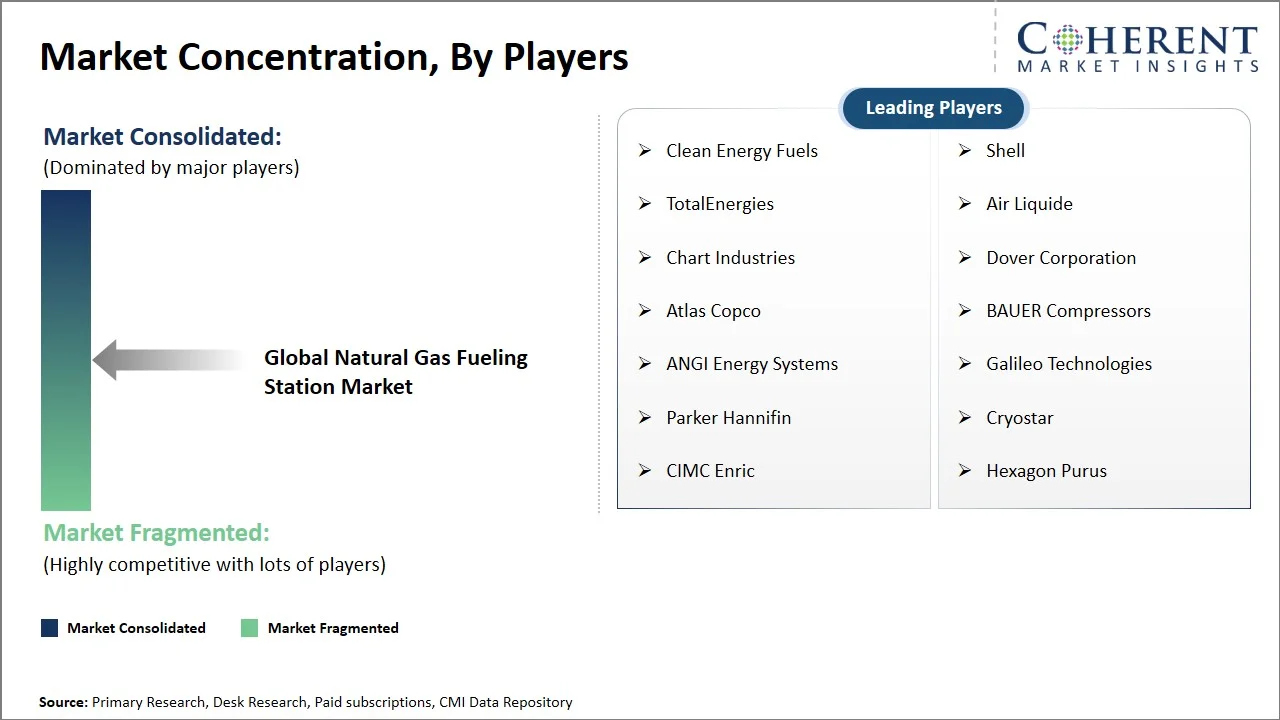
Key Developments
- In May 2026, Clean Energy Fuels expanded its renewable natural gas station network with six operational stations located across California, New Jersey, Oklahoma, Michigan, and Washington. This is important for the global natural gas fueling station market because the additions improve heavy-truck access along major freight routes and demonstrate corridor-based station deployment supported by fleet fuel-cost and emissions objectives.
- In February 2026, Gasum opened a liquefied-biogas filling station for heavy-duty vehicles in Ylivieska, Finland. This is important for the global natural gas fueling station market because the location connects freight activity and logistics terminals with renewable-gas supply, showing how station siting around identified transport customers can improve utilization and extend low-emission freight corridors beyond major metropolitan areas.
- In May 2025, ReFuels opened a Bio-CNG refueling station in Livingston, Scotland, between Edinburgh and Glasgow. This is important for the global natural gas fueling station market because the development expands public access for heavy goods vehicles on a strategically important logistics route and supports the commercial model of locating high-capacity biomethane stations where multiple fleet operators can aggregate demand.
Competitive Landscape
The global natural gas fueling station market is moderately fragmented, combining international station-equipment manufacturers, compressor specialists, cryogenic-system suppliers, gas utilities, fuel retailers, engineering contractors, and regional city-gas distributors. Competition is shaped less by dispenser price alone and more by station throughput, compressor uptime, fuel-supply continuity, safety compliance, permitting capability, and lifecycle maintenance. Regional participants retain an advantage where gas allocation, land access, local approvals, and fleet relationships determine project viability, while global suppliers compete through standardized technology, engineering scale, and service networks.
Key focus areas include
- Station throughput and availability: Buyers favor systems capable of maintaining target pressure and serving vehicles without extended queues.
- Total ownership cost: Energy consumption, overhaul frequency, spare parts, and maintenance labor influence procurement alongside capital expenditure.
- Safety and regulatory compliance: Pressure-vessel certification, gas detection, emergency shutdowns, and metering accuracy remain essential bid requirements.
- Modular customization: Configurable storage, compression, and dispensing systems allow capacity to follow actual fleet adoption.
- Fuel-supply integration: Operators able to coordinate pipeline gas, mobile cascades, LNG logistics, and biomethane procurement can protect station utilization.
- Distribution and network reach: Corridor coverage and cross-network payment access increase the commercial usefulness of public stations.
- Local technical support: Fast access to trained technicians, replacement components, and preventive maintenance creates defensible customer relationships.
Market Report Scope
Natural Gas Fueling Station Market Report Coverage
| Report Coverage | Details | ||
|---|---|---|---|
| Base Year: | 2025 | Market Size in 2026: | USD 2,804.4 Mn |
| Historical Data for: | 2020 To 2024 | Forecast Period: | 2026 To 2033 |
| Forecast Period 2026 to 2033 CAGR: | 7.7% | 2033 Value Projection: | USD 4,713.6 Mn |
| Geographies covered: |
| ||
| Segments covered: |
| ||
| Companies covered: | Clean Energy Fuels, Shell, TotalEnergies, Air Liquide, Chart Industries, Dover Corporation, Atlas Copco, BAUER Compressors, ANGI Energy Systems, Galileo Technologies, Parker Hannifin, Cryostar, CIMC Enric, and Hexagon Purus | ||
| Growth Drivers: |
| ||
| Restraints & Challenges: |
| ||
Analyst Opinion (Expert Opinion)
- The global natural gas fueling station market leadership is likely to shift from companies selling standalone compressors and dispensers toward providers offering complete fueling availability. Fleet buyers will increasingly expect station design, fuel procurement, remote monitoring, maintenance, and performance guarantees under one commercial arrangement. This transition will favor suppliers capable of assuming operational risk and earning recurring revenue rather than relying primarily on one-time equipment sales.
- Verified low-carbon fuel attributes could separate the commercial value of the physical gas from its environmental credentials. As customers seek auditable supply-chain emissions data, station operators may need systems that track fuel origin, renewable content, custody transfer, and environmental claims. Commodity-only operators could face margin pressure, while participants combining fuel infrastructure with credible certification and customer reporting may gain pricing power.
- Market participants should prioritize modular station platforms, trained service teams, gas-quality controls, and contracts with fleets that provide predictable minimum throughput. Partnerships with gas distributors, logistics-property owners, and vehicle suppliers can reduce demand and site-development risk. Companies should avoid oversized installations based solely on optimistic vehicle forecasts, particularly where gas supply, permitting, or competing powertrain infrastructure remains uncertain.
Speak to the analyst
Want personalized insights?
Take the findings above to one of our principal consultants, or have the report rebuilt around the segments, geographies and competitors you actually track.
Market Segmentation
- Fuel Type Insights (Revenue, USD Mn, 2021 - 2033)
- Compressed Natural Gas
- Liquefied Natural Gas
- Station Type Insights (Revenue, USD Mn, 2021 - 2033)
- Fast Fill Stations
- Time Fill Stations
- Combination Fill Stations
- Station Access Insights (Revenue, USD Mn, 2021 - 2033)
- Public Stations
- Private and Fleet Stations
- Vehicle Application Insights (Revenue, USD Mn, 2021 - 2033)
- Heavy Duty Commercial Vehicles
- Light Commercial Vehicles
- Passenger Vehicles
- Buses and Coaches
- Others
- Regional Insights (Revenue, USD Mn, 2021 - 2033)
- North America
- U.S.
- Canada
- Latin America
- Brazil
- Argentina
- Mexico
- Rest of Latin America
- Europe
- Germany
- U.K.
- Spain
- France
- Italy
- Russia
- Rest of Europe
- Asia Pacific
- China
- India
- Japan
- Australia
- South Korea
- ASEAN
- Rest of Asia Pacific
- Middle East
- GCC Countries
- Israel
- Rest of Middle East
- Africa
- South Africa
- North Africa
- Central Africa
- North America
- Key Players Insights
- Clean Energy Fuels
- Shell
- TotalEnergies
- Air Liquide
- Chart Industries
- Dover Corporation
- Atlas Copco
- BAUER Compressors
- ANGI Energy Systems
- Galileo Technologies
- Parker Hannifin
- Cryostar
- CIMC Enric
- Hexagon Purus
Sources
Primary Research Interviews
- Natural gas fueling station operators, CNG and LNG equipment manufacturers, compressor suppliers, cryogenic-system providers, gas utilities, engineering contractors, fuel retailers, and fleet operators
- Operations, engineering, procurement, maintenance, business development, regulatory, safety, sustainability, marketing, and sales executives
Stakeholders
- Natural gas producers, city-gas distribution companies, LNG suppliers, biomethane producers, pipeline operators, station developers, and fuel distributors
- Compressor, storage cylinder, dispenser, cryogenic tank, vaporizer, pump, valve, payment-system, telemetry, and safety-equipment suppliers
- Commercial fleet owners, logistics companies, bus operators, municipal transport authorities, waste-management fleets, taxi operators, and passenger-vehicle users
- EPC contractors, technology integrators, maintenance providers, investors, insurers, certification agencies, and landowners
End-use Sectors
- Heavy-duty trucks, light commercial vehicles, passenger vehicles, buses, coaches, refuse-collection vehicles, municipal fleets, taxis, and off-road vehicles
- Freight transportation, public transit, urban delivery, waste management, construction, mining, ports, airports, and industrial logistics
- Public-access fueling networks, private fleet depots, highway corridors, logistics hubs, industrial facilities, and multi-energy retail forecourts
Regulatory & Government Bodies
- U.S. Department of Energy, Alternative Fuels Data Center, U.S. Environmental Protection Agency, Department of Transportation, PHMSA, and Federal Motor Carrier Safety Administration
- European Commission, Directorate-General for Mobility and Transport, European Alternative Fuels Observatory, European Union Agency for the Cooperation of Energy Regulators, and national transport ministries
- India Ministry of Petroleum and Natural Gas, Petroleum and Natural Gas Regulatory Board, Petroleum and Explosives Safety Organisation, and Ministry of Road Transport and Highways
- China National Development and Reform Commission, Ministry of Transport, Ministry of Industry and Information Technology, and national market-regulation authorities
- Natural Resources Canada, Transport Canada, Australian Department of Climate Change, Energy, the Environment and Water, Japan METI, and national energy and transport agencies
Databases
- International Energy Agency, U.S. Alternative Fuels Data Center, U.S. Energy Information Administration, European Alternative Fuels Observatory, Eurostat, and ACEA
- UN Comtrade, ITC Trade Map, WTO Statistics, World Bank, OECD, OICA, and national customs databases
- India PPAC, PNGRB, Vahan Dashboard, China Customs, Statistics Canada, Japan e-Stat, and Australian Bureau of Statistics
- Company filings, annual reports, station-location databases, fleet-registration records, equipment-pricing databases, tender documents, fuel-price records, and infrastructure investment databases
Magazines and Journals
- NGV Journal, LNG Industry, Gasworld, Natural Gas World, Fleet Equipment, Commercial Carrier Journal, and Sustainable Bus
- Journal of Natural Gas Science and Engineering, Applied Energy, Energy Policy, Transportation Research, Fuel, and International Journal of Sustainable Transportation
- Industry publications covering CNG, LNG, renewable natural gas, biomethane, commercial vehicles, fleet management, and alternative-fuel infrastructure
Associations
- NGV Global
- NGVA Europe
- International Gas Union
- Coalition for Renewable Natural Gas
- American Gas Association
- Gas Infrastructure Europe
- Society of Automotive Engineers
- International Association for Natural Gas Vehicles
- National truck, bus, fleet, gas-distribution, and transport associations
Public Domain Sources
- Alternative-fuel infrastructure, transport-emission, vehicle-registration, fuel-pricing, pipeline, gas-distribution, and energy-transition authorities
- Company annual reports, investor presentations, sustainability reports, station maps, product catalogues, technical specifications, safety manuals, and press releases
- Government tenders, environmental permits, construction approvals, fleet-conversion programs, public-transit procurement records, and infrastructure funding announcements
- Fuel retailer websites, fleet operator disclosures, equipment certification records, station directories, and public charging and fueling databases
Key Standards and Regulations
- NFPA 52 Vehicular Natural Gas Fuel Systems Code and applicable U.S. fire, pressure-vessel, pipeline, environmental, and workplace-safety requirements
- ISO 16923 for CNG vehicle fueling stations, ISO 16924 for LNG vehicle fueling stations, and ISO 14469 for CNG vehicle refueling connectors
- UNECE Regulation No. 110 covering components and vehicles using compressed or liquefied natural gas
- EU Alternative Fuels Infrastructure Regulation, TEN-T requirements, renewable-energy rules, fuel-quality provisions, and national permitting regulations
- ADR requirements for the transport of dangerous goods and applicable European pressure-equipment and explosive-atmosphere directives
- India Gas Cylinders Rules, Static and Mobile Pressure Vessels Rules, PNGRB technical standards, PESO approvals, and state-level fire and environmental clearances
- Applicable Chinese, Japanese, Canadian, Australian, Brazilian, and Middle Eastern technical, construction, metering, fuel-quality, and station-safety standards
Proprietary Elements
- CMI Data Analytics Tool, Proprietary CMI Existing Repository of information for last 10 years.
Get access to 250+ pages report
Every segment, forecast, competitor profile and data table behind the analysis above — available for instant download.
- ESOMAR Member
- ISO 9001:2015 Certified
- D-U-N-S Registered
- GDPR & CCPA Compliant
Missing comfort of reading report in your local language? Find your preferred language:
Transform your Strategy with Exclusive Trending Reports
Frequently Asked Questions
The CAGR of the global natural gas fueling station market is projected to be 7.7% from 2026 to 2033.
The global natural gas fueling station market is estimated to be valued at USD 2,804.4 million in 2026 and is expected to reach USD 4,713.6 million by 2033.
Expansion of natural gas commercial vehicle fleets increasing fueling infrastructure demand and lower fuel costs and emission advantages supporting CNG and LNG station deployment are the major factors driving the growth of the global natural gas fueling station market.
High station installation costs limiting network expansion in emerging markets and limited refueling coverage reducing natural gas vehicle adoption among private users are the major factors hampering the growth of the global natural gas fueling station market.
Fast fill stations are the leading station type due to their rapid refueling capability and suitability for high-utilization commercial fleets.
Public stations lead the market because they serve multiple vehicle categories and support broader access across urban areas and transportation corridors.
Key trends include biomethane integration, modular multi-fuel station development, digital station monitoring, and fleet-based fueling agreements.