

Global Oil and Gas Pumps Market Size and Forecast – 2026-2033
The global oil and gas pumps market is estimated to be valued at USD 9.77 Bn in 2026 and is expected to reach USD 13.38 Bn by 2033, exhibiting a compound annual growth rate (CAGR) of 4.6% from 2026 to 2033.
Key Takeaways of the Oil and Gas Pumps Market
- The centrifugal pumps segment is expected to account for 47.6 % of the global oil and gas pumps market share in 2026.
- The upstream segment is projected to capture 49.8 % of the market share in 2026.
- The oil & gas industry segment is expected to represent 35.6 % of the market share in 2026.
- North America is set to lead the global oil and gas pumps market in 2026 with a 35.2 % share. Asia Pacific, with an estimated share of 21.5% in 2026, and it is projected to be the fastest-growing region.
Market Overview
Market trend is dominated by increasing focus on technology upgrades in the form of IoT-integrated smart pumps for real-time monitoring and predictive maintenance. Furthermore, mounting environmental regulations are forcing users toward energy-efficient and green pump sets. The transition toward green energy sources is also impacting market dynamics, prompting companies to develop and diversify their product base for promoting green operations in the oilfield services sector.
Current Events and Its Impact
Current Events | Description and its Impact |
Oversupply warning from the International Energy Agency (IEA) |
|
Digitalization & IoT integration in oil & gas pump systems |
|
Segmental Insights
- Current Industry Events of 2026
- Market Size Estimation
- Regional Breakdown
- Competitive Landscape
- Customer Intelligence
- Segmental Analysis
- Pricing Analysis
- Key Market Drivers, Challenges & Future Trends
- Customized Insights Section
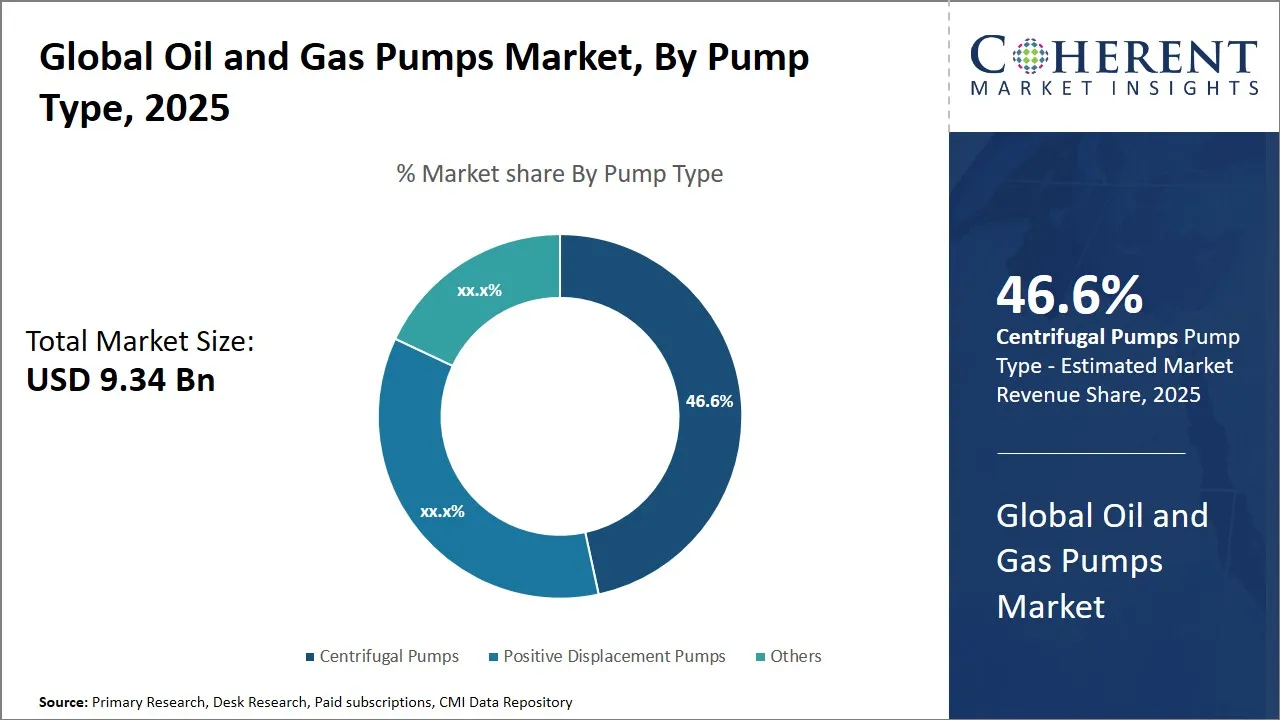
Oil and Gas Pumps Market Insights, By Pump Type - Centrifugal Pumps Segment Dominates the Market Due to their Operational Efficiency and Versatile Application Across the Oil and Gas Industry
Centrifugal pumps segment is expected to hold 47.6% of the global oil and gas pumps market share in 2026, on account of their ability to process huge amounts of fluid having comparatively low viscous characteristics. Their basic structure, ease of maintenance, and ability to deliver steady flow render them extremely suitable for aggressive industrial usage. In upstream oil and gas operations, where the extraction of crude oil demands assured fluid transfer, centrifugal pumps are the choice because they can efficiently handle fluctuating flow rates and pressures. On top of that, their versatility with power sources—ranging from electric motors to steam turbines—contributes to their prevalence in remote and onshore or offshore facilities.
For example, in offshore oil platforms, centrifugal pumps are widely used for transferring seawater to cool down the drilling equipment, as well as for injecting water into wells to maintain pressure and enhance oil recovery. Their robust design allows them to handle the challenging conditions of offshore environments, including fluctuating pressures and the need for reliable operation over long periods.
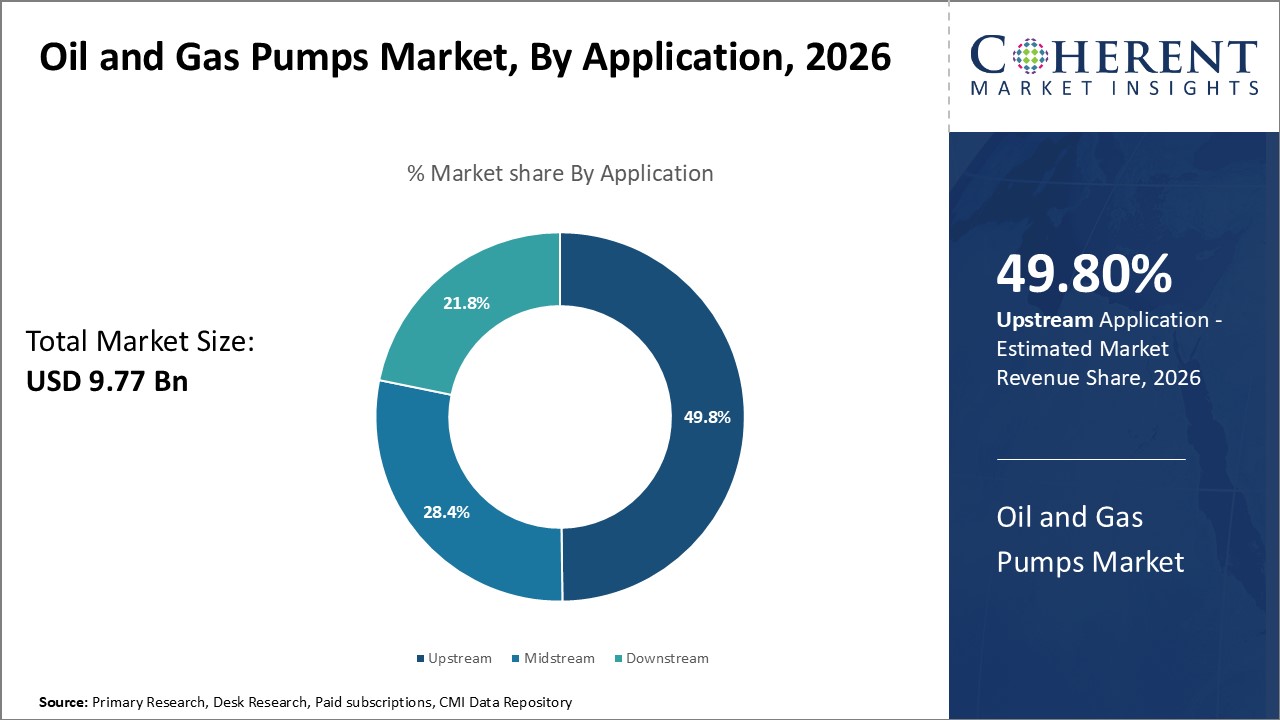
Oil and Gas Pumps Market Insights, By Application - Upstream Segment Dominates the Market Driven by the Escalating Exploration and Production Activities Worldwide
The upstream segment is set to hold 49.8% of the market share in 2026, owing to soaring worldwide demand for hydrocarbons and continuous establishment of new oilfields and offshore drilling ventures. Pumps for this industry need to provide reliable fluid transportation from crude oil and natural gas extraction from subsurface reservoirs to pumping it through wellheads and separators which requires specialized pumps with high efficiency and durability.
New technologies, including deepwater drilling and unconventional extraction, have put more emphasis on high-performance pumping solutions that can withstand adverse conditions such as high pressure, fluctuating temperatures, and abrasive fluids. This heightens the need for resistant pumps that provide consistent performance, with centrifugal pumps often taking center stage based on their flexibility and operational benefits in such applications.
Oil and Gas Pumps Market Insights, By End User - Oil & Gas Industry Segment Dominates the Market Propelled by Continuous Infrastructure Development and Rigorous Operational Demands
The oil & gas industry segment is projected to hold 35.6% share in 2026, including upstream, midstream, and downstream operations. Pumps are vital in all the stages, ranging from crude oil transport, gas compression, handling of refined products, to dosing chemicals in refineries, thereby guaranteeing seamless operations in value chains. Continued investments in refinery growth, pipeline networks, and storage facilities increase the need for an array of pumps tailored to individual operational needs.
Regional Insights
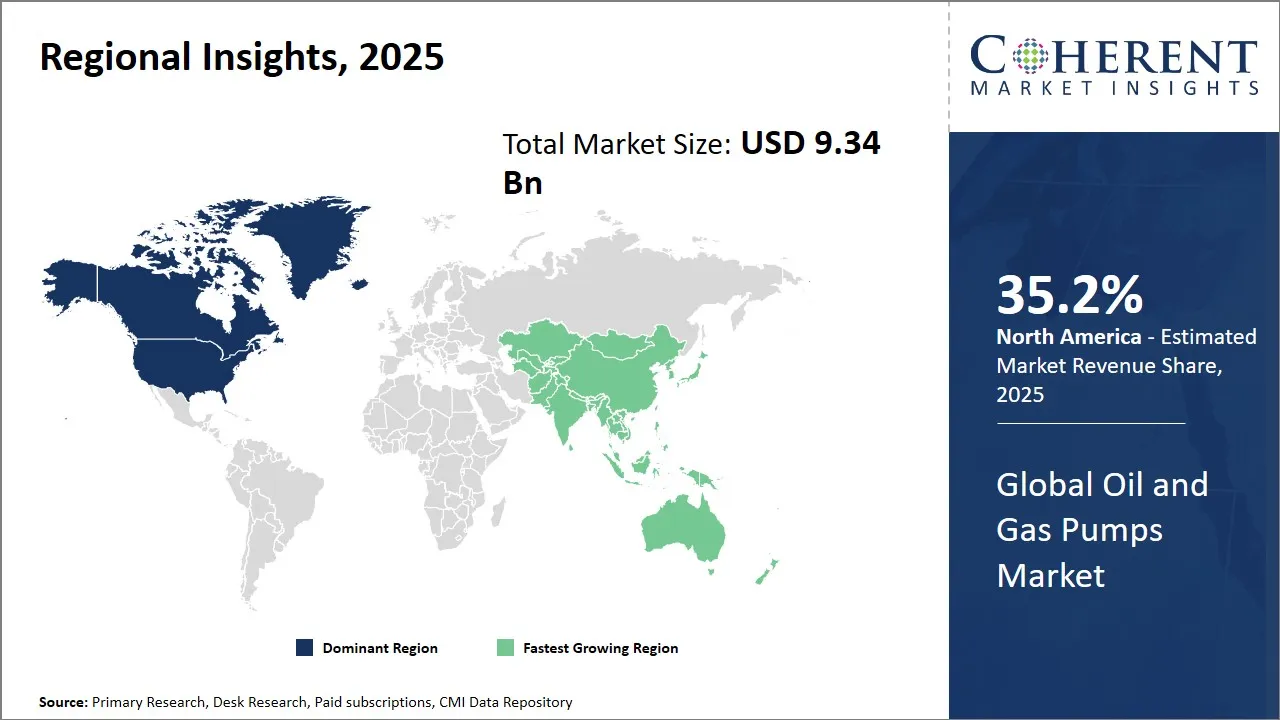
North America Oil and Gas Pumps Market Analysis and Trends
The North America region is projected to lead the market with a 35.2% share in 2026, The U.S. has immense shale oil and gas operations necessitating advanced pumping technologies for extraction, transportation, and refining. Energy independence policies coupled with high investments in infrastructure upgradation have strengthened demand for advanced pump technology.
Furthermore, North America's well-established industrial base facilitates innovation, with organizations like Flowserve Corporation, Schlumberger Ltd., and Baker Hughes spearheading the industry through uninterrupted product development and acquisition plans. Trade forces are positive, with the region enjoying strong export capabilities for premium pumping equipment, backed by solid logistics networks and adherence to strict environmental regulations.
Asia Pacific Oil and Gas Pumps Market Analysis and Trends
The Asia Pacific region is expected to exhibit the fastest growth in the market contributing 21.5% share in 2026, due to rapid industrialization, expanding oil and gas exploration, and increased refinery construction across countries like China, India, and Southeast Asian nations. Energy security and infrastructure upgradation initiatives by government have also pushed the installation of efficient pumping systems at a fast pace. The fast-growing petrochemical industry further drives demand, accompanied by rising investments in offshore drilling activities.
The area enjoys a vibrant manufacturing environment that facilitates competitive production of pumps of different specifications. Major players like Kirloskar Brothers Limited (India), Weir Group (having vast operations in Asia Pacific), and Sulzer Ltd. have fortified their operations here through strategic alliances and localization of production, facilitating quick market penetration. Foreign trade policies encouraging foreign direct investment have also facilitated technology transfer and supply chain optimization.
Global Oil and Gas Pumps Market Outlook for Key Countries
U.S. Oil and Gas Pumps Market Analysis and Trends
The U.S. oil and gas pumps market is dominated by its varied oil and gas industry, particularly the shale and offshore drilling divisions. Leading players such as Flowserve and Baker Hughes contribute significantly through the provision of sophisticated pump technologies designed to address intricate extraction and refining needs. Strong R&D capacities and focus on upgrading the energy infrastructure in the country enable sustained innovation. Regulation systems that highlight environmental conformity also propel the use of low-emission and energy-efficient pumping systems, solidifying the U.S’. position as a market leader.
China Oil and Gas Pumps Market Analysis and Trends
China oil and gas pumps market is defined by its vast upstream and downstream development, courtesy of government policies that stress energy independence and infrastructural growth. Local competitors such as KSB and foreign businesses such as Sulzer have invested heavily, improving pump manufacturing and service levels. The nation's drive towards the modernization of oil refineries and the development of offshore drilling projects has fueled demand for durable and multi-application pumps, making China a key market in the fast-paced growth environment of Asia Pacific.
India Oil and Gas Pumps Market Analysis and Trends
India is persisting in dominating the Asia Pacific oil and gas pumps market growth owing to its rising exploration efforts and refinery expansion operations. One of the largest local pump makers, Kirloskar Brothers Limited, has established its position in the market by innovation and tailormade pump solutions compatible with diversified operational landscapes. Government efforts to enhance energy infrastructure and increase oil production positively impact the market growth directly. Also, collaborations between domestic and international players enable technology integration and improved after-sales support.
Saudi Arabia Oil and Gas Pumps Market Analysis and Trends
The market in Saudi Arabia is closely related to its position as one of the major oil-producing countries with large-scale offshore and onshore developments requiring efficient pumping equipment. The market demand is greatly affected by the presence of Aramco, with joint partnerships among multinational pump manufacturers such as Sulzer and Flowserve to achieve demanding performance and reliability in extreme conditions. National strategies dictate investment in refinery modernization and petrochemical complexes to secure continuous demand for state-of-the-art pumps to enhance operational efficiency and minimize downtime.
Brazil Oil and Gas Pumps Market Analysis and Trends
Brazil's economy is defined by its offshore pre-salt oil fields which call for customized pumps that can deal with demanding extraction environments. Petrobras, the national oil company, is instrumental in providing a boost to the market by collaborating with international pump companies like Schlumberger and Sulzer to install high-performance pumping systems on their offshore platforms. Government incentives towards exploration and infrastructure development further support the market. Moreover, Brazil's emphasis on the construction of downstream processing units continues to demand diverse categories of industrial pumps essential to refining processes.
Macro and Micro Economic Factors Impacting Oil and Gas Pumps Market Growth
Macroeconomic Factors
- Oil Price Volatility: Crude oil prices are expected to continue changing at around USD 70-80 a barrel, largely driven by ongoing geopolitical tensions in the Middle East and a trade conflict between the U.S. and China. These prices are affecting capital expenditure levels in oil exploration and purchasing pumping equipment.
- Global Energy Demand: Industrialization and growth, especially in Asia and the Middle East, is increasing energy usage, leading to total oil and gas demand increasing by 5.2% through 2029. This growth supports demand for pumps in extraction and refining applications.
- Trade Tariff Policies: Adjustments to U.S. tariffs in 2025 increased costs for pump component parts, which resulted in having to redesign sourcing strategies and localizing production. A macro event such as this affects capital cycles and profitability on pumps.
Micro Economic Factors
- Technology: Adoption of Internet of Things (“IoT”) enabled “smart pumps”, predictive maintenance, and digital twin technology improve efficiency and decrease business downtime, boosting replacement cycle demand.
- Material Cost Fluctuation: Increasing fluctuations in the price of steel and aluminum increase manufacturing costs and compress margins for pump manufacturers, resulting in higher prices for end-users, especially for upstream projects.
Market Players, Key Development, and Competitive Intelligence
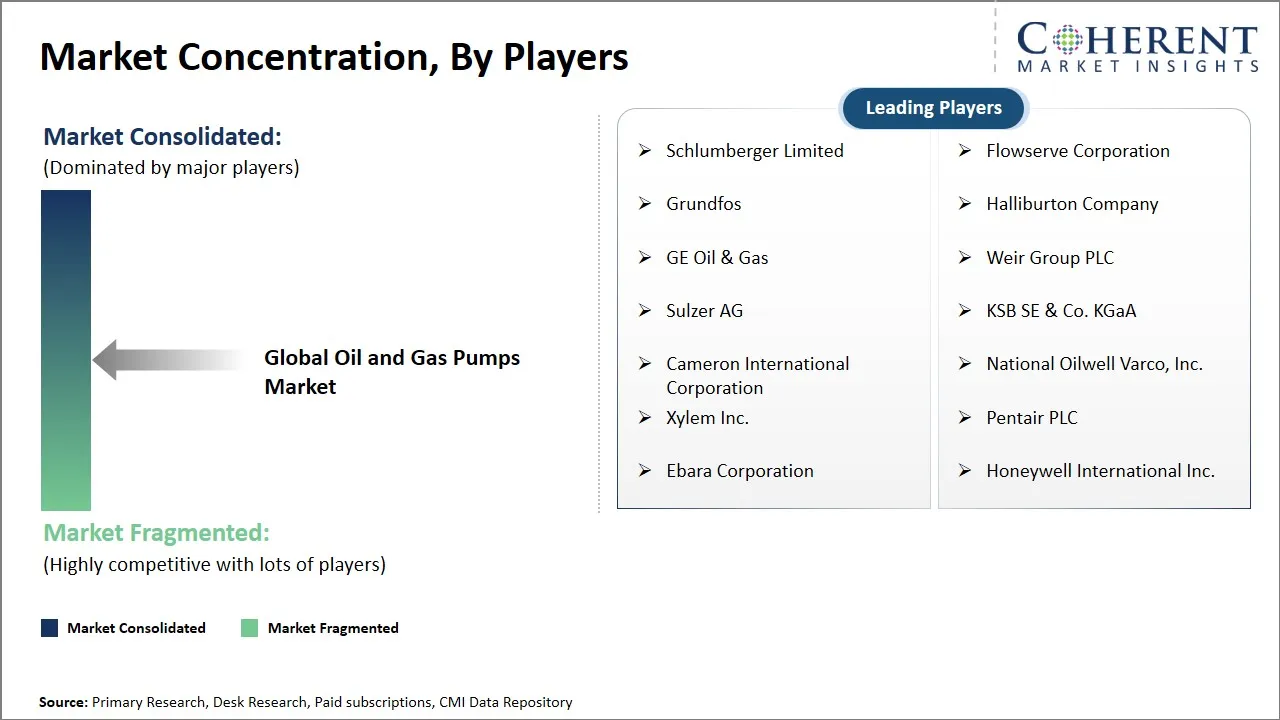
Key Developments
- In April 2024, Baker Hughes secured an order from Black & Veatch to supply electric-driven liquefaction equipment, comprising centrifugal pumps, to Cedar LNG in Canada. The array of turbomachinery equipment includes four electric-propelled main refrigeration compressors, six centrifugal pumps, and two electric-driven boil-off gas compressors.
- In February 2024, ITT Inc. inked a three-year contract to supply highly engineered API-610 centrifugal pump systems and associated products along with engineered services to ExxonMobil.
- In August 2023, as the demand accelerates for smart solutions to build more connected, resilient, and sustainable cities, Grundfos, the world's leading manufacturer of advanced pump solutions and water technologies, launched its new NK and NKE series in Malaysia. The new long-connection suction pumps have industry-leading energy efficiency, and the premium NKE range uses smart technology for ease of use, advanced monitoring capabilities, and better connectivity.
Top Strategies Followed by Global Oil and Gas Pumps Market Players
- Established players are focused on making large investments in research and development (R&D) to help innovate high-performance, durable, and energy efficient pumps that can continue to meet the evolving needs of the oil and gas industry. The company seeks to maintain technological leadership through advances such as improved material coatings or the incorporation of smart sensors.
- For instance, Grundfos is focused on developing energy-efficient centrifugal and submersible pump systems to meet decarbonization targets by nations worldwide, while Sulzer focuses on improving the durability of pumps by introducing corrosion resistant materials and advanced impeller coatings for use in high pressure, sour crude situations.
- Mid-level players mid-level players, they have differentiated themselves in order to maximize and deliver cost effective solutions while also providing reliable pump performance. These players recognize that certain segments of the market are sensitive to price, and have developed pumping solutions to help address perceived quality and life expectancy concerns. They target value focused requirements by private contractors and smaller operators in the market alike.
- For example, SPX FLOW has focused on working towards standardized pump designs that can be built to convenient customization for ease of shorter lead times and flexible configurations that can be used within midstream transport projects.
- Small-scale participants in the oil and gas pumps sector specialize with an emphasis on innovation and adaptivity. Their strength is in developing products with unique functions-developing specialized pumps for unconventional fluids, form-factor for compact mobile rigs, or designing expressively green materials, which address specific yet unmet needs that larger players do not serve.
- For example, Netzsch develops relatively unique progressing cavity pumps that handle unconventional fluids, like viscous crude or drilling muds from tight reservoirs.
Market Report Scope
Oil and Gas Pumps Market Report Coverage
| Report Coverage | Details | ||
|---|---|---|---|
| Base Year: | 2025 | Market Size in 2026: | USD 9.77 Bn |
| Historical Data for: | 2020 To 2024 | Forecast Period: | 2026 To 2033 |
| Forecast Period 2026 to 2033 CAGR: | 4.6% | 2033 Value Projection: | USD 13.38 Bn |
| Geographies covered: |
| ||
| Segments covered: |
| ||
| Companies covered: | Schlumberger Limited, Flowserve Corporation, Grundfos, Halliburton Company, GE Oil & Gas, Weir Group PLC, Sulzer AG, KSB SE & Co. KGaA, Cameron International Corporation, National Oilwell Varco, Inc., Xylem Inc., Pentair PLC, Ebara Corporation, and Honeywell International Inc. | ||
| Growth Drivers: |
| ||
| Restraints & Challenges: |
| ||
Oil and Gas Pumps Market Dynamics
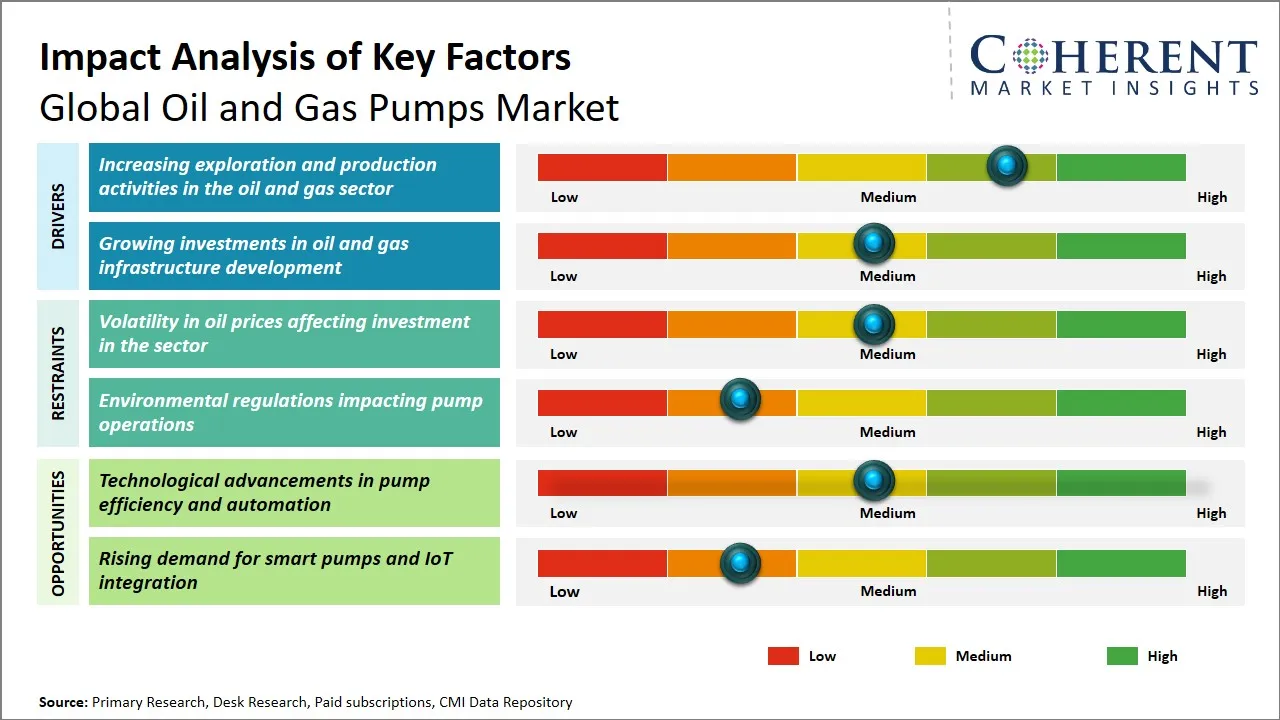
Oil and Gas Pumps Market Driver - Increasing Exploration and Production Activities in the Oil And Gas Sector
The spurt in production and exploration activity in the oil and gas industry is a key driver fueling demand for high-performance oil and gas pumps across the world. As companies ramp up efforts in search of new reservoirs and to boost output from legacy fields; accompanying these activities is a need for cost-efficient and high-performance pumping equipment that is reliable. Pumps will play an important role during each phase of upstream operations from the extraction and transportation of the crude oil and natural gas to processing as well.
For instance, ExxonMobil's Guyana and U.S. Permian Basin offshore developments have fueled the procurement of submersible and multistage pumps to enable efficient extraction and transportation of crude from deepwater reservoirs.
Oil and Gas Pumps Market Opportunity - Technological Advancements in Pump Efficiency and Automation
The global oil and gas pumps market is likely to gain a substantial boost from the continuous technological developments that lead to improved pump efficiency as well as automated capabilities. Variable frequency drives (VFDs), smart control systems, and IoT-enabled sensors are changing not only the performance but also the reliability of pumps in the oil and gas industry. Each of these advancements allows pumps to be monitored in real-time and to do predictive maintenance to reduce both downtime and operating costs and to achieve maximum efficiency when it comes to energy consumption. In fact, one area where IoT based sensors were introduced is from Flowserve through its RedRaven platform for monitoring the condition of pumps in real-time and predictive maintenance specifically for refinery and pipeline pumps.
For instance, Flowserve rolled out IoT-based sensors via its RedRaven platform, enabling real-time condition monitoring and predictive maintenance of refinery and pipeline pumps.
Analyst Opinion (Expert Opinion)
- The global oil and gas pumps market is set to witness massive growth, with rising energy needs and the quest for higher efficiency in extraction and transportation activities. Inputs from the Offshore Technology Conference (2023) and the American Petroleum Institute's Annual Meeting (2022) highlighted major breakthroughs, with Flowserve and Schlumberger among the companies leading the race in pump technology advancements.
- Flowserve's recent development of intelligent pumps that leverage IoT-enabled technology demonstrates a strategic effort to address the demand from the industry for both real-time monitoring and predictive maintenance, enabling companies to enhance performance while decreasing downtime. Remarks made in these conferences underscored how the topic of sustainability is much more important than in years prior, with the need for environmentally responsible pumping alternatives at an even higher premium to help, of course, reduce emissions and enhance efficiency. Lurking in the background of most discussions were concerns that volatility in raw materials prices and regulatory issues may present challenges.
- Businesses that invest in R&D to create more efficient and environmentally friendly pumps will probably enjoy a competitive advantage. Further, strategic partnerships with energy companies can lead to improved market penetration. Finally, the expansion of the global oil and gas pumps market will rely on its capacity to innovate while satisfying environmental issues and responding to the changing requirements of the energy industry.
Speak to the analyst
Want personalized insights?
Take the findings above to one of our principal consultants, or have the report rebuilt around the segments, geographies and competitors you actually track.
Market Segmentation
- Pump Type Insights (Revenue, USD Bn, 2021 - 2033)
- Centrifugal Pumps
- Positive Displacement Pumps
- Others
- Application Insights (Revenue, USD Bn, 2021 - 2033)
- Upstream
- Midstream
- Downstream
- End User Insights (Revenue, USD Bn, 2021 - 2033)
- Oil & Gas Industry
- Chemical Industry
- Power Generation
- Others
- Regional Insights (Revenue, USD Bn, 2021 - 2033)
- North America
- U.S.
- Canada
- Latin America
- Brazil
- Argentina
- Mexico
- Rest of Latin America
- Europe
- Germany
- U.K.
- Spain
- France
- Italy
- Russia
- Rest of Europe
- Asia Pacific
- China
- India
- Japan
- Australia
- South Korea
- ASEAN
- Rest of Asia Pacific
- Middle East
- GCC Countries
- Israel
- Rest of Middle East
- Africa
- South Africa
- North Africa
- Central Africa
- North America
- Key Players Insights
- Schlumberger Limited
- Flowserve Corporation
- Grundfos
- Halliburton Company
- GE Oil & Gas
- Weir Group PLC
- Sulzer AG
- KSB SE & Co. KGaA
- Cameron International Corporation
- National Oilwell Varco, Inc.
- Xylem Inc.
- Pentair PLC
- Ebara Corporation
- Honeywell International Inc.
Sources
Primary Research Interviews
- R&D Director – Major Oilfield Equipment Manufacturer
- Procurement Manager – Oilfield Service Company
- Product Development Head – Leading Pump Manufacturer (Serving Upstream & Midstream)
- Sustainability Manager – Energy Equipment Certification Organization
Stakeholders
- Manufacturers: Flowserve Corporation, Sulzer Ltd., Alfa Laval, Weir Group, KSB SE & Co., Xylem Inc., Gardner Denver, SPP Pumps, HMS Group, Grundfos.
- End-use Sectors
- Upstream (exploration and production pumping systems)
- Midstream (pipeline transport and pumping stations)
- Downstream (refineries, petrochemical, and gas distribution plants).
- Regulatory & Certification Bodies: API (American Petroleum Institute), ISO, IECEx, and regional standards organizations.
- Service & Technology Integrators: Automation and IoT providers for smart and energy-efficient pumping solutions.
- Oilfield Service Providers & EPC Contractors: Baker Hughes, TechnipFMC, Schlumberger, Halliburton, Wood Group.
Databases
- UN Comtrade Database – Export-import statistics for oilfield equipment and pumping systems
- India Import Export (EXIM) Database – Trade data on industrial pump imports & exports
- EIA & IEA Energy Data Portals – Oil and gas production and infrastructure statistics
Magazines
- Oil & Gas Journal – Global petroleum market and pump technology trends
- World Oil – Upstream drilling and pump technology innovations
- Oilfield Technology – Engineering insights on pump efficiency and reliability
- World Pipelines – Midstream transport & pumping infrastructure
- Hydrocarbon Engineering – Refining and petrochemical sector machinery
- Oil Review Middle East – Regional pump installations and oilfield upgrades
Journals
- Journal of Petroleum Science and Engineering – Flow dynamics and pump performance research
- Energy Reports (Elsevier) – Pump energy efficiency studies in oil infrastructure
- Journal of Mechanical Engineering Science – Advances in rotating machinery
- Industrial Lubrication and Tribology – Reliability and material science for oil and gas pumps
Newspapers
- The Financial Times – Analysis of oilfield capital investment and energy equipment markets
- The Economic Times – Developments in Indian oil infrastructure and pump supply chains
- The Guardian – Coverage of decarbonization and sustainable pumping technologies
- The Wall Street Journal – Reports on upstream CAPEX and oil price-linked demand
Associations
- American Petroleum Institute (API)
- International Association of Drilling Contractors (IADC)
- Hydraulic Institute
- Energy Equipment & Infrastructure Alliance (EEIA)
- European Committee for Standardization (CEN) – Mechanical equipment directives
- World Petroleum Council (WPC)
Public Domain Sources
- U.S. Department of Energy (DOE) – Efficiency guidelines for industrial pumps
- Environmental Protection Agency (EPA) – Emission and efficiency compliance
- European Commission – Industrial Equipment Regulations
- Organization for Economic Cooperation and Development (OECD) – Energy market sustainability assessments
Proprietary Elements
- CMI Data Analytics Tool, Proprietary CMI Existing Repository of information for last 8 years.
Get access to 250+ pages report
Every segment, forecast, competitor profile and data table behind the analysis above — available for instant download.
- ESOMAR Member
- ISO 9001:2015 Certified
- D-U-N-S Registered
- GDPR & CCPA Compliant
Missing comfort of reading report in your local language? Find your preferred language:
Transform your Strategy with Exclusive Trending Reports
Frequently Asked Questions
The global oil and gas pumps market is estimated to be valued at USD 9.77 Bn in 2026 and is expected to reach USD 13.38 Bn by 2033.
The CAGR of the global oil and gas pumps market is projected to be 4.6% from 2026 to 2033.
Increasing exploration and production activities in the oil and gas sector and growing investments in oil and gas infrastructure development are the major factors driving the growth of the global oil and gas pumps market.
Volatility in oil prices affecting investment in the sector and environmental regulations impacting pump operations are the major factors hampering the growth of the global oil and gas pumps market.
In terms of pump type, the centrifugal pumps segment is estimated to dominate the market revenue share in 2026.
Schlumberger Limited, Flowserve Corporation, Grundfos, Halliburton Company, GE Oil & Gas, Weir Group PLC, Sulzer AG, KSB SE & Co. KGaA, Cameron International Corporation, National Oilwell Varco, Inc., Xylem Inc., Pentair PLC, Ebara Corporation, and Honeywell International Inc. are the major players.
North America is expected to lead the global oil and gas pumps market in 2026.