

Global Organic Capsules Market Size and Forecast – 2026 To 2033
The global organic capsules market is expected to grow from USD 651.2 Mn in 2026 to USD 1,037.9 Mn by 2033, registering a compound annual growth rate (CAGR) of 6.9% from 2026 to 2033. The market for global organic capsules is poised for significant expansion, fueled by the growing consumer preference for plant-based and clean-label products, encouraging nutraceutical and pharmaceutical manufacturers to adopt plant-derived capsule shells.
According to the Good Food Institute (GFI), the U.S. plant-based food retail market grew from USD 3.9 billion in 2017 to USD 7.9 billion in 2025, while nearly 60% of U.S. households consumed plant-based foods in 2025, highlighting the broader shift toward plant-derived products.
Key Takeaways of the Global Organic Capsules Market
- Hard capsule is projected to hold 65.5 % of the global organic capsules market share in 2026, making it dominant type segment, across North America due to the region’s established dietary-supplement manufacturing infrastructure and strong quality-control requirements. For instance, the U.S. Food and Drug Administration (FDA) requires dietary-supplement manufacturers to comply with current good manufacturing practice requirements under 21 CFR Part 111, supporting standardized production and quality controls for capsule-based supplements.
- Plant source is projected to hold 91.0 % of the global organic capsules market share in 2026, making it dominant source segment, across Europe due to strong regulatory support for certified organic production and labeling. For instance, the European Commission enforces Regulation (EU) 2018/848, which establishes requirements for organic production, certification, labeling, and controls, supporting demand for compliant plant-derived organic products.
- Pharmaceuticals are projected to hold 66.2 % of the global organic capsules market share in 2026, making it dominant application segment, across North America due to stringent pharmaceutical manufacturing and quality standards. For instance, the FDA's 21 CFR Parts 210 and 211 establish current good manufacturing practice requirements for drug manufacturing and finished pharmaceuticals, supporting demand for standardized capsule-based drug delivery formats.
- North America market maintains dominance with an expected share of 33.7 % in 2026, bolstered by the region’s established dietary-supplement industry and regulatory oversight of product quality and labeling. For instance, the U.S. Food and Drug Administration (FDA) regulates dietary supplements and requires manufacturers and distributors to ensure products meet applicable safety and labeling requirements, supporting a structured market for supplement-based capsule products.
- Europe is expected to exhibit the fastest growth in the global organic capsules market, registering an estimated CAGR of 7.4 % during 2026–2033, driven by expanding organic consumption and strong regulatory support for organic products. For instance, the European Commission reported that EU organic-product retail sales exceeded USD 52.6 billion (EUR 45 billion), while organic farming reached around 17 million hectares in 2025, indicating a well-established organic ecosystem that can support demand for organic capsule-based products.
Segmental Insights
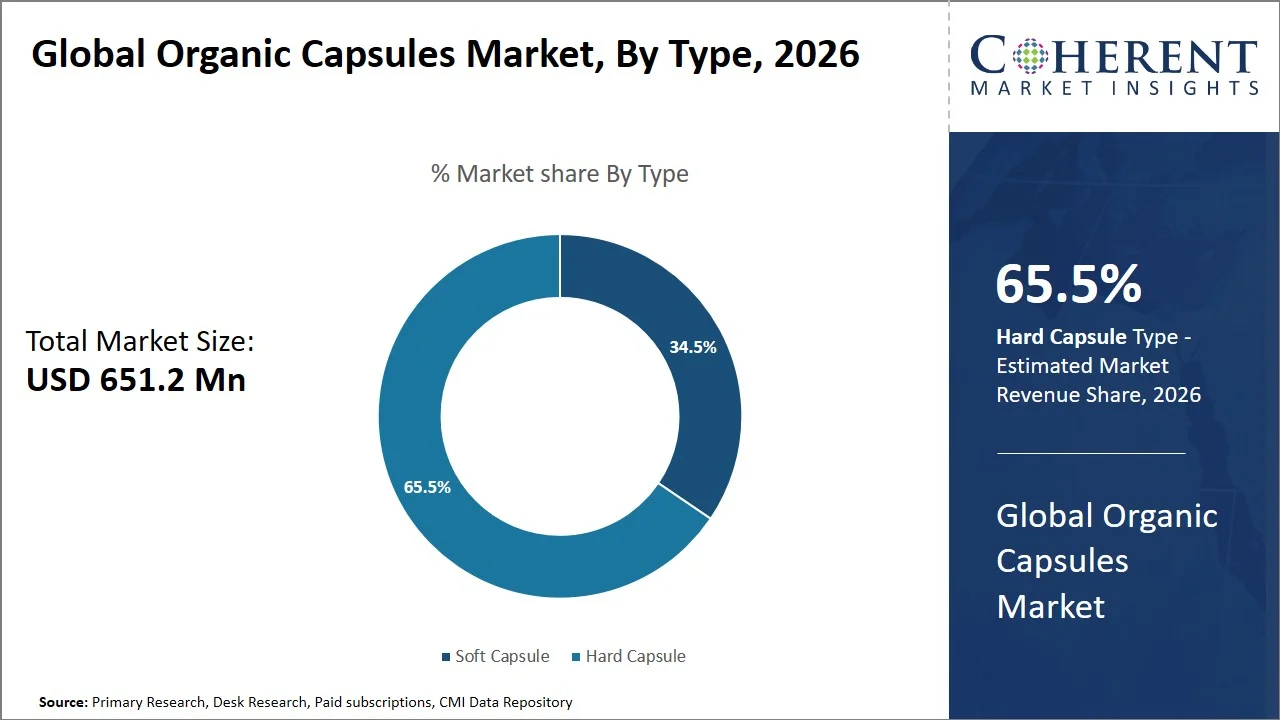
Why Do Hard Capsule Dominate the Global Organic Capsules Market?
Hard capsule is projected to hold the market share of 65.5% in 2026, due to their broad array of applications such as flexibility, filling rates, efficiency with powder, granules, and plants. The hard-shell packaging offers comprehensive protection for sensitive products and contributes to clean-labeling and vegan standards. For instance, Qualicaps offers its hard capsules Nutra'V HPMC for nutraceutical uses – a plant-based alternative that is virtually dustless and has a low moisture content, making it perfect for nutritional uses.
- Current Industry Events of 2026
- Market Size Estimation
- Regional Breakdown
- Competitive Landscape
- Customer Intelligence
- Segmental Analysis
- Pricing Analysis
- Key Market Drivers, Challenges & Future Trends
- Customized Insights Section
Why Does Plant Source Represent the Largest Source Segment in the Organic Capsules Market?
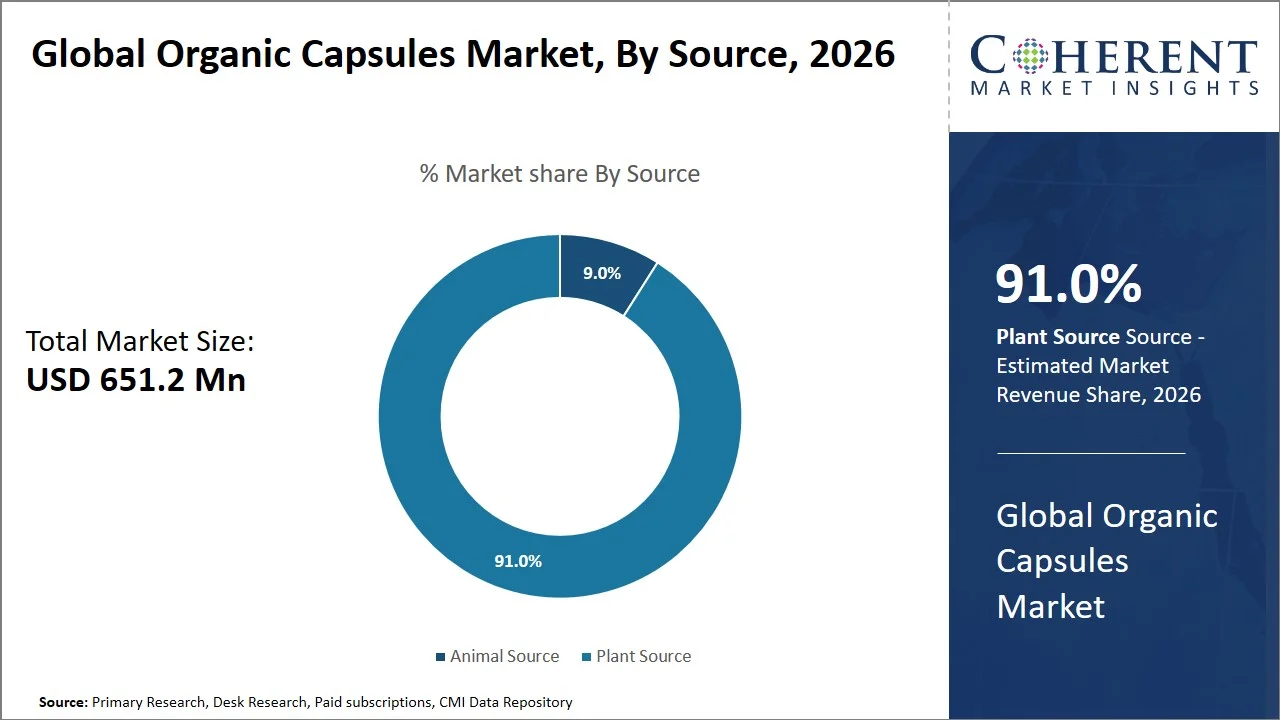
Plant source is projected to hold a market share of 91.0% in 2026, owing to the growing demand for vegan, vegetarian, and animal-free capsule forms and ease of integration in organic and clean label formulations. Additionally, plant-derived materials such as HPMC and Pullulan provide comparable performance for nutraceutical based uses and are consistent with various dietary preferences. For instance, in February 2025, ACG Capsules launched its certified 100% vegan printed capsules derived from HPMC (plant-based) capsule shells with an approved printing procedure by The Vegetarian Society and Vegan Action.
Pharmaceuticals Segment Dominates the Global Organic Capsules Market
The pharmaceuticals segment is projected to hold a market share of 66.2% in 2026, due to the stringent requirement for accurate drug dosage, protection of API and highly demanding drug-delivery features. Plant-based capsules are being increasingly applied to complex pharmaceutical forms, particularly for drug delivery of acid sensitive APIs targeted toward specific organ. For instance, in June 2024, Lonza released the Capsugel Enprotect Size 9 capsule, which is intended for preclinical testing of stomach acid-sensitive APIs, and provides stomach acid protection, as well as release in the small intestine, without extra enteric coating.
Current Events and their Impact
Current Events | Description and its Impact |
EU Reported Salmonella in Organic Turmeric Capsules (June 2026) |
|
EU Strengthened Controls on Organic Food and Supplement Supply Chains (January 2026) |
|
U.S. FDA Investigated Salmonella Outbreak Linked to Organic Moringa Capsules (January 2026) |
|
Organic Capsules Market Dynamics
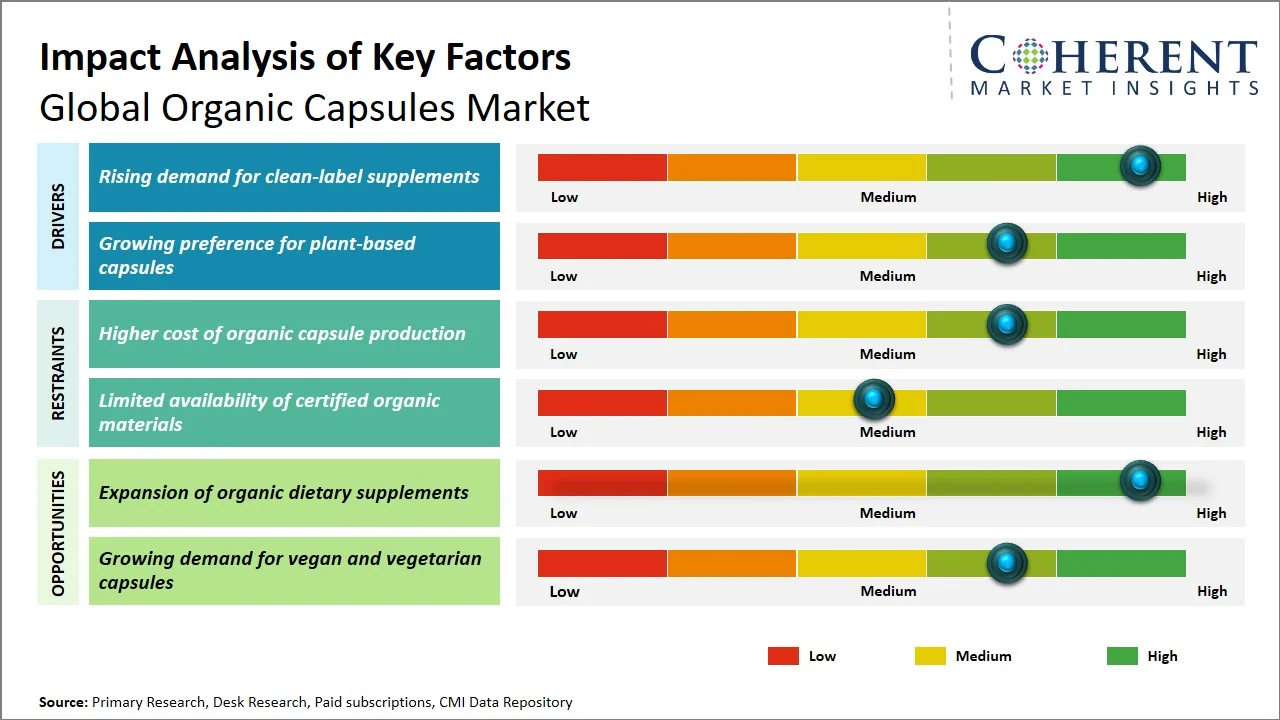
Market Drivers
- Rising demand for clean-label supplements: The increasing preference for clean-label and transparent supplement formulations is supporting demand for organic capsules as consumers seek certified and traceable ingredients. Organic certification requirements are encouraging manufacturers to strengthen sourcing, processing, and labeling practices across the supply chain. For instance, the European Commission requires products carrying the EU organic logo to contain at least 95% organic ingredients and meet strict production, processing, and labeling requirements. This regulatory framework strengthens transparency and consumer confidence, encouraging manufacturers to adopt certified organic capsule solutions.
- Growing preference for plant-based capsules: The growing preference for plant-based capsules is supporting market growth as nutraceutical manufacturers increasingly replace animal-derived gelatin with vegetarian and vegan capsule shells. This shift is particularly relevant for organic supplements, where plant-derived formats help align capsule delivery with vegan, vegetarian, and clean-label positioning. For instance, the U.S. Department of Agriculture (USDA) added pullulan to the National List for use in tablets and capsules for dietary supplements labeled “made with organic,” providing a regulatory pathway for plant-based capsule formulations in the U.S.
- Rising Use of Dietary Supplements: The increasing use of dietary supplements and botanical products is expanding the consumer base for capsule-based formulations, supporting demand for organic capsule delivery formats. The trend is particularly relevant to nutraceutical manufacturers, where capsules are widely used for vitamins, minerals, botanicals, and herbal ingredients. For instance, the U.S. Centers for Disease Control and Prevention (CDC) reported that 60.2% of adults aged 20 years and older used at least one dietary supplement during August 2021–August 2023, up from 53.8% in 2013–2014, demonstrating sustained growth in supplement consumption.
Emerging Trends
- Shift Toward Vegan Softgel Formats: Capsule manufacturers are increasingly developing plant-based alternatives for soft capsules, expanding organic options beyond traditional hard-shell formats. This trend is broadening organic capsule applications across oils, botanical extracts, vitamins, and other nutraceutical formulations.
- Growing Use of Smart Capsule Manufacturing: Capsule production is increasingly incorporating automated filling, in-line inspection, and process-monitoring technologies to improve dose uniformity, shell consistency, and manufacturing efficiency. These capabilities are becoming important as organic capsule producers scale production while maintaining stringent quality requirements.
- Greater Demand for Specialty Capsule Sizes and Formats: Nutraceutical manufacturers are increasingly seeking capsule formats tailored to specific formulations, including smaller capsules for concentrated ingredients and larger formats for botanical powders. This is encouraging suppliers to expand capsule size portfolios and provide greater formulation flexibility.
Regional Insights
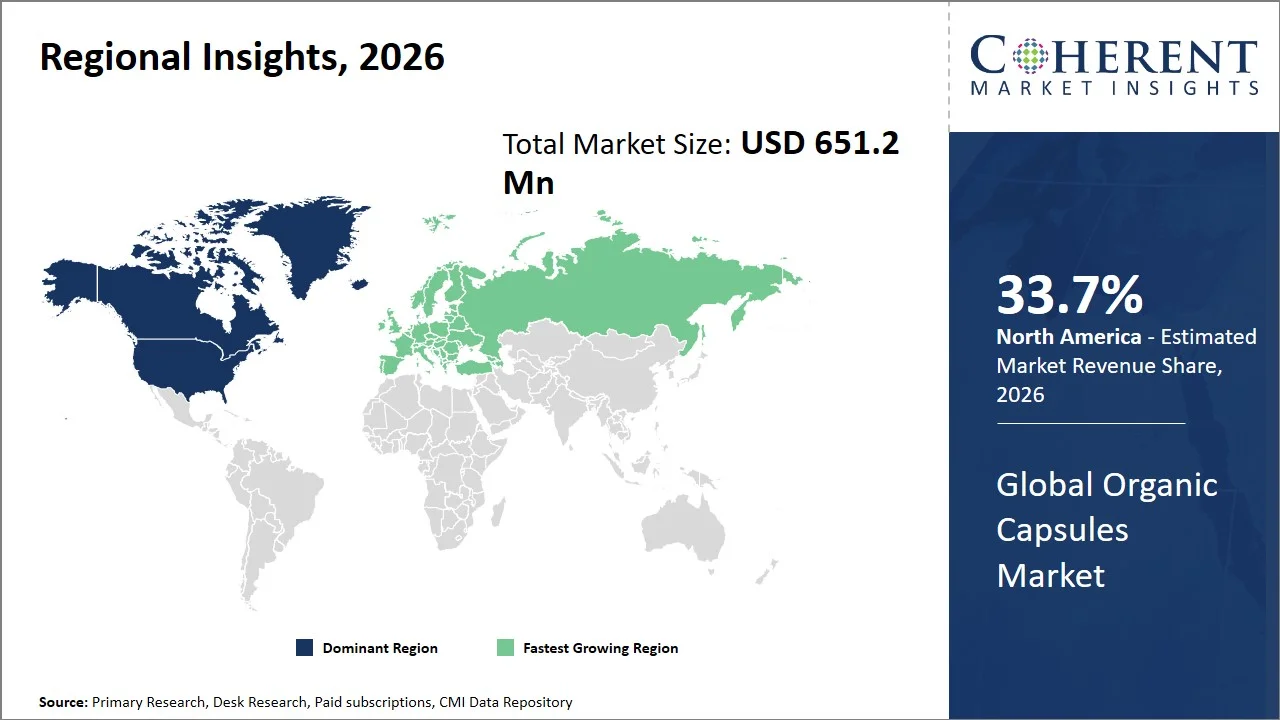
Why is North America a Strong Market for Organic Capsules?
North America leads the global organic capsules market, accounting for an estimated 33.7% share in 2026, attributed to its established nutraceutical sector, increasing consumer inclination for organic/clean-label supplements, and significant role played by stringent regulatory norms. U.S. Food and Drug Administration, and Health Canada both implement guidelines on manufacturing standards, quality requirements, safety, labeling requirements, and specifications for the regulation of natural health products and dietary supplements, thus augmenting consumer trust toward the products.
For instance, U.S. FDA’s regulation for current good manufacturing practice (CGMP) for dietary supplements (21 CFR Part 111) mandates producers to follow strict standards in their manufacturing process, quality assurance procedures, packaging, labeling and recordkeeping. Furthermore, stringent U.S. Department of Agriculture Organic standards and well-developed organic supply chains contribute towards its better production and marketing of the certified organic capsules based dietary supplements in the region.
Why Does Europe Organic Capsules Market Exhibit High Growth?
Europe is expected to exhibit the fastest growth in the global organic capsules market, registering an estimated CAGR of 7.4% during 2026–2033. The region is projected to account for approximately 27.0% of the global market in 2026, attributed to growing consumer interest toward organic and plant-based alternatives, and rapid adoption of clean label supplements with increasing interest among population toward natural healthcare products. Strong organic supply chain and mature nutraceutical industry help to facilitate the development and commercialization of organic capsule-based formulations.
Furthermore, the European Commission promotes the sector through a harmonized EU framework for the production, certification, traceability and labelling of organic products, with the aim of increasing consumer confidence in this certified organic food. For instance, EU Organic Regulation 2018/848 ensures common rules for production and labeling throughout the EU Members States, with provisions on certification, control and traceability. (Source: European Commission)
Global Organic Capsules Market Outlook for Key Countries
Why is the U.S. Leading Innovation and Adoption in the Organic Capsules Market?
The U.S. holds the largest market share for innovation and adoption in organic capsules market driven by a sophisticated ecosystem for certified organic dietary supplement as well as organic capsule plant-based technological capacities due to readily defined industry regulations surrounding the certification of organic product lines and production protocols regarding dietary supplements. In addition, widespread use of capsules across a wide range of health supplement categories (organic and non-organic botanical/plant extracts included in capsules too) allows for economies of scale. The country holds excellent potential for capsule use in the organic market due to its infrastructure to support organic certification and a mature organic capsule supply Chain.
Is UK a Favorable Market for Organic Capsules Market?
The UK is seen as an attractive market due to existing legislation that specifically applies to organic capsule-based Food Supplements in its broadest sense. The regulatory structure requires that all organic operators engaged in manufacturing, storing, importing, wholesaling, and labeling of products be certified, resulting in a framework designed for the sale of products meeting the regulatory definitions.
Is China Emerging as a Key Growth Hub for the Organic Capsules Market?
China represents an emerging rather than a developed opportunity driven by its mature regulatory framework for organic products and considerable size of organized health food market. According to State Administration for Market Regulation (SAMR) as of March 2025, China had registered 13,000 valid health food registration certificates and filed 22,000 filings certificates, this represented a solid regulated base for supplement products. Additionally, the country uses organic product certification that addresses cultivation, processing, import and sales thereby establishing the formal channel for the flow of certified organic products.
Why Does Germany Top the European Organic Capsules Market?
Germany constitutes a significant and mature market for organic capsules owing to a well-developed organic products value chain, a significant nutraceutical segment and a high product receptivity of certified organic products among its population. Existing organic retail and distribution infrastructure in Germany supports commercialization of supplements based on organic capsules. High potential in terms of utilization of specialized capsules form the organic dietary-supplement industry in Germany.
Is Organic Capsules Market Developing in Japan?
Japan is emerging as a market for organic capsules, with an official Organic JAS certification system for organic plant-based foods, organic processed foods and animal-origin foods. It provides authorization for certified operators to adopt the Organic JAS logo on their products and enable similar imported organic products from equivalent third country certification systems into the Japanese market under JAS approval.
Organic Capsule Materials and Certification Landscape
Capsule Material / Format | Source | Organic Relevance | Key Certification / Regulatory Consideration |
Pullulan | Plant-based / fermentation-derived | High | Permitted by the USDA for use in tablets and capsules for dietary supplements labeled “made with organic.” |
HPMC (Hypromellose) | Plant cellulose-derived | High | Widely used for vegetarian and vegan capsules; organic eligibility depends on the specific material, processing, and certification requirements. |
Gelatin | Animal-derived collagen | Low | Suitable for conventional capsule applications but less aligned with vegan, vegetarian, and plant-based organic positioning. |
Organic Pullulan Capsules | Certified organic pullulan | Very High | Can support organic supplement formulations when the capsule and finished product meet applicable organic certification and labeling requirements. |
How is the expansion of organic dietary supplements creating new growth opportunities in the organic capsules market?
The proliferation of organic food supplements offers opportunities for organic capsule manufacturers while broadening the organic product sphere beyond foods into health and wellness goods. This presents an extended application area for dietary supplements in capsule form with the inclusion of organic botanicals, herbs, and nutritional ingredients. For instance, the U.S Department of Agriculture National Organic Program allows processed products containing at least 95% certified organic ingredients to use the “organic” designation, while such items containing at least 70% may use a “made with organic” claim, supporting differentiated organic supplement formulations.
Market Players, Key Development, and Competitive Landscape
Key Developments
- In March 2026, Lone Star Funds entered into an agreement to acquire Lonza’s Capsules & Health Ingredients (CHI) division for an enterprise value of USD 2.9 billion (CHF 2.3 billion). The division includes hard empty gelatin and plant-based capsules serving pharmaceutical and nutraceutical customers. The transaction is expected to strengthen CHI’s strategic focus and investment in capsule innovation and is expected to close in H2 2026.
- In January 2026, Kuli Kuli Foods launched Pure Organic Moringa Capsules, containing 100% organic moringa leaf powder in a convenient capsule format. The launch expands the application of organic capsules in the wellness and dietary supplements segment, reflecting growing consumer demand for convenient, plant-based organic products.
- In October 2025, Elevate Organic launched its organic, clinically studied Shatavari supplement line, including Elevated Shatavari Capsules formulated with Organic SRI-81 Shatavari. The launch expands the use of organic capsule formats in women’s health and nutraceutical applications, supporting demand for organic capsule solutions.
- In October 2025, Lonza Capsugel launched Organicaps, a USDA organic-certified, plant-based pullulan capsule designed for immediate-release organic nutraceutical formulations. The capsule offers a high oxygen barrier, non-reactive shell, and strong polymer stability to protect sensitive organic ingredients. The launch expands certified organic capsule solutions and supports growing demand for organic and plant-based supplements.
Competitive Landscape
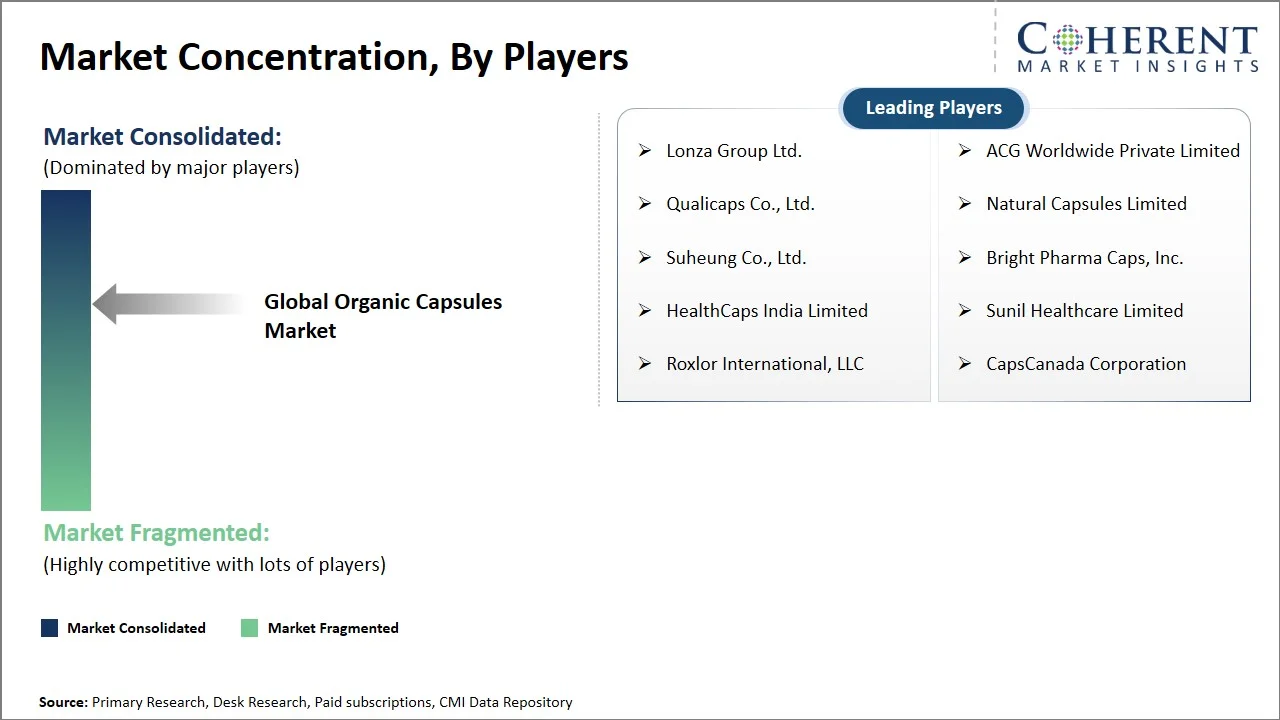
The global organic capsules market is moderately competitive, with market dynamics shaped by organic certification, plant-based capsule development, formulation performance, manufacturing capabilities, and compliance with evolving organic standards. Market participants are increasingly focusing on expanding certified organic capsule portfolios, improving capsule performance for sensitive ingredients, and developing solutions aligned with vegan, clean-label, and sustainability requirements. Key focus areas include:
- Development of certified organic capsule shells
- Expansion of plant-based and vegan capsule portfolios
- Improvement of capsule stability and ingredient protection
- Integration of clean-label and sustainability certifications
- Expansion of capsule manufacturing and formulation capabilities
Market Report Scope
Organic Capsules Market Report Coverage
| Report Coverage | Details | ||
|---|---|---|---|
| Base Year: | 2025 | Market Size in 2026: | USD 651.2 Mn |
| Historical Data for: | 2020 To 2024 | Forecast Period: | 2026 To 2033 |
| Forecast Period 2026 to 2033 CAGR: | 6.9% | 2033 Value Projection: | USD 1,037.9 Mn |
| Geographies covered: |
| ||
| Segments covered: |
| ||
| Companies covered: | Lonza Group Ltd., ACG Worldwide Private Limited, Qualicaps Co., Ltd., Natural Capsules Limited, Suheung Co., Ltd., Bright Pharma Caps, Inc., HealthCaps India Limited, Sunil Healthcare Limited, Roxlor International, LLC, CapsCanada Corporation | ||
| Growth Drivers: |
| ||
| Restraints & Challenges: |
| ||
Analyst Opinion (Expert Opinion)
- In the coming years, global organic capsules market is expected to move toward plant-derived, certified, and formulation-specific capsule solutions, with manufacturers increasingly differentiating through organic compliance, capsule performance, and compatibility with sensitive botanical and nutritional ingredients. The industry is likely to shift from basic vegetarian alternatives toward specialized organic capsule platforms serving diverse nutraceutical and pharmaceutical formulations.
- The maximum opportunities are foreseen within hard capsules for nutraceuticals in the U.S., supported by the country’s large supplement industry, established organic certification ecosystem, and strong consumer acceptance of plant-based and clean-label products. Manufacturers should prioritize certified plant-based hard capsules designed for botanical extracts, vitamins, minerals, and other organic nutraceutical formulations.
- In order to gain a competitive advantage market players should focus on certified organic capsule materials, formulation-specific performance, and supply-chain traceability rather than competing solely on capsule pricing. Building capabilities in organic certification, consistent raw-material sourcing, customized capsule formats, and scalable manufacturing will help companies differentiate and secure long-term partnerships with premium nutraceutical brands.
Speak to the analyst
Want personalized insights?
Take the findings above to one of our principal consultants, or have the report rebuilt around the segments, geographies and competitors you actually track.
Market Segmentation
- Type Insights (Revenue, USD Mn, 2021 - 2033)
- Soft Capsule
- Hard Capsule
- Source Insights (Revenue, USD Mn, 2021 - 2033)
- Animal Source
- Plant Source
- Application Insights (Revenue, USD Mn, 2021 - 2033)
- Pharmaceuticals
- Nutraceuticals
- End User Insights (Revenue, USD Mn, 2021 - 2033)
- Contract Manufacturers
- Pharmaceutical Manufacturers
- Nutraceutical Manufacturers
- Others
- Regional Insights (Revenue, USD Mn, 2021 - 2033)
- North America
- U.S.
- Canada
- Latin America
- Brazil
- Argentina
- Mexico
- Rest of Latin America
- Europe
- Germany
- U.K.
- Spain
- France
- Italy
- Russia
- Rest of Europe
- Asia Pacific
- China
- India
- Japan
- Australia
- South Korea
- ASEAN
- Rest of Asia Pacific
- Middle East
- GCC Countries
- Israel
- Rest of Middle East
- Africa
- South Africa
- North Africa
- Central Africa
- North America
- Key Players Insights
- Lonza Group Ltd.
- ACG Worldwide Private Limited
- Qualicaps Co., Ltd.
- Natural Capsules Limited
- Suheung Co., Ltd.
- Bright Pharma Caps, Inc.
- HealthCaps India Limited
- Sunil Healthcare Limited
- Roxlor International, LLC
- CapsCanada Corporation
Sources
Primary Research Interviews
- Organic capsule manufacturers and capsule-material suppliers
- Nutraceutical and dietary supplement manufacturers using organic capsule formats
- Contract manufacturers specializing in organic and plant-based supplements
- Organic certification and compliance specialists
- Formulation scientists involved in plant-based capsule development
- Procurement and supply-chain executives sourcing certified organic capsule materials
Stakeholders
- Organic capsule manufacturers and capsule-shell suppliers
- Nutraceutical and dietary supplement companies
- Pharmaceutical manufacturers using plant-based capsule technologies
- Contract development and manufacturing organizations (CDMOs)
- Organic ingredient suppliers and processors
- Organic certification bodies and accredited certifying agents
- Distributors and specialty supplement retailers
- End-use Sectors
- Nutraceuticals and dietary supplements
- Herbal and botanical supplements
- Vitamins and minerals
- Functional nutrition products
- Pharmaceuticals
- Sports and wellness supplements
- Regulatory & Health Bodies
- U.S. Department of Agriculture (USDA) – National Organic Program
- U.S. Food and Drug Administration (FDA) – Center for Food Safety and Applied Nutrition
- European Commission – Organic Farming
- European Commission – Food Supplements
- Health Canada – Natural and Non-prescription Health Products Directorate (NNHPD)
- UK Food Standards Agency (FSA)
- Food Safety and Standards Authority of India (FSSAI)
- Japan Ministry of Agriculture, Forestry and Fisheries (MAFF)
Databases
- USDA Organic Integrity Database
- FDA Dietary Supplement Label Database
- EU TRACES – Organic Products
- ClinicalTrials.gov
Journals
- Journal of Pharmaceutical Sciences
- International Journal of Pharmaceutics
- AAPS PharmSciTech
- Journal of Dietary Supplements
- Journal of Functional Foods
Associations
- Organic Trade Association
- Council for Responsible Nutrition
- American Herbal Products Association
- International Alliance of Dietary/Food Supplement Associations
- European Federation of Associations of Health Product Manufacturers
- International Pharmaceutical Excipients Council (IPEC)
Public Domain Sources
- USDA National Organic Program publications
- FDA dietary supplement publications
- European Commission organic-sector publications
- European Commission food-supplement publications
- Health Canada natural health product publications
- FSSAI dietary supplement and nutraceutical regulations
- UK Food Standards Agency publications
- MAFF organic certification and labeling publications
Proprietary Elements
- CMI Data Analytics Tool, Proprietary CMI Existing Repository of information for last 10 years.
Get access to 250+ pages report
Every segment, forecast, competitor profile and data table behind the analysis above — available for instant download.
- ESOMAR Member
- ISO 9001:2015 Certified
- D-U-N-S Registered
- GDPR & CCPA Compliant
Missing comfort of reading report in your local language? Find your preferred language:
Transform your Strategy with Exclusive Trending Reports
Frequently Asked Questions
Organic capsules are mainly manufactured using plant-derived materials such as hypromellose (HPMC) and pullulan.
Yes, plant-based organic capsules are generally vegan- and vegetarian-friendly as they do not contain animal-derived gelatin.
Organic capsules use certified organic and naturally derived materials, whereas conventional capsules may use non-organic gelatin or other materials.
Hard capsules offer ease of filling, formulation flexibility, and compatibility with powders, botanicals, vitamins, and minerals.
Organic capsules are primarily used in nutraceutical, dietary supplement, herbal, and pharmaceutical formulations.
The shift toward plant-based supplements is increasing demand for vegetarian, vegan, and plant-derived capsule shells.
Manufacturers must comply with applicable organic certification, ingredient sourcing, processing, labeling, and quality requirements in target markets.