

Asia Pacific Generic Oncology Sterile Injectable Market Size and Forecast – 2026 to 2033
The Asia Pacific Generic Oncology Sterile Injectable Market is anticipated to grow at a CAGR of 13.1% with USD 17.5 Bn share in 2026 and is expected to reach USD 27.3 Bn in 2033. Rising cancer prevalence, an aging population, and expanding healthcare infrastructure drive the Asia Pacific generic oncology sterile injectable market. Global cancer cases are projected to exceed 35 million by 2050, representing a 77% increase from the 20 million cases recorded in 2022.
Key Takeaways
- Monoclonal Antibodies hold the largest market share of 38.8% in 2026 owing to its rising cancer incidence and expanding treatment demand. In India, approximately one in nine individuals is expected to develop cancer during their lifetime.
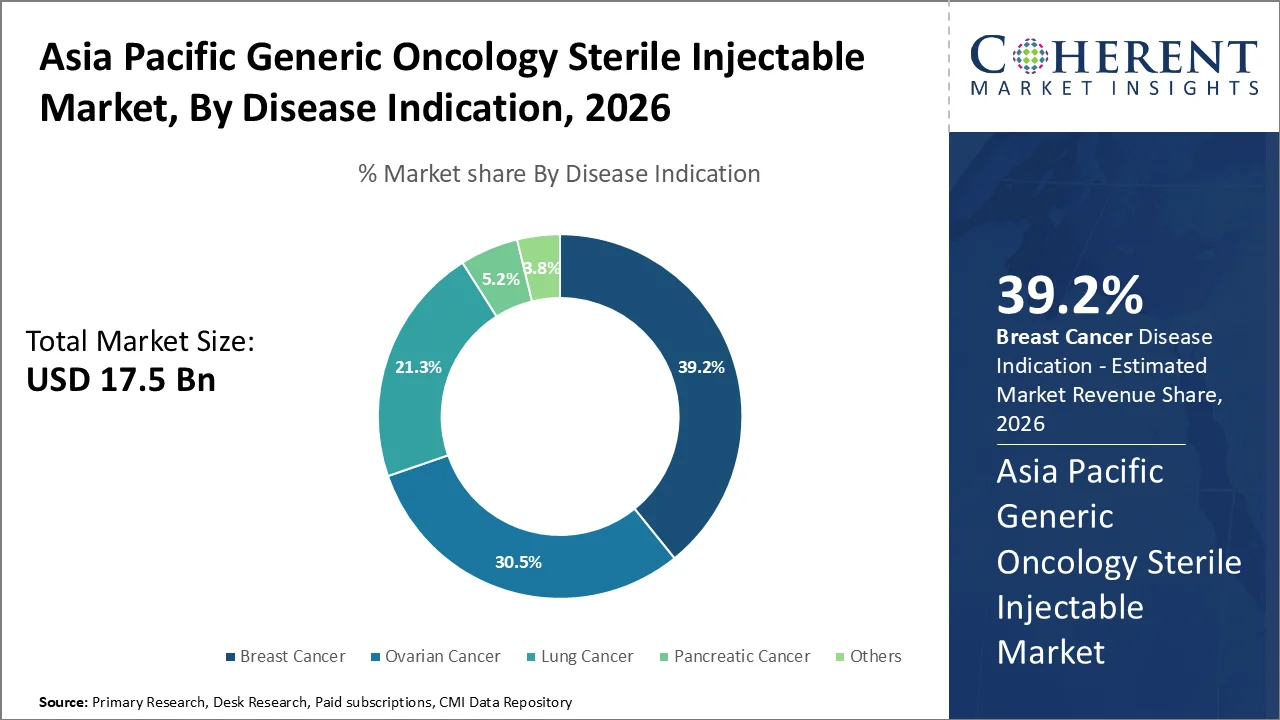
- Breast Cancer expected to hold largest market share of 39.2% in 2026 owing to the high and rising breast cancer incidence in asia pacific. Breast cancer is the most common cancer among women in India, with more than 240,000 new cases and nearly 100,000 deaths reported each year.
- Hospital Pharmacies acquired the largest market share of 43.3% in 2026 owing to its hospital-based administration requirement for oncology injectables.
- Japan is expected to acquire the dominant share of 41.8% in 2026 owing to its rapidly aging population and high cancer prevalence. More than 10% of Japan’s population is aged 80 or older, making it the world’s oldest population and creating significant challenges for the country’s economy, labor force, and social systems.
Current Events and Their Impact on the Asia Pacific Generic Oncology Sterile Injectable Market
Current Event | Description and its Impact |
China’s 2025 National Reimbursement Drug List (NRDL) Reform |
|
Japan’s Accelerated Drug Approval and Reimbursement Reforms |
|
Segmental Insights
- Current Industry Events of 2026
- Market Size Estimation
- Regional Breakdown
- Competitive Landscape
- Customer Intelligence
- Segmental Analysis
- Pricing Analysis
- Key Market Drivers, Challenges & Future Trends
- Customized Insights Section
Breast Cancer expected to hold largest market share
Breast Cancer expected to hold largest market share of 39.2% in 2026 owing to the earlier diagnosis and improved screening programs. High and rising breast cancer incidence among women across Asia Pacific drives demand in the generic oncology sterile injectable market. Breast cancer is the most prevalent cancer among women in Japan, with approximately 90,000–100,000 new cases diagnosed each year. Healthcare systems depend heavily on injectable chemotherapy regimens such as taxanes, anthracyclines, and combination therapies for treatment. Expanding screening programs and earlier diagnosis improve patient access to therapy. Governments support affordability through initiatives and reimbursement programs. Growing hospital infrastructure strengthens treatment delivery, while increasing adoption of biosimilars and cost-effective generics boosts demand for sterile injectable formulations used in breast cancer care.
Why is Monoclonal Antibodies Acquiring the Largest Market Share?
Monoclonal Antibodies hold the largest market share of 38.8% in 2026. Rising cancer prevalence across Asia Pacific drives demand for monoclonal antibodies in the generic oncology sterile injectable market, while increasing preference for targeted therapies further supports their use. According to the National Institutes of Health, more than 2.73 million people in South Korea are cancer survivors, representing approximately 5.3% of the population. The country reports a 5-year relative survival rate of 73.7%, supported by widespread screening and early detection programs, with an annual cancer incidence rate of about 288.6 cases per 100,000 population. Patent expirations of key biologics expand access to biosimilars, encouraging wider adoption. Governments promote affordable cancer care through supportive reimbursement policies and healthcare initiatives. Expanding hospital infrastructure and infusion centers improve treatment delivery capacity. Strong manufacturing bases in India, China, and South Korea secure supply, while physicians increasingly adopt biosimilars and cost-effective treatment options across the region. For instance, in May 2026, Everest Medicines has secured exclusive rights to develop and commercialize Bejescin (MIL62, Obinutuzumab beta Injection), a third-generation anti-CD20 monoclonal antibody, across the Asia-Pacific region.
Which Distribution Channel segment dominates the market?
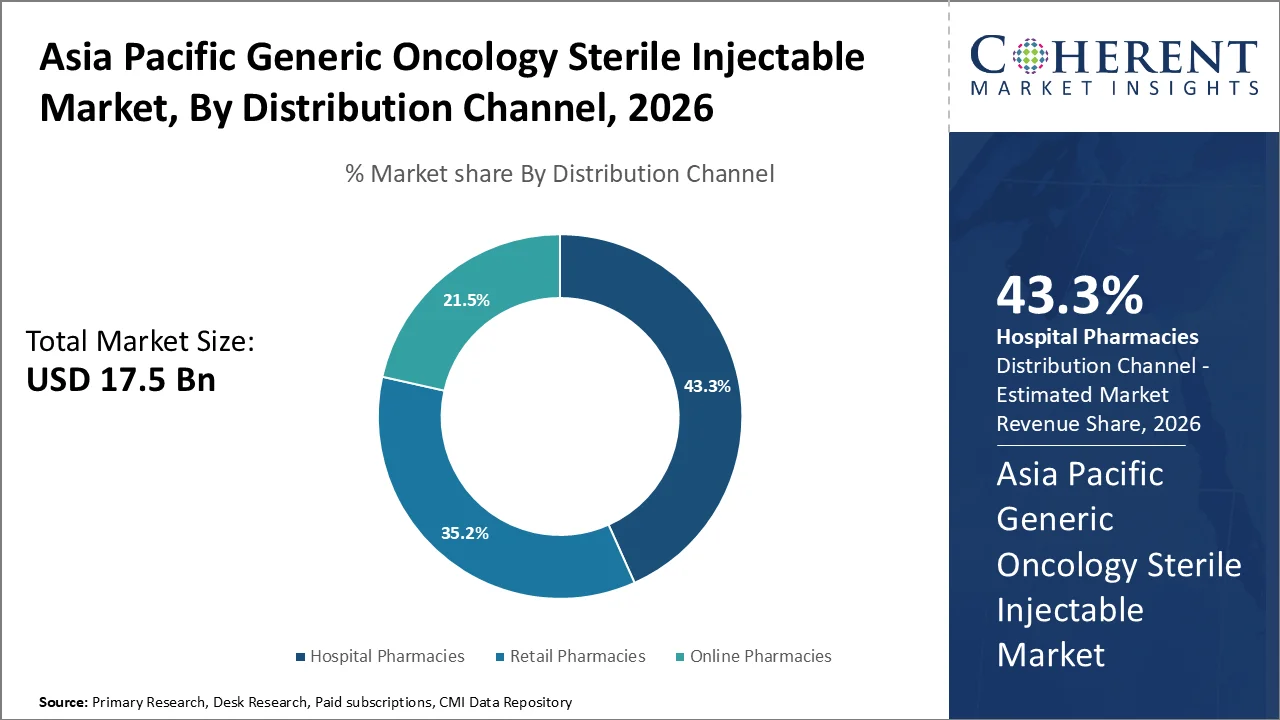
Hospital Pharmacies acquired the largest market share of 43.3% in 2026. Hospital pharmacies drive the Asia Pacific generic oncology sterile injectable market by managing procurement, storage, and dispensing of high-risk chemotherapy drugs. They support hospital-based administration of sterile injectables through infusion centers and oncology wards. Government tender systems and centralized purchasing increase their importance in supply chains. Strict requirements for sterile handling and cold-chain storage reinforce their dominance. Integration with oncology protocols and growing use of biosimilars further enhance their market role.
Asia Pacific Generic Oncology Sterile Injectable Market Trends
- Increasing preference for targeted therapies and monoclonal antibodies drives demand for advanced sterile injectable formulations. The U.S. Food and Drug Administration approved over 100 monoclonal antibody products by 2025, with oncology representing one of the largest therapeutic segments. Many of these therapies are administered intravenously or subcutaneously, supporting demand for sterile injectable manufacturing and administration infrastructure.
- Expanding hospital infrastructure and infusion centers strengthens oncology treatment capacity. India's healthcare infrastructure continues to expand, with the government allocating approximately INR 98,300 crore (USD 11.8 billion) to the health sector in the Union Budget, supporting new hospitals, cancer centers, and treatment facilities that increase demand for injectable oncology drugs.
- Rising government initiatives and reimbursement support programs improve access to oncology treatments. China's 2025 National Reimbursement Drug List (NRDL) added 114 new medicines, including numerous oncology therapies, expanding reimbursement coverage and increasing patient access to hospital-administered cancer treatments.
- Increasing focus on cost-effective cancer care and hospital procurement tenders strengthens demand for generic oncology sterile injectables, as healthcare systems prioritize affordable and high-volume treatment solutions for expanding patient populations.
Regional Insights
Japan dominates owing to strong regulatory framework supporting generics and biosimilars
Japan is expected to acquire the dominant share of 41.8% in 2026. Japan drives the Asia Pacific generic oncology sterile injectable market through its rapidly aging population and high cancer burden, which increase demand for injectable chemotherapy treatments. Japan reports approximately 979,300 new cancer cases annually, with prostate cancer as the most frequently diagnosed type. Lung cancer is the leading cause of cancer-related deaths, followed by colorectal and stomach cancers. Its strong hospital-based oncology system enables widespread use of sterile injectables under clinical supervision. Government-regulated pricing and reimbursement policies promote adoption of cost-effective generics and biosimilars. Advanced oncology infrastructure, strict regulatory standards, and high-quality manufacturing expectations ensure safe drug use. Growing acceptance of biosimilars and guideline-based treatment further strengthen market growth.
China Generic Oncology Sterile Injectable Market Trends
China drives the Asia Pacific generic oncology sterile injectable market through its large cancer patient population and increasing demand for cost-effective chemotherapy treatments. Expanding hospital infrastructure and oncology centers improve access to injectable therapies across urban and rural regions. Government healthcare reforms and national reimbursement policies support wider adoption of generics and biosimilars. Strong domestic pharmaceutical manufacturing capabilities ensure a stable supply of sterile injectables. Rising awareness of early cancer diagnosis and growing use of standardized treatment protocols further strengthen market demand across the country.
Who are the Major Companies in Asia Pacific Generic Oncology Sterile Injectable Industry
Some of the major key players in Asia Pacific Generic Oncology Sterile Injectable are Eli Lily and Company, Biocon Ltd., Sun Pharmaceutical Industries Ltd., Dr. Reddy’s Laboratories Ltd, Baxter International Inc., Hikma Pharmaceuticals, Mylan N.V., Sandoz International GmbH, Teva Pharmaceutical Industries Ltd., and Pfizer Inc.
Key News
- In June 2024, Bridgewest Group, a global private investment firm known for building companies in life sciences, software, and deep tech, has launched a new Contract Development and Manufacturing Organisation (CDMO) focused on sterile injectable drug products. This move follows its recent acquisition of Pfizer’s sterile injectable manufacturing facility in Perth.
Market Report Scope
Asia Pacific Generic Oncology Sterile Injectable Market Report Coverage
| Report Coverage | Details | ||
|---|---|---|---|
| Base Year: | 2025 | Market Size in 2026: | USD 17.5 Bn |
| Historical Data for: | 2020 To 2024 | Forecast Period: | 2026 To 2033 |
| Forecast Period 2026 to 2033 CAGR: | 13.1% | 2033 Value Projection: | USD 27.3 Bn |
| Geographies covered: |
| ||
| Segments covered: |
| ||
| Companies covered: | Eli Lily and Company, Biocon Ltd., Sun Pharmaceutical Industries Ltd., Dr. Reddy’s Laboratories Ltd, Baxter International Inc., Hikma Pharmaceuticals, Mylan N.V., Sandoz International GmbH, Teva Pharmaceutical Industries Ltd., and Pfizer Inc. | ||
Analyst Opinion
- The Asia Pacific generic oncology sterile injectable market is fundamentally driven by clinical necessity rather than discretionary demand. Cancer incidence in the region is among the highest globally, with Asia accounting for nearly 50% of new cancer cases worldwide, forcing healthcare systems to rely heavily on injectable chemotherapy and biosimilar-based regimens as first-line treatment options in both public and private hospitals.
- Breast and lung cancers alone account for a major share of oncology treatment volume in Asia Pacific, with breast cancer being the most frequently diagnosed cancer among women in several countries such as China and India. This creates sustained, repeat-cycle demand for sterile injectables like paclitaxel, doxorubicin, and platinum-based compounds, which remain core components of standardized treatment protocols despite the rise of oral therapies.
- Biosimilar monoclonal antibodies are reshaping treatment access in a very practical way, not theoretical adoption. For example, trastuzumab biosimilars have reduced treatment costs significantly in countries like South Korea and India, enabling broader hospital adoption under public reimbursement programs. Clinical equivalence data across multiple studies has supported substitution in HER2-positive breast cancer treatment pathways, accelerating real-world uptake in hospital oncology departments.
- Hospital dependency is structurally non-negotiable in this market. More than 80% of systemic cancer therapies in major APAC economies are administered through hospital infusion centers, where sterile injectables are prepared and delivered under strict supervision. This ensures that procurement decisions are centralized, volume-driven, and heavily influenced by government tenders rather than retail pharmacy channels, reinforcing the dominance of hospital-based supply chains.
- The market is also being shaped by treatment intensity rather than patient counts alone. Standard chemotherapy regimens for solid tumors often require multiple cycles over several months, with drugs administered in combination protocols. This creates repeated sterile injectable utilization per patient, meaning a single treatment pathway generates sustained demand across multiple drug classes, reinforcing long-term consumption stability within oncology departments.
Speak to the analyst
Want personalized insights?
Take the findings above to one of our principal consultants, or have the report rebuilt around the segments, geographies and competitors you actually track.
Market Segmentation
- By Drug Type (Revenue, USD Bn, 2021-2033)
- Monoclonal Antibodies
- Chemotherapy
- Alkylating Agents
- Antimetabolites
- Plant Alkaloids
- Antitumor Antibiotics
- Others
- Cytokines
- Peptide Hormones
- By Disease Indication (Revenue, USD Bn, 2021-2033)
- Ovarian Cancer
- Breast Cancer
- Lung Cancer
- Pancreatic Cancer
- Others
- By Distribution Channel (Revenue, USD Bn, 2021-2033)
- Hospital Pharmacies
- Retail Pharmacies
- Online Pharmacies
- By Region
- Asia Pacific
- China
- India
- Japan
- Australia
- South Korea
- ASEAN
- Rest of Asia Pacific
- Asia Pacific
Sources
Primary Research interviews
- Oncologists and clinical specialists across Asia Pacific hospitals
- Hospital procurement managers and pharmacy directors
- Pharmaceutical manufacturing and formulation experts
- Distributors and supply chain stakeholders in injectable oncology drugs
- Regulatory and quality compliance professionals in healthcare sector
Databases
- National healthcare and drug regulatory databases (APAC countries)
- Clinical trial registries (oncology injectables and sterile formulations)
- Drug formulation and excipient databases
- Import–export pharmaceutical trade databases
- Hospital procurement and formulary databases
Magazines
- Pharmaceutical industry trade magazines
- Healthcare delivery and hospital management publications
- Oncology-focused medical magazines
- Drug delivery and formulation technology magazines
- Asia Pacific healthcare business magazines
Journals
- Oncology and cancer research journals
- Drug delivery and pharmaceutical sciences journals
- Clinical pharmacology and therapeutics journals
- Sterile manufacturing and aseptic processing journals
- Public health and epidemiology journals
Newspapers
- Leading national business newspapers across Asia Pacific
- Healthcare and medical news sections in major dailies
- Financial newspapers covering pharmaceutical sector developments
- Regional newspapers reporting healthcare policy and drug pricing updates
Associations
- Oncology and cancer research associations in Asia Pacific
- Pharmaceutical manufacturing and sterile injectables industry bodies
- Hospital and healthcare provider associations
- Regulatory and drug safety organizations
- Clinical oncology professional societies
Public Domain sources
- Government health ministry publications and reports
- World health and cancer burden statistics portals
- Public drug pricing and reimbursement policy documents
- Hospital annual reports and tender documents
- International health organization datasets
Proprietary Elements
- CMI Data Analytics Tool
- Proprietary CMI Existing Repository of information for last 10 years
Get access to 250+ pages report
Every segment, forecast, competitor profile and data table behind the analysis above — available for instant download.
- ESOMAR Member
- ISO 9001:2015 Certified
- D-U-N-S Registered
- GDPR & CCPA Compliant
Missing comfort of reading report in your local language? Find your preferred language:
Transform your Strategy with Exclusive Trending Reports
Frequently Asked Questions
The Asia Pacific Generic Oncology Sterile Injectable Market is anticipated to grow at a CAGR of 13.1% with USD 17.5 Bn share in 2026 and is expected to reach USD 27.3 Bn in 2033.
The market is estimated to be valued at USD 17.5 Bn in 2026.
Eli Lily and Company, Biocon Ltd., Sun Pharmaceutical Industries Ltd., Dr. Reddy’s Laboratories Ltd, Baxter International Inc., Hikma Pharmaceuticals, Mylan N.V., Sandoz International GmbH, Teva Pharmaceutical Industries Ltd., and Pfizer Inc are some of the prominent players operating in the market.
The market is expected to be valued at USD 27.3 Bn in 2033.
Japan is the prominent region in the market.
Patent expiry of biologics and rising incidence of cancer are some of the factors, which are expected to drive the growth of the market.