

Global Propeller Shafts Market Size and Forecast – 2026 To 2033
The global propeller shafts market is expected to grow from USD 9.50 Bn in 2026 to USD 13.50 Bn by 2033, registering a compound annual growth rate (CAGR) of 5.1% from 2026 to 2033. The global propeller shafts market is driven by expansion of logistics and transportation activities. On May 4, 2026, Amazon announced the launch of Amazon Supply Chain Services (ASCS), which extends the company’s entire portfolio of freight, distribution, fulfillment, and parcel shipping solutions to businesses of all types and sizes.
Key Takeaways of the Global Propeller Shafts Market
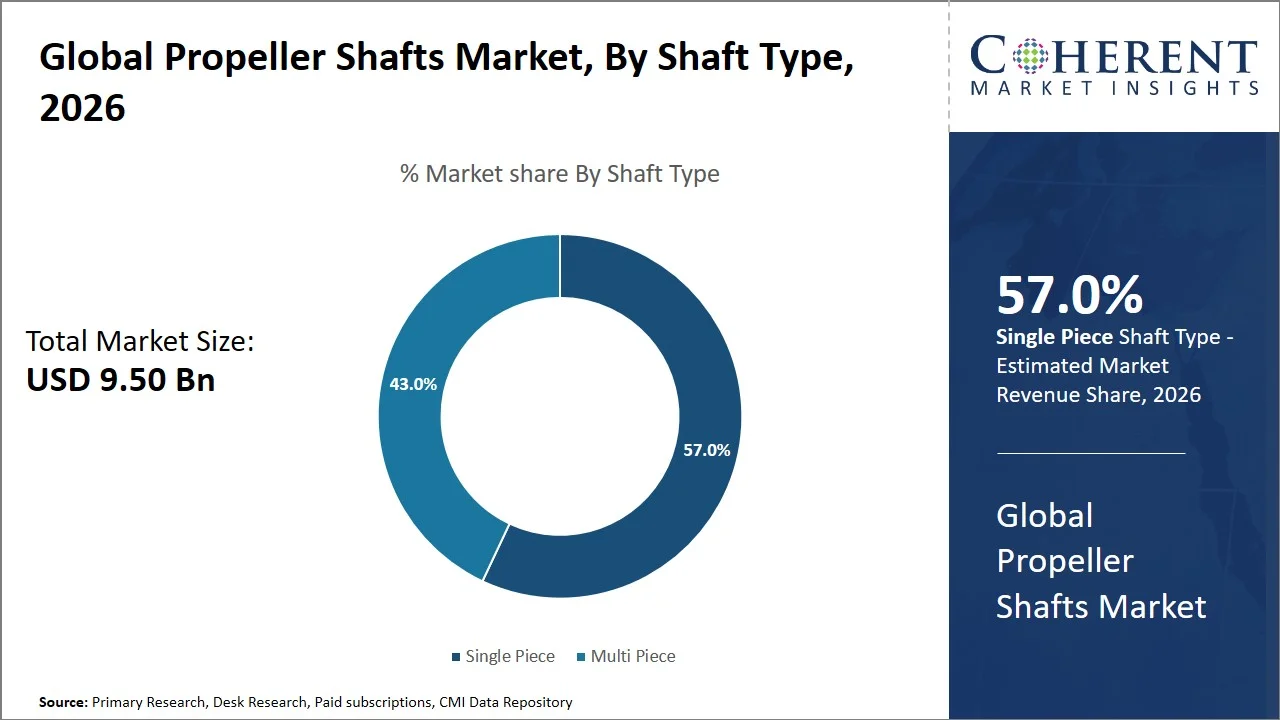
- The Single Piece segment is expected to account for 57.0 % of the global propeller shafts market share in 2026. Growing replacement demand from aging vehicle fleets is driving the growth of the segment. On June 11, 2026, Dana announced a planned combination with Eaton Mobility valued at almost USD 5.1 billion. The transaction specifically targets resilient aftermarket demand as U.S. consumers retain vehicles longer because of inflation and elevated new vehicle prices.
- The Rear Wheel Drive segment is estimated to capture 41.0 % of the market share in 2026. Expansion of hybrid vehicle platforms is majorly driving the growth of the segment. In April 2025, Hyundai Motor Group unveiled its next-generation hybrid system. The 2.5-liter turbo hybrid system is designed for both front-wheel-drive and rear-wheel-drive applications.
- The Steel segment is estimated to capture 38.0 % of the market share in 2026. Increasing use of advanced composite materials is majorly driving the growth of the segment. On October 27, 2025, Hyundai Motor Group and Toray Industries, Inc. signed a Strategic Joint Development Agreement to collaborate on advanced materials and components innovation, aiming to set new standards in future mobility.
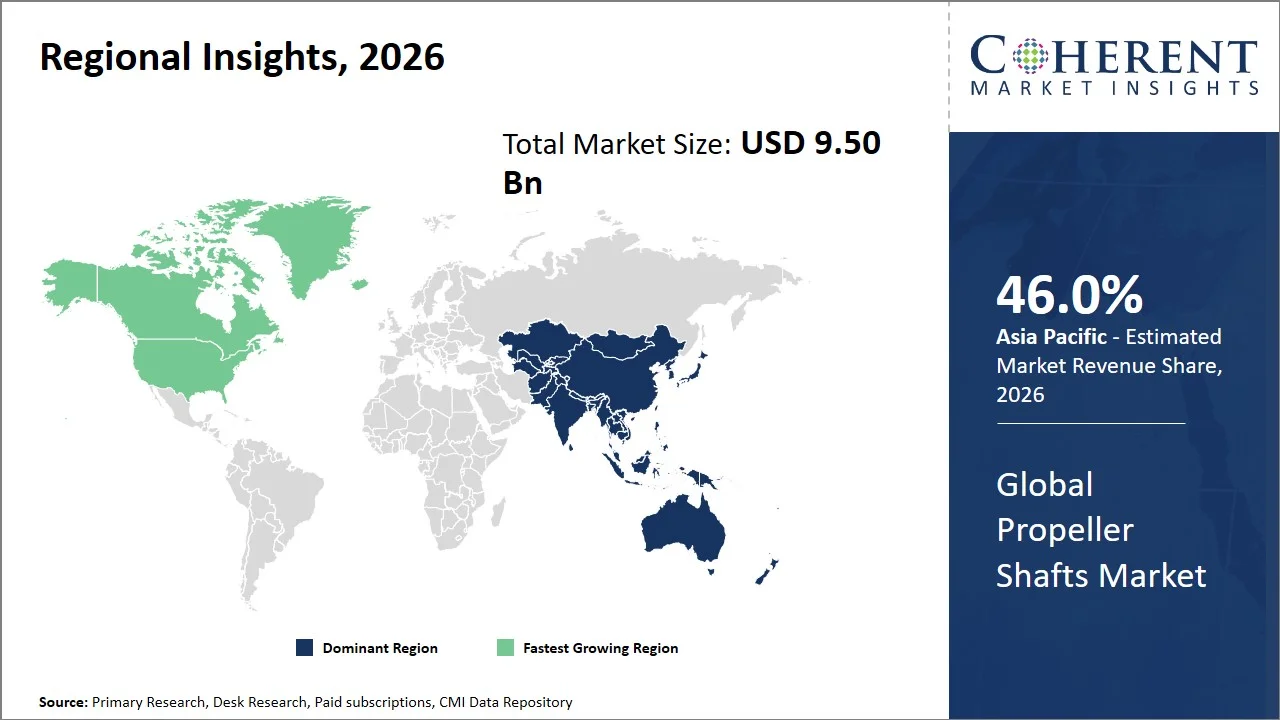
- Asia Pacific is expected to dominate the propeller shafts market in 2026 with a market share of 46.0 %. Growth of aftermarket replacement components in Asia Pacific is driving the growth of the regional market. On February 18, 2026, Valeo announced more than USD 200 million of planned investment in India. The company aims to triple Indian sales by 2028 while increasing manufacturing localization.
- North America is expected to account for 23.0 % share in 2026 and is projected to record the fastest growth over the forecast period. Integration of advanced vibration reduction technologies in North America is driving the growth of the regional market. For instance, in 2025, Neapco received a U.S. patent for an improved propeller shaft damper with a retention lip. The design protects the tuned damper from displacement while maintaining its vibration absorption function.
Segmental Insights
Why Does Single Piece Dominate the Global Propeller Shafts Market?
The single piece segment is expected to account for 57.0% of the global propeller shafts market share in 2026. Single piece propeller shafts are easier to manufacture and install having less connecting components in the drivetrain construction. Require fewer joints in general. Less risk for vibration and less maintenance sites. They are just designed to be an efficient power transfer on a lot of vehicle chassis. Plus, the quicker production procedures and better integration with conventional drivetrains are a plus for manufacturers. These benefits make single piece shafts especially suitable for applications needing reliable and economical torque transfer. In June 2026, the Society of Automotive Engineers published research on supercritical behavior in single-piece composite driveshafts. The work highlights continuing engineering development around lightweight single-piece shaft structures.
- Current Industry Events of 2026
- Market Size Estimation
- Regional Breakdown
- Competitive Landscape
- Customer Intelligence
- Segmental Analysis
- Pricing Analysis
- Key Market Drivers, Challenges & Future Trends
- Customized Insights Section
Why is Rear Wheel Drive the Most Preferred Drivetrain?
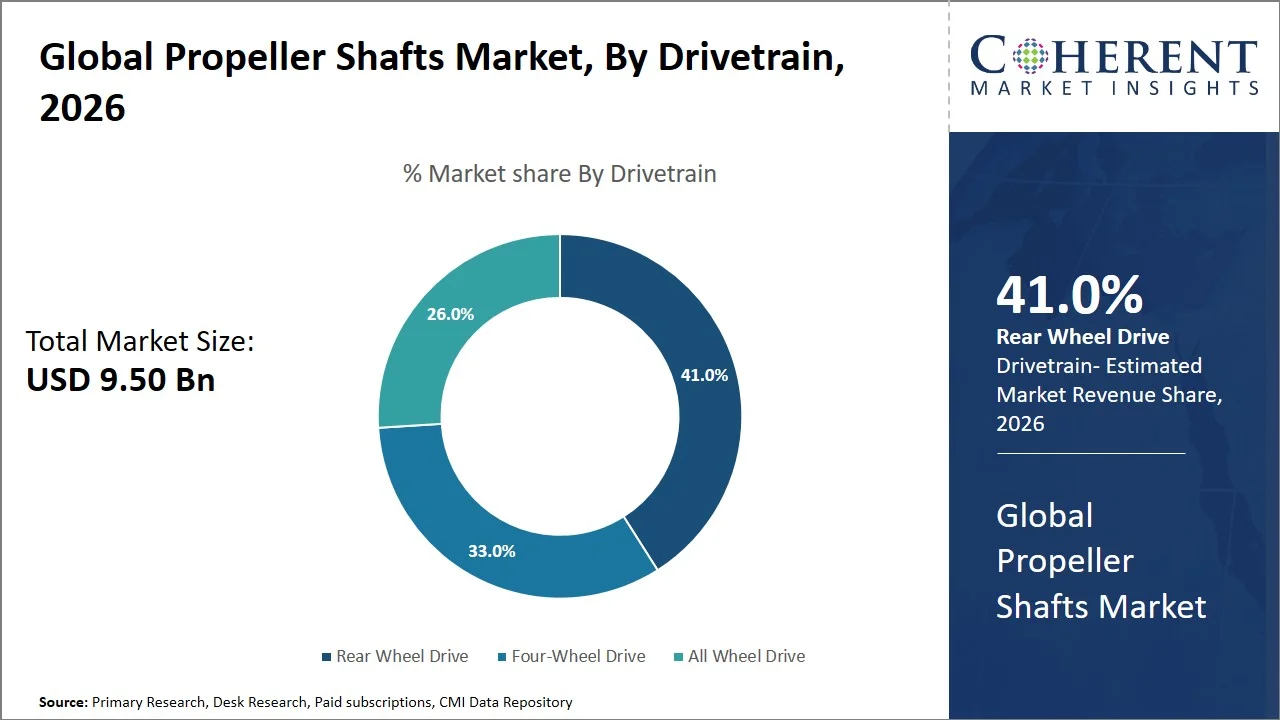
The rear wheel drive segment is expected to account for 41.0% of the global propeller shafts market share in 2026. For cars that need good acceleration and load carrying capability, rear wheel drive is a good way to transmit torque. The drivetrain transmits propulsion forces to the rear wheels when accelerating. This configuration enhances traction management in performance vehicles and commercial applications. It also has balanced vehicle dynamics and predictable handling characteristics. These advantages make rear wheel drive a great choice for pickups, performance cars and heavy commercial vehicles. On March 31, 2026, BMW introduced the BMW iX3 40, the second drive system variant of the fully electric Neue Klasse Sports Activity Vehicle. Equipped with a 320 hp electric motor and rear-wheel drive, the new model variant shares both its styling and standout technological innovations with the BMW iX3 50 xDrive.
Steel Dominates the Global Propeller Shafts Market
The steel segment is expected to account for 38.0% of the global propeller shafts market share in 2026. Steel offers high tensile strength and durability under demanding drivetrain operating conditions. It is resistant to torsional loads and provides reliable power transmission for a variety of automotive applications. Steel manufacturing methods are very well established and consistent production at low pricing is possible. Steel propeller shafts can tolerate repeated mechanical loads and temperature changes during vehicle operation. These properties make steel a suitable material for big volume car drivetrain manufacture. For instance, Dana expanded its Spicer Life Series line of driveshafts for light-, medium- and heavy-duty commercial vehicles. The range is designed for demanding applications requiring reliable and robust torque transmission and drivetrain operation.
Current Events and their Impact
Current Events | Description and its Impact |
U.S Environmental Protection Agency Motor Vehicle Greenhouse Gas Rule |
|
India Motor Vehicle Regulations Amendments |
|
U.S Environmental Protection Agency Heavy-Duty Vehicle Phase 3 Rule |
|
Propeller Shafts Market Dynamics
Market Drivers
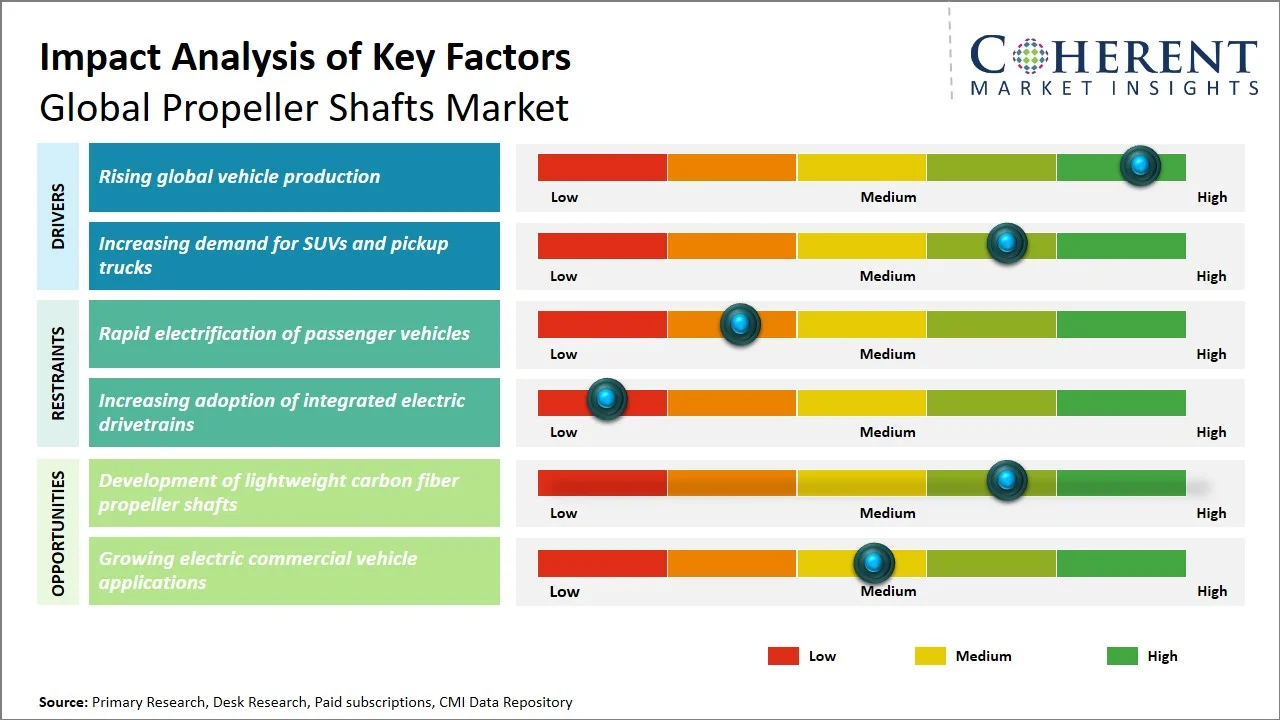
- Rising global vehicle production: Demand for propeller shafts is rising across passenger and commercial vehicle platforms owing to increasing global vehicle production. Increasing demand for SUVs and pickup vehicles also supports needs for durable drivetrain components. These vehicles often require high torque transmission and more powerful drivetrain systems under tough operating conditions. Manufacturers are consequently integrating propeller shafts across platforms using rear wheel drive, four-wheel drive and all-wheel drive combinations. This trend is driving demand for components as car production ramps up in key automotive manufacturing regions. On August 26, 2026, Hyundai stated it would build 1.27 million units of worldwide production capacity by 2030. The company also expects to introduce and renew over 100 vehicles globally.
- Increasing demand for SUVs and pickup trucks: Increasing demand for SUVs and pick-up trucks is fueling the demand for robust propeller shafts in the worldwide automotive markets. These cars often have rear-wheel drive, four-wheel drive or all-wheel drive setups. Such drivetrains need components that can transmit large torque between the transmission and the driving axles. Thus, the growing consumer preference for larger automobiles is driving the demand for stronger and more dependable shaft assemblies. Pickup trucks also require tough drivetrain components for towing, hauling cargo, and tough working conditions. On June 10, 2025, General Motors announced a USD 4 billion investment to expand production of gasoline powered full size sport utility vehicles and light duty pickup trucks. Production at Orion Assembly is scheduled to begin in 2027. The investment was explicitly linked to continued customer demand.
Emerging Trends
- Lightweight Propeller Shaft Development: Manufacturers are creating lightweight steel, aluminum, and composite propeller shafts to cut vehicle weight. The lighter the component, the better the fuel economy and performance of the vehicle. This trend is especially relevant for hybrid vehicles and efficiency-driven vehicle platforms.
- Increasing Adoption of Carbon Fiber Shafts: Carbon fiber propeller shafts are becoming more popular due to their lightweight, high torsional strength, and vibration-damping properties. They are increasingly being used in performance vehicles and premium applications that require better drivetrain efficiency and lower spinning mass.
- Growing Integration with Electrified Drivetrains: Hybrid vehicles are driving new demands for compact and efficient powertrain parts. Propeller shaft manufacturers are creating designs that are compatible with hybrid topologies. These advancements satisfy torque transmission requirements while allowing for tighter packaging limitations in electrified vehicle platforms.
- Advanced Manufacturing and Precision Technologies: Manufacturers are utilizing automated balancing, precision machining and advanced welding technologies in the production of propeller shafts. These innovations improve dimensional accuracy, minimize vibration and improve durability. Digital quality monitoring is also assisting in maintaining constant component performance in high volume manufacturing.
Regional Insights
Why is Asia Pacific a Strong Market for Propeller Shafts?
Asia Pacific is expected to account for a market share of 46.0% in 2026. The Asia Pacific region is well-placed with dense automobile production networks in China, Japan, India, and South Korea. China, Japan, and India together will build 48.6 million vehicles in 2025. Regional providers such as NTN Corporation and Hyundai Wia sustain the primary driveline operations. In China, clusters in Jiangsu and Zhejiang provide precise machining and the manufacture of drivetrain components. India is increasing component manufacturing through production-linked incentives. Japan provides high-tech metallurgy and automated manufacturing expertise. Increasing manufacturing of commercial vehicles in Southeast Asia is also driving demand. Indonesia, Thailand, and Malaysia provide additional assembly and component manufacturing opportunities.
Why Does North America Propeller Shafts Market Exhibit High Growth?
North America is expected to register the fastest growth with a CAGR of 6.3% over the forecast period. It is projected to account for 23.0% of the global propeller shafts market in 2026. North America benefits from strong pickup truck, sport utility vehicle, and commercial vehicle production. The United States represents the region’s primary demand center for automotive axle and propeller shaft systems. Mexico has become increasingly important for axle casting, machining, and drivetrain assembly. United States-Mexico-Canada Agreement rules support regional sourcing and manufacturing integration. Japanese automakers have invested more than USD 61.6 billion across 24 U.S. manufacturing plants. These facilities support localized drivetrain component requirements and supplier development. Electric pickup programs are also creating demand for specialized shaft and drivetrain assemblies.
Global Propeller Shafts Market Outlook for Key Countries
Why is China Emerging as a Major Hub in the Propeller Shafts Market?
China benefits from a large automobile production ecosystem and a broad range of automotive component suppliers. Demand is being supported by major manufacturers including BYD, Geely and Changan across a number of drivetrain architectures. Wanxiang Qianchao, Xuchang Yuandong Drive Shaft, Guansheng vehicle Parts Manufacture offer vehicle programs at home and abroad. Jiangsu, Zhejiang, Hubei and Guangdong are key concentrations of drivetrain production. The emergence of new energy vehicles is forcing vendors to rethink the shaft designs to reach lighter and more compact structures. Chinese vendors are also developing component localization and export capabilities. Such improvements deepen domestic manufacturing and bolster regional supply chains.
Is U.S. the Next Growth Engine for the Propeller Shafts Market?
The U.S. market is heavily supported by high demand for pickup trucks, sport utility vehicles, and four-wheel drive cars. The country has more than 280 million vehicles on its roads. Large production networks of major automotive manufacturers are located in Michigan, Texas, Kentucky, Alabama and Tennessee. Japanese carmakers have developed 24 production units across the country. United States-Mexico-Canada Agreement regional sourcing rules boost local component sourcing. Electric pickup projects are putting further demands on modern drive-train assembly. Good aftermarket demand also exists for replacement propeller shafts for aged vehicle fleets.
Germany Propeller Shafts Market Analysis and Trends
Germany benefits from the concentration of luxury automobile manufacturers and strong drivetrain engineering capabilities. Volkswagen, Mercedes Benz, BMW and Porsche have extensive manufacturing and development facilities across the country. German suppliers such as ZF Friedrichshafen and Schaeffler provide innovative drivetrain technologies. Lightweight materials and precision balancing continue to be major development priority for German vehicle platforms. However, local vehicle production is being pressured by the growing competition from Chinese electric vehicles. The suppliers are responding to this by diversifying automotive technologies into robotics, medical technology, defense and space applications.
Japan Propeller Shafts Market Analysis and Trends
Japan is still relevant because of its sophisticated car manufacturing infrastructure and deep indigenous drivetrain engineering expertise. Toyota, Nissan, Honda and Subaru have wide production networks supporting a variety of car architectures. Japanese vendors, such as NTN Corporation, JTEKT Corporation, Showa Corporation and Yamada Manufacturing, focus on precision drivetrain components. Subaru’s emphasis on all wheel drive cars results in particular requirements for propeller shaft assemblies. Japanese manufacturers also focus on lightweight construction, advanced metallurgy and automated manufacturing processes. These qualities help provide reliable shaft performance and reduce vibration and rotational mass. Japan’s engineering expertise strengthens its position in premium and technologically advanced drivetrain applications.
India Propeller Shafts Market Analysis and Trends
India is benefiting from expanding passenger vehicle, sport utility vehicle, and commercial vehicle production. Utility vehicle growth is particularly important because many newer platforms use stronger drivetrain architectures. Localized automotive component manufacturing and investment are being boosted by production-linked incentive schemes. Access to major vehicle manufacturers and tier-one suppliers is available in established automotive clusters like as Pune, Chennai and others. Indian vendors are also boosting exports to multinational car assembly operations. The needs for sturdy shafts with the ability to take larger torque loads are increased by the demands for commercial vehicles. Infrastructure development and logistics activity further support heavy vehicle utilization.
Global Propeller Shafts Market - Carbon Fiber Propeller Shaft Adoption (2025)
Metric | Data |
Carbon fiber shaft share | 11.4% estimated penetration |
Carbon fiber market share | 36.65% estimated non steel share context |
Asia Pacific share | 38.6% Asia Pacific share |
North America share | 34.2% North America share |
Passenger vehicle application | 42.3% passenger vehicle application |
Original Equipment Manufacturer share | 61.2% Original Equipment Manufacturer share |
Single piece shaft share | 52.3% single piece shaft share |
How is Development of Lightweight Carbon Fiber Propeller Shafts Creating New Growth Opportunities in the Propeller Shafts Market?
Development of lightweight carbon fiber propeller shafts is creating opportunities by reducing rotating mass while maintaining high torsional performance. Hitachi Automotive Systems developed CFRP shafts for rear wheel drive and all-wheel drive passenger cars. Its Alfa Romeo Giulia shaft reduced weight by approximately 5 kilograms compared with conventional steel. Due to the high specific stiffness the carbon fiber allows for longer shafts without intermediate bearings. Another value proposition pointed out by DYNEXA is the lower needs for bearing and universal joint.
A 2024 study also indicated a significant mass reduction for carbon fiber shafts in light commercial vehicle applications. These improvements generate opportunity for vendors that are focused on premium automobiles, performance vehicles and lightweight commercial platforms. Nissan has carried over carbon fiber driveshaft technology in its Z performance vehicle lineage, ahead of the new 2026 manual transmission option. The Z continues to utilize lightweight shaft technology in performance drive trains. Toray kept developing carbon fiber reinforced polymer technology for automotive use. The plan is focused on lighter mobility components with better structural performance and production efficiency.
Market Players, Key Development, and Competitive Landscape
Key Developments
- On February 3, 2026, Dauch Corporation announced it has completed its previously announced acquisition of Dowlais Group plc (Dowlais) and its subsidiaries, GKN Automotive and GKN Powder Metallurgy.
- On July 15, 2025, American Axle & Manufacturing Holdings, Inc. (AAM) announced that at a special meeting of its stockholders held in connection with AAM’s recommended offer to acquire Dowlais Group plc, AAM Stockholders approved all proposals related to the Combination as described in AAM’s definitive proxy statement filed with the U.S. Securities and Exchange Commission.
Competitive Landscape
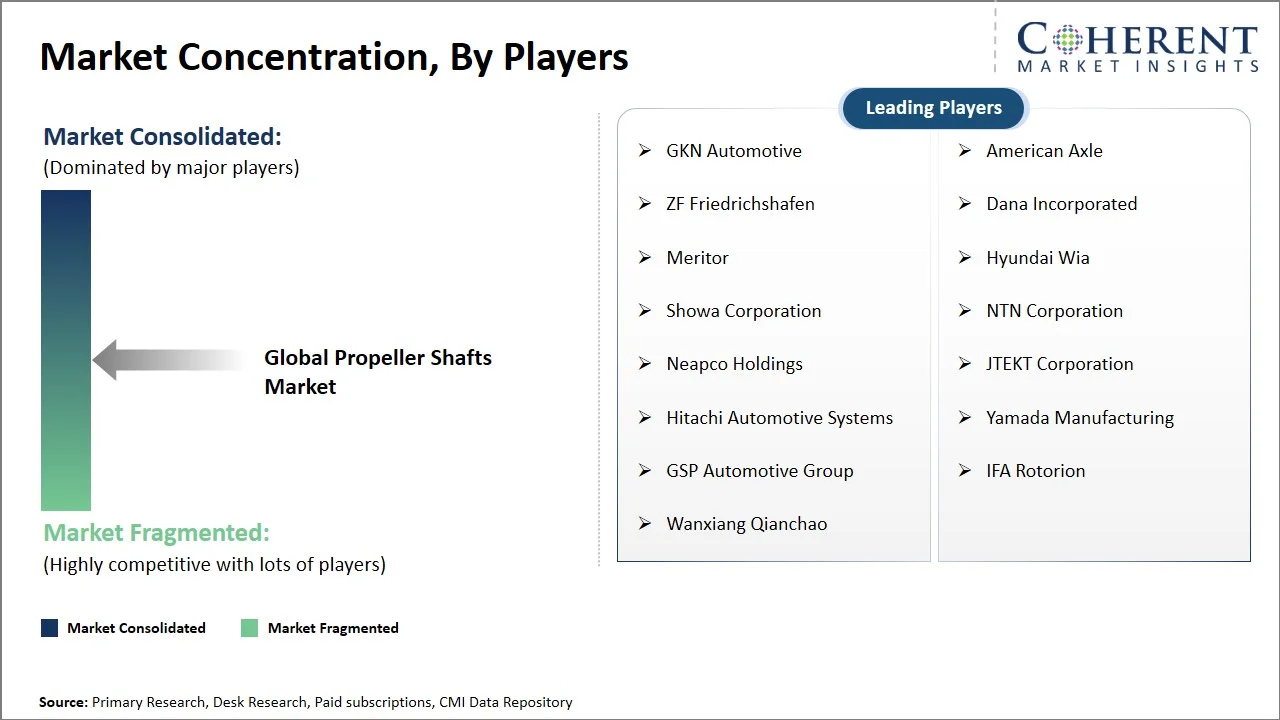
GKN Automotive remains a major competitor through modular lightweight propeller shaft systems and complete all-wheel drive integration. Its modular concept uses high strength tubular shafts, constant velocity joints, and Direct Torque Flow interfaces. American Axle & Manufacturing focuses heavily on rear wheel drive and all-wheel drive platforms. It offers driveline solutions for passenger automobiles, light trucks and commercial vehicles. ZF Friedrichshafen is a global leader in integrated driveline engineering and precision components for car development. Dana Incorporated is a leader in light duty, commercial and off highway drivelines. Japanese suppliers including JTEKT Corporation and NTN Corporation emphasize precision manufacturing and joint technologies.
Market Report Scope
Propeller Shafts Market Report Coverage
| Report Coverage | Details | ||
|---|---|---|---|
| Base Year: | 2025 | Market Size in 2026: | USD 9.50 Bn |
| Historical Data for: | 2020 To 2024 | Forecast Period: | 2026 To 2033 |
| Forecast Period 2026 to 2033 CAGR: | 5.1% | 2033 Value Projection: | USD 13.50 Bn |
| Geographies covered: |
| ||
| Segments covered: |
| ||
| Companies covered: | GKN Automotive, American Axle, ZF Friedrichshafen, Dana Incorporated, Meritor, Hyundai Wia, Showa Corporation, NTN Corporation, Neapco Holdings, JTEKT Corporation, Hitachi Automotive Systems, Yamada Manufacturing, GSP Automotive Group, IFA Rotorion, Wanxiang Qianchao | ||
| Growth Drivers: |
| ||
| Restraints & Challenges: |
| ||
Analyst Opinion (Expert Opinion)
- The industry is expected to shift toward lightweight propeller shafts supporting hybrid, all-wheel drive, and performance vehicles. Carbon fiber and advanced tubular steel should gain greater attention where weight reduction directly improves drivetrain efficiency. Multi piece architectures should remain important for longer wheelbase sport utility vehicles and light commercial vehicles. China and India should provide strong opportunities because their vehicle manufacturing ecosystems continue expanding. GKN Automotive is already emphasizing modular lightweight propeller shaft systems for hybrid and internal combustion applications.
- The strongest opportunities should emerge in lightweight shafts for sport utility vehicles, pickup trucks, and hybrid platforms. Carbon fiber should remain particularly attractive for premium vehicles requiring lower rotating mass and improved vibration control. North America should have considerable potential for pickup and commercial vehicle uses. China should provide opportunities for localized component development supporting domestic vehicle manufacturers. India should become increasingly important for cost optimized shafts serving passenger and commercial vehicle production.
- Manufacturers should create modular shaft topologies for various vehicle sizes and powertrain types. Advanced balancing, vibration control, lightweight materials and automated manufacturing should be the focus of investments. Suppliers must establish early engineering relationships with vehicle manufacturers to get into the platform level of design. Localized production in China and India could improve supply responsiveness and manufacturing competitiveness. Companies should also develop hybrid compatible shafts instead of relying exclusively on conventional internal combustion vehicle applications.
Speak to the analyst
Want personalized insights?
Take the findings above to one of our principal consultants, or have the report rebuilt around the segments, geographies and competitors you actually track.
Market Segmentation
- Shaft Type Insights (Revenue, USD Billion, 2021 - 2033)
- Single Piece
- Multi Piece
- Drivetrain Insights (Revenue, USD Billion, 2021 - 2033)
- Rear Wheel Drive
- Four-Wheel Drive
- All Wheel Drive
- Material Insights (Revenue, USD Billion, 2021 - 2033)
- Steel
- Aluminum
- Carbon Fiber
- Composite
- Application Insights (Revenue, USD Billion, 2021 - 2033)
- Automotive
- Marine
- Aerospace
- Industrial Machinery
- Regional Insights (Revenue, USD Billion, 2021 - 2033)
- North America
- U.S.
- Canada
- Latin America
- Brazil
- Argentina
- Mexico
- Rest of Latin America
- Europe
- Germany
- U.K.
- Spain
- France
- Italy
- Russia
- Rest of Europe
- Asia Pacific
- China
- India
- Japan
- Australia
- South Korea
- ASEAN
- Rest of Asia Pacific
- Middle East
- GCC Countries
- Israel
- Rest of Middle East
- Africa
- South Africa
- North Africa
- Central Africa
- North America
- Key Players Insights
- GKN Automotive
- American Axle
- ZF Friedrichshafen
- Dana Incorporated
- Meritor
- Hyundai Wia
- Showa Corporation
- NTN Corporation
- Neapco Holdings
- JTEKT Corporation
- Hitachi Automotive Systems
- Yamada Manufacturing
- GSP Automotive Group
- IFA Rotorion
- Wanxiang Qianchao
Sources
Primary Research Interviews
- Propeller Shaft Manufacturers & OEM Suppliers
- Marine & Automotive Drivetrain Engineers
- Fleet Operators & Shipbuilding Companies
- Industrial Machinery & Power Transmission Specialists
Magazines
- Marine Technology Magazine
- Power Transmission Engineering Magazine
- Maritime Reporter & Engineering News
Journals
- Journal of Marine Engineering & Technology
- International Journal of Automotive Technology
- Journal of Mechanical Engineering Science
Associations
- Society of Automotive Engineers (SAE International)
- International Maritime Organization (IMO)
- Society of Naval Architects and Marine Engineers (SNAME)
- Power Transmission Distributors Association (PTDA)
Public Domain Sources
- U.S. Bureau of Transportation Statistics (BTS)
- European Maritime Safety Agency (EMSA) Reports
- United Nations Conference on Trade and Development (UNCTAD) Maritime Reports
- U.S. Department of Commerce – International Trade Administration
Proprietary Elements
- CMI Data Analytics Tool
- Proprietary CMI Existing Repository of Information for the Last 10 Years
Get access to 250+ pages report
Every segment, forecast, competitor profile and data table behind the analysis above — available for instant download.
- ESOMAR Member
- ISO 9001:2015 Certified
- D-U-N-S Registered
- GDPR & CCPA Compliant
Missing comfort of reading report in your local language? Find your preferred language:
Transform your Strategy with Exclusive Trending Reports
Frequently Asked Questions
The global propeller shafts market is expected to stand at USD 9.50 Bn in 2026 and is expected to reach USD 13.50 Bn by 2033.
The CAGR of the global propeller shafts market is projected to be 5.1% from 2026 to 2033.
A propeller shaft transfers rotational torque from the transmission or transfer case to the driven axle.
Pickup trucks require durable shafts capable of transferring high torque during towing and heavy-load operation.
Hybrid platforms encourage compact and lightweight shaft designs compatible with increasingly integrated drivetrain architectures.
Aging vehicle fleets require replacement shafts, joints, bearings, and related drivetrain components throughout their operating lives.
Precision balancing minimizes vibration and supports smoother operation at high rotational speeds.