

Global Refrigerated Display Cases Market Size and Forecast – 2026 To 2033
The global refrigerated display cases market is expected to grow from USD 14 Bn in 2026 to USD 23 Bn by 2033, registering a compound annual growth rate (CAGR) of 7.2% from 2026 to 2033. The global refrigerated display cases market is driven by growth of convenience stores and organized food retail. On August 3, 2026, Seven-Eleven announced plans to add approximately 1,000 stores in Japan and 1,300 new locations worldwide.
Key Takeaways of the Global Refrigerated Display Cases Market
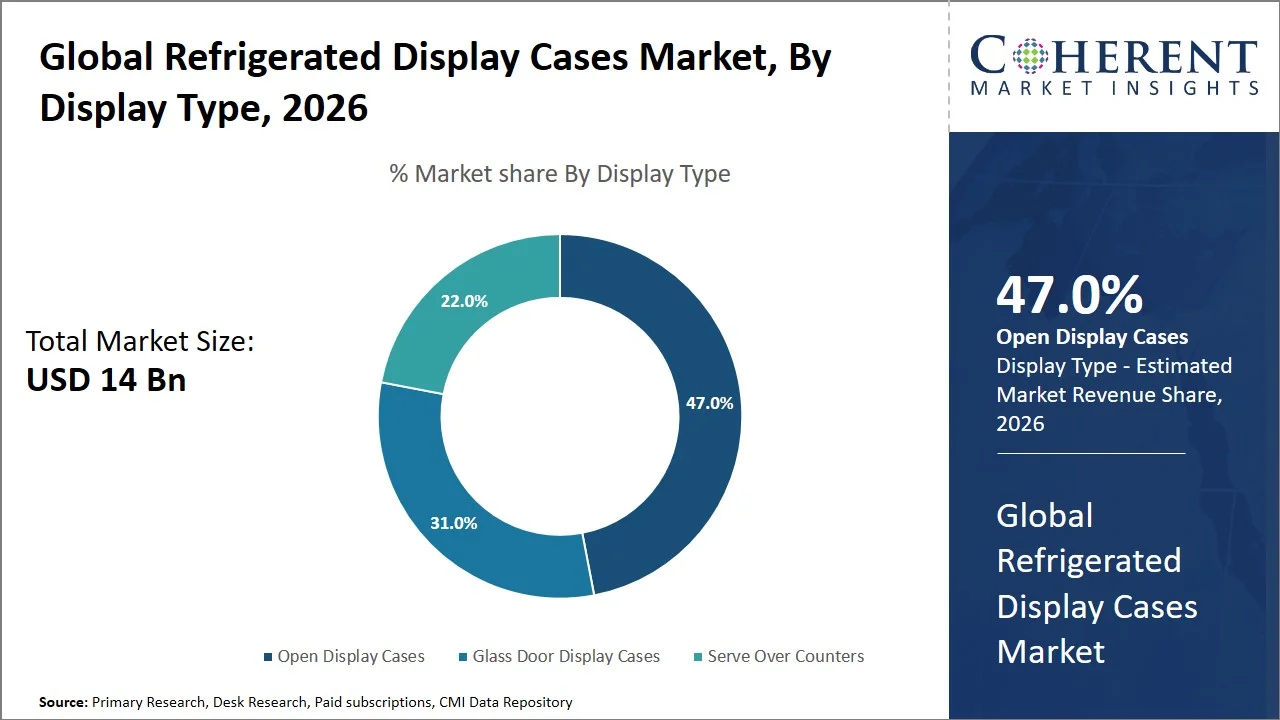
- The Open Display Cases segment is expected to account for 47.0 % of the global refrigerated display cases market share in 2026. Rising demand for ready to eat meals and chilled beverages is driving the growth of the segment. On February 19, 2026, PepsiCo announced it is entering into a new food category with the launch of a ready-to-heat range of vegetable soups under its Alvalle brand.
- The Vertical segment is estimated to capture 63.0 % of the market share in 2026. Growing demand for improved product visibility in retail stores is majorly driving the growth of the segment. On June 11, 2025, Epta unveiled UNIT, the first Iarp-branded refrigerated display case developed entirely under circular economy principles.
- The Supermarkets and Hypermarkets segment is estimated to capture 35.0 % of the market share in 2026. Growth of grocery delivery and omnichannel retail is driving the growth of the segment. On April 15, 2026, Walmart redesigned its Great Value private-label packaging with a more modern visual identity intended to improve shopping accessibility across physical stores and digital platforms.
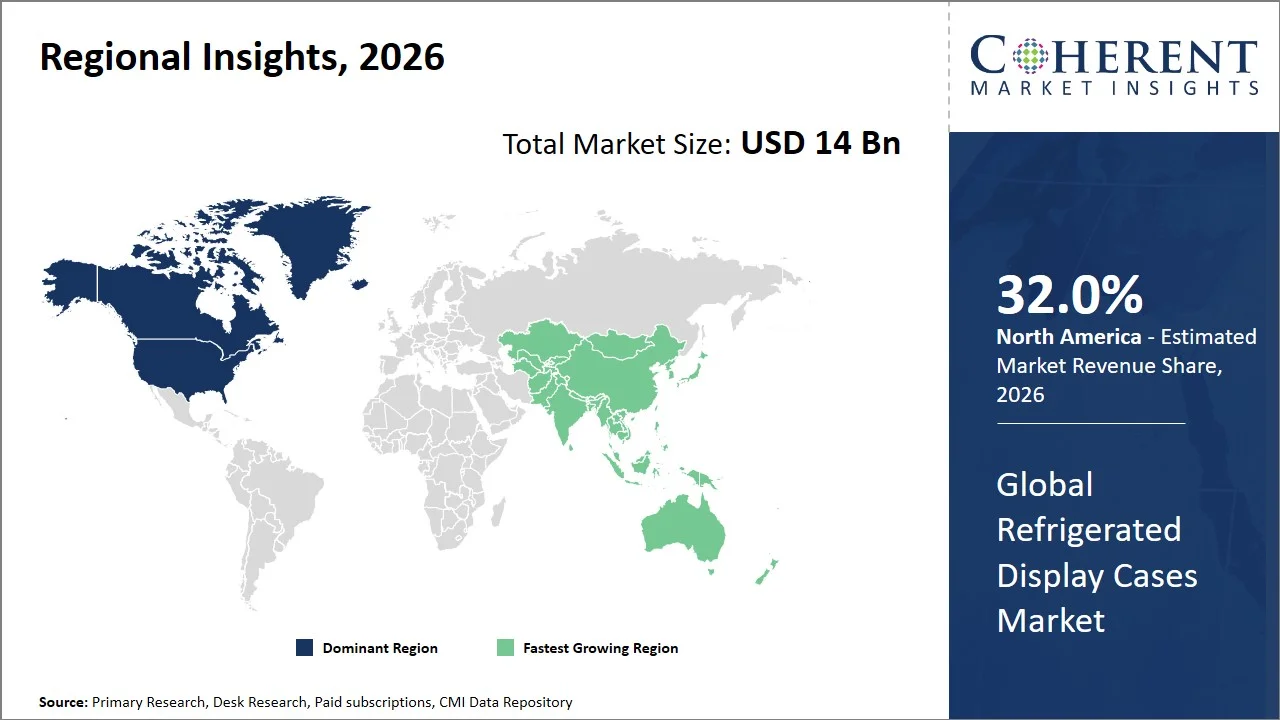
- North America is expected to dominate the refrigerated display cases market in 2026 with a market share of 32.0 %. Increasing adoption of natural refrigerant based systems in North America is driving the growth of the regional market. On March 17, 2026, Zero Zone introduced the Genesys CO₂ Edge Compact, a transcritical CO₂ condensing unit designed for smaller commercial refrigeration applications, with a capacity range of 3-12 TR and operating capability from approximately -20°F to 105°F.
- Asia Pacific is expected to account for 24.0% share in 2026. Growth of modern grocery retail in India and Southeast Asia is driving the growth of the regional market. In June 2026, Reliance Retail reported that its Smart Bazaar network crossed 1,000 stores, with a substantial portion of the network now serving Tier 2 and smaller markets.
Segmental Insights
Why Does Open Display Cases Dominate the Global Refrigerated Display Cases Market?
The open display cases segment is expected to account for 47.0% of the global refrigerated display cases market share in 2026. Open display cases are well positioned, since they enable unimpeded product exposure and allow customers to rapidly get chilled food and drinks without opening doors. This makes them especially well-suited for high-traffic supermarkets, convenience stores and foodservice outlets. The open-front design facilitates quick merchandising and frequent replenishing of products and allows retailers to construct appealing displays for fresh produce, dairy products, beverages and ready-to-eat foods, thus boosting shopping convenience and encouraging impulse purchases. For instance, in 2025, Hussmann's S5S-S self-contained multi-deck merchandiser for packaged foods, produce, meal kits, fresh meat, beverages, wine, flower products and dairy, which comes in 3-foot and 4-foot versions was introduced. The design specifically combines open self-service access with compact dimensions, making it relevant to retailers seeking additional refrigerated selling space without committing to large remote supermarket cases.
- Current Industry Events of 2026
- Market Size Estimation
- Regional Breakdown
- Competitive Landscape
- Customer Intelligence
- Segmental Analysis
- Pricing Analysis
- Key Market Drivers, Challenges & Future Trends
- Customized Insights Section
Why is Vertical the Most Preferred Design?
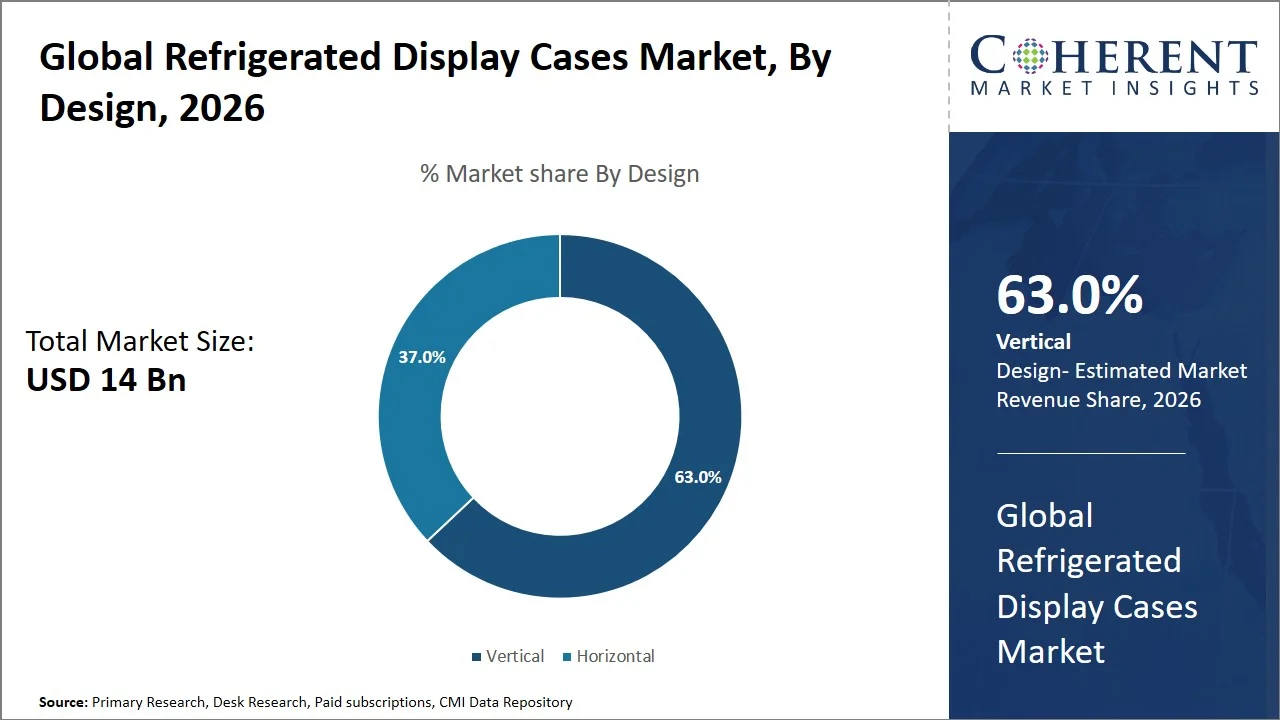
The vertical segment is expected to account for 63.0% of the global refrigerated display cases market share in 2026. Vertical designs are more popular because they provide maximum capacity of refrigerated product for a given amount of floor space. They are suitable for supermarkets, convenience stores and other retail locations where floor space is at a premium. The upright setup also allows for neat product presentation on several shelf levels, so that shops may offer a greater variety in one unit and clients can easily see and reach the products. On April 23, 2026, Epta introduces Zenith, the latest generation of positive vertical cabinets by Costan and Bonnet Névé. More than a technological upgrade, Zenith is a new vision of refrigeration where performance meets visual excellence.
Supermarkets and Hypermarkets Dominates the Global Refrigerated Display Cases Market
The supermarkets and hypermarkets segment is expected to account for 35.0% of the global refrigerated display cases market share in 2026. Supermarkets and hypermarkets are large format retail locations with considerable refrigeration merchandising capability to accommodate a wide variety of perishable products including dairy, meat, seafood, fresh vegetables, frozen foods and chilled beverages. These retailers use refrigerated display cases to preserve products at the right temperatures and to display different categories in structured areas. This promotes frequent customer access, effective inventory restocking and beautiful in-store merchandising. On January 12, 2026, Aldi announced plans to open more than 180 new stores across 31 U.S. states during 2026, with the network expected to approach 2,800 stores by year-end as part of its USD 9 billion five-year U.S. expansion program.
Current Events and their Impact
Current Events | Description and its Impact |
European Union - F-Gas Regulation (EU) 2024/573 |
|
United States - American Innovation and Manufacturing Act HFC Technology Transitions Rule |
|
Refrigerated Display Cases Market Dynamics
Market Drivers
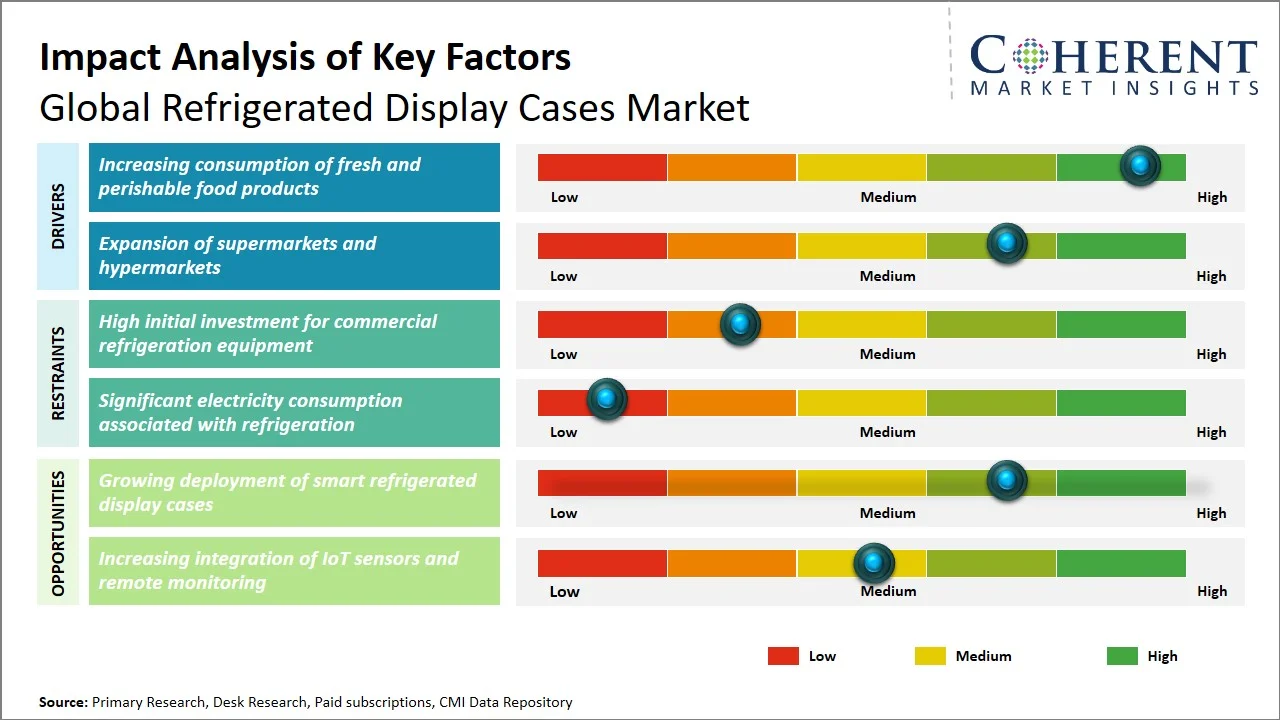
- Increasing consumption of fresh and perishable food products: Growing customer preference for fresh fruit, dairy products, meat, seafood, chilled beverages, and ready-to-eat foods is expected to increase the requirement for reliable refrigerated merchandising infrastructure across food retail outlets. Retailers are expanding their chilled product selections and implementing tighter temperature control over shop operations, contributing to the increased need for refrigerated display cases that will keep products fresh while offering customers clear vision and easy access. On April 29, 2026, Walmart celebrated a major milestone with the grand opening of its third owned and operated milk processing facility in Robinson, Texas. The facility will create more than 400 new jobs, strengthen Walmart’s end-to-end supply chain for affordable, high-quality milk and further the company’s longstanding commitment to U.S. manufacturing and local sourcing.
- Expansion of supermarkets and hypermarkets: The expansion and modernization of supermarkets and hypermarkets is generating demand for larger and more diverse refrigerated display displays in dairy, meat, seafood, beverage, frozen food and fresh food sections. New store openings, retail format modifications and investments in organized merchandising are enabling retailers to adopt energy-efficient and visually optimized display cases that can hold greater assortments of products while enhancing space utilization and in-store presentation. On September 15, 2025, Aldi UK announced that it would invest USD 2.0 billion over two years to accelerate its store expansion. The retailer had 1,060 stores at the time of the announcement and plans to open 80 more stores in the next two years with a long-term goal of 1,500 stores.
Emerging Trends
- Adoption of Natural Refrigerants: The adoption of low-GWP natural refrigerants, including CO₂ and propane, by refrigerated display case manufacturers is accelerating in response to more stringent environmental policies and the ongoing phase-down of high-GWP HFC refrigerants. This is spurring the adoption of compliant and environmentally sustainable commercial refrigeration
- Integration of Smart Monitoring Technologies: IoT-enabled sensors, remote temperature monitoring, cloud-based platforms, and automated alerts are increasingly being integrated into refrigerated display cases, allowing retailers to monitor operating conditions, detect temperature deviations, identify equipment issues, and enhance preventive maintenance.
- Development of Energy-Efficient Display Cases: More manufacturers are using electronically commutated motors, high efficiency compressors, LED lighting, improved insulation, low emissivity glass and improved air flow management to reduce electricity use while maintaining product temperature.
- Growth of Connected and Automated Retail Refrigeration: Refrigerated display cases are increasingly being connected to centralized refrigeration controls and retail management systems, allowing for automatic temperature adjustments, energy optimization, equipment diagnostics and performance analytics across multiple stores.
Regional Insights
Why is North America a Strong Market for Refrigerated Display Cases?
North America is expected to account for a market share of 32.0% in 2026. The demand in North America is being molded by the rapid shift to low-GWP refrigeration and large-scale supermarket remodeling are having a big impact. In 2024, the region had an estimated 4,970 commercial and industrial locations with critical CO2 refrigeration, an estimated 45% increase in installations in 2024, while nearly 4.6 million hydrocarbon refrigerated display cases were already installed throughout the region in 2024. Retailers such as Kroger, ALDI, Whole Foods and Walmart have incorporated CO₂ systems into their new-store and refrigeration plans, which has opened the door for display cases designed for natural refrigerants. The U.S. EPA’s Technology Transitions Program also began implementing HFC limitations on some retail-food stand-alone refrigeration equipment starting January 1, 2025, providing additional incentives for manufacturers to develop cases around lower-GWP refrigerants and higher-efficiency components.
Why Does Asia Pacific Refrigerated Display Cases Market Exhibit High Growth?
Asia Pacific is expected to register the fastest growth with a CAGR of 9.6% over the forecast period. The region is projected to account for 24.0% of the global refrigerated display cases market in 2026. Asia Pacific is being propelled by the rapid conversion from traditional food shops to organized supermarkets, convenience stores, and modern grocery formats, particularly across China, India, Southeast Asia, and South Korea. South Korean convenience retailers are reportedly replacing older refrigeration units with inverter-based high-efficiency display cases, with conversion rates above 70%, while Indonesia and Vietnam are seeing increasing deployment of plug-in and open display cases through chains such as Alfamart, Indomaret, and Circle K. Japan's convenience-store network is also driving replacement demand, while India is seeing increasing use of plug-in and open cabinets in pastry, meat, dairy, chilled, and frozen-food stores because these units avoid dedicated machinery rooms and permit flexible store layouts.
Global Refrigerated Display Cases Market Outlook for Key Countries
Why is U.S. Emerging as a Major Hub in the Refrigerated Display Cases Market?
The federal refrigerant transition rules and large installed base of retail refrigeration equipment especially affect the U.S. market. Retail Food Refrigeration EPA regulates retail food refrigeration as stand-alone equipment, remote condensing units, and supermarket systems. Display cases are an integrated part of these systems. Restrictions for certain stand-alone retail-food refrigeration equipment began in January 2025, and additional restrictions for remote condensing units and larger supermarket systems will begin on later dates. The EPA is also providing strong support for improved centralized DX and distributed refrigeration systems that can reduce refrigerant charge and leakage, creating demand for display cases compatible with optimized supermarket refrigeration networks rather than isolated conventional units.
Is China the Next Growth Engine for the Refrigerated Display Cases Market?
The modernization of grocery retail and the increasing importance of chilled prepared meals, fresh-food sections and convenience-oriented retail formats are driving China. With Chinese total retail sales of consumer goods up 3.7% in 2025 to USD 7,400 billion and catering revenue rising 3.2% to USD 860 billion, major grocery operators such as Sun Art and Yonghui are investing in modern refrigeration infrastructure to support ongoing demand for refrigerated merchandising in supermarkets, foodservice outlets and prepared-food counters. At the same time, the country’s heightened attention to food safety and energy-efficient refrigeration is also pushing shops to replace older equipment with vertical cabinets, remote systems and digitally controlled refrigeration solutions.
Germany Refrigerated Display Cases Market Analysis and Trends
Germany's opportunity is being shaped by the replacement of conventional supermarket refrigeration with highly energy-efficient systems and natural-refrigerant technologies, particularly CO₂-based solutions. The country benefits from a highly developed grocery structure in which large supermarket operators and discount chains operate extensive refrigerated sections, while European F-Gas requirements are forcing equipment suppliers and retailers to reduce dependence on high-GWP refrigerants; Germany is also part of the European market where CO₂ technology has achieved substantially greater penetration than North America. This regulatory and technological transition creates replacement demand for display cases incorporating low-GWP refrigerants, efficient compressors, improved insulation, electronic controls, and doors designed to reduce refrigeration losses.
Japan Refrigerated Display Cases Market Analysis and Trends
Japan is characterized by replacement-driven demand from its exceptionally dense convenience-store and supermarket infrastructure, where refrigerated cases are essential for chilled ready-to-eat meals, beverages, dairy products, desserts, and fresh foods. Major convenience-store chains such as 7-Eleven, FamilyMart and Lawson have recurring replacement needs, while Japanese refrigeration suppliers such as Panasonic/Hussmann and Mayekawa are associated with premium equipment with inverter compressors and connected monitoring technologies. In addition, Japan has about 12,720 transcritical CO₂ commercial and industrial installations, compared to North America’s 4,970 installations in 2024, showing the country's established preference for natural-refrigerant refrigeration technology which provides a strong technology base for next-generation display cases.
India Refrigerated Display Cases Market Analysis and Trends
India is being driven by the structural shift from fragmented traditional food retail toward organized supermarkets, modern convenience formats, specialty food outlets, and temperature-controlled grocery distribution. Plug-in and open display cabinets are particularly suited to Indian retailers because they can be installed without a separate machinery room and can be repositioned as store layouts change, making them suitable for pastry, meat, dairy, chilled-food, and frozen-food outlets; domestic manufacturers including Blue Star, Voltas, and Godrej & Boyce are also expanding their commercial refrigeration capabilities. Expansion of cold-chain infrastructure, increasing organized meat and fish retailing, rising frozen-food consumption, and the development of grocery e-commerce are creating additional requirements for reliable refrigerated merchandising from distribution facilities through the retail store.
Global Refrigerated Display Cases Market - Display Case Installations by Food Category (2025)
Food Category | Estimated Display Case Installations | Share of Global Installations |
Dairy Products | 300,000 | 26.1% |
Beverages | 255,000 | 22.2% |
Meat & Seafood | 190,000 | 16.5% |
Fresh Produce | 155,000 | 13.5% |
Frozen Food | 130,000 | 11.3% |
Bakery | 120,000 | 10.4% |
Total | 1,150,000 | 100.0% |
How is Growing Deployment of Smart Refrigerated Display Cases Creating New Growth Opportunities in the Refrigerated Display Cases Market?
Growing deployment of smart refrigerated display cases is creating a measurable opportunity for retailers to shift from reactive equipment maintenance toward continuous, data-driven refrigeration management. For example, Kroger has installed more than 750,000 IoT temperature monitoring devices in its stores, which allows the company to monitor refrigerated food cases automatically and minimize the need for manual temperature checks. Danfoss says its connected food-retail solutions are already in use in more than 50,000 installations around the world. These systems capture data on temperature, energy, alarms and equipment performance that enable retailers to spot aberrant temperatures, compressor performance difficulties, high energy use and probable food-loss occurrences before they become serious operational concerns. On November 21, 2025, Frigoglass announced the launch of the next generation smart cooler platform, a high-tech platform that would alter the beverage and hotels, restaurants and catering sectors. Building on its track record of developing and deploying the world’s most advanced A-class energy-efficient coolers, Frigoglass is now expanding into connected and unattended retail solutions that deliver new levels of insight, efficiency, and customer engagement.
Market Players, Key Development, and Competitive Landscape
Key Developments
- On September 22, 2025, Hussmann launched its newest merchandiser complete with Microblock Technology. The RLN-A and RMN-A offer refrigerated retail solutions for both medium and low temperature applications. The display case features an all-in-one, top-mounted refrigeration system to simplify the installation and service process.
- On March 31, 2025, Arneg announced it is expanding its range of refrigerated displays for frozen foods with two new families of single-basin islands, the Riga open islands and Baku closed islands. Both are designed to combine efficiency, looks and maximum product visibility.
Competitive Landscape
The competitive landscape is increasingly being shaped by companies that can combine refrigerated display cases with natural-refrigerant systems, energy optimization, digital monitoring, and after-sales service rather than competing only on cabinet design. Hussmann is strengthening its position through natural-refrigerant cases and its Insight merchandiser platform, with the company highlighting propane-based refrigeration and improvements in product temperature control, energy savings, cleaning, and serviceability. Epta is pursuing an integrated strategy spanning R290 plug-in cases, transcritical CO₂ remote systems, propane integral cabinets, compressor racks, and lifecycle services; its 2026 Zenith range combines natural refrigerants, PFAS-free insulation, up to 36% energy savings in the Advance model, and integration with the SwitchOn platform for 24/7 remote monitoring. Arneg is differentiating through technologies such as Eco Ring and Cold Ring, which use limited quantities of R290 together with water-glycol circuits, while its Hot & Cold system recovers heat from a transcritical CO₂ cycle to provide both heated and refrigerated merchandising within one cabinet.
Market Report Scope
Refrigerated Display Cases Market Report Coverage
| Report Coverage | Details | ||
|---|---|---|---|
| Base Year: | 2025 | Market Size in 2026: | USD 14 Bn |
| Historical Data for: | 2020 To 2024 | Forecast Period: | 2026 To 2033 |
| Forecast Period 2026 to 2033 CAGR: | 7.2% | 2033 Value Projection: | USD 23 Bn |
| Geographies covered: |
| ||
| Segments covered: |
| ||
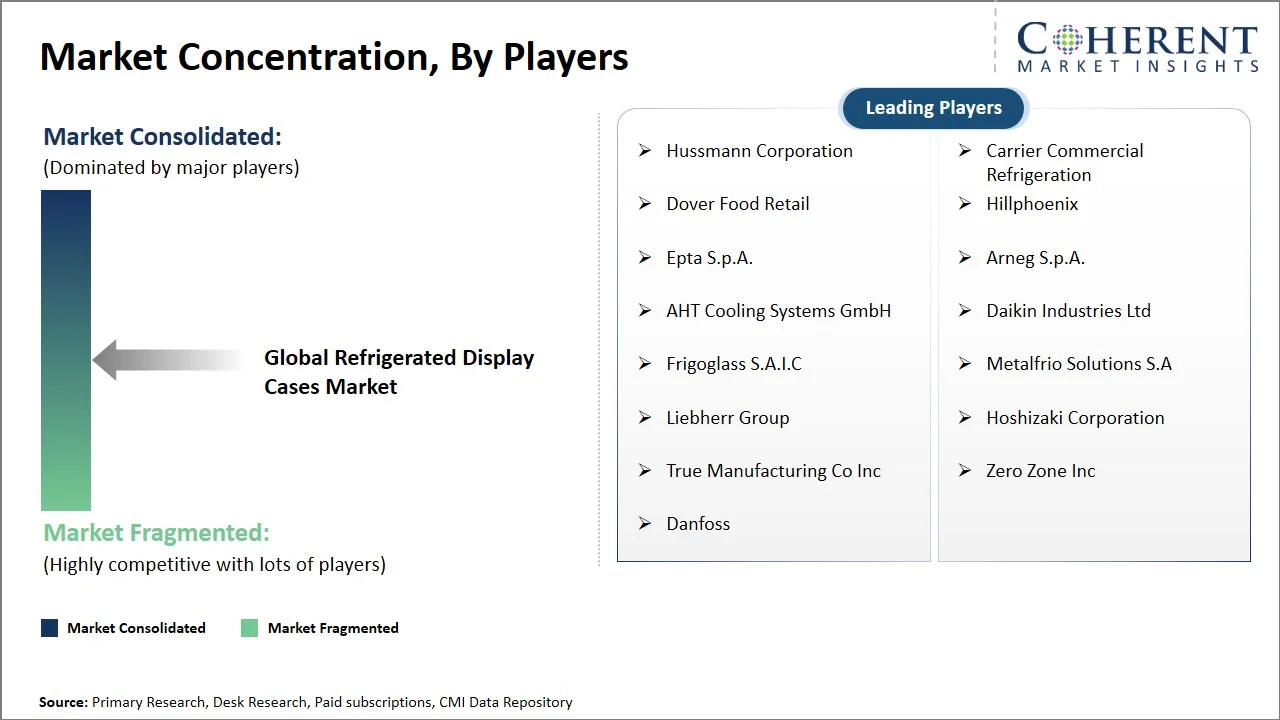
| Companies covered: | Hussmann Corporation, Carrier Commercial Refrigeration, Dover Food Retail, Hillphoenix, Epta S.p.A., Arneg S.p.A., AHT Cooling Systems GmbH, Daikin Industries Ltd, Frigoglass S.A.I.C, Metalfrio Solutions S.A, Liebherr Group, Hoshizaki Corporation, True Manufacturing Co Inc, Zero Zone Inc, Danfoss | ||
| Growth Drivers: |
| ||
| Restraints & Challenges: |
| ||
Analyst Opinion (Expert Opinion)
- The future of the industry is expected to move toward refrigerated display cases functioning as connected components of the entire store refrigeration system, rather than standalone cabinets. The strongest products are likely to combine natural refrigerants, variable-speed components, electronic controls, remote diagnostics, and high-visibility merchandising features, with Epta's Zenith providing a current example of how energy performance, connectivity, natural refrigerants, and merchandising are being integrated into one platform.
- The greatest opportunity is expected to be concentrated in vertical refrigerated display cases for supermarkets and convenience-oriented food retail, particularly configurations using R290 for plug-in applications and CO₂ for larger remote systems. Japan, China, India, and other Asian markets should receive particular attention because replacement of conventional refrigeration, expansion of organized food retail, and demand for chilled ready-to-eat products create different but complementary opportunities, while Japan's established use of CO₂ refrigeration provides an important technology reference point for the region.
- To gain an edge, manufacturers should prioritize refrigerant-flexible cabinet platforms rather than developing isolated product ranges, allowing the same core cabinet architecture to accommodate R290 plug-in, CO₂ remote, and other configurations. Investment should also be directed toward connected service platforms, predictive fault detection, easier maintenance access, retrofit packages, and measurable energy-performance improvements, because retailers are increasingly evaluating refrigeration equipment on lifetime operating performance and service capability rather than purchase price alone. Arneg's retrofit approach, which includes electronic component upgrades, LED relamping, door installation, and replacement of obsolete HFC refrigerants, illustrates how suppliers can capture additional revenue from the large installed equipment base instead of relying exclusively on new-store installations.
Speak to the analyst
Want personalized insights?
Take the findings above to one of our principal consultants, or have the report rebuilt around the segments, geographies and competitors you actually track.
Market Segmentation
- Display Type Insights (Revenue, USD Billion, 2021 - 2033)
- Open Display Cases
- Glass Door Display Cases
- Serve Over Counters
- Design Insights (Revenue, USD Billion, 2021 - 2033)
- Vertical
- Horizontal
- End User Insights (Revenue, USD Billion, 2021 - 2033)
- Supermarkets and Hypermarkets
- Convenience Stores
- Foodservice
- Specialty Food Stores
- Bakeries and Confectioneries
- Others
- Regional Insights (Revenue, USD Billion, 2021 - 2033)
- North America
- U.S.
- Canada
- Latin America
- Brazil
- Argentina
- Mexico
- Rest of Latin America
- Europe
- Germany
- U.K.
- Spain
- France
- Italy
- Russia
- Rest of Europe
- Asia Pacific
- China
- India
- Japan
- Australia
- South Korea
- ASEAN
- Rest of Asia Pacific
- Middle East
- GCC Countries
- Israel
- Rest of Middle East
- Africa
- South Africa
- North Africa
- Central Africa
- North America
- Key Players Insights
- Hussmann Corporation
- Carrier Commercial Refrigeration
- Dover Food Retail
- Hillphoenix
- Epta S.p.A.
- Arneg S.p.A.
- AHT Cooling Systems GmbH
- Daikin Industries Ltd
- Frigoglass S.A.I.C
- Metalfrio Solutions S.A
- Liebherr Group
- Hoshizaki Corporation
- True Manufacturing Co Inc
- Zero Zone Inc
- Danfoss
Sources
Primary Research Interviews
- Refrigerated Display Case Manufacturers
- Supermarket and Hypermarket Procurement Managers
- Convenience Store Operators
Journals
- International Journal of Refrigeration
- IIR Refrigeration Science and Technology
Associations
- International Institute of Refrigeration
- Global Cold Chain Alliance
- Eurovent
Public Domain Sources
- U.S. Census Bureau
- U.S. Bureau of Labor Statistics
- European Commission
Proprietary Elements
- CMI Data Analytics Tool
- Proprietary CMI Existing Repository of Information for the Last 10 Years
Get access to 250+ pages report
Every segment, forecast, competitor profile and data table behind the analysis above — available for instant download.
- ESOMAR Member
- ISO 9001:2015 Certified
- D-U-N-S Registered
- GDPR & CCPA Compliant
Missing comfort of reading report in your local language? Find your preferred language:
Transform your Strategy with Exclusive Trending Reports
Frequently Asked Questions
The global refrigerated display cases market is expected to stand at USD 14 Bn in 2026 and is expected to reach USD 23 Bn by 2033.
The CAGR of the global refrigerated display cases market is projected to be 7.2% from 2026 to 2033.
CO₂ systems are increasingly being adopted as lower-GWP alternatives to conventional high-GWP HFC refrigerants.
Restrictions on high-GWP HFC refrigerants are accelerating equipment redesign and increasing demand for cases compatible with natural refrigerants.
IoT-enabled cases can continuously monitor temperature, energy consumption, equipment performance, and alarms, enabling retailers to identify problems remotely and reduce product-loss risks.
Energy efficiency is becoming increasingly important because refrigeration operates continuously and electricity consumption represents a significant component of retail operating costs.
Plug-in cases can operate without extensive remote refrigeration infrastructure, allowing retailers to install or reposition refrigeration equipment with greater flexibility.