

Contactless Biometrics Technology Market Size And Share Analysis - 2026 to 2033
The Global Contactless Biometrics Technology Market is estimated to be valued at USD 20.10 Bn in 2026 and is expected to reach USD 55.33 Bn by 2033, exhibiting a compound annual growth rate (CAGR) of 15.6% from 2026 to 2033.
Key Takeaways
- By Technology, the facial recognition segment is projected to dominate the global contactless biometrics technology market with a 42.7% share in 2026, owing to its fast, frictionless, and user-friendly verification process.
- By Application, the government and law enforcement segment are expected to lead the contactless biometrics technology market with a 40.4% share in 2026, fuelled by mission-critical security requirements.
- By End User, the public sector segment is projected to dominate the global contactless biometrics market with a 57.6% share in 2026, owing to the rising number of large-scale citizen enrolment and e-governance programs.
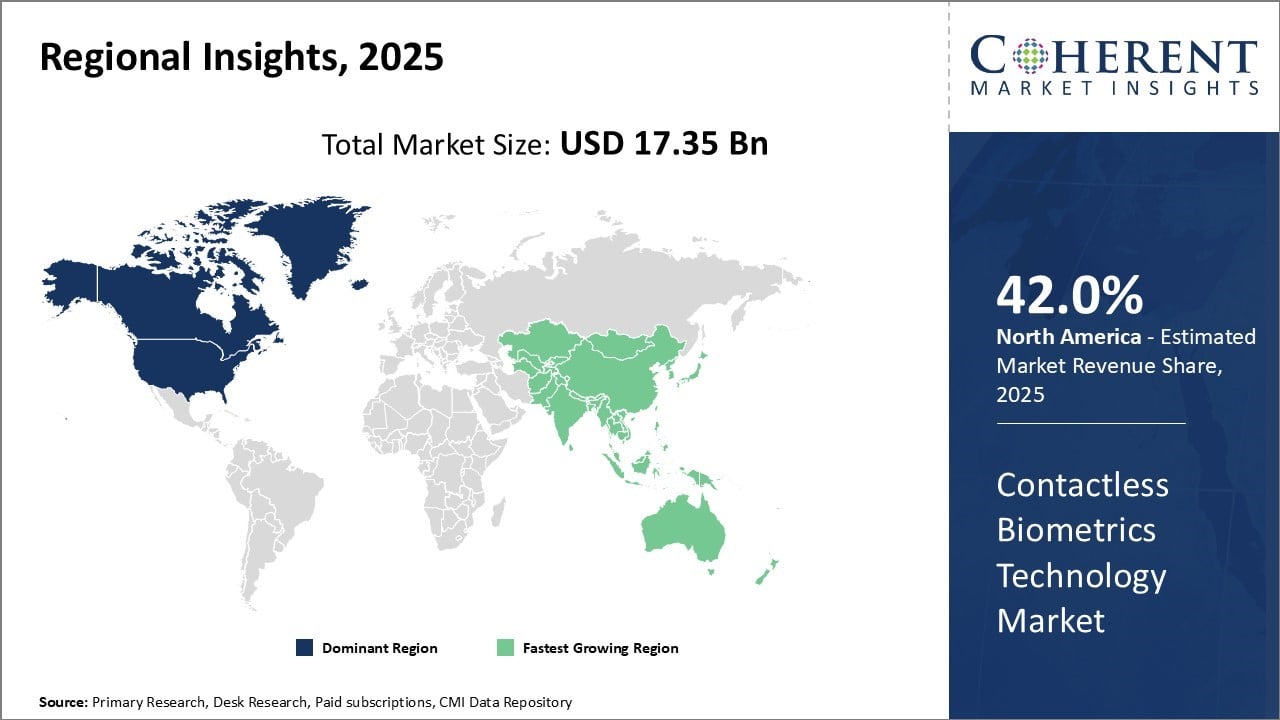
- North America is set to maintain its leadership in the global contactless biometrics’ technology market, accounting for an estimated 42.0% share in 2026.
Market Overview
The global contactless biometrics technology market is experiencing robust growth, fueled by increasing demand for hygienic, secure, and seamless identity verification solutions. Accelerated by hygiene concerns and advancements in AI-driven recognition technologies, industries are rapidly adopting contactless modalities such as facial, iris, and voice recognition. Facial recognition leads the technology segment due to its convenience and widespread deployment across surveillance and access control.
Current Events and Its Impact on the Contactless Biometrics Technology Market
Current Event | Description and its impact |
Increased Government Focus on National Digital ID Programs |
|
AI and Edge Computing Accelerate Biometric Accuracy and Speed |
|
Integration of Contactless Biometrics in National Digital Transformation Programs |
|
Role of Technologies like AI on the Market Contactless Biometrics Technology
Artificial Intelligence (AI) plays a pivotal role in accelerating the adoption and advancement of the contactless biometrics’ technology market. AI enhances the accuracy, speed, and adaptability of biometric systems by enabling real-time analysis of facial features, iris patterns, and voiceprints under varying conditions. Through deep learning and neural networks, AI algorithms can identify subtle distinctions and detect spoofing attempts, significantly improving security and reliability.
AI-powered analytics also facilitate continuous system learning, allowing for better adaptability in dynamic environments such as crowded airports or surveillance zones. Moreover, AI supports automation in identity verification processes, reducing human intervention and operational costs.
The integration of AI with edge computing and cloud platforms further enables scalable and contactless authentication solutions across sectors such as banking, healthcare, and public security. As AI technologies mature, they will continue to drive innovation and expand the capabilities and applications of contactless biometrics globally.
- Current Industry Events of 2026
- Market Size Estimation
- Regional Breakdown
- Competitive Landscape
- Customer Intelligence
- Segmental Analysis
- Pricing Analysis
- Key Market Drivers, Challenges & Future Trends
- Customized Insights Section
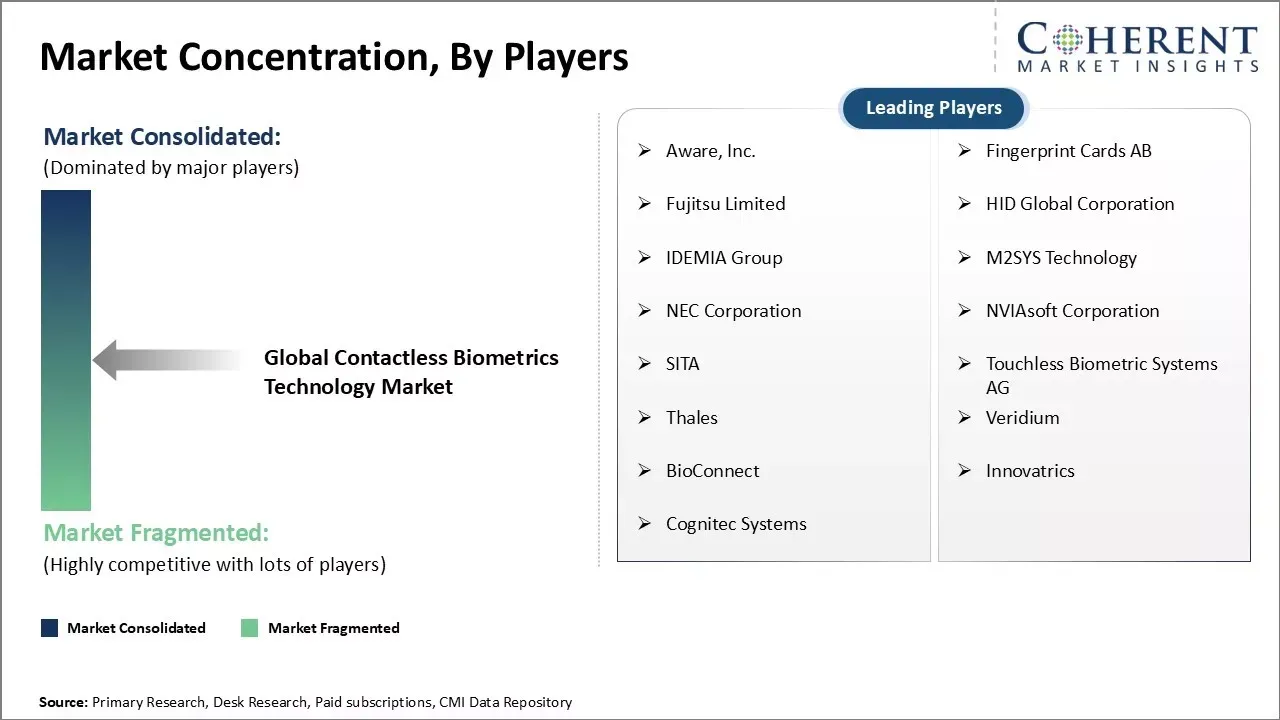
Market Concentration and Competitive Landscape
Contactless Biometrics Technology Market Trends
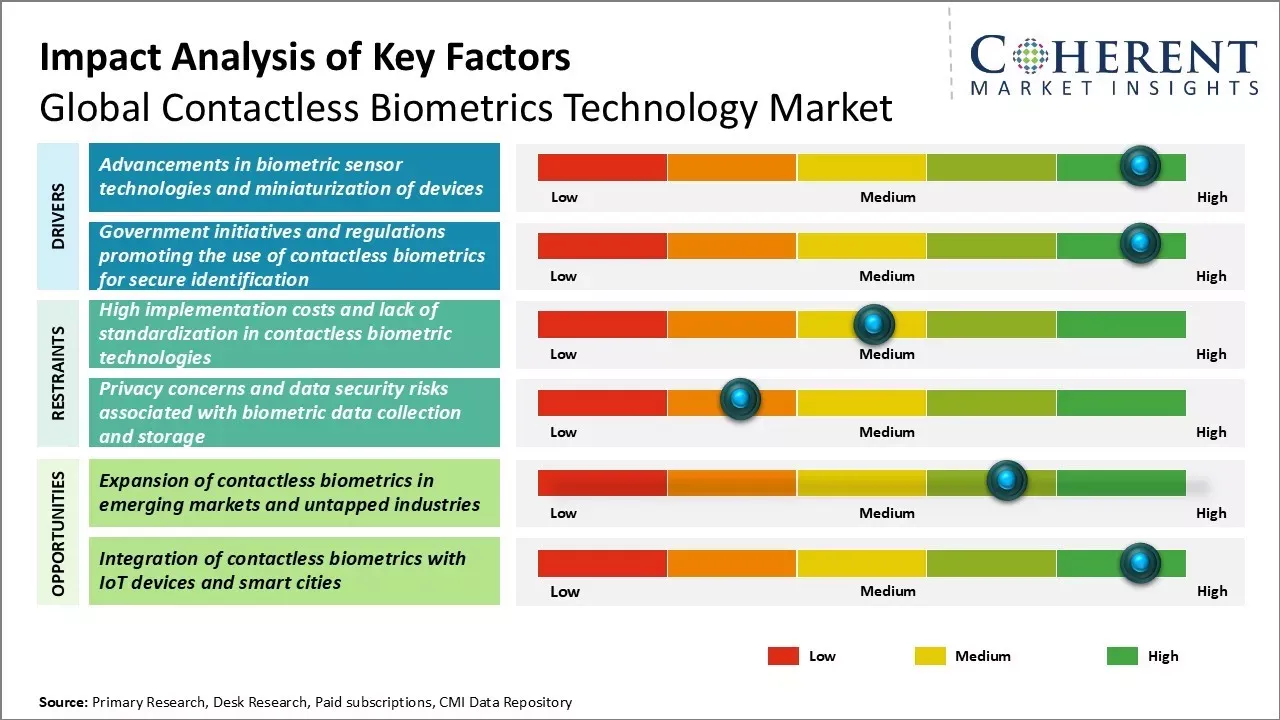
- Advancements in biometric sensor technologies and miniaturization of devices
Advancements in biometric sensor technologies have enabled contactless biometric identification to emerge as a promising solution in recent years. Significant improvements have been achieved in sensor accuracy, processing power, and miniaturization of components. Several new biometric modalities are now feasible for contactless configurations such as iris recognition, fingerprint, and palmprint scanning.
Major technology giants and start-ups have poured resources into developing sophisticated biometric sensors and cutting-edge algorithms capable of extracting identification signals even from a distance. Advancements in technologies like infrared imaging, 3D, and high-definition cameras and ML/AI have substantially boosted the capabilities of contactless biometric devices.
The miniaturization of sensors and fusion of biometric readers with other devices has enabled contactless biometrics to integrate seamlessly into our daily lives. Smartphones now offer advanced security features such as iris scanners, facial recognition, and fingerprint readers, making authentication quick and easy. These technologies have also been miniaturized to fit into thin laptops and PCs, integrating seamlessly without affecting their design.
Additionally, wearable devices like smart watches are beginning to include compact biometric sensors. Innovations in access control are leading to the development of contactless fingerprint and palmprint readers as small as a coin. Such innovations are helping address practical challenges and driving more frequent usage of contactless biometrics in commercial applications. The improved cost effectiveness afforded by size reduction is further stimulating wider deployment across sectors.
In May 2025, The Times of India reported that Bharathidasan University (BDU) implemented a photo-biometric attendance system across all campuses. This contactless setup requires staff and students to register at designated times, improving attendance tracking, accountability, and campus security.
- Government initiatives and regulations promoting the use of contactless biometrics for secure identification
Many governments across regions have acknowledged the potential of contactless biometrics in strengthening identity management systems and enhancing public safety & national security. Favourable regulations and funding support to develop digital ID infrastructures based on biometrics is translating into significant market opportunities.
For example, the Aadhaar program in India leveraging iris and fingerprint authentication has become the world's largest biometric ID system. In the Americas and Europe as well, national ID programs increasingly require or recommend the use of contactless biometric technologies for passport issuance, e-gov services, border security, law enforcement, etc.
International organizations too have played a role through standardization efforts facilitating interoperable deployment of contactless biometrics across borders. However, ensuring privacy and social acceptance remains a challenge to be addressed through appropriate legal and ethical guidelines.
Overall, the expanding regulatory push by governments around secure digital identities is a primary driver propelling innovations as well as mass adoption in the contactless biometrics’ domain. Major technology suppliers are proactively collaborating with governments to upgrade identification systems per their mandated timelines and security specifications.
In July 2025, The Times of India reported that key districts in Uttar Pradesh including Kanpur Nagar, Ghaziabad, Bijnor, Unnao, and Jhansi have adopted facial recognition for the state’s Take-Home Ration (THR) scheme. As of June 2025, biometric data for 10.84% of 11.85 crore eligible beneficiaries was collected, with 7.18% completing Aadhaar-based facial authentication.
Segmental Insights
Contactless Biometrics Technology Market Insights, By Technology
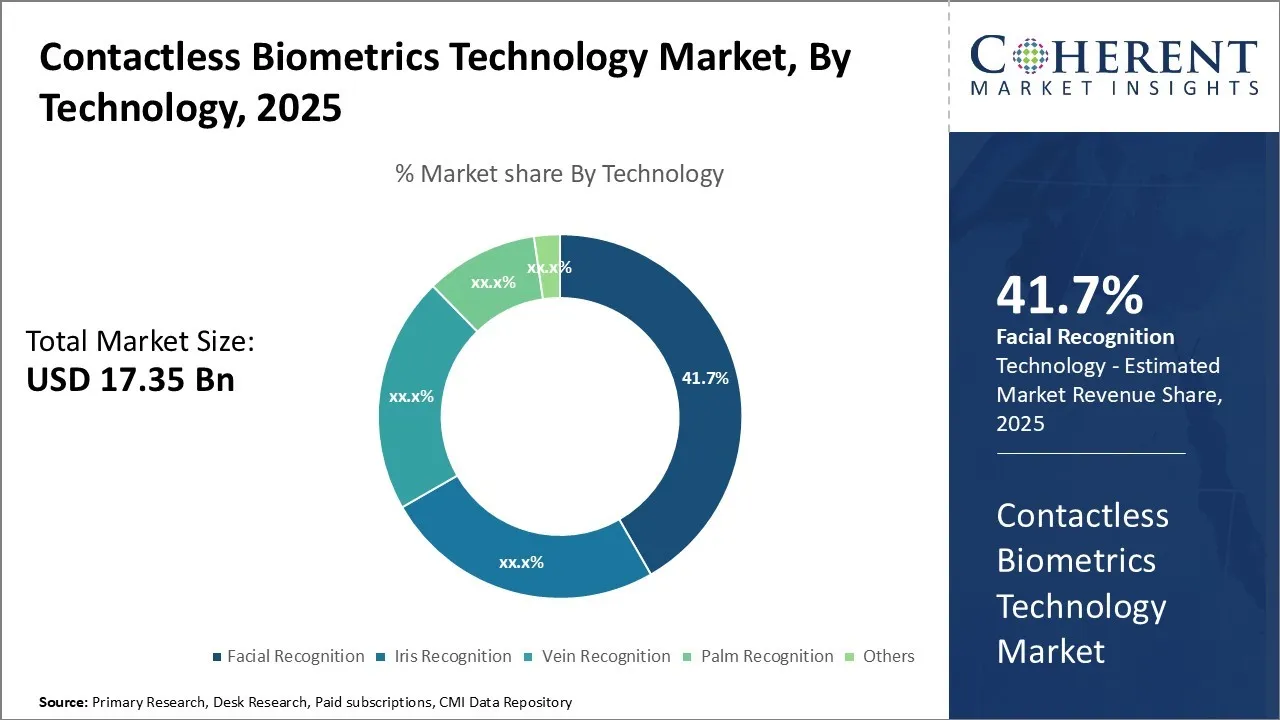
The facial recognition segment is projected to dominate the global contactless biometrics technology market with a 42.7% share in 2026, owing to its fast, frictionless, and user-friendly verification process.
This technology utilizes advanced AI algorithms to analyze facial features from static images or live video streams and compare them with secure databases for accurate identification. Its widespread adoption across applications such as airport security, mobile banking, public surveillance, and border control reflects its growing importance.
With continuous improvements in deep learning models, facial recognition systems are becoming more robust under diverse lighting and environmental conditions, ensuring higher reliability and reinforcing its role as a preferred modality for contactless identification.
Contactless Biometrics Technology Market Insights, By Application
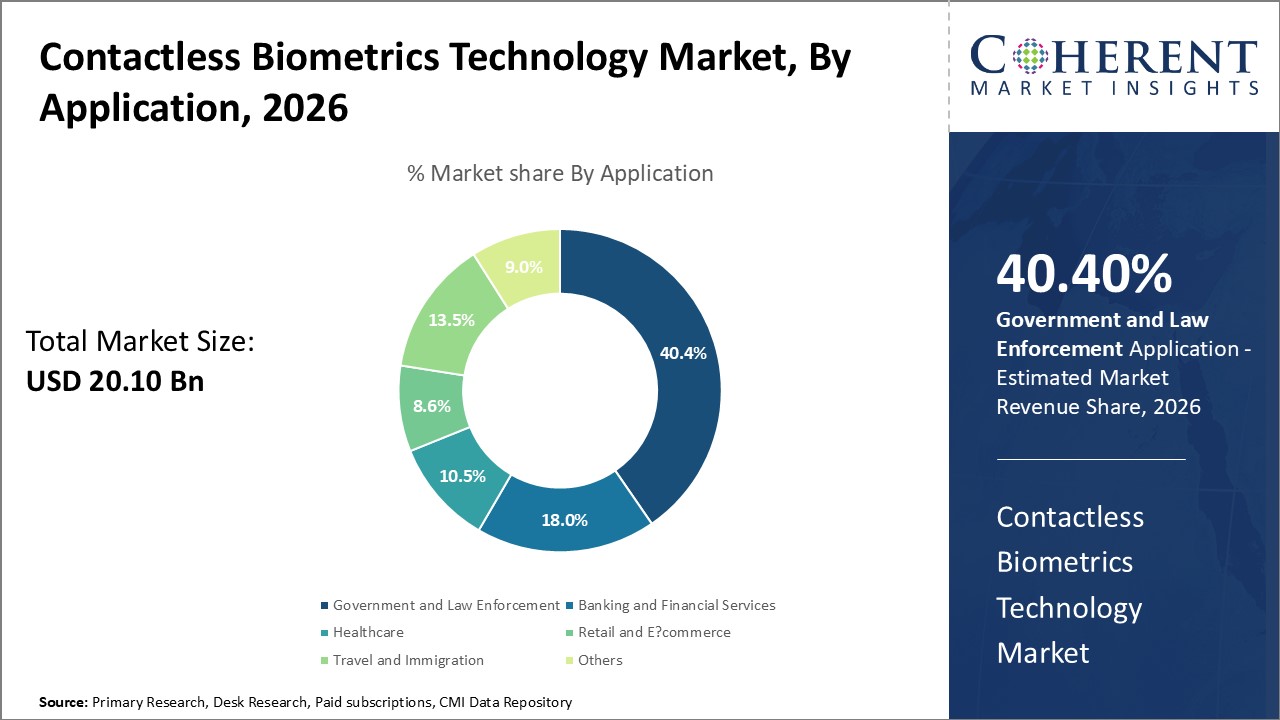
The government and law enforcement segment is expected to lead the contactless biometrics technology market with a 40.4% share in 2026, driven by increasing demand for secure and non-intrusive identity verification in mission-critical areas.
Facial, iris, and contactless fingerprint recognition systems are being increasingly deployed for national ID programs, border management, crime control, and immigration services. Public safety concerns, combined with digital transformation across law enforcement agencies, are boosting the deployment of biometric surveillance and real-time identification systems.
Major infrastructure upgrades and ongoing digital identity initiatives across developed and developing regions are further supporting the segment's market leadership.
Contactless Biometrics Technology Market Insights, By End User
The public sector segment is projected to dominate the global contactless biometrics market with a 57.6% share in 2026, owing to a surge in national identity, social welfare, and public healthcare initiatives that utilize biometric authentication.
Governments across Asia, Africa, and Latin America are increasingly implementing large-scale e-governance programs that leverage contactless modalities for their hygienic, efficient, and scalable nature. From biometric voter IDs to healthcare beneficiary verification, contactless technologies are central to enhancing service delivery while reducing identity fraud. The integration of biometric verification into national digital ID platforms is expected to further entrench the public sector’s dominance in the market.
Regional Insights
North America Contactless Biometrics Technology Market Trends and Analysis
North America is set to maintain its leadership in the global contactless biometrics’ technology market, accounting for an estimated 42.0% share in 2026. The region’s dominance is supported by strong investments in national security, border control, and AI-powered surveillance technologies.
The U.S. and Canada are pioneers in adopting facial recognition, iris scanning, and voice authentication across high-security environments including airports, government buildings, and law enforcement agencies. Favourable regulatory frameworks, well-established biometric infrastructure, and continuous innovation in machine learning and neural networks position North America as the global epicentre for secure, contactless biometric solutions.
Europe Contactless Biometrics Technology Market Trends and Analysis
Europe follows as a key market, driven by stringent data privacy regulations, digital identity initiatives, and robust public sector engagement. The European Union’s General Data Protection Regulation (GDPR) and the eIDAS regulation have shaped a privacy-first environment for biometric data usage.
Countries such as Germany, France, the UK, and the Netherlands are deploying facial and iris recognition systems in e-passports, border management, and smart city surveillance. Government-funded pilot projects and EU-wide digital ID frameworks are accelerating adoption of secure, contactless authentication technologies. The region’s focus on ethical AI, interoperability, and citizen data control will continue to shape market growth in the coming years.
Contactless Biometrics Technology Market Dominating Countries
United States and Canada
The United States remains a global leader in the contactless biometrics technology market, driven by high levels of investment in national security, airport screening, and smart surveillance systems. U.S. agencies have widely adopted facial and iris recognition technologies across TSA checkpoints, federal ID programs, and law enforcement databases.
With strong support from regulatory bodies and ongoing innovation in AI and machine learning, the U.S. leads in deploying scalable, secure, and privacy-conscious biometric solutions. The private sector is also adopting these systems in mobile banking, healthcare, and consumer electronics to enhance convenience and fraud prevention.
Canada supports North America’s dominance through progressive adoption of contactless biometrics in border control, government e-services, and law enforcement. The country’s privacy-forward frameworks and alignment with global biometric standards ensure secure identity management while supporting innovation. Canadian airports, immigration offices, and financial institutions are increasingly adopting facial and voice recognition to improve user experience and operational efficiency.
Market Report Scope
Contactless Biometrics Technology Market Report Coverage
| Report Coverage | Details | ||
|---|---|---|---|
| Base Year: | 2025 | Market Size in 2026: | USD 20.10 Bn |
| Historical Data for: | 2020 To 2024 | Forecast Period: | 2026 To 2033 |
| Forecast Period 2026 to 2033 CAGR: | 15.6% | 2033 Value Projection: | USD 55.33 Bn |
| Geographies covered: |
| ||
| Segments covered: |
| ||
| Companies covered: | Aware, Inc., Fingerprint Cards AB, Fujitsu Limited, HID Global Corporation, IDEMIA Group, M2SYS Technology, NEC Corporation, NVIAsoft Corporation, SITA, Touchless Biometric Systems AG, Thales, Veridium, BioConnect, Innovatrics, and Cognitec Systems | ||
| Growth Drivers: |
| ||
| Restraints & Challenges: |
| ||
Analyst Viewpoint
- The global contactless biometrics’ technology market growth is driven by the rising demand for hygienic, secure, and user-friendly authentication solutions. Technologies such as facial recognition, iris scanning, and voice authentication are increasingly viewed as essential components of digital identity frameworks and national security strategies.
- Experts highlight rapid adoption across government, law enforcement, banking, and healthcare sectors where accurate, touch-free identification is critical. The rise of e-passports, digital onboarding, and AI-driven surveillance is propelling market growth, particularly in public sector applications and border control initiatives.
- North America leads the market, supported by its mature biometric infrastructure, strong regulatory support, and investments in AI-powered security technologies. Meanwhile, Asia Pacific is expected to witness the fastest growth, fuelled by large-scale citizen ID programs, mobile penetration, and smart city initiatives in countries like China and India.
Speak to the analyst
Want personalized insights?
Take the findings above to one of our principal consultants, or have the report rebuilt around the segments, geographies and competitors you actually track.
Contactless Biometrics Technology Market: Key Development
- In May 2025, researchers introduced G-MSGINet, a lightweight yet highly accurate deep learning architecture for contactless fingerprint recognition. With 97–99% identification accuracy and an extremely low Equal Error Rate (EER), G‑MSGINet offers efficient fingerprint analysis using only 0.38 million parameters suitable for low-resource, real-time applications in smartphones and kiosks.
- In March 2025, Switzerland proposed amendments to its Aviation Act to broaden the use of facial recognition at airports. The updates would allow biometric authentication for check-in, boarding, and baggage drop without requiring user consent, pending legal approval. Zurich and Geneva airports are already equipped with the necessary systems, positioning Switzerland to become a leader in seamless biometric-enabled air travel.
- In January 2025, Nigeria launched a new National Biometric Identity Card, integrating fingerprint authentication and digital wallet functionality for secure offline and online usage. Designed to improve financial inclusion and streamline access to government services, the card supports multifunctional use for identity, payments, and utilities. This initiative reflects growing demand for secure, contactless identification in developing regions and supports Africa’s expanding digital infrastructure.
- In November 2024, the Australian Border Force began pilot trials of a passport-free border clearance system using contactless facial recognition at Sydney Airport. Initially tested with Qantas crew, the system allows passengers to pass through immigration checkpoints without presenting physical documents. The initiative aligns Australia with global biometric border advancements and enhances security while improving traveller experience.
Market Segmentation
- By Technology Insights (Revenue, USD Bn, 2021 - 2033)
- Facial Recognition
- Iris Recognition
- Vein Recognition
- Palm Recognition
- Others (Fingerprint, Voice, Gesture, etc.)
- By Application Insights (Revenue, USD Bn, 2021 - 2033)
- Government and Law Enforcement
- Banking and Financial Services
- Healthcare
- Retail and E commerce
- Travel and Immigration
- Others
- By End User Insights (Revenue, USD Bn, 2021 - 2033)
- Public Sector
- Private Sector
- By Regional Insights (Revenue, USD Bn 2021 - 2033)
- North America
- U.S.
- Canada
- Latin America
- Brazil
- Argentina
- Mexico
- Rest of Latin America
- Europe
- Germany
- U.K.
- Spain
- France
- Italy
- Russia
- Rest of Europe
- Asia Pacific
- China
- India
- Japan
- Australia
- South Korea
- ASEAN
- Rest of Asia Pacific
- Middle East
- GCC Countries
- Israel
- Rest of Middle East
- Africa
- South Africa
- North Africa
- Central Africa
- Key Players Insights
- Aware, Inc.
- Fingerprint Cards AB
- Fujitsu Limited
- HID Global Corporation
- IDEMIA Group
- M2SYS Technology
- NEC Corporation
- NVIAsoft Corporation
- SITA
- Touchless Biometric Systems AG
- Thales
- Veridium
- BioConnect
- Innovatrics
- Cognitec Systems
Sources
The Stakeholders Consulted
- Biometric system manufacturers and technology developers
- Facial, iris, and voice recognition hardware suppliers
- IT security and identity management professionals
- Government officials from national ID and border control programs
- Law enforcement and homeland security agencies
- Airport and transportation authority representatives
- Digital banking and fintech executives
- Healthcare and public service administrators
- Smart city infrastructure planners and AI ethics consultants
Databases Opened
- U.S. Department of Homeland Security – Biometric Identity Systems
- European Union Agency for Cybersecurity (ENISA) – Biometric Security Reports
- UIDAI (India) – Aadhaar Statistics and Digital Identity Insights
- World Bank Open Data – Digital Identity & Inclusion Metrics
- UNDP – Digital Public Infrastructure Resources
Magazines & Trade Publications
- Biometric Technology Today
- Security Today Magazine
- Government Technology Magazine
- Homeland Security Today
- FindBiometrics – Industry News & Market Trends
Scientific and Industry Journals
- IEEE Transactions on Biometrics, Behavior, and Identity Science
- Pattern Recognition Letters
- Computer Vision and Image Understanding
- Journal of Information Security and Applications
- International Journal of Biometrics
Newspapers & Media Outlets
- Reuters – Technology and Homeland Security Section
- Bloomberg – Tech and Surveillance Market Reports
- The Wall Street Journal – Cybersecurity and Public Safety Coverage
- The Economic Times – Tech & Identity Management Segment
- Business Standard – National ID and Digital Governance Features
Associations and Regulatory Bodies
- International Biometrics + Identity Association (IBIA)
- U.S. National Institute of Standards and Technology (NIST) – Biometric Evaluation Program
- International Civil Aviation Organization (ICAO) – MRTD and Biometrics Standards
- ISO/IEC JTC 1/SC 37 – Biometric Standardization
- Data Security Council of India (DSCI) – Identity & Access Management Initiatives
Public Domain Sources
- U.S. Government Accountability Office (GAO) – Biometrics & Privacy Reports
- European Commission – Digital ID, GDPR, and Biometrics Integration Reports
- United Nations – Digital Identity Guidelines and Case Studies
- World Bank – ID4D Global Dataset and Reports
- African Union & ID4Africa – Digital ID Infrastructure Documentation
Proprietary Research Elements
- CMI Biometric Data Intelligence Platform
- Proprietary CMI Repository of Contactless Biometrics Market Data (covering past 8 years)
- CMI Analyst Interviews and Transcripts (focused on facial recognition, border security systems, and national identity frameworks)
- Primary survey data from biometric system integrators, AI startups, and public sector procurement officers
- In-house benchmarking models comparing modality accuracy, adoption trends, and deployment costs across regions
Get access to 250+ pages report
Every segment, forecast, competitor profile and data table behind the analysis above — available for instant download.
- ESOMAR Member
- ISO 9001:2015 Certified
- D-U-N-S Registered
- GDPR & CCPA Compliant
Missing comfort of reading report in your local language? Find your preferred language:
Transform your Strategy with Exclusive Trending Reports
Frequently Asked Questions
The Contactless Biometrics Technology Market size is estimated to be valued at USD 20.10 Bn in 2026, and is expected to reach USD 55.33 Bn by 2033.
The CAGR of the global Market is projected to be 15.6% from 2026 to 2033.
Advancements in biometric sensor technologies and miniaturization of devices and government initiatives and regulations promoting the use of contactless biometrics for secure identification are the major factors driving the growth of the global market.
High implementation costs and lack of standardization in contactless biometric technologies and privacy concerns and data security risks associated with biometric data collection and storage are the major factors hampering the growth of the global market.
In terms of Technology, the Facial Recognition segment is estimated to dominate the market revenue share in 2026.
Aware, Inc., Fingerprint Cards AB, Fujitsu Limited, HID Global Corporation, IDEMIA Group, M2SYS Technology, NEC Corporation, NVIAsoft Corporation, SITA, Touchless Biometric Systems AG, Thales, Veridium, BioConnect, Innovatrics, and Cognitec Systems are the major players.
North America is expected to lead the global contactless biometrics technology industry.