

Commercial Refrigeration Equipment Market Analysis & Forecast: 2026-2033
Commercial Refrigeration Equipment Market is estimated to be valued at USD 64.27 Bn in 2026 and is expected to reach USD 89.84 Bn in 2033, exhibiting a compound annual growth rate (CAGR) of 4.9% from 2026 to 2033.
Key Takeaways
- By Product Type, the Refrigeration & Freezer segment leads Commercial Refrigeration Equipment Market and account for 55.0% of market share value in 2026. Due to its expansive deployment across retail spaces, foodservice operations, and the broader cold chain logistics network.
- Regionally, North America is projected to increase its market footprint from 36% in 2026. This continued growth is fueled by mature infrastructure, rigorous energy efficiency mandates, and an accelerating uptake of intelligent refrigeration systems.
Market Overview
The global commercial refrigeration market growth is steady, driven by the expanding foodservice industry and the increasing shift toward energy-efficient cooling technologies. Accelerating urban population growth, coupled with the ongoing proliferation of retail formats—particularly chains, supermarkets, and convenience stores—is heightening the need for advanced refrigeration networks. At the same time, stricter government policies aimed at eliminating high-GWP refrigerants and lowering overall carbon emissions are accelerating the adoption of greener technologies. For example, the rapid uptake of CO₂ refrigerants across Europe, which not only aligns with compliance targets but also delivers marked energy savings.
Current Events and Its Impact on the Global Commercial Refrigeration Equipment Market
Event | Description and Impact |
Energy Crisis and Rising Utility Costs (Macro-Level Economic Event) |
|
Supply Chain Disruptions and Raw Material Shortages (Macro-Level Economic Event) |
|
Climate Change Regulations and Environmental Policies (Regional Regulatory Event) |
|
Role of Technologies like AI on the Commercial Refrigeration Equipment Market
Artificial intelligence is reshaping commercial refrigeration, upgrading traditional, inflexible chillers into adaptable, intelligent ecosystems. It is no longer just a matter of automating routine operations; AI allows systems to identifiy issues before they arise, continuously tracks critical parameters, and fine-tunes set points autonomously to optimize both energy use and reliability. To understand this take Danfoss’s latest line of smart compressors as an example, which leverage machine learning to analyze sensor data and adjust cooling duty in microseconds. When a door is opened, the system ramps up; when it’s closed, it relaxes, all while keeping product temperatures stable and energy bills lean.
The company weaves AI into its refrigeration lineup, using machine-learning models on real-time performance data to anticipate maintenance interventions and dynamically calibrate cooling cycles. Similarly, Carrier’s i-Vu platform leverages those same predictive techniques to reduce equipment failures by almost 40 percent. Grocery chains can therefore maintain fully stocked shelves while also extending the useful life of their assets.
Johnson Controls’ OpenBlue platform uses computing power to set ideal temperature ranges and schedule defrosts, delivering energy cuts of 15 to 30 percent, enhancing food safety, and lowering spoilage rates. All these systems support remote surveillance, instant notifications, and clear analytics on user-friendly displays, empowering managers to act before problems escalate.
As the algorithms grow more capable, they will drive even greater energy savings, tie more tightly into entire facility networks, and move the refrigeration sector toward fully autonomous, sustainable operation.
- Current Industry Events of 2026
- Market Size Estimation
- Regional Breakdown
- Competitive Landscape
- Customer Intelligence
- Segmental Analysis
- Pricing Analysis
- Key Market Drivers, Challenges & Future Trends
- Customized Insights Section
Pricing Analysis
The global market for commercial refrigeration equipment displays a broad pricing spectrum that varies according to product type, capacity, energy efficiency, manufacturer reputation, and geographical differences. Major product segments include reach-in refrigeration, walk-in systems, countertop units, under-counter models, and freestanding displays, each exhibiting its own pricing pressures.
Reach-in systems generally situate between $2,600 for compact under-counter designs and $18,000 for full-height, commercial-grade refrigerators and freezers. Walk-in coolers and freezers exhibit a wider range, starting around $6,000 for basic models and exceeding $45,000 for bespoke setups produced by high-end brands such as Kolpak and Norlake.
Countertop Commercial Refrigeration Equipment, such as ice machines and compact display cases, usually costs between $2,200 and $15,000 depending on capacity and technology. Under-counter units, valued for space-saving, range from $2,600 to $4,800.
Freestanding and a Commercial Refrigeration Equipment Market reflect mid-tier pricing with considerations for recyclable material Commercial Refrigeration Equipment gaining importance due to environmental regulations, potentially influencing costs but offering sustainability benefits.
Energy efficiency certifications (ENERGY STAR), smart technology integrations, and installation complexity further affect pricing. As environmental compliance tightens, demand for recyclable material Commercial Refrigeration Equipment is rising, potentially shifting price trends toward sustainable, cost-effective solutions.
Emergence of New Technology in Commercial Refrigeration Equipment Market
The commercial refrigeration sector is moving fast, fueled by connectivity and the IoT. Modern cases and walk-ins are outfitted with smart sensors and cloud links that deliver 24/7 monitoring, predictive maintenance, and automated alerts, all of which bring downtime and spoilage risks to near-zero.
Meanwhile, variable-speed compressors dial cooling power up or down, aligning energy use with the ebb and flow of customer traffic and varying load in grocery aisles and storage areas throughout the day. Advanced heat-recovery circuits seize excess heat and redirect it for heating air and water, delivering energy savings in kitchens, dining areas, and healthcare facilities.
Although still in the early stages, magnetic cooling technology promises a chemical-free, highly efficient option for select applications. Meanwhile, gains in cabinet insulation, enclosure design, and digital temperature controls yield tighter thermal performance, reduced energy use, and precise temperature management within specific zones. Overall, these developments raise the overall efficiency of the sector.
Segmental Insights
Global Commercial Refrigeration Equipment Market Insights, By Product Type
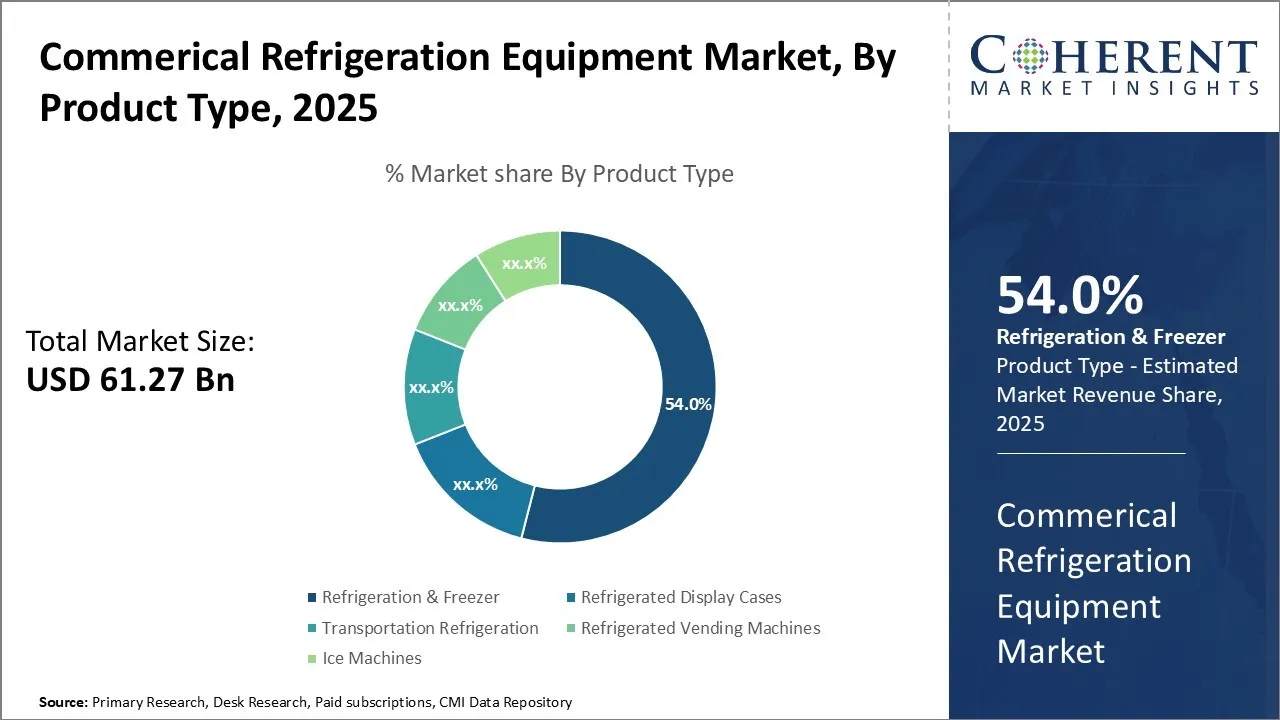
The Refrigeration & Freezer segment is the largest slice of the Global Commercial Refrigeration Equipment Market, expected to hold 55.0% share by 2026. This leading position stems from the critical function these units serve in homes, businesses, and factories by safeguarding perishables and upholding food safety.
Demand is rising across food-storage needs, the expanding cold chain movement, and a growing global inclination toward fresh and frozen offerings. While refrigerated display cases and vending machines also capture meaningful portions of the market, reflecting their growing role in retail and consumer convenience, they complement the segment’s overall weight.
Display cases, in particular, enhance the merchandising of perishables in supermarkets and food-service establishments, driving revenue by combining striking visibility with effective preservation. Refrigerated Vending Machines are gaining traction as automated, on-the-go solutions for cold beverages and snacks, especially in urban and workplace environments.
The smaller segments, specifically Transportation Refrigeration and Ice Machines, carry smaller market shares but are essential in targeted applications. Transportation Refrigeration protects temperature-sensitive cargo during transit, which is key to maintaining integrity in logistics and supply chains.
Ice Machines serve a narrow but critical niche, providing a steady supply of ice in hospitality and healthcare where service consistency is non-negotiable. Refrigeration and Freezers lead market value, while these complementary segments fulfil specialized cooling requirements across sectors, together forming a varied product ecosystem that adapts to changing consumer and commercial refrigeration needs.
Regional Insights
North America Commercial Refrigeration Equipment Market Analysis and Trends
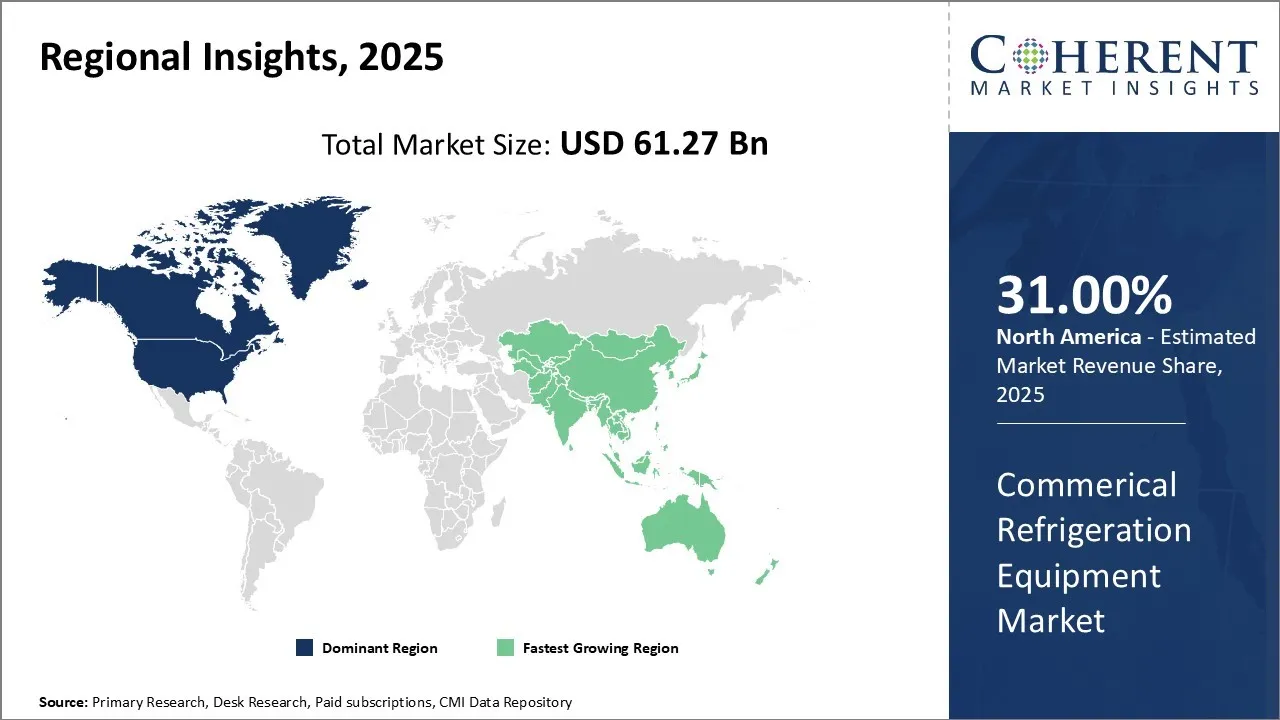
North America is poised to maintain its stronghold in the global commercial refrigeration equipment market, expected to hold around 36% of the market share by 2032, up from 36.00% in 2026. The region benefits from the presence of leading industrial refrigeration manufacturers such as Excellence Industries, Illinois Tool Works Inc., Lennox International Ltd., and Standex International Co.
These companies supply advanced refrigeration solutions to a broad range of commercial sectors. The mature construction and retail markets, including supermarkets, malls, and cold storage facilities, further support demand. Innovation and energy-efficient technologies are also driving growth in North America’s refrigeration market.
Asia Pacific Commercial Refrigeration Equipment Market Analysis and Trends
The Asia Pacific (APAC) region is the fastest-growing market for commercial refrigeration equipment and is expected to continue this rapid growth trajectory. Expanding economies such as China and South Korea are driving increased demand, fueled by rapid urbanization, rising disposable incomes, and growth in retail and foodservice sectors. Investments in modern commercial infrastructure and cold chain logistics further boost the need for advanced refrigeration solutions across the region.
Europe Commercial Refrigeration Equipment Market Analysis and Trends
Europe is witnessing rising demand for commercial refrigeration equipment, largely driven by the trend toward technologically advanced buildings. Modern malls, supermarkets, and hypermarkets are increasingly equipped with sophisticated cold storage solutions to meet consumer demand for frozen and fresh foods. Sustainability regulations and energy efficiency targets are also shaping market preferences toward cutting-edge refrigeration technologies.
Dominating Countries in the Commercial Refrigeration Equipment Market
United States Commercial Refrigeration Market Analysis and Trends
The United States leads the North American market with a strong industrial base and established manufacturers. The retail and foodservice sectors’ demand for innovative, energy-efficient refrigeration solutions underpins steady growth.
China Commercial Refrigeration Market Analysis and Trends
China drives growth in Asia Pacific, with rapid urbanization and expanding retail and cold chain infrastructure. Domestic manufacturers are increasingly innovating to meet rising demand.
South Korea Commercial Refrigeration Market Analysis and Trends
South Korea contributes significantly to the APAC market, propelled by technological advancement and strong commercial construction activity.
Market Report Scope
Commercial Refrigeration Equipment Market Report Coverage
| Report Coverage | Details | ||
|---|---|---|---|
| Base Year: | 2025 | Market Size in 2026: | USD 64.27 Bn |
| Historical Data for: | 2020 To 2024 | Forecast Period: | 2026 To 2033 |
| Forecast Period 2026 to 2033 CAGR: | 4.9% | 2033 Value Projection: | USD 89.84 Bn |
| Geographies covered: |
| ||
| Segments covered: |
| ||
| Companies covered: | United Technologies Corporation, Ingersoll-Rand plc, Johnson Controls Incorporated, Daikin Industries Limited, Dover Corporation, Hussmann Corporation, AHT Cooling Systems GmbH, Ali SpA, Illinois Tool Works Incorporated, Emerson Electric Company, Leer Incorporated, True Manufacturing Company Incorporated, and Whirlpool Corporation | ||
| Growth Drivers: |
| ||
| Restraints & Challenges: |
| ||
Commercial Refrigerant Equipment Market – Drivers
- Growing Food Production
As food production increases, there is an increasing need for better storage and refrigeration solutions - ultimately driving growth in this market. The increase in the supply of food and frozen eatables requires appropriate freezers and storage facilities as well. This means Refrigerant Equipment shall be needed to cater to the growing demand.
The perishable nature of food means that it needs to be preserved so that it lasts for a longer period of time. Refrigeration slows down the growth of bacteria and yeast, thereby increasing the shelf life of food items. The frozen food market is gaining popularity due to the abovementioned benefits.
- Technological Advancements
The refrigeration sector has seen an improvement in performance due to the implementation of automated systems, resulting in reduced operational costs and greater productivity. The addition of automation and reduction in the dependency of manual labor shall improve the cost efficiency as well as the quality of the products.
Frigo Plus is a trading company, dealing in cooling and refrigeration equipment. They also provide comprehensive automation systems for the operation of refrigeration plants. In a refrigeration plant, compressors, liquid levels in pressure vessels, system temperatures and pressures, liquid pumps, and so on are all controlled by PLC.
These PLCs can be installed across the plant to guarantee the wellbeing of the parts and ideal working circumstances which converts into inconvenience free running of the framework and energy utilization streamlining.
- Significant Investments in Research and Development
Businesses are investing heavily in R&D to develop innovative refrigeration systems, which is helping the commercial refrigeration equipment companies’ industry expand their market share. Research and Development into product development as well as new product generation are leading to sustainable refrigeration solutions being introduced to the pre-existing market.
Commercial Refrigerant Equipment Market – Opportunity
- Rise in FMCG Storage Needs
Fast-Moving Consumer Goods or FMCG continues to influence markets across the globe. Consumers want cheap and easy products including pre-packaged food and beverages. As a result, demand for self-serve commercial refrigeration will continue to grow. From major grocery chains to fast-food restaurants and corner stores to hotel lobbies, the FMCG trend will increase demand for cold storage.
Trends in refrigeration therefore will need to focus on easy access, high-efficiency cold storage that optimizes space, accommodates more inventory and makes it easy for customers to access the products they want. The India Government's Department of Commerce, Ministry of Commerce, and Industry established the India Brand Equity Foundation (IBEF), a trust.
The primary objective of IBEF is to spread the word about Indian goods and services and to promote and raise international awareness of the Made in India label in international markets. To achieve this goal, IBEF collaborates closely with industry and government stakeholders.
According to ibef.org, as of December 2022, the FMCG market was worth USD 56.8 billion. From 2021 to 2027, the FMCG market is expected to see a CAGR of 27.9%, reaching nearly USD 615.87 billion. In 2025, the rural segment of India contributed more than 35% of the total annual sales of FMCG, while the urban segment contributed 65%. Good harvest; in FY24, the government is expected to spend money to help rural demand recover.
Last fiscal year, the industry's revenues increased by 8.5% and volume increased by 2.5%. In the January-June time of 2022, the area saw esteem development of around 8.4% by virtue of cost climbs because of inflationary tensions. In Q2, CY22, the FMCG area timed a worth development of 10.9% Y-o-Y — higher than the 6% Y-o-Y esteem development seen in Q1.
- Eco-Friendly Refrigerants Development
Growing concern about the environment is also increasing demand for eco-friendly solutions right across the industry. This includes refrigeration which is infamous for contributing to ozone depletion due to the use of refrigerants containing hydrofluorocarbon (HFC). As a result, natural refrigerants designed to combat climate change like ammonia or CO2 will soon become the norm.
An increase in these sustainable options is a must as businesses continue to find ways to meet customer expectations, while also meeting their own environmentally friendly mandates. Lower global warming potential (GWP) will soon become a standard requirement across more provinces, states and countries.
- Rise in On-The-Go Refrigeration Needs
Increasing global importing and exporting has subsequently increased demand for on-the-go refrigeration such as cooled van containers and shipping units. Long distance cold storage shipping capabilities will help support the growing international food trade, bringing a more diverse selection to consumers via restaurants as well as grocers. An interest in exotic flavors and ingredients will continue to push demand for foods that cannot be produced locally and affordably.
Analyst Viewpoint: Commercial Refrigeration Equipment Market
- The market shows strong momentum driven by the expansion of foodservice industries and evolving retail environments worldwide.
- Rising consumer demand for fresh and frozen foods, alongside the growth of organized retail chains and quick-service restaurants, acts as a major growth driver.
- Increasing adoption of energy-efficient refrigeration aligns with stricter environmental regulations and corporate sustainability goals, pushing businesses to modernize cooling systems.
- High initial capital investment for advanced refrigeration technology remains a key restraint limiting faster market expansion.
- The global phase-out of hydrofluorocarbon (HFC) refrigerants under international agreements introduces compliance challenges and raises operational costs for users.
- Supply chain disruptions and volatile raw material prices add further pressure on market growth trajectories.
- IoT-enabled smart refrigeration solutions offering predictive maintenance and real-time monitoring represent significant emerging opportunities.
- The expanding cold chain logistics sector, fueled by e-commerce growth and pharmaceutical distribution needs, presents considerable market potential.
- Adoption of natural refrigerants such as CO₂ and ammonia provides manufacturers with competitive advantages in sustainability.
- North America continues to dominate the market, supported by established foodservice infrastructure and stringent food safety regulations driving equipment upgrades.
- Asia-Pacific is the fastest-growing region, propelled by rapid urbanization, growing middle-class populations, rising disposable incomes, and government initiatives promoting cold storage infrastructure development.
Commercial Refrigeration Equipment Market: Key Developments
- In July 2025, Emerson introduced an AI-driven remote monitoring platform for commercial refrigeration equipment, enabling real-time diagnostics and energy consumption optimization. This advancement aligns with the industry’s shift toward digital transformation and smart building solutions.
- In April 2025, Daikin opened a cutting-edge smart refrigeration R&D facility in Japan, focusing on AI-powered predictive maintenance and IoT integration. The new center aims to accelerate innovation and improve operational efficiencies for commercial refrigeration systems worldwide.
- In December 2024, Johnson Controls entered a strategic partnership with a leading AI software provider to co-develop autonomous refrigeration systems that minimize manual intervention and optimize performance. The collaboration supports enhanced reliability and lower total cost of ownership for end-users.
Market Segmentation
- Global Commercial Refrigeration Equipment Market, By Product Type (Revenue, USD Bn, 2021 - 2033)
- Shipping Container
- Trailer
- Truck
- Walk In
- Reach In
- Chest
- Drinking Fountain
- Soda Fountain
- Beverage Dispensing
- Beer Dispensing
- Other Beverage Cases
- Wine Cases
- Transportation Refrigeration
- Refrigerator and Freezer
- Beverage Refrigeration
- Refrigerated Display Cases
- Ice Machine
- Refrigerated Vending Machine
- Global Commercial Refrigeration Equipment Market, By Application (Revenue, USD Bn, 2021 - 2033)
- Food and Beverage Production
- Food and Beverage Retail
- Food and Beverage Distribution
- Food Service
- Global Commercial Refrigeration Equipment Market, By Region (Revenue, USD Bn, 2021 - 2033)
- North America
- U.S.
- Canada
- Latin America
- Brazil
- Argentina
- Mexico
- Rest of Latin America
- Europe
- Germany
- U.K.
- Spain
- France
- Italy
- Russia
- Rest of Europe
- Asia Pacific
- China
- India
- Japan
- Australia
- South Korea
- ASEAN
- Rest of Asia Pacific
- Middle East
- GCC Countries
- Israel
- Rest of Middle East
- Africa
- South Africa
- North Africa
- Central Africa
- North America
- Company Profiles
- United Technologies Co.
- Product Portfolio
- Financial Performance
- Key Strategies
- Recent Developments/ Updates
- Ingersoll-Rand plc
- Johnson Controls Incorporated
- Daikin Industries Limited
- Dover Corporation
- Hussmann Corporation
- AHT Cooling Systems GmbH
- Ali SpA
- Illinois Tool Works Incorporated
- Emerson Electric Company
- Leer Incorporated
- True Manufacturing
- Whirlpool Corporation
- Others
- United Technologies Co.
Sources
Primary Research Interviews
- Commercial refrigeration equipment manufacturers
- HVAC contractors and installation specialists
- Food service industry operators and restaurant chains
- Retail grocery store managers and cold chain logistics providers
- Others
Databases
- IBISWorld Industry Research Database
- Others
Magazines
- Commercial Refrigerator Magazine
- HVAC&R Nation
- Food Service Equipment & Supplies Magazine
- Refrigeration & Air Conditioning
- Others
Journals
- International Journal of Refrigeration
- Applied Thermal Engineering Journal
- Journal of Food Engineering
- Others
Newspapers
- The Wall Street Journal
- Financial Times
- Reuters Business News
- Bloomberg Business
- Others
Associations
- Air-Conditioning, Heating, and Refrigeration Institute (AHRI)
- Commercial Food Equipment Service Association (CFESA)
- International Association of Refrigerated Warehouses (IARW)
- North American Association of Food Equipment Manufacturers (NAFEM)
- Others
Public Domain Sources
- U.S. Department of Energy (DOE) reports
- Environmental Protection Agency (EPA) regulatory documents
- International Energy Agency (IEA) publications
- World Bank industry reports
- Others
Proprietary Elements
- CMI Data Analytics Tool
- Proprietary CMI Existing Repository of information for last 8 years
*Definition: Commercial refrigeration equipment refers to the cold storage equipment used in commercial settings.
Get access to 250+ pages report
Every segment, forecast, competitor profile and data table behind the analysis above — available for instant download.
- ESOMAR Member
- ISO 9001:2015 Certified
- D-U-N-S Registered
- GDPR & CCPA Compliant
Missing comfort of reading report in your local language? Find your preferred language:
Transform your Strategy with Exclusive Trending Reports
Frequently Asked Questions
The Commercial Refrigeration Equipment Market size is estimated to be valued at USD 64.27 Bn in 2026, and is expected to reach USD 89.84 Bn by 2033.
The global commercial refrigeration equipment market is estimated to value at USD 89.84 Bn by 2033.
Major players operating in the market include United Technologies Corporation, Ingersoll-Rand plc, Johnson Controls Incorporated, Daikin Industries Limited, Dover Corporation, Hussmann Corporation, AHT Cooling Systems GmbH, Ali SpA, Illinois Tool Works Incorporated, Emerson Electric Company, Leer Incorporated, True Manufacturing Company Incorporated, and Whirlpool Corporation among others.
Increasing preference among customers to preserve food is one of the major factors that is expected to propel growth of the market over the forecast period.
The CAGR of the Commercial Refrigeration Equipment Market is projected to be 4.9% from 2026 to 2033.
Among regions, North America held a dominant position in the market in 2026, and is expected to retain its dominance over the forecast period.
The market has evolved with advancements in energy efficiency, adoption of eco-friendly refrigerants, smart controls, and growing demand for sustainable solutions.