

Global Remote Control Market Size and Forecast – 2026 To 2033
The global remote control market is expected to grow from USD 11.80 Bn in 2026 to USD 18.50 Bn by 2033, registering a compound annual growth rate (CAGR) of 6% from 2026 to 2033. The global remote control market is driven by rapid growth in connected consumer electronics devices. On January 7, 2025, Samsung Electronics unveiled its new AI for All vision at CES 2025, with the focus of making AI an Everyday, Everywhere experience. Building on a decade of connected home leadership, Samsung is leveraging the power of AI to bring intelligence to every day, enabling people to experience a more personal, impactful and empowering world.
Key Takeaways of the Global Remote Control Market
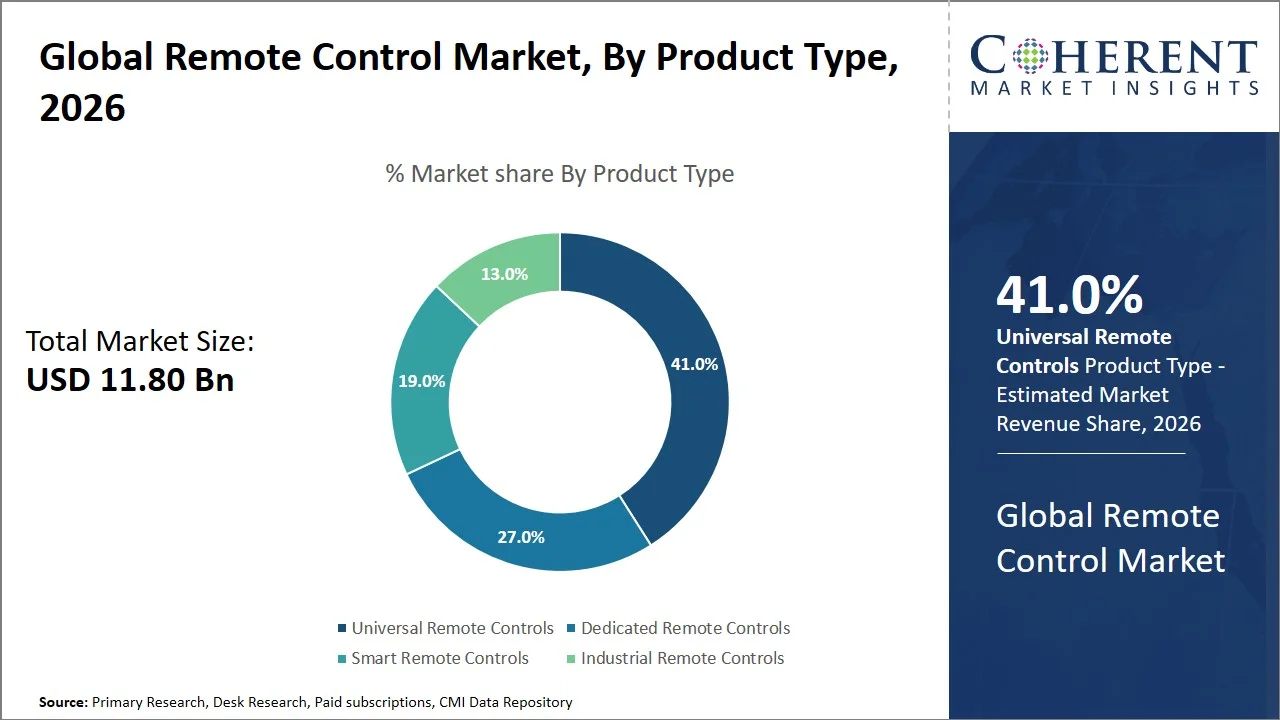
- The universal remote controls segment is expected to account for 41.0 % of the global remote control market share in 2026. Higher integration of voice assistants with remote control devices is driving the growth of the segment. On September 4, 2025, Samsung Electronics unveiled the Vision AI Companion at IFA 2025, introducing the next evolution of AI-powered displays across Samsung TVs and monitors.
- The consumer electronics segment is estimated to capture 31.0 % of the market share in 2026. Expansion of home entertainment systems is majorly driving the growth of the segment. On July 1, 2025, Sony India expanded its BRAVIA Theatre portfolio with the launch of two new immersive soundbars, the BRAVIA Theatre Bar 6 (3.1.2ch soundbar with a wireless subwoofer) and the BRAVIA Theatre System 6.
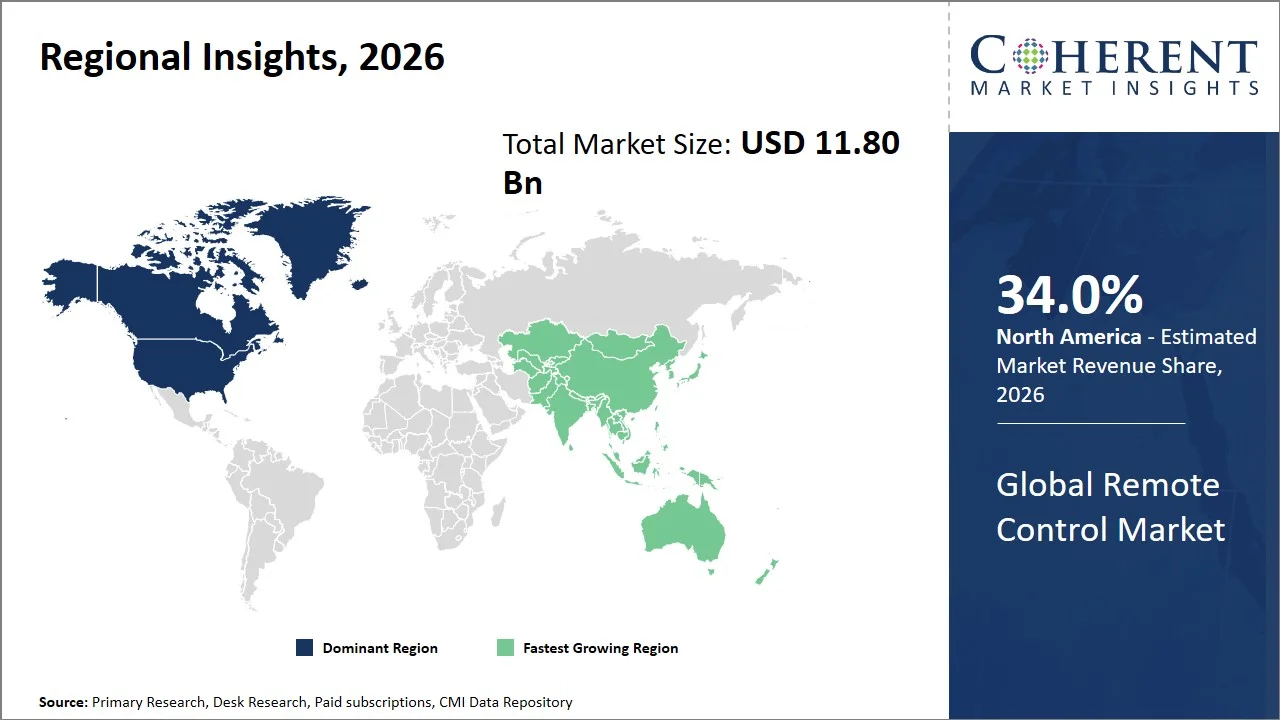
- North America is expected to dominate the remote control market in 2026 with a market share of 34.0 %. Growing demand for remote controls in healthcare equipment in North America is driving the growth of the regional market. On February 11, 2025, Agiliti launched the Essentia multi-acuity hospital bed, introducing an advanced patient hand control (remote), caregiver control panel, and programmable positioning functions designed to improve patient mobility, safety, and ease of operation across U.S. hospitals.
- Asia Pacific is expected to account for 30.0 % of the market share in 2026 and is projected to record the fastest growth over the forecast period. Increasing deployment of IoT based home automation across Asia Pacific is driving the growth of the regional market. On December 29, 2024, LG Electronics unveiled an expanded Matter-enabled ThinQ smart home ecosystem during CES 2025, allowing broader interoperability between connected appliances, smart TVs, lighting, and third-party IoT devices.
Segmental Insights
Why Do Universal Remote Controls Dominate the Global Remote Control Market?
The universal remote controls segment is expected to account for 41.0% of the global remote control market share in 2026. Universal remote controllers have been mostly preferred since they greatly ease device management by allowing users to control televisions, streaming devices, sound systems, gaming consoles and set-top boxes with one controller. With consumers adding many connected entertainment devices and smart home gadgets in their homes, they are looking for the convenience of reducing remote clutter and achieving seamless interoperability across different brands. Additionally, manufacturers are now upgrading universal remotes with customizable buttons, Bluetooth and Wi-Fi connectivity, voice assistant compatibility, and smartphone integration. This makes universal remotes a practical and economical alternative for home and business customers. As of September 4, 2024, SwitchBot continued to grow its Universal Remote ecosystem, supporting over 80,000 remote control models and working with infrared appliances, Apple TV, Fire TV, SwitchBot smart devices, Matter-enabled automation and customized one-touch smart scenes from one controller.
- Current Industry Events of 2026
- Market Size Estimation
- Regional Breakdown
- Competitive Landscape
- Customer Intelligence
- Segmental Analysis
- Pricing Analysis
- Key Market Drivers, Challenges & Future Trends
- Customized Insights Section
Why are Consumer Electronics the Most Widespread Application?
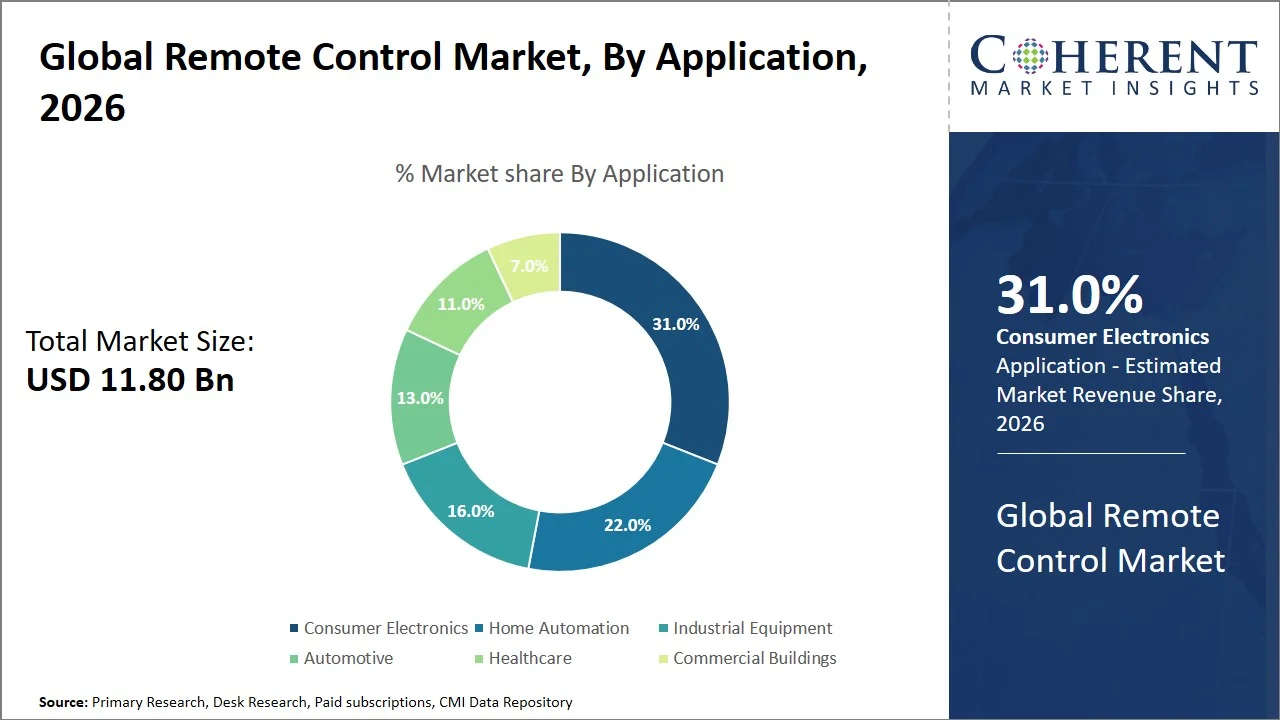
The consumer electronics segment is expected to account for 31.0% of the global remote control market share in 2026. The consumer electronics application has the greatest share in the remote control market as televisions, streaming devices, air conditioners, sound systems, projectors and smart home entertainment items are still being installed in huge volumes in houses around the globe. The demand for easy and intuitive control has increased with more and more devices getting connected in one household. New features such as voice control, Bluetooth, programmable features and smart home integration have further expanded the scope of remote controls in daily consumer electronics use. On April 28, 2025, LG Electronics announced that it is rolling out its 2025 QNED evo lineup, reinforcing its presence in the premium LCD TV segment. Marking a significant leap forward for LCD TVs, the new QNED evo TVs inherit the differentiated value of LG OLED, along with various color solutions, Mini LED technology, the latest α (Alpha) AI processor, top-tier gaming performance and the versatile award-winning webOS platform.
Current Events and their Impact
Current Events | Description and its Impact |
European Union Radio Equipment Directive Delegated Regulation (EU) 2022/30 |
|
United States FCC Cyber Trust Mark Program 2025 |
|
Global Remote Control Market Dynamics
Market Drivers
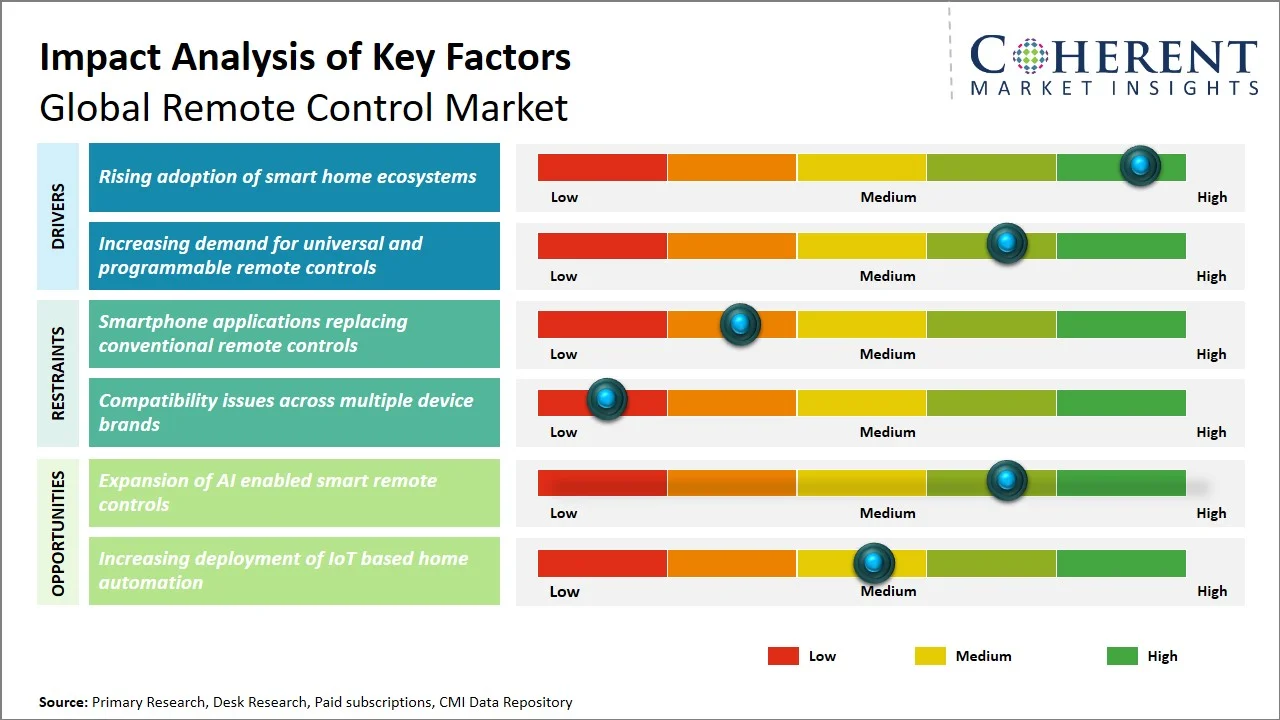
- Rising adoption of smart home ecosystems
The fast growth of smart home ecosystems is driving the demand for sophisticated remote control solutions capable of managing various connected devices via a single platform. Consumers are increasingly incorporating smart televisions, lighting systems, thermostats, security cameras, smart speakers, and home appliances into unified platforms, requiring remote controls that enable seamless interoperability across multiple communication technologies like Bluetooth, Wi-Fi, Zigbee, and Matter. Modern smart remotes with voice assistants, touchscreen features and automation capabilities make a huge difference and are an integral part of linked living spaces.
On December 30, 2024, LG Electronics presented its enhanced second-generation LG SIGNATURE lineup at CES 2025 in Las Vegas, U.S. The new LG SIGNATURE range, exhibited under the Live Beyond brand theme, includes outstanding products that combine the latest technology and refined design to deliver improved usability, seamless connectivity and an unmatched smart home experience.
- Increasing demand for universal and programmable remote controls
The increasing number of entertainment and smart devices possessed by people has led to a notable growth in demand for universal and programmable remote controls that facilitate device administration on a daily basis. Consumers would rather have one programmable controller that they can personalize to do numerous functions and suit their preferences, instead of having to juggle separate remotes for televisions, audio systems, streaming devices, gaming consoles and set-top boxes. Continuous improvements in macro programming, cloud-based device databases, smartphone integration and AI-assisted setup are further enhancing compatibility and ease of use, supporting ongoing market growth in both residential and commercial applications. On May 18, 2026, SofaBaton unveiled the SofaBaton U3, an Air Mouse universal remote for streaming-first living rooms. It will be available on SofaBaton’s official website.
Emerging Trends
- Integration of artificial intelligence and voice assistance: Remote controllers are rapidly combining artificial intelligence, allowing for customized recommendations, contextual shortcuts, and natural speech interactions. Smart TVs, streaming services and home automation systems are now working with digital assistants, enhancing their hands-free capabilities.
- Growing adoption of rechargeable and USB-C enabled remote controls: The industry is shifting to rechargeable designs with USB-C charging, moving away from throwaway batteries, to offer convenience and minimize electronic waste. This trend fits with global sustainability efforts and changing customer expectations for green consumer electronics.
- Expansion of Matter compatible smart remote controls: The Matter smart home standard allows remote controls to operate smoothly with devices from different brands in a shared ecosystem. This is driving interoperability and making it easier to control linked lighting, entertainment, climate and security systems.
- Increasing use of touch, gesture, and customizable control interfaces: Sophisticated remote controllers are expanding beyond classic button-driven designs to incorporate touchpads, motion sensing, programmable keys and customized user profiles. These features enable a more intuitive user experience as well as support for additional consumer gadgets and smart home applications.
Regional Insights
Why is North America a Strong Market for Remote Control?
North America is expected to account for a market share of 34.0% in 2026. North America continues to be a key location for advanced remote control technology, supported by the broad adoption of premium smart TVs, streaming players, home automation systems and linked entertainment ecosystems. North America is the biggest market for streaming services with significant penetration in the US and Canada. This leads to high demand for Bluetooth, RF and Wi-Fi enabled remote controls that are compatible with platforms like Roku, Apple TV, Amazon Fire TV, Google TV and Comcast Xfinity. Some of these are Universal Electronics Inc. of Arizona, which provides advanced remote control solutions to the world’s leading TV and pay-TV operators, and Crestron Electronics and Savant Systems, who continue to deploy premium home automation controllers in luxury residential and commercial installations. Matter-enabled smart home deployments and growing adoption of rechargeable USB-C remotes are further accelerating product innovation, supported by strong consumer demand for voice-enabled control through Amazon Alexa, Google Assistant, and Apple Siri.
Why Does the Asia Pacific Remote Control Market Exhibit High Growth?
Asia Pacific is projected to account for 30.0% of the global remote control market in 2026 and is expected to register the fastest growth. Asia Pacific represents the largest manufacturing hub for remote controls owing to the extensive consumer electronics production ecosystem in China, Japan, South Korea, Taiwan, and Southeast Asia. Companies including Samsung Electronics, LG Electronics, Sony, Panasonic, TCL, Hisense, Xiaomi, and Haier manufacture millions of televisions and smart appliances annually, each requiring dedicated or smart remote control solutions. China is a leading maker of television and appliance products worldwide, and South Korea and Japan are still producing AI-enhanced televisions with complicated Bluetooth voice remotes. The rapid adoption of smart home devices in countries such China, South Korea, Japan, Singapore and India is driving demand for programmable universal remote controllers with Wi-Fi, Zigbee, Bluetooth and Matter connectivity. Electronics makers in the region are also moving toward rechargeable USB-C remotes, driven by ecological efforts and changing consumer tastes.
Global Remote Control Market Outlook for Key Countries
Why is the U.S. Emerging as a Major Hub in the Remote Control Market?
The market in the U.S. is experiencing innovation in premium remote control technology, spurred by robust demand for smart entertainment systems, home automation and connected IoT devices. Roku, Amazon, Apple, Comcast, DirecTV, Dish Network, and Universal Electronics have created advanced voice-enabled remote platforms that combine streaming, gaming, and smart home capabilities into a unified interface. Crestron Electronics and Savant Systems are expanding their professional automation remotes for luxury residences, hotels, conference centers and commercial buildings. The FCC Cyber Trust Mark program is spurring manufacturers to improve cybersecurity practices around linked remote controls, while the growing use of Matter-compatible products is leading to better interoperability between televisions, lights, climate control and security systems. Growing popularity of streaming platforms continues to increase shipments of Bluetooth and RF-based remotes compared with conventional infrared models.
Is China the Next Growth Engine for the Remote Control Market?
China is the world’s largest manufacturing base for televisions, air-conditioners, set-top boxes and smart appliances, and a key market for remote control manufacture and innovation. Domestic firms such as TCL, Hisense, Xiaomi, Skyworth, Haier and Huawei are putting AI voice assistants, Bluetooth connection and smart home capabilities into their next-generation remote controllers. Xiaomi’s HyperOS ecosystem offers a single smart remote solution to operate various connected devices including TVs, lightings, air conditioners, cameras, etc. centrally. In Guangdong, Zhejiang and Jiangsu there are substantial concentrations of manufacturers producing infrared, RF, Bluetooth and Wi-Fi remote controls in big volumes for domestic and export markets. The increasing adoption of smart residential communities and intelligent home ecosystems is driving up demand for multipurpose universal remotes.
Germany Remote Control Market Analysis and Trends
Germany is a major European market for premium home automation and industrial remote control systems, supported by its strong engineering and building automation sectors. The demand is especially high for programmable remote controls used with smart lighting, HVAC systems, motorized blinds and integrated home entertainment installations. The operation of the connected building ecosystems, which companies like Bosch Smart Home, Gira, Jung and Homematic IP have expanded, is made crucial by the centralized remote control. In response to the European Union Radio Equipment Directive cybersecurity regulations, manufacturers have enhanced the security of firmware, encrypted communication and secure software upgrades for linked remote equipment. The country's emphasis on energy-efficient smart buildings is also driving the use of clever remote-controlled automation systems.
Japan Remote Control Market Analysis and Trends
Japan is one of the world’s most advanced marketplaces for remote control technology, with globally respected consumer electronics firms such as Sony, Panasonic, Sharp, Toshiba and Mitsubishi Electric. Japanese consumers have quickly adopted smart televisions that offer Bluetooth voice remotes, AI-driven content navigation and connectivity with cloud-based entertainment services. With the proliferation of sophisticated air conditioning systems, robotic appliances and smart home gadgets in homes, the need has arisen for the development of multipurpose remote controls capable of controlling several interconnected items concurrently. Manufacturers are now launching ergonomically designed rechargeable remotes with programmable shortcuts and are increasing connectivity with voice assistants and home automation systems across luxury product ranges.
South Korea Remote Control Market Analysis and Trends
South Korea is leading the way in AI-enabled remote control innovation, with Samsung Electronics and LG Electronics both launching cutting-edge smart remotes that incorporate speech recognition, motion control and AI-based content recommendations. A good example of sustainable remote control design is Samsung’s SolarCell Remote, which runs on indoor and outdoor light and USB-C charging, cutting out the need for disposable batteries. LG’s Magic Remote aims to simplify interaction with smart televisions using pointer-based navigation, voice control and gesture recognition. The country’s vast smart home infrastructure, abundant access to high-speed broadband, and early adoption of AI-powered consumer products continue to fuel demand for sophisticated wireless remote control solutions in both residential and commercial settings.
Global Remote Control Market - Remote Control Adoption By Devices (2025)
Device Category | Adoption Share | Key Adoption Factors |
Smart Televisions | 32% | Expansion of smart TV installations, AI-enabled navigation, voice assistant integration, streaming platform control, and Bluetooth remote adoption |
Streaming Devices | 18% | Growth of OTT platforms, cord-cutting trends, and demand for simplified content navigation through voice-enabled controllers |
Air Conditioners And Smart HVAC Systems | 16% | Increasing smart appliance adoption, IoT-based climate management, and demand for energy-efficient remote operation |
Audio Systems And Soundbars | 12% | Expansion of home theater systems, wireless audio products, and multi-device entertainment control requirements |
Gaming Consoles And Accessories | 9% | Growth of connected gaming ecosystems, cloud gaming services, and demand for integrated entertainment control |
Smart Home Devices | 8% | Rising adoption of connected lighting, security systems, smart locks, and Matter-compatible automation platforms |
Projectors And Professional Displays | 3% | Increasing use of projectors in education, corporate environments, and premium home theaters |
Healthcare And Industrial Equipment | 2% | Adoption of wireless controllers for hospital beds, medical devices, automation systems, and machinery control |
How is the Expansion of AI Enabled Smart Remote Controls Creating New Growth Opportunities in the Remote Control Market?
Growing demand for smart remote controls with AI capabilities is providing new growth prospects in the market, changing remotes from simple input devices into intelligent control hubs that can recognize user behavior and automate device interactions. Samsung’s AI-embedded TV ecosystem allows the remote to interact with on-device AI capabilities like content recognition, personalized recommendations and intelligent picture optimization, while LG’s AI Magic Remote enables conversational voice commands and contextual navigation through ThinQ AI.
Roku has launched AI-enabled voice features that assist customers in finding content via natural language, rather than specific titles, saving time searching across numerous streaming platforms. In luxury smart home setups, AI-enabled remote controls are increasingly being programmed to launch customized automation routines, such as adjustment of lighting, motorized shades, climate settings and entertainment systems – based on user profiles or time of day. Those capabilities are driving manufacturers to embed machine learning, cloud connectivity, edge AI processing and Matter compatibility into next-generation remote controls, creating opportunities for higher-value products, subscription-based smart home services and deeper ecosystem integration across consumer electronics.
On July 2, 2026, Lumio announced Project Neo, which investigates AI based conversational control of televisions, enabling customers to engage with TV systems using familiar messaging channels like WhatsApp and Instagram, rather than exclusively physical remotes.
Market Players, Key Development, and Competitive Landscape
Key Developments
- On December 10, 2025, Cantatacs unveiled the Haptique RS90 Universal Remote. Powered by an Android operating system, the Haptique RS90 Universal Remote features a color touchscreen, Wi-Fi, Bluetooth and infrared connectivity, voice command capability and compatibility for whole-home automation and is aimed at the premium universal remote category.
- On November 18, 2025, SofaBaton launched the premium X2 Universal Remote, a new-generation universal remote that turns both hardware craftsmanship and IR performance up to eleven. Its body is built from a unibody zinc-alloy metal chassis with careful chamfer edges and a clean, well-spaced button layout.
Competitive Landscape
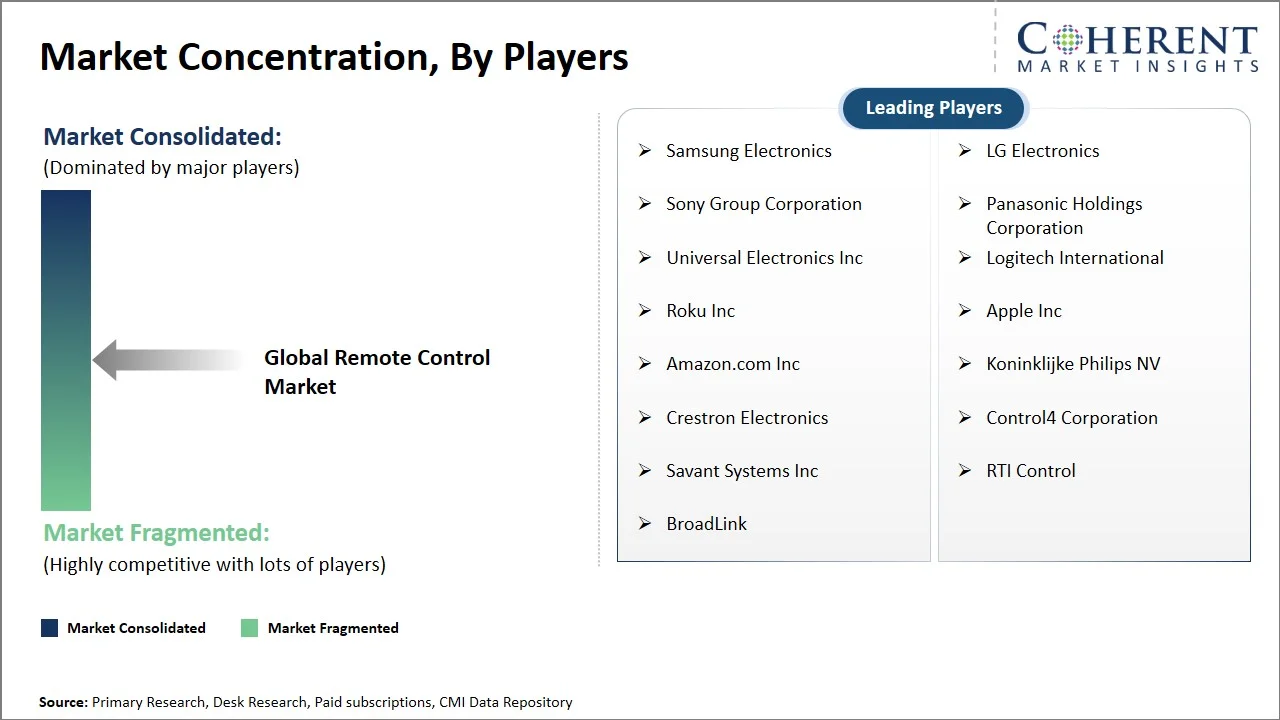
The global remote control market is led by Samsung Electronics, LG Electronics, Sony Group, Universal Electronics Inc. (UEI), Roku, Apple, Logitech, Panasonic, Crestron Electronics, Savant Systems, and BroadLink. These companies are focusing on ecosystem integration, rather than differentiating standalone hardware. Samsung cemented its position with its SolarCell Remote, adding AI-powered voice control and SmartThings connectivity to its television lineup, while LG kept up with upgrades to its AI Magic Remote with pointer navigation, ThinQ AI and webOS integration.
Universal Electronics Inc. has built lasting relationships with TV OEMs, pay-TV operators and smart home providers across the globe by providing cloud-based device databases, QuickSet software and white-label universal remote platforms. Roku and Apple are targeting seamless streaming experiences by integrating voice-enabled remotes with content discovery and smart home control, while Crestron and Savant are targeting the luxury residential and commercial automation market with highly customized remote control ecosystems. BroadLink is also extending its presence in Asia, with Matter-compatible universal remotes that can control old infrared devices as well as newer Wi-Fi smart home gadgets, underscoring the industry’s move to unified connected-device management.
Market Report Scope
Remote Control Market Report Coverage
| Report Coverage | Details | ||
|---|---|---|---|
| Base Year: | 2025 | Market Size in 2026: | USD 11.80 Bn |
| Historical Data for: | 2020 To 2024 | Forecast Period: | 2026 To 2033 |
| Forecast Period 2026 to 2033 CAGR: | 6% | 2033 Value Projection: | USD 18.50 Bn |
| Geographies covered: |
| ||
| Segments covered: |
| ||
| Companies covered: | Samsung Electronics, LG Electronics, Sony Group Corporation, Panasonic Holdings Corporation, Universal Electronics Inc, Logitech International, Roku Inc, Apple Inc, Amazon.com Inc, Koninklijke Philips NV, Crestron Electronics, Control4 Corporation, Savant Systems Inc, RTI Control, and BroadLink | ||
| Growth Drivers: |
| ||
| Restraints & Challenges: |
| ||
Analyst Opinion (Expert Opinion)
- The future of the industry is expected to shift from conventional infrared controllers toward AI-enabled, software-defined smart remotes that function as central control interfaces for connected homes and entertainment ecosystems. Growth is likely to be driven by the convergence of artificial intelligence, Matter interoperability, edge computing, and voice interaction rather than by incremental hardware improvements alone.
- The strongest opportunities are expected to emerge in smart remote controls for consumer electronics in China and the U.S., where smart television penetration, streaming platform usage, and connected home adoption continue to expand rapidly. South Korea, Japan and Germany also provide excellent potential for premium home automation applications, particularly rechargeable Bluetooth and Wi-Fi universal remotes combined with AI assistants and multi-device automation platforms.
- Manufacturers should focus on software platforms that will continue to increase functionality to the platform through over-the-air updates. AI-powered personalization, matter certification, rechargeable USB-C designs and sophisticated cybersecurity capabilities will give manufacturers a competitive advantage. Those companies that establish strategic alliances with TV manufacturers, streaming platform providers and smart home ecosystem developers will be better positioned to achieve long-term client retention and recurring income from software and services beyond traditional hardware sales.
Speak to the analyst
Want personalized insights?
Take the findings above to one of our principal consultants, or have the report rebuilt around the segments, geographies and competitors you actually track.
Market Segmentation
- Product Type Insights (Revenue, USD Billion, 2021 - 2033)
- Universal Remote Controls
- Dedicated Remote Controls
- Smart Remote Controls
- Industrial Remote Controls
- Application Insights (Revenue, USD Billion, 2021 - 2033)
- Consumer Electronics
- Home Automation
- Industrial Equipment
- Automotive
- Healthcare
- Commercial Buildings
- Regional Insights (Revenue, USD Billion, 2021 - 2033)
- North America
- U.S.
- Canada
- Latin America
- Brazil
- Argentina
- Mexico
- Rest of Latin America
- Europe
- Germany
- U.K.
- Spain
- France
- Italy
- Russia
- Rest of Europe
- Asia Pacific
- China
- India
- Japan
- Australia
- South Korea
- ASEAN
- Rest of Asia Pacific
- Middle East
- GCC Countries
- Israel
- Rest of Middle East
- Africa
- South Africa
- North Africa
- Central Africa
- North America
- Key Players Insights
- Samsung Electronics
- LG Electronics
- Sony Group Corporation
- Panasonic Holdings Corporation
- Universal Electronics Inc
- Logitech International
- Roku Inc
- Apple Inc
- Amazon.com Inc
- Koninklijke Philips NV
- Crestron Electronics
- Control4 Corporation
- Savant Systems Inc
- RTI Control
- BroadLink
Sources
Primary Research Interviews
- Remote Control Manufacturers and Product Managers
- Smart TV Manufacturers and Consumer Electronics Companies
- Smart Home Automation Solution Providers
- AV System Integrators and Home Theater Installers
Magazines
- CE Pro Magazine
- Sound & Vision Magazine
- Electronics Weekly
- Consumer Electronics Daily
Journals
- IEEE Transactions on Consumer Electronics
- IEEE Internet of Things Journal
- IEEE Access
Associations
- Consumer Technology Association (CTA)
- Connectivity Standards Alliance (CSA)
- Bluetooth Special Interest Group (Bluetooth SIG)
- Zigbee Alliance
Public Domain Sources
- Samsung Electronics Press Releases and Annual Reports
- LG Electronics Press Releases and Investor Reports
- Sony Group Annual Reports and Product Announcements
- Universal Electronics Inc Company Filings and Product Updates
Proprietary Elements
- CMI Data Analytics Tool
- Proprietary CMI Existing Repository of Information for the Last 10 Years
Get access to 250+ pages report
Every segment, forecast, competitor profile and data table behind the analysis above — available for instant download.
- ESOMAR Member
- ISO 9001:2015 Certified
- D-U-N-S Registered
- GDPR & CCPA Compliant
Missing comfort of reading report in your local language? Find your preferred language:
Transform your Strategy with Exclusive Trending Reports
Frequently Asked Questions
The global remote control market is expected to stand at USD 11.80 Bn in 2026 and is expected to reach USD 18.50 Bn by 2033.
The CAGR of the global remote control market is projected to be 6% from 2026 to 2033.
Rising adoption of smart home ecosystems and increasing demand for universal and programmable remote controls are the major factors driving the growth of the global remote control market.
Smartphone applications replacing conventional remote controls and compatibility issues across multiple device brands are the major factors hampering the growth of the global remote control market.
In terms of product type, the universal remote controls segment is estimated to dominate the market revenue share in 2026.
They allow customized commands and automation for multiple electronic devices.
Connected remote controls require stronger protection against unauthorized access and cyber threats.