

Global Remote Sensing Data Analysis Market Size and Forecast – 2026-2033
The Global Remote Sensing Data Analysis Market is estimated to be valued at USD 24.24 Bn in 2026 and is expected to reach USD 53.58 Bn by 2033, exhibiting a compound annual growth rate (CAGR) of 12.0% from 2026 to 2033.
Key Takeaways of the Remote Sensing Data Analysis Market
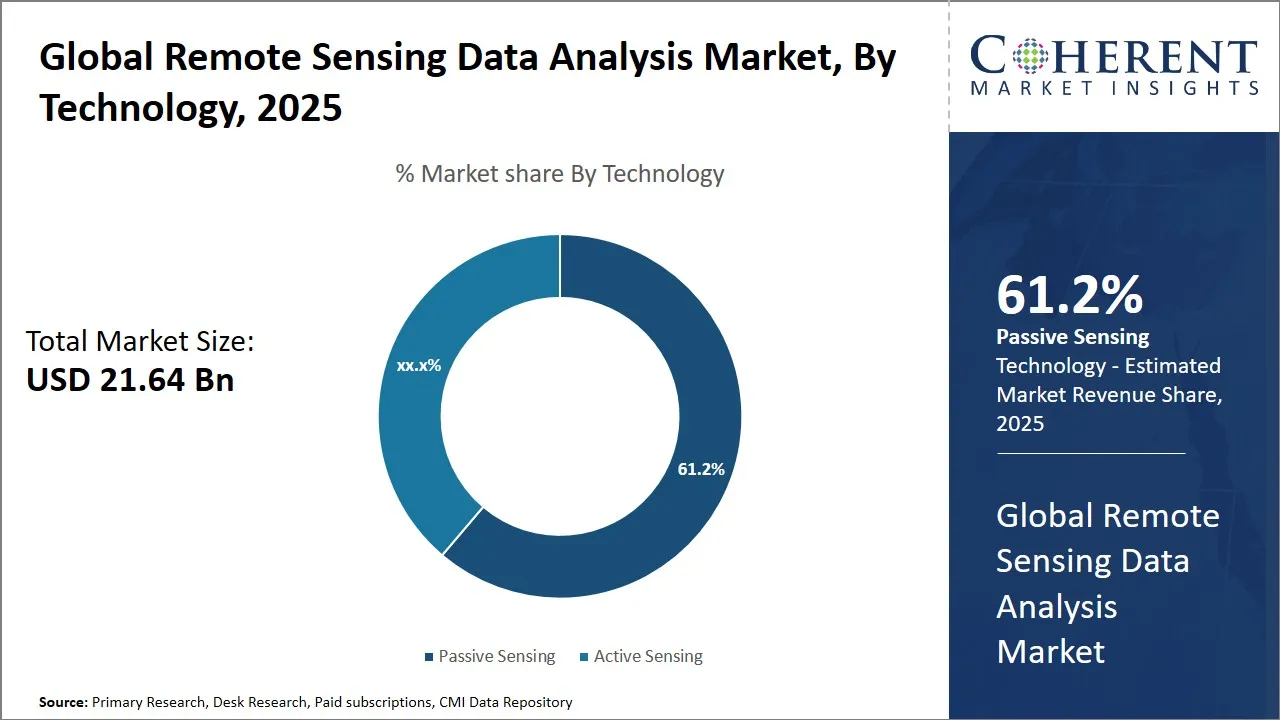
- The passive sensing segment leads the market holding an estimated share of 62.2 % in 2026.
- The Data Acquisition & Processing segment is projected to dominate with a share of 50.4 % in 2026.
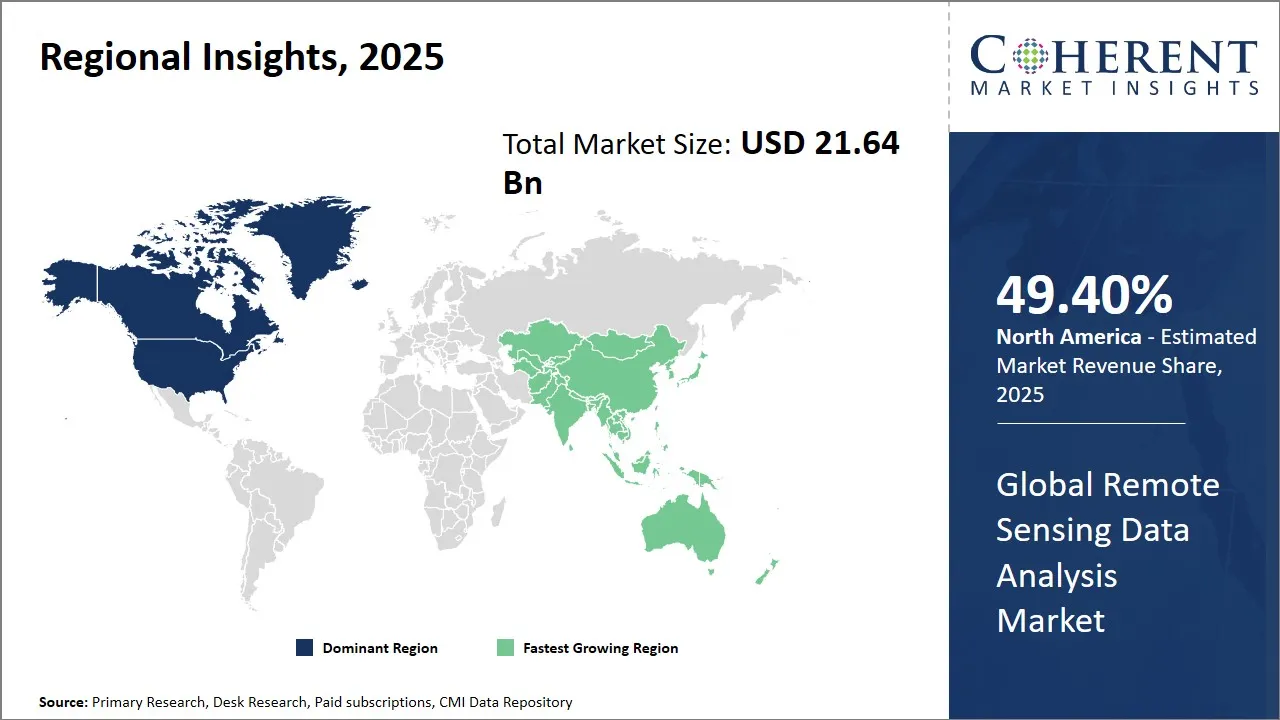
- North America is estimated to lead the market with a share of 49.4 % in 2026
- Asia Pacific, holding a share of 24.5 % in 2026, is projected to be the fastest growing region.
Market Overview
Current market trends highlight a growing emphasis on integrating artificial intelligence (AI) and machine learning with remote sensing data analysis, enabling more precise and faster data interpretation. Also, advancements in sensor technologies and the proliferation of small satellites (CubeSats) are reducing costs and increasing accessibility for many applications. Environmental concerns and the need for real-time monitoring are also adding to demand, making remote sensing data analysis a critical tool for decision-making in both commercial and governmental domains.
Current Events and Its Impact
Current Events | Description and Impact |
Geopolitical and Trade Developments |
|
Climate and Environmental Mandates |
|
Economic and Infrastructure Trends |
|
Technological Advancements |
|
Segmental Insights
- Current Industry Events of 2026
- Market Size Estimation
- Regional Breakdown
- Competitive Landscape
- Customer Intelligence
- Segmental Analysis
- Pricing Analysis
- Key Market Drivers, Challenges & Future Trends
- Customized Insights Section
Global Remote Sensing Data Analysis Market Insights, by Technology - Passive Sensing Leads Due to its Cost-Effectiveness and Broad Application Spectrum
The Passive Sensing segment dominates the global remote sensing data analysis market, holding an estimated share of 62.2% in 2026. Passive sensors depend on detecting natural energy, such as sunlight, reflected or emitted from the Earth's surface. This reduces the complexity and energy consumption of passive sensing systems, making them more affordable and easier to deploy on a large scale.
Passive sensors can capture multispectral and hyperspectral data, which is very important for assessing vegetation health and soil conditions. The increasing focus on sustainable agriculture and natural resource management also adds to the demand for passive sensing data. Also, advancements in satellite and aerial imaging technologies have improved the resolution and accuracy of passive sensors, adding to their usability in different fields such as forestry and urban planning.
To add, there is a widespread availability of satellite platforms equipped with passive sensors. Many government and private satellites continuously gather vast amounts of passive remote sensing data, offering real-time insights into climate change trends, deforestation rates, and other critical environmental factors. As passive sensors can operate continuously without the need for active signal generation, it makes them very reliable and suited for long-term monitoring projects, which adds to their adoption.
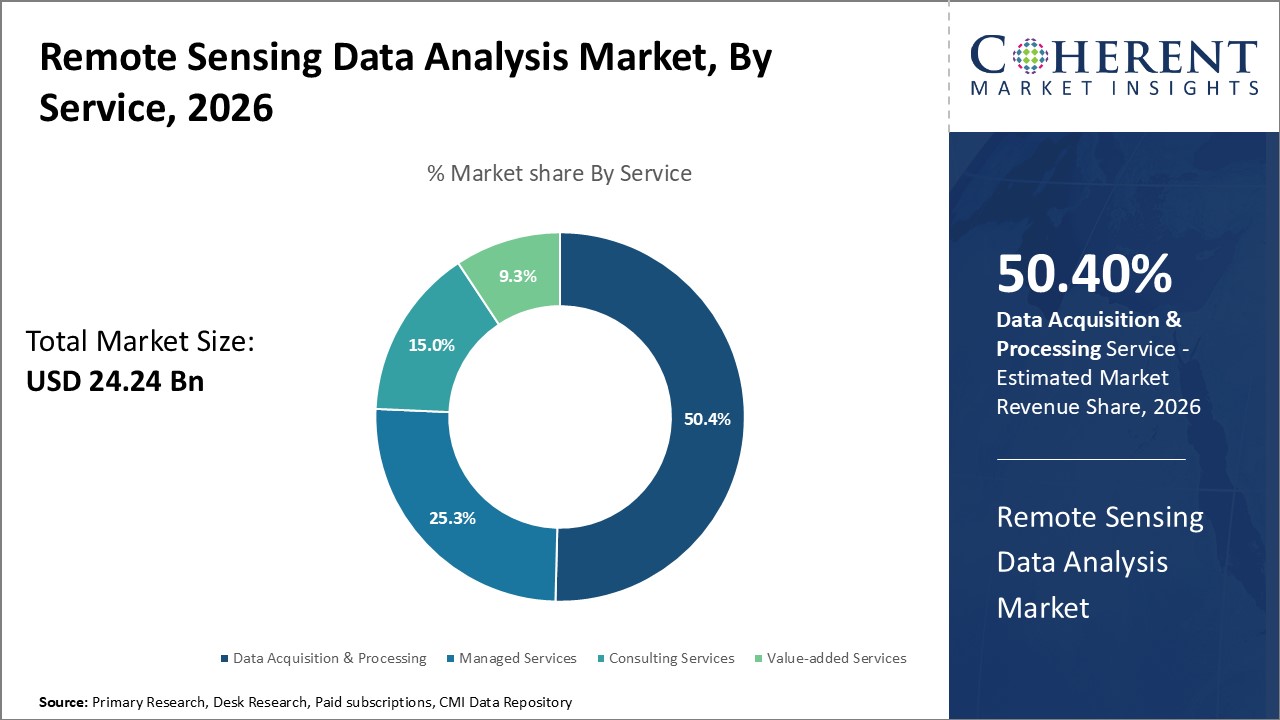
Global Remote Sensing Data Analysis Market Insights, by Service - Data Acquisition & Processing Leads the Market, Driven by the Critical Need for Accurate and Timely Remote Sensing Data
Within the global remote sensing data analysis market, the data acquisition & processing segment stands out as the largest contributor, holding an estimated share of 50.4% in 2026. This segment includes the collection, calibration, correction, and initial analysis of data captured through sensing technologies. It is seeing growth due to the increased demand from sectors such as agriculture, defense, environmental management, and urban planning, all of which require precise and validated remote sensing data to guide critical decisions. Accurate data acquisition makes sure that the high volumes of information captured by satellites and drones can be used for detailed analysis. Considering the complexities involved in remote sensing, including atmospheric disturbances and sensor limitations, good processing methodologies are important to improve data quality.
Also, advancements in sensor technologies and a proliferation of remote sensing platforms have exponentially increased the volume and variety of data collected. This surge necessitates sophisticated data processing techniques, including noise reduction, image correction, and feature extraction, to convert raw signals into meaningful datasets. Innovations such as artificial intelligence and cloud computing have enhanced the scalability and speed of data processing services, allowing providers to handle large datasets efficiently and deliver timely outputs to end users.
Regulatory and policy frameworks also add to the use of geospatial data for infrastructure development, environmental compliance, and disaster resilience, adding to the demand for reliable data acquisition and processing services.
Impact of AI on the Remote Sensing Data Analysis Market
Artificial Intelligence (AI) is profoundly transforming the remote sensing data analysis market by automating and accelerating the interpretation of massive volumes of satellite and aerial imagery. Traditional manual analysis, which is time-consuming and prone to human error, is being replaced by AI-driven tools that can detect patterns, classify land cover, monitor environmental changes, and even forecast natural disasters in near real-time. Machine learning algorithms, particularly convolutional neural networks (CNNs), are widely used to enhance image segmentation and anomaly detection. This has significantly improved the speed, scalability, and accuracy of geospatial insights across sectors such as agriculture, defense, urban planning, and disaster management.
A real-world example of this is Planet Labs’ use of AI to monitor deforestation in the Amazon. The company processes imagery from its daily-updated constellation of CubeSats using AI models to automatically identify illegal logging activities and changes in forest cover.
Regional Insights
North America Remote Sensing Data Analysis Market Analysis and Trends
North America, holding an estimated share of 49.4% in 2026, dominates the global remote sensing data analysis market because of a well-established ecosystem integrating advanced technological infrastructure, robust government support, and a mature industry presence across both private and public sectors. The United States and Canada boast significant investments in space programs, defense applications, agriculture monitoring, and environmental management that heavily rely on remote sensing technologies. Government agencies such as NASA and USGS actively promote satellite data utilization, fostering innovation and practical applications.
Moreover, a dense network of private companies, including industry leaders like Maxar Technologies, L3Harris Technologies, and Hexagon Geospatial, provide cutting-edge solutions spanning data acquisition, processing, and analytical software. Planet Labs has developed a real-time AI-powered change detection system known as Planetary Variables, which uses machine learning to convert satellite imagery into ready-to-use geospatial insights like soil moisture, biomass, and land surface temperature.
Asia Pacific Remote Sensing Data Analysis Market Analysis and Trends
The Asia Pacific, holding an estimated share of 24.5% in 2026, exhibits the fastest growth in the remote sensing data analysis market driven by rapid digital transformation, expanding infrastructure projects, and increasing governmental focus on smart cities and sustainable development. This region benefits from rising demand in agriculture optimization, disaster management, and urban planning, especially in countries like China, India, Japan, South Korea, and Australia. Pixxel, a India-based startup, is deploying a constellation of hyperspectral imaging satellites capable of capturing data in over 150 spectral bands. This technology allows detection of phenomena invisible to traditional satellites—such as crop health stress and mineral composition.
Initiatives such as China’s BeiDou satellite system and India’s National Remote Sensing Centre (NRSC) amplify the regional capabilities. Moreover, the increasing presence of global and local players, including companies like GeoIQ, SatSure, and SI Imaging Services, contributes to a highly competitive and innovative market landscape.
Remote Sensing Data Analysis Market Outlook for Key Countries
U.S. Remote Sensing Data Analysis Market Analysis and Trends
The U.S. is seeing government programs and private sector innovation focusing on defense, environmental monitoring, and commercial space ventures. Major players, such as Maxar Technologies, use a huge constellation of satellites to provide high-resolution imagery and advanced data analytics. Collaborative research initiatives with NASA and the Department of Defense add to technological advancements, supporting applications in disaster management, agriculture, and energy sectors.
China Remote Sensing Data Analysis Market Analysis and Trends
China is fast expanding, supported by large investments in satellite technology. Big organizations like China Aerospace Science and Technology Corporation and private firms, such as GeoStar, add to the proliferation of remote sensing data applications in land management, urban planning, and environmental protection. The government’s emphasis on integrating BeiDou Navigation Satellite System data with remote sensing analytics creates competitive advantages domestically and in Belt and Road Initiative partner countries.
India Remote Sensing Data Analysis Market Analysis and Trends
India continues to lead in using remote sensing for agricultural monitoring, natural resource management, and disaster response. The Indian Space Research Organisation (ISRO) provides a dense array of Earth observation satellites and data products. Collaborations with private players such as Earth2Orbit and analytical platforms like TartanSense improve data accessibility and utilization.
Japan Remote Sensing Data Analysis Market Analysis and Trends
Japan’s market integrates cutting-edge remote sensing technologies with established industrial applications in forestry, fisheries, and disaster prevention. Big corporations like NEC Corporation and Mitsubishi Electric provide advanced sensors and processing technologies, combining satellite data with AI-driven analytics for precision monitoring. Government policies supporting technological innovation and international space collaborations contribute to a stable market environment, making possible the development of solutions suited to the region’s challenges.
Market Players, Key Development, and Competitive Intelligence
Key Developments
- On July 10, 2025, Neo Space Group (NSG), a PIF company and Saudi Arabia’s leading commercial space services provider, announced that the company has completed its previously announced acquisition of UP42 GmbH, the leading Earth Observation (EO) platform previously owned by Airbus Defence and Space GmbH.
- In April 2025, Headwall Photonics partnered with GRYFN, a developer of multi-modal sensing solutions, to streamline hyperspectral data collection and processing. The collaboration seeks to enhance accessibility and precision for industries such as agriculture, natural resources, environmental monitoring, and defense.
- In November 2024, Pixxel, a space technology company building the world's highest-resolution hyperspectral satellite constellation, announced that it has signed a memorandum of understanding (MOU) with SIIS Co., Ltd., to supply hyperspectral satellite data in Korea. The signing ceremony, held during the Satellite Utilization Conference, marks a significant step towards providing hyperspectral data to relevant institutions and companies in the country.
- In September 2024, Pixxel, a leader in hyperspectral imaging and Earth Observation, announced its selection as part of NASA’s USD 476 million Commercial SmallSat Data Acquisition Program On-Ramp1 Multiple Award contract. This contract period of performance runs through November 2028.
Top Strategies Followed by Remote Sensing Data Analysis Market Players
- Established market leaders heavily invest in research and development to drive innovation, continuously enhancing their product offerings to deliver high-performance, cutting-edge solutions.
- Maxar Technologies (USA) invested over USD 400 million into its next-generation WorldView Legion satellite constellation, which offers faster revisit rates and higher-resolution imagery.
- In contrast, mid-level market players adopt a more cost-conscious strategy, aiming to offer products and services that strike a balance between quality and affordability.
- SatSure (India), a mid-level geospatial analytics company, offers low-cost, satellite-based agricultural intelligence to banks, insurers, and agribusinesses in emerging markets.
- Small-scale players in the global remote sensing data analysis market typically focus on carving out specialized niches by developing innovative or highly specialized products that address unique customer requirements.
- Synspective (Japan), a small-scale startup, specializes in urban infrastructure monitoring using SAR (Synthetic Aperture Radar) data. Their satellites can detect millimeter-level ground deformation, enabling precise risk assessment for smart cities and disaster-prone areas.
Market Report Scope
Remote Sensing Data Analysis Market Report Coverage
| Report Coverage | Details | ||
|---|---|---|---|
| Base Year: | 2025 | Market Size in 2026: | USD 24.24 Bn |
| Historical Data for: | 2020 To 2024 | Forecast Period: | 2026 To 2033 |
| Forecast Period 2026 to 2033 CAGR: | 12.0% | 2033 Value Projection: | USD 53.58 Bn |
| Geographies covered: |
| ||
| Segments covered: |
| ||
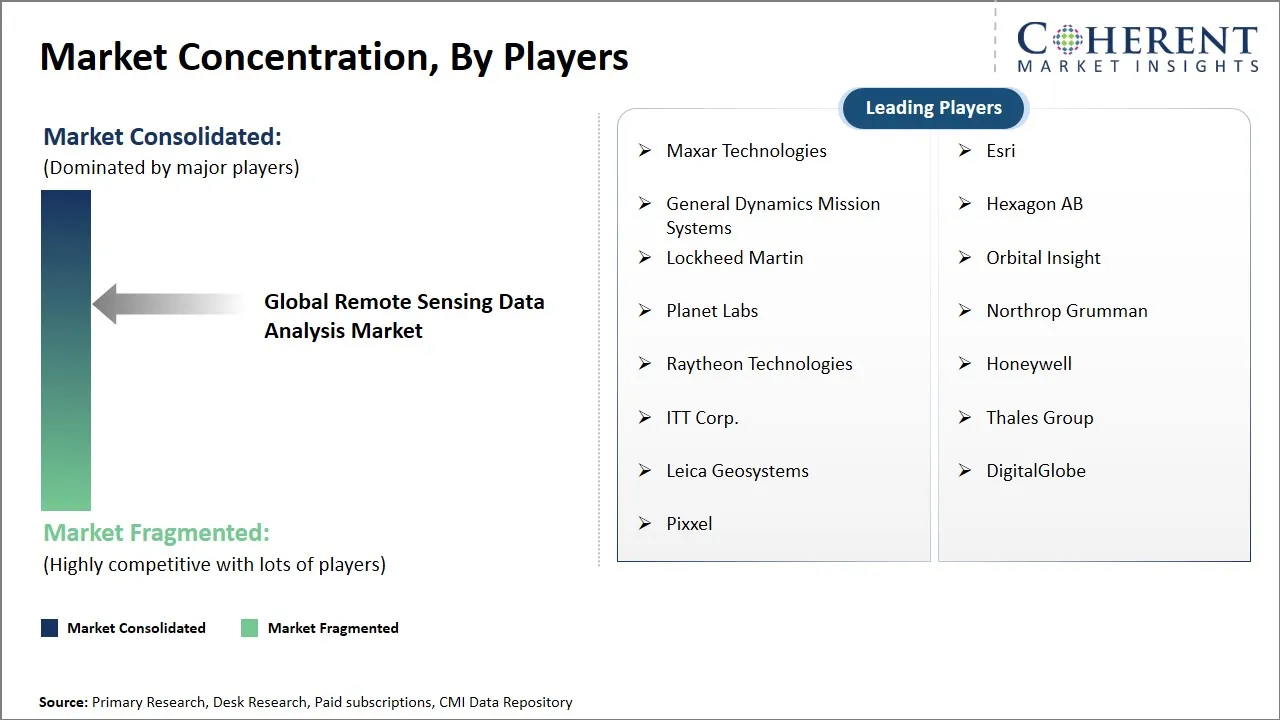
| Companies covered: | Maxar Technologies, Esri, General Dynamics Mission Systems, Hexagon AB, Lockheed Martin, Orbital Insight, Planet Labs, Northrop Grumman, Raytheon Technologies, Honeywell, ITT Corp., Thales Group, Leica Geosystems, DigitalGlobe, and Pixxel | ||
| Growth Drivers: |
| ||
| Restraints & Challenges: |
| ||
Market Dynamics
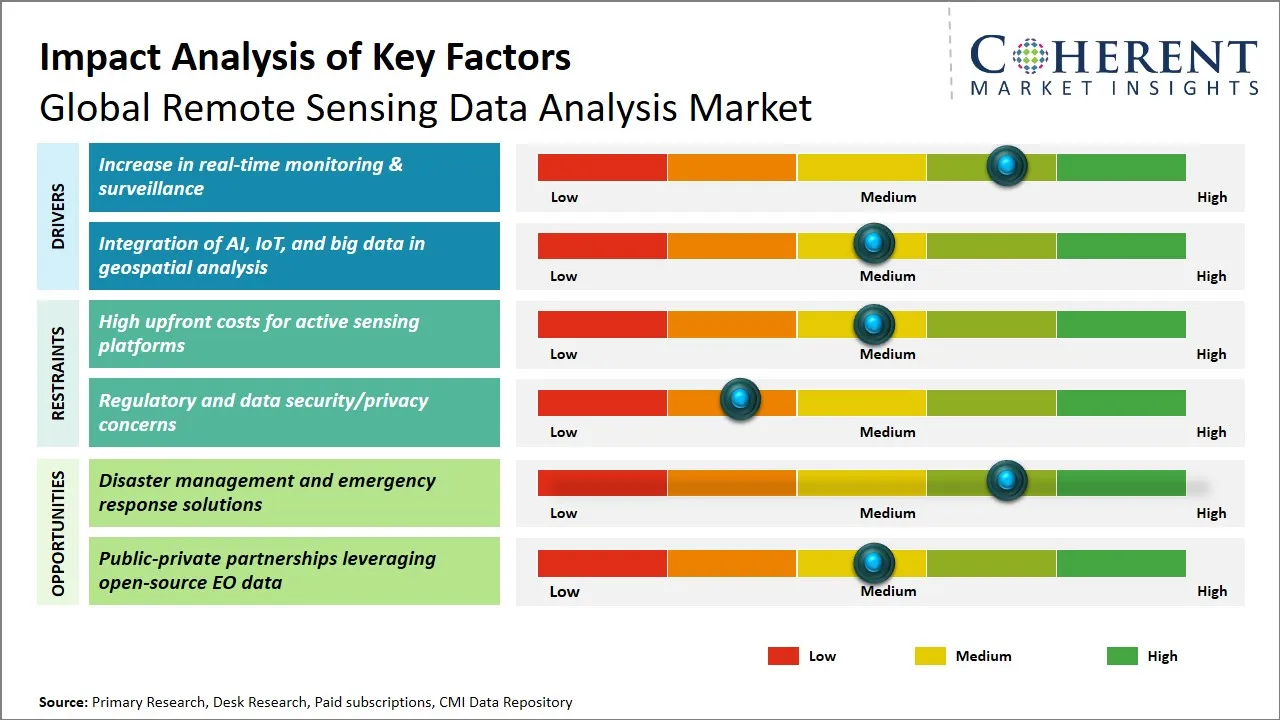
Global Remote Sensing Market Driver - Increase in Real-time Monitoring & Surveillance
With advancements in sensor technology and satellite capabilities, organizations are increasingly relying on remote sensing data to obtain immediate, accurate insights about environmental conditions, urban development, and security threats. Real-time data makes rapid decision-making possible in disaster management and agricultural monitoring, helping stakeholders respond and mitigate risks effectively. Also, the rise in smart city initiatives and border surveillance programs has added to the importance of continuous data collection and analysis. These applications need sophisticated algorithms to process huge datasets quickly, making timely alerts and actionable intelligence possible.
Global Remote Sensing Market Opportunity – Disaster Management and Emergency Response Resolution
With the increasing incidences of natural disasters such as hurricanes, floods, wildfires, and earthquakes resulting from climate change and urbanization, the demand for accurate, real-time data has grown a lot. Remote sensing technologies make fast acquisition and analysis of geospatial data possible, facilitating timely identification of hazard zones, assessing damage extent, and monitoring environmental changes before, during, and after disasters. Integrating AI and machine learning with remote sensing data further improves predictive analytics, allowing authorities to deploy resources more efficiently and develop proactive mitigation strategies.
Also, advancements in satellite imaging and unmanned aerial vehicles (UAVs) provide high-resolution and multispectral data needed for detailed terrain mapping and situational awareness in inaccessible or hazardous areas.
Analyst Opinion (Expert Opinion)
- The Remote Sensing Data Analysis Market is witnessing dynamic growth, with demand patterns shaped by industry-specific needs and emerging technologies. Defense and Intelligence continue to serve as the cornerstone of the market, driven by the growing need for high-resolution, real-time geospatial intelligence. Rising geopolitical tensions and the deployment of low-Earth orbit (LEO) satellite constellations have significantly enhanced revisit frequency and data accuracy, making these solutions indispensable for surveillance, border monitoring, and mission planning.
- Simultaneously, agriculture is emerging as one of the fastest-growing application areas, especially in developing regions. The increasing adoption of precision farming practices is fueling demand for satellite- and drone-based analytics for crop health monitoring, soil analysis, irrigation planning, and yield forecasting. Remote sensing is becoming a vital tool to enhance food security, optimize inputs, and improve sustainability.
- Meanwhile, sectors like energy, mining, and infrastructure are accelerating their use of geospatial analytics to monitor assets, plan exploration activities, and ensure regulatory compliance. The integration of AI and big data with remote sensing enables predictive insights, helping organizations mitigate risk, reduce costs, and improve decision-making in highly dynamic environments.
Speak to the analyst
Want personalized insights?
Take the findings above to one of our principal consultants, or have the report rebuilt around the segments, geographies and competitors you actually track.
Market Segmentation
- Technology Insights (Revenue, USD Bn, 2021 - 2033)
- Passive Sensing
- Active Sensing
- Service Insights (Revenue, USD Bn, 2021 - 2033)
- Data Acquisition & Processing
- Managed Services
- Consulting Services:
- Value‑added Services
- Regional Insights (Revenue, USD Bn, 2021 - 2033)
- North America
- U.S.
- Canada
- Latin America
- Brazil
- Argentina
- Mexico
- Rest of Latin America
- Europe
- Germany
- U.K.
- Spain
- France
- Italy
- Russia
- Rest of Europe
- Asia Pacific
- China
- India
- Japan
- Australia
- South Korea
- ASEAN
- Rest of Asia Pacific
- Middle East
- GCC Countries
- Israel
- Rest of Middle East
- Africa
- South Africa
- North Africa
- Central Africa
- North America
- Key Players Insights
- Maxar Technologies
- Esri
- General Dynamics Mission Systems
- Hexagon AB
- Lockheed Martin
- Orbital Insight
- Planet Labs
- Northrop Grumman
- Raytheon Technologies
- Honeywell
- ITT Corp.
- Thales Group
- Leica Geosystems
- DigitalGlobe
- Pixxel
Sources
Primary Research Interviews
Stakeholders
- Geospatial Analytics Firms and Consultants (e.g., Data Scientists, GIS Engineers)
- Satellite Operators and Manufacturers (e.g., Payload Engineers, EO Program Leads)
- Defense and Homeland Security Agencies (e.g., ISR Officers, Strategic Analysts)
- Environmental Monitoring Bodies (e.g., Remote Sensing Technicians, Forest Managers)
- Agricultural Cooperatives and Agri-Tech Startups (e.g., Precision Farming Experts)
- Urban Planning Departments and Smart City Developers
- AI/ML Solution Providers specializing in geospatial data analytics
Databases
- Global Space Applications Portal (GSAP)
- Earth Observation Data Repository (EODR)
- Satellite Utilization Statistics Index (SUSI)
- National Center for Geospatial Intelligence (NCGI)
Magazines
- Earth Observation Weekly
- Satellite Imaging Digest
- AI in Geospatial Review
- Global Surveillance & Recon Magazine
Journals
- Journal of Remote Sensing Applications & Innovations
- Geospatial Intelligence and Security Studies
- International Journal of Earth Observation Data Analytics
- Journal of Satellite Technology and Environmental Science
Newspapers
- The Orbital Times
- Earth Intelligence Daily
- The Satellite Report (Canada)
- Asia Geospatial Review (Singapore)
Associations
- International Remote Sensing Alliance (IRSA)
- Asia-Pacific Earth Observation Association (APEOA)
- American Geospatial Intelligence Council (AGIC)
- Hyperspectral Imaging Consortium (HIC)
- Global Remote Sensing Data Society (GRSDS)
Public Domain Sources
- U.S. Geological Survey (USGS)
- EUROSTAT
- United Nations Office for Outer Space Affairs (UNOOSA)
- World Bank
- NASA Earth Science Data Systems (ESDS)
- ResearchGate
Proprietary Elements
- CMI Data Analytics Tool, Proprietary CMI Existing Repository of information for the last 8 years
Get access to 250+ pages report
Every segment, forecast, competitor profile and data table behind the analysis above — available for instant download.
- ESOMAR Member
- ISO 9001:2015 Certified
- D-U-N-S Registered
- GDPR & CCPA Compliant
Missing comfort of reading report in your local language? Find your preferred language:
Transform your Strategy with Exclusive Trending Reports
Frequently Asked Questions
The global remote sensing data analysis market is estimated to be valued at USD 24.24 billion in 2026 and is expected to reach USD 53.58 billion by 2033.
The CAGR of global remote sensing data analysis market is projected to be 12.0% from 2026 to 2033.
Increase in real-time monitoring & surveillance and Integration of AI, IoT, and big data in geospatial analysis are the major factors driving the growth of global remote sensing data analysis market.
Emerging sensor technologies include hyperspectral imaging (capturing hundreds of spectral bands for detailed material analysis), LiDAR (for high-precision 3D mapping), and SAR (Synthetic Aperture Radar), which provides consistent imaging regardless of weather or lighting—ideal for defense, disaster response, and terrain analysis.
Resolution directly affects the granularity and accuracy of insights in remote sensing data analysis. Higher spatial resolution enables detailed object detection (e.g., vehicles, infrastructure cracks), while higher spectral resolution supports precise material identification. Temporal resolution impacts how frequently changes can be monitored, which is critical for real-time applications like surveillance and agriculture.
Maxar Technologies, Esri, General Dynamics Mission Systems, Hexagon AB, Lockheed Martin, Orbital Insight, Planet Labs, Northrop Grumman, Raytheon Technologies, Honeywell, ITT Corp., Thales Group, Leica Geosystems, DigitalGlobe, and Pixxel are the major players in the global remote sensing data analysis market.
In terms of Technology, Passive Sensing is estimated to dominate the market revenue share in 2026.