

Global Retail Bakery Market Size and Forecast – 2026 To 2033
The Global Retail Bakery Market is estimated to be valued at USD 246.24 Bn in 2026 and is expected to reach USD 288.72 Bn by 2033, growing at a compound annual growth rate (CAGR) of 2.30% during 2026–2033. Market growth is supported by consumer preferences for freshly baked products, convenient ready-to-eat foods, and premium cakes and pastries.
The expansion of organized bakery cafés, drive-through formats, and digital ordering services is further improving product accessibility and customer convenience. In January 2025, 85°C Bakery Cafe opened its first East Coast location in Cherry Hill, New Jersey, featuring the company's first drive-through facility. This expansion demonstrates how bakery retailers are diversifying store formats to improve convenience and reach new customer groups, supporting long-term market development.
Key Takeaways of the Global Retail Bakery Market
- Bread and Rolls are projected to grow at an estimated CAGR of 2.0% from 2026 to 2033 and represent 31.4% of global retail bakery market in 2026. Their recurring use for breakfast and prepared meals supports frequent purchases, while flexible formats help retailers protect basket value. In April 2026, Panera Bread introduced its Italian Stuffer Roll for new salad-stuffed offerings at participating bakery cafes.
- Independent Bakery Shops are estimated to grow at a CAGR of 1.7% from 2026 to 2033 and capture 37.3% of global retail bakery market revenue in 2026. Customer loyalty to neighborhood operators reflects customization, perceived freshness, and familiarity with local tastes, supporting sales without national-scale footprints. In October 2025, the Baking Industry Awards named Grant's Bakery Craft Bakery Business of the Year, recognizing its expanded facilities and assortment.
- Conventional Bakery Products could record an estimated CAGR of 1.9% from 2026 to 2033 while accounting for 81.7% of global retail bakery market in 2026. Familiar recipes, accessible prices, and minimal dietary restrictions make mainstream breads, doughnuts, and pastries easier to sell across customer groups. In July 2026, Krispy Kreme promoted its signature Original Glazed doughnuts through a birthday offer at participating U.S. shops.
- Europe is forecast to post an estimated CAGR of 1.6% from 2026 to 2033 while commanding 33.7% of global retail bakery market revenue in 2026. Mature high-street bakery networks, established bread-eating habits, and convenient food-to-go formats support its leading position. In June 2026, Greggs opened a compact Bitesize shop at London Bridge Station, extending bakery access within commuter traffic.
- Asia Pacific is projected to achieve an estimated CAGR of 3.5% from 2026 to 2033 and hold 32.2% of global retail bakery market in 2026. Urban convenience shopping and widening bakery-café networks should increase purchase occasions, while regional supply investments improve product availability. In February 2025, SPC Group opened a new bakery plant in Johor, Malaysia, supporting Paris Baguette's expansion across Southeast Asia
Segmental Insights
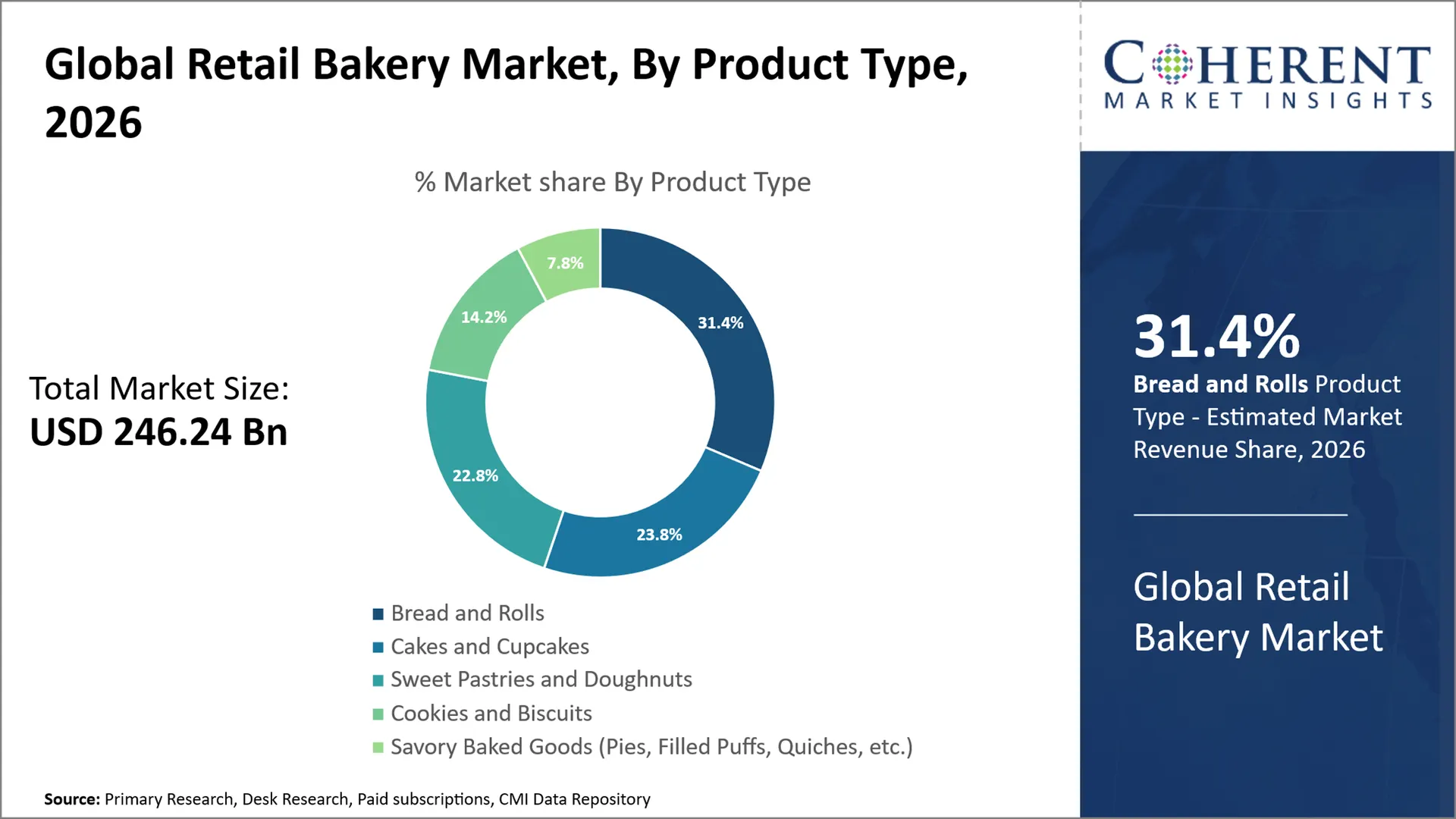
Why Do Bread and Rolls Dominate the Global Retail Bakery Market?
Bread and Rolls are expected to account for 31.4% of the global retail bakery market in 2026, making them the leading product category. Their commercial advantage lies in predictable dough production and broad retail utility, allowing bakeries to allocate equipment, labor, and shelf space across loaves, buns, and rolls. Fermentation schedules and high-throughput ovens enable retailers to plan sequential baking cycles without relying on elaborate decoration or assembly processes. This makes bread useful for household purchases and filled-roll meal formats, while baking times can be aligned with anticipated shopping peaks. In August 2025, Marks & Spencer reopened its expanded Orpington store with a dedicated bakery and coffee counter offering baked breads, including Collection Sourdough made using a 30-hour process. The investment illustrates why retailers continue allocating prominent selling space to bread and related products.
- Current Industry Events of 2026
- Market Size Estimation
- Regional Breakdown
- Competitive Landscape
- Customer Intelligence
- Segmental Analysis
- Pricing Analysis
- Key Market Drivers, Challenges & Future Trends
- Customized Insights Section
Why Do Independent Bakery Shops Represent the Largest Retail Outlet Type in the Global Retail Bakery Market?
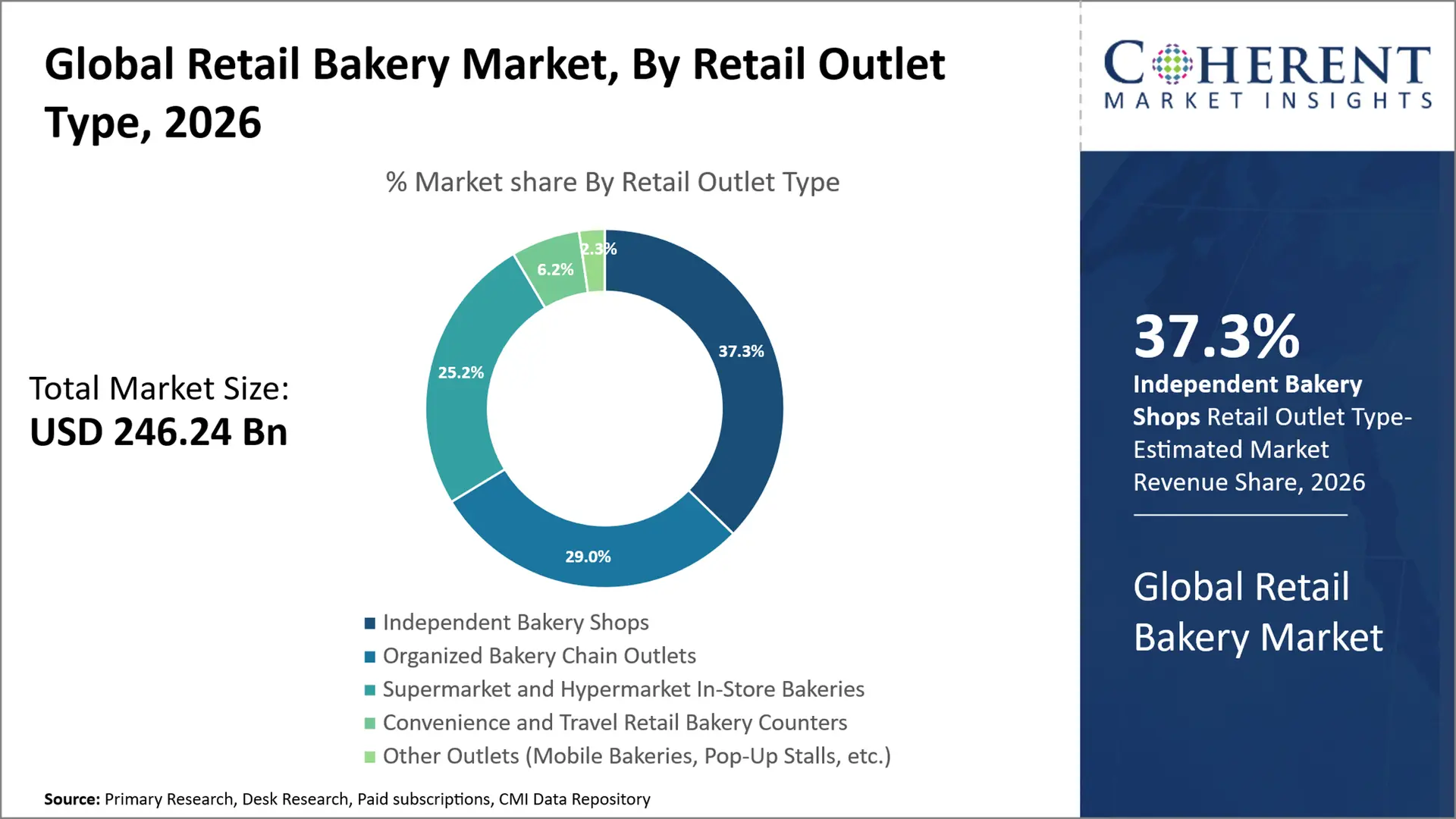
Independent Bakery Shops are projected to hold 37.3% of the global retail bakery market in 2026, leading the retail outlet category. Their advantage extends beyond product choice to operating flexibility: owners can adjust production volumes, opening hours, and limited-run assortments without approval from a centralized chain. This responsiveness helps smaller outlets serve tightly defined shopping catchments and manage unsold stock when purchasing patterns change. Independent operators also benefit from visibility tools that direct customers to individual storefronts without requiring substantial advertising budgets. In June 2024, the Real Bread Campaign, operated by Sustain, upgraded its Real Bread Map with improved location browsing and free bakery listings. By making specialist outlets easier to discover, the initiative demonstrated how independent bakeries can strengthen customer access while retaining their local operating model.
Why Do Conventional Bakery Products Dominate Product Positioning in the Global Retail Bakery Market?
Conventional Bakery Products are expected to represent 81.7% of the global retail bakery market in 2026, maintaining the largest share by product positioning. Standard recipes allow retailers to use overlapping inventories of flour, sugar, fats, and eggs across multiple categories, simplifying purchasing and reducing production changeovers. Operators can refresh assortments through familiar seasonal flavors rather than invest in separate formulation systems for specialized dietary products. This flexibility is particularly useful for supermarket bakery departments that must balance variety with consistent output and manageable preparation costs. In September 2025, Publix introduced Pumpkin and Cheese Croissants, Pumpkin Mini Cakes, and Pumpkin Petite Shortcakes while returning established pumpkin bakery favorites, including cookies and pies. The assortment demonstrates how conventional product platforms support seasonal differentiation without requiring an entirely new retail category.
Current Events and their Impact
Current Event | Description and Its Impact |
January 2025 – U.S. FDA Revokes Authorization for Red No. 3 in Food |
|
March 2025 – Australia and New Zealand Strengthen Allergen Labeling Implementation |
|
June 2025 – United Kingdom Introduces Packaging Waste Responsibility Fees |
|
Global Retail Bakery Market Dynamics
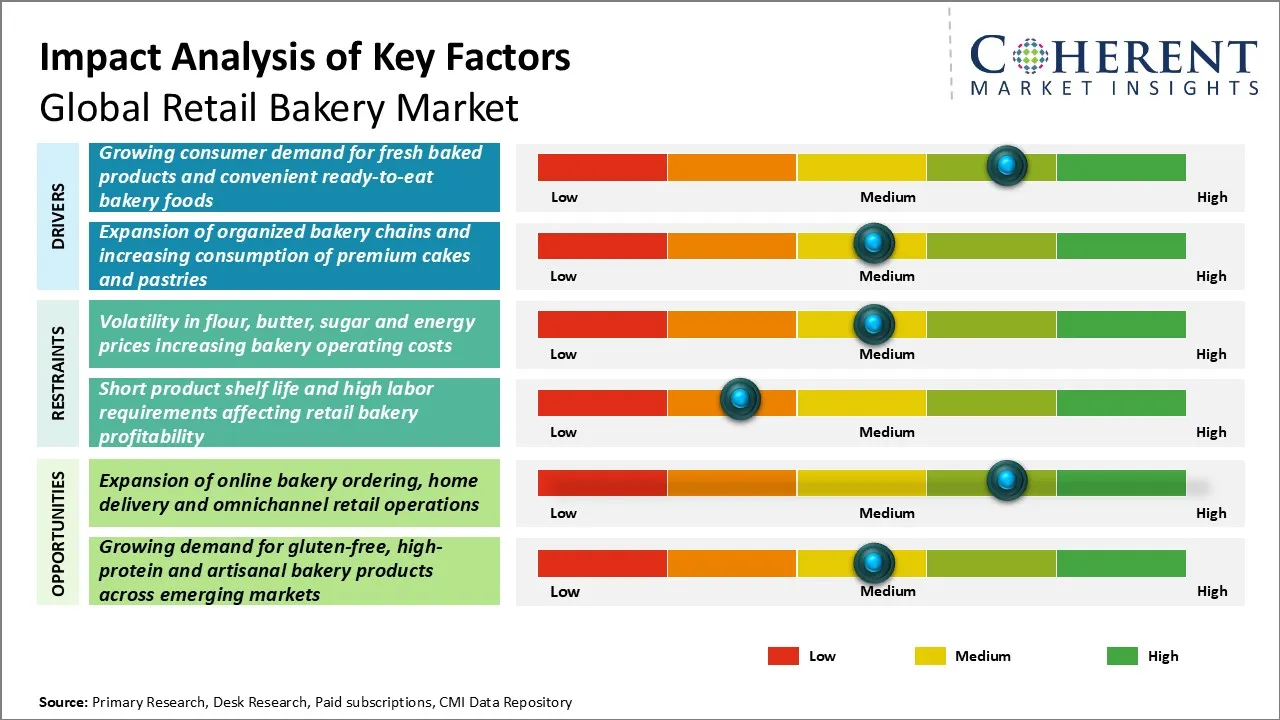
Key Market Drivers
- Growing consumer demand for fresh baked products and convenient ready-to-eat bakery foods: Daily bakery purchasing increasingly overlaps with quick-service meals as consumers seek convenient breakfast and snacking options. Retail bakeries offering warm pastries and savory baked goods throughout the day can increase purchase frequency while generating additional beverage sales. This benefits bakery cafés, convenience counters, and franchise operators with efficient replenishment systems. In January 2025, Tim Hortons introduced its Spinach & Feta Savoury Egg Pastry within its Canadian value menu, featuring bakery products prepared fresh daily and served warm. Such offerings combine convenience with affordability while expanding everyday consumption occasions.
- Expansion of organized bakery chains and increasing consumption of premium cakes and pastries: Organized bakery chains are extending their retail networks while developing premium assortments for celebrations, gifting, and personal indulgence. Franchise-based expansion supports consistent product standards, recognizable branding, and localized customer engagement, enabling operators to reach new markets efficiently. Specialty cake retailers benefit from differentiated products and recurring purchases associated with social occasions. In May 2025, Nothing Bundt Cakes announced the opening of its 700th bakery in Rosenberg, Texas, reflecting continued investment in specialty cake retailing. Such expansion strengthens organized operators' ability to serve established and emerging customer locations.
Emerging Market Trends
- Smaller Portions and Flexible Bakery Assortments Reshaping Product Economics: Retail bakery assortments are shifting toward smaller indulgence portions and flexible multi-item boxes that allow households to control spending without abandoning variety. This changes product architecture because bakers must calibrate unit size, decoration labor, and per-pack pricing rather than treating large formats as the default. Specialty shops and supermarket bakery counters may gain more frequent, lower-ticket visits, while businesses built around fixed production runs face additional scheduling complexity. Over the forecast period, modular assortments could support faster menu rotation if packaging costs and handling time remain controlled.
- Flexible Ingredient Formulation Emerging as a Margin Protection Strategy: Bakeries are beginning to design recipes around qualified alternative ingredients instead of depending on narrow flour, cocoa, and fat specifications. This shifts procurement from reactive spot purchasing toward planned substitution pathways, with implications for taste consistency, labeling, and production costs. Operators with internal recipe-testing capabilities and vetted ingredient suppliers can preserve menu availability during agricultural supply disruptions, while smaller businesses may struggle with formulation expense and quality checks. Throughout the forecast period, flexible recipe engineering could become a commercially important source of margin protection and operational continuity.
Regional Insights
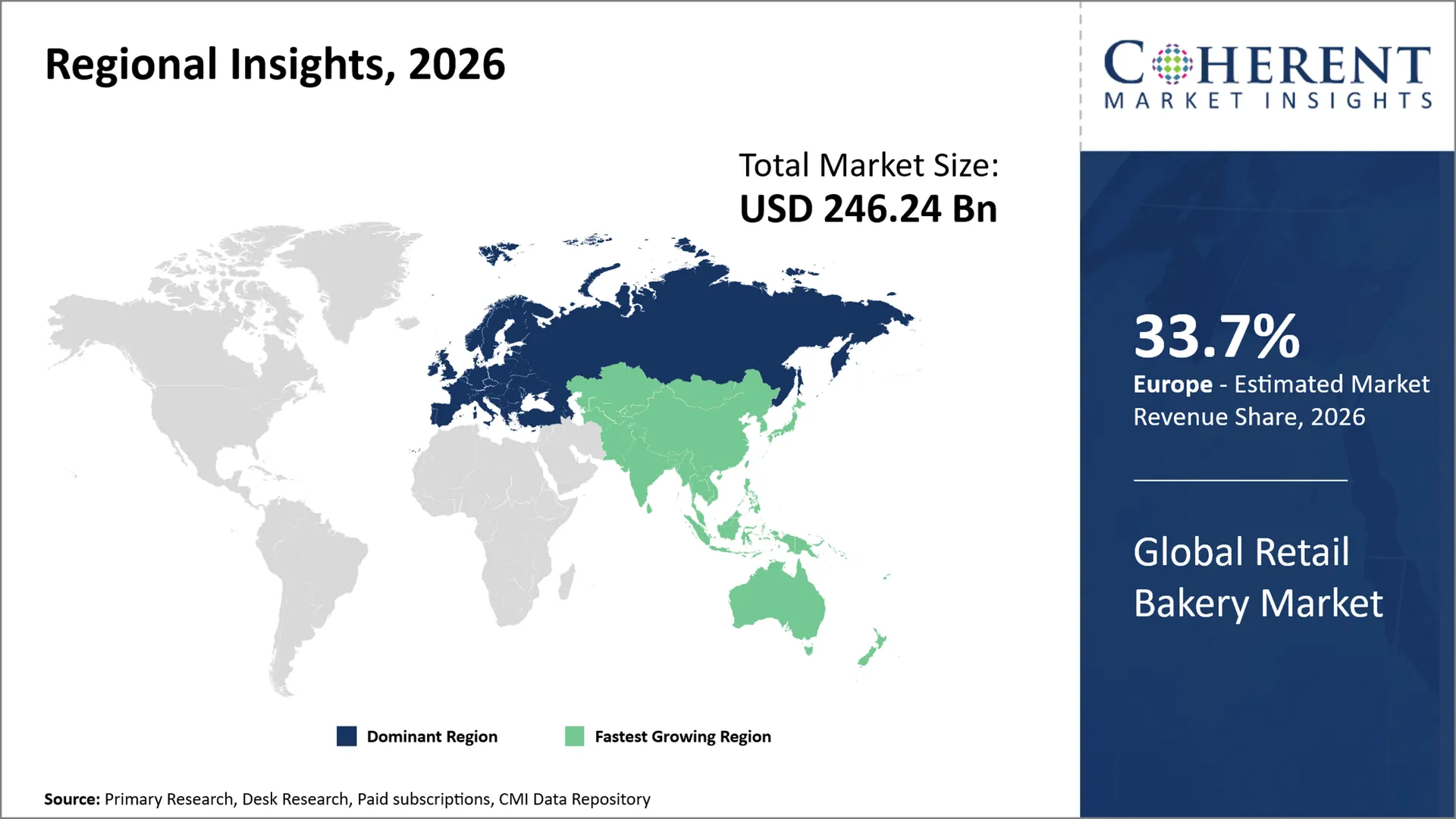
Why Does Europe Dominate the Global Retail Bakery Market?
Europe is expected to account for 33.7% of the global retail bakery market in 2026, supported by its extensive bread, viennoiserie, and confectionery assortments. Retail bakeries can serve several purchasing occasions from a single counter, allowing operators to diversify revenue beyond staple loaves. Established franchising systems also help transfer recipes, merchandising practices, and staff training to secondary cities where independent bakeries remain influential. In February 2025, French bakery chain La Mie Câline opened a new outlet in Issoire, Auvergne, within a developing commercial area. The opening illustrates how standardized bakery concepts can reach smaller towns without relying exclusively on large metropolitan locations. European operators will need to balance traditional product quality with efficient staffing and selective store investment, particularly where energy, rental, and ingredient costs restrict operating margins.
Why Is Asia Pacific Emerging as the Fastest-Growing Region in the Global Retail Bakery Market?
Asia Pacific is projected to hold 32.2% of the global retail bakery market in 2026 and emerge as its fastest-growing region. An important opportunity lies in adapting international bakery formats to local tastes, purchasing power, and religious dietary requirements across diverse national markets. Shopping-mall bakery cafés can combine Korean-style breads, celebration cakes, and beverages in one visit, helping operators test premium assortments without depending on a single product category. In June 2025, CJ Newsroom Foodville introduced its TOUS les JOURS bakery café at Sunway Pyramid in Kuala Lumpur, marking the brand's first Malaysian outlet under a local master-franchise arrangement. The development highlights the commercial value of partnerships that translate foreign bakery concepts into locally relevant menus. Continued expansion will depend on product localization, franchise execution, and sustainable store-level sales.
Global Retail Bakery Market Outlook for Key Countries
Why Is the U.S. a Key Market for the Global Retail Bakery Market?
The U.S. remains a key retail bakery market because consumers purchase baked goods across breakfast, snacking, celebrations, and quick-service meal occasions. A developed network of franchised doughnut shops, bagel cafés, specialty bakeries, and supermarket departments enables operators to adjust offerings by daypart. Commercial success increasingly depends on coordinating pastries with beverage menus, using limited-duration flavors to attract repeat visits, and managing throughput during morning peaks. In October 2025, Dunkin' announced a Raspberry Striped Croissant for its holiday menu, alongside croissant-based savory sandwiches. The introduction demonstrates how an established U.S. retail operator can generate seasonal interest while using familiar bakery production platforms. Future opportunities will favor chains that refresh menus without complicating franchise kitchens or increasing unsold stock across suburban, travel, and office-oriented retail locations nationwide.
Why Does China Support Growth in the Global Retail Bakery Market?
China plays an important role in the global retail bakery market through differentiated shopping environments, digital customer engagement, and opportunities for location-specific menus. Beyond major urban neighborhoods, tourism districts create demand for baked snacks that can be consumed immediately or purchased as gifts. Bakeries serving these locations must combine recognizable products with regional ingredients and store designs suited to local visitor flows. In July 2025, Chanson International Holding announced new bakery outlets at the Urumqi International Grand Bazaar and Kashgar Old City in Xinjiang. The company incorporated traditional kiln-fired ovens at the Urumqi location and planned regionally inspired specialties. This approach illustrates how retail bakers can use destination positioning to widen customer access, although seasonal visitor patterns make site selection and production planning important.
Why Is India Important in the Global Retail Bakery Market?
India is becoming increasingly important to the global retail bakery market as organized patisserie and confectionery outlets extend into new urban catchments. Celebration cakes, savory patties, individual pastries, and tea-room assortments allow retailers to address family occasions alongside everyday purchases. Operators must balance distinctive recipes with local taste preferences, reliable ingredient sourcing, and the economics of smaller commercial premises. In August 2026, Apeejay Surrendra Park Hotels opened the first standalone Flurys café in Gurugram's Galleria Market, taking the Kolkata-origin bakery brand further into North India. The compact outlet combines patisserie products and savory selections within a neighborhood café format. Its expansion illustrates how heritage bakery concepts can enter new cities while retaining product identity and adapting service hours to local demand.
Why Is Germany a Strategic Country in the Global Retail Bakery Market?
Germany is a strategic retail bakery market because specialist breadmaking skills and substantial bakery employment underpin a sophisticated network of artisan businesses and branches. However, the country's commercial outlook increasingly hinges on business succession, labor availability, and cost control rather than simply adding storefronts. Bakeries that professionalize staffing and production scheduling may be better equipped to maintain traditional assortments amid competition from industrial baked goods sold through supermarkets. In June 2026, the German Bakers' Confederation reported that 448 master bakers had started new businesses during 2025, the highest number of such start-ups since 2018, even as the total number of craft bakery enterprises declined. This contrast underscores both continued entrepreneurial interest and the operational pressures shaping Germany's retail bakery structure.
Why Is the U.K. an Important Growth Market for the Global Retail Bakery Market?
The U.K. supports a substantial retail bakery ecosystem through national grocery distribution, regional bakers, and consumer familiarity with loaves, crumpets, bagels, and sweet bakery snacks. Competition is particularly visible at the supermarket shelf, where packaging clarity and range navigation influence how shoppers distinguish established brands from retailer-owned products. For suppliers, refreshed presentation must justify valuable shelf space while keeping core products easily recognizable. From March 2026, Warburtons scheduled the rollout of redesigned packaging across its portfolio of more than 70 products as part of its anniversary brand refresh. The initiative shows that retail growth can depend on merchandising execution as much as new recipes or outlets. Manufacturers that improve product identification and maintain dependable daily deliveries are positioned to strengthen retailer relationships and repeat purchasing.
Retail Bakery Production and Product Innovation Landscape
Technology | Application in Retail Bakeries | Commercial Significance | Adoption Considerations |
Automated Dough Dividing and Sheeting Systems | Standardized portioning and shaping of bread, rolls, pastries, and doughnuts | Improves portion consistency, reduces manual preparation time, and supports repeatable production quality | Equipment investment, recipe compatibility, and staff training |
Programmable Proofing and Fermentation Systems | Controlled temperature and humidity during dough development | Supports predictable dough quality and more consistent preparation schedules | Energy consumption, maintenance, and dough-specific programming |
Energy-Efficient Convection and Combination Ovens | Baking and finishing products across independent shops, chains, and in-store bakeries | Supports batch flexibility, consistent baking performance, and improved energy management | Capital costs, ventilation requirements, and kitchen layout |
AI-Assisted Sales Forecasting and Production Planning | Using transaction histories and demand patterns to plan daily bakery output | Helps align production with expected sales, reducing avoidable overproduction and product shortages | Data quality, system integration, and forecasting reliability |
Digital Batch Traceability and Allergen Management | Tracking ingredients, recipes, production batches, and declared allergens | Strengthens quality assurance, supports compliance reviews, and improves recall preparedness | Supplier data accuracy, documentation requirements, and software costs |
Automated Visual Quality Inspection | Checking baked products for shape, dimensions, surface appearance, and production defects | Reduces inconsistent presentation and supports standardized quality across larger bakery operations | Calibration requirements, equipment costs, and product variability |
How Are Workplace Preorders and Scheduled Group Purchases Creating New Growth Opportunities in the Global Retail Bakery Market?
Scheduled workplace bakery orders represent an underdeveloped retail opportunity between individual snack purchases and large-scale foodservice contracts. Offices, coworking spaces, small businesses, and professional meeting organizers regularly need convenient breakfast assortments, celebration boxes, and afternoon refreshments, but ordering remains fragmented across nearby shops.
Retail bakeries could capture these purchases through standardized group menus, advance-order windows, consolidated billing, and clear substitution rules. Unlike wholesale supply, orders would be fulfilled directly to final business customers through individual retail locations.
Operators would need reliable production scheduling, packaging that protects texture during transport, delivery coordination, and customer-service processes for recurring accounts. Carefully designed minimum orders and cancellation terms could protect profitability, while a limited set of configurable assortments would reduce kitchen complexity.
This opportunity may favor established local bakeries with business-district proximity and specialist chains able to centralize ordering without losing store-level accountability. Success will depend on punctual fulfillment and measurable service reliability rather than aggressive outlet expansion.
Market Players, Key Development, and Competitive Intelligence
Key Developments
- In August 2026, Shipley Donuts signed a franchise agreement covering fifteen outlets in metropolitan Detroit, with the first opening targeted for 2027. The agreement would bring handmade doughnuts and savory kolaches to a new market, demonstrating the commercial role of experienced local partners in geographic expansion.
- In April 2025, Duck Donuts partnered with 3Owl to launch an updated website integrated with Olo online ordering. The platform simplifies customization of individual doughnuts and assorted boxes, illustrating how bakery retailers can reduce ordering friction while connecting product personalization with more efficient store operations.
- In April 2025, GoTo Foods announced Cinnabon Swirl, a retail concept combining Cinnabon baked goods with Carvel soft serve, with its first Oregon location scheduled for May. The proposed format broadens dessert purchase occasions through cross-category product combinations and a shared retail footprint.
Competitive Landscape
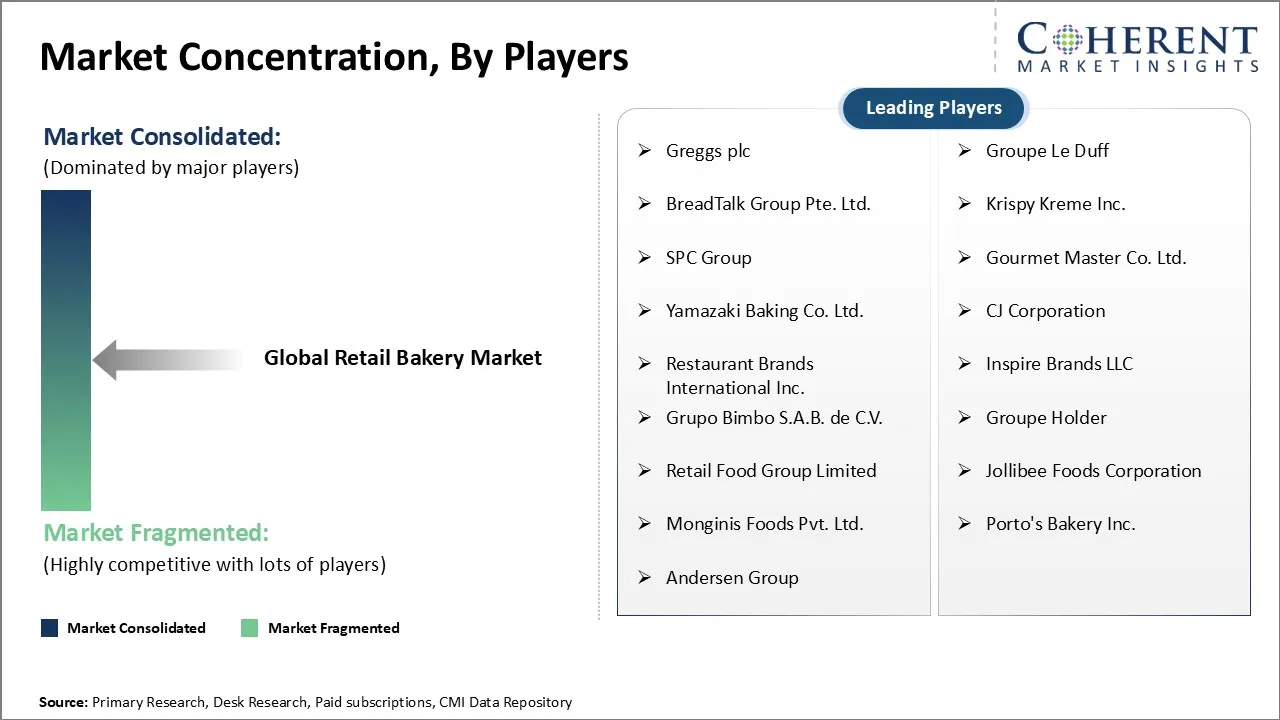
The global retail bakery market remains fragmented, with independent neighborhood bakeries competing alongside franchised chains, supermarket in-store departments, and specialist dessert outlets. Competition depends on convenient catchment locations, consistent batch quality, staff execution, and disciplined inventory economics rather than brand recognition alone. Regional operators retain influence through distinctive local menus, whereas larger networks can negotiate ingredient contracts and deploy standardized operating procedures.
Key focus areas include
- Product Quality Differentiation: Consistent texture, taste, appearance, and product presentation support customer retention.
- Pricing and Profitability: Competitive positioning depends on balancing affordable product options with ingredient, labor, and operating costs.
- Retail Network Optimization: Store placement, catchment accessibility, and efficient space utilization influence individual outlet performance.
- Production Reliability: Reliable baking processes and equipment maintenance help minimize interruptions and product inconsistencies.
- Food Safety and Quality Assurance: Strong hygiene practices, allergen controls, and regulatory compliance protect consumer trust.
- Supplier and Procurement Management: Stable ingredient availability, purchasing arrangements, and supplier qualification support uninterrupted operations.
- Customer Relationship Management: Customer feedback, loyalty initiatives, and responsive service help independent and organized retailers retain business.
Market Report Scope
Global Retail Bakery Market Report Coverage | |||
Report Coverage | Details | ||
Base Year | 2025 | Market Size in 2026: | USD 246.24 Bn |
Historical Data For: | 2021 To 2024 | Forecast Period: | 2026 To 2033 |
Forecast Period 2026 To 2033 CAGR: | 2.30% | 2033 Value Projection: | USD 288.72 Bn |
Geographies covered: |
| ||
Segments covered: |
| ||
Companies covered: | Greggs plc, Groupe Le Duff, BreadTalk Group Pte. Ltd., Krispy Kreme Inc., SPC Group, Gourmet Master Co. Ltd., Yamazaki Baking Co. Ltd., CJ Corporation, Restaurant Brands International Inc., Inspire Brands LLC, Grupo Bimbo S.A.B. de C.V., Groupe Holder, Retail Food Group Limited, Jollibee Foods Corporation, Monginis Foods Pvt. Ltd., Porto's Bakery Inc., Andersen Group | ||
Growth Drivers: |
| ||
Restraints & Challenges: |
| ||
Analyst Opinion (Expert Opinion)
- The global retail bakery market is likely to move toward store-level profitability as a more meaningful measure of competitive success than outlet expansion alone. Operators that understand production costs, staff productivity, and local purchasing patterns will be better positioned to maintain sustainable earnings. Commercial leadership may increasingly depend on operating discipline rather than the breadth of available products.
- Dynamic pricing linked to remaining product shelf life could fundamentally change bakery inventory economics. Retailers may increasingly adjust late-day prices based on product age and expected sell-through rather than applying uniform closing discounts. However, implementation will require transparent communication and reliable freshness controls to prevent customer concerns about quality and inconsistent pricing.
- Bakery operators should prioritize efficient production equipment, profitable outlet locations, and resilient ingredient sourcing arrangements. Particular attention should be given to labor availability, rental expenses, packaging costs, and product wastage. Companies should evaluate expansion opportunities against realistic outlet economics, strengthen quality-control procedures, and avoid excessive investment in production capacity without confirmed retail demand.
Speak to the analyst
Want personalized insights?
Take the findings above to one of our principal consultants, or have the report rebuilt around the segments, geographies and competitors you actually track.
Market Segmentation
- Product Type Insights (Revenue, USD Bn, 2021 - 2033)
- Bread and Rolls
- Cakes and Cupcakes
- Sweet Pastries and Doughnuts
- Cookies and Biscuits
- Savory Baked Goods (Pies, Filled Puffs, Quiches, etc.)
- Retail Outlet Type Insights (Revenue, USD Bn, 2021 - 2033)
- Independent Bakery Shops
- Organized Bakery Chain Outlets
- Supermarket and Hypermarket In-Store Bakeries
- Convenience and Travel Retail Bakery Counters
- Other Outlets (Mobile Bakeries, Pop-Up Stalls, etc.)
- Product Positioning Insights (Revenue, USD Bn, 2021 - 2033)
- Conventional Bakery Products
- Specialty Diet and Health-Positioned Bakery Products
- Baking Model Insights (Revenue, USD Bn, 2021 - 2033)
- Scratch Baking at Retail Outlets
- Partially Baked Products Finished at Retail Outlets
- Fully Baked Products Supplied from Central Bakeries
- Price Segment Insights (Revenue, USD Bn, 2021 - 2033)
- Economy and Mass Market
- Mid-Range
- Premium and Artisanal
- Sales Channel Insights (Revenue, USD Bn, 2021 - 2033)
- Physical In-Store Purchases
- Online Orders with Home Delivery
- Online Click and Collect
- Regional Insights (Revenue, USD Bn, 2021 - 2033)
- North America
- U.S.
- Canada
- Latin America
- Brazil
- Argentina
- Mexico
- Rest of Latin America
- Europe
- Germany
- U.K.
- Spain
- France
- Italy
- Russia
- Rest of Europe
- Asia Pacific
- China
- India
- Japan
- Australia
- South Korea
- ASEAN
- Rest of Asia Pacific
- Middle East
- GCC Countries
- Israel
- Rest of Middle East
- Africa
- South Africa
- North Africa
- Central Africa
- North America
Sources
Primary Research Interviews
- Independent bakery owners and organized bakery chain operators
- Bakery manufacturers, ingredient suppliers, and equipment providers
- Supermarket bakery managers, distributors, and industry experts
Stakeholders
- Retail bakery chains, franchise operators, and independent bakeries
- Flour, yeast, dairy, sugar, and bakery ingredient suppliers
- Bakery equipment, packaging, and technology providers
- Supermarkets, convenience retailers, and online delivery platforms
End-use Sectors
- Independent and organized retail bakeries
- Supermarket and hypermarket in-store bakeries
- Bakery cafés and convenience retail outlets
- Online bakery ordering and home delivery
Regulatory and Industry Bodies
- U.S. Food and Drug Administration (FDA)
- European Commission
- European Food Safety Authority (EFSA)
- Food Safety and Standards Authority of India (FSSAI)
- Food Standards Agency (FSA), U.K.
- International Organization for Standardization (ISO)
Databases
- Company annual reports and investor presentations
- USDA and U.S. Census Bureau retail bakery statistics
- Eurostat and national food retail databases
- UN Comtrade and FAOSTAT
- Bakery outlet, franchise, pricing, and consumption databases
Magazines and Journals
- Baking & Snack
- British Baker
- Bakery and Snacks
- Journal of Cereal Science
- Food Quality and Preference
- Journal of Food Science
Associations
- Retail Bakers of America (RBA)
- American Bakers Association (ABA)
- Federation of Bakers, U.K.
- German Bakers' Confederation
- International Union of Bakers and Confectioners (UIBC)
Public Domain Sources
- Retail bakery production, sales, and consumption statistics
- Bakery outlet expansion, franchise, and store opening data
- Bread, cakes, pastries, and specialty bakery consumption trends
- Ingredient pricing, labor costs, and food wastage statistics
- Product launches, investments, and bakery technology developments
Key Standards and Regulations
- Regulation (EC) No. 852/2004 – Food hygiene
- Regulation (EU) No. 1169/2011 – Food information and allergen labeling
- U.S. FDA 21 CFR Part 117 – Food safety and manufacturing practices
- FSSAI Food Safety and Standards Regulations – Food business licensing and safety
- ISO 22000:2018 – Food safety management systems
- Codex CXC 1-1969 – General Principles of Food Hygiene
Proprietary Elements
- CMI Data Analytics Tool
- Proprietary CMI repository containing 10+ years of food and bakery industry intelligence covering retail bakery demand, consumer preferences, product pricing, bakery production, retail distribution, franchise expansion, ingredient costs, food safety, competitive intelligence, and market developments.
Get access to 250+ pages report
Every segment, forecast, competitor profile and data table behind the analysis above — available for instant download.
- ESOMAR Member
- ISO 9001:2015 Certified
- D-U-N-S Registered
- GDPR & CCPA Compliant
Frequently Asked Questions
The CAGR of global retail bakery market is projected to be 2.30% from 2026 to 2033.
The global retail bakery market is estimated to be valued at USD 246.24 Bn in 2026 and is expected to reach USD 288.72 Bn by 2033.
The report helps businesses evaluate consumer purchasing behavior, competitive positioning, retail infrastructure, and market entry considerations across key geographical markets.
The global retail bakery market is highly fragmented, with independent bakeries, organized retail chains, and specialty bakery operators competing on product quality, pricing, convenience, and brand loyalty.
Investors should assess store-level profitability, customer purchasing patterns, supply chain efficiency, competitive intensity, and operational scalability before making investment decisions.
Businesses can evaluate shopping frequency, product preferences, spending behavior, and consumption occasions to improve product offerings, retail positioning, and customer engagement strategies.
The major factors driving the growth of the global retail bakery market include growing consumer demand for freshly baked and convenient ready-to-eat products. The expansion of organized bakery chains and increasing consumer preference for premium cakes and pastries further support market growth.