

Global Rice Cooker Market Size and Forecast – 2026 To 2033
The Global Rice Cooker Market is estimated to be valued at USD 5.56 Bn in 2026 and is expected to reach USD 8.58 Bn by 2033, exhibiting a compound annual growth rate (CAGR) of 6.40% from 2026 to 2033. Market growth is supported by urban lifestyles, smaller households, expanding appliance ownership, and consumer preference for convenient, consistent, and energy-efficient meal preparation.
Product innovation is also shifting competition toward automated water measurement, grain-specific programs, texture customization, and multifunction cooking. In March 2026, KitchenAid introduced its Compact Grain & Rice Cooker with an integrated scale, automatic water dispensing, and 16 presets for rice, grains, and beans, demonstrating how intelligent automation is strengthening product differentiation and encouraging premium purchases.
Key Takeaways of the Global Rice Cooker Market
- Conventional electric heating is expected to hold 76.8% of the global rice cooker market in 2026 because heating-plate models offer lower prices, simple controls, easy servicing, and dependable everyday performance. The format preserves strong unit economics across emerging and value-conscious markets despite premium IH alternatives. In August 2026, Xiaomi’s global support documentation continued to identify a traditional bottom-heating system in its 1.5-liter rice cooker.
- The 0 to 1.8 liters segment is expected to account for 53.8% of the market share in 2026, reflecting the capacity range best aligned with regular family portions, manageable countertop footprints, and practical cooking times. It offers flexibility without the price and space penalties of oversized units. In February 2024, Philips issued product documentation for its 1.8-liter, ten-cup Rice Cooker 1000 Series.
- Household end users are expected to represent 84.6% of the market share in 2026 because rice cookers remain high-frequency countertop appliances for unattended cooking, meal scheduling, reheating, and one-pot preparation. Replacement purchases and migration from stovetop cooking sustain a wider installed base than commercial kitchens. In January 2025, Toshiba Canada released a compact six-cup programmable model with eight functions for rice, soups, stews, porridge, and desserts.
- Asia Pacific is expected to contribute 62.4% of market share in 2026, supported by rice-centered diets, frequent appliance use, dense manufacturing networks, and rapid product renewal across major Asian economies. Regional brands compete from basic models to premium pressure-IH platforms. In June 2026, Tiger Corporation released its twentieth-anniversary ceramic-inner-pot flagship rice cooker in Japan.
- North America is expected to hold 15.8% of the market share in 2026 while recording the fastest regional expansion as Asian cuisine becomes more mainstream, multicultural households widen the buyer base, and consumers adopt rice cookers as multifunctional grain and meal appliances. Strong e-commerce and specialty retail access improve product discovery. In March 2025, CUCKOO presented its new rice-cooker lineup at Chicago’s Inspired Home Show.
Segmental Insights
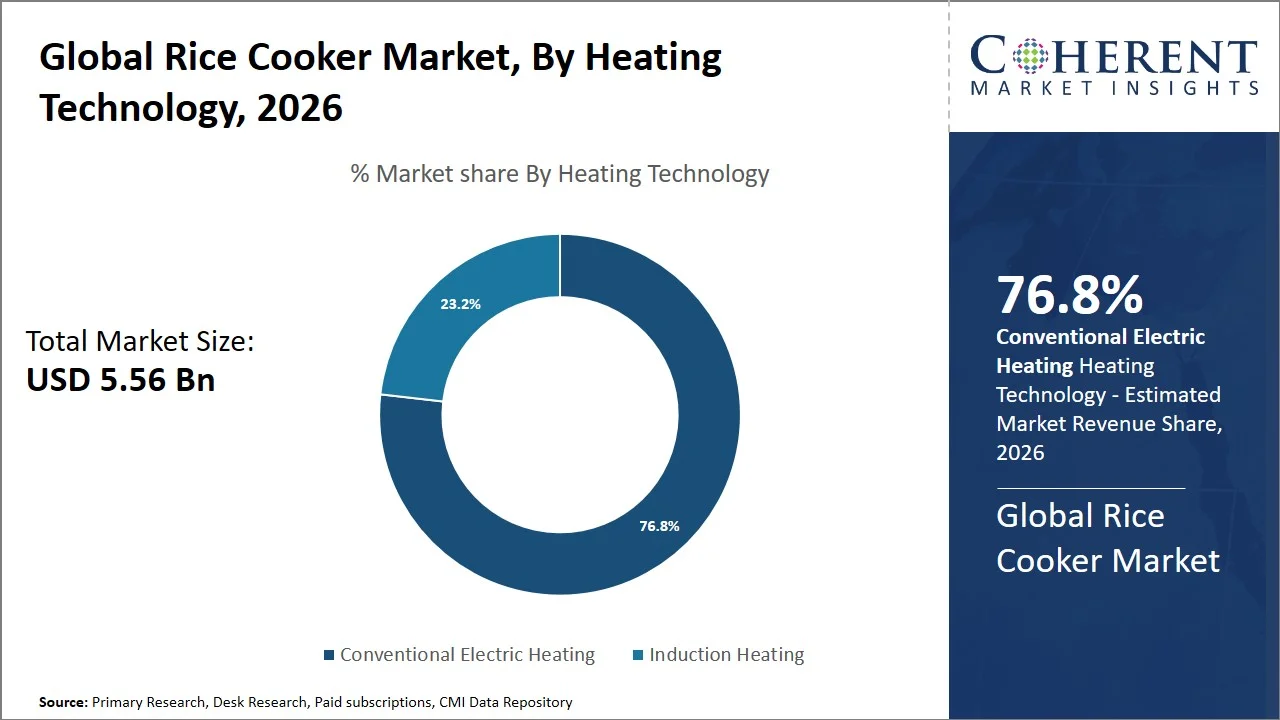
Why Does Conventional Electric Heating Dominate the Global Rice Cooker Market?
Conventional electric heating is expected to lead the heating technology category with an expected share of 76.8% in 2026 because it offers the lowest practical entry price, straightforward thermostat-based operation, and broad compatibility with aluminum or non-stick inner pots. Manufacturers can source heating plates, thermal fuses, switches, and housings through mature component networks, supporting high-volume production and simpler repair. The format is particularly relevant in price-sensitive Asian, Latin American, Middle Eastern, and African households where buyers prioritize reliable rice preparation over premium pressure or induction functions. Retailers also benefit from familiar product positioning, lower inventory risk, and wide price-band coverage. In January 2025, Malaysia’s Energy Efficiency and Conservation Act framework brought rice cookers under regulated energy-using products, requiring manufacturers and importers to obtain efficiency certification before distribution, reinforcing formal performance requirements for mainstream electric models.
- Current Industry Events of 2026
- Market Size Estimation
- Regional Breakdown
- Competitive Landscape
- Customer Intelligence
- Segmental Analysis
- Pricing Analysis
- Key Market Drivers, Challenges & Future Trends
- Customized Insights Section
Why Does the 1.0 to 1.8 Liters Segment Represent the Largest Capacity Category in the Global Rice Cooker Market?
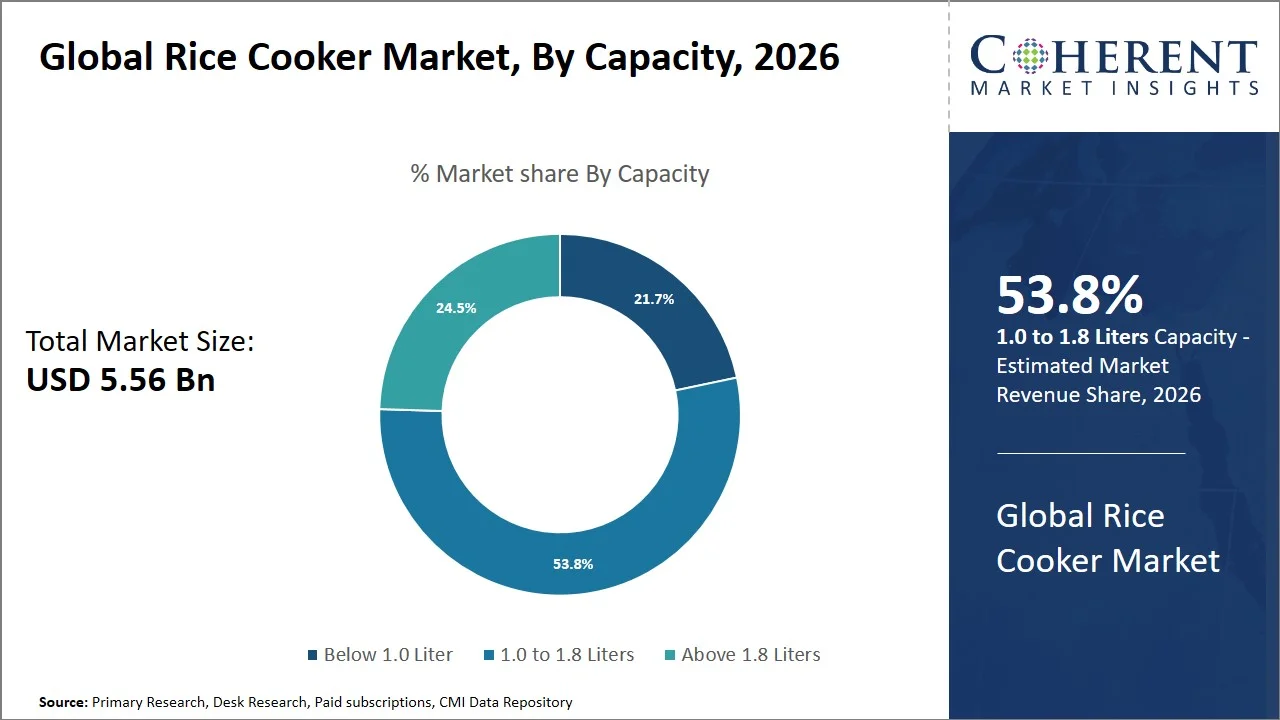
The 1.0 to 1.8 liters segment is expected to hold 53.8% of the market share in 2026 because it balances household serving needs, countertop efficiency, electricity use, and purchase price. Models in this range can typically support routine meals for small and medium-sized families without the unused volume associated with larger cookers. This makes the category suitable for urban apartments, nuclear households, students sharing accommodation, and consumers preparing rice alongside curries, vegetables, or steamed foods. Suppliers also gain merchandising advantages because the same capacity band supports basic, digital, double-pot, and multifunction variants across several price points. In January 2025, TTK Prestige’s official analyst communication listed its Cute Rice Cooker 1.8-2 SS, showing continued portfolio emphasis on the upper end of the dominant capacity range and its commercial relevance in everyday household cooking.
Why Does the Household Segment Dominate the End User Category of the Global Rice Cooker Market?
Household buyers are expected to dominate with a market share of 84.6% in 2026 the end user category because rice cookers are primarily purchased as daily-use kitchen appliances rather than dedicated foodservice equipment. Automatic cooking, keep-warm functions, compact storage, and limited supervision reduce meal-preparation effort for working adults, families, elderly consumers, and first-time appliance users. Household demand is further reinforced by replacement cycles, gifting occasions, online product comparison, and the use of rice cookers for porridge, grains, steaming, and one-pot meals. For manufacturers, this creates opportunities to differentiate through safer materials, removable components, intuitive controls, and designs matched to smaller kitchens. In March 2025, Bear Electric Appliance announced that multifunctional rice cookers would form part of its latest small-appliance showcase at the Canton Fair, highlighting continued supplier investment in versatile products designed for modern domestic cooking.
Current Events and their Impact
Current Event | Description and Its Impact |
China Revises Rice Cooker Energy-Efficiency Labeling Rules – January 2025 |
|
European Union General Product Safety Regulation Becomes Applicable – December 2024 |
|
Global Rice Cooker Market Dynamics
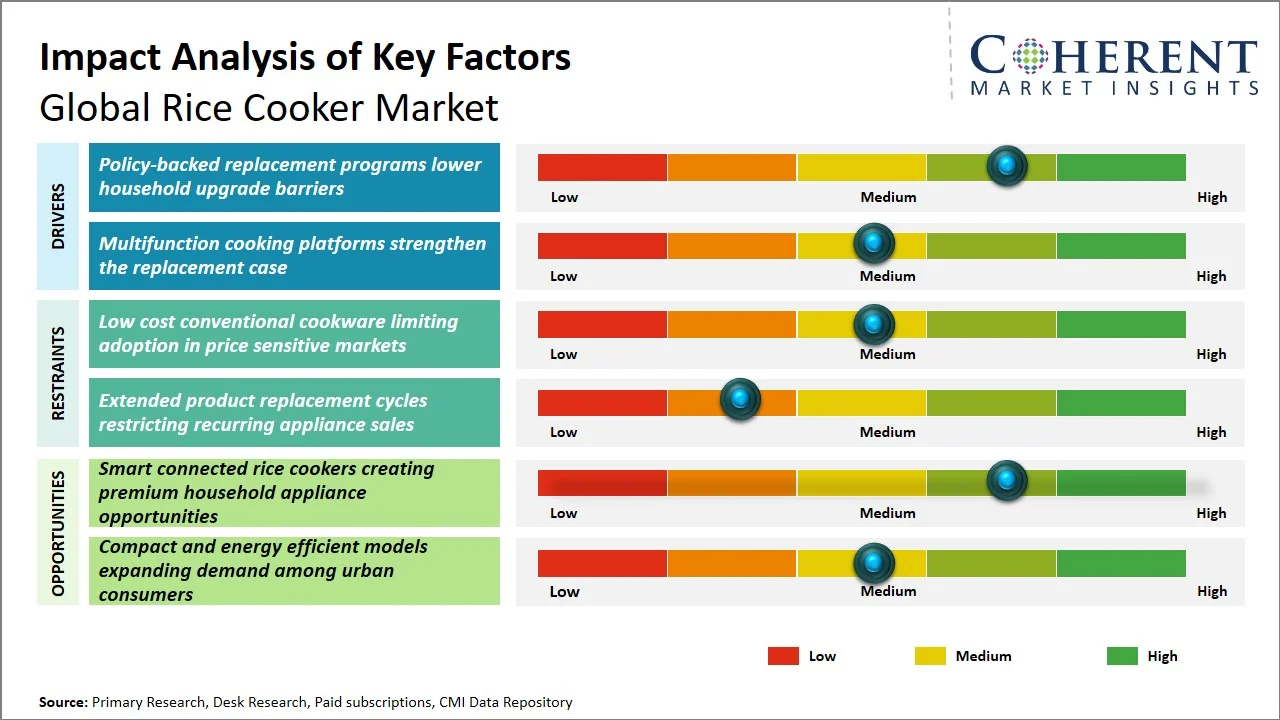
Key Market Drivers
Policy-Backed Replacement Programs Lower Household Upgrade Barriers
Household appliance penetration expands rice cooker demand when first-time purchases are reinforced by subsidized replacement cycles. Rice cookers are relatively affordable durable goods, yet consumers often postpone replacing functional basic models. Trade-in support narrows the price gap between entry-level products and energy-efficient units with improved insulation, controls, and inner pots. Manufacturers benefit from faster portfolio rotation, retailers gain promotion-led store and online traffic, and recycling operators receive a more predictable flow of retired appliances. Commercially, the mechanism converts a passive installed base into time-bound upgrade demand rather than relying only on new household formation. In January 2025, China’s Ministry of Commerce included electric rice cookers among twelve appliance categories eligible for trade-in subsidies, with additional support for top-tier energy-efficiency products.
Multifunction Cooking Platforms Strengthen the Replacement Case
Multifunction cooking platforms strengthen rice cooker replacement demand by expanding the appliance’s role from grain preparation to coordinated meal production. Consumers can justify upgrading when a new model reduces the need for separate steamers, slow cookers, pressure cookers, or saucepans while improving timing across meal components. This supports higher average selling prices and creates differentiation through program design, interface quality, safety systems, and recipe ecosystems rather than capacity alone. Appliance brands, component suppliers, digital-content teams, and omnichannel retailers are positioned to benefit, while single-function products face greater price pressure. The strategic opportunity is strongest where countertop space is limited and buyers evaluate appliances by frequency of use. In May 2025, Instant Pot introduced its Dual Action Multi-Cooker with separate main and rice-and-grain pots plus synchronized finishing controls.
Emerging Market Trends
Inner-Pot Materials Influence Purchasing
Inner-pot material is becoming an important buying criterion as consumers assess coating safety, scratch resistance, cleaning ease, durability, and replacement availability. This is encouraging manufacturers to adopt ceramic, stainless-steel, and coating-free designs with clearer material information. Brands offering validated durability and accessible spare parts can support premium pricing, reduce returns, and strengthen customer trust across online and specialty retail channels.
Texture Personalization Shapes Product Differentiation
Rice cooker manufacturers are using sensors, heating curves, pressure control, and programmed soaking stages to customize texture for different rice and grain types. This allows premium brands to compete on cooking consistency rather than function count alone. Suppliers with strong control-system engineering and localized recipe testing can develop scalable products suited to regional preferences, while mid-range brands can adopt simplified adaptive programs to improve performance and customer appeal.
Regional Insights
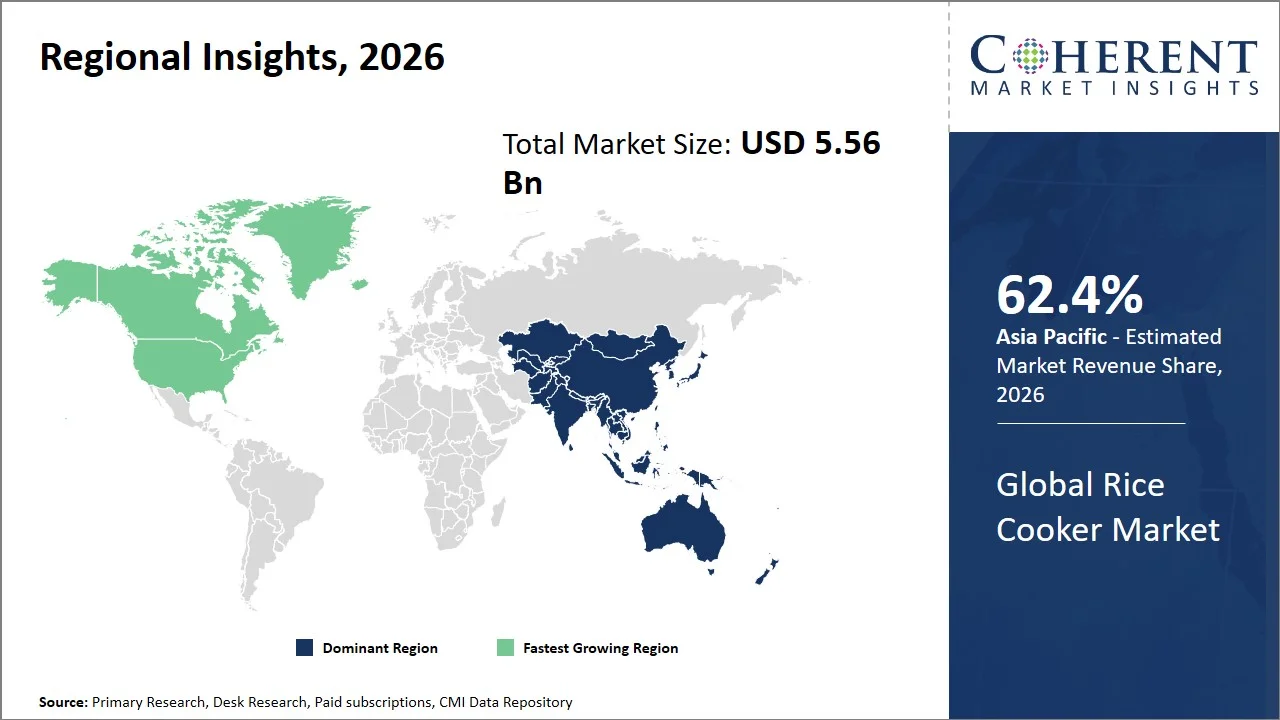
Why Does Asia Pacific Dominate the Global Rice Cooker Market?
Asia Pacific is expected to dominate the global rice cooker market with a 62.4% share in 2026. Rice remains central to daily diets across China, India, Japan, Southeast Asia, and other regional markets, supporting frequent appliance use and recurring replacement demand. The region also benefits from dense electronics manufacturing, broad component availability, and brands serving entry-level, mid-range, and premium price points. Urbanization, smaller households, dual-income families, and expanding e-commerce access further support demand for compact, programmable, and multifunctional models. Regional competition is increasingly based on cooking precision, faster preparation, energy use, and inner-pot quality rather than basic heating alone. In May 2024, Panasonic Australia promoted its SR-DA152WST and SR-DA182KST multifunction rice cookers, highlighting quick cooking, fuzzy-logic control, and non-rice meal preparation, illustrating continued product diversification within Asia Pacific.
Why is North America Emerging as the Fastest-Growing Region in the Global Rice Cooker Market?
North America is projected to hold 15.8% of the global rice cooker market in 2026 and emerge as the fastest-growing region. Expansion is supported by multicultural food consumption, wider adoption of Asian cuisines, and growing use of countertop appliances for batch cooking, grains, steaming, and one-pot meals. Consumers increasingly evaluate rice cookers against multicookers, encouraging suppliers to add digital presets, induction heating, delayed start, and specialized settings for brown rice and other grains. Strong online retail, product-review ecosystems, and access to Japanese, Korean, Chinese, and U.S. brands shorten product-discovery cycles and support premiumization. In April 2026, the U.S. Department of Agriculture reported that implied 2025/26 U.S. domestic and residual rice use remained at a record level despite a downward forecast revision, reinforcing the demand foundation for dedicated rice-preparation appliances across the region.
Global Rice Cooker Market Outlook for Key Countries
Why is the U.S. a Key Market for the Global Rice Cooker Market?
The U.S. is a key market for rice cookers because appliance demand extends beyond traditional rice-consuming households into meal-prep users, health-oriented buyers, students, and consumers seeking convenient grain preparation. The country’s mature mass-retail, specialty-appliance, warehouse-club, and e-commerce channels provide broad access to basic cookers, digital multicookers, and premium induction-heating models. Diverse culinary preferences support settings for long-grain, short-grain, brown rice, quinoa, oatmeal, and steamed foods, allowing manufacturers to position rice cookers as versatile countertop systems rather than single-purpose devices. Replacement purchases are also influenced by easier cleaning, nonstick-material preferences, compact footprints, and programmable controls. In November 2025, USA Rice reported that 73.2 million hundredweight of rice was shipped domestically, up 5.5% from the previous reporting period, demonstrating a substantial food-use base that supports continued household appliance adoption.
Why Does China Support Growth in the Global Rice Cooker Market?
China is central to the global rice cooker market because it combines a very large rice-consuming population with one of the world’s deepest small-appliance manufacturing ecosystems. Domestic suppliers benefit from established component networks, advanced molding and electronics capabilities, rapid product development, and close integration with major online marketplaces. Market development is increasingly shaped by replacement demand, premium inner-pot materials, induction and pressure-assisted cooking, smart controls, and products tailored to smaller households and older consumers. Chinese brands can test new technologies domestically and then scale successful platforms for export, strengthening the country’s influence on global pricing and feature standards. In January 2025, Supor launched its FIR steam induction-heating rice cooker; the company subsequently reported that the model ranked first in China’s offline market for six consecutive months, demonstrating strong consumer acceptance of differentiated heating and cooking technologies.
Why is India Important in the Global Rice Cooker Market?
India is important in the global rice cooker market because rice is consumed regularly across southern, eastern, northeastern, and many urban markets, while household electrification and changing work patterns increase the value of unattended cooking. Demand spans compact cookers for students and small households, mid-capacity models for families, and larger units for hostels, canteens, and foodservice establishments. Domestic brands compete strongly on affordability, durability, service availability, and compatibility with regional preparations such as steamed rice, pulao, biryani, and idli-related cooking. E-commerce is widening access beyond major cities, while dealer networks remain critical for demonstrations and after-sales support. In November 2025, Stove Kraft’s investor presentation identified a rice cooker among its new product launches and reported 296 stores across 21 states and 120 cities, indicating continued investment in product availability and nationwide retail reach.
Why is Germany a Strategic Country in the Global Rice Cooker Market?
Germany is a strategic country for the global rice cooker market because consumers place high value on product durability, energy efficiency, precise temperature control, safety, and multifunctionality. Demand is supported by multicultural households, growing familiarity with Asian cuisines, and interest in compact appliances that reduce active cooking time. German buyers are also receptive to premium materials, repair support, clear technical specifications, and appliances that can prepare grains, porridge, steamed dishes, and yogurt in addition to rice. These favors differentiated products rather than purely low-cost conventional models. Specialist retailers and major electronics chains provide strong channels for product comparison, while Berlin’s trade-fair ecosystem gives suppliers visibility across Europe. In June 2026, IFA Berlin featured Rommelsbacher’s MRK 950 multi rice cooker with twelve programs, 3D heating, and electronic temperature control, reflecting Germany’s emphasis on engineered, versatile small appliances.
Why is Brazil an Important Growth Market for the Global Rice Cooker Market?
Brazil is an important growth market for rice cookers because rice is routinely consumed with beans and other staple foods, creating frequent household cooking occasions. Electric models offer convenience through automatic shutoff, warming functions, and reduced supervision, which is relevant for working households and consumers seeking predictable results. The market benefits from large national retail chains, installment-based purchasing, expanding online sales, and strong domestic appliance brands that understand local voltage, price, and service requirements. Mid-capacity conventional cookers remain commercially important, while steaming accessories and sauté functions help brands position products as broader meal-preparation tools. In 2025, Britânia’s official catalog featured the BPA06A rice cooker with six-cup capacity, a steaming accessory, keep-warm function, removable cord, and nonstick bowl, illustrating how suppliers are adapting practical feature bundles to Brazilian family cooking habits.
Technology Adoption Landscape in the Global Rice Cooker Market
Technology | Adoption Level | Key Application Area | Business Impact |
Thermostat-Controlled Electric Heating | High | Mainstream household rice cooking and entry-level models | Supports economical mass production, simple operation, and affordable replacement parts. |
Fuzzy-Logic Microprocessor Control | High | Automatic adjustment of cooking time and temperature | Improves consistency across different rice quantities and reduces user measurement errors. |
Induction Heating | Medium | Premium household rice cookers requiring uniform bowl heating | Enables more responsive heat control and supports higher-value product positioning. |
Pressure-Assisted Induction Cooking | Medium | Premium texture optimization and accelerated water absorption | Improves grain texture differentiation but raises component, certification, and manufacturing costs. |
Multi-Sensor Thermal and Moisture Feedback | Medium | Adaptive cooking and extended keep-warm performance | Reduces overcooking, dryness, and quality variation while strengthening premium performance claims. |
App-Connected Recipe and Control Platforms | Low | Remote settings, recipe guidance, diagnostics, and software updates | Creates post-purchase engagement opportunities, although customer value depends on practical use cases and reliable connectivity. |
How are Distributed Foodservice Kitchens Creating New Growth Opportunities in the Global Rice Cooker Market?
Distributed foodservice kitchens create an underdeveloped opportunity between household rice cookers and large institutional equipment. Cloud kitchens, takeaway restaurants, convenience stores, workplace caterers, small hotels, and specialty Asian food outlets require repeatable batch output but may lack the space, capital, or service infrastructure for high-capacity commercial systems. Suppliers can address this gap with stackable medium-capacity units, durable stainless food-contact components, programmable batch profiles, validated holding modes, replaceable heating modules, and simplified cleaning. Commercial capture will depend on distributor training, spare-parts availability, leasing or maintenance packages, and product certification suited to professional use. Regional menu calibration can further differentiate systems for long-grain, short-grain, biryani, sushi, and mixed-grain preparation. The opportunity is likely to favor established appliance companies with service networks and specialist foodservice suppliers that understand uptime requirements. New entrants may participate through contract manufacturing, but weak after-sales support would limit adoption where equipment failure directly interrupts meal service.
Market Players, Key Development, and Competitive Intelligence
Key Developments
- In October 2025, Reishunger introduced a compact 0.3-liter mini rice cooker as part of its new-product portfolio. This is important for the global rice cooker market because it addresses single-person households, students, limited-space kitchens, and portion-controlled cooking while enabling lifestyle-oriented differentiation through compact form factors and design-led merchandising.
- In July 2025, Midea Electronics Indonesia launched a one-year replacement-guarantee program covering rice cookers and selected household appliances purchased through eligible channels. This is important for the global rice cooker market because it positions after-sales certainty as a customer-acquisition tool, lowers perceived ownership risk, and places greater strategic value on service infrastructure and rapid product replacement.
- In May 2025, Zojirushi Corporation announced the NX-AA pressure-induction rice cooker, scheduled for commercial release in June 2025, with a redesigned bottom induction heater, stronger heat output, personalized texture settings, and improved cleaning features. this is important for the global rice cooker market because it strengthens premium competition around cooking precision and user-specific performance rather than capacity alone.
Competitive Landscape
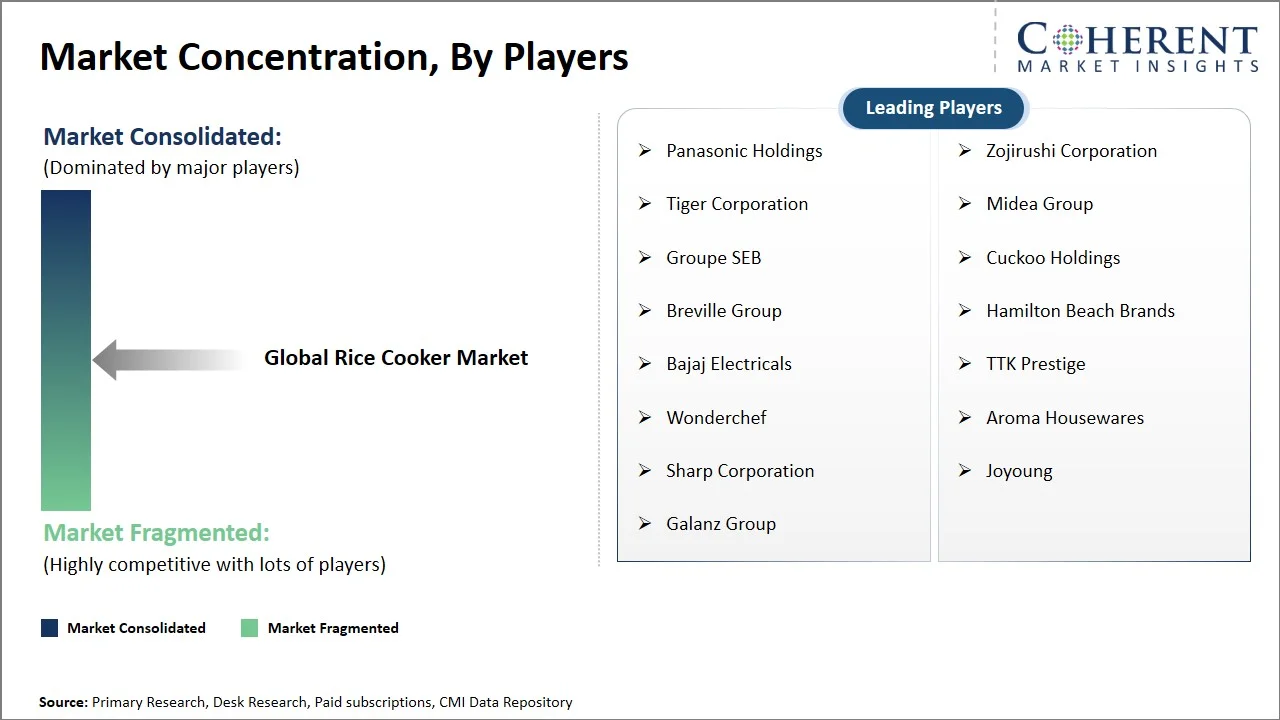
The global rice cooker market is moderately fragmented, combining multinational appliance groups, established Asian rice-cooker specialists, regional electrical-appliance manufacturers, private-label suppliers, and digitally native kitchenware brands. Competition occurs across distinct price tiers, ranging from basic heating-plate products to pressure-induction systems. Market position depends not only on cooking performance but also on thermal safety, component quality, channel access, localized menu functions, spare-part availability, and after-sales responsiveness. Regional suppliers can compete effectively through lower manufacturing costs and local distribution, while specialist brands retain advantages in cooking-control knowledge and premium product credibility.
Key focus areas include
- Cooking consistency: Accurate heat distribution and repeatable grain texture support brand differentiation and reduce product returns.
- Portfolio architecture: Multiple capacities, control formats, and feature tiers allow suppliers to address household and commercial requirements without excessive SKU complexity.
- Pricing discipline: Entry-level competition remains intense, making sourcing efficiency and platform standardization important for protecting margins.
- Safety assurance: Thermal fuses, insulation, pressure controls, and food-contact materials require robust testing and supplier quality management.
- Manufacturing flexibility: Modular product platforms help companies adapt controls, plugs, voltage specifications, and cooking programs for different countries.
- Channel execution: Marketplace content, specialist demonstrations, retail availability, and verified customer reviews materially influence purchase conversion.
- After-sales support: Replacement inner pots, lids, seals, and heating components can strengthen customer retention and extend appliance life.
- Culinary localization: Programs calibrated for regional rice varieties and dishes provide a more defensible advantage than generic function expansion.
Market Report Scope
Rice Cooker Market Report Coverage
| Report Coverage | Details | ||
|---|---|---|---|
| Base Year: | 2025 | Market Size in 2026: | USD 5.56 Bn |
| Historical Data for: | 2020 To 2024 | Forecast Period: | 2026 To 2033 |
| Forecast Period 2026 to 2033 CAGR: | 6.40% | 2033 Value Projection: | USD 8.58 Bn |
| Geographies covered: |
| ||
| Segments covered: |
| ||
| Companies covered: | Panasonic Holdings, Zojirushi Corporation, Tiger Corporation, Midea Group, Groupe SEB, Cuckoo Holdings, Breville Group, Hamilton Beach Brands, Bajaj Electricals, TTK Prestige, Wonderchef, Aroma Housewares, Sharp Corporation, Joyoung, and Galanz Group | ||
| Growth Drivers: |
| ||
| Restraints & Challenges: |
| ||
Analyst Opinion (Expert Opinion)
- The global rice cooker market leadership is likely to shift from maximizing standalone unit sales toward managing appliance portfolios across the customer lifecycle. Manufacturers that connect core platforms with localized cooking programs, replacement components, accessories, service packages, and direct customer support should capture more value per installed unit. This transition will reward disciplined platform engineering and customer retention capabilities rather than continuous expansion of loosely differentiated models.
- Digital retail and improving private-label quality may materially weaken the premium attached to brand recognition alone. Online buyers can compare specifications, reviews, safety documentation, replacement-part access, and cooking results across numerous suppliers within minutes. Established participants will therefore need demonstrable performance advantages and stronger ownership experiences, while contract manufacturers with credible quality systems could move closer to consumers and place pressure on traditional distribution structures.
- The global rice cooker market participants should prioritize thermal-control reliability, localized cooking validation, modular components, food-contact material assurance, and accessible spare parts. Regional service partnerships will be particularly important where distribution expands faster than company-owned support networks. Suppliers should manage exposure to commodity components and aggressive entry-level pricing while avoiding excessive investment in connected features that do not improve cooking outcomes, maintenance, or customer convenience.
Speak to the analyst
Want personalized insights?
Take the findings above to one of our principal consultants, or have the report rebuilt around the segments, geographies and competitors you actually track.
Market Segmentation
- Heating Technology Insights (Revenue, USD Bn, 2021 - 2033)
- Conventional Electric Heating
- Induction Heating
- Capacity Insights (Revenue, USD Bn, 2021 - 2033)
- Below 1.0 Liter
- 0 to 1.8 Liters
- Above 1.8
- End User Insights (Revenue, USD Bn, 2021 - 2033)
- Household
- Commercial
- Distribution Channel Insights (Revenue, USD Bn, 2021 - 2033)
- Online Retail
- Specialty Appliance Stores
- Supermarkets and Hypermarkets
- Department Stores
- Others
- Regional Insights (Revenue, USD Bn, 2021 - 2033)
- North America
- U.S.
- Canada
- Latin America
- Brazil
- Argentina
- Mexico
- Rest of Latin America
- Europe
- Germany
- U.K.
- Spain
- France
- Italy
- Russia
- Rest of Europe
- Asia Pacific
- China
- India
- Japan
- Australia
- South Korea
- ASEAN
- Rest of Asia Pacific
- Middle East
- GCC Countries
- Israel
- Rest of Middle East
- Africa
- South Africa
- North Africa
- Central Africa
- North America
Sources
Primary Research Interviews
- Rice cooker, multicooker, component, control-system, inner-pot, coating, and small-appliance manufacturers
- Households, restaurants, hotels, caterers, institutional kitchens, cloud kitchens, and specialty food operators
- Distributors, dealers, importers, exporters, e-commerce sellers, retailers, repair centers, and certification agencies
- Procurement, production, engineering, quality, R&D, regulatory, sales, supply-chain, and service executives
Stakeholders
- Rice cooker brands, OEMs, ODMs, private-label suppliers, and contract manufacturers
- Heating-element, induction-coil, thermostat, sensor, PCB, thermal-fuse, and power-module suppliers
- Inner-pot, aluminium, stainless-steel, ceramic, non-stick coating, plastic, and packaging suppliers
- Households, foodservice operators, institutional buyers, retailers, distributors, logistics providers, and testing laboratories
End-use Sectors
- Households, apartments, students, and single-person families
- Restaurants, QSRs, cafés, sushi outlets, biryani outlets, and cloud kitchens
- Hotels, caterers, hostels, hospitals, schools, universities, and workplace cafeterias
- Convenience stores, meal-preparation businesses, and institutional kitchens
Regulatory and Government Bodies
- U.S. Consumer Product Safety Commission and U.S. Food and Drug Administration
- European Commission, European Chemicals Agency, CEN-CENELEC, and national market-surveillance authorities
- U.K. Office for Product Safety and Standards
- China State Administration for Market Regulation and National Development and Reform Commission
- Japan Ministry of Economy, Trade and Industry
- Bureau of Indian Standards and Ministry of Consumer Affairs
- Korea Agency for Technology and Standards, Malaysia Energy Commission, Australian authorities, and Brazil INMETRO
Databases
- UN Comtrade, ITC Trade Map, WTO, Eurostat, World Bank, OECD, and national statistics databases
- USITC DataWeb, U.S. Census Bureau, China Customs, Japan Trade Statistics, India Export Import Data Bank, Korea Customs, and Brazil Comex Stat
- U.S. CPSC, EU Safety Gate, U.K. product-safety, BIS, Safety Korea, and INMETRO databases
- Espacenet, WIPO PATENTSCOPE, company filings, catalogues, manuals, price lists, shipment records, and retailer databases
Magazines and Journals
- HomePage News, TWICE, Kitchenware News, Consumer Reports, Which?, and Nikkei Asia
- Journal of Food Engineering
- Applied Thermal Engineering
- International Journal of Consumer Studies
- Food Research International
- Journal of Food Process Engineering
Associations
- Association of Home Appliance Manufacturers
- International Housewares Association
- APPLiA – Home Appliance Europe
- China Household Electrical Appliances Association
- Japan Electrical Manufacturers’ Association
- Consumer Electronics and Appliances Manufacturers Association, India
- Korea Electronics Association
Public Domain Sources
- Electrical-safety, energy-efficiency, certification, and product-registration records
- Product recalls, safety alerts, border rejections, and corrective-action notices
- Household appliance ownership, rice consumption, urbanization, and consumer-expenditure statistics
- Rice cooker import, export, tariff, and customs records
- Government appliance incentives and trade-in programs
- Product catalogues, technical specifications, manuals, patents, annual reports, and press releases
Key Standards and Regulations
- IEC 60335-1 and IEC 60335-2-15 for household electrical-appliance safety
- India IS 302 and BIS compulsory registration requirements
- China GB 21456 energy-efficiency requirements
- EU Low Voltage, EMC, RoHS, REACH, and General Product Safety regulations
- EU food-contact material requirements
- Japan PSE, Korea KC, Australian RCM, Canadian safety certification, U.K. requirements, and Brazil INMETRO
- ISO 9001, ISO 14001, and ISO 45001
Proprietary Elements
- CMI Data Analytics Tool
- Proprietary CMI Existing Repository of information for last 10 years.
Get access to 250+ pages report
Every segment, forecast, competitor profile and data table behind the analysis above — available for instant download.
- ESOMAR Member
- ISO 9001:2015 Certified
- D-U-N-S Registered
- GDPR & CCPA Compliant
Missing comfort of reading report in your local language? Find your preferred language:
Transform your Strategy with Exclusive Trending Reports
Frequently Asked Questions
The CAGR of the global rice cooker market is projected to be 6.40% from 2026 to 2033.
The global rice cooker market is estimated to be valued at USD 5.56 Bn in 2026 and is expected to reach USD 8.58 Bn by 2033.
The 1.0 to 1.8 liters capacity segment leads the market due to its suitability for small and medium-sized households.
The household segment dominates owing to the widespread use of rice cookers for convenient, unattended, and consistent meal preparation.
Multifunction cooking programs, texture customization, induction heating, easy-clean inner pots, and smart controls are gaining importance.
Rising household appliance adoption supporting electric rice cooker demand and multifunction cooking features increasing replacement and premium product purchases are the major factors driving the growth of the global rice cooker market.
Low cost conventional cookware limiting adoption in price sensitive markets and extended product replacement cycles restricting recurring appliance sales are the major factors hampering the growth of the global rice cooker market.