

Global Rice Seed Market Size and Forecast – 2026 to 2033
According to Coherent Market Insights, the global rice seed market is estimated to be valued at USD 8.23 Bn in 2026 and is expected to reach USD 10.98 Bn by 2033, expanding at a compound annual growth rate (CAGR) of 4.2% from 2026 to 2033.
Key Takeaways of the Rice Seed Market
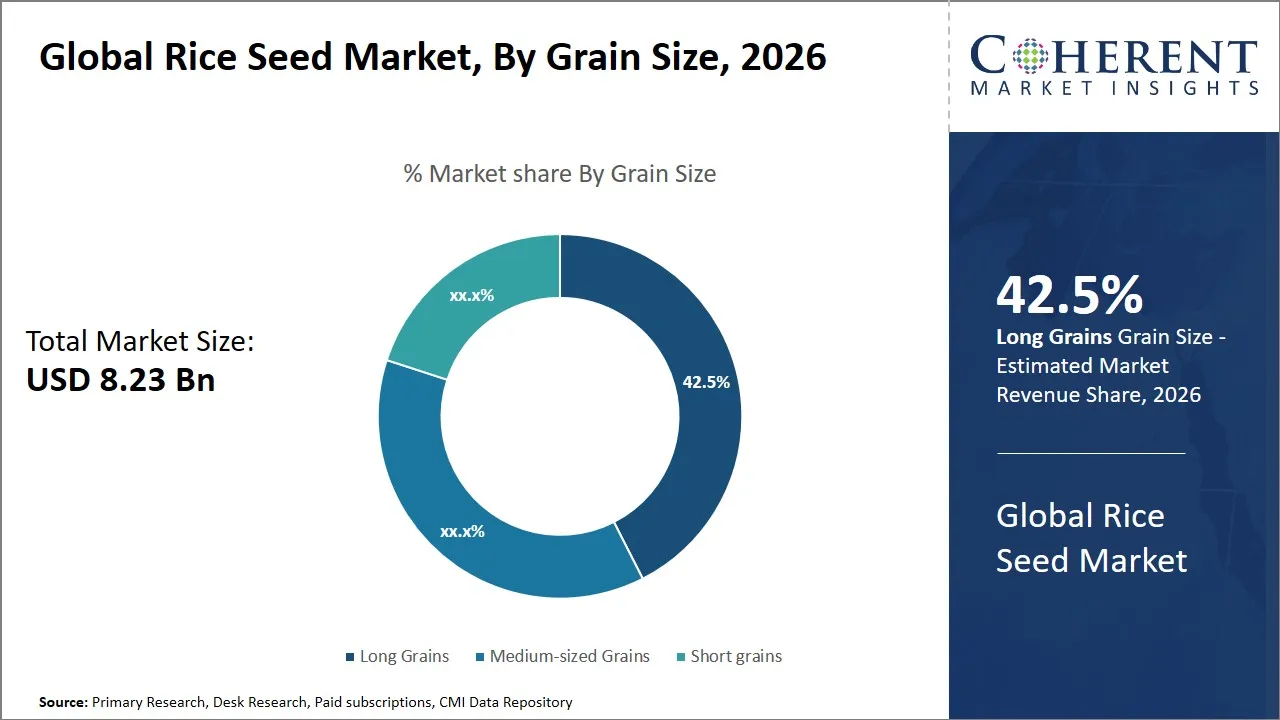
- The long grains segment is projected to capture 42.5% of the global rice seed market share in 2026.
- The treated segment is expected to hold 56.9% of the market share in 2026.
- The three-line system is projected to hold 66.4% of the rice seed market share in 2026.
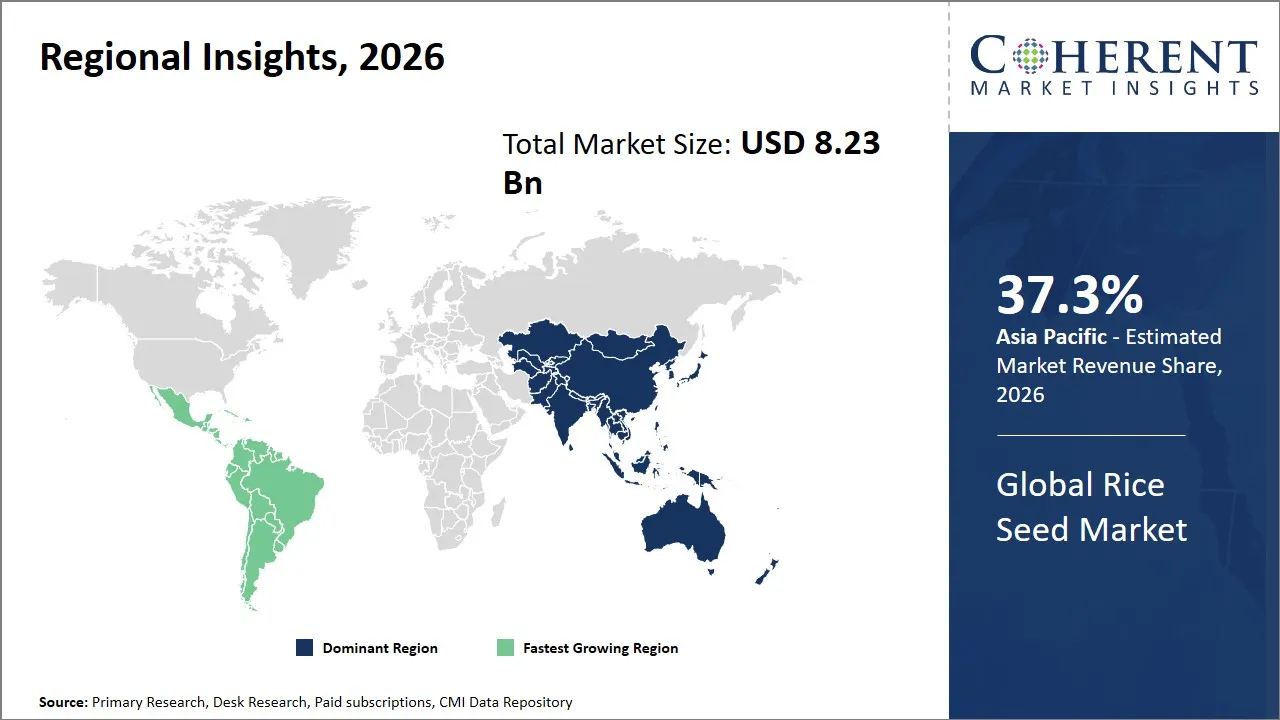
- The Asia Pacific region is expected to dominate the market, holding a 37.3% share in 2026.
- The Latin America region is anticipated to show the fastest growth in the market, capturing 16.3% share in 2026.
Market Overview
- In terms of market trends, there is a significant shift towards hybrid and genetically modified rice seeds that offer improved resilience against climate change and environmental stresses.
- Sustainable farming practices and precision agriculture are also gaining prominence, encouraging the adoption of superior seed varieties that optimize productivity while minimizing resource use.
- Additionally, growing awareness about food security and government initiatives supporting seed innovation are fostering continuous development of grain analysis in the rice seed market globally.
Currents Events and Its Impacts
Current Events | Description and its Impact |
Increased Adoption of Hybrid Rice Seeds |
|
Climate Change Impacting Rice Production |
|
Segmental Insights
- Current Industry Events of 2026
- Market Size Estimation
- Regional Breakdown
- Competitive Landscape
- Customer Intelligence
- Segmental Analysis
- Pricing Analysis
- Key Market Drivers, Challenges & Future Trends
- Customized Insights Section
Why Does the Long Grains Segment Dominate the Global Rice Seed Market in 2026?
Long grains segment is expected to hold 42.5% in the global rice seed market share in 2026, fueled by large market share and the inherent characteristics of long grain rice varieties. In most areas, particularly in the countries like India, Thailand, Vietnam, and some of the West African countries, consumers prefer long grain rice due to its typical thin form, reduced stickiness, and fluffy post cooking texture. These are important sensory characteristics that can have great impact on purchasing behavior that consequently affects farmers selection of seed varieties. The downstream demand encourages seed producers to dwell much on long grain seeds production and supply.
For example, in India, long grain varieties like Basmati are highly favored due to their texture, which is less sticky and fluffier when cooked, making them ideal for dishes like biryani and pilaf. This preference influences farmers' seed selection, driving the demand for long grain varieties in the region.
Why Is the Treated Segment Dominating the Rice Seed Market?
The treated segment is projected to account for 56.9% of the market share in 2026, which is becoming more and more aware of the merits of seed treatment technologies in assuring improved crop results. Seed treatment entails the use of biological or chemical agents on rice seeds prior to planting, which provides immunity against soil-borne pathogens, insects and fungi which would otherwise cause serious damage to seedlings. Such a layer of protection does not only enhance the healthier growth of the plants, but it also lowers the death rate at an early stage, an essential part of the production of the maximum yield.
One of the factors that have seen the treated seeds becoming more favorable is the increased awareness of farmers as to the concept of integrated pest and disease management. Farmers are able to invest in treated seeds and prevent risks posed by some threats which are prevalent including bacterial blight, blast disease and root maggots. This preventive measure would result in minimal use of post-emergence pesticides and hence, cost reduction and less environmental impact. It goes along with the changing agricultural trends that are more sustainable and responsible in their use of chemicals.
Three-Line System Dominates the Global Rice Seed Market
The three-line system segment is expected to hold 66.4% of the global rice seed market share in 2026, due in part to the fact that it has tapped into the advantages of hybrid vigor, as well as the established breeding framework. In this conventional approach, utilization of three different lines cytoplasmic male sterile (CMS) line, maintainer line, and restorer line is involved in the production of the high-yielding hybrid seeds. The resulting hybrids are usually superior in the way that they have higher yield potential, better stress resistance, and better grain quality than the conventional varieties.
The reason that made the three-line system prevail is likely one of the primary elements that made its use widespread in the large rice-producing nations. The three-line system has been streamlined over decades through extensive research and breeding projects, and now is a predictable and scalable method of satisfying the needs of rice farmers. The maturity of this system ensures the steadiness of the seed purity and quality; it helps to minimize the risks of the producers and guarantees the reliability of the performance in the field.
Regional Insights
Asia Pacific Rice Seed Market Analysis and Trends
The Asia Pacific region is projected to lead the market with a 37.3% share in 2026, with the major propelling force being the regions position as the largest producer and consumer of rice in the world. China, India, Indonesia and Vietnam are the countries that have established well-developed agricultural ecosystems used in the cultivation of rice with their own extensive research institutions and seed development programs.
The policies of the government in this region often focus on food security and modernization of agriculture, which encourages the implementation of high yielding and stress resistant varieties of rice seed. The existence of the major corporations like Bayer Crop Science, Nuziveedu Seeds, and East-West Seed enhance the strength of the markets, and the investments in the research and development process and in the programs of communication with farmers are very significant. In addition, trade relations inside the area of Asia Pacific, through intra-regional exports and import substitution also consolidate its position of leadership.
Latin America Rice Seed Market Analysis and Trends
The Latin America region is expected to exhibit the fastest growth in the market contributing 16.3% share in 2026, due to the growing trends of ensuring that the region produces more rice to satisfy the domestic demand, as well as the export market. Such nations as Brazil and Colombia have been implementing strong agricultural subsidy packages and technology adoption subsidies which seek to modernize the farming process.
High potential of better seed varieties and growing irrigation infrastructure are some of the factors leading to the increased adoption of high-quality rice seeds. Louis Dreyfus Company and Corteva Agriscience are major players that are aggressively investing in breeding programs that are designed to grow in tropical and subtropical climates. Also, trade blocs such as Mercosur help in easy exchange of seeds and technologies that lead to faster entry into the market.
Global Rice Seed Market Outlook for Key Countries
China Rice Seed Market Trends
The market of rice seeds in China is driven by well-developed government programs on agricultural innovation and sustainability through institutions such as the National Rice Research Institute. The market is characterized by concentration on genetically enhanced seeds that withstand the local pests and environmental stimuli. Both local firms such as China Seed Group and multinationals like Bayer Crop Science play a significant role in collaborating with farmers in the country and with extension services. The adoption of hybrid varieties of rice to increase yield is also one of the essential forces that drive the ecosystem of rice seed in Chinas.
Is India’s Rice Seed Market Poised for Growth with Hybrid Adoption and Government Support?
The rice seed market in India is characterized by a large fragmented farming base, smallholder farmers being a major concern in the market. The role played by government plans that subsidize quality varieties of seed and encouragement of the use of hybrid seeds is very crucial in the development of the market. Nuziveedu Seeds and Maharashtra Hybrid Seeds Company (Mahyco) are companies that dominate the industry and they offer region-specific seeds and agronomy services. The goal of the public-private partnerships is to enhance the quality of seeds, resistance to diseases and climate, which will make it more productive in large-scale paddy fields in states such as Punjab, West Bengal and Andhra Pradesh.
Indonesia Rice Seed Market Trends
Indonesia continues to lead the rice seed market in Southeast Asia driven by strong governmental support under its food security programs and a large agrarian community dependent on rice farming. Seed replacement cycles are encouraged by means of subsidies and institutional structures that support the use of certified seeds by the government. The East-West Seed and the PT Sang Hyang Seri firms are major actors in the distribution of seeds that suit the various agro-climatic areas of the archipelagos. The emphasis of Indonesia’s in developing hybrid and high qualities of local varieties has triggered the demand and supply in the domestic rice seed industry.
Is Brazil’s Rice Seed Market Set to Thrive with Government Support and Multinational Investment?
The rice seed market in Brazil is yet to be fully developed and this has been stimulated by the growing acreage under rice cultivation and the modernization that is going on in the agricultural sector. The governments facilitate by funding and regulation creating the ability of the farmers to use better varieties which yield better and can resist pests prevalent in South America.
There are multinational players, like Corteva Agriscience or Louis Dreyfus Company who invest in breeding programs which are adapted to the conditions of Cerrado and southern regions. Technology transfer and market penetration is also faster through strategic alliances with the local seed businesses, which makes Brazil a rapidly-developing powerhouse in the rice seed business.
Vietnam Rice Seed Market Trends
The rice seed market in Vietnam is flourishing due to its great contribution to a country as a large exporter of rice and the great intention to achieve better quality in the last few years. The adoption of hybrid seeds and sustainable farming is encouraged by the government, as it provides good conditions to superior seed varieties. Bayer Crop Science collaborate with farmers to market certified seeds that are productive and resistant to diseases. The active supply chain in Vietnam and the export-driven production of rice stimulates on-going investment and innovation of the rice seed market.
Regional Yield per Hectare Gains by Variety
Rice Variety | Region | Average Yield (kg/ha) | Improvement (%) |
Hybrid Rice Variety A | Asia Pacific | 7,500 | 25% |
Hybrid Rice Variety B | South America | 8,200 | 20% |
High-Performance Hybrid C | North America | 9,000 | 15% |
Cost-Benefit & ROI per Variety
Rice Variety | Cost-Benefit & ROI per Variety | Revenue per Hectare (USD) | Net Profit per Hectare (USD) |
Hybrid Rice Variety A | 1,200 | 9,000 | 7,800 |
Hybrid Rice Variety B | 1,000 | 9,020 | 8,020 |
Traditional Long Grain A | 800 | 8,060 | 7,260 |
Market Players, Key Development, and Competitive Intelligence
Key Developments
- In January 2025, Horizon Ag incorporated new rice varieties into its portfolio in the Clearfield and Provisia systems that performed well across the Midsouth and Gulf Coast. These varieties will be available in the coming season, along with a new medium grain and a high-amylose long grain. During the recent USA Rice Outlook Conference, Horizon Ag CEO Tim Walker took a moment to discuss the company's portfolio.
- In May 2024, Savannah Seeds, a subsidiary of the U.S.-based RiceTec Inc., introduced a new technology called FullPage Rice Cropping Solution to promote DSR (direct-seeded rice) farming. Besides saving water, the new integrated solution will help farmers substantially reduce labor costs and greenhouse gas emissions by about 25%.
Top Strategies Followed by Global Rice Seed Market Players
Player Type | Strategic Focus | Example |
Established Market Leaders | Heavy investment in R&D and innovation | For example, Monsanto, currently a subsidiary of Bayer Crop Science, has made massive investment in genetic modification and breeding methods to produce rice types that have a higher yield and resistance to pests. Also, these giant players often enter into strategic relationships and alliances with original equipment manufacturers (OEMs) and big farming conglomerates. |
Mid-Level Players | Cost-effective solutions with balanced quality | For example, Hi-Bred, a mid-level seed firm that is focusing the Southeast Asian markets with a variety of cheap rice with high yields and resistant to diseases at affordable prices. Further, the middle level players tend to enter into regional contracts with seed farmers and agricultural research companies. |
Small-Scale Players | Niche specialization & innovative variants | For instance, Seedworks International, a small player that specializes in rice varieties of seed that can grow in particular geographical areas that are either drought-prone, in India and Africa. These smaller companies usually establish close partnerships with smaller businesses in the area, research institutions, or local manufacturers in order to enter the market and raise their recognition in a particular geographical region. |
Market Report Scope
Rice Seed Market Report Coverage
| Report Coverage | Details | ||
|---|---|---|---|
| Base Year: | 2025 | Market Size in 2026: | USD 8.23 Bn |
| Historical Data for: | 2020 To 2024 | Forecast Period: | 2025 To 2032 |
| Forecast Period 2026 to 2033 CAGR: | 4.2% | 2033 Value Projection: | USD 10.98 Bn |
| Geographies covered: |
| ||
| Segments covered: |
| ||
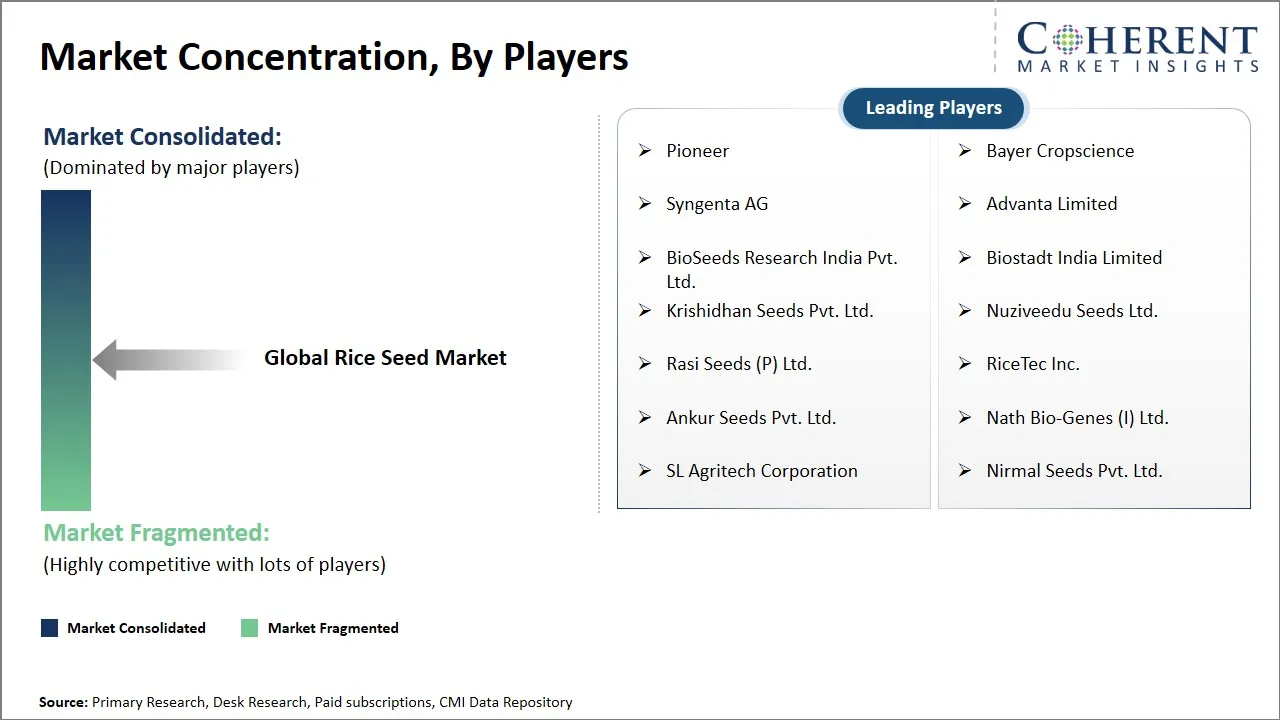
| Companies covered: | Pioneer, Bayer Cropscience, Syngenta AG, Advanta Limited, BioSeeds Research India Pvt. Ltd., Biostadt India Limited, Krishidhan Seeds Pvt. Ltd., Nuziveedu Seeds Ltd., Rasi Seeds (P) Ltd., RiceTec Inc., Ankur Seeds Pvt. Ltd., Nath Bio-Genes (I) Ltd., SL Agritech Corporation, and Nirmal Seeds Pvt. Ltd. | ||
| Growth Drivers: |
| ||
| Restraints & Challenges: |
| ||
Rice Seed Market Dynamics
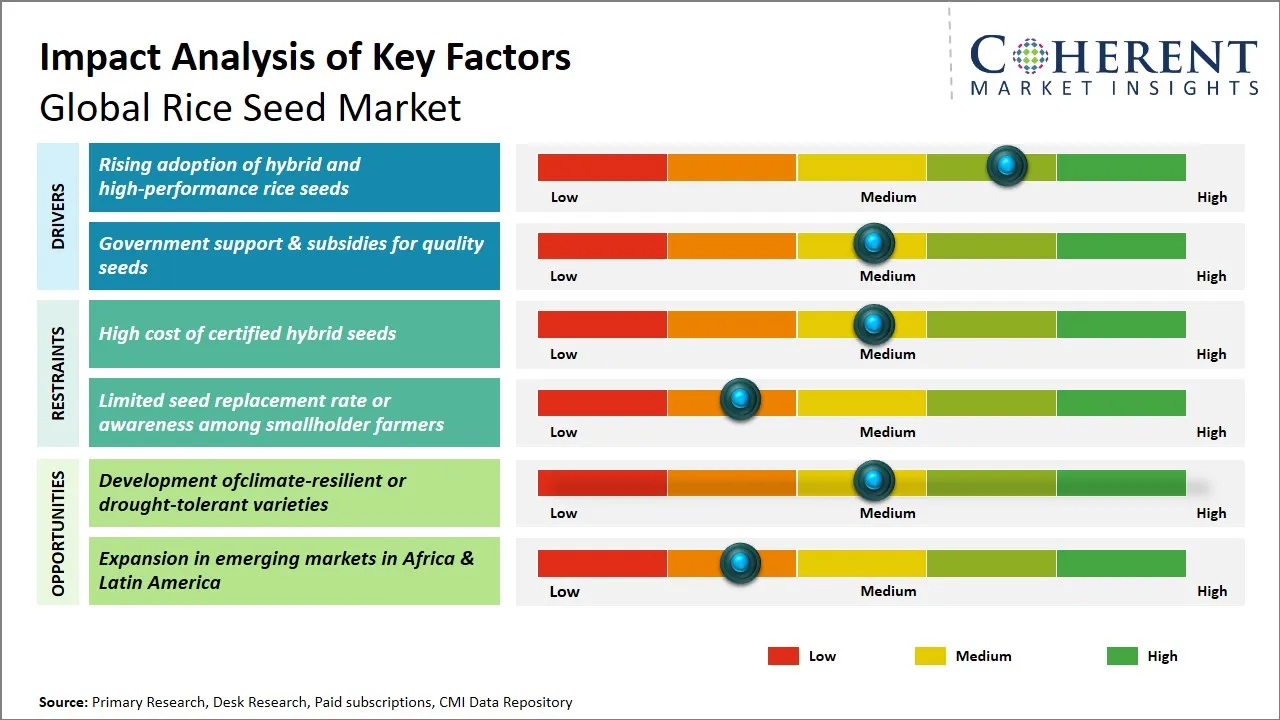
Rice Seed Market Driver - Rising Adoption of Hybrid and High ‑ Performance Rice Seeds
The rising usage of hybrid and high-performance rice seeds is playing a key role in enhancing the development of the rice seed market in the world. Farmers are increasingly adopting hybrid seeds as opposed to the traditional ones because they possess better genetic qualities, which are usually higher yield potential, resistance to pests, diseases and other abiotic stresses like drought and salinity. To a large extent, this change is driven by the increasing need of food security in the face of changing climatic conditions and increasing populations pressures in the world. Further, hybrid rice seeds help make land use more effective as the output per hectare of the rice seeds is higher hence rendering agriculture more sustainable farming.
For example, China’s Hybrid Rice Expansion, hybrid rice has been a cornerstone of China’s food production strategy since the 1970s. By recent counts hybrid rice is planted on millions of hectares annually, contributing a significant share of national rice output and becoming a central part of national food security policy.
Rice Seed Market Opportunity - Development of Climate-Resilient and Drought-Tolerant Rice Seed Varieties
The growing prevalence of adverse weather conditions caused by climate change, such as irregular rainfall patterns and extended droughts, is a major opportunity in the world rice seed market in the creation of the climate-resistant and drought-tolerant rice seeds. Since rice is a major staple food of over half of the world population especially in Asia Pacific and Africa, it is vital to maintain stable production of rice in the wake of environmental pressures. Biotechnology and the genome have facilitated the development of rice seed varieties that are capable of enduring water inadequacy and withstanding elevated temperatures without reducing yield and quality of the grains.
For an instance, Swarna-Sub1, a type of rice that has been genetically modified to endure floods of about two weeks. In a similar manner, in Africa, New Rice for Africa (NERICA) varieties are resistant to climate, exhibiting a high yield potential of the Asian rice, and the stress resistance of the varieties found in Africa.
Analyst Opinion (Expert Opinion)
- The rice seed market is experiencing massive growth, and this has been driven by the rising demand of rice as a staple food in the world and the necessity to have more yields due to the changing climatic conditions. The articles by the International Rice Research Conference (2023) and Global Agribusiness Conference (2022) revealed that there have been considerable developments in this field, and organizations such as Bayer Crop Science and Syngenta have been on the frontline in coming up with resilient and high yielding rice seed varieties.
- A new program by Bayers to launch drought-resistant rice cultivar emphasizes how the industry has been determined to enhance food security and find alternatives in changing climatic conditions. Debates during these gatherings highlighted the importance of biotechnology and hybrid seeds in productivity especially in areas where agriculture is a problem. Nonetheless, obstacles like the cost of high production and how the farmers should be educated about the new seed technologies were common.
- Those companies, which focus on the innovative breeding strategies and deal with the local farmers to show the advantages of the high-quality rice seeds, will most likely increase their market share. Finally, the expansion of the rice seed market will be based on its innovation that is sustained addressing the urgent need of food security and sustainability in rice production.
Speak to the analyst
Want personalized insights?
Take the findings above to one of our principal consultants, or have the report rebuilt around the segments, geographies and competitors you actually track.
Market Segmentation
- Grain Size Insights (Revenue, USD Bn, 2021 - 2033)
- Long Grains
- Medium-sized Grains
- Short grains
- Treatment Insights (Revenue, USD Bn, 2021 - 2033)
- Treated
- Untreated
- Hybridization Technique Insights (Revenue, USD Bn, 2021 - 2033)
- Three-line System
- Two-line System
- Regional Insights (Revenue, USD Bn, 2021 - 2033)
- North America
- U.S.
- Canada
- Latin America
- Brazil
- Argentina
- Mexico
- Rest of Latin America
- Europe
- Germany
- U.K.
- Spain
- France
- Italy
- Russia
- Rest of Europe
- Asia Pacific
- China
- India
- Japan
- Australia
- South Korea
- ASEAN
- Rest of Asia Pacific
- Middle East
- GCC Countries
- Israel
- Rest of Middle East
- Africa
- South Africa
- North Africa
- Central Africa
- North America
- Key Players Insights
- Pioneer
- Bayer Cropscience
- Syngenta AG
- Advanta Limited
- BioSeeds Research India Pvt. Ltd.
- Biostadt India Limited
- Krishidhan Seeds Pvt. Ltd.
- Nuziveedu Seeds Ltd.
- Rasi Seeds (P) Ltd.
- RiceTec Inc.
- Ankur Seeds Pvt. Ltd.
- Nath Bio-Genes (I) Ltd.
- SL Agritech Corporation
- Nirmal Seeds Pvt. Ltd.
Sources
Primary Research Interviews
- CEO – Leading Rice Seed Producer (e.g., Syngenta or Bayer Crop Science equivalent)
- Supply Chain Director – Major Rice Seed Distributor
- Production Lead – Hybrid Rice Seed Manufacturer
- Sustainability Officer – Rice Seed Certification Authority (e.g., IRRI-affiliated)
Stakeholders
End-use Sectors
- Rice Farmers and Growers
- Agricultural Cooperatives
- Food Processing Companies (Milling and Export)
- Regulatory & Certification Bodies
- FAO Seed Quality Standards
- IRRI Rice Breeding and Certification
- National Seed Associations (e.g., in India, U.S.)
- E-commerce Platforms and Retailers
- Alibaba, Amazon Industrial Suppliers
- Specialized Ag Input Retailers (e.g., Seed Today affiliates)
- Technology Integration Players
- Biotech Firms for Hybrid and GM Rice Seeds (e.g., drought-resistant varieties)
Databases
- UN Comtrade Database (HS Code 1006 for Rice)
- FAO Rice Market Monitor and Trade Statistics
- USDA Foreign Agricultural Service Reports
- Eurostat Agricultural Trade Statistics
- India EXIM Database for Rice Seeds
Magazines
- RiceOnline/Creed Rice Market Report – Global rice industry trends
- Seed Today – Seed market dynamics and innovations
- Farm Progress – Rice crop and seed news
- Grain Journal – Associated seed and grain market analysis
Journals
- Journal of Agricultural Economics – Rice seed value chains
- Field Crops Research – Hybrid rice breeding
- Agricultural Systems – Sustainable rice seed production
- Cogent Food & Agriculture – Rice seed profitability
Newspapers
- The Economic Times – Rice seed production and exports (India focus)
- Business Standard – Asia rice seed market growth
- Reuters – Global rice price volatility and seeds
- The Wall Street Journal – Commodity seed demand
Associations
- International Rice Research Institute (IRRI)
- FAO Intergovernmental Group on Rice
- Sustainable Rice Platform
- Seed Savers Networks (e.g., Vrihi Rice Seed Bank)
- American Seed Trade Association
Public Domain Sources
- FAO – Seed Systems and Quality Guidelines
- IRRI – Rice Breeding Innovations and Safety Standards
- USDA – Rice Seed Statistics and Trade Assessments
- OECD – Agricultural Trade and Sustainability Reports
- WHO – Food Safety Standards for Seeds (if applicable)
Proprietary Elements
- CMI Data Analytics Tool
- Proprietary CMI Existing Repository of information for last 8 years.
Get access to 250+ pages report
Every segment, forecast, competitor profile and data table behind the analysis above — available for instant download.
- ESOMAR Member
- ISO 9001:2015 Certified
- D-U-N-S Registered
- GDPR & CCPA Compliant
Missing comfort of reading report in your local language? Find your preferred language:
Transform your Strategy with Exclusive Trending Reports
Frequently Asked Questions
The global rice seed market is estimated to be valued at USD 8.23 Bn in 2026 and is expected to reach USD 10.98 Bn by 2033.
The CAGR of global rice seed market is projected to be 4.2% from 2026 to 2033.
Rising adoption of hybrid and high‑performance rice seeds and government support & subsidies for quality seeds are the major factors driving the growth of the global rice seed market.
High cost of certified hybrid seeds and limited seed replacement rate or awareness among smallholder farmers are the major factors hampering the growth of the global rice seed market.
In terms of grain size, long grains are estimated to dominate the market revenue share in 2026.
Pioneer, Bayer Cropscience, Syngenta AG, Advanta Limited, BioSeeds Research India Pvt. Ltd., Biostadt India Limited, Krishidhan Seeds Pvt. Ltd., Nuziveedu Seeds Ltd., Rasi Seeds (P) Ltd., RiceTec Inc., Ankur Seeds Pvt. Ltd., Nath Bio-Genes (I) Ltd., SL Agritech Corporation, and Nirmal Seeds Pvt. Ltd. are the major players.
Asia Pacific is expected to lead the global rice seed market in 2026.